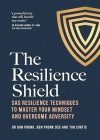
Macmillan Australia, 2021, 336 pp RRP: $36.99
Paperback ISBN 9781760983499
Written By: Dan Pronk, Ben Pronk and Tim Curtis
Reviewed By: Darren Cronshaw
The Resilience Shield is a book written by three former Australian special forces soldiers that urges readers to build resilience by focusing on six interrelated layers.[1] The book’s underpinning proposition is that the best time to develop a so-called ‘resilience shield’ is before crises so that compounding stressors do not get the better of us. I was drawn to reading the book by recommendations from a psychologist and other chaplains who have used it in their units as a basis for evaluating and developing resilience resources.
As Defence members, there are two critical levels at which we need to understand and apply resilience—at a personal level for ourselves, and at a team level for the learners and colleagues we support. I am curious about why—at our best—we can bounce back from adversity and grow stronger from challenges; yet when we are most stretched, frustrating circumstances or our misunderstanding of colleagues can unduly drain us. Why does one soldier face a physical setback with discipline and determination, yet another hesitates at the first sign of uncomfortable pain in rehab? What is it that helps some members respond to discipline and hard lessons with eagerness to learn and grow, yet others default to dysfunctional conflict patterns or pleas of unfairness? Being committed to growing myself and nurturing the teams I support as a chaplain, I am committed to learning what it takes to guard wellbeing and foster resilience.
The authors draw on their collective experiences as members of the Special Air Service Regiment (SASR) and also from their time in boardrooms and in their family and personal lives. Their views are evidently shaped by personal traumas and the struggles of mates who battled through hell in warzones. Dr Dan Pronk was an Army medical officer who also went through selection for and served with the SASR. Ben Pronk DSC was the Commanding Officer SASR and is now a consultant with Mettle Global (which he co-founded) as well as a member of the adjunct faculty, Australian Graduate School of Management. Tim Curtis also served in the SASR and is co-founder of Mettle Global. The book is framed as a conversation which aims to help readers develop the kind of resilience that helps people thrive under pressure–whether in unique military combat situations or in response to broader life challenges.
The Resilience Shield is structured into an introduction and six chapters. Within the introduction, the authors argue that resilience develops, not from one single facet, but from six interrelated and mutually strengthening layers [of what?]. They further outline the importance of building a ‘resilience shield’ in order to make sense of the complexity of the world, and the stressors we face. Six chapters then follow the introduction, each devoted to a layer of this shield.
The authors contend that the first layer of the shield comprises an innate layer (or measure) of ‘grit’ and values upon which all the other layers are built. We can reflect and build on this layer with the help of after-action reviews, resilience journaling and professional psychological support. Many stories in the book illustrate how happiness and flourishing come after overcoming profound challenges and ‘post-traumatic growth’. In breaking down our personal ‘Everest’ into achievable goals, we may often need to ‘embrace the suck’ and embody the British SAS motto ‘always a little further’.
The mind layer chapter explores the restorative benefits of meditation and mindfulness, breathwork and grounding, music and art, gratitude and cognitive flexibility, virtue ethics and a growth mindset. The authors offer a helpful Stoic reminder to ‘get active in your own rescue’ and proactively take steps to develop and utilise mental resilience. Defence has done a lot to resource mental health support programs and to remove stigma, but we need to do a lot more. In my own experience, Lieutenant Colonel Simmone Reynolds (a previous Commanding Officer at Defence Force School of Signals (DFSS)), liked to say that—just as we need physio for our bodies—we need cognitive physio for our minds. While we may all get an annual dentist appointment, she felt that most of us would also benefit from an annual visit to a psychologist to check-in on how we are processing inevitable stresses and challenges, grief and trauma.
The body layer is something the SASR knows well—in selection and training it systematically seeks to break down and (re-) build trainees both mentally and physically. The authors consider the relevance of this process to resilience. Moreover, they outline principles of exercise and recovery, nutrition and sleep, and minimising alcohol, caffeine, and computer light before sleep. The body layer chapter offers helpful introduction to each of these topics.
The social layer is critical when we experience loneliness and anxiety. We all need depth and meaning in supportive relationships that go beyond social media or work colleagues. Among the best sources of perspective and support are good friends. The authors urge us to bring the best version of ourselves and to be ‘the energy in the room’, approaching situations and people with enthusiasm and active listening. We are also encouraged to ‘build-in’ psychological transition periods between our work and home environments. As an aside, I have been learning that this kind of transition space is also helpful between appointments so that I can be better prepared to focus on the next person I am talking with.
At a professional layer, work can easily wear us down—with stresses caused by workload, time constraints, uncertainties, change, micromanaging bosses and troubled colleagues. The writers offer a wealth of advice on work purpose, mastery and autonomy while drawing on other experts. Sources focus on ‘finding your why’ (inspired by Simon Sinek),[2] ‘looking for flow’ (Mihaly Csikszentmihalyi),[3] ‘engaging deep wor’k (Cal Newport),[4] and utilising the Promodoro technique of 25 minutes focused work.[5] Aside from their pointers on professional efficiency, among the authors best advice relates to guarding one’s professional reputation and being consciously careful to separate role from identity.
The final resilience layer of adaptation is about being ‘antifragile’—not just withstanding adversity but thriving and growing from volatility, disorders and stress. It is what ‘strategic corporals’[6] and other Australian diggers demonstrated in East Timor when engaged in reconnaissance one day, offensive operations the next, and then tasked to provide force protection to the Task Force Commander [rank at the time] Peter Cosgrove. In the coming decades, we do not know the scope of ethical challenges ADF members may face, or what wicked problems or unexpected ‘black swan’[7] events may challenge us. Generating adaptation and other resilience layers among military members is therefore well worth the investment if we are to be ready now and future ready.
On reflection, the six layers of resilience proposed in The Resilience Shield are similar to the nine Department of ‘wellbeing factors’.[8] In this regard, my one criticism of the book is that the authors do not consider ‘meaning and spirituality—concepts which are included in the departments’ wellbeing factors. This layer does not have to be tied to religion but is significant for purpose and connection and thus also to resilience. Equally, the authors do not explore the relevance to resilience of income and finance, and home and housing—the wellbeing factors remind us to be attentive to these.
I have drawn on The Resilience Shield as a valuable reference for character and leadership training sessions at DFSS and 6th Battalion, the Royal Australian Regiment, and have compared notes with chaplains who have used it in other units too. An associated resource— that also helped members identify which layers are stronger and which need more development— is the survey instrument the authors have developed as part of resilience research at the University of Western Australia.[9] This has assisted members with their own self-reflection and also prompted vulnerable and valuable peer conversations.
The Chief of Army (CA)Lieutenant General Simon Stuart, AO, DSC, has written that in response to the Royal Commission into Defence and Veteran Suicide,[10] Army will be focusing on measurably reducing suicide and suicidality, building individual and collective resilience, and strengthening culture. He expanded on this at the 2024 Chief of Army Symposium Keynote Speech “The Human Face of Battle and the State of the Army Profession”.[11] The Resilience Shield gives some guidance as to actionable steps that can help strengthen the outcomes CA is calling for.
In summary, The Resilience Shield is an excellent resource for all those in Defence interested in supporting their own and others’ wellbeing. Commanders will benefit from reading it as a framework for their own leadership and for helping their team members foster resilience layers. Health providers and chaplains will benefit from seeing how resilience layers can be contextualised in the lives of soldiers. Individual soldiers and their teams at all levels can benefit from the book as a checklist of the different resilience layers we all need to develop and guard.
Endnotes
[1] Dr Dan Pronk, Ben Pronk DSC and Tim Curtis, The Resilience Shield: SAS Resilience Techniques to Master Your Mindset and Overcome Adversity (Sydney: Pan Macmillan 2021)
[2] Simon Sinek, David Mead and Peter Docker, Find with Why?: A Practical Guide for Discovering Purpose for You and Your Team (London: Penguin UK, 2017)
[3] Mihaly Csikszentmihalyi, Flow: The Psychology of Optimal Experience (New York: Harper and Row, 1990).
[4] Cal Newport, Deep Work: Rules for Focused Success in a Distracted World (New York: Grand Central Publishing, 2016)
[5] “The Pomodoro Technique”, Todoist, https://www.todoist.com/productivity-methods/pomodoro-technique
[6] General Charles C. Krulak, ‘The Strategic Corporal: Leadership in the Three Block War’, Marines Magazine, 28.1 (1999), 28-34.
[7] Andrew A Hill, “Black Swan, Red Beard: Recognizing the Unexpected”, War Room (June 22, 2017) https://warroom.armywarcollege.edu/articles/black_swan_red_beard/
[8] Australian Government Department of Defence and Department of Veterans’ Affairs, “Defence and Veteran Mental Health and Wellbeing Strategy consultation draft” (Commonwealth of Australia 2024), 6,
[9] Master your mindset and overcome adversity | The Resilience Shield, https://resilienceshield.com
[10] Royal Commission into Defence and Veteran Suicide, Final Report (2024), https://defenceveteransuicide.royalcommission.gov.au/publications/final-report
[11] Chief of Army Symposium Keynote Speech “The Human Face of Battle and the State of the Army Profession” (12 Sep 2024), https://www.army.gov.au/news-and-events/speeches-and-transcripts/2024-09-12/chief-army-symposium-keynote-speech-human-face-battle-and-state-army-profession