Chief of Army Essay Competition Papers - 2025
Foreword
Chief of Army - Lieutenant General Simon Stuart
The Australian Army is transforming in response to the direction of the National Defence Strategy. It is clear to us that this transformation must be comprehensive. It must touch all three identities of the Army: as a national institution, a profession, and a fighting force. Anything less will almost certainly fall short.
This is why in December 2024 I commissioned a comprehensive review of the state of the Army profession. The aim of this was to look at the foundations of our profession: the clarity of our jurisdiction; the sufficiency of our expertise; and the strength of our capacity for self-regulation.
We sought to foster a broad enquiry across the Army – to identify our strengths, but more importantly to address our weaknesses.
The 2025 Chief of Army Essay Competition is an excellent outcome of that enquiry. The theme of The State of the Army Profession – The Past, Present and Future set the stage for our soldiers to probe our professional foundations. You did so in spades. I suspect that General Sir Harry Chauvel, for which the essay prize is named, would have approved of the outcome; of the investment our soldiers have made into our profession.
I offer my warmest thanks and congratulations to the winner of the 2025 Chauvel Prize, Corporal John Wellfare, whose essay employs a compelling medical analogy to explore the core facets of the profession of arms. He reminds us that our profession can only exist if it is supported by a mandate from the society we exist to serve. His work reminds us of the trust society places into its Army, and the responsibility this entails. If you want to know what analogy he uses, you have to read his work! It is excellent.
I also congratulate the runner-up, Major Robert Bruce, whose essay situates the profession in the context of mobilisation. He argues convincingly that our professional identity is inseparable from the expectations of the Australian people: expectations which only sharpen at times of extreme strategic risk. The ability to mobilise, he argues, is not just an institutional output. It is a fundamental expression of professional duty. His work is thought provoking, and I commend it to you.
In addition to the winning entries, this collection features three highly commended essays that examine the Army profession through a broad and comprehensive sweep.
Ms Rosemary Woodbridge, an Australian public servant, argues that the Army needs to evolve our professional model if we are to best contribute to an Integrated Force. She usefully highlights that the Australian Army is not alone in this challenge: our ‘Five Eyes’ partners all face similar issues. This is both a challenge and an opportunity, depending on how we approach it.
Major Matthew Jefferies also situates the Army profession within the contexts of rapid mobilisation and expansion for war. He argues eloquently that trust, ethical leadership, and a culture of adaptation are foundational to surviving the ‘stress test’ that mobilisation would entail. A timely input.
Corporal Jeremy Stredwick looks to history in his examination of the profession, drawing lessons from the 1945 Borneo campaign to examine what is required to achieve professional success in littoral warfare today. His work emphasises the contexts of history, climate, culture, and geography as being central in informing the Army’s transformation.
Finally, I have selected six worthwhile essays for inclusion in this publication. Their analysis is impressive, and worthy of your consideration.
Private R offers a cautionary tale on the risks of information overload. He argues eloquently that, in a demanding profession, leaders must make judicious decisions about what not to do. He reminds us that ‘balance’ is a professional and strategic necessity.
Lieutenant Colonel McLeod Wood proposes the construction of a “Ghost Division” to pre-empt the demands of large-scale mobilisation, encouraging us to think creatively about structures, preparedness, and tempo.
Captain Matthew Malcolm frames the Army profession within the broader demands being applied on the Australian Defence Force. He highlights the need for what he calls ‘Military Collaborative Practice’, drawing useful parallels from health, organisational management, and business.
Lieutenant Colonel Brendan Gilbert applies the model of the ‘fundamental inputs to capability’ to the problem of mobilisation, reminding us that our profession must extend across the full breadth of capability development if it is to be effective.
Lieutenant Christopher Wooding examines one of the foundations of our profession: that of lethality. He focuses on the reconnaissance-strike relationship in littoral operations, providing a broad literature review of how to understand the evolving character of war.
Lieutenant Colonels David Caligari and Zach Lambert take us back to first principles, examining the three pillars of the Army profession in jurisdiction, legitimacy, and expertise. Their essay reinforces the need for deliberate, daily investment in each of these three pillars, to best maintain a healthy profession.
I would like to thank all who contributed to the competition this year. The Army profession is the enduring foundation of the Army, in all its dimensions. The sheer number and quality of the submissions reflect the intellectual strength of our Army today. We are in a good place.
And yet our circumstances demand that we do more. As the current steward of the Army profession, it is clear to me that we must act now to strengthen our profession while we remain out of contact. We will not have time to do so once an enemy gets a vote. I commend these essays to you, and ask that you emulate their example in contributing to our profession.
God speed, and Good Soldiering!
Author: Major Robert Bruce
Our peace strategy must formulate our war strategy, by which I mean that there cannot be two forms of strategy, one for peace and one for war, without wastage—moral, physical and material when war breaks out. The first duty of the grand strategist is, therefore, to appreciate the commercial and financial position of his country; to discover what its resources and liabilities are. Secondly, he must understand the moral characteristics of his countrymen, their history, peculiarities, social customs and systems of government, for all these quantities and qualities form the pillars of the military arch which it is his duty to construct.[1]
JFC Fuller, The Reformation of War
Army, as a profession, needs to set the conditions through which to enable rapid mobilisation for conflict. Currently the Australian Army appears to be precluded from vigorously pursuing mobilisation preparation, due to a lack of clear mandate within the current strategy. The National Defence Strategy 2024 (NDS) sets the primary strategic objective of deterrence and does not mention mobilisation. This presents the Army with a dilemma of justifying mobilisation preparation in the event of a failure to achieve the primary strategic objective. If this dilemma is not addressed, and Army’s approach to mobilisation preparation is not reconciled with the NDS, there is a risk of undermining mobilisation preparations through lack of understanding and under-resourcing. This essay seeks to address this dilemma by analysing how Army can pursue mobilisation preparation when viewed as a function of the profession. In doing so, it presents recommendations as to how Army as a profession can derive a mandate for mobilisation preparation congruent with the NDS.
This essay presents two key arguments through which to justify its recommendations. Firstly, if the Army is a profession, then Australian society dictates the need for mobilisation preparation as a requirement for the profession. This is a social constructivist approach best viewed through James Burk’s model of the military profession. Secondly, mobilisation can and should be integrated into our approach to deterrence by considering mobilisation as an interpretive structure through which deterrent effects are communicated. To make these arguments, this paper will begin by defining mobilisation and examining the development of the concept of the military as a profession. It will then explore the Army profession through Burk’s pillars of jurisdiction, expertise and legitimacy. It will contend that mobilisation preparation can be legitimated in the eyes of society by describing it as within the jurisdiction of Army. The confluence of mobilisation and deterrence will then be explored through the pillar of expertise. Finally, it presents civil–military relations as the key component for assuring the legitimacy of mobilisation as a function of the Army profession. While providing recommendations throughout, this essay concludes that if mobilisation is viewed as a function of the profession, the impediments of the NDS can be overcome, thereby enabling Army to fully pursue mobilisation preparation.
Mobilisation
Mobilisation, as it relates to military usage, is primarily about the preparation of the nation and its resources for war. The previous publicly released Australian Defence Force (ADF) mobilisation doctrine provides a solid foundational definition, with mobilisation defined as ‘the process that generates military capabilities and marshals national resources to defend the nation and its interests’.[2] United States (US) Army doctrine provides a more specific Army-focused definition, stating:
Army mobilization is the process of bringing the Army to a state of readiness for war, contingency, or national emergency. This includes activating all or part of the Reserve Component (RC), as well as assembling and organizing personnel, supplies, and materiel.[3]
These doctrinal definitions are broadly consistent with academic definitions.[4] For the purposes of this essay, a combination of the ADF and US Army definitions will be utilised. Mobilisation should be read as the marshalling of resources and capabilities at either the national or army level (inclusive of the activation of reserves and force expansion) in preparation for war.
The definition of mobilisation proposed in this essay is by no means conclusive. It is acknowledged that the term may be used to describe the preparation of any number of organisations in the event of ‘war, crisis, or disaster’[5] and that there are ongoing discussions about the levels and phases of mobilisation in the context of defence versus national mobilisation.[6] It is also worth noting that ‘mobilisation’ is often used in tandem with ‘force expansion’.[7] Recently the Australian Army Journal featured an article titled ‘Defining Land Force Mobilisation’ which details the nuances of the definition and the variety of usages in far more detail than will be attempted here.[8] For the purposes of discussing the Army profession, the proposed definition is sufficiently detailed to explore recommendations for mobilisation preparation.
The Military Profession and James Burk’s Model
The conceptualisation of the military as a profession is a relatively recent development. Two early seminal texts in this area were Samuel Huntington’s The Soldier and the State (1957) and Morris Janowitz’s The Professional Soldier (1960).[9] Huntington sought to establish the officer corps as distinct from ‘warriors of previous ages’[10] and to elevate the status of military officers to the level of other professionals such as lawyers and doctors.[11] Huntington observed that ‘the distinguishing characteristics of a profession as [a] special type of vocation are its expertise, responsibility and corporations’.[12] By defining the military profession though these pillars, Huntington established an early model for analysis. However, Huntington largely sought to separate the military profession from politics, which has led many to be critical of this aspect of his writing.[13] Janowitz, while acknowledging Huntington’s model, emphasised group identity and a ‘system of internal administration’, which involved a body of ethics and a standard of performance.[14] Further distinguishing Janowitz’s model from Huntington’s was the former’s belief that the officer corps required an understanding of politics.[15] These early writings form the intellectual foundations for the military as a profession, providing a useful framework for analysing how militaries and their societies have responded to changing geopolitical circumstances.
This framework was further developed by Burk through his model of the military profession. Burk’s study, while synthesising Huntington’s and Janowitz’s works, provides a description of the formulation of norms and the interplay between society and the military over time. As Burk states:
To call an occupation a ‘profession’ is usually to make a positive normative judgment about the work being done, and, since we think that professional work is a social good, whatever we call professional work also reveals something about what we believe is required for the well-being of society.[16]
The corollary of this point is that as the strategic circumstances adapt over time, so too do the normative judgements by society about what the military is required to do for the wellbeing of society. To make this point, Burk quotes Samuel Haber defining professional activities as ‘social artefacts fashioned by public events and usage’.[17] Therefore, to understand and define a profession is to recognise the societal norms, at a particular time, to which the profession is expected to conform.
In Burk’s model there are three factors through which to examine the military profession; these are jurisdiction, expertise and legitimacy. Jurisdiction is defined by ‘the boundaries of the domain within which expert knowledge is applied’.[18] Thus, jurisdiction is prone to expansion and contraction in line with the societal requirements, the changing character of war and strategic circumstance. Expertise is broadly defined as specialised abstract knowledge and skills. Burk argues that the military’s professional identity at the end of the 20th century was founded on its claim to expert knowledge in the management of violence, but acknowledges that this expertise could be expanded.[19] Finally, legitimacy refers to the trust that society places in a profession regarding the application of this expertise within the bounds of its jurisdiction.[20] By exploring the Army profession through the pillars of jurisdiction, expertise and legitimacy, the profession can be prepared for rapid and effective mobilisation.
Jurisdiction and Normative Structures
The first step in preparing the Army profession for mobilisation is to affirm its jurisdiction in this area. While Burk employs the word ‘jurisdiction’ when considering the Army profession, it may be equally valid to consider this in terms of norms. Burk makes an explicit connection to norms when he states that the labelling of an occupation as a ‘profession’ makes a ‘positive normative judgment about the work being done’ and reveals what is believed to be required for societal good.[21] Norms ‘describe collective expectations for proper behaviour of actors with a given identity’ and this describes both ‘regulative and constitutive elements’.[22] Importantly, by considering Burk’s concept of ‘jurisdiction’ through a normative lens, this allows for recognition of the evolving nature of norms in society. Burk stresses this point by describing the adaptation of the military profession’s role over the last century—from the management of violence in the early 20th century to the management of defence during the Cold War and finally the management of peace once the Cold War ended.[23] Given these adaptations over time, and in line with Carl von Clausewitz’s warning about ‘arbitrary relationships’,[24] the Army can ill afford to assume what normative expectations Australian society carries with regard to mobilisation and the Army.
To affirm the Army profession’s jurisdiction, Australian society should be consulted regarding its understanding and beliefs about the Army and mobilisation. Recent history demonstrates that the Australian public’s understanding of the ADF cannot be assumed. In 2015, in the lead-up to the release of the 2016 Defence White Paper, a major community consultation was conducted regarding public attitudes towards and understanding of Defence. The consultation produced a report entitled Guarding Against Uncertainty: Australian Attitudes to Defence.[25] The report revealed a significant disconnect between the Australian people and the ADF. It stated ‘the panel heard repeated concerns that much of the Australian community did not have a good understanding of their present-day defence force’.[26] While this report is now a decade old, it remains unclear if this attitude still prevails. Consequently, the Army should not wait for an existential crisis to confirm what Australian society expects with regard to mobilisation.
The war in Ukraine is demonstrative of the risk that misalignment of norms poses to mobilisation. For Russia, mobilisation has required conscription, which has brought to the fore norms about the use of Russian conscripts in war. The Russian people expected that conscripts would only be used on Russian territory.[27] When evidence arose of conscripts being used on the Ukrainian front line, it was not immediately acknowledged by the Kremlin, resulting in campaigns from Russian NGOs to acknowledge the true use of these conscripts.[28] Issues with the mobilisation more generally have generated protests from Russian wives and mothers.[29] While this has not been assessed to be particularly damaging to Russian mobilisation (and may even have been co-opted),[30] in a democracy the impact may be considerably different. These examples demonstrate that transgressions of the normative framework, whether deliberate or unintentional, may have implications that hinder mobilisation. It is therefore important for the Army to baseline existing norms.
Importantly, it is insufficient to simply understand these norms; professions must play an active role regarding their jurisdiction. Given that society’s prescriptions for social good change over time, the profession is therefore required in a consultative manner to ‘define and defend the domain within which they work’.[31] In the context of mobilisation, the Army needs to consider Australian society’s understanding of the requirement for mass in high-end conflict. The war in Ukraine has generated a broad consensus among commentators that mass is still of critical importance in modern war.[32] Technological asymmetry or sophistication is yet to compensate for a deficit in numbers, with mass required to counter the adversary’s mass.[33] Furthermore, AI-enabled or autonomous weapon systems are unlikely ever to completely remove the requirement for a large number of humans somewhere in the combined arms system. Jack Watling makes this point regarding the depth of support required for automated systems.[34] The ongoing requirement for mass in high-end conflict presents a powerful argument for the Army to ensure mobilisation remains within the remit of the profession, an argument that nonetheless needs to be made explicitly to the Australian public.
The struggle to generate and retain mass has caused the Ukrainian Armed Forces and its government to reconsider several of Ukraine’s laws and norms around mobilisation. In an October 2024 interview, Ukrainian defence minister Rustem Umerov revealed that only 12 per cent of new recruits are volunteers.[35] Approximately 16 per cent of the population who are eligible to serve have not renewed their contact and personal details with draft officers.[36] One of the ways to address the issues regarding manpower has been to reconsider the criminalisation of absent without leave (AWOL) cases. AWOL numbers have been described as ‘endemic’.[37] This is reflected in figures from the Ukrainian prosecutor-general’s office showing a sharp increase in the number of deserters from 2022 to 2024; in 2024 the figures reached highs of 19,922 battlefield desertions and 41,950 AWOL cases registered.[38] In response, laws have changed to allow first-time offenders to return to service, provided the offender did not flee from the battlefield. Units and brigades which have opened their ranks to returning AWOL absconders have enjoyed high levels of recruitment from this source.[39] Anecdotally, absconders who return to different units do so due to the good reputation of the gaining unit, in the hope of better treatment and service.[40] In particular, prestigious and elite units in Ukraine that conduct their own advertising and recruiting have had fewer manpower shortages.[41] This demonstrates how reviewing existing norms and laws can assist in mobilising the requisite mass for high-end conflict, and how a profession can positively impact its jurisdiction.
Recommendations Regarding the Army Profession’s Jurisdiction
The lessons of the Ukrainian War provide two immediate recommendations for the Australian Army to act on in order to affirm and mould its jurisdiction as a profession with regard to mobilisation. Firstly, the Army should commission a public consultation. In a manner similar to the community consultation in 2015 for the 2016 Defence White Paper, this consultation should be aimed at understanding the public’s perception of the Army, their current grasp of the strategic situation, and their expectations around high-end conflict, particularly as it relates to mobilisation. A specific example is that existing norms on the use of reserves are likely to have changed following 2nd (Australian) Division’s tasking with a domestic security role.[42] Confirmation of the impact that this task has on the collective expectations of Australian society will aid the Army, as a profession, to prepare for mobilisation.
Secondly, the findings of this consultation should then be used to inform the Army profession’s engagement with society regarding its mobilisation jurisdiction. Topics which the Army might be expected to address include the persistence of mass in modern war, the inability of AI/autonomous systems to ameliorate this requirement for mass, recruitment policies and concepts for localised recruiting. This engagement should take several forms, from articles and other publications to proposals for legislative change. Documents such as The Australian Army Contribution to the National Defence Strategy 2024[43] establish important waypoints in this regard by providing publicly available reference material to inform such discussions. By pursuing these two recommendations, the Army will affirm its jurisdiction, as a profession, thereby creating space to expand its mobilisation expertise.
Expertise and Integrating Mobilisation into Deterrence
The second step in preparing the Army, as a profession, for rapid mobilisation is to examine its expertise on mobilisation. For Burk, expertise rests on the Army’s ‘claim to expert knowledge in the management of violence’.[44] Importantly, Burk argues that the nature of this knowledge is not static and has evolved over time. Until World War II, the foundation of this claim lay in an ‘emphasis on the science (not the art) of war’.[45] The development of nuclear weapons during the Cold War and the concomitant creation of national security and strategic studies resulted in an expansion in scope of the profession’s expertise.[46] This argument is compelling when read alongside Burk’s views regarding the adaptation of the military profession’s jurisdiction—that is, from the management of violence in the early 20th century to the management of defence during the Cold War and finally the management of peace once the Cold War ended.[47] Ultimately, there is a requirement for different expertise in this evolving role. While Burk does not explicitly make this connection, he argues that the conceptualisation of the expert knowledge necessarily adapts with the role. For the Army seeking to prepare for mobilisation, this becomes a question of what knowledge is required and how it is conceptualised.
The NDS’s expression of strategy and strategic objectives presents a difficult challenge for the Army in conceptualising mobilisation expertise. This difficulty is most readily observed in the NDS’s circuitous expression of deterrence—that is, that the strategy of denial seeks to deter by deterring through denial. Deterrence is almost exclusively expressed in the context of purchasing capabilities or of working within an alliance to deliver a denial effect. Consideration of the communicative aspect of deterrence is limited to a single line about ‘signalling’ to a potential adversary that Defence has capabilities and friends which would frustrate any plans of aggression.[48] The result is conceptually unclear, with no discussion of mobilisation.
The NDS’s lack of conceptual clarity around deterrence has historical precedent: the same issues were evident during the Cold War. In the Cold War the ‘new strategy of deterrence’ conflicted with many of the traditional military ideas and goals, given that the ‘object of military force now is not to win a war but to prevent it’.[49] At the heart of this confusion was a widening of the term ‘strategy’.[50] Hew Strachan’s seminal article ‘The Lost Meaning of Strategy’ provides an authoritative account of this confusion.[51] Central to Strachan’s argument is that strategy is often conflated with policy.[52] During the Cold War this conflation occurred between strategy and foreign policy.[53] The result was that conventional military forces, intent on mobilisation for total war, were replaced by ‘force(s) in being’ designed to achieve deterrence.[54] Today, in a similar fashion, Australia has adopted a strategy of denial[55] whereby the primary strategic objective is deterrence,[56] to be achieved by an ‘enhanced force-in-being’.[57] It is worth noting that Paul Dibb in his 1986 review of the ADF recommended a ‘Strategy of Denial’ but conceded that this strategy was more akin to a policy.[58] This concession eerily foreshadows Strachan’s critique of the conflation of strategy and policy decades later. With no discussion of mobilisation, a lack of conceptual clarity surrounding deterrence, and possible conflation between strategy and policy, the NDS provides little substance in which to ground an argument for mobilisation.
To provide a modicum of theoretical structure, it should be inferred that the NDS is pursuing deterrence by denial. This inference is supported by the Defence Strategic Review, which mentions ‘deterrence through denial’ twice and is juxtaposed with its alternative, deterrence by punishment.[59] Early thinkers during the Cold War were chiefly concerned with the development of nuclear weapons and thus deterrence by punishment.[60] However, deterrence by denial, which came to the fore primarily at the end of the Cold War, focused on the use of conventional forces to achieve deterrence.[61] Glenn Herald Snyder provides an apt summary of the two forms and their corresponding logic:
Denial capabilities—typically, conventional ground sea, and tactical air forces––deter chiefly by their effect on the … aggressor’s calculus, [and] estimate of the probability of gaining his objective. Punishment capabilities—typically, strategic nuclear power for either massive or limited retaliation—act primarily on the … aggressor’s estimate of possible costs, and may have little effect on his chances for territorial gain.[62]
More recently, Alex Wilner and Andreas Wegner expressed this more simply as ‘punishment deters through fear of pain, denial deters through fear of failure’.[63] Through this apposition, deterrence by denial emerges as the form of deterrence most obviously aligned to the NDS, and it provides a simple coherent formulation of deterrence for integration with mobilisation.
Mobilisation integrates with deterrence by denial by providing an interpretive structure. Emile Simpson in War from the Ground Up describes how these ‘interpretive structure(s)’ operate in conflict to provide meaning.[64] Simpson argues that ‘strategy must in reality configure the abstract template of war to provide an interpretive structure that has purchase on its audiences’.[65] An understanding of the adversary and their decision-making calculus is critical. As Thomas Schelling asks:
But what configuration of value systems for the two participants—of the ‘payoffs,’ in the language of game theory—makes a deterrent threat credible? How do we measure the mixture of conflict and common interest required to generate a ‘deterrence’ situation? What communication is required, and what means of authenticating the evidence communicated? What kind of ‘rationality’ is required of the party to be deterred—a knowledge of his own value system, an ability to perceive alternatives and to calculate with probabilities, an ability to demonstrate (or an inability to conceal) his own rationality?[66]
As Schelling identifies, there is a complex and evolving interplay between the deterrer and the deterred. Mobilisation contributes to this by simultaneously providing communicative actions and evidence. Thus, the pattern of mobilisation in pursuit of deterrence becomes dialectic.[67] Antulio Echevarria describes this process as a ‘fragile’ ongoing exchange which requires ‘constant attention’ to ensure the ongoing cultivation of deterrence in the mind of the target.[68] It is the combination of force structure and preparedness conceived in the context of an adversary’s plan that makes it credible.[69] The intent to deter is therefore credibly communicated by the various actions of mobilisation by a state.
Mobilisation for the purposes of deterrence, however, must be used cautiously. Reflecting on Word War I, Schelling argues that mobilisation for deterrence would have appeared no different to mobilisation for war.[70] Schelling’s point is that to the target of deterrent strategy, the difference between defensive and offensive mobilisation is likely to be difficult to discern.[71] However, Schelling concedes that World War I mobilisation was reliant on mechanical factors which are not necessarily relevant to modern mobilisation. Further to this, if the mobilisation is pursued in such a way as to reduce the impact or success of surprise attacks, this could communicate a deterrent effect.[72] Indeed, as Jack Watling stated in his recent book The Arms of the Future, ‘a credible defence can be emplaced without suggesting an intent to attack’.[73] The advent of clear, detailed satellite imagery has enabled the interrogation of logistic chains to determine whether a combatant is actually preparing for combat operations.[74] Watling argues that unambiguous force structure can be used to signal intent.[75] Thus, mobilisation can be conducted in support of deterrence by denial without being misconstrued, although this requires careful consideration of communicated signals and their impact on the intended target.
Recommendations Regarding the Army Profession’s Expertise in Mobilisation
It is recommended that the Army develop a model for the integration of mobilisation into a deterrence framework. As this is a currently understudied area, it will require a multi-disciplinary approach including history, legal, security and strategic studies. This will provide a more solid theoretical backbone to the Australian expression of deterrence, culminating in the creation of options with which Australia can seek to manipulate escalation dynamics. Key to this will be the development of stages or phases within the mobilisation framework which directly support the credibility of Australian deterrence. In practical terms, the result of this study should trigger new doctrine and planning, with a particular focus on publicly accessible material. This material can then be used to support the argument that mobilisation expertise forms part of the Australian Army profession, with the Army employing this expertise to directly contribute to the primary strategic objective of deterrence.
Legitimacy
Establishing legitimacy is the final step in preparing the Army profession for mobilisation. Burk’s exposition on legitimacy in his oft-cited chapter in The Future of the Army Profession is incomplete. This is because Burk, somewhat unhelpfully, explains this factor in the negative, focusing on the challenges to legitimacy to define it. Specifically, he highlights the deleterious effects of modern scepticism and ‘uncertainty about “objective truth”’ as obstacles to the military profession’s legitimacy.[76] Burk’s esoteric epistemological inquiries almost entirely obfuscate his definition. Arguably, his article ‘Theories of Democratic Civil-Military Relations’, written in the same year, provides a more thorough account of his thoughts on legitimacy as it relates to the military profession.[77] In this article, he provides a detailed description of the scope of civil–military relations, stating:
The empirical domain of civil-military relations is large. It includes direct and indirect dealings that ordinary people and institutions have with the military, legislative haggling over the funding, regulation and use of the military, and complex bargaining between civilian and military elites to define and implement national security policy.[78]
Importantly, Burk uses the article to call for ‘a new normative theory of civil-military relations for mature democracies’.[79] This focus on civil–military relations echoes his discussion on dialogue, the ‘public’s trust’ and the development of ‘sustainable partnerships’ within his model of the military profession.[80] By synthesising Burk’s work, it becomes evident that Burk perceives civil–military relations as a key component of assuring the legitimacy of the military profession.
A central tension within civil–military relations lies in the oscillation between the mobilised and demobilised states. This is most readily evident in an exploration of the ‘citizen-soldier ideal’.[81] The issue, as Burk sees it, is the ‘gap’ between the citizen and the soldier, which has widened as citizens have become less likely to be required to defend their democratic state.[82] Mass standing armies have been reduced in favour of small professional armies reliant on mobilisation to produce mass as required.[83] For Burk, this necessarily requires questioning as to how to encourage citizens to ‘participate in public life and to take responsibility for the defense and well-being of their society’.[84] On the other hand, Janowitz makes an equally valid point about the ‘civilianizing’ effect that mobilisation can have.[85] In relation to the mobilisation of a ‘military force for deterrence’, Janowitz states:
The line between the military and the larger society weakened because of military dependence on civilian industry and science, and because of the impact of the mobilization of large numbers of civilians for wartime service. ‘Total war’ made both soldier and civilian objects of attack and served to attenuate the distinction between the military and civilian sectors of society.[86]
The corollary is that the gap (and the state of civil–military relations) alters between the pre- and post-mobilisation states. Two important conclusions should be drawn from this. Firstly, the gap between citizens and soldiers must be considered in all messaging relating to mobilisation and, where possible, reduced. Secondly, the establishment of any Army ethic, culture or institution must allow for a degree of civilianisation upon mobilisation. Thus, for Army to cultivate legitimacy as a profession concerned with mobilisation, planning and communications, it will need to demonstrate sensitivity to the changing nature of civil–military relations from the pre- to the post-mobilised state.
Civil–military relations are also relevant to the consideration and formulation of strategy. For Huntington, the increased participation of civilian entities in the formulation of strategy was a key concern.[87] Importantly, he highlighted that a wealth of strategic writing in the 1960s was conducted by academics, while military officers were left to ‘lag behind’ in the development of strategic thought on deterrence.[88] The result was a gap in the writing of military policy in the US. This led to allegations at the Pentagon that the ‘civilian “whiz kids”’ were ‘unduly contemptuous of the military officers for their backwardness and ignorance’.[89] In practice there must be a balance between the civilian and military entities, given the iterative and dialogic nature of strategy. Strachan’s views on strategy as they relate to civil–military relations are relevant here. He states:
In the ideal model of civil-military relations, the democratic head of state sets out his or her policy, and armed forces coordinate the means to enable its achievement. The reality is that this process—a process called strategy—is iterative, a dialogue where ends also reflect means, and where the result—also called strategy—is a compromise between the ends of policy and military means available to implement it.[90]
To be effective in this process, there is a requirement for members of the profession to cultivate ‘strategic mindedness’ and in turn contribute to the dialogue.[91] Simply put, the Army profession will not be perceived as legitimate if it cedes the intellectual space on deterrence and mobilisation to others.
Recommendations Regarding the Army Profession’s Legitimacy in Mobilisation
To cultivate legitimacy in the civil–military relations space, there are four immediate recommendations. Firstly, reduce the citizen–soldier gap. This recommendation is already recognised in part through the call for a larger reserve force.[92] Efforts to increase the reserve force, however, should consider not just the ‘capability’ that these reserves bring but also their impact on national defence consciousness within communities. Reserve members have a unique position of participating in daily civilian life with an increased awareness of Defence’s equities, which can give them an important role in connecting the Army with local communities. Secondly, the Army’s messaging regarding mobilisation requires increased awareness of the citizen–soldier gap. As Burk argues, the decreased requirement to defend the democratic state impacts the citizen’s views more broadly, indicating that deontological arguments may not be as impactful.[93] Thirdly, decisions about the institutional Army need to consider Janowitz’s ‘civilianising’ effect post mobilisation. This means future decisions, particularly around culture and ethic, should take into account the more diverse citizen-soldier rather than just the full-time professional soldier of today’s standing army. This point is about ensuring Army’s culture and ethic are accessible to everyday Australians who, in the event of high-intensity conflict, may be called upon to serve. This leads to the fourth recommendation in relation to legitimacy: to reinvigorate the study and discussion of these topics in such a way as to impact civil–military spaces and strategy. In part, the legitimacy of the Army profession’s purchase on mobilisation will be judged by its ability to contribute intelligently to the dialogue. The overarching effect of these recommendations is to ensure the validity of the Army’s jurisdiction and expertise, as a profession, in the eyes of the various stakeholders concerned with civil–military relations.
Conclusion
If Army is ill-prepared to mobilise for high-intensity conflict, it will be insufficient to respond that mobilisation was not part of the National Defence Strategy. While the Army has a role to perform within the NDS, there are certain duties owed to the Australian people that run deeper than the current strategic focus. By taking a social constructivist approach through Burk’s model of the military profession, with the pillars of jurisdiction, expertise and legitimacy providing a strong framework, Army can set the conditions for rapid and effective mobilisation. Mobilisation preparation becomes justified as a legitimate expectation of society, while emphasising the importance of the connection between Army and the society it serves. Importantly, viewing mobilisation as a function of the Army profession elevates it beyond the confines of the current strategy, and provides a theoretical framework through which actionable recommendations can be made and implemented.
Endnotes
[1] JFC Fuller, The Reformation of War (London: Hutchinson & Co, 1923), p. 218.
[2] Department of Defence, ADDP 00.2: Preparedness and Mobilisation (Provisional) (Canberra: Defence Publishing Service, 2004). Quoted in Peter Layton, National Mobilisation During War: Past Insights, Future Possibilities, National Security College Occasional Paper (Canberra: Australian National University, 2020), p. 4, at: https://nsc.anu.edu.au/content-centre/research/national-mobilisation-during-war-past-insights-future-possibilities.
[3] U.S. Army, Army Regulation 500-5 Army Mobilization (Washington DC: Headquarters Department of the Army, 2015.
[4] Peter Layton agrees with the definition of ADDP 00.2 but with qualifications about its ‘shortcomings’, specifically about the focus on military capabilities. See Layton, National Mobilisation During War, p. 4. Yenin et al. provide perhaps one of the most comprehensive definitions: ‘Mobilisation is thus the process of simultaneous structuring of society and acquisition of access to the benefits available in society, regardless who owned them before the mobilisation. In the case of military mobilisation, the state is the key structure that deals with the redistribution of resources needed for war. Such resources could include human resources, which could both be used as fulfilment for the military and be the workforce in the war economy to provide goods and services for the military efforts of the state.’ Maksym Yenin et al., ‘Improvement of Human Capital Development: A Factor in Increasing the Mobilisation Potential of Ukraine’, Periodica Polytechnica Social and Management Sciences 32, no. 1 (2024): 80, at: https://doi.org/10.3311/PPso.20547.
[5] Mick Ryan states: ‘Mobilisation involves the deliberate, planned use of a society’s resources to achieve national objectives in time of war, crisis, or disaster.’ Mick Ryan, ‘Mobilising for the Moment’, Engelsberg Ideas, 3 October 2024, at: https://engelsbergideas.com/essays/military-mobilisation/.
[6] In Australian discussions there are considered to be four levels: 1. Select; 2. Partial; 3. Defence (Whole); 4. National Mobilisation. ADDP 00.2: Preparedness And Mobilisation (Provisional), 3-2. Layton, National Mobilisation During War, p. 5. See also Zach Lambert and David Caligari, ‘On Mobilisation’ (speech transcript), Australian Army Journal 20, no. 3 (2024). It is also worth noting that Peter Layton explicitly states that all mobilisation should be considered national mobilisation. Layton, National Mobilisation During War, p. 5.
[7] Hannah Woodford-Smith, ‘Defining Land Force Mobilisation’, Australian Army Journal 2o, no. 1 (2024). See also Layton, National Mobilisation During War.
[8] Woodford-Smith, ‘Defining Land Force Mobilisation’. See also Layton, National Mobilisation During War.
[9] James Burk, ‘Expertise, Jurisdiction, and Legitimacy of the Military Profession’, in Lloyd J Matthews (ed.) The Future of the Army Profession (New York: McGraw-Hill Primis Custom Publishing, 2002), p. 39. See also Suzanne C Nielsen and Hugh Liebert, ‘The Continuing Relevance of Morris Janowitz’s The Professional Soldier for the Education of Officers’, Armed Forces & Society 47, no. 4 (2021): 733, at: https://doi.org/10.1177/0095327X20960480.
[10] Samuel P Huntington, The Soldier and the State: The Theory and Politics of Civil-Military Relations (Cambridge MA: Belknap Press, 1957).
[11] Ibid., pp. 7–8.
[12] Ibid., p. 8.
[13] Nielsen and Liebert, ‘The Continuing Relevance of Morris Janowitz’s The Professional Soldier for the Education of Officers’, p. 738.
[14] Morris Janowitz, The Professional Soldier: A Social and Political Portrait (The Free Press, 1964), pp. 5–7.
[15] Ibid., p. 426. See also Nielsen and Liebert, ‘The Continuing Relevance of Morris Janowitz’s The Professional Soldier for the Education of Officers’.
[16] Burk, ‘Expertise, Jurisdiction, and Legitimacy of the Military Profession’, p. 39.
[17] Samuel Haber, The Quest for Authority and Honor in the American Professions, 1750–1900 (Chicago: University of Chicago Press, 1991), p. x. Quoted in Burk, ‘Expertise, Jurisdiction, and Legitimacy of the Military Profession’, p. 40.
[18] Burk, ‘Expertise, Jurisdiction, and Legitimacy of the Military Profession’, p. 49.
[19] Ibid., p. 49.
[20] Burk’s section entitled ‘Legitimacy’ (pp. 51–52) does not explicitly offer this definition; instead, in incidental conversation at p. 54, Burk refers to gaining the ‘public’s trust on which professional legitimacy depends’. Burk, ‘Expertise, Jurisdiction, and Legitimacy of the Military Profession’.
[21] Ibid., p. 39. For confirmation of this normative approach see also Suzanne C Nielsen and Hugh Liebert, ‘Theories of Democratic Civil–Military Relations and the Enduring Value of the Citizen-Soldier Ideal’, Armed Forces & Society 51, no. 2 (2025): 525, at: https://doi.org/10.1177/0095327X241254030.
[22] Peter Katzenstein quoted in Jan Angstrom, ‘The Changing Norms of Civil and Military Relations Theory’, Small Wars & Insurgencies 24, no. 2 (2013): 226, at: https://doi.org/10.1080/09592318.2013.778014.
[23] Burk, ‘Expertise, Jurisdiction, and Legitimacy of the Military Profession’, p. 50. Janowitz provides an interesting term for the militaries’ role in the Cold War—a ‘constabulary’. Janowitz, The Professional Soldier, p. 418.
[24] ‘A theory that ignores any one of them or seeks to fix an arbitrary relationship between them would conflict with reality to such an extent that for this reason alone it would be totally useless.’ Carl von Clausewitz, On War, trans. Michael Howard and Peter Paret (Oxford, New York: Oxford University Press, 2007 [1832]), p. 31.
[25] Peter Jennings et al., Guarding Against Uncertainty: Australian Attitudes to Defence: Report on Community Consultations by the External Panel of Experts on the 2015 Defence White Paper (Department of Defence, 2015), at: https://webarchive.nla.gov.au/awa/20151020041130/http://www.defence.gov.au/Whitepaper/Links.asp.
[26] Ibid., p. 5.
[27] Jennifer Mathers, ‘Ukraine War: Families of Unhappy Russian Conscripts could Undermine Kremlin’s War Effort’, The Conversation, 5 March 2022, at: https://theconversation.com/ukraine-war-families-of-unhappy-russian-conscripts-could-undermine-kremlins-war-effort-178362.
[28] Ibid.; Emily Ferris, ‘Russian Soldiers’ Mothers: Independent Activists or State Agents?’, RUSI (website), 31 March 2023, at: https://www.rusi.org/explore-our-research/publications/rusi-newsbrief/russian-soldiers-mothers-independent-activists-or-state-agents.
[29] Steve Cannane, ‘The Women Taking on Vladmir Putin, One Flower at a Time’, ABC News, 7 March 2024, at: https://www.abc.net.au/news/2024-03-07/wives-and-mothers-of-mobilised-soldiers-challenge-vladimir-putin/103520022. See also Mathers, ‘Ukraine War’.
[30] Ferris, ‘Russian Soldiers’ Mothers’.
[31] Burk, ‘Expertise, Jurisdiction, and Legitimacy of the Military Profession’, p. 40.
[32] Julian Brazier, Mass, Mobilisation and Reserve Forces, RUSI Occasional Paper (London: Royal United Services Institute for Defence and Security Studies, 2022), p. v, at: https://www.rusi.org/explore-our-research/publications/occasional-papers/mass-mobilisation-and-reserve-forces; Jack Watling, The Arms of the Future: Technology and Close Combat in the Twenty-First Century (London: Bloomsbury Academic, 2024), p. 225; Andrew Michta, ‘Mass Still Matters: What the US Military Should Learn from Ukraine’, Atlantic Council (website), 3 October 2023, at: https://www.atlanticcouncil.org/blogs/new-atlanticist/mass-still-matters-what-the-us-military-should-learn-from-ukraine/; Vincent Connelly, ‘Delivering “Mass” for the British Army: Defence Reviews and Second Echelon Choices’, RUSI (website), 7 March 2025, at: https://www.rusi.org/explore-our-research/publications/commentary/delivering-mass-british-army-defence-reviews-and-second-echelon-choices.
[33] Michta, ‘Mass Still Matters’.
[34] Watling, The Arms of the Future, pp. 224–225.
[35] Gil Barndollar, ‘The Deep Strike Dodge: Firepower and Manpower in Ukraine’s War’, War on the Rocks, 26 February 2025, at: https://warontherocks.com/2025/02/the-deep-strike-dodge-firepower-and-manpower-in-ukraines-war/.
[36] Maria Varenikova, ‘The Concert Was Great, Until the Ukrainian Draft Officers Showed Up’, The New York Times, 22 October 2024.
[37] Barndollar, ‘The Deep Strike Dodge’. See also Max Hunder, ‘Ukraine Gives Absconding Soldiers Second Chance as Forces Dwindle’, Reuters, 4 December 2024, at: https://www.reuters.com/world/europe/depleted-by-war-ukraine-gives-absconding-soldiers-second-chance-2024-12-04/.
[38] Hunder, ‘Ukraine Gives Absconding Soldiers Second Chance as Forces Dwindle’.
[39] Ibid.
[40] Ibid.
[41] Yurri Clavilier and Michael Gjerstad, ‘Combat Losses and Manpower Challenges Underscore the Importance of “Mass” in Ukraine’, IISS (website), 10 February 2025, at: https://www.iiss.org/online-analysis/military-balance/2025/02/combat-losses-and-manpower-challenges-underscore-the-importance-of-mass-in-ukraine/.
[42] Department of Defence, Strategic Review of the Australian Defence Force Reserves (Australian Government, 2024), p. 18, at: https://www.defence.gov.au/about/reviews-inquiries/strategic-review-of-the-adf-reserves. As the review states: ‘Most recently, the tasking of the 2nd (Australian) Division in a domestic security role has taken them away from a purely force expansion role to be a more operationally focused organisation.’
[43] Department of Defence, The Australian Army Contribution to the National Defence Strategy 2024 (Commonwealth of Australia, 2024).
[44] Burk, ‘Expertise, Jurisdiction, and Legitimacy of the Military Profession’, p. 49.
[45] Ibid., p. 49 (emphasis in the original).
[46] Ibid., p. 49.
[47] Ibid., p. 50. See also Janowitz’s discussion of the ‘constabulary’. Janowitz, The Professional Soldier, p. 418.
[48] Department of Defence, National Defence Strategy (Australian Government, 2024), p. 22, at: https://www.defence.gov.au/about/strategic-planning/2024-national-defence-strategy-2024-integrated-investment-program.
[49] Samuel P Huntington, ‘Power, Expertise and the Military Profession’, Daedalus 92, no. 4 (1963): 801.
[50] Hew Strachan, ‘The Lost Meaning of Strategy’, Survival 47, no. 3 (2005): 49, at: https://doi.org/10.1080/00396330500248102.
[51] Ibid.
[52] Ibid., p. 40.
[53] Ibid., p. 43.
[54] Morris Janowitz, ‘Toward a Redefinition of Military Strategy in International Relations’, World Politics 26, no. 4 (1974).
[55] Department of Defence, National Defence Strategy, p. 21.
[56] Ibid., p. 22, para. 3.6.
[57] Ibid., p. 28, para. 4.5.
[58] Dibb states this explicitly twice in his report. Paul Dibb, Review of Australia’s Defence Capabilities: Report for the Minister of Defence (Canberra: Australian Government Publishing Service, 1986), pp. 5, 50, at: https://parlinfo.aph.gov.au/parlInfo/search/display/display.w3p;query=Id%3A%22library%2Flcatalog%2F10039019%22;src1=sm1.
[59] Department of Defence, National Defence: Defence Strategic Review (Australian Government, 2023), paras 3.10, 4.6 at: https://www.defence.gov.au/about/reviews-inquiries/defence-strategic-review.
[60] Bec Shrimpton, Deterrence, Escalation and Strategic Stability: Rebuilding Australia’s Muscle Memory (ASPI, 2024), p. 11, at: https://www.aspi.org.au/report/deterrence-escalation-and-strategic-stability-rebuilding-australias-muscle-memory. For example see Basil Henry Liddell Hart, Deterrent of Defense: A Fresh Look at the West’s Military Position (New York: Praeger, 1960); Bernard Brodie, The Anatomy of Deterrence (Santa Monica CA: RAND Corporation, 1958), at: https://www.rand.org/pubs/research_memoranda/RM2218.html; Thomas Schelling, The Strategy of Conflict (Cambridge MA: Harvard University Press, 1960); Glenn Herald Snyder, Deterrence and Defense (Princeton NJ: Princeton University Press, 1961); André Beaufre, Deterrence and Strategy, trans. RH Barry (London: Faber & Faber, 1965).
[61] Samuel Zilincik and Tim Sweijs, ‘Beyond Deterrence: Reconceptualizing Denial Strategies and Rethinking Their Emotional Effects’, Contemporary Security Policy 44, no. 2 (March 2023): 249, at: https://doi.org/10.1080/13523260.2023.2185970. Only relatively recently has there been renewed focus on deterrence by denial, although John Mearsheimer’s Conventional Deterrence, first published in 1983, stands out as an early exception. John J Mearsheimer, Conventional Deterrence (Ithaca NY: Cornell University Press, 1983).
[62] Snyder, Deterrence and Defense, pp. 14–15.
[63] Alex Wilner and Andreas Wegner, ‘Introduction: Deterence by Denial’, in Alex Wilner and Andreas Wegner (eds), Deterrence by Denial: Theory and Practice (Amherst NY: Cambria Press, 2020), p. 7.
[64] Emile Simpson, War from the Ground Up (Melbourne: Scribe, 2013), p. 23.
[65] Ibid., p. 53.
[66] Schelling, The Strategy of Conflict, p. 13.
[67] André Beaufre describes the dialectic of deterrence in several ways in both Deterrence and Strategy and Strategy for Tomorrow. For the purposes of this discussion I am referring to Beaufre’s description of the ‘dialectic of the expectation of victory’ in Deterrence and Strategy. Beaufre, Deterrence and Strategy, pp. 50–53.
[68] Antulio J Echevarria, Operating in the Gray Zone: An Alternative Paradigm for U.S. Military Strategy (Strategic Studies Institute, US Army War College, 2016), p. 37, at: https://press.armywarcollege.edu/monographs/425/.
[69] Wirtz states: ‘Capability (the material capacity to make good on a threat should deterrence fail) plus credibility (the belief in the mind of the opponent that the party making a threat will actually be able and willing to execute the threat)’. However, I would argue that this entire extract speaks to credibility as formulated above. James Wirtz, ‘Deterrence as Strategy’, in Alex Wilner and Andreas Wegner (eds), Deterrence by Denial: Theory and Practice (Amherst NY: Cambria Press, 2020), p. 126.
[70] Thomas Schelling, Arms and Influence (Yale University Press, 2020), pp. 268–269. Schelling’s Chapter 6, ‘The Dynamics of Mutual Alarm’, focuses heavily on World War I and the difficulty in clear communication of the intentions of mobilisation.
[71] Ibid., p. 225.
[72] Ibid., pp. 226–227.
[73] Watling, The Arms of the Future, p. 154.
[74] Ibid., p. 154.
[75] Ibid., p. 154.
[76] Burk, ‘Expertise, Jurisdiction, and Legitimacy of the Military Profession’, pp. 51–52.
[77] James Burk, ‘Theories of Democratic Civil-Military Relations’, Armed Forces & Society 29, no. 1 (2002), at: https://www.jstor.org/stable/45346973.
[78] Ibid., p. 7.
[79] Ibid., p. 7; Nielsen and Liebert, ‘Theories of Democratic Civil–Military Relations and the Enduring Value of the Citizen-Soldier Ideal’, p. 524.
[80] Burk, ‘Expertise, Jurisdiction, and Legitimacy of the Military Profession’, p. 54.
[81] Nielsen and Liebert, ‘Theories of Democratic Civil–Military Relations and the Enduring Value of the Citizen-Soldier Ideal’, p. 524.
[82] Burk, ‘Theories of Democratic Civil-Military Relations’, pp. 18–19. Burk states: ‘there has been a gradual erosion of the idea that citizens have an unlimited obligation to bear arms in the defense of their countries … In general, citizens are now free to decide for themselves whether this is an obligation that they should perform. The roles of citizen and soldier are no longer intertwined—a gap has opened between them. We might say that the charisma of the citizen soldier was routinized and diminished as the choice to perform military service became much like a choice to fill any job.’
[83] Ibid., pp. 18–19. Burk’s point here is about the overall reduction in the number of citizen-soldiers, not mobilisation. See also Nielsen and Liebert, ‘Theories of Democratic Civil–Military Relations and the Enduring Value of the Citizen-Soldier Ideal’, p. 529.
[84] Burk, ‘Theories of Democratic Civil-Military Relations’, p. 18.
[85] Janowitz, ‘Toward a Redefinition of Military Strategy in International Relations’, p. 500.
[86] Ibid., p. 500.
[87] Huntington, ‘Power, Expertise and the Military Profession’, p. 798.
[88] Ibid., p. 798.
[89] Ibid., p. 798.
[90] Strachan, ‘The Lost Meaning of Strategy’, 52.
[91] William Rapp, ‘Civil-Military Relations: The Role of Military Leaders in Strategy Making’, Parameters 45, no. 3 (2015): 14, at: https://doi.org/10.55540/0031-1723.2739.
[92] Department of Defence, Strategic Review of the Australian Defence Force Reserves, p. 11.
[93] Burk, ‘Theories of Democratic Civil-Military Relations’, pp. 18–19. Burk states: ‘there has been a gradual erosion of the idea that citizens have an unlimited obligation to bear arms in the defense of their countries’.
Jurisdiction, Legitimacy, and Expertise
Authors: LTCOL David Caligari & LTCOL Zach Lambert
And through all this welter of change and development, your mission remains fixed, determined, inviolable—it is to win our wars. Everything else in your professional career is but corollary to this vital dedication. All other public purposes, all other public projects, all other public needs, great or small, will find others for their accomplishment; but you are the ones who are trained to fight: yours is the profession of arms—the will to win, the sure knowledge that in war there is no substitute for victory; that if you lose, the nation will be destroyed; that the very obsession of your public service must be Duty—Honor—Country.
General Douglas MacArthur, West Point Address, 1962
The military profession, often called the profession of arms, is the foundation of the Australian Defence Force (ADF). The Army’s officers serve in that profession. It exists through a unique social contract: society grants Army officers the privilege to use lethal force and in exchange expects them to ethically use force for the benefit of society while working to prevent their soldiers’ deaths. Said differently, Army officers, largely through the acts of soldiers under their command, are trusted to kill their nation’s enemies on the battlefield and risk death doing it. To uphold this contract, Army officers must reinforce their commitment to the military profession through everyday actions. In doing so, Army officers preserve the social contract so that the military profession might remain trusted to fight wars against their nation’s enemies and remain stewards of their profession for those officers who follow them. This contract can be an uncomfortable one; as stewards, Army officers are responsible for reminding the public and our bureaucracy that effectiveness might come at the cost of efficiency, and that pursuing efficiency in war might cost Australian lives.
The Australian military profession has a strong lineage. Observers might first notice its origins in the traditions of the early 1900s United Kingdom, though United States academics shortly after the Second World War further contributed to its development. Building on this base, US academic James Burk wrote of the need for Army officers to reinforce their commitment to their profession. James Burk offered a useful framework to consider the military profession which consists of three elements: jurisdiction, legitimacy and expertise.[1] This paper will use Burk’s framework to explore the military profession to show why Army officers must reinforce their commitment and how they might do so. Consequently, it will use Burk’s framework to show the features of the military profession.
The Military Profession
In general, professions are occupations whose members apply specialist knowledge to solve problems with tacit authorisation from society. Society allows professions, and their professional associations, to handle certain types of problems that require knowledge that society does not generally possess, as within medicine or law.[2] In practice, members of a profession are the interface between citizens and bodies of expert knowledge—which take a lifetime to master. As part of the management of this expert knowledge, members assemble into professional associations, which work to ensure quality and standards are maintained in the practice of professional work. These associations guarantee the:
technical competence of their members by controlling their training and testing their ability; they imposed a code of ethics that put the needs of clients in first place and limit intra-professional competition by barring customary commercial practices (haggling over fees, advertising, etc.); and they protected the domain of professional practice from encroachment by non-members.[3]
Professional associations apply these practices in good faith so society may benefit from their activities, as well as to ensure they are protected from unreasonable outside regulation by those who do not possess the requisite knowledge. In so doing, professional associations preserve the respected position tacitly provided by a society which values the contributions of the association’s members.
The military profession has many similarities to other professions, but there are three important differences. Firstly, the military profession has no financial incentive to do its business, as its business is that of war. In fact, officers of the military profession have the greatest incentive to avoid the conduct of their business—to make war—unless it is unavoidably required of them by society. While that is the case, officers of the military profession do self-select to serve for many reasons, but on a fundamental level their purpose is to serve and command soldiers who might fight for their nation. Secondly, the military profession holds the application of force as the singular focus of all its efforts, and must hold as sacrosanct its privilege to use lethal force. While other professions generally support society by actions that assist in areas such as law, order and health, the military profession alone serves society by fighting its enemies, and safeguarding the knowledge of how to do so effectively. Liberal democracies fundamentally hold the authority to use lethal force as sacrosanct and do not share it easily. To be able to kill another and not face the harshest legal consequences makes the social contract between society and the military profession—sometimes ‘the grand bargain’—one that requires regular strengthening and stewardship. Finally, officers of the military profession, by continuing to serve, agree to fight for their nation with the recognition that that agreement might mean their death on a future battlefield—the ultimate sacrifice, called ‘unlimited liability’.[4]
Due to the unique features of the military profession, the Army’s officers must act to strengthen the profession as a moral imperative. The Army’s officers are obligated to prevent professional failure—which has enormous consequences, including death—by developing professional competence in applying expert knowledge.[5] Army officers rarely apply lethal force themselves—their soldiers do—and in fact the risk to their own life is of secondary importance to the risk to their soldiers. Australian parents trust officers of the military profession with the lives of their children, with the belief that their children will face combat and risk death only if the need is absolute, and that their officers will zealously use expert knowledge—as a commander—to avoid this necessity. The ADF’s command doctrine captures this: ‘there is no more challenging role in the ADF than to command in war … [a military officer] will plan and direct operations that may result in the death and maiming of your own force’.[6] Should Army officers fail in command, soldiers might be killed or misapply lethal force. Recognising this responsibility, observers might see an officer without a strong commitment to the military profession—in this case to developing their expert knowledge—as wilfully risking soldiers’ lives and compromising the social contract. Therefore, the ADF needs Army officers committed to strengthening the profession through everything they do, every day.
So how might an Army officer strengthen the military profession through their actions? Answering this question requires that Army officers recognise the features of their profession. Samuel Huntington initially posited that the military profession includes expertise, responsibility (or service to society), and corporateness (or group cohesion).[7] Huntington saw expertise as the knowledge to master the functional requirements of war, to organise and train the military to meet them, and to lead the military to fight when ordered by political authorities to do so.[8] Huntington’s ‘responsibility’ might be an acknowledgement of the social contract. Morris Janowitz, writing later, agreed with Huntington’s concept of corporateness as a recognition of group identity and cohesion, but developed it further to include a group ethic.[9] The military profession’s ethic represents a set of beliefs, values and customs that are shared and self-regulated by officers of the profession.[10] These early thinkers advanced the understanding of the military profession, which continues to evolve. Burk, taking Huntington and Janowitz in the context of their time, advances that the military profession of today is a framework of three elements: a jurisdiction for specialist problem solving (the business of war), a ‘high status’ provided by society (a function of its legitimacy), and applied abstract knowledge (the source of expert knowledge or ‘expertise’).[11] Using Burk’s framework, Army officers ought to see how to strengthen their commitment to their profession and why they must do so.
Jurisdiction
A professional jurisdiction is defined by the boundaries of the domain within which expert knowledge is applied. It is sometimes an actual place, like a hospital, courtroom or battlefield, and sometimes an aspect of life.[12] The military profession holds the battlefield—as the place of war—as its jurisdiction. As Clausewitz explains, war is nothing but a duel on a larger scale, where enemies use physical force to compel the other to do his will.[13] ‘It would be futile—even wrong—to try and shut one’s eyes to what war really is from sheer distress at its brutality.’[14] For these reasons, officers of the military profession work within the most confronting and violent jurisdiction of any profession. Their jurisdiction uniquely breaks social conventions, such as restrictions on harm to others, and is not a passive jurisdiction—it is a duel against an enemy. While its jurisdiction is similar to those of other professions, the brutality and contest of the military profession’s jurisdiction requires Army officers to master command on the battlefield, to compete with an adversary—the goal being to strengthen their commitment to the profession. The military profession requires that officers study, practise, and reflect upon command. The military profession requires officers who command effectively to compete in the duel. Command on the battlefield, a feature of the military profession, is not found in any other area of society.
The commander on the battlefield has something which others want and which only they can provide. Hackett explains: ‘the man who can show the tribesmen where the waterhole is has a special knowledge: he can direct those in need to the place where their need can be satisfied’.[15] The Army officer can only have ‘something’ through developed professional practice, offering him or her insight into what they should do and when. Hackett uses the analogy of a tribesman, but it might very well be a platoon disorientated in an assault after an artillery barrage and needing to return to their axis of assault. That ‘something’ might be navigational excellence, or the learned understanding of how to read and memorise a map or landmarks; it could be personal leadership by showing example; or it might be understanding one’s soldiers enough to know who might be pushed to show others how to get back on track. To attain and maintain this expert knowledge, an Army officer requires deliberate practice and a lifelong pursuit of learning. While the individual Army officer might not know what to study so that at a future time they might reliably point to the waterhole while their soldiers hunt for it, other stewards of the profession—regularly more senior—provide this guidance. Command in the military profession is difficult to quantify, and the battlefield jurisdiction cannot be foreseen with clarity, which is why it takes a lifetime to develop the breadth of skills required to be prepared for the unknown.
Soldiers require officers to demonstrate expert knowledge if they are to trust that those officers can lead them as effective commanders. In that way, officers committed to their profession are those driven to command better, earn the trust of their soldiers, and therefore become more effective. A good officer appreciates their soldier’s welfare and knows how to get the strongest performance from them. Soldiers see an officer committed to the practice of command and they are assured that other leaders are also sufficiently committed—strengthening confidence in the chain of command. Soldiers applying lethal force and risking their lives must see the demonstrated strength of their officers’ commitment to the military profession.[16] Officers demonstrate their commitment by embodying the features expected of the profession: a competence in the distinguishable corpus of expert knowledge and doctrine, a more or less exclusive group coherence, a history of professional education adapted to specific needs (what the battlefield demands), and a career structure with ranks of its own.[17]
Army officers embody these features by attending promotion courses as they progress through the ranks, where superior officers assess them and deem them competent. However, the Army can only force its officers to commit to the profession to a limited degree. Army officers must commit through intrinsic motivation to steward the military profession. The Army excludes non-military specialists, those without the appropriate military training, from entering the profession sideways as a middle-ranked officer. It does this to preserve the profession. In so doing, the Army prevents those without practised command finding themselves in the jurisdiction of the battlefield, empowered with command, risking the peril of their soldiers. In this way, an officer’s rank, and accompanying command opportunities afforded with each promotion, shows the Army’s deepening confidence in that individual to be a suitable steward of the profession. When an officer is promoted and given a command, they are certified to command in battle with the military profession’s blessing as a statement that they will use lethal force judiciously and prevent unnecessary deaths of Australian sons and daughters. The military profession must actively work to sustain a culture that respects this process.
Fortunately the Army’s brigades, those placed closest to seeing potential battle, recognise the need for strengthening the profession and how command might be applied in their jurisdiction. Army officers risk losing sight of that jurisdiction when they are distant from brigades, and so regular postings to brigades renew both currency and understanding of command. Army officers might preserve this sight by constant study of the profession and its body of knowledge. Army officers in staff roles might be challenged to conjure memories of training for or fighting on battlefields, but that can be overcome. In staff roles, Army officers might perceive their role as being to excel in the jurisdictions of others—for example, politics—as they see the diversity of roles outside Army’s brigades. However, Army officers must leave the business of other jurisdictions to those in other occupations.[18] Those not in the military profession ought to forgive Army officers for novice or naive job performance outside their jurisdiction, perhaps in the bureaucracy of Russell Offices. Perhaps more importantly, if Army officers become indistinguishable from public servants, they lose their one key contribution to Defence—their expertise in land warfare and the legal application of violence. Here, officers become redundant and likely to perform worse than public servants better placed to carry out those roles.
Members of the military profession should consider carefully their interests in other jurisdictions, as not all officers are destined to remain part of it. The Army’s officers commit to the lifelong pursuit of excellence in the military profession expressed through command on the battlefield, and that might be to the exclusion of skill acquisition in other areas. As officers advance in an organisation, those progressing to the highest levels do not specialise; they further generalise in their skills. They eventually become ‘generals’—it is in the name. Officers do not hold responsibilities for abstract specialist areas of work, or authorities for unique functions within an organisation. Command requires responsibility, authority and accountability to be intertwined in a single officer; they cannot be broken apart and shared in the military profession.[19] Other areas separate these three features, but this would break the military profession, which requires them to be combined for good reason—you cannot order a soldier to die if you are not responsible for their life and accountable for their death. The military profession has no room for sharing accountabilities; whether its members are fighting on the battlefield or at home training, they command or they are staff officers to those in command.
Army officers practise command for the purpose of leading cohesive teams. One important tool for sustaining team cohesion is the deliberate application of discipline. Officers of the military profession hold the heavy responsibility to legally discipline soldiers and other officers, as only the specialist knowledge they possess entitles them to exercise coercion over others in a society of free people.[20] This is not the false discipline of self-centred warrior culture, but instead the true discipline of organised soldiers—those who are paid by society to defend it. The Army polices itself not for privilege or elitism but because its lethal trade demands higher standards than other professions. Professions are generally allowed to govern themselves, to regulate their own behaviour and those of their members, and to impose rewards and sanctions as appropriate.[21] In the military profession, self-regulation must remain with military professionals, as they are the only individuals in society with the same commitment to unlimited liability as the soldiers they will judge. Without this awareness, decisions become divorced from the context. It is critical that regulation, and particularly discipline, is imposed by officers and non-commissioned officers who are held accountable under the same rules as soldiers and share in the same unlimited liability contract as an expression of command.
Critically, unlimited liability also requires unlimited care. True stewardship means demanding that the institution support soldiers as fiercely as it demands their sacrifices. Army’s officers and soldiers are subordinate to a level of discipline that is above and beyond that of the general public, as one of those sacrifices. A bureaucracy—instead of a profession—holding authority to discipline is at risk of losing sight of the individuals being regulated. This is all the more reason why the military profession must judiciously use the powers provided by military law. The military profession must sustain ownership of the discipline system. It allows Army officers to regulate the application of lethal force and execute their command over their teams. At its greatest position of strength, the Army must push discipline decisions to the lowest levels to empower commanders and must only question punishment in the rarest of circumstances to prevent compromise of self-regulation.
Discipline has two features that work to strengthen the military profession. Firstly, discipline is linked to group coherence. The Army is strengthened by coherence. Army officers might use the judicious application of discipline like the everyday business of uniformity in radio telephone language, field signals, and orders formats. Soldiers and officers treated fairly and promptly corrected by a commander are more likely to remain coherent on the battlefield. The battlefield is so far outside the norms of society that the best chance of maintaining discipline before behavioural failure occurs is through the actions of the Army officers physically present—it must be believed in good faith that a commander is right, with direct superiors maintaining a weather eye. Discipline in peacetime saves lives in war. Secondly, discipline might be used as a component of self-regulation and applying learning to recognised bad actions. Although conceivably harsh, it is in the best interests of the individual and the team for poor behaviour to be quickly corrected. Australian soldiers and officers are an egalitarian group, and seeing justice done quickly, responsibly and with the purpose of rehabilitating offenders ensures discipline and morale is maintained. These factors combine to strengthen Army’s performance in its professional jurisdiction, but discipline is a command responsibility to care for soldiers, and this responsibility should not be regulated by those who do not share in it.
Legitimacy
The military profession cannot act without tacit agreement from society, and there are parts of society that are sceptical of the agreement and ready to leap where they observe failure to adhere to it. This circumstance is good: the military profession must work for the privilege of using lethal force. Legitimacy is the core of this work. The military profession works to maintain legitimacy to uphold the social contract. The social contract often referred to when discussing military service is not a traditional contract drafted by lawyers. It has never formally been:
reduced to writing and signed, its terms have never been unambiguously and exhaustively articulated, and no one has actually consented expressly to the full set of rights and obligations that it seems to lay down.[22]
Nonetheless, it is no less binding for the military profession. Members of the military profession must, through everyday actions, satisfy their obligations to the contract. Susskind offers an example of terms whereby a profession might generally live up to its commitment:
In acknowledgement of and in return for their expertise, experience, and judgement, which they are expected to apply … on the understanding that they will curate and update their knowledge and methods, train their members, set and enforce standards for the quality of their work, and that they will only admit appropriately qualified individuals into their ranks, and that they will always act honestly, in good faith, putting the interests of [society] ahead of their own, we [society] place our trust in the professions … by conferring upon them independence, autonomy, rights of self-determination, and by according them respect and status.[23]
These are demanding requirements for any profession. Society grants military officers a monopoly on lethal force only conditionally and it can be lost quickly. To satisfy the obligations of its commitment, the military profession must act to preserve its legitimacy to determine actions to meet government requirements and policies, to act with autonomy to confer command and execute it, and to determine its own standards of performance and discipline on the battlefield. Should the military profession fail at this task, it risks losing trust with its government and its society. Scholars often quote retired US Army Chief of Staff Martin Dempsey’s warning that trust in a military ‘requires continual nourishment’ due to its fragility.[24] As this quote indicates, Army officers cannot claim legitimacy through tradition. Legitimacy is rented, not owned. Army officers cannot assume public trust; they must earn it daily by being more professional and ethical than others. In effect, each generation of military officers and society must reaffirm that the Army will use force ethically and competently.
A government that does not trust its military is a government that will be reluctant to give the military the authority it needs to operate effectively within its jurisdiction.[25] Officers of the military profession must learn the ethics of their profession and the individual and collective standards of practice. The military profession performs this role to maintain the necessary trust with government and society. In doing so, the Army sits within the context of its time. For example, the Army suffered a blow to the trust afforded to it by society when it became apparent that its special forces had committed war crimes in Afghanistan and after the findings of the Royal Commission into Defence and Veteran Suicide indicated organisational failures. Whether it feels the blow directly or not, the military profession has been adversely affected by the loss of trust. Perniciously, the military profession will not easily observe how lost trust affects it. That loss might manifest as scepticism of the Army’s recommended capability acquisition requirements; it might be felt by a commander who sees authorities raised to a higher-ranked decision-maker; or it might result in new forms requiring onerous details to be filled out to prevent perceived poor decision-making at junior levels. Each of these outcomes is evidence of damage to the legitimacy of the military profession.
Trust for professions works differently from trust for individuals. The military profession holds, and might so lose, two types of trust. Firstly, the military profession must be reliable. The military profession might be reliable if it performs as expected. The military profession is challenged to show its reliability by working within its jurisdiction, as war is, thankfully, rarely fought. Because of that, it might usefully use its operations in humanitarian assistance and disaster relief, but society might not respond with trust that the Army can fulfil its main purpose—to fight and win wars—as those operations are not the purpose of the Army. Consequently, the military profession might receive limited benefit from fulfilling those roles as they do not show reliability or engender trust in an ability to fight wars. Secondly, and more importantly, the military profession might be trustworthy if it displays moral virtue.[26] The military profession, to sustain trust, must demonstrate consistent moral judgement that proves its good nature, acting with right intentions and backed by expertise. Unfortunately, trust is easily eroded by scandal and atrocity—as demonstrations of poor moral judgement—and is difficult to rebuild.
Lost trust compromises the military profession’s authority to self-regulate. The military profession is not alone among professions in holding the authority to self-regulate. Self-regulation allows professions to ensure that their work complies with clearly stated standards of conduct and ethical codes.[27] In the context of the Army, self-regulation allows military officers to determine and lead preparations for war. For example, an Army officer preparing for a task should be provided latitude to prepare as they see fit—with supervision from their commander—rather than being provided with prescriptive requirements that a third party will assess. The loss of trust, in this instance, has seen the commander’s judgement be replaced by bureaucracy. Operationally, this means armies must demonstrate excellence every time they deploy and, when they fail to meet this standard, leaders must be held to account. A punished soldier is observed conducting corrective drill on a battalion’s parade ground; a punished officer must be recognisably punished for all to appreciate the failure that led to punishment, while allowing for a pathway to redemption and rehabilitation to exist. For example, Army officers must never see military codes of conduct and laws-of-war training as bureaucratic details to be removed, but instead must see them as the linchpins of public confidence.
An unstrengthened military profession is one that rests on the laurels of good faith. Society recognises that those who serve in the military profession subordinate their personal interests to the nation’s interests. As Snider explains: ‘they are prepared if necessary, to lay down their own lives and the lives of their soldiers in the Nation’s interests’.[28] However, trust is not singularly transactional, to be battered with individual news headlines. Officers of the military profession sustain an ethic of service. An ethic, as a set of moral principles, must be demonstrated in everyday actions unendingly to preserve trust. Officers are considered honourable, in that their conduct is admirable, and have been so for generations, as seen through demonstrated courage in combat. Army officers are part of a history that represents demonstrated virtues of integrity and honesty. The role of the military in contemporary Australian society is still one which holds a ‘goodness’ which invites mothers and fathers to encourage their children to serve, based on a belief that service is good and necessary. The current stewards of the military profession owe it to their forbearers not to rest on their sacrifices but instead to work hard to sustain earned trust with government and society. The profession of arms is never guaranteed. Sociologically, it is a custodial role for society’s darkest task—to kill its enemies.
Expertise
The military profession includes stewards of immense expert knowledge. Army officers must recognise their unique knowledge to develop a clear concept of what they alone can provide. For most professions, formal knowledge can be found in published books, journals and online resources. More than this, professional knowledge, as distinct from that of theorists or academics, extends also to practical knowledge.[29] This knowledge can be referred to as applied knowledge or know-how and might be considered a close relative of what is often spoken of as ‘professional practice’. Therefore, officers of the military profession have a foundation of expertise and professional practice that enables the daily exercise of discretionary judgement to make decisions and take actions to fulfil command and ultimately maintain their legitimacy to act in their jurisdiction.
The military profession is unique in that it predominantly accepts young men and women into training, provides them a baseline education before asking them to command, and then progressively trains them further as they are promoted. This model is different from the training of doctors, lawyers and others. Other professions see their members educated, then require an extended period as a trainee before unsupervised execution of professional practice. The military approach reflects the varied expertise, which to some degree differs between each rank, which cumulatively forms the military profession’s expert knowledge. Snider captures this diversity as ‘tactics; weapons capabilities; use of available fires; logistics; leadership and care of soldiers; how to work with other professionals …; the laws of land warfare; and so on’.[30] Not only this—the military profession’s approach accounts for the younger age of its officers, who often have yet to reach middle age or later. Moral maturity tends to develop with age and, arguably, people go through predictable moral maturity stages.[31] This approach is the surest means to hold trust in commanders throughout all ranks, each having been provided mandated and definite high-quality learning before taking each step.
Officers of the military profession require consistent professional renewal. Most officers are trained immediately before a command posting. Because of their expert knowledge and the moral obligation inherent in professional practice, the military profession focuses heavily on developing individual members’ expertise.[32] This can break down without clear gateways through which all professionals must pass for progression. Currently, the Army uses promotion courses as gateways. Other professions use barrier tests such as the bar in law or the fellowship exams in medicine. Should barriers be lowered, a profession risks damaging itself. A profession which lowers its bar risks welcoming members who are inadequately prepared to operate in the profession. A failure in professional practice might destroy legitimacy, if sufficiently severe. For the Army, an officer who is underprepared might not have the requisite knowledge to fight and win against an enemy—risking lives. The Army ought to consistently evaluate its training and do so with a mind to maintaining whatever it can. Accepting that immediate practice on the battlefield is rare, the Army is challenged to anchor professional standards to contemporary experience.
The military profession must address threats to its monopoly of expert knowledge needed for the battlefield. Army officers must be clear-eyed about the fact that their profession exists within a bureaucracy. Unlike professions:
bureaucracies focus on routine applications of nonexpert knowledge, usually through standing operating procedures or policies and regulations, more than through the professional expertise of their employees, in whom often little is invested.[33]
Hackett observed in 1983 that the British Army was losing the fight to preserve decision space for expert knowledge when he indicated that it was ‘astonishing how prone the British have become in military affairs to seek triumphs of tidiness over common-sense’.[34] The military profession must esteem command judgement over rigid adherence to checklists and procedures. For example, a deploying commander ought to determine her team’s preparedness for a mission directly, not by means of a software tool showing individualised traffic lights for mandatory training completion within a force. For a profession, success is measured primarily by effectiveness—how well the team performs—rather than by a bureaucracy’s preferred measure of efficiency: how close adherence was to rigid procedures. Army officers have a professional responsibility to contest bureaucrats on matters of efficiency versus effectiveness and constantly strive to ensure that short-term efficiency does not come at the cost of Australian lives. Hackett’s context provides a telling view of the distinct features—and conflicts—of a profession and a bureaucracy.
The bureaucracy within which the military profession operates may work to crowd out the profession. No bureaucracy can understand the jurisdiction of the battlefield. A bureaucracy can only ever be inflexible when competition with an enemy demands immediate action. The bureaucracy does not battle to maintain legitimacy through demonstrated judgement; it maintains legitimacy through adherence to processes and standard operating procedures. When bureaucracies dominate the profession, there is cause for tension between individual professionals and the organisation. Suddenly, officers of the profession are prevented from using expert-led judgement as decisions are embedded in lengthy approval processes, rather than resting with a single professional making a choice. Unless the profession is strengthened, Army officers might fail to resolve this tension and, as a result, ‘die’ in a professional sense. Eventually, should it not fight to sustain the military profession, the Army and the ADF might look more like an obedient bureaucracy exhibiting little of the effectiveness of a vocational profession. In this parallel universe, officers of the profession might be exasperated that they lack authority for simple decisions and that they have lost discretion in the application of their command to determine their team’s focus for training; or box-ticking forms might represent the basis of readiness decisions instead of a commander’s judgement.
The bureaucracy and the profession are in constant dialogue, yet neither side should overwhelm the other. The military profession ought to concentrate on command and battlefield performance. The bureaucracy ought to supply the backbone of a supportive administration that couches military decision-makers in a framework that supports prudent fiscal management, provides appropriate risk management structures, and develops policy to create military opportunities before future issues arise. Officers of the military profession require this equilibrium to deliver expert knowledge on the battlefield. In contrast, the bureaucracy should steward the public trust by ensuring that commanders are using their command time in undertaking only the most prudent bureaucratic tasks so that Defence meets its statutory obligations to government. The bureaucracy and the profession must exist in balance. In a renewal of the military profession, Army officers might take action to ensure the correct balance exists between professional knowledge and bureaucratic support.
Conclusion
To those in the profession—stop apologising. You are not public servants in uniform. You are officers in the profession of arms. Allow others to be experts in their jurisdiction and understand that Army officers do not need to compete with them. However, to keep your membership of the profession of arms, you must strengthen the technical and ethical skills that set you apart from the bureaucracy that surrounds you. The military profession—defined by its unique social contract, expert knowledge and moral responsibility—is the foundation of the ADF’s capability to fight and win wars. Army officers, as stewards of this profession, must actively preserve and strengthen it through their leadership, expertise, and commitment to ethical command. Drawing on frameworks from Huntington, Janowitz and Burk, this paper has outlined the military profession’s defining characteristics: jurisdiction over the battlefield, legitimacy granted by society, and specialised expertise to fight a war. These elements demand continuous development through rigorous training, moral leadership, and professional self-regulation. Army officers must guard the profession’s autonomy against bureaucratic encroachment, renew society’s trust through ethical behaviour, and maintain the professional competence necessary for the challenges of future warfare. Without this stewardship, the military profession risks degradation into bureaucracy, endangering both the Army’s effectiveness and the social contract that legitimises its existence. The Army must act on these risks, as it contains the majority of the ADF’s officer cohort, because without cohesive action by the profession, the consequences in Australian lives could be catastrophic, and Australia deserves better from its armed forces.
Endnotes
[1] James Burk, ‘Expertise, Jurisdiction, and Legitimacy of the Military Profession’, in Don Snider and Gayle Watkins (eds), The Future of the Army Profession (New York: McGraw-Hill, 2002), p. 48.
[2] Richard Susskind, Future of the Professions: How Technology Will Transform the Work of Human Experts (Oxford: Oxford University Press, 2015), p. 39.
[3] Burk, ‘Expertise, Jurisdiction, and Legitimacy of the Military Profession’, p. 42.
[4] John Hackett, The Profession of Arms (New York: MacMillan Publishing Company, 1983), p. 202.
[5] Don Snider, ‘Officership: The Professional Practice’, Military Review 83 (2003): 6.
[6] Department of Defence, Command, ADF Philosophical Doctrine, 0 Series (Canberra: Australian Defence Force, 2024), p. 1.
[7] Samuel Huntington, The Soldier and the State: The Theory and Politics of Civil-Military Relations (Cambridge MA: Harvard University Press, 1957), p. 7.
[8] Burk, ‘Expertise, Jurisdiction, and Legitimacy of the Military Profession’, p. 46.
[9] Morris Janowitz, The Professional Soldier: A Social and Political Portrait (New York: Free Press, 1960), pp. 5–7.
[10] Susskind, Future of the Professions, p. 239.
[11] Burk, ‘Expertise, Jurisdiction, and Legitimacy of the Military Profession’, p. 41.
[12] Ibid., p. 49.
[13] Carl von Clausewitz, On War, ed. and trans. Michael Howard and Peter Paret (Princeton NJ: Princeton University Press, 1974), p. 104.
[14] Ibid., p. 104.
[15] Hackett, The Profession of Arms, p. 216.
[16] Ibid., p. 216.
[17] Ibid., p. 9.
[18] Don M Snider, ‘Will Army 2025 Be a Military Profession?’, The US Army War College Quarterly: Parameters 45, no. 4 (2015): 40, at: https://doi.org/10.55540/0031-1723.2985.
[19] Department of Defence, Command, p. 4.
[20] Hackett, The Profession of Arms, p. 196.
[21] Craig Orme, Beyond Compliance: Professionalism, Trust and Capability in the Australian Profession of Arms, Report of the Australian Defence Force Personal Conduct Review (Commonwealth of Australia, 2011), p. 25.
[22] Susskind, Future of the Professions, p. 23.
[23] Ibid., p. 22.
[24] Margaret Klein and Kevin Basik, ‘The (New) Horizon for Value-Based Ethics: Insights and Opportunities for Our Profession’, Journal of Character & Leadership Integration 3, no. 2 (2016): 34.
[25] Orme, Beyond Compliance, p. 3.
[26] Susskind, Future of the Professions, p. 236.
[27] Ibid., p. 17.
[28] Snider, ‘Officership’, p. 5.
[29] Susskind, Future of the Professions, p. 16.
[30] Snider, ‘Officership’, p. 4.
[31] Orme, Beyond Compliance, p. 26.
[32] Snider, ‘Officership’, p. 1.
[33] Ibid., p. 2.
[34] Hackett, The Profession of Arms, p. 168.
Enhancing Strategic Preparedness for Rapid Mobilisation and Force Expansion through the Lens of the Fundamental Inputs to Capability
Author: Lieutenant Colonel Brendan Gilbert
Introduction
The Australian Army’s mission is to prepare land power to enable the integrated force in competition and conflict.[1] Inherent in preparing land power is ensuring that the Army is prepared for the right contingencies. In 2023, the Defence Strategic Review (DSR) identified that while conflict in the Indo-Pacific is not inevitable, Australia faces its most complex and challenging strategic environment since the Second World War and that ‘Major power competition in our region has the potential to threaten our interests, including the potential for conflict’.[2] In 2024, the National Defence Strategy (NDS) stated that ‘the strategic environment has continued to deteriorate since the release of the DSR and that an unprecedented military build-up is increasing the risk of military escalation or miscalculation that could lead to a major conflict in the region’.[3]
In the event of major power conflict in the Indo-Pacific, the Australian Army may be required to execute two core undertakings simultaneously. Firstly, Army would be required to provide land forces for force employment to achieve immediate national strategic objectives. Secondly, Army might be required to rapidly expand and generate significant additional land forces to meet the demands of major power conflict.
This essay will address the military problem of how the Army, as a profession, can enable rapid mobilisation and expansion for conflict, if required. Part One argues the central idea: that Army personnel need to be prepared to conduct force expansion and support mobilisation as a normal part of being in the profession of arms. It describes the requirement for the current force to be prepared to be the base to enable force expansion. Understanding this is key to implementing the arguments that are put forward in the following sections. Part Two will explain in detail the actions that can be taken now to enhance Army’s ability to conduct mobilisation through the lens of the fundamental inputs to capability (FIC).
Professional mastery is the ability of Defence members to execute their duties. It encompasses their ability to perform these duties in a range of circumstances, their self-confidence to act autonomously despite risk and ambiguity, and their understanding of the purpose and consequences of their actions.[4] Part Two will identify concrete actions that can be taken now to enhance Army members’ ability to perform their duties during mobilisation and to understand the purpose and consequence of their actions. This will include the application of Defence[5] technical[6] and social mastery[7] to the tasks of mobilisation and force expansion.
Mobilisation, in a time of great power conflict, is a national undertaking involving the coordination of whole-of-government and whole-of-nation efforts to meet a potential threat.[8] The scope of this paper is limited to those actions that can be undertaken by Army. It is acknowledged that Army’s force expansion and mobilisation will be enabled by actions being conducted at the joint force, whole-of-government and national levels.
Part One
Preparedness is the measurable capacity of Defence to generate sustainable military power to achieve government-directed objectives over time.[9] Being prepared for major power conflict in the Indo-Pacific involves balancing competing priorities within a resource-constrained environment. It is not feasible for Australia to maintain a standing army during peacetime that is the size required for conflict.[10] To be prepared, Army must therefore provide two functions. Army must be prepared to generate a force, capable of deploying at relatively short notice, to be employed to meet immediate strategic objectives. This function is already well understood. The second function is for Army to be prepared to provide the base for an expanded force that meets the demand of great power conflict.
Force expansion is the act of increasing the size of the Australian Defence Force (ADF) through the generation of significant additional capability and capacity. Force expansion allows the application of increased levels of military power.[11] Force expansion is likely to be required due to the scale, demands and risk of great power conflict. Achieving the five ADF tasks described in the NDS,[12] potentially concurrently, in a high threat environment is unlikely to be sustainable with the ADF at its current size. For historical context, during 1942, in the period of greatest strategic risk, the Australian Army expanded to 10 divisions which were available for the defence of Australia or deployment into the Indo-Pacific.[13]
Force expansion requires significant additional resources and is not an activity that can be achieved by Army alone. National mobilisation will enable Army to conduct force expansion. Mobilisation in defence is the act of moving from the state of being prepared for a range of contingencies to the state of being ready to execute a specific operation. It involves generating defence capabilities and capacities outside the scope and capacity of existing preparedness guidance and budgetary allocations. Mobilisation may necessitate the marshalling of national resources to defend the nation and its interests.[14] Through mobilisation, Army may be provided the extra resources, including personnel and materiel, to generate the additional land power required to defend the nation during a great power conflict.
Army personnel should develop a mindset that considers force expansion and mobilisation as integral parts of the profession of arms. Understanding this key role as an expansion base for a larger force is a cultural shift for many in the current force. Army has conducted relatively limited expansions, such as raising extra infantry battalions, but has not been required to expand at scale or speed since the Second World War. As professionals, Army personnel must be prepared to undertake this vital requirement so they can perform their duties during mobilisation. The specific steps that can be taken to enable this preparedness are described in Part Two.
Mobilisation and force expansion involve the generation of additional capability and capacity. The generation of effective Defence capabilities is dependent on the FIC.[15] It is therefore appropriate to examine how mobilisation and expansion for conflict will be achieved through the lens of the FIC. Examination of each FIC will include a description, a discussion of considerations or challenges likely to be encountered during mobilisation, and recommendations for actions that can be taken now to enable Army, as a profession, to conduct rapid mobilisation and expansion for conflict, if required.
Part Two
Personnel
The soldier is central to how Army generates capability. Generating an effective workforce is the single most important FIC to the expansion of Army. Fortunately, the requirement to generate competent trained soldiers plays to Army’s existing strengths, and the current processes in Army contribute to this effort. With minor adaptation, Army can achieve the personnel component of force expansion by utilising the processes of recruiting, leadership and individual training. These are defined in the following paragraphs.
Recruiting
To expand, the Army will need additional soldiers. This is achieved by drawing individuals from the available national workforce into the Army. National service or conscription is one way to gain additional soldiers and has been used in different guises at various times throughout Australia’s history.[16] This is ultimately a decision for government and will be informed not only by the strategic situation and land force demand but also by community expectations and support.[17] History shows us there is also likely to be a surge of recruits at the outset of hostilities.[18]
There are other ways to boost numbers. One is by recalling the ADF Reserves, including Service Category[19] (SERCAT) 2 soldiers and officers who have transferred from full-time service. Section 28 of the Defence Act 1903 allows the Governor-General, under specific circumstances, to compel some or all ADF Reserves (SERCAT 2–5) to render service for a specific period.[20]
This provides several opportunities to enable force expansion. Firstly, section 28 can be used to recall specific soldiers whose skills are critical; examples could include specialist technical trades or medical personnel. It can also be used to recall personnel with relevant experience, minimising the training burden on the expanded force. Finally, it can be used to recall individuals with leadership experience to fill the critical command and control positions in new formations. This will be critical to generating additional formations. It was prevalent during both the First and Second World Wars, when a large percentage of the officers commanding the expanded forces had previous military experience.[21]
Ultimately, any expansion of personnel in the Army will come at the cost of other competing national mobilisation demands. For example, in many cases, Army and some areas of industry will be competing for the same workforce and both areas are essential to generating FIC. In the Second World War the Australian Army over-mobilised and by 1943 it had to be reduced to balance the national workforce.[22] This demonstrates the importance of national coordination of the workforce during mobilisation.
The personnel FIC also relies on maintaining broader Australian community support.[23] Maintaining this support is critical to drawing new soldiers into Army and to providing the social licence that enables the government to allocate extra resources to Defence. Army professionals must understand how their actions affect community support and social licence. It is the Australian community that contributes to national resilience during conflict.[24]
Leadership
A key challenge for any expanded force is generating people with the requisite leadership qualities to fill key command appointments.[25] Apart from recalling the reserves, Army will have to generate additional leaders through immediate large-scale promotions across the force. Members of the current force could be required to perform the role one rank higher than their current position when employed in the expanded force. This is an experience not entirely new to Army. When re-raising the 7th Battalion, Royal Australian Regiment (7 RAR) in 2006–2007, the then Commanding Officer, Shane Gabriel, described the process of immediate promotion:
with the return of B Company from Afghanistan in April 2007, lance corporals were promoted to corporal and sufficient private soldiers were promoted to lance corporal to provide the leadership for both A Company and B Company.
He later described this early promotion of selected personnel as ‘central to the re-raising of 7 RAR’ due to the expectation of mutual trust.[26]
Army can prepare for this now by accelerating leadership training for soldiers and officers as early in their careers as possible as an element of social mastery. Army can also ensure that individual career courses and training prepare soldiers and officers to perform roles above their current rank within their respective organisations. Training soldiers and officers so they are better prepared for their ‘one up’ job reflects an understanding that being prepared for generating an expanded force is a key function of Army.
Individual Training
Once new soldiers are recruited, they must be trained. The existing instructor workforce that provides individual training for ab initio solders is likely to be insufficient for the significantly greater throughput required to expand Army. Training system capacity will need to be expanded in conjunction with the operational force being committed. The expanded NCO cohort that results from immediate large-scale promotions will also contribute to the instructor workforce that will provide training to new recruits.[27] This will come at the cost of reducing the number of experienced personnel available to the deployable force, and this trade-off should be understood by planners across Army and Defence. Understanding the trade-off is a component of Defence mastery and will enable planners to conduct the detailed consideration necessary to implement such a workforce strategy.
There are other opportunities that Army has now to enhance the understanding of leaders and better prepare them for planning and conducting operations during a great power conflict in the Indo-Pacific. One is the study of history, particularly of the Pacific campaign in the Second World War. There is value in the Army of today having an in-depth understanding of this campaign, particularly the effects of physical terrain and the lessons that were learned from the successful conduct of amphibious operations. While the ever-changing character of war will mean some elements have changed, there is much to be gained from this professional understanding.
As a profession, Army should also enable strategic planners to develop an in-depth understanding of the history of mobilisation in Australia and around the world. Many of the challenges will remain consistent with previous efforts. Mobilisation planning could be included in major exercises, and mobilisation doctrine could be inserted into the individual all-corps training continuum. Both of these actions would enhance the Army’s professional mastery of mobilisation.
Major Systems
Generating additional capability and capacity for the land force will require the acquisition of large amounts of equipment, ranging from the soldier combat system to armoured fighting vehicles. Significant quantities of major systems to equip additional formations during expansion will be procured from a variety of sources. Acquiring systems from overseas during a major power conflict may not be reliable, as many nations will be expanding their own militaries without spare capacity to support the ADF.[28]
One potential source is pools of retired equipment stored through the logistics system. Currently the availability of additional major systems through this mechanism is limited because storing equipment is costly and Defence has a culture that encourages the disposal of equipment once it is withdrawn from service. The current policy on disposals is to ‘minimise ongoing storage charges by expeditious disposal action’.[29] Army can enhance our ability to use this as a source of major systems by including ‘long term storage for use during force expansion’ as a consideration to apply to the disposal of Defence assets as described in the Product Support Manual.[30]
Army, supported by the Capability, Acquisition and Sustainment Group, could also repurpose civilian systems. This is a suitable way to generate capabilities such as light-skinned vehicles, including trucks and four-wheel drives. This approach, however, has the trade-off that such systems are not optimised for military use and will concurrently be demanded by the mobilising industry.
Domestic manufacturing through sovereign defence industry is another option for acquiring additional equipment. The Defence Industry Development Strategy describes the need to sustain and enhance the combined-arms land system by ‘consolidat[ing] domestic capacity and enhanc[ing] supply chain resilience to support land capabilities and defence (national) mobilisation activities’.[31] Australia has companies capable of contributing to the manufacture of land systems; for example, we have three factories capable of building protected and armoured vehicles.[32] The limiting factors with regard to this approach are likely to be supply chains. Defence industry is reliant on parts, components and materials sourced from global supply chains, as discussed in the ‘Supplies’ section.
National capacity combined with supply chain constraints will limit Australia’s ability to generate some specific major systems required for military functions. Generating additional major systems will therefore involve innovative thinking and the rapid introduction of those capabilities that can be produced locally and at scale. Army can utilise asymmetric approaches to compensate for the lack of extra major systems. The war in Ukraine has demonstrated the utility of drones and uncrewed systems as one example of a cheap and available alternative to more complex major systems.[33]
Investing now in the innovation system will pay dividends if force expansion is required, as there will be an established process with a workforce of innovative thinkers capable of quickly building, acquiring, testing and fielding new capabilities. Army capability professionals should be exposed to this rapid innovation system to develop their own knowledge and inject an operational perspective into the system. The conflict in Ukraine also demonstrates the importance of battlefield adaptation. Lessons learned will drive an expedited capability cycle that emphasises flexibility. This will also be influenced by the reaction and adaptation of threat forces, which will drive an innovation cycle as each side fights for an advantage.[34] Investment in the innovation workforce will develop the technical mastery required. This is more valuable than simply procuring warehouses full of platforms that may rapidly become obsolete.
Command and Management
Command and management provide coherent doctrine, command and control mechanisms, and processes and procedures at all levels to ensure effective and efficient delivery of Defence outputs.[35] Army has recently reorganised its higher command and control to train as we would fight. These changes include directing the 1st (Australian) Division to deploy and sustain land forces to defend our national interest, meeting the requirements described in Part One to generate a force to be employed immediately to achieve national strategic objectives. The changes also focus the 2nd (Australian) Division as Australia’s domestic security and response force, and strengthen Forces Command’s ability to generate well-trained soldiers and teams.[36] These changes produce a base from which Army can expand; however, it is likely that force expansion during mobilisation would require further refinement in command and management to meet the strategic situation.
One change could see the Army Headquarters re-roled as a corps headquarters to manage the multiple subordinate divisions that will be raised. At the operational level there may also need to be changes to joint command and control to allow force employment in multiple theatres beyond the capacity of Headquarters Joint Operations Command in its current configuration. A single-service corps headquarters and/or expanded joint operational headquarters will need to be staffed, in part, by Army personnel who have the requisite training and experience.
Second (Australian) Division Headquarters may also need further reorganising to command and control its domestic security and response role. For historical context, after the Japanese entry into the Second World War, the defence of Australia was reorganised with three corps HQ commanding a total of 10 divisions, not including American troops or forces allocated to the Northern Territory and Papua New Guinea.[37] Opportunities for reorganisation could include expanding the Regional Force Surveillance Group (RFSG) into a full division, to reinforce the success of that formation and provide additional force protection to Australia’s network of northern bases.
Army, as a profession, can prepare for enabling this expansion of command and management by ensuring officers of field grade[38] and above remain capable of being re-roled into headquarters staff roles. For example, the Land Systems Division is staffed by Army officers with a wealth of experience across the joint force. During conflict, additional civilians could be brought into the Land Systems Division, freeing these officers to be re-roled as staff officers in division or above headquarters. To be ready for such roles, officers in these postings should remain conversant with current planning procedures and doctrine. This could be achieved by participating in large-scale command post exercises such as those conducted by Headquarters Joint Operations Command.
Organisation
During an expansion for conflict, Army will use mobilisation plans and generate additional formations to meet the operational need with additional resources allocated by government. There are steps Army, as a profession, can take now to enhance our ability to raise additional formations at speed if required.
Consideration should be given to the kinds of formations that will be required during force expansion. One of the conclusions of the NDS is that Defence must be postured to enable the impactful projection of military effects from Australia by delivering a logistically networked and resilient set of bases, predominantly across the north of Australia, to enhance force projection and improve Defence’s ability to recover from an attack.[39]
As described previously, the RFSG—currently tasked in Australia’s north to provide remote surveillance and reconnaissance to help secure Australia’s borders, key bases and infrastructure[40]— would be a prime candidate for expansion to meet the increased threat during conflict. The RFSG also offers lessons in the rapid individual training of ab initio soldiers that would be required during force expansion. Currently Regional Force Surveillance List soldiers are fully qualified patrolmen, capable of deploying on border protection operations after a total of four weeks of training.
To meet the integrated force’s needs to project force from the network of northern bases, Army may also be required to generate additional combat service support brigades. Creating additional logistics capabilities may prove more impactful in the short term than generating additional combat formations. Logistics-focused units also have the advantage of being easier to raise rapidly by leveraging civilian skills, training and repurposed major systems.
During protracted conflict there will eventually be a need to raise additional combat formations to reinforce or conduct relief in place with the forces deployed. It will fall on the current force to prepare this follow-on force for the rigours of combat.
The challenges in generating additional organisations with major systems and personnel also provide other opportunities to aid operational plans—for example, equipping organisations with dummy equipment solely focused on deception. Deception is a critical component of warfare and it is a force multiplier—a relatively small proportion of a force on deception-related tasks can achieve benefits out of proportion to the numbers involved.[41] Creating an organisation to achieve deception generates an operational effect within workforce and major systems constraints.
Supplies
Supplies are all materiel and items used in the equipment, support and maintenance of military forces.[42] Supply chains will be critical to the Army and the integrated force’s ability to conduct operations and expand for conflict.[43] In preparing for mobilisation and expansion, Army professionals can benefit from understanding the second-order effects of sovereign versus global supply chains.
Supply chains for platforms, equipment and critical material will not be assured during conflict.[44] Even capabilities supported by Australian industry might not be resilient to the effects of conflict on overseas supply chains, due to the requirement for imported components such as a certain grade of steel or other minerals.
Army capability and logistics officers can enhance the ability of the national support base to provide support during conflict by using local industry to perform sustainment now. As well as establishing supply chains, this approach develops expertise both in platforms and in the more general management that will be required. This expertise takes time to develop during conflict, so establishing it now will better ensure it is available when required.[45]
Australia is currently reliant on imported liquid fuels and does not possess either significant national fuel reserves or the capability to refine sufficient quantities of fuel on shore.[46] Fuel security is a whole-of-nation responsibility, not one that Army can solve independently. Army’s land, maritime and rotary-wing platforms are all highly dependent on liquid fuel to operate. Army professionals can contribute to addressing this vulnerability by exploring options such as the use of low-carbon or sustainable fuels in land platforms. Sustainable fuels still require investment in refining facilities but do not require importation of crude oil from overseas.[47]
Support
Supporting deployed forces as well as a rapidly expanding Army will place stress on the current Defence logistics system. As a profession, Army must understand how it will support the required forces across geographically dispersed locations, possibly while under threat of kinetic and non-kinetic attack.
The Army support system will gain access to national resources during mobilisation.[48] These national resources will be coordinated by government and they will play a crucial role in enabling the expansion of Army and sustainment of the deployed force. National resources include the civilian strategic fleet[49] and shipping, civilian aircraft, and dual-use infrastructure such as power, sewerage, medical facilities, telecommunications and accommodation.[50] Many of these resources will require government decisions to prioritise Defence and coordination through the recently raised National Support Division. Army will need to clearly communicate its demand so that resource allocation decisions can be made.
The support system itself will need to expand and Army will need to support this expansion with appropriately expert personnel. Army is also likely to contribute to the broader sustainment of the ADF beyond its own needs. Northern Australia has limited national or dual-use facilities that could be used to support force projection as described in the NDS; therefore, Army will need to support the joint force in the north. Army will enable the integrated force by expanding key capabilities such as the generation of additional logistics formations as described above. Army might also be required to support allies and partners in the event that Australia becomes a force projection node or theatre gateway for partner nations. Finally, Army might be tasked to support the civilian community, often in remote locations, with a broad range of tasks including physical defence.
As part of technical mastery, Army logisticians need to understand the national support base and what it can contribute, and how Army can access domestic support mechanisms. This can be learned and practised during peacetime for rapid mobilisation during conflict.
Industry
Defence industry is essential to delivering on strategic direction and supporting our national security through the development, delivery and sustainment of capabilities Defence relies on. Defence industry includes not just those businesses with which Defence has an existing relationship but also those that can be adapted if required.[51] During a national mobilisation, this would see industry that does not currently service Defence pivot to meet the strategic need of the nation. As with the support FIC, Army will need to clearly communicate its demand to industry so that resources can be allocated.
One important factor about the industry FIC during a national mobilisation event is that it can take a significant amount of time for industry to expand to meet the requirements of an expanding military.[52] For example, during the Second World War, it took several years for Australian industry to expand and reach the level of output required by the strategic circumstances. Factories and assembly lines take time to build or convert from civilian applications. Supply chains take time to establish. Personnel take time to train and practise at both the worker and manager levels.[53] Indeed, Australia was fortunate that the declaration of war against Nazi Germany gave government the social licence to begin mobilising industry more than two years before the existential threat of Imperial Japan entered the war. Australian industry expansion to support Defence began in 1939 and only by 1942 was it reaching full-rate production in time to equip the additional soldiers being raised to fight Japan.[54]
As a profession, Army needs to understand how the decisions made in the procurement and sustainment of capability impact on domestic industries’ ability to support an expanded force during mobilisation. As part of technical mastery, capability professionals need to understand the delivery pathway used to acquire capability and the second-order effects of avenues such as foreign military sales (FMS) as opposed to developing sovereign capabilities.[55] FMS acquisitions are often highly attractive as they routinely deliver a mature, often combat-proven capability that is highly interoperable with the capabilities of our allies, with lower technical or schedule risk.
This presents the trade-off that support, replacement or expansion of a capability might not be available to Australia during major conflict as the supporting nations prioritise their own militaries. Further, the supply of parts or additional systems may also be constrained by vulnerabilities in global supply chains, and FMS acquisitions may not set up the expertise to conduct sovereign sustainment activities that will be required during force expansion. A balance needs to be sought between mature FMS acquisitions and sovereign solutions.
Collective Training
Collective training is team training which follows on from prerequisite individual training as described in the ‘Personnel’ FIC section.[56] Just as in sport, a champion team will beat a team of champions; collective training is essential to success in combat. Achievement of collective training is fundamental for capability generation and Defence preparedness.[57]
The collective training demands of raising additional forces will place a significant burden on the support system and the facilities and training area FIC. They will also challenge both commanders and staff officers to perform roles at a level not routinely practised. During 2025, Army exercised a division as the unit of action on Exercise Talisman Sabre. However, the only opportunity for exposure to land-focused planning at corps level and above is with allied forces. Army can use simulation and command post exercises to mitigate this shortfall. For example, simulation could be used to exercise the RFSG HQ or Land Systems Division in performing the role of a division headquarters tasked as part of the defence of Australia, simulating their expansion in conflict. Trainees at the Officer Training Wing could conduct a staff planning exercise based on the employment of a corps consisting of three Australian divisions. Australian Headquarters could rehearse the role as a potential corps headquarters. Command post exercises at that level would be unfamiliar to almost all Army officers today; however, they would develop professional mastery to enable rapid mobilisation and expansion for conflict by focusing on the collective requirements of experienced officers during expansion.
Facilities and Training Areas
Facilities and training areas are a key enabler to achieve all other FIC requirements of force expansion. Defence’s existing facilities are likely to be at capacity during conflict, so Army will be heavily reliant on the use of national resources to meet the demand for facilities and training areas.[58] Northern Australia already has fewer facilities and infrastructure than the south, and with Northern Australia likely to be used for force projection,[59] force expansion activities should be focused in the southern parts of Australia, where civilian and dual-use facilities are more available.
Although facilities are largely managed by the Security and Estate Group, Army needs to be aware of the opportunities and limitations presented by the use of civilian facilities during a potential mobilisation. Civilian land offers opportunities for collective training,[60] although opportunities for live fire may be more restricted. Civilian facilities will be necessary to accommodate the additional soldiers enlisted during mobilisation for the period when they are undergoing training and force preparation. These may not be optimised for soldier accommodation as purpose-built Defence buildings are. Portable or temporary facilities offer another opportunity to meet the demand for additional facilities. Mining camps offer an example of facilities that can be rapidly created to meet the need. Army planners must consider basic functions such as power, sewerage connectivity and freshwater requirements at expanded and temporary bases. In some locations the capacity of the civilian suppliers of these functions may not enable expansion to meet Army’s greater demand, meaning that more austere conditions may have to be endured until purpose-built facilities can be established.
Data
Data, a recently added FIC, is the raw material used to represent information or from which information can be derived.[61] Managing data will be essential to achieving the tasks outlined in the above FIC sections. Data on personnel, major systems, supplies and support arrangements will all require expansion on existing Defence data systems and infrastructure. Data is also essential to achieving decision advantage as a prioritised capability effect.[62] This will require additional hardware and software changes potentially utilising civilian infrastructure, including space-based systems.[63] With the collection of data comes the importance of data security, particularly at a time of conflict when the threat of cyber attacks will be at its most extreme.
Army needs professionals who understand the complex world of data, data management and data security. These professionals can enhance their technical mastery through a deep understanding of the role data will play to enable Army and the integrated force to make better decisions more quickly than an adversary during mobilisation.
Conclusion
Strategic preparedness focuses on building military capability and proficiency for future crises or conflict while still meeting existing strategic missions and demands. Strategic readiness evaluates the ability of Defence to mobilise an integrated force within a required time.[64] Immediate readiness concerns at the operational level are often prioritised, which can direct attention and resources away from strategic preparedness. As a profession, Army needs to understand the difference between operational and strategic preparedness to appropriately balance resources between the two. Army’s ability to rapidly expand will rely on an increased level of strategic preparedness.
This essay has argued that providing a base for force expansion is a key role of the current Army. This role is one unfamiliar to many due to the length of time since Army last expanded at the scale required for great power conflict. Part One described the central idea that Army personnel need to be prepared to conduct force expansion and support mobilisation as a normal part of being in the profession of arms. Part Two examined, through a FIC lens, the methods to address the military problem of how Army, as a profession, can enable rapid mobilisation and expansion for conflict. By conducting the activities described, the Australian Army will have a greater level of strategic preparedness to execute force expansion, if required.
Should great power conflict break out in the Indo-Pacific, the Army that finishes such a conflict will be significantly different from the current force. Large numbers of new soldiers would be brought into Army. Innovative new capabilities would be introduced at speed. Training pathways would be significantly accelerated. Industry, the national support base and dual-use facilities would all support Defence to a greater extent than is currently done. It is the actions taken today by the existing force and the knowledge developed by the current professionals in Army that will determine the success of force expansion and the speed at which an expanded force could be generated.
Endnotes
[1] Australian Defence Force, ADF-I-3 ADF Land Power, Edition 1 (Canberra: Commonwealth of Australia, 2024), p. 15.
[2] Australian Government, National Defence: Defence Strategic Review 2023 (Canberra: Commonwealth of Australia, 2023), p. 23.
[3] Australian Government, National Defence Strategy (Canberra, Commonwealth of Australia, 2024), p. 11.
[4] Australian Defence Force, ADF-C-0 Australian Military Power, Edition 2 (Canberra: Commonwealth of Australia, 2024).
[5] Defence mastery is balanced and continual development in the fields of cognitive abilities, profession of arms, and national security policy and strategy.
[6] Technical mastery is the combination of an individual’s training, knowledge, experience and skills that ensures their ability to carry out a specific employment function with a high level of competence.
[7] Social mastery is the balanced and continual development of leadership, ethics, character and cultural intelligence that is needed to understand, influence and act in the best interests of our mission and people.
[8] RAND, Defence Mobilisation Planning Comparative Study: An Examination of Overseas Planning (Santa Monica CA: RAND Corporation, 2021).
[9] Australian Defence Force, ADF-P-0 Preparedness and Mobilisation, Edition 1 AL1 (Canberra: Commonwealth of Australia, 2024), p. 27.
[10] RAND, Defence Mobilisation Planning Comparative Study.
[11] Australian Defence Glossary.
[12] The five tasks are: defend Australia and our immediate region; deter through denial any potential adversary’s attempt to project power against Australia through our northern approaches; protect Australia’s economic connection to our region and the world; contribute with our partners to the collective security of the Indo-Pacific; and contribute with our partners to the maintenance of the global rules-based order (Australian Government, National Defence Strategy, p. 25).
[13] Dudley McCarthy, South-West Pacific Area – First Year: Kokoda to Wau, Australia in the War of 1939–1945, Series 1: Army, Volume V (Canberra: Australian War Memorial, 1959), p. 26. (Author’s note: This total did not include the Second Australian Imperial Force divisions deployed in the Middle East or the 8th Division, which was largely captured or destroyed in the months after Imperial Japan entered the war.)
[14] Australian Defence Force, ADF-P-0 Preparedness and Mobilisation, p. 27.
[15] Department of Defence, The One Defence Capability System (ODCS) Manual, Version 2.0 (Canberra: Commonwealth of Australia, 2025), p. 75.
[16] Jeffrey Grey, A Military History of Australia, 3rd Edition (Cambridge University Press, 2008).
[17] Thomas Richardson, ‘“The Army Is Too Small”: Lessons from the National Service Scheme, 1965–1972’, Australian Army Journal 20, no. 3 (2004).
[18] McLeod Wood, Finding Asymmetry During Mobilisation in the Australian Army, Australian Army Occasional Paper No. 30 (Australian Army Research Centre, 2025), p. 18.
[19] Service Category (SERCAT) groups members into like service arrangements that share mutual obligations and conditions of service. In the Military Personnel Policy Manual, SERCAT 2–5 are defined as reservists and SERCAT 6–7 are defined as the permanent force.
[20] Australian Defence Force, ‘Call Out of the Australian Defence Force Reserves’, Military Personnel Policy Manual.
[21] Wood, Finding Asymmetry During Mobilisation in the Australian Army.
[22] Peter Layton, National Mobilisation During War: Past Insights, Future Possibilities, Australian National University National Security College Occasional Paper (Acton ACT: ANU National Security College, 2020).
[23] K Reynolds and E Dunstone, Defence Mobilisation: The Role of Group Psychology and Social Cohesion, Australian National University Research School of Psychology (Acton ACT: ANU, 2020), p. 8.
[24] David Kilcullen, ‘Mobilisation and Australia’s National Resilience’, Australian Army Journal 20, no. 3 (2004).
[25] Wood, Finding Asymmetry During Mobilisation in the Australian Army.
[26] Shane Gabriel, ‘Re-raising the Seventh Battalion, the Royal Australian Regiment’, Australian Army Journal 20, no. 3 (2004).
[27] Sean Parkes, Hannah Woodford-Smith and John Pearse, ‘Contemporary Plan 401: Mobilisation Planning Requirements for the Land Domain Training System’, Australian Army Journal 20, no. 3 (2004).
[28] David Beaumont, ‘Future Land Warfare Collection 2021: The Debris of an Organisation’, Land Power Forum, 2 August 2021.
[29] Australian Defence Force, Product Support Manual (2024), Policy Component, Chapter 12 ‘Disposal of Defence Assets’, para. 12.13
[30] Ibid., para 12.52.
[31] Australian Government, Defence Industry Development Strategy (Canberra: Commonwealth of Australia, 2024), p. 18.
[32] These are Hanwha Defence Australia and Thales in Victoria, and Rheinmetall Defence Australia in Queensland.
[33] Oleksandra Molloy, Drones in Modern Warfare: Lessons Learnt from the War in Ukraine, Australian Army Occasional Paper No. 29 (Australian Army Research Centre, 2024).
[34] Ibid.
[35] Australian Defence Glossary.
[36] Australian Army, The Australian Army Contribution to the National Defence Strategy 2024 (Canberra: Department of Defence, 2024).
[37] McCarthy, South-West Pacific Area, p. 26.
[38] ‘Field grade’ refers to officers with the rank of Major to Colonel (O4–O6).
[39] Australian Government, Defence Strategic Review, p. 29.
[40] Australian Army, The Australian Army Contribution to the National Defence Strategy 2024, p. 16.
[41] Australian Defence Force, LWP-G 3-2-2 Deception (Canberra: Commonwealth of Australia, 2021).
[42] Australian Defence Glossary.
[43] David Beaumont, ‘Logistics and the Strangling of Strategy’, The Paper War (website), 22 April 2017, at: https://logisticsinwar.com/2017/04/22/logistics-and-the-strangling-of-strategy.
[44] Theo Notteboom, Hercules Haralambides and Kevin Cullinane, ‘The Red Sea Crisis: Ramifications for Vessel Operations, Shipping Networks, and Maritime Supply Chains’, Maritime Economics & Logistics 26 (2024): 1–20.
[45] Layton, National Mobilisation During War.
[46] Liam Carter, Audrey Quicke and Alia Armistead, Over a Barrel: Addressing Australia’s Liquid Fuel Security (Canberra: The Australia Institute, 2022).
[47] CT Oloyede, OE Itabiyi, OA Popoola, SO Jekayinfa, MA Olaniyan, AO Adebayo, O Ogunkunle, MFMA Zamri and IMR Fattah, ‘Navigating Prospects and Challenges for Green Fuels for Achieving Economical, Environmental and Ecological Resilience: A Scientific Review’, Biofuels 15, no. 7 (2023): 929–941.
[48] Peter Layton, Being Prepared for Unprecedented Times: National Mobilisation Conceptualisations and Their Implications (Griffith University, 2021), p. 18.
[49] Strategic Fleet Project Team, Strategic Fleet Taskforce: Final Report (Canberra: Commonwealth of Australia, 2023); Australian Government, Australian Government Response to the Strategic Fleet Taskforce Final Report (Canberra: Commonwealth of Australia, 2023).
[50] RAND, Defence Mobilisation Planning Comparative Study.
[51] Australian Government, Defence Industry Development Strategy, p. 3.
[52] Brendan Gilbert, ‘The Importance of Time to Conduct National Mobilisation’, The Cove, 23 July 2024, at: https://cove.army.gov.au/article/importance-time-conduct-national-mobilisation.
[53] Layton, National Mobilisation During War.
[54] McCarthy, South-West Pacific Area, p. 30.
[55] Department of Defence, The One Defence Capability System (ODCS) Manual, p. 79.
[56] Australian Defence Force, ADF-P-7 Learning (Canberra: Commonwealth of Australia, 2021), p. 5.
[57] Ibid.
[58] Layton, Being Prepared for Unprecedented Times, p. 17.
[59] Australian Government, Defence Strategic Review, p. 29.
[60] Parkes, Woodford-Smith and Pearse, ‘Contemporary Plan 401’.
[61] Department of Defence, Defence Data Strategy 2.0: Decision Advantage in the Data Age (Canberra: Commonwealth of Australia, 2024), p. 6.
[62] Ibid., p. 3.
[63] Cassandra Steer, ‘Mobilising Space for Army: Space Assets, Space Data, and Space Workforce on the Ground’, Australian Army Journal 20, no. 3 (2004).
[64] Australian Defence Force, ADF-P-0 Preparedness and Mobilisation, p. 12.
The Past, Present and Future
Author: Major Matthew Jefferies
Introduction: a Professional Covenant for National Defence
Australia faces its most challenging strategic environment since World War II. In response, the 2024 National Defence Strategy (NDS) calls for a fundamental transformation of Defence, a whole-of-nation approach to security and an ambitious expansion of the Australian Defence Force (ADF).[1] For the Australian Army, this mandate is a call to renew its professional covenant with the nation, an implicit contract of trust and responsibility between Army and society. Chief of Army (CA), Lieutenant General Simon Stuart, has emphasised that trust is the central strategic priority for Army. It forms the bedrock of Army’s social licence to recruit from the citizenry, to operate within society, and ultimately to mobilise the nation in a time of crisis.[2] CA’s vision for Army’s professional renewal centres on three priorities: trust, a reinvigorated professionalism (re-examining Army’s jurisdiction, expertise and self-regulation), and continual adaptation.[3] These themes frame Army’s obligations to the nation.
Rapid mobilisation is a stress test of the Australian Army’s professional character. This ultimate test scrutinises how faithfully Army upholds its ethos under the extreme pressures of expansion, and it pushes the social contract between Army and society to its limits. As General Sir John Hackett argued, every soldier accepts an ‘unlimited liability’ to risk life in national service;[4] in return, society must honour that sacrifice and trust Army to wield lethal force ethically. Army must therefore approach mobilisation as a sacred covenant: a promise that it will expand quickly without compromising its values, its professionalism or the nation’s trust.
At first glance, there appears to be a tension between preparing for mass mobilisation and the post-Defence Strategic Review (DSR) vision of a lean, high-technology littoral manoeuvre force. The 2023 DSR envisions a more focused Army, optimised for operations in Australia’s north and integrated with a joint force executing a ‘Strategy of Denial’ in our region.[5] This seems to imply a smaller, highly specialised force centred on long-range fires and littoral manoeuvre. Yet this is a paradox, not a true contradiction. Mobilisation is the enabler of that high-tech integrated force. A cutting-edge littoral strike formation will impose incredible demands on logistics, data processing, maintenance and personnel tempo, far beyond what the current standing Army can sustain. Rapid expansion provides the depth, resilience and endurance needed for this ‘tip of the spear’ to persist in a protracted conflict. In other words, mass mobilisation gives the supporting base that makes the technologically advanced force envisioned by the DSR credible. Modern mobilisation is not about fielding hordes of identical divisions; it is about harnessing the nation’s total talent and resources to reinforce a lethal but finite core. Army’s professional duty is to bridge the gap and ensure its pursuit of high-tech excellence is backed by an ability to scale when required.
This essay argues that Army, as a profession, can enable rapid mobilisation and expansion by embracing a professional covenant for national defence built on five key commitments. These commitments span the critical areas of people, technology, materiel, ethics and agility. They align closely with CA’s priorities (building trust, fostering continual adaptation, and exercising ethical leadership) and with the directives of the 2024 NDS and 2023 DSR, from transforming recruitment and retention to leveraging innovation and integrating national resources for defence. The following sections outline how each area contributes to a holistic strategy for professional mobilisation, drawing on international best practices and modern initiatives to propose actionable solutions. The essay concludes by distilling these insights into five clauses of the professional covenant that Army must uphold to mobilise effectively, legitimately and swiftly in an era of sudden conflict.
People: the Foundation of Rapid Mobilisation
Effective mobilisation begins and ends with people. Army’s ability to rapidly find, recruit, train and lead Australians in uniform will determine whether it can expand in time for conflict. Recent experience underscores the challenge: despite a government target to grow the ADF to 80,000 by 2040, recruitment from 2020 to 2023 achieved only about 80 per cent of its target, leaving a shortfall of 4,400.[6] In 2024 alone, approximately 64,000 Australians applied to join the ADF; however, the vast majority did not progress through the lengthy selection process.[7] Such delays are untenable if Australia must surge personnel in a crisis. Moreover, relying solely on voluntary enlistment is risky; history shows that an initial wave of enthusiastic volunteers often dwindles as conflicts drag on, forcing other mechanisms such as conscription (as seen in World War I and in Ukraine today). Current force-generation practices are too slow and too narrow for rapid mobilisation.
The current challenge is not a lack of willingness among Australians to serve, but rather a critical failure in the ADF’s ability to recruit and process them effectively. The current recruitment system presents a debilitating paradox: despite receiving approximately 64,000 applications in 2024, a cumbersome, outsourced process averaging 300 days fails to convert this overwhelming interest into enlistments. This peacetime bureaucratic inertia is untenable for crisis mobilisation and directly undermines the public’s confidence that Army can competently manage a surge. Army must therefore professionalise and reinvent its personnel pipeline. The NDS explicitly calls for widening recruitment eligibility and for overhauling the recruiting process to make it faster and more effective.[8] Army should treat these as professional imperatives. It needs to slash bureaucratic delays through pre-planned emergency recruiting streams. For example, it should consider online registration portals and on-demand recruiting drives that can process thousands of volunteers within weeks rather than months. Peacetime preparation is key: enlistment standards that are non-critical in wartime (minor medical or educational prerequisites) can be relaxed temporarily, without sacrificing core fitness and character requirements, to expedite intake. The priority must be rapidly transitioning motivated Australians into uniform rather than letting peacetime bureaucracy deter willing applicants.
Encouragingly, looming societal trends can work in Army’s favour. Technological disruption is predicted to displace up to five million Australian jobs by 2030 (around 36 per cent of the workforce),[9] creating a large pool of skilled mid-career personnel who may seek a new purpose. By positioning itself as an employer of choice offering stable careers and meaningful purpose aligned with national service, Army can attract talent from fields like mining, manufacturing and technology, especially those jobs at risk from automation. This is a strategic opportunity to infuse the force with mature expertise when it is needed most.
Army must tap these broader pools of talent across society. This means making far better use of the reserve, veterans, industry experts, and other skilled civilians. Many professionals outside the regular Army—engineers, IT specialists, medical staff, logistics managers and more—would be likely to answer the call to serve if war were to break out. The Army should identify these individuals now and establish fast-track pathways for their integration, such as direct commissions for critical specialists and compressed induction courses. A total workforce approach that blends regulars, reservists and civilians would massively expand capacity during mobilisation. Indeed, CA has noted that with soldiers operating from hundreds of community bases, Army is well placed to leverage its connection to society and draw strength from it.[10]
Beyond expanding the ranks, Army as a profession should help unite the nation in the defence effort. Some countries (like Finland and Singapore) have formal ‘total defence’ frameworks that integrate government, industry and citizens in national preparedness.[11] Australia would benefit from a similar national resilience and mobilisation framework, essentially an Australian total defence plan that clearly assigns roles across all levels of government, business and the community.[12] An expanded total defence concept would encompass serving the nation broadly—not just those in uniform but also civilians in critical support roles during conflict. If Army champions this idea in peacetime, mobilisation will be embraced as a shared national mission when crisis comes.
Meeting personnel demands may require unconventional solutions. The government’s exploration of allowing non-citizens to serve in the ADF underscores the urgency.[13] Army should support such bold ideas, provided they uphold our core values of patriotism and duty. Other militaries (for instance, the French Foreign Legion) demonstrate that cohesion and loyalty can be forged from diverse recruits through strong indoctrination and standards.[14] With careful implementation, broadening the recruiting base could provide much-needed skills without eroding Army’s ethos. Ultimately, those who rally to the colours in an emergency must be inspired by honour, camaraderie and love of country. Army leaders, through both word and deed, should constantly reinforce the intrinsic honour of service so that a rapid influx of new members does not dilute the profession’s identity or the nation’s trust.
Crucially, rapid expansion must not come at the expense of quality. Training capacity should be surged and modernised (for example, through greater use of simulation, as addressed in the ‘Technology’ section) to quickly transform civilians into competent soldiers. At the same time, Army’s regimental system and leadership culture must instil discipline and ethos within a compressed timeline. Even amid a recruiting surge, core standards of conduct cannot be compromised; rigorous screening and supervision are required to uphold standards, with those who fall short swiftly removed. As custodians of Army’s culture, commanders and NCOs have a pivotal role in this effort. They must model the highest standards and ensure that even as Army grows, its values remain non-negotiable. History reinforces this point: citizen-soldier forces perform best when guided by strong professional cadres. During World War II, Australia’s rapidly expanded units that excelled were those anchored by experienced officers and NCOs.[15] Today, Army should likewise embed seasoned leaders (including recently retired veterans or other experts recalled to duty) in newly raised formations from day one. Their presence will enforce Army’s ethos and prevent quantity from undermining quality. By framing mobilisation as a shared mission, Army can forge a unified, professional fighting force even amid rapid expansion.
Army’s first covenant is with its people: to recruit widely and swiftly, to train efficiently and rigorously, and to lead ethically and inspirationally, such that even a mass mobilisation yields a highly motivated, cohesive and professional force.
Technology: a Trust Multiplier for Mobilisation
In the digital age, technology is a decisive enabler of rapid mobilisation. The Army must leverage technology as a ‘trust multiplier’ that enhances transparency, speed and public confidence during a national call-out. Recent conflicts show how digital tools can dramatically accelerate mobilisation when used well. Ukraine’s adoption of a smartphone app for reservists in 2022 enabled hundreds of thousands to self-report for duty, vastly streamlining call-ups.[16] Likewise, Estonia’s nationally integrated e-mobilisation system can notify reservists by SMS and assemble units within hours.[17] Australia should study and emulate these examples by developing a unified mobilisation platform that integrates recruiting, personnel data and unit deployment in one secure digital system. In peacetime, such a platform would allow volunteers and reservists to register and complete preliminary screening online; in crisis, it would enable surges in enlistments, issue electronic call-up orders, and track mobilisation progress in real time. By replacing paper shuffling and bottlenecks with automation and live data, Army can accelerate mobilisation. A professionally managed system would reassure both the government and the public that force expansion is proceeding in a controlled and competent manner, bolstering trust.
However, a professional approach to technology must also account for its vulnerabilities. Centralising mobilisation on a single digital platform creates a prime target for adversary cyber attacks designed to sow chaos and delay force generation. Therefore, the covenant of trust requires building resilience through redundancy. Alongside digital systems, Army must develop and practice robust analogue backups, decentralised processing capabilities and non-networked procedures, ensuring that a successful cyber attack does not cripple Australia's mobilisation.
Technology can also transform how Army trains and educates new troops during a rapid expansion. A key challenge is imparting essential military skills to thousands of recruits on a compressed timeline. Here, Army should invest in simulation and e-learning platforms that can scale training delivery with a minimal increase in instructors or facilities. Modern militaries are increasingly using virtual reality (VR) and other simulators for many training applications. The conflict in Ukraine has demonstrated the potential of such tools, with emerging technologies like the HeisterVR training platform utilised to allow new soldiers to practice tactics and weapons handling off the live-fire range, reducing the time and ammunition needed to reach basic proficiency.[18],[19] Australia can follow suit by fielding portable, networked simulators for individual and team training. One skilled instructor can oversee multiple trainees in a virtual environment, increasing training throughput. For each critical skill, Army should ensure a ‘fast-track’ digital training package exists to take a raw recruit to a safe basic standard. Simulation cannot fully replace live-fire training, but it can significantly reduce the time required in the field by pre-loading knowledge and muscle memory. The professional mandate is clear: do not compromise training standards; instead, find new ways to meet those standards more efficiently. Embracing technology for accelerated training ensures the Army can grow quickly without swelling the ranks with half-trained troops (a recipe for high casualties and failure in the field).
Another vital aspect of technology is how the Army communicates publicly during mobilisation. In the era of social media and instant news, the way Army tells its story will directly influence public support. As CA emphasises, trust with the Australian public is built on credibility and transparency. In a crisis, Army must become a source of truth and inspiration, countering adversary misinformation with timely, factual updates and engaging the home front with honest communication. Interactive websites and social media updates could inform families about enlistment processes or deployment timelines, reducing uncertainty and anxiety. The Army’s professional obligation to the nation includes communicative honesty: acknowledging setbacks, highlighting sacrifices and sharing victories. A robust mobilisation communication plan should be prepared in advance and should span traditional media and online channels to ensure that a message of unity and resolve reaches all Australians. By communicating clearly and proactively, the Army reinforces its authenticity and fortifies national morale.
Technology is an indispensable enabler of rapid, professional mobilisation. Army should invest early in digital infrastructure and integrate it into doctrine and exercises, so that bottlenecks can be automated and data-driven tools can augment manpower. Of course, Army must remain master of its tools, guiding them with ethical principles and strategic intent. Properly used, technology will allow the Army to mobilise more quickly, more smartly and more transparently, strengthening public trust. By staying on the cutting edge of such innovations, Army fulfils its covenant to defend Australia with integrity in the digital era.
Materiel: Equipping the Force for Sustained Conflict
Mobilisation will fail if Army cannot arm and equip its expanded ranks, and on this point the professional covenant faces its most tangible risk. Australia’s acute dependence on global supply chains and its deindustrialised base creates a profound vulnerability. Without sovereign capacity in munitions, spare parts and critical inputs, the promise to sustain an expanded force in a high-intensity conflict risks becoming a hollow covenant, a moral failure to support those it sends into harm’s way. The 2023 DSR underscores this priority, calling for expanded domestic production of missiles and munitions, robust national logistics, and an industrial base with the capacity to scale.[20] The call for an expanded domestic industrial base is an ethical and professional imperative. Army should define its surge requirements well in advance and work with government and industry to meet them. The Army’s professional input is vital here: it must relentlessly advocate for investment in the munitions, equipment and supplies that will be indispensable in a major conflict (artillery shells, rockets, explosives, fuel, spare parts etc.). It should also leverage alliances to pre-position critical materiel in or near Australia. A professionally mobilised Army is one that can draw on a deep well of weapons and supplies from the first day of a conflict.
Rapid expansion will also put immense strain on infrastructure and logistics networks. How will our bases, training areas, ports and transport assets handle an influx of 20,000 additional personnel within a few months? Army should plan now for surge capacity by establishing contingency training camps and accommodation, expanding ammunition depots and equipment stockpiles, designating staging areas for newly raised units, and arranging surge sealift and airlift to move forces to theatres. Army should institute regional mobilisation hubs in each state, one-stop centres where new soldiers are equipped and deployed efficiently. Our allies offer inspiration: Singapore maintains an elaborate mobilisation system that can activate entire brigades within days using pre-packed kits and dedicated processing centres,[21] and Finland’s National Emergency Supply Agency is tasked with ensuring industry can pivot to wartime production in a crisis.[22] Drawing on such models, the Australian Army should help forge an ‘industrial covenant’ with domestic industry, a formal partnership framework for defence emergencies. This would ensure critical suppliers are ready to surge production, strategic stockpiles (fuel, pharmaceuticals, rare components) are maintained, and legal/financial mechanisms exist to expedite contracts in conflict. By investing in these enablers now and conducting periodic logistics ‘stress tests’ with industry, Army can avoid a supply-chain paralysis when mobilisation commences. Professionalism in this context means learning from others and not letting Australia’s geographic dispersion be an excuse; it simply means our planning must be smarter to sustain the fight.
Ethics: Preserving Legitimacy Under Pressure
A large-scale mobilisation will strain the ethical and legal norms that govern military service. The speed and scope of expansion, the prospect of conscription, and the fog of war will all create situations where actions may conflict with values. Here, Army’s status as a profession faces its sternest test. Mobilisation is a test of Army’s moral integrity. To expand rapidly without compromising public trust or legitimacy, Army must redouble its commitment to ethical leadership, strict adherence to the law, and transparency in its dealings with society.
One immediate ethical challenge is conscription. If initial volunteer waves prove insufficient in a protracted, high-intensity conflict, the government may invoke a draft. Army’s responsibility is to implement conscription fairly and humanely. It should advocate for an impartial, lottery-like call-up and execute it with equity, under bipartisan oversight to ensure no group unfairly shoulders the burden. Moreover, once citizens are conscripted, they must not be treated as second-class soldiers. Army should invest just as much in training and integrating draftees as it does for volunteers, assigning its best leaders to conscript-heavy units to instil discipline and confidence. Anything less would be unethical and militarily unsound; mishandled conscription could spark public outrage, whereas a fair share-of-sacrifice approach can bolster national unity (as it did in World War II, when the dire threat made conscription broadly accepted). The professional standard is impartiality and justice: the Army must be seen as rigorously fair and compassionate when calling citizens to serve.
Beyond the mechanics of a draft, there is the human dimension of moral risk. High-intensity warfare will inevitably confront troops with horrors that can scar their conscience. This danger is especially acute for citizen-soldiers and draftees who did not choose military service and may feel the state has thrust them into situations that violate their personal morals. If unaddressed, widespread moral injury could lead to a postwar mental health crisis,[23] a tragedy foreshadowed by the experiences of Vietnam veterans. Army must anticipate and mitigate this. Soldiers need preparation not only in tactics but also in ethics: training should include moral reasoning and an understanding of why our cause is just. Leaders at all levels must foster an environment of open communication and trust so that troubled troops can access support. Strong unit cohesion, built on shared values and mutual trust, will help buffer individuals against moral trauma. Additionally, Army should have resources such as chaplains, psychologists and seasoned mentors ready to support the force’s mental and spiritual wellbeing. Part of the professional covenant is a promise to care for the soul of the Army: to ensure that those rushed into combat are not left helpless, bearing invisible wounds. Fulfilling this promise is not only morally right; it preserves the Army’s long-term effectiveness and upholds the trust society places in its military.
Army’s relationship with Australian society during mobilisation must also be managed with respect for democratic norms. A nationwide call-out blurs the line between civilian and military life; tens of thousands of families will be sending loved ones to war. The public will rightly demand transparency about how these forces are used and what sacrifices will be expected from the home front. Army should lean into civilian oversight and clear communication. If extraordinary powers or impositions are required from society (for example, prioritising industry for defence production or enforcing blackouts or rationing), the rationale must be clearly and candidly explained in terms of national survival. By treating Australians as partners in the defence effort, Army honours its side of the covenant. The likely result is a public that meets mobilisation with understanding and unity of purpose.
Above all, Army must uphold Australian values even under the extreme pressures of war. If we compromise our principles when tested, Army might win battles but lose the moral war, and with it the nation’s support. Therefore, Army will strive to be authentic, credible and transparent in all its actions, even in existential crises (qualities that CA notes are the foundation of trust). The ethics clause of the professional covenant is a pledge that, when our survival is at stake, Army will not abandon its professional ideals that make it a trusted national institution. Keeping that pledge through action is what will set our military apart from our adversary’s and preserve the moral high ground and social unity required for victory.
Agility: Institutional Adaptation as a Wartime Reflex
Organisational agility may seem less tangible than firepower or troop numbers, but it could be the decisive factor in whether mobilisation succeeds. In war, rigidity is a killer: rigid plans, rigid hierarchies and rigid mindsets. The Australian Army rightly prides itself on discipline and doctrine, but in a crisis these must be leavened with flexibility and initiative at all levels. A full-scale mobilisation today would be unprecedented for recent generations and would unfold in unexpected ways. How quickly Army can change gears and adapt will determine whether it can field a credible expanded force in time. Agility is a professional imperative. Army must deliberately cultivate the capacity to rapidly adjust structures, processes and tactics as circumstances demand, while staying within lawful bounds and command intent. The imperative for such agility is a stark lesson from modern military history. The British success in the Falklands was a triumph of logistical improvisation that was forced upon the armed forces when pre-war plans proved inadequate for an 8,000-mile expedition. Conversely, the US military’s difficult adaptation during the Iraq insurgency demonstrates the high cost of institutional inertia when a force prepared for conventional warfare confronts an entirely different threat. A professional Army must cultivate a culture that plans for flexibility but also expects and can rapidly recover from initial failure.
Army’s peacetime bureaucracy must be prepared to transform when required. Many of our current procedures, such as procurement, personnel management and readiness reporting, were designed for efficiency and accountability in steady-state conditions. Army should identify which rules, approvals and workflows could be streamlined or temporarily suspended in the event of a full-scale conflict. Certain authorities can be pre-delegated to enable faster action under ‘mission command’. History provides examples: during World War I, Australian commanders creatively converted civilian ships into troop transports on short notice to meet urgent needs. Army should similarly war-game the mobilisation process itself during peacetime exercises. How quickly could a brigade double in size? What policies or bottlenecks would slow it down? By simulating these scenarios, Army can pinpoint friction points in advance and prepare ‘break glass’ orders to grant flexibility when the time comes.
To institutionalise adaptability, Army could establish a standing mobilisation task force, empowered to innovate and coordinate during crisis. Answering directly to CA, this multidisciplinary team would effectively serve as the nerve centre for expansion. It would oversee the execution of the mobilisation plan, solve problems, and direct resources across the organisation wherever bottlenecks emerge. In peacetime, this team could run regular mobilisation drills and incorporate lessons from allies (like US or UK mobilisation planning) to continually refine our readiness. By the time a conflict is looming, such a cell would ensure the various parts of the Army (personnel, logistics, training, operations etc.) all synchronise and adapt together.
Crucially, Army mobilisation must be fully integrated into the broader national crisis response. Major conflicts will engage the whole of government and the nation. Army’s expansion plans should be linked to national emergency management frameworks so that military mobilisation is synchronised with civil actions and economic mobilisation. Close coordination will be required at the highest levels of government. Peacetime surge exercises should practise this integration; for example, drilling a scenario of doubling Army’s strength in parallel with activating industry, transport and state emergency services. When the Army surges, the rest of government and society must surge in tandem.
Agility is the trait that binds all the previous elements together. Without it, having more people, more technology, more materiel and even a strong ethical framework might still fail. The organisation could become a victim of its own inertia. An agile Army constantly asks ‘How do we need to change to meet this threat?’ and then has the courage to implement the required change. Importantly, agility complements discipline. A truly agile Army is a highly disciplined force in which every level understands the commander’s intent and can adjust their actions within a clear framework of trust and mission command. With that mindset, the Australian Army becomes formidable. In the context of mobilisation, agility means Army will find a way to accomplish the mission, regardless of the obstacles. It will respond like a living organism, flexing without breaking under strain. That is the ultimate promise of agility.
Conclusion: Five Clauses of the Professional Covenant for Mobilisation
In answering how Army can enable rapid mobilisation and expansion, we return to the central idea of a professional covenant, a bond of trust and responsibility between Army and the Australian nation. This covenant can be expressed in five essential clauses, corresponding to the five key areas discussed. These clauses distil the core recommendations of this essay and reflect the Army’s strategic and professional obligations in the current era:
- People clause—national talent, fairly harnessed: Army commits to rapidly mobilising the nation’s citizens in a fair and inclusive manner. This means casting the recruiting net across all communities, streamlining induction to a matter of weeks, and ensuring that every Australian who joins, whether volunteer or conscript, is treated with dignity and trained to professional standards. Army will harness society’s strengths (regulars, reservists, industry experts and motivated civilians) while maintaining equity and shared sacrifice in service. It will champion a whole-of-nation ‘total workforce’ approach, so that mobilisation is truly a national endeavour founded on mutual trust between Army and the public.
- Technology clause—digital speed with integrity: Army will leverage technology to expedite mobilisation and to maintain transparency, reinforcing public trust in the process. It will use secure, sovereign digital systems for recruiting, administration and communication to break traditional bottlenecks. Army will uphold strict cybersecurity and data protection measures to ensure that speed never compromises privacy or public confidence. Critically, ethical safeguards will ensure that automation is used responsibly in personnel decisions. Technology will serve as both a force multiplier and a trust multiplier, making a larger Army effective without sacrificing accountability or values.
- Materiel clause—equip and sustain the fight: Army guarantees that those who serve will be properly armed, equipped and sustained. It will relentlessly plan and advocate for the stockpiles, surge production capacity and logistics networks required to support an expanded force in intense conflict. This includes pre-positioning essential materiel, expanding local industry for munitions and supplies, and leveraging allies and the private sector to ensure no critical resource falls short. If the nation provides its sons and daughters to the cause, the Army will ensure they have what they need to prevail, keeping faith with its soldiers and with the Australian public.
- Ethics clause—values under fire: Army vows to uphold Australian values and the rule of law, even under the extreme pressures of war. Every aspect of mobilisation— from calling up citizens and integrating volunteers and draftees to employing force in the field—will be guided by principles of fairness, legality and moral responsibility. Army will maintain rigorous discipline over its expanded ranks, enforce the laws of armed conflict uncompromisingly, and remain transparent and accountable to the democracy it serves. It will also take care of the moral wellbeing of its people, recognising the risks of moral injury and providing support to mitigate them. By proving that we do not abandon our ideals even when our survival is at stake, Army preserves the nation’s unity and honour, denying our enemies any chance to divide us or undermine our cause.
- Agility clause—adapt and overcome: Army pledges to lead with flexibility, initiative and continual adaptation throughout the mobilisation effort. Rigid peacetime protocols will yield to wartime innovation; commanders at all levels will be empowered to make bold decisions, within intent, to get the job done. The organisation will learn and adjust more quickly than the enemy, embodying a culture where every challenge is met with a creative solution. Through mission command, decentralised execution and a bias for action, the Army will ensure that a rapidly expanded force is also an agile and responsive force, one that can turn the speed of mobilisation into a decisive strategic advantage.
These five commitments form a blueprint for how the Australian Army, as a professional institution, can credibly answer the nation’s call in perilous times. They span the tangible (people recruited, kits issued) to the intangible (trust maintained, ethos upheld), reflecting the comprehensive nature of military preparedness. Underlying all five is trust: trust from the public that Army is competent and will do right by its people; trust by the government that Army can deliver results rapidly; trust within Army (between leaders and soldiers) that each will fulfil their duties; and trust by Army in the Australian people that they will rally to the colours when treated with respect and honesty. As CA has observed, trust is built on authenticity, credibility and transparency, precisely the qualities Army must demonstrate through this covenant.
We must be clear-eyed: Australia could well face a conflict where mobilisation is an existential necessity. In that moment of crisis, Army’s actions will speak louder than its words. A military profession prepared in peace—by modernising its people practices, investing in technology and stockpiles, inculcating ethics and nurturing agility—will rise to the occasion in war. The transformation of Army is currently underway (guided by the DSR and Army leadership) and it is encouraging, but it must be accelerated and expanded to meet the future challenge.
Ultimately, enabling rapid mobilisation and expansion is about living up to our professional covenant. It means proving, through action, that the Australian Army remains the nation’s disciplined, adaptable and honourable guardian. If we uphold the five key principles—people, technology, materiel, ethics and agility—we will reaffirm the bond between the Australian Army and the nation. Army will provide the capability to defend Australia, and the Australian people will provide their trust and support. That mutual commitment, that covenant, is how Australia can confidently say that when crisis comes, we can mobilise and prevail. As professionals, we will accept nothing less.
Endnotes
[1] Department of Defence, 2024 National Defence Strategy (Commonwealth of Australia, 2024); Department of Defence, 2024 Integrated Investment Program (Canberra: Commonwealth of Australia, 2024).
[2] Lieutenant General Simon Stuart, ‘The Challenges to the Australian Army Profession’, speech, ANU National Security College, 25 November 2024, transcript at: https://nsc.anu.edu.au/content-centre/article/news/
challenges-australian-army-profession-address-chief-army-ltgen-simon.
[3] Ibid.
[4] John Hackett, The Profession of Arms (1962). Quoted in Nikki Coleman, ‘The Unlimited Liability Contract and Its Effects on Serving Military Personnel’, in George Lucas (ed.), Routledge Handbook of Military Ethics (London: Routledge, 2015), p. 312.
[5] Australian Government, National Defence: Defence Strategic Review 2023 (Canberra: Commonwealth of Australia, 2023).
[6] Department of Defence, Factsheet: Defence Workforce (Department of Defence, 2024).
[7] Joe Saballa, ‘Australia Still Facing Troop Shortage Despite 64,000 Applications in 2024’, The Defense Post, 9 January 2025.
[8] Department of Defence, 2024 National Defence Strategy.
[9] OECD, Preparing for the Future of Work Across Australia (Paris: OECD Publishing, 2021).
[10] Marcus Schultz, ‘Australian Army Chief Prioritises Trust, the Study of War and Military Professionalism’, The Strategist, 20 September 2024, at: https://www.aspistrategist.org.au/
australian-army-chief-prioritises-trust-the-study-of-war-and-military-professionalism.
[11] Vephkhvia Grigalashvili, ‘Total Defence: A Comprehensive Approach to National Defence Governance’, International Journal of Scientific and Management Research 6, no. 5 (2023): 240–248.
[12] Joanne Nicholson, Marigold Black and Peter Dortmans, ‘Australia Needs to Build Total Defence in the Face of National Crises’, The Strategist, 18 October 2021, at: https://www.aspistrategist.org.au/australia-needs-to-build-total-defence-in-the-face-of-national-crises.
[13] ‘ADF Opens Its Ranks to Non-Citizens’, Defence News, 4 June 2024, at: https://www.defence.gov.au/news-events/news/2024-06-04/adf-opens-its-ranks-non-citizens.
[14] Melissa George, Non-Citizen Recruitment in the ADF: International Comparisons, FlagPost (Parliamentary Library, Parliament of Australia, 2024).
[15] Michael John Pyne, Relationships between Officers and Other Ranks in the Australian Army in the Second World War, PhD dissertation, Western Sydney University, 2016, p. 264, at: https://researchers.westernsydney.edu.au/en/studentTheses/relationships-between-officers-and-other-ranks-in-the-australian.
[16] Oleksandr V Danylyuk, ‘The Current State of Ukrainian Mobilisation and Ways to Boost Recruitment’, Royal United Services Institute (website), 8 August 2024, at: https://www.rusi.org/explore-our-research/publications/commentary/current-state-ukrainian-mobilisation-and-ways-boost-recruitment.
[17] ‘Strategic Insights: Defense Mobilization Plans Unveiled’, Mylitary.com (website), 8 June 2024, at: https://mylitary.com/article/defence-mobilization-plans.
[18] TechUkraine, ‘HeisterVR: Ukrainian Startup Uses VR to Train Soldiers in Battlefield Sound Recognition’, TechUkraine (website), 13 January 2025, at: https://techukraine.org/2025/01/13/heistervr-ukrainian-startup-uses-vr-to-train-soldiers-in-battlefield-sound-recognition.
[19] Halldale Group, ‘Ukraine Leverages VR to Train Soldiers’, Halldale Group (website), 22 January 2025, at: https://www.halldale.com/defence/ukraine-leverages-vr-to-train-soldiers.
[20] Australian Government, National Defence: Defence Strategic Review 2023.
[21] Mindef Pioneer, ‘MOBILISED!’, Mindef Pioneer (website), 1 March 2018, at: https://www.defencepioneer.sg/pioneer-articles/MOBILISED.
[22] National Emergency Supply Agency, The NESA’s Strategy for 2024–2027 (National Emergency Supply Agency, 2024).
[23] Royal Commission into Defence and Veteran Suicide, Final Report—Volume 2: Serving the Nation, and Defence Culture and Leadership (Canberra: Commonwealth of Australia, 2024).
Author: CAPT Matthew Malcom
The Problem: Fully and Effectively Contributing to the ADF’s Integrated Force
The publication of the National Defence Strategy in 2024 heralded the turn to an ‘integrated, focused force designed to address the nation’s most significant strategic risks’.[1] This integration involves coordination across the five domains of maritime, land, air, space, and cyber. Further, it involves a focus on capability development that will necessarily involve the Australian Public Service and industry.[2] Beyond this, it involves deepening connections with Indo-Pacific partners.[3] All of this is with a view to being ready to respond at scale in Australia’s interests.[4]
In such a context, integration faces numerous challenges. There is a need for cooperation between Defence members with different service cultures and domain expertise. There is a need for cooperation between military and non-military personnel, with contrasting vocabularies and workplace practices. There is a need for cooperation between Australians and representatives of partner nations, over boundaries of language and culture. And, if Army were to rapidly scale, there would be a need to work with and lead a large, inexperienced volunteer contingent.
The need for effective integration has also been recognised among our allies. A White Paper from the US Global Competition and Conflict project states: ‘the United States needs to consider major, not incremental, institutional reforms in order to remain competitive in an increasingly inter-connected and complex operational environment’.[5]
A Professional Solution: a Militarised Application of Collaborative Practice
While one may rightly consider tactical or training perspectives on a solution, this essay focuses strictly on a professional response to the challenges identified above. In short: the Army can most effectively contribute to the ADF’s integrated force by embracing what I will refer to as military collaborative practice (MCP).
Collaborative practice is an emerging feature of various professions, known by different names. In health professions, the terms interprofessional practice (IPP) and interprofessional collaborative practice (IPCP, IPC or ICP) are frequently used. In education, the term interprofessional education (IPE) is common. In organisational management, reference is made to cross-functional collaboration and boundary-spanning. In business, terms such as inter-departmental collaboration (IDC) are used. In each sphere, the phenomenon involves structuring the profession so as to foster intentionally collaborative input from diverse contributors in order to come up with widely informed solutions, while avoiding the pitfalls of fragmentation.
Given that militaries have long operated with coordinated input from diverse contributors, one might expect that theoretical consideration of collaborative practice would already be well established among professions of arms. But existing applications to military contexts are sparse, and the term ‘military collaborative practice’ has not been used prior to this essay. Before focusing on military application, we will survey collaborative practice as a feature of other professions.
Collaborative Practice in Other Professions
Health Care
As a widespread, diverse set of professions with an ancient heritage, health care has pioneered various features that are today considered standard across professions—such as a professional code of ethics. It is in these professions that collaborative practice is most prominent.
In 2024, the Australian Health Practitioner Regulation Agency released a statement on IPCP as ‘a fundamental step towards achieving effective team-based and coordinated care across Australia’.[6] The move is intended to embed IPCP across Australian health care. The Australian statement is based in part on a statement prepared by the World Health Professions Alliance: ‘Collaborative practice happens when multiple health workers from different professional backgrounds work together with patients, families, carers and communities to deliver the highest quality of care across settings.’[7] This sort of intentional integration aims to overcome ‘duplication, gaps and discontinuity’.
It is important to note that IPP/IPCP in health care is a practice, supported by governance, infrastructure and education. An example of this practice would be a speech pathologist, occupational therapist, neurologist and nurse meeting together to discuss the case of a particular patient in order to consider courses of action beyond a single channel of expertise. There is openness to how each person’s knowledge and skills might contribute to the patient’s recovery, and there are managed means of traversing differences of terminology and capability.
While professions no doubt experience institutional fads, collaborative practice in health care seems more robust than this, resting on significant research and being globally adopted. According to one systematic review of data regarding successful outcomes, ‘the overall results indicate that IPC may affect PRO [patient-reported outcomes] positively across all outcomes’.[8] These outcomes include nine different measures of success for patients, including ‘pain’, ‘treatment success’ and ‘satisfaction’. There is also evidence of positive outcomes for the practitioners, including job satisfaction and retention.[9]
Organisational Management
Research on cross-institutional integration in the field of organisational management is also vast. Schotter et al. look at the challenges of integrating across countries and cultures, affirming that ‘managing and coordinating across different inter- and intra-organizational boundaries has emerged as an important capability for the success of global organizations’.[10] Boundaries can be exacerbated or bridged depending on key actors: ‘A broker increases distrust (maintains the need for brokerage) and a boundary spanner makes the connection more penetrable (increases trust) and greases the channel.’
A 2024 scoping review considers a wide range of international studies on boundary-spanning, giving special attention to the interplay between global and local interests. It urges that large-scale efforts at integration and collaboration should not ignore the fact that ‘in the end it is people who are doing the work of crossing sectoral and disciplinary boundaries’.[11] This is an important point, and indeed the present essay will later consider both organisational and individual applications of collaborative practice for an Army context.
Business
According to Stephens et al.,[12] the concept of boundary-spanning in public organisational management initially arose from attention to boundary-crossing in the business world. Integration of disparate elements within and between companies in the private sector continues to receive attention in research.
Ma et al. look at challenges to IDC in China, arguing that IDC can ‘overcome knowledge fragmentation, bureaucracy and inertia’. It benefits from ‘cultural trust and common beliefs’, while being endangered by ‘status differences and workplace hierarchy’.[13] Given that hierarchy is inherent to military organisations, this is an interesting point. Indeed, we move now to consider specific military challenges.
Specific Military Challenges to Effective Integration
While collaborative practice generally seeks to benefit from diverse viewpoints, avoid fragmentation and overcome boundaries, there are some unique military challenges worth considering.
Rank Disparity
As noted above, the existence of hierarchy in military contexts may be a challenge to free collaboration. One recent article looks at interprofessional healthcare teams in military contexts, offering an interesting observation regarding rank disparity:
[M]ilitary rank can facilitate collaboration by establishing clear lines of reporting but can problematise collaboration when inexperienced care providers (e.g., early career physicians) outrank other team members (e.g., medics) who have more experience providing care in deployment contexts.[14]
This problem, whereby high-ranking Army members may have less experience, but more clout, than their civilian or low-ranked counterparts, may present challenges for effective integration. Any proposal for collaborative practice in Army contexts will need to take this into account.
Parallel Services
Army presents itself as the integrated force’s expert in land combat. This expertise is essential but may also bring the tendency to over-prioritise the land domain or to envisage solutions in terms that diminish other domains. A consideration of the US Department of Defense argues that while military ‘silos’ are important for the sake of deep specialisation, they can also ‘inhibit cooperation, limit mission effectiveness, and leave critical decision points inadequately addressed’.[15]
Incorporating Civilians
Army personnel frequently work together with Australian Public Service or contracted civilians in carrying out tasks. This can be very fruitful but can also be a locus for misunderstanding and mismatched expectations. An opinion piece at West Point’s Modern War Institute looks at the problems of ‘othering’ and perceived superiority bringing a lack of trust and resulting ‘dysfunction’. It asserts that ‘microlevel and early-stage integration failures at lower levels of the military establish a basis for othering’.[16]
Looking to more formal research, a recent article considers the relation between Defence members and Defence civilians (public servants working for Defence). Looking across findings from different countries, the authors discern some common problems: ‘lack of understanding’; ‘poor attitudes about others’; ‘cultural differences’; ‘work style or ethic’; ‘unstable work environment’; and ‘unfairness and inequality’.[17] The authors also point to some cross-national opinions in terms of optimising civilian-military integration: both military and civilian members hold that understanding of the other, space for diverse input, and workplace continuity can promote effective integration.
Working with International Partners
Similar issues have been identified with regard to integration across international partnerships. US Joint Publication 3-16, Multinational Operations, points out that ‘partners with similar cultures and a common language experience fewer obstacles to interoperability’.[18] The flip side is that there are challenges to integration when language and culture are at odds.
Military Collaborative Practice
The thesis of this essay is that MCP should be adopted as a feature of the Army profession. Collaborative practice is as basic to the profession as service to society, a body of professional knowledge, and self-regulation.
MCP might be defined as follows (adapting the statement by the World Health Professions Alliance noted above):
Military Collaborative Practice (MCP) happens when multiple Defence members from different ranks, units, and Service backgrounds work together, as relevant, with government departments, civilian public servants, industry, international partners, and communities to deliver the highest quality solutions to military problems.
Although the focus of this essay is optimising Army’s contribution to the integrated force, MCP by its very nature needs to be bigger than Army—thus the label military collaborative practice. Of course, MCP also brings implications for civilians, so ‘military’ in this context should be understood to refer to the professional area of relevance, rather than only the status of the personnel involved.
At the heart of MCP, as with other professional collaborative practices, is the conviction that intentional and well-supported cooperation by diverse actors will produce strong, widely resourced solutions, while avoiding fragmentation and unnecessary duplication. As the Global Competition and Conflict White Paper states, ‘Diversity of perspective is our best bet against groupthink and common contagion or failure’.[19]
But MCP also primes contributors for collaboration beyond present parameters: it ingrains professional habits of boundary-crossing communication and cooperation that can be expected to come to greater fruition should Army need to scale in a time of national mobilisation. Australia’s professional land force cannot wait until large-scale combat to learn how to participate successfully with potential volunteers and new partners.
We will now turn to consider implications of adopting MCP at organisational and individual levels of the Army profession.
MCP at an Organisational Level: the Army Profession as an Integrating Body
Army already benefits from being inherently collaborative, perhaps seen most clearly in its commitment to combined arms on the battlefield. This inherent collaboration can be enhanced and expanded by formalising support for the intentional management of diverse contributions across the profession.
What should Army do to foster MCP as a feature of the profession? Drawing selectively on the example of the World Health Professions Alliance,[20] I propose the following three areas.
- Governance
Army should publish guidance for adoption of MCP, including the articulation of professional competencies for individuals. Three such professional competencies will be proposed later in this essay. These professional competencies should be evaluated as part of the regular personal annual review process, within the existing assessment dimensions of ‘interpersonal style’ and ‘teamwork’. This would be a very achievable adjustment within Army’s means.
More could also be done without stretching resources. As one meta-review of studies of interprofessional collaboration finds, ‘Improving IPC requires organizational, teams, and individuals’ combined efforts’.[21] So Army could also articulate team competencies. A recent study proposes six team competencies for collaborative practice in health care, which may prove instructive. They are shared decision-making; interprofessional values and ethics; communication; interprofessional conflict resolution; reflection; and role clarification. Each of these team competencies is associated with multiple behaviours.[22]
As a matter of course, Army should include space for inter-service, inter-rank input in the ideation stages of relevant decision-making. It should set the expectation and conditions for integrated working groups to be adopted not only at strategic-operational levels but also at lower levels, to expose more junior ranks to integrated environments. To support these efforts, Army should provide policies that allow funding for the sake of collaborative practice, in the way of human resources, financial planning, travel, and ICT support.
Army should pursue greater integration of some of its departments and platforms with other services, without losing a distinctive Army identity. For example, the Professional Military Education platforms of Army (The Cove), Navy (Horizon) and Air Force (Runway) could present a certain degree of content that exposes their respective audiences to the priorities and voices of the other services—not only with matters of strategic-operational significance (as with The Forge) but also with matters of interest to more junior ranks.
- Infrastructure
Army should improve information accessibility and sharing. This will include the continued prioritisation of the rollout of enterprise resource planning, as well as improvements to search functions on the Defence Protected Network, and standardised email addresses for units and departments. It needs to ensure that diverse practitioners and capability providers can find each other without having to know obscure acronyms or references.
For individuals, Army should add non-technical role descriptions for all members on Skype contact cards. Members should be searchable by features of their role, not only by department or position titles. Army should optimise online meeting facilities and encourage the development of inter-service forums.
- Education
Army should orient members to MCP in the subject courses for Corporal and the First Appointment Course for officers. From the outset of incorporation into the Army profession, collaborative practice should be enacted and normalised.
Army should streamline and socialise measures to enable intercultural understanding across service cultures, workplace cultures and national cultures.
None of these proposed organisational adjustments—to governance, infrastructure or education—would require Army to make major changes. The move to feature MCP as an element of the Army profession at an organisational level is really about streamlining and supporting a tightening of mindset and practice among individual professionals. It is to this individual level that we now turn.
MCP at an Individual Level: Army Professionals as Practitioners of MCP
Before considering implications for the Army professional, it is worth identifying which individuals belong to that category. Older considerations limit membership of the profession to officers,[23] while more recent considerations imply that the profession is made up of all military members.[24] In this essay, I consider Army professionals to be commissioned officers, warrant officers and non-commissioned officers. Those at prior stages of an Army career should be regarded as being apprenticed into the profession. Defence civilians should be regarded as adjacent to the profession. This brings implications for the characteristics of Army professionals that will be considered below. For example, while Army professionals ought to recognise the rank structures and basic cultural features of the other services, it need not be expected that those at the rank of Private will have this knowledge.
Australia’s Interprofessional Education Collaborative has produced a number of ‘core competencies’ that they consider to be relevant for individuals involved in collaborative practice within healthcare professions.[25] These fall into four broad areas which, while they need not be slavishly reproduced, may resource consideration of expected competencies for Army professionals. The four areas are (1) values and ethics, highlighting mutual respect within a team; (2) roles and responsibilities, highlighting the need to understand one’s own role and the expertise of others; (3) communication, highlighting the need to connect effectively with fellow collaborators; and (4) teams and teamwork, highlighting the value of the ‘science of teamwork’ to optimise group participation.
What then should Army professionals be like as practitioners of MCP? I propose the following three core competencies.
- Respect Difference
Respectful communication: Army professionals should be able to communicate clearly, able both to use and to avoid using service-specific terminology. They should be able to explain military or service-specific terms for the sake of those who are unfamiliar with them.
Respectful openness: Army professionals must be open to learning from fellow collaborators, regardless of their place in a hierarchy. They should use their own rank and influence to open up opportunities for others to share their views.
Respectful humility: Army professionals should expect to build strength through diversity and partnership. They should recognise the value of different cultures, different approaches and different vantage points. They should acknowledge and listen to expertise, wherever it comes from.
- Know the ‘Other’
Know the other services: Commensurate with rank and posting, Army professionals should recognise the rank structures and basic cultural features of Navy and Air Force members.
Know Defence civilians and industry: Army professionals should understand the employment expectations and workplace culture of civilians relevant to their position.
Know international partners: Army professionals should know where to go to find expert advice on language and cultural issues. Where relevant, they should recognise partner nation ranks and cultural practices.
- Seek Collaboration
Share expertise: Army professionals should be able to articulate their own role in a way that outsiders can quickly understand. They should actively seek to collaborate and share outputs. Whenever possible, they should adopt a habit of gate-opening rather than gatekeeping when parallel lines of effort can be discerned.
Seek the involvement of others: Army professionals should seek feedback from other services, relevant civilians and relevant international partner representatives on how planned projects or decisions will impact them. They should invite participation from others for the sake of shared benefits, making use of actively collaborative teams. They should avoid duplication of effort.
An Example of an Army Professional Practising MCP
The danger of considering MCP at a merely general level is that it results in vagueness; the risk of applying it to a specific role is that it may limit the imagination. With this risk in mind, it will remain valuable to focus on a fictional individual, to consider what one instance of MCP might look like.
We will consider the case of a junior staff officer. CAPT Smith has been appointed to a training centre (TC) as Staff Officer Grade 3 in charge of a learning production development team (LPDT) supporting the TC with the development of learning products for its various training establishments (TEs). The LPDT consists of uniformed and contracted staff with different areas of expertise. The TC is an Army establishment but includes trainees and instructors from other services. Other LPDTs exist at other TCs, although there is no formal relationship between them, other than operating under the same higher command, FORCOMD.
How would a commitment to MCP impact CAPT Smith’s professional life? We will apply briefly the three core competencies proposed above: respect difference; know the other; seek collaboration.
Respect Difference
When the opportunity to offer a new learning technology emerges, CAPT Smith invites a cross-section of the team to participate in ideating possibilities for its enactment, including different ranks, different roles, and both uniformed and civilian members—regardless of whether those members will be involved in developing the new technology. This is with the expectation that diversity of perspective will achieve a more comprehensive and robust set of ideas. In the course of this ideation, CAPT Smith uses her rank to give voice to more junior members, specifically inviting their perspectives and learning from their different areas of expertise.
Know the Other
If this new technology proves to provide a useful learning application to one of the TEs at the TC, CAPT Smith will find an opportunity to bring a point of contact from that TE into an inter-TE conversation, showcasing how the new technology has paid off. Having developed broad networks across the TC, she will facilitate opportunities for the TEs to share resources relevant to this new technology.
Seek Collaboration
With the success of the new technology, CAPT Smith will reach out to LPDTs in other TCs, having cultivated networks with her counterparts there. She will seek ways to free her counterparts from having to retread the ground of initial development, and will pursue opportunities to share resources. Pondering Army’s current priorities, it may strike CAPT Smith that this learning technology could have applications for fast-tracking littoral training. Rather than assuming that this is someone else’s job, and prompted by the professional competency of MCP, she will initiate conversations with relevant areas of Army training, as well as Navy training, to find out what is already planned and to offer to share applications of the new technology.
Just as it was noted that the move to embrace MCP would not involve major organisational changes, so it should now be evident that it would not involve major individual retraining. Moving to feature MCP as a characteristic of the Army professional would involve achievable adjustments to mindset and practice. But if major changes are not required, does MCP represent a genuine advance? We now turn to consider the potential value for Army.
Value for Army
It might be objected that motivated individuals and diverse teams will naturally practise collaborative behaviours, without the need for extra organisational governance and the development of published core competencies.
But the example of health care is again instructive here: since the World Health Organization’s advocacy of collaborative practice as a professional feature in 2010,[26] healthcare professions worldwide have found benefit in giving prominence and precision to those practices that one might hope would happen naturally. The point of developing professional competencies is to standardise and socialise high-performance behaviours and set them as defining characteristics of the profession.
But Army is both like and unlike other professions. It will be useful to articulate how the addition of MCP might be of value to Army in each of these respects.
A Profession among Other Professions: the General Value of MCP
The general value of MCP is the enhancement of successful collaboration among professionals. As healthcare professions have discovered, successful collaborative practice is not something that happens automatically,[27] even when people from different roles operate together in teams. A study of Australian healthcare collaborative practice makes a distinction between practice that is merely multi-professional and practice that is truly interprofessional:
Within a multi-professional context, health professionals learn alongside each other and do not necessarily learn and work collaboratively or pursue common goals. Conversely, inter-professional education or collaborative practice offers more than parallel learning within an inter-professional context. The nature of inter-professional activities requires health professionals to engage in collective actions to learn with, from, and about each other to pursue collaborative goals.[28]
Using this terminology, the value of articulating MCP as a feature of the Army profession would be to set professionals on a clear trajectory from multi-professionalism to interprofessionalism.
Healthcare professionals report that there are barriers to collaborative practice that require concerted attention to overcome. According to one report, these include a perception of lack of time, ‘hubris and pride within providers’, and a lack of openness to different ways of thinking. The authors propose that organisations find strategies to promote ‘openness to abandon territorial thinking and collaboration blind spots’ in the light of such feedback.[29]
It is not only healthcare professions that have moved in the direction of evidence-based collaborative practice. In the field of academic science, practitioners are finding that natural efforts at multi-professional combination of expertise are not as successful as clearly guided collaborative practice. A recent consideration in the scientific journal Nature comments:
The literature is clear that solving complex problems requires more than contributory expertise, expertise required to contribute to a field or discipline. It also requires interactional expertise, socialised knowledge that includes socialisation into the practices of an expert group.[30]
It is not enough, then, to bring different Army or Defence people together and expect that their presence together will result in improved outcomes or ‘integration’. The article above examines competencies of successful teams in the scientific profession. Among these are several that may have application for military teams. For example, ‘interdisciplinary scientific progress benefits significantly when interpersonal relationships among scientists from diverse disciplines are formed’.[31] Does Army provide sufficient opportunity for the building of such relationships? This could be investigated in the enactment of MCP as a feature of the profession.
A Profession Unlike Others: the Value of MCP for Warfighting
The activities of Army’s people when under the pressure of war will reflect the habits that they have adopted as a result of institutional culture. An examination of lack of effective integration in Russian wartime practice illustrates this phenomenon:
[T]he Russian military is a reflection of the state that created it: Autocratic, security-obsessed, and teeming with hyper-centralized decision-making, dysfunctional relations between civilian and military authorities, inefficiency, corruption, and brutality.[32]
When war brings with it wicked problems that require collaborative finesse, a grounding in practised MCP will provide a professional force that is able to work together and with others, at speed and at scale, in seeking solutions.
It would be glib to claim that additional grounding in MCP would have decisively altered particular scenarios in the complexity and chaos of past wars. But it remains relevant to contemplate historical wartime challenges to effective integration that make MCP worthy of consideration at the present time of heightened strategic tension. It will be useful to consider two examples in particular, one relating to a lack of integration between services, and one relating to a lack of civil–military integration.
The example of lack of integration between services comes from Japan during the Second World War. Yuma Totani’s analysis of a major (102 volume) Japanese history of that war points to failures that paved the pathway to destruction. One ‘core problem’ was ‘the inter-service rivalry between the Imperial Japanese Army (IJA) and the Imperial Japanese Navy (IJN)’.[33] These two services had long experienced a tense relationship, holding mismatched long-term strategic visions and competing bitterly for limited resources.
With the onset of war, these divergences were not put aside or negotiated; they were deepened, with catastrophic results. Totani notes:
[M]any army and navy men in the 1930s and in the early 1940s had become vested in promoting the partisan interests of their service organizations, even if that meant putting the interests of the Japanese nation as a whole at great risk.[34]
For example, rather than sharing information about losses, the IJN covered up information about the extent of naval losses, with the result that the IJA was not able to sufficiently understand the desperation of the situation in the South Pacific. Accordingly, it took more than two months for the Army to agree that the Battle of Guadalcanal was of decisive significance. This realisation came too late.
Whether a pre-emptive grounding in collaborative practice that fostered structured cooperation between IJA and IJN members at all levels might have alleviated tensions and altered outcomes is impossible to know. But the example presents a salutary lesson in failure to achieve meaningful integration, and the dangers of unchecked partisanship between services.
The example of a lack of civil–military integration comes from Georgia, in its war with Russia in 2008. In an analysis of this war, Jahangir Arasli asserts that it demonstrates an ‘obvious malfunction’ of communication between relevant civilians and military representatives, leading to ‘disconnectedness between the civilian and the military domains’ and setbacks with regard to political victory.[35]
After the collapse of the Soviet Union, the Georgian military was made up of a poorly integrated collection of forces, operating in parallel under the same flag. Reforms were launched from 2003, and civilian control was strengthened and systematised. However, distance emerged between an ‘inner circle’ of civilian decision-makers on the one hand and those who had to enact the decisions on the other. According to Arasli, the inner circle was characterised by ‘cronyism, personal ambitions and rivalry’.[36] This disconnection from the ground led to a distorted big picture and a disenfranchised defence force. Decision-making regarding the Russian threat was out of touch, and ‘within five days Georgia suffered a humiliating defeat’. Arasli evaluates that there were errors of miscommunication and low professionalism on both sides of the civil–military divide, exacerbating the military failure.
Again, one cannot know for certain whether a professional commitment to MCP might have helped to alleviate the disconnectedness between civilian and military stakeholders, but the case study is illustrative of fragmentation getting out of hand at the highest levels—a problem that MCP is designed to counter.
If the general value of MCP is the enhancement of successful collaboration among professionals, the specific value for warfighting is the genuine integration of military stakeholders, with a view to streamlining the activities of war.
Conclusion
Collaborative practice has emerged as an important feature of numerous professions over the last 15 years. At an organisational level, it promotes structured and informed collaboration by practitioners through governance, infrastructure and education. At an individual level, it promotes core competencies that enable professionals to achieve ambitious outcomes while overcoming fragmentation and unnecessary duplication.
With the Australian Government calling on the Army to contribute to an ‘integrated, focused force designed to address the nation’s most significant strategic risks’,[37] it would be wise to learn from this global development among other professions. The introduction of MCP as a feature of the Army profession would represent the first military adoption of this practice in the world, providing an example of cutting-edge professionalism both for the ADF and for our allies and partners. Implemented well, MCP could help the Australian Army to reduce wartime inhibitors such as inter-service gatekeeping and distrust between civilian and military sectors, while advancing robust cooperative solutions to unforeseen problems.
‘Full and effective’ integration will not happen naturally, even when people from different services and backgrounds are made to work together. It will require dedicated attention to those competencies and practices that will turn multi-professional groups into interprofessional teams. It is this that MCP promises to deliver.
Endnotes
[1] Australian Government, National Defence Strategy (Canberra: Commonwealth of Australia, 2024), p. 19.
[2] Ibid., p. 37.
[3] Ibid., p. 38.
[4] Ibid., p. 57.
[5] David J Lyle, Overcoming “the Silo Effect” in the Department of Defense, Invited Perspective Series: Future of Great Power Competition & Conflict Effort, US Department of Defense Strategic Multilayer Assessment Program (National Security Innovations Inc., 2019).
[6] Aphra Board Accreditation Committee, Interprofessional Collaborative Practice Statement of Intent (Australian Health Practitioner Regulation Agency, 2024), at: https://www.ahpra.gov.au/About-Ahpra/Who-We-Are/Ahpra-Board/Accreditation-Committee/Publications.aspx.
[7] ‘WHPA Statement on Interprofessional Collaborative Practice’, World Health Professions Alliance (website), May 2019, at: https://www.whpa.org/news-resources/statements/whpa-statement-interprofessional-collaborative-practice.
[8] Laura Kaiser, Susann Conrad, Edmund AM Neugebauer, Barbara Pietsch and Dawid Pieper, ‘Interprofessional Collaboration and Patient-Reported Outcomes in Inpatient Care: A Systematic Review’, Systematic Reviews 11, no. 1 (2022): 169.
[9] Sarah Shrader, Renee Hodgkins, Shelley Bhattacharya, Delois M Laverentz, Kristy Johnston and Steve Jernigan, ‘Evaluating the Impact of an Interprofessional Education Program on Workforce: Recruitment, Collaborative Practice, and Culture’, Journal of Interprofessional Education & Practice 28, no. 5 (2022): 100495.
[10] Andreas PJ Schotter, Ram Mudambi, Yves L Doz and Ajai Gaur, ‘Boundary Spanning in Global Organizations’, Journal of Management Studies 54, no. 4 (2017): 403–421.
[11] William Stephens, Ronald van Steden and Linda Schoonmade, ‘Boundary Spanning in Local Governance: A Scoping Review’, Administration & Society 56, no. 2 (2024): 99–144.
[12] Ibid.
[13] Xifang Ma, Zhengyun Rui and Genyuan Zhong, ‘How Large Entrepreneurial-Oriented Companies Breed Innovation: The Roles of Interdepartmental Collaboration and Organizational Culture’, Chinese Management Studies 17, no. 1 (2023): 64–88.
[14] Lara Varpio, Karlen S Bader, Holly Meyer, Steven J Durning, Anthony R Artino and Meghan K Hamwey, ‘Interprofessional Healthcare Teams in the Military: A Scoping Literature Review’, Military Medicine 183, no. 20 (2018): e448-e454.
[15] Lyle, Overcoming “the Silo Effect”.
[16] James Settles, ‘One Team, One Fight? Integration versus Assimilation and the Problem of Othering’, Modern War Institute at West Point (website), 25 September 2023, at: https://mwi.westpoint.edu/one-team-one-fight-integration-versus-assimilation-and-the-problem-of-othering.
[17] Irina Goldenberg, Manon Andres, Johan Österberg, Sylvia James-Yates, Eva Johansson and Sean Pearce, ‘Integrated Defence Workforces: Challenges and Enablers of Military–Civilian Personnel Collaboration’, Journal of Military Studies 8 (2019): 28–45.
[18] US Department of Defense, JP 3-16, Multinational Operations (2019), I-3.
[19] Lyle, Overcoming “the Silo Effect”.
[20] ‘WHPA Statement on Interprofessional Collaborative Practice’.
[21] Holly Wei, Phyllis Horns, Samuel F Sears, Kun Huang, Christopher M Smith and Trent L Wei, ‘A Systematic Meta-Review of Systematic Reviews about Interprofessional Collaboration: Facilitators, Barriers, and Outcomes’, Journal of Interprofessional Care 36, no. 5 (2022): 735–749.
[22] Elizabeth McLaney, Sara Morassaei, Leanne Hughes, Robyn Davies, Mikki Campbell and Lisa Di Prospero , ‘A Framework for Interprofessional Team Collaboration in a Hospital Setting: Advancing Team Competencies and Behaviours’, Healthcare Management Forum 35, no. 2 (2022): 112–117.
[23] ABN Churchill, ‘The Army as a Profession’, The Journal of the Royal United Service Institution 54, no. 384 (1910): 166–198.
[24] ‘The Australian Profession of Arms’, The Forge, at: https://theforge.defence.gov.au/australian-profession-arms (accessed 26 March 2025).
[25] Interprofessional Education Collaborative, ‘IPEC Core Competencies for Interprofessional Collaborative Practice: Version 3’ (Washington DC: Interprofessional Education Collaborative, 2023).
[26] World Health Organization, ‘Framework for Action on Interprofessional Education and Collaborative Practice’ (Geneva: World Health Organization, 2010).
[27] See, for example, Osama Alshogran and Mohammed Almansour, ‘Impact of Interprofessional Education and Collaborative Practice on Healthcare Outcomes: Evidence and Implications’, in Novel Health Interprofessional Education and Collaborative Practice Program: Strategy and Implementation (Singapore: Springer Nature, 2023), pp. 147–169.
[28] Bau Dilam Ardyansyah, Reinie Cordier, Margo L Brewer and Dave Parsons, ‘An Evaluation of the Psychometric Properties of the Australian Collaborative Practice Assessment Tool’, PLOS One 19, no. 5 (2024): e0302834.
[29] Teresa Cardon, Annette K Griffith, Anthony D Koutsoftas, Chrystal Jansz Rieken and Angeline Eaton, ‘What Is Working for Practitioners: A Mixed Method Analysis Using the Collaborative Practice Assessment Tool’, Seminars in Speech and Language 45, no. 3 (2024): 213–227.
[30] Hannah B Love, Jennifer Cross, Bailey Fosdick, Kevin Crooks, Susan VandeWoude and Ellen Fisher, ‘Interpersonal Relationships Drive Successful Team Science: An Exemplary Case-Based Study’, Humanities and Social Sciences Communications 8, no. 1 (2021): 1–10.
[31] Ibid.
[32] Zoltan Barany, ‘Armies and Autocrats: Why Putin’s Military Failed’, Journal of Democracy 34, no. 1 (2023): 80–94.
[33] Yuma Totani, ‘Guadalcanal Revisited’, Hoover Digest 3 (2017): 110–120.
[34] Ibid., p. 115.
[35] Jahangir Arasli, ‘Blackout: Civil-Military Miscommunication as a Recipe for a War Failure—A Case Study of Israel and Georgia’, Baltic Security & Defence Review 14, no. 1 (2012): 73.
[36] Ibid., p. 85.
[37] Australian Government, National Defence Strategy, p. 19.
The Threat of Information Overload
Author: Private R.
A wealth of information creates a poverty of attention.
Herbert A Simon
During one of the courses I undertook this year, a corporal shared a tale from his time as a private. The story went that he was seated in the passenger side of a Unimog when a sergeant climbed into the driver’s seat and sat perfectly still for a period before admitting that it had been 10 years since he had operated this vehicle and that ‘I… I can’t remember how this works’.
The purpose of this anecdote is not to embarrass or belittle this sergeant; rather, it serves as a starting point for the broader issues facing the Australian Army on its journey to fully and effectively contributing to the ADF’s integrated force. With the rapidly changing nature of both modern warfare and technology, fewer troops are being asked to absorb increased amounts of information without the much-needed repetitions that lead to proficiency. While the electronic systems in place to enhance team learning are effective and can deliver vast amounts of important information quickly—ADELE, ForceNet, LXP—a once-through online or in-person course with a few straightforward multiple-choice questions lacks the repetition required for key information to be transferred from short-term to long-term memory and does not adequately reflect the true understanding and proficiency that is required from soldiers under duress.[1]
It is the aim of this paper to explore this issue through the following: an overview of some of the historical changes in warfare and their traditionally long gestation period; an example of just one of the rapid technological changes facing our Army alongside AI; the problems associated with information overload due to the accelerated nature of such swift change; a review of the learning process and how to best retain information; and some key points to consider moving forward towards optimised integration. If we wish to be effective alongside the Royal Australian Air Force and the Royal Australian Navy, we need to keep in mind the adage of ‘the forest for the trees’ and be brilliant at our basics. For this to occur, multiple opportunities to practise are required—something the ever-changing nature of modern warfare makes increasingly difficult.
Warfare and Change
The history of warfare is punctuated with a multitude of examples of necessity leading to the creation of countermeasures—the shield to deflect swords and projectiles, the horse to outmanoeuvre the foot soldier, the rifle to outperform the musket etc. Major adaptations on the battlefield, however, have historically occurred over centuries or even millennia.
Archaeological evidence suggests that the first recorded use of the shield dates back to the Predynastic Era in Egypt (6000–3150 BCE).[2] Shields were eventually abandoned by European armies sometime around the 16th century.[3] The first evidence of horses on the battlespace dates back to their domestication between 4000 and 3000 BCE;[4] they then played a central role on the battlefield until they were replaced with tanks during World War I, and cavalry units largely morphed into their modern-day ceremonial role during World War II. The musket first appears in use in the early 16th century before the introduction of the breech-loading rifle in the mid-1800s, which then became standardised by the end of the 19th century.[5] Lastly, one of the most significant changes in the 20th century was the introduction and evolution of both satellite technology and night fighting equipment, which reduced the ability of troops and military vehicles to move undetected at night—movement they had been able to do in darkness since the beginning of human warfare.
This historical overview of weaponry serves to illustrate the historically slow nature of the change of weaponry on the battlefield, a luxury that the advancement of science and technology is eroding. Put simply, we live in an age where technology is changing so quickly that the standard centuries-long process of innovation is happening within decades, sometimes years—changes which our soldiers must adapt to and master in order to stay one step ahead of potential adversaries. This point was made by our own 2016 Defence White Paper, which stated that high rates of technological change are a legitimate issue that we face as a force.[6] Technological advancement and the development/deployment of new weaponry means increased amounts of technical information needing to be learned, processed, understood and countered, as well as multiple exposures to usage during training and operational environments being required to achieve mastery and maximise reaction and activation time. There is no greater example of this than the recent advances in drone technology (unmanned aerial vehicles), which have changed the nature of warfare considerably in this decade alone.
During combat in Iraq, Syria and Afghanistan this decade, Western forces witnessed the deployment of ‘suicide drones’ for surveillance, harassment and attacks upon Allied personnel.[7] The Russia–Ukraine conflict not only produced the first ever drone-on-drone conflict;[8] this war has even been described as having rewritten ‘the playbook of warfare globally’.[9] The Russian military have introduced drones as ‘glide bombs’,[10] where storehouses of old Soviet grenades and mortar rounds have been repurposed and attached to glide kits with satellite navigation/guidance packages fired from stand-off ranges inside Russia where the Ukrainians cannot defend.[11] Even Russian President Vladamir Putin’s helicopter was the target of a drone attack in May of this year—an attack Russian air defences were able to nullify despite the drone entering air space near a world leader’s convoy.[12] Ukraine’s recent Operation Spiderweb saw drones concealed within trucks and driven near Russian airbases (one 4,000 kilometres from Ukraine) before conducting successful attacks on at least 21 aircraft (the Tu-95 and Tu-22M3 bombers and A-50 spy planes[13]), inflicting $7 billion in damage.[14] Lastly, drones have also shown advancements in full-body scan identification, as demonstrated by the Israeli military during their Gaza campaign when eliminating Hamas’s leader, Yahya Sinwar. The most impressive element of Yahya Sinwar’s identification was that he was fully clothed with his face obscured, yet the full-body scan (which took mere seconds) was able to produce an accurate identification.[15]
All of these examples reveal a few important truths about drones on the battlespace: they are increasing in capability and number; they are able to disrupt far larger and more sophisticated advanced weapons systems which have taken decades to design and perfect;[16] and they are being adapted in real time, which means our troops need to keep pace through constant education, training and use in order to properly master, evade and use this new weaponry.
While the ADF recognises the importance of drones and the need to integrate them into our soldiers’ arsenal—evidenced by Project Land 156,[17] the acquisition of Tritons, and the Innovaero Owl Loitering Munition uncrewed aerial system,[18] to name but a few—these also represent an increase in debate and decision-making around the ethics of drone usage, particularly in an ever-increasingly urbanised world. With more civilians occupying urban areas than ever before, public perception needs to be factored in when using this technology to minimise collateral damage and civilian casualties. This means more discussion and debate by our troops who are operating in real-time environments where decision-making takes place in a compacted timeframe, especially when the speed of missile technology is increasing with hypersonic delivery systems.[19]
Although the abovementioned forces and conflicts are overseas, the point remains that drone warfare is rapidly evolving and advancing for everyone, and this is just one weapons system. Australian forces have been working diligently towards increasing firepower across many fronts, with the addition of more Tomahawk missiles for HMAS Sydney (and some Anzac-class frigates and Hobart-class destroyers), the purchase of HIMARS for firing from land, the addition of AGM-99 HARM missiles for our planes to target radar systems, and the increase in our acquisition of F-35 fighter jets.[20] There are also future areas of expansion on the agenda, with up to 14 radar systems being delivered 10 Fires Brigade by 2027,[21] and the Virginia-class submarines scheduled to enter Royal Australian Navy service early next decade.[22] As we and other militaries compete for the technological advantage in the field of operations, so increases the learning required for effective use. New weapons mean new training, all of which is happening with the fastest and largest technological change in modern times—the development and integration of AI into military systems.
Artificial Intelligence
To say that AI is developing at a breakneck pace would be an understatement. Currently AI is expanding at a compound annual growth rate of 35.9 per cent; 83 per cent of companies claim AI as a top priority; 48 per cent of businesses are using AI for data modules; and 38 per cent of medical practitioners have integrated AI systems to deliver diagnoses.[23] Worldwide estimates of military spending on AI reveal that it has increased from ‘US$4.6 billion in 2022 to US$9.2 billion in 2023, and is forecasted to reach US$38.8 billion by 2028’.[24] One policy analyst even predicts that lethal autonomous weapons systems ‘will lead to a seismic change in the world order far greater than that which occurred with the introduction of nuclear weapons’.[25] Put simply, AI is ‘revolutionizing nearly every industry and reshaping traditional systems’,[26] including ours, through its ability to analyse large quantities of data rapidly, ‘generating targeting options faster than adversaries … by significantly shortening the “sensor-to-shooter” timeline, which corresponds to the interval of time between acquiring and prosecuting a target’.[27]
Despite such factors, all human decision-making still requires enough processing time to make an informed choice, which is where proficiency and mastery of one’s role is paramount—something an emerging technology involving a new data language, processes and systems works against. In short, AI might be able to identify targets more quickly than ever before, but using this technology requires substantial time for integration of both the software and hardware, as well as the time needed for training and developing the human capacity to use it for effective decision-making and optimum battlefield performance—while our adversaries race to do the same.
The Chinese Communist Party has prioritised ‘employing non-kinetic military weapons (such as AI) to win decisive victories at the earliest possible stages of conflict, most notably with the reunification of Taiwan to the mainland’.[28] According to the Australian Strategic Policy Institute, the People’s Republic of China now leads the world in 57 of 64 critical technologies, AI being chief among them.[29] An issue created by this rapid technological development is that any new technology like AI creates the ‘fear of missing out’ dynamic, leading to a desire to acquire and keep ahead of our adversaries who are also pursuing this technology, so that we are not ‘disadvantaged in a potential AI arms race’.[30] AI private sector industry leader Thomas Tull suggests that once you fall behind with AI, it is uncertain ‘that you can catch up’;[31] yet what we need to be mindful of here is what has been described as playing a ‘never-ending game of catch-up’.[32] Once again this highlights the importance of maintaining line of sight on the ‘forest for the trees’ in our race to adopt/learn/integrate/master this new technology in a finite amount of learning time.
An example of this breakneck pace occurred during a conference on special operations forces in Florida earlier last year, where leading industry figures spoke of the integration of AI software into the special forces realm as an area that is ‘moving really fast’, a pace which needs to continue if Allied forces are to keep up with adversaries like China.[33] For this to occur, AI needs to be integrated into software design but also adapted to legacy hardware, which requires command to ‘develop “digital fluency,” meaning an ability to not just use AI technology but also understand how it works and then be able to apply it effectively and creatively’.[34] One approach taken by the US in this area was for roughly 400 of the command’s leaders to complete a Massachusetts Institute of Technology-affiliated six-week course on the topic—another course, which means more processing of more information.[35] More mass learning, more evolution, and more cognitive space dedicated to processing and grappling with new information will be required.[36]
To tie this all together, we no longer live in a time when the development and deployment of a rifle over a musket only impacts one soldier in the line of fire; instead, we live in a technological age where these advances impact large numbers of people. The military has shifted from a time of airborne attacks limited to mostly pilots and the Air Force to one in which understanding drone operation is fast becoming expected of frontline troops from multiple corps. In this new age, advanced missiles systems are increasing their speed and reducing reaction time, creating an environment in which our troops must have mastery not only of their role but also of some of the systems and practices of both the Air Force and the Navy if we are to achieve fluency and success in integrating and fighting effectively.
Weaponry and technology are no longer slowly changing over a millennium, and thanks to AI all militaries are in a knowledge deficit and need to catch up with continual learning and integration of new systems into current practices. This is not to say we should not keep up with advances in AI; rather, we need to focus on the finite amount of learning time available when troop recruitment and retention is an issue—an issue outlined by Admiral David Johnston AC in his first interview upon accepting the role of Chief of the Defence Force.[37]
While the Army is taking steps to address this situation, we must acknowledge that our very own 2024 National Defence Strategy described our current numbers as a ‘workforce crisis’.[38] While there is no question that the Australian military has been proactive in this space (expanding the Five Eyes residents’ opportunities,[39] implementing the ADF Continuation Bonus, and expanding health and study benefits[40]), being under strength leads to skill gaps, which exacerbates the issue of information overload as our organisation is forced to ask infinitely more of fewer people. To put it simply, we need to be cognisant of the need ‘to prevent information overload for war fighters’.[41]
Advancing with technology is necessary; however, we must remember that in technology’s wake always comes new learning, which takes time. We must be wary of information overload.
Information Overload
In this digital age of computers and smartphones, we are bombarded by information every minute of every day. Historically, from 1900 to the 1990s, people spent an average of one to two hours a day reading or writing; that was until text messaging came along and that number rose to around four to five hours a day.[42] We are presented with so much information now that the average person’s daily browsing may expose them to 490,000 words, a figure not far removed from the length of Tolstoy’s classic work of nearly 600,000 words—one of the world’s longest novels.[43]
When we factor in our daily emails—reading, replying, following up issued tasks and directives—the ‘busyness’ of our workday increases, as demonstrated by the statistic that the average office worker is likely to receive in excess of 100 emails a day (not to mention the time and toll it takes to reply).[44] Signal chat groups are an additional area of information needing to be absorbed (with military personnel often being in more than one group at a time) and extra time is sometimes needed to address Skype for Business chat meetings where more information is dispensed for absorption. Returning to the opening sentence of this piece, I referenced just one of the courses undertaken this year which drew me away from my daily duties—duties involving emails, taskings and standing orders that await everyone’s attention at the end of each day.
Having access to the internet at our fingertips presents a vast array of benefits when it comes to learning and locating new information; however, as cognitive psychologist Professor Erik Reichle, Head of the Department of Psychology at Macquarie University, states, ‘There are physical limits on how quickly we can read and how accurately we can comprehend the information we are reading about.’[45]
Yes, we live in an age where we are bombarded by information, but are we taking it all in?
Reichle says we humans instinctively develop filters known as ‘heuristics’ to help us skim-read texts; our brains make split-second decisions to filter out what they deem essential information and discard that which they do not.[46] With our abundance of emails, chat groups and courses (both in person and online), daily duties, standing orders, regular meetings and briefings, our limited attention span begins to filter some information out. This is why a sharp and narrow focus on what is essential for each corps to master is needed for us to effectively perform in an integrated force. First, however, let us review the learning process; it is the essential element to all of this, given how much information we need to take in and master.
A Review of the Learning Process
When dealing with a broad spectrum of people ranging in abilities, interests and intellects—and within a compacted timeframe—base-level training is structured in such a way as to reach as many troops as possible. The most common method of delivery of this information for the Army is the single-instructor-led PowerPoint presentation of information delivered to silent recipients in a classroom format.
Although this format is an effective way to summarise key information and provide graphics and mnemonics to aid in recall—as well as giving opportunities for the instructor to engage the audience with anecdotes, jokes and their personality—these presentations capture the roughly 60 per cent of learners who are visual, leaving the 30 per cent of learners who are aural and 10 per cent who are kinaesthetic to insufficiently engage with this mode of delivery.[47] This is a not a criticism or a call for a replacement method for large amounts of information to be delivered in such a short space of time; rather, it is a point to raise awareness of the opportunities available to increase learning and understanding.
As an educator of 25 years, I humbly offer a crucial model that can be added to the military education toolkit: Howard Gardner’s theory of multiple intelligences, which puts forth that instead of a single type of general intelligence, there are in fact eight different types: linguistic, logical/mathematical, spatial, bodily-kinaesthetic, musical, interpersonal, intrapersonal, and naturalist.[48] If we begin to properly factor this into our delivery and training, we best optimise the engagement and output of our soldiers.
It is no great secret that revision and exposure to multiple repetitions is a key ingredient to mastery of any skill or topic—something addressed by Malcolm Gladwell in his theory of 10,000 hours being required to master a skill.[49] As we practice a key skill our brain reorganises itself (neuroplasticity) and each repetition ‘strengthens the neural connections associated with a specific skill or task, making us more proficient over time’.[50] Repetition is vital to habit formation, and habits are ‘the building blocks of expertise … Over time, these habits shape our behaviour and drive us closer to mastery’.[51]
So, for effective assimilation into an integrated force, focusing on the key skills necessary and providing multiple opportunities for revision is essential. Much has been made of repetition of drills in the realms of sport and combat, but an important point to keep in mind is that you can practise something 1,000 times but if you’re doing it incorrectly it will not bring about perfection. Therefore, it’s not practice that makes perfect; it’s perfect practice. The more we revise, focus on the key skills needed, perfect our practice and provide multiple repetitions at regular intervals to keep that information or skill top of mind, the more we will be at our best as an integrated fighting force.
Some Key Points: Moving Forward Towards Effective Integration
If we are truly in a situation, after 25 years of peacekeeping and low-intensity conflict, where the Army needs to prepare for the complete opposite—high-intensity conflict in which it is fighting alongside and within an integrated force—there are a few key things we must keep top of mind. Joint training means more systems, more information, and more learning and time needed to develop fluency towards mastery. For the Army as an organisation, and members of the Army as professionals, to adapt to the changes so that we can fully and effectively contribute to the ADF’s integrated force, we need to be conscious of addition and subtraction regarding new technology and training.
When identifying and isolating gaps in combined military training, a natural starting point would be the suggestion of more training, such as an increase in amphibious operations, extended cross-service postings, more Talisman Sabre type exercises and a streamlining of vernacular and qualifications of services. Along with such suggestions, however, a portion of time allocated to regular revision and practice of key skills needs to be embedded in future planning.
One could easily propose a dozen new courses or exercises, but new training subtracts time and manpower from base units and troops’ daily duties, and reduces the chance to hone and perfect the craft and skill for soldiers’ designed role in their corps.[52] That is not to say that such endeavours are not required for successful integration of our armed forces but that the best integration will take place when our forces can perform key skills automatically. For integration to be seamless, we need to be seamless, and here are a few thoughts on ways to possibly achieve such ends:
- Each corps needs a level of detailed consideration about which are the important or key skills required in conflict that need additional repetitions, which ones are necessary to share, and which are superfluous and can be discarded. This extends to each service as well.
- With every introduction or adaptation of a new technological system, planning must take into consideration that time is a fixed commodity. How much learning time will be necessary? Where will this time be taken from when our focus shifts to another area with the next new piece of technology?
- Incorporate spiralling revision. Soldiers need more chances to transfer information from short-term to long-term memory of key skills.[53] Also, a deliberate plan on how and where to find/make time for multiple revisions of key skills needs to be developed.
- Take advantage of online learning by matching subject experts to their area of interest/expertise. Enthusiasm is a key element in audience engagement in education, so pairing the right people with the right topic is one way to increase buy-in.[54] This could be rolled out on Tuesday nights for reservists, then later for full-time soldiers.
- Incorporate a degree of choice for the learners when it comes to their key skills (supervised by their chain of command).[55] To continue with the reservist example, if there were three online modules delivered by engaging and expert instructors, soldiers would have a choice in their learning, be engaged while learning an essential skill, and be motivated to attend the following Tuesday night, helping to address one element of the retention ‘crisis’ previously mentioned. This approach could be trialled first through reserves as a beta test, focusing on the teaching and revision of what is truly important, and could then potentially be expanded to the regular Army. This caters to the interest and learning style of the learner, builds and embeds key skills and offers choice, making the learner feel empowered.
- Make more use of game-based learning when the time comes to revise key skills.[56] Revision doesn’t have to take long but it does need to be ‘quick, exciting and interesting’.[57]
- Be sure not to change what works when it comes to learning. ‘When you discover a lucrative silver mine, do not try to change it into a gold mine!’[58]
When I attended Kapooka, the quotation which resonated with me the most was: ‘We don’t rise to the level of our expectations; we fall to the level of our training.’ For our training to pay off, our troops need regular revision of key skills to keep them top of mind, which means we need to move beyond the finish-and-forget nature of some of our training and guard against the ever-increasing information overload new technology presents. This will help make us the most effective fighting force. No longer will we hear the sentence ‘I … I can’t remember how this works’. Instead, we will have a force of highly trained soldiers whose integration will be smoother and more efficient as they will know their roles innately and say, ‘I know this. Let’s go.’
Endnotes
[1] That is not to say we need to overhaul things like our Force Preservation Training model training; rather, we need more repetitions of key/core skills for effective integration.
[2] Greg Beyer, ‘The Evolution of Shields: From Ancient Soldiers to Riot Police’, The Collector, 21 April 2023, at: https://www.thecollector.com/evolution-of-shields-from-ancient-soldiers-to-riot-police.
[3] Patrick Senft, ‘Military Use of Ballistic Shields: Part 1, ca. 1500–1918’, Armament Research Services (website), 26 October 2020, at: https://armamentresearch.com/military-use-of-ballistic-shields-part-1-ca-1500-1918.
[4] Christopher McFadden, ‘When Horses Go to War: The Incredible History of Man’s Actual “Best Friend”’, Interesting Engineering, 2 November 2022, at: https://interestingengineering.com/lists/war-horses-battlefield-history.
[5] Richard Holmes, ‘From Musket to Breech Loader’, BBC History (website), 18 September 2014, at: https://www.bbc.co.uk/history/trail/wars_conflict/weapons/musket_to_breech_08.shtml.
[6] Shane Dunn, Jesse Laroche and Pete Mitchell, ‘Open System Architecture for the ADF: Opportunities and Challenges’, Australian Defence Force Journal 204 (2018): 41.
[7] Joseph Trevithick, ‘Drones Have Been “Raining” Small Bombs on American Troops Guarding Oil Sites in Syria’, TWZ, 9 March 2020, at: https://www.twz.com/32514/drones-have-been-raining-small-bombs-on-american-troops-guarding-oil-sites-in-syria.
[8] Thomas Newdick, ‘This Drone-Versus-Drone Kill in Ukraine Could Be an Air Combat First’, TWZ, 13 October 2022, at: https://www.twz.com/this-drone-versus-drone-kill-in-ukraine-could-be-an-air-combat-first.
[9] Mansur Mirovalev, ‘What’s Behind Russia’s “Evolving” Drone Warfare in Ukraine?’, Al Jazeera, 11 June 2025, at: https://www.aljazeera.com/news/2025/6/11/whats-behind-russias-evolving-drone-warfare-in-ukraine.
[10] Scott Horton, ‘Part of the Problem: Episode 1254’ (video), YouTube, 17 April 2025, at: https://youtu.be/gH2-qojtQQI?si=PThZ1gTPC0WVeicV.
[11] Ibid.
[12] Priyanka Kumari, ‘Putin Has Narrow Escape as Ukrainian Drone Targets His Helicopter in Russia’s Kursk Region’, India TV News, 25 May 2025, at: https://www.indiatvnews.com/news/world/russia-ukraine-war-latest-update-vladimir-putin-has-narrow-escape-as-ukrainian-drone-targets-his-helicopter-in-russia-s-kursk-region-2025-05-25-991843.
[13] Abbey Fenbert, ‘Ukraine’s SBU Releases New Footage of Operation Spiderweb Drone Strike on Russian Tu-22 Bomber’, The Kyiv Independent, 7 June 2025, at: https://kyivindependent.com/ukrainian-drone-strikes-russian-tu-22m3-bomber-new-footage-of-operation-spiderweb-from-sbu.
[14] Again, this is not to say Western forces are not advancing and adapting at the same time; it is more a comment on the changing nature of warfare, which is always linked to new information, gadgetry and learning being required.
[15] Aric Toler and Christiaan Triebert, ‘Israeli Military Drone Footage Claims to Show Sinwar Shortly Before He Was Killed’, The New York Times, 17 October 2024, at: https://www.nytimes.com/2024/10/17/world/middleeast/yahya-sinwar-death-drone-footage.html.
[16] A quadcopter drone costing $2,000 nearly accidentally took out Lockheed Martin’s F-35 multirole combat aircraft at an Adelaide airshow in 2024—a plane with decades of research and development behind it and costing over $100 million to produce. See Max Blenkin, ‘Countering Drone Threats’, Australian Defence Magazine 33, no. 1 (December 2024/January 2025): 36.
[17] Ibid., p. 37.
[18] Ben Felton, ‘Army to Introduce Owl Loitering Munition’, Australian Defence Magazine 32, no. 6 (2024): 12.
[19] As seen in the Russia–Ukraine war, Russia has introduced two hypersonic missiles: the Kinzhal, said to achieve Mach 6–8, and the Zircon, said to achieve Mach 7–0. See Peter Zeihan, ‘Russian Hypersonic Missiles: Unstoppable or Skeet Practice for Ukraine’, The Peter Zeihan Podcast Series, 18 April 2024, at: https://open.spotify.com/episode/51rSlxMPsjtLujMOFd4agz?si=MIFRHa-wTm2ekmyegEr0Xg.
[20] The Military Show, ‘Why Is Australia Preparing for War with China?’ (video), YouTube, 2 January 2025, at: https://www.youtube.com/watch?v=THcjBOV-7yg.
[21] Ibid.
[22] Ben Felton, ‘HMAS Sydney Fitted with Naval Strike Missile’, Australian Defence Magazine 32, no. 6 (2004): 14.
[23] Josh Howarth, ‘50 NEW Artificial Intelligence Statistics (May 2025)’, Exploding Topics, 16 May 2025, at: https://explodingtopics.com/blog/ai-statistics.
[24] Kurtis H Simpson, Samuel Paquette, Raphael Racicot and Samuel Villanove, ‘Militarizing AI: How to Catch the Digital Dragon?’, Center for International Governance Innovation (website), 26 February 2025, at: https://www.cigionline.org/articles/militarizing-ai-how-to-catch-the-digital-dragon.
[25] Paul Lushenko, ‘AI and the Future of Warfare’, The Bulletin, 29 November 2023, at: https://thebulletin.org/2023/11/ai-and-the-future-of-warfare-the-troubling-evidence-from-the-us-military.
[26] ‘How Artificial Intelligence Can Accelerate the Rate of Change in Traditional Systems’, Pexelle, 15 February 2025, at: https://pexelle.com/how-artificial-intelligence-can-accelerate-the-rate-of-change-in-traditional-systems.
[27] Lushenko, ‘AI and the Future of Warfare’.
[28] Simpson et al., ‘Militarizing AI’.
[29] And this paper does not even factor in cyber warfare and the information and additional learning/preparation time this challenge presents. See Simpson et al., ‘Militarizing AI’.
[30] Lushenko, ‘AI and the Future of Warfare’.
[31] Matthew Olay, ‘Experts Say Special Ops Has Made Good AI Progress, but There’s Still Room to Grow’, U.S. Department of War (website), 7 May 2025, at: https://www.defense.gov/News/News-Stories/Article/Article/4177966/experts-say-special-ops-has-made-good-ai-progress-but-theres-still-room-to-grow.
[32] Tshilidzi Marwala, ‘Militarization of AI Has Severe Implications for Global Security and Warfare’, United Nations University (website), 24 July 2023, at: https://unu.edu/article/militarization-ai-has-severe-implications-global-security-and-warfare.
[33] Olay, ‘Experts Say Special Ops Has Made Good AI Progress’.
[34] Ibid.
[35] Ibid.
[36] This paper acknowledges that our adversaries face the same information overload and memory/time deficit.
[37] Andrew Greene, ‘New Defence Chief Says War with China Not “Imminent” but Australian Military Ready to Support Region’, ABC News, 31 July 2024, at: https://www.abc.net.au/news/2024-07-31/war-with-china-not-imminent-new-defence-chief-says/104162894.
[38] Australian Government, National Defence Strategy (Canberra: Commonwealth of Australia, 2024), p. 8.
[39] Greene, ‘New Defence Chief’.
[40] Australian Government, National Defence Strategy, p. 8.
[41] Simpson et al., ‘Militarizing AI’.
[42] Karl Stephan, ‘Is the Internet Making Us Too Literate?’, Mercator, 30 April 2022, at: https://www.mercatornet.com/internet-over-literacy.
[43] Ibid.
[44] Sarah Maguire, ‘TMI: The Cognitive Science Behind Why You Can’t Read All Your Emails in a Day’, The Lighthouse, 14 October 2019, at: https://lighthouse.mq.edu.au/article/october2/TMI-the-cognitive-science-behind-why-you-cant-read-all-your-emails.
[45] Ibid.
[46] Ibid.
[47] Queensland Department of Education, ‘Professional Development Seminar’, Rockhampton High School, 21 April 2014.
[48] Michael Marenus, ‘Gardner’s Theory of Multiple Intelligences’, Simply Psychology, 26 March 2025, at: https://www.simplypsychology.org/multiple-intelligences.html.
[49] Stanley Leary, ‘The Path to Mastery: The Power of Repetition and Practice’, StanleyLeary.com, 23 May 2024, at: https://picturestoryteller.com/2024/05/23/the-path-to-mastery-the-power-of-repetition-and-practice.
[50] Ashan Chandrasekara, ‘The Power of Repetition: Mastering Skills Through Consistency’, Medium, 12 September 2023, at: https://ashanchandrasekara.medium.com/the-power-of-repetition-mastering-skills-through-consistency-6ac2b417ead3.
[51] Ibid.
[52] This paper is talking about skills needed for combat alongside the Navy and Air Force—which include ethical decision-making—and not memorising superfluous information such as the exact name of a form to amend personal details on PMKeys.
[53] Spiralling revision simply means revisiting key information at regular intervals; the Army already embeds this practice as demonstrated with the ‘Crawl/Walk/Run’ exercises it delivers.
[54] I am sure I am not alone in having experienced the same course in the military being delivered by two vastly different instructors—the one who is engaged, professional and a master in their subject area versus the one who is injured, is frustrated because they have been given this course since they cannot perform their regular duties, and wants to speed through it because they themselves are disengaged. With online modules this problem can be reduced, and learning can be maximised. In short, geeks love to geek out about their passions —let them.
[55] Although this is anecdotal, I came to the military through the reservist system and within two years some of my class of 55 soldiers had either dropped out or gone inactive with little intention of returning (the core reason being the lack of direction and engagement on a Tuesday night). Again, this is not a knock on the corporals tasked with these nights, as they are inundated and swamped with administration tasks they must do within a computer-driven compliance-based system and limited timeframe of one night a week. Instead, these types of webinars could free the corporals up to address such an overload of admin while the troops are gaining new information from subject experts.
[56] For example, I once had a sergeant who used to time us loading dummy rounds into magazines in a competitive environment, which was fun and also inspired camaraderie.
[57] Blaine Helwig, ‘Atomic Habits—Repetition, Mastery, Pedagogy’, The New 3Rs Academic Transformation, 9 September 2022, at: https://www.thenew3rseducationconsulting.com/post/atomic-habits-repetition-mastery-and-pedagogy.
[58] Ibid.
Lessons from the Past, Imperatives for the Future
Author: Jeremy Stredwick
The 2023 Defence Strategic Review and the 2024 National Defence Strategy direct the Australian Army to reorient its operational focus towards high-intensity conflict scenarios within the complex littoral environments in Australia’s immediate region. This strategic imperative requires the Army to fundamentally adapt its equipment, tactics and professional institution while relying on support from a resilient national enterprise.
This paper examines how the Australian Army can optimise its specialised knowledge, ethics, culture and member attributes to meet the unique demands of littoral warfare operations. It draws critical lessons from the historical context of the 1945 Borneo campaign, specifically examining the significant communications, logistics and cultural engagement challenges that were encountered. These include the professional innovations demonstrated during Operations Oboe, Semut and Agas.
By juxtaposing these historical insights with the requirements imposed by the contemporary strategic environment, including the critical need for sovereign industrial resilience, this paper advocates for a comprehensive, multifaceted approach to professional optimisation. This approach involves tightly integrated organisational and individual adaptations, including enhancing joint force interoperability and cultivating resilience in personnel, systems and supply chains. It prioritises mastering technologies that are suited to contested electromagnetic and physical environments and embedding a deep understanding of the littoral domain across the force. Additionally, it emphasises the development of robust language and cultural intelligence capabilities as core professional competencies.
Thoughtful consideration and deliberate implementation of these adaptations, including a genuine whole-of-nation partnership with industry, are crucial for informing and improving the Australian Army’s current trajectory in generating forces capable of achieving strategic objectives and succeeding in the demanding littoral conflicts of the future.
Introduction
As Australia faces its most challenging strategic environment in a generation, its Defence Force is beginning one of the greatest transformations in history: evolving from a balanced force to a focused force. The demands placed on the force by a strategy of denial in the maritime and archipelagic environment are not trivial. For native inhabitants of this domain, such as the Navy and Air Force, there is at least a clear, if demanding, road ahead. However, for an Army that has only ever been a visitor to this domain, optimising for littoral operations in our northern land and maritime spaces while providing a long-range strike capability poses deeply existential questions.
Success will demand far more than the acquisition of new platforms and weapon systems; it necessitates a profound adaptation across the Army as a professional institution, and a concurrent strengthening of the national support base that is required to sustain high-intensity operations.
This paper argues that there are three key factors the Australian Army as a profession should address to effectively optimise for littoral warfare. First the paper draws on lessons from the Army’s own history during the 1945 Borneo campaign, particularly the amphibious assaults of Operation Oboe and the unconventional special warfare activities of Operations Semut and Agas. These operations, conducted in challenging coastal and jungle terrain against a determined adversary, offer enduring insights into the complexities of communications, logistics, joint coordination and, crucially, cultural engagement in a littoral context. Second, the paper will assess the specific implications of a strategy of denial for high-intensity conflict in the Indo-Pacific littoral, and the implicit need for national resilience for the Army. Finally, drawing these historical lessons and strategic demands together, it outlines specific, actionable organisational and individual adaptations necessary to optimise the Army profession for success. These include enhanced joint integration, resilience, technological mastery and significantly uplifted linguistic, cultural and partnering capabilities.
The Strategic Context
The Defence Strategic Review[1] in 2023 and the subsequent National Defence Strategy[2] in 2024 mark a pivotal juncture[3] in Australian Defence policy, arguably the most significant since the Defence of Australia policy shift in the 1980s.[4]
Consequently, the Australian Defence Force (ADF) is directed to undergo a fundamental transformation, transitioning from a ‘balanced force’—designed to provide options across a wide spectrum of contingencies—to an ‘integrated, focused force’.[5] This reconfigured force must be optimised to address the nation’s most significant military risks, primarily those associated with coercion or aggression against Australia and its immediate interests. The strategic concept underpinning this shift is a ‘Strategy of Denial’.[6] For the Australian Army, this strategic reorientation translates into a clear and demanding directive: it ‘must be optimised for littoral operations in our northern land and maritime spaces and provide a long-range strike capability’.[7]
This directive represents a significant departure from the operational focus of the past two decades, which was largely dominated by counterinsurgency, stabilisation and advisory missions in environments like Afghanistan, Iraq and Timor-Leste. While those operations honed valuable skills, the demands of high-intensity, state-on-state conflict in a contested littoral environment are fundamentally different and unarguably more complex.
The littoral environment, broadly defined as the intricate interface between land and sea—encompassing coastlines, archipelagos, estuaries, riverine systems and adjacent inland areas[8]— presents a uniquely challenging operational milieu. It is often characterised by dense populations, complex and restrictive geography (jungles, mountains, swamps, urban areas), dispersed infrastructure, and the inherent potential for contested access from sea, air, land, space and cyber domains.[9] Success in this environment demands far more than acquiring new platforms and weapon systems; it necessitates a profound adaptation across the Army as an institution and a strengthening of the national support base required to sustain high-intensity operations.
Most concepts of the military as a profession generally include several core characteristics: a unique body of specialised knowledge and expertise acquired through extensive education and training, a shared ethos and code of ethics governing conduct, a sense of corporate identity and responsibility to society, and a commitment to service before self.[10]
Optimising the Army profession for littoral warfare, therefore, requires a holistic examination of its specialised knowledge base; ethical framework; organisational culture; structures and processes; education and training systems; and the specific attributes and competencies cultivated in its members.[11] Critically, it also requires the profession to understand and integrate effectively with the national industrial capabilities essential for sustained operations.[12] The Army has had to undertake such transformations as a profession before, adapting its ethos and systems to meet the demands of new operational challenges, as illustrated vividly in historical campaigns like Borneo 1945.
Lessons from Borneo 1945
The final major Allied land campaign conducted under Australian command in the South West Pacific Area (SWPA) during the Second World War, the 1945 Borneo campaign (codenamed Operation Oboe),[13] serves as a rich historical case study. The campaign offers valuable, albeit cautionary, insights into the enduring challenges of littoral warfare. Launched in the final months of the war, the campaign involved a series of large-scale amphibious assaults by the Australian divisions at Tarakan, North Borneo (Brunei Bay) and Balikpapan, aimed at securing vital oil fields, strategic harbours, and airfields, and liberating territory occupied by Japanese forces.[14] Concurrently, covert operations under the auspices of the Services Reconnaissance Department (SRD), most notably Operations Semut and Agas in Sarawak and North Borneo respectively, aimed to gather intelligence and raise local guerrilla forces to harass the embedded Japanese forces.[15]
While the specific technologies and geopolitical context have drastically changed since 1945, the fundamental problems Australian forces encountered in Borneo foreshadow the challenges the Army will face in future littoral scenarios. Operating effectively in complex coastal and jungle terrain, maintaining reliable communications across dispersed units, and coordinating complex joint actions (particularly amphibious landings and air support) will all stress the force.
These challenges are made harder by the need to sustain forces with disrupted supply lines, gain support of diverse local populations, and adapt individual and collective behaviour to overcome environmental and enemy-imposed pressure. These remain central concerns for the modern Army profession. The Army’s experiences in the SWPA provide powerful lessons for the profession as it considers how to rise to meet these challenges in the future.
The Tyranny of Topography
The extreme demands of Borneo’s physical environment demonstrated how the environment can test the limits of military operations, especially communications. The dense, multi-canopy jungle foliage severely hampered radio signals, drastically reducing the effective range and reliability of radio communications.[16]
Modern military radios still require ‘line of sight’ to work effectively; that is, each antenna must have a direct line between it and the intended recipient in most situations. Advances in satellite communications provide an alternative but also create a dependency on a third-party system that is out of the local commander’s control. The littoral environment in our region is often a sea-abutting mountainous terrain, blocking line-of-sight radio transmissions and creating a communications gap between the amphibious insertion elements and those already inland.
The pervasive tropical climate in Borneo relentlessly degraded sensitive electronic equipment with its extreme humidity, frequent torrential rain and ubiquitous mud. Radios, telephones, batteries and generators required constant maintenance, meticulous waterproofing efforts and frequent field repairs under demanding conditions.[17] While technology has evolved, the jungle endures; the harsh operating environment that defines the littoral will continue to place demands on the Army as a profession.
Future operations will demand not only technologically robust and environmentally hardened systems but also personnel possessing the technical skills, resilience and adaptability to maintain functionality in degraded conditions in the field. As military technology has grown in complexity, so has the need to support it. Modern systems have limited ability for field repair and often require a return to the originating manufacturer,[18] an activity that is very challenging in a contested environment. The assumption of seamless connectivity, often taken for granted in less demanding environments or benign training scenarios, is unlikely to hold true in a contested littoral battlespace.
Layered Systems, Redundancy and Specialised Capabilities
In 1945 the Australians used high frequency (HF) radios for reach, very high frequency (VHF) radios for manoeuvre and field telephones for certainty, yet still resorted to runners when the jungle swallowed the signals. Each layer worked, but none worked everywhere or all the time. Modern command, control, communications and computers (C4) must imitate that redundancy with HF, VHF or ultra-high frequency (UHF) mesh radios and satellite communication (SATCOM) carried ashore but must also include alternatives like low‑tech backups a corporal can fix with a Leatherman. Designing networks this way links directly with Army’s path to a resilient, sovereign C4 capability.
Australian units in Borneo used HF radios to provide longer-range links for command and control between higher headquarters and deployed formations, though often requiring large, carefully sited antennas. Portable VHF sets were intended for line-of-sight tactical communications within battalions and companies but often struggled with range limitations in the jungle and mountains. Field telephones remained a vital component, providing relatively secure point-to-point communications with low probability of detection, but their reliance on physical lines made them labour intensive and vulnerable to disconnection. This layered approach, combining different technologies with overlapping capabilities, aimed to provide redundancy; if one system failed or was ineffective, others could potentially fill the gap.
The Borneo campaign also highlighted the necessity for specialised communication capabilities tailored to specific littoral tasks. Dedicated beach signal sections,[19] for instance, were essential components of the amphibious assault forces. These specialist teams landed with the initial waves, equipped with a multi-spectrum approach from radiofrequency radios to signalling lamps,[20] which established vital communication links between the troops ashore, supporting naval vessels providing fire support, and coordinating aircraft. Their ability to rapidly establish and maintain communications amid the chaos of the landing beaches was critical for controlling the flow of forces, directing naval gunfire, and reporting situational awareness back to commanders afloat.
Similarly, the covert operations conducted by SRD teams, such as those deployed under Operation Semut deep behind enemy lines in Sarawak, relied heavily on specialised clandestine radios operated by highly skilled personnel in the Z Special Unit.[21] These operatives faced extreme challenges, needing to transmit vital intelligence reports over long distances from concealed locations while evading enemy detection. A key aspect, highlighted by the design of radios like the Boston HF suitcase set used by SRD, was the ability to physically recharge the batteries via a hand or foot crank, underscoring the critical importance of considering sustainment and potential supply chain interruption or non-existence.
This is particularly important for littoral and special warfare operations that are detached from conventional logistics. Success depended not only on the technology but also on the skill, courage and fieldcraft of the operators working under immense pressure and often in complete isolation.[22] Operation Semut, in particular, focused on intelligence-gathering and fostering resistance among the indigenous Dayak populations in Sarawak, underscoring the critical need for personnel who possessed not just classical combat skills but also the aptitude and training for cross-cultural engagement, unconventional warfare and special warfare.[23]
The Human Element
One of the most profound lessons from Borneo is that people remained central to success in the face of environmental adversity, technological limitations and logistical hardship. Regular Australian forces and SRD operatives consistently displayed remarkable ingenuity, adaptability and resilience, attributes that remain core tenets of military professionalism.
Faced with poor radio propagation, signallers improvised solutions like hoisting antennas high into treetops using ropes and pulleys and suspending cables across obstacles. Inventive junior soldiers utilised captured enemy vehicles or local watercraft for faster cable-laying and performing intricate equipment repairs in rudimentary forward workshops or even under fire.
This capacity for practical problem-solving and improvisation in the face of unexpected difficulties was often the difference between mission success and failure. Army must consider how it develops the skills, experience and attitudes in today’s profession that allow soldiers to combine technical mastery, innovation and determination to win.
Crucially, the success of the Semut operation was fundamentally dependent on the operatives’ ability to establish trust and effective working relationships with local indigenous groups, primarily the various Dayak peoples of Sarawak (including Iban, Kelabit, Kayan and Kenyah communities).[24] Many SRD operatives parachuted or were inserted by sea into remote, unfamiliar territory, often possessing minimal, if any, knowledge of local languages or customs beyond potentially harmful stereotypes and rudimentary pre-mission briefings.[25] In her book Semut,[26] Christine Helliwell reveals the profound cultural gulf that operatives had to bridge. Survival, let alone the successful execution of intelligence-gathering and the organisation of effective guerrilla forces against the Japanese, demanded the rapid building of rapport and mutual respect.[27]
Despite formidable language barriers, historical accounts suggest only a very small number of operatives possessed even basic Malay, the lingua franca, let alone fluency in specific Dayak dialects. Successful operatives had to demonstrate considerable interpersonal skill to overcome these challenges. They leveraged interpreters whenever possible (often locally recruited), relied heavily on non-verbal communication and observation, showed respect for local customs and leadership structures (even when poorly understood), shared resources and, crucially, built personal relationships based on trust and shared purpose.
In some instances, operatives were effectively ‘adopted’ into local communities, providing a degree of protection and facilitating deeper cooperation. This hard-won trust was operationally vital; when technical communications inevitably failed or were too risky to use, these established relationships enabled the use of local runners, employing traditional communication networks, to carry vital messages across long distances through difficult terrain, bypassing Japanese patrols.[28]
Therefore, the Semut experience offers a compelling historical illustration that cultural intelligence (CQ)[29]—the capability to relate and work effectively across cultures—adaptability and interpersonal skills are not peripheral ‘soft skills’ but fundamental professional competencies. This is particularly critical in complex littoral environments where interaction with, and reliance on, local populations may be essential for access, intelligence, logistical support and operational success. It underscores that building trust across cultural divides is a prerequisite for effective partnerships and operations in human terrain.
Command Responsibility for Communications
Commanders leading these operations needed a deep understanding of the technical communication capabilities and the nuanced interpersonal and cross-cultural communication required to guide and influence their indigenous partners. This highlights an enduring principle: communications, encompassing both the technical means of transmission and the human dimensions of interpersonal and cross-cultural engagement, are not merely logistical or technical support functions.
The historical record is also replete with instances where tactical communication breakdowns—due to equipment failure, enemy action, or environmental effects that led to significant delays—caused units to become isolated and vulnerable, increased the risk of fratricide, and hampered commanders’ ability to maintain situational awareness and control the battle.[30]
Similarly, the operational effectiveness of SRD missions like Semut and Agas was directly contingent not only on establishing reliable technical communication links back to Allied headquarters (often problematic) but also on the effectiveness of communication and coordination they fostered with the local guerrilla forces.[31]
Command and control in littoral terrain is unforgiving. Networks drown, spectrum congestion occurs and every minute of silence bleeds tempo. Manoeuvre commanders, not just signallers, must therefore own the network: know its limits, rehearse fail‑overs and insist on layered alternatives. Making this a compulsory learning outcome on subject and Combat Officers Advanced courses costs little yet pays tomorrow. In 1945, leaders drilled HF, VHF and line-laying and improvised to use local runners; today, they must be skilled in VHF/UHF, ethernet and SATCOM, and improvise using alternative communication solutions like commercial off-the-shelf radios and phone apps to provide the combat advantages that only integrated communications can offer.
Optimising the Profession for Contemporary Littoral Warfare
Optimising the Army as a profession for this new era demands purposeful, integrated changes across all professional pillars and, significantly, the cultivation of specific individual attributes and competencies, including a much greater emphasis on language skills and cultural intelligence.
Doctrine, Professional Military Education, and Training
A fundamental prerequisite for optimisation is developing and disseminating a deep, shared and nuanced understanding of the littoral environment—its physical characteristics, strategic significance, operational complexities and human dimensions—throughout the force at all ranks and corps.
This necessitates a critical review and potential revision of existing Army and joint doctrine to ensure that littoral concepts, challenges and operational approaches are comprehensively addressed and integrated, moving beyond niche applications towards mainstream understanding.[32] Concepts such as distributed maritime operations, expeditionary advanced base operations,[33] coastal defence, contested logistics in archipelagic settings, and operations in dense urban coastal areas need to be thoroughly explored and doctrinally codified.
The Army’s Professional Military Education (PME) continuum must mirror this doctrinal evolution. From foundation training at the Australian Defence Force Academy (ADFA) and the Royal Military College, Duntroon (RMC-D), through recruit and initial employment training, to advanced courses at corps schools and the Australian War College, littoral-specific content must be embedded.
This content should include the technical and tactical aspects and relevant historical case studies (like Borneo, Kokoda and East Timor). It should focus on concepts such as joint maritime and air power integration, planning considerations unique to the littoral (hydrography, tides, population density, infrastructure limitations, sustainment challenges) and, crucially, have a significantly enhanced focus on cultural intelligence and regional language awareness relevant to the Indo-Pacific.
Proposals should expand on dedicated littoral warfare modules at ADFA, adapting RMC planning exercises to focus explicitly on complex littoral scenarios involving joint and coalition partners and incorporating basic littoral survival skills, small boat handling awareness, and foundational cultural awareness relevant to South-East Asia and the Pacific into recruit training syllabuses.[34]
Expanding programs like the Australian Army Research Centre’s Staff Ride program[35] offers an exceptional return on investment by not only providing ADF members with the depth and breadth of appreciation of military history and ramifications for future conflicts but also creating opportunities to create lasting cultural relationships across regional militaries and local groups. The Staff Ride program should be expanded to include a greater focus on historical amphibious and littoral campaigns and repeat previously successful Staff Rides for a new cohort of ADF members, with embedded discussions with local leaders and partner forces.
Training methodologies must also adapt to rigorously replicate the unique stresses of high-intensity littoral combat. This adaptation involves moving beyond conventional field exercises and incorporating scenarios that simulate the environmental challenges (heat, humidity, restricted terrain) of a littoral conflict. It involves training in technological challenges such as operating within a contested electromagnetic spectrum, dealing with GPS-denied environments, and facing ongoing cyber threats. It also includes simulating logistical pressures on supply lines and navigating cultural complexities such as engaging with local populations, partner forces and non-governmental organisations that speak different languages.
However, domestic training cannot fully replicate the complexities of operating in culturally diverse, potentially hostile foreign environments where basic navigation or interaction can be challenging. Expanding exercises and meaningful overseas training opportunities, such as enhancing the scope and size of Rifle Company Butterworth[36] or conducting more complex training in locations like Timor-Leste,[37] can provide invaluable experience for ADF personnel while simultaneously strengthening relationships with regional partners.
This overseas training must complement robust domestic exercises designed to systematically test capabilities against sophisticated state-level threats, potentially leveraging advanced simulation, immersive technologies and dedicated littoral training areas.
Structure, Capabilities, Culture, and National Industrial Partnership
The demands of dispersed, potentially non-contiguous operations in the littoral may necessitate adjustments to the Army’s force structure. While the precise configuration is subject to ongoing analysis and experimentation, the trend is likely to favour more modular, task-organised and self-reliant combat teams capable of operating semi-independently across islands or coastal sectors, supported by robust joint capabilities.[38] These formations will require enhanced organic capabilities for intelligence, surveillance and reconnaissance, logistics, signals, and long-range strike.
Some units in particular will need significant enhancement beyond their traditional provision. They need to be structured and equipped to operate effectively within a heavily contested electromagnetic spectrum. This involves integrating embedded electronic warfare, cyber defence, and space-based communication capabilities to ensure resilient communications, protect friendly networks and disrupt adversary systems.
It is essential to incorporate a renewed focus on low-probability-of-intercept/low-probability-of-detection communications and procedures for operating effectively in highly limited or denied communication environments. The acquisition of dedicated littoral manoeuvre capabilities, such as the new landing craft planned under Project Land 8710 (Littoral Manoeuvre Vessels)[39] is also a critical enabler, echoing the need for specialised amphibious capabilities demonstrated in historical campaigns like Borneo.[40]
However, the effective integration of these new platforms requires corresponding developments in doctrine, training for embarked forces, maintenance support structures, and close integration with Royal Australian Navy ships, systems and command structures. Achieving true joint integration demands that Army’s Battle Management System be fully interoperable with the Navy’s Combat Management System and the Royal Australian Air Force’s Common Operating Picture, enabling seamless real-time sharing of sensor data and targeting information across domains—the sensor-to-shooter link.[41]
The strategic environment of potential high-intensity conflict fundamentally challenges assumptions about the reliability of global supply chains. Extended sea lines of communication are likely to be severely contested or interdicted, impacting the flow of essential resources. These resources range from bulk commodities such as diesel fuel to specialised materials critical for munitions and military system manufacturing,[42] such as antimony.
This stark reality places an unprecedented premium on enhancing Australia’s sovereign industrial capability.[43] Optimising the Army for littoral warfare, therefore, cannot be divorced from strengthening the national industrial base required to support sustained operations.[44] This involves fostering not only domestic manufacturing capacity but also robust capabilities for maintenance, repair and overhaul and the reliable supply of critical consumables, spares and munitions under the duress of conflict. Generating and sustaining combat power in dispersed littoral operations will depend heavily on secure, resilient and responsive domestic supply chains.
Achieving this level of industrial readiness demands a paradigm shift towards a genuine whole-of-nation approach to national security. True national readiness requires testing and exercising this complex civil–military integration before a crisis erupts.[45] The Department of Defence, encompassing the Army and the broader ADF, must proactively incorporate trusted Australian industry partners directly into strategic planning processes and large-scale national preparedness exercises. This involves sharing strategic objectives, operational concepts and anticipated sustainment requirements more transparently, allowing industry to understand Defence needs, identify potential industrial base bottlenecks or vulnerabilities, and invest appropriately in capacity and resilience.
Whole-of-nation exercises, specifically designed to simulate industrial mobilisation challenges, test supply chain integrity under pressure and refine collaborative crisis response mechanisms, become crucial tools for validating plans, building mutual understanding between Defence and industry, and forging the robust partnerships essential to underpin the strategy of denial. Paradoxically, conducting whole-of-nation exercises early can also mitigate the stressors of a major conflict on local populations.[46] Exposing civilians to military exercises and building their understanding of the rationale and role helps manage the social disorder that will arise from a major conflict.[47]
Success in the littoral demands a national mission-command culture[48]—a culture that is adaptable, decentralised and willing to accept calculated risk and local innovation. Leaders must trust subordinates to act within intent, share lessons swiftly and treat cultural awareness and language skills as core professional skills.[49] This requires leaders at all levels to actively cultivate an environment where subordinates feel trusted to exercise initiative within the commander’s intent, where lessons learned (both successes and failures) are rapidly disseminated, and where cultural awareness and language skills are recognised not just as desirable adjuncts but as core professional competencies essential for operational effectiveness.
For the Army profession, adapting to this reality also implies developing a deeper institutional understanding of Australia’s industrial capacity and the intricacies of Defence logistics beyond traditional military supply chains. Logisticians, capability developers, strategic planners, and commanders must learn to engage with industry not merely as transactional suppliers but as indispensable partners in generating and sustaining national defence capability. This cultural shift, embedding industrial partnership thinking alongside cultural intelligence development, must become a continuous thread throughout PME and career progression.
Language and Cultural Capability
Effective military operations, particularly those involving deterrence by denial, partnership building, capacity building, or combined operations within the culturally diverse littoral regions to Australia’s north, demand a profound and sustained uplift in the ADF’s language skills and cultural understanding.[50] For decades, partly driven by operational demands in the Middle East, ADF language training priorities heavily favoured languages such as Arabic, Dari and Pashto.
The strategic reorientation towards the Indo-Pacific necessitates a corresponding rebalancing of language priorities towards the key languages of South-East Asia and the Pacific, including Bahasa Indonesia, Bahasa Melayu (Malaysia), Tok Pisin (Papua New Guinea), Tagalog (Philippines), Vietnamese, and Tetum (Timor-Leste). Additionally, Mandarin should not just be considered a major language in China; it is also often the lingua franca of many large local Chinese populations along with other Chinese dialects in the region.[51]
The Defence Force School of Languages (DFSL) plays a vital role as the ADF’s primary institution for language training. However, achieving the required scale, breadth and depth of language capability across the Army and wider ADF will require significant expansion of DFSL’s capacity and potentially a review of its delivery models, course structures, instructor recruitment, and funding. The complexity of many regional languages amplifies the challenge; achieving meaningful proficiency in tonal Asian languages like Mandarin, Vietnamese and Thai, or navigating diverse local dialects, requires a very significant multi-year ongoing investment in training and immersion.
History shows that operational priorities can shift more quickly than language proficiency can be developed, risking investments not coming to fruition before the strategic focus changes. This moving target highlights the critical need for innovative, flexible and tiered language acquisition and maintenance approaches. Essentially, language skill should be seen and treated as a capability in and of itself rather than an adjunct ‘nice to have’.
Inspiration might be drawn from programs like the United States Marine Corps Regional, Culture, and Language Familiarization program,[52] which aims to provide foundational language and cultural learning integrated throughout a Marine’s career, rather than relying solely on intensive, specialist language training for a small cadre.[53] Consideration should also be given to leveraging external expertise through enhanced partnerships with Australian universities or specialist contracted language training providers, potentially offering more flexible, tailored or accelerated learning options.
Perhaps most significantly, a largely untapped resource exists within Australia’s diverse multicultural society. Proactively engaging with diaspora communities located near major ADF bases presents a substantial opportunity. Identifying, carefully vetting, training and potentially integrating individuals from these communities could provide a valuable surge capacity of high-quality linguists and cultural advisors when required for specific operations. Training in a language and culture can never be as good as growing up with it. Such engagement, conducted sensitively and ethically, could also foster deeper community ties and enhance the ADF’s social licence to operate within these communities.
Language proficiency and demonstrated cultural competence must be actively incentivised and formally recognised as critical professional skills within Army personnel management systems. This should involve significantly increasing language proficiency allowances, providing preferential consideration for promotion or key appointments based on relevant language and cultural expertise, and potentially creating dedicated career streams or specialisations for personnel with advanced linguistic and regional qualifications.
Without such structural reinforcement and clear signalling of value, language and cultural capabilities risk remaining perpetually marginalised rather than becoming the core components of the littoral-optimised Army profession that the strategic environment demands.
The Littoral Professional
Ultimately, the effectiveness of the Army in the littoral environment hinges on the qualities and competencies of its individual members. Optimising the profession requires deliberately cultivating specific attributes suited to the demands of this challenging domain.
Enhanced cognitive skills are essential for personnel operating in complex, ambiguous and data-saturated environments. These skills include the ability to make rapid and effective decisions under extreme pressure, often with incomplete or contradictory information; strong analytical reasoning; pattern recognition; and creative problem-solving.[54]
Given the reliance on networked systems and advanced technologies, a deep conceptual understanding of technology—encompassing communications systems, sensor networks, cyber vulnerabilities, electronic warfare principles, unmanned systems, and data analytics—is vital. This understanding goes beyond mere operator-level proficiency; personnel need to understand how systems integrate, their limitations and vulnerabilities, and how to adapt or employ them innovatively when faced with degradation, hostile interference, or sustainment constraints.
Resilience—encompassing mental toughness, physical endurance and emotional regulation—is paramount for personnel who will face the physiological stresses of the tropical climate and the psychological pressures of high-intensity combat, potential isolation, logistical uncertainty, and the ethical complexities of operating among civilian populations.[55]
Profound joint literacy and an ingrained, integrated mindset are non-negotiable for Army personnel operating as part of a joint force in the littoral domain.[56] These require a genuine understanding of maritime and air power capabilities, limitations, command structures, and planning processes, enabling seamless cooperation and leveraging complementary effects across domains.
Critically, individual Army members require high levels of CQ. While genuine language skills are the ideal foundation, strong CQ allows individuals to navigate cross-cultural interactions more effectively even without fluency. This must be underpinned by a strong ethical grounding, enabling personnel to make sound moral judgments in complex situations involving local populations, partner forces and the laws of armed conflict.[57]
Optimising the Army profession for littoral warfare is therefore a multidimensional undertaking. It involves systematically addressing doctrine, PME, training, structure, capabilities, culture, language proficiency, individual attributes, and integration with the national industrial base. It ensures that the Army is holistically prepared to contribute effectively to the ADF’s overarching plans for the strategy of denial.
Conclusion
To effectively meet the evolving strategic demands of an increasingly complex and contested littoral future, the Australian Army must undergo a profound and holistic evolution of its professional identity. Drawing critical insights from historical precedents and galvanised by national strategic resolve, this transformation is not merely desirable but essential.
The 1945 Borneo campaign underscores the timeless operational challenges inherent in littoral warfare, particularly in communications, logistics and cross-cultural engagement. It vividly demonstrates the enduring premium on human adaptability, specialised capabilities and deep cultural intelligence in achieving success.
Fast-forwarding to the present, Defence has been given an unequivocal mandate for this professional reorientation, directing an Army optimised for high-intensity littoral operations within a national strategy of denial. Achieving this future-ready posture requires a collaborative and sustained commitment across the entire Army. It demands integrated advancements in doctrine and training, the development of sophisticated joint capabilities tailored for littoral complexities, a significant uplift in language and cultural competence pertinent to our region, and a strengthened sovereign industrial partnership.
Ultimately, all these elements must be anchored by the deliberate cultivation of core professional attributes, cognitive agility, resilience and ethical leadership in every soldier. Therefore, the journey towards littoral mastery is one of continuous professional adaptation and institutional learning. Embarking on this path with purpose and urgency is critical for the Australian Army’s enduring relevance and effectiveness and for Australia’s lasting security in its dynamic maritime region.
Endnotes
[1] Australian Government, National Defence: Defence Strategic Review 2023 (Canberra: Commonwealth of Australia, 2023).
[2] Australian Government, ‘2024 National Defence Strategy and 2024 Integrated Investment Program’, (website), at: https://www.defence.gov.au/about/strategic-planning/2024-national-defence-strategy-2024-integrated-investment-program.
[3] ‘Australia’s 2023 Defence Strategic Review’, Strategic Comments 29, no. 9 (2025), at: https://www.iiss.org/publications/strategic-comments/2023/australias-2023-defence-strategic-review.
[4] Gonzalo Vázquez, ‘Australia’s Strategic Review and the Implications for its Maritime Security’, Universidad de Navarra (website), 15 June 2023, at: https://www.unav.edu/web/global-affairs/australia-strategic-review-and-the-implications-for-its-maritime-security.
[5] Australian Government, National Defence Strategy (Canberra: Commonwealth of Australia, 2024), p. 27.
[6] Marles, ‘2024 National Defence Strategy’.
[7] Australian Government, Defence Strategic Review.
[8] Milan Vego, ‘On Littoral Warfare’, Naval War College Review 68, no. 2 (2015): 4, at: https://digital-commons.usnwc.edu/nwc-review/vol68/iss2/4.
[9] Jennifer Parker and Peter Jones, Australian Naval Capabilities in the Littoral: Past, Present and into the Future, Australian Naval Institute Occasional Paper No. 4: 29, at: https://navalinstitute.com.au/wp-content/uploads/Jennnifer-Parker-Peter-Jones_Australian-Naval-Capabilities-in-the-Littoral_Occasional-Paper-No4.pdf.
[10] Australian Defence Force, ADF-P-0 Character in the Profession of Arms (Canberra: Commonwealth of Australia, 2023), at: https://theforge.defence.gov.au/sites/default/files/ADF-P-0%20Character%20in%20the%20Profession%20of%20Arms%20%281%29.pdf.
[11] Ibid.
[12] Australian Government, Defence Industry Development Strategy (Canberra: Commonwealth of Australia, 2024), at: https://www.defence.gov.au/about/strategic-planning/defence-industry-development-strategy.
[13] Gavin Long, Chapter 16 ‘Planning for Borneo—April to June 1945’, in Volume VII: The Final Campaigns, Australia in the War of 1939–1945, Series 1: Army (Canberra: Australian War Memorial, 1963), at: www.awm.gov.au/collection/C1417402.
[14] Peter Stanley, Invading Australia: Japan and the Battle for Australia, 1942 (Camberwell, Victoria: Penguin, 2008).
[15] Alan Powell, War by Stealth: Australians and the Allied Intelligence Bureau, 1942–1945 (Carlton South, Victoria: Melbourne University Press, 1996).
[16] Christine Helliwell, Semut: The Untold Story of a Secret Australian Operation in WWII Borneo (Penguin, 2023).
[17] Ibid.
[18] Tim Lawless, James ‘Jay’ R Black, Dave Goldberg and Qing Qing Wu, ‘Bottom-Up Methods of Estimating Depot Level Repairables (DLR) Costs’, presentation, International Cost Estimating and Analysis Association Professional Development and Training Workshop, June 2015.
[19] Norman Bradford Stuckey, ‘Members of Australian Army 1 Beach Signal Section’, photograph, 1 July 1945, AWM 110376, at: www.awm.gov.au/collection/C279733.
[20] ‘Sadau Island, Borneo. 1945-04-30. Signalman K. Newton, 2 Royal Australian Navy Beach Commandos’, photograph, 30 April 1945, AWM 090863, at: www.awm.gov.au/collection/C68646.
[21] Helliwell, Semut.
[22] Ooi Keat Gin, ‘Prelude to Invasion: Covert Operations before the Re-Occupation of Northwest Borneo, 1944–45’, Journal of the Australian War Memorial 37 (2000), at: https://www.awm.gov.au/articles/journal/j37/borneo.
[23] Ibid.
[24] Robyn van Dyk and Christine Helliwell, ‘A Matter of Trust: Dayaks & Z Special Unit Operatives in Borneo 1945’, exhibition (Australian War Memorial, 2018), at: https://www.awm.gov.au/visit/exhibitions/a-matter-of-trust.
[25] Henry Storey, ‘Semut: Australia’s Secret War against the Japanese in Borneo’, The Interpreter, 27 July 2022, at: https://www.lowyinstitute.org/the-interpreter/semut-australia-s-secret-war-against-japanese-borneo.
[26] Helliwell, Semut.
[27] ‘Operation Semut I’, Australian War Memorial (website), at: www.awm.gov.au/collection/E84767; Bob Long, ‘Z’ Special Unit’s Secret War: Operation Semut 1: Soldiering with the Head-Hunters of Borneo, 2nd edition (Bayswater, WA: B. Long, 1999).
[28] Robyn Van Dyk, ‘With the Dayaks in Borneo’, Australian War Memorial (website), 20 March 2018, at: https://www.awm.gov.au/articles/blog/with-the-dayaks-in-borneo.
[29] ‘About Cultural Intelligence’, Cultural Intelligence Center (website), 30 October 2018, at: https://culturalq.com/about-cultural-intelligence.
[30] Peter Dean, ‘The (Re)Rise of the Archipelagic Army: Geography, History, and the Ongoing Utility of Land Power in Australia’s Littoral Arc—A Primer’, Australian Army Journal 19, no. 2 (2024); Long, ‘Z’ Special Unit’s Secret War.
[31] Ibid.
[32] Mark Mankowski, ‘What Is Littoral Manoeuvre?—Part 1’, Land Power Forum, Australian Army Research Centre (website), 21 August 2023.
[33] United States Marine Corps, Tentative Manual For Expeditionary Advanced Base Operations (Department of the Navy Headquarters, United States Marine Corps, May 2023), at: https://www.marines.mil/Portals/1/Docs/230509-Tentative-Manual-For-Expeditionary-Advanced-Base-Operations-2nd-Edition.pdf?ver=05KvG8wWlhI7uE0amD5uYg%3d%3d.
[34] Jessie Reis, ‘Short Thoughts Comp: Runner Up—Training System Adaptation for Littoral Warfare, The Cove, 4 September 2022, at: https://cove.army.gov.au/article/short-thoughts-comp-runner-training-system-adaptation-littoral-warfare.
[35] ‘Australian Army Staff Rides’, Australian Army Research Centre (website) (accessed 18 April 2025).
[36] Richard Niessl, ‘Rifle Company Butterworth 1970–2020: Origins, Role and Future Possibilities’, Australian Army Journal 16, no. 2 (2020).
[37] ‘Defence Cooperation Program (DCP): Timor-Leste, Nautilus Institute for Security and Sustainability (website), 19 December 2011, at: https://nautilus.org/publications/books/australian-forces-abroad/east-timor/defence-cooperation-program-dcp-timor-leste.
[38] Brian Raike, ‘First to Adapt: Why the Joint Force Should Be Closely Watching the Sweeping Overhaul of the Marine Corps’, Modern War Institute at West Point (website), 11 August 2020, at: https://mwi.westpoint.edu/first-to-adapt-why-the-joint-force-should-be-closely-watching-the-sweeping-overhaul-of-the-marine-corps.
[39] ‘New Skills Shore up Capability,’ Department of Defence (website), 12 January 2024), at: https://www.defence.gov.au/news-events/news/2024-01-12/new-skills-shore-capability.
[40] Marcus Schultz, ‘The Australian Army and the Transformation of US Land Forces in the Indo-Pacific,’ The Strategist, 4 October 2023, at: https://www.aspistrategist.org.au/the-australian-army-and-the-transformation-of-us-land-forces-in-the-indo-pacific.
[41] Pablo Kruger, Michael Molinari and Benjamin Baumann, ‘The Future of Air-Ground Integration: Linking Sensor to Shooter in the Deep Fight’, Air Land Sea Space Application (ALSSA) Center (website), 1 July 2021, at: https://www.alssa.mil/News/Article/2667778/the-future-of-air-ground-integration-linking-sensor-to-shooter-in-the-deep-fight.
[42] DP Mellor, Chapter 6 ‘Raw Materials: Chemical Industry’, in Volume V—The Role of Science and Industry, Australia in the War of 1939–1945, Series 4: Civil (Canberra: Australian War Memorial, 1958), at: www.awm.gov.au/collection/C1417277.
[43] ‘Sovereign Defence Industrial Priorities’, Department of Defence (website), 3 May 2024, at: https://www.defence.gov.au/business-industry/industry-capability-programs/sovereign-defence-industrial-priorities.
[44] DP Mellor, Chapter 2 'Mobilising Industry for War’, in Volume V—The Role of Science and Industry, Australia in the War of 1939–1945, Series 4: Civil (Canberra: Australian War Memorial, 1958), at: www.awm.gov.au/collection/C1417273.
[45] Eric Lies and Jeremy Stredwick, ‘Whole-of-Nation Readiness Demands Whole-of-Nation Exercises’, The Strategist, 24 July 2024, at: https://www.aspistrategist.org.au/whole-of-national-readiness-demands-whole-of-nation-exercises.
[46] Katja Fedina and Rebecca Lucas, ‘Building Societal Resilience Through Wargaming’, RAND (website), 2 April 2025, at: https://www.rand.org/pubs/commentary/2025/04/building-societal-resilience-through-wargaming.html.
[47] Elisabeth Braw, ‘National Resilience Is a Crucial Part of Defense. Here Are the Countries Doing It Right.,’ National Resilience Is a Crucial Part of Defense. Here Are the Countries Doing It Right, Atlantic Council (website), 3 June 2024, at: https://www.atlanticcouncil.org/blogs/new-atlanticist/national-resilience-is-a-crucial-part-of-defense-here-are-the-countries-doing-it-right.
[48] Roger Nobel, ‘The Essential Thing: Mission Command and Its Practical Application’, Australian Army Journal 3, no. 3 (2006).
[49] Ibid.
[50] Samuel White, ‘It’s Time for the ADF to Train in Asia-Pacific Languages’, The Strategist, 25 March 2025, at: https://www.aspistrategist.org.au/its-time-for-the-adf-to-train-in-asia-pacific-languages.
[51] Wei Zhou and Lay Hoon Ang, ‘Assessing the Vitality of a Local Chinese Community Language: Cantonese in Ipoh, Malaysia’, Sage Open 14, no. 2 (2024): 21582440241247452, at: https://doi.org/10.1177/21582440241247452.
[52] Center for Advanced Operational Culture Learning, ‘Regional, Culture, and Language Familiarization’, U.S. Marine Corps University (website), at: https://www.usmcu.edu/Portals/218/CAOCL/RCLF%20Workbooks/OB5EB6%20Senior%20Workbook.pdf (accessed 18 April 2025).
[53] James Haw, ‘Idea Pitch—A Cultural and Regional Training Continuum’, Grounded Curiosity, 8 November 2016, at: https://groundedcuriosity.com/idea-pitch-a-cultural-and-regional-training-continuum.
[54] Hugh Smith and Anthony Bergin, ‘How Are We Educating Our Military?,’ The Strategist, 28 August 2012, at: https://www.aspistrategist.org.au/how-are-we-educating-our-military.
[55] Jordan Chee, ‘Army Adapting Its Views on Combined Arms to Contribute to Littoral Operations’, Land Power Forum, Australian Army Research Centre (website), 27 June 2024.
[56] Department of Defence, The Australian Joint Professional Military Education Continuum (Canberra: Defence Publishing Service, 2019), at: https://theforge.defence.gov.au/sites/default/files/jpme_handbook_-_english_version.pdf.
[57] Ollie Palmer, ‘The Current State of Ethical Decision-Making in the Australian Army Training Context: Future Ready? ’, The Cove, 14 October 2024, at: https://cove.army.gov.au/article/current-state-ethical-decision-making-australian-army-training-context-future-ready.
The Professional Revolution to Transform Army into an Integrated Enabler
Author: CPL John Wellfare
Hungarian physician Ignaz Semmelweis died in an asylum in 1865, a pariah in the European medical profession. Two decades earlier at Vienna’s General Hospital, Semmelweis had made a simple observation: the obstetric ward attended by doctors had a maternal mortality rate three times higher than the one attended by midwives. The difference? Doctors performed autopsies in addition to delivering babies, which Semmelweis hypothesised may have caused ‘cadaverous particles’ to transfer from the morgue to the birthing bed. When Semmelweis introduced a chlorinated hand-wash basin outside the maternity ward, mortality rates plummeted. Yet his peers dismissed him. Many professional physicians were insulted by the suggestion that their hands were instruments of death. Semmelweis was ridiculed, ignored, and ultimately broken by a profession unwilling to confront its own shortcomings.[i]
The story seems absurd in hindsight—less than 200 years ago, medical professionals rejected outright the suggestion that they should wash their hands between dissecting corpses and delivering babies. But professions are not immune to self-deception. True professionalism requires the humility to seek perspectives beyond one’s own expertise and the agility to adapt when others bring new insight. The profession of arms is no different.
Symptoms and Diagnosis
It was difficult for many surgeons at the height of their careers to face the fact that for the past fifteen or twenty years they might have been inadvertently killing patients by allowing wounds to become infected with tiny, invisible creatures.
Lindsey Fitzharris[ii]
In the early 1800s, medicine was more trade than profession. What transformed medicine from butchery to one of the most respected professions in society was its willingness to integrate with other domains such as microbiology, chemistry and physics. Semmelweis may have been ignored, but later visionaries, such as English surgeon Joseph Lister, saw more success in bringing lasting change to medicine. Lister embraced germ theory, sterile practice, and new methods of anaesthesia, drawing on ideas outside what were, at the time, medicine’s traditional boundaries. That interdisciplinary integration, more than any single invention, marked medicine’s transition into a modern profession.
So it must be with the Australian Army.
In a 2024 address to the Australian National University’s National Security College, the Chief of Army, Lieutenant General Simon Stuart, emphasised the image of Army as a profession.[iii] He noted, however, that being a profession was not a static state, but an ongoing commitment. Drawing from the work of prominent military theorists, the Chief of Army proposed that the profession of arms rested on three defining pillars: jurisdiction, expertise, and self-regulation.
This essay will argue that Army, by embracing integration as a mode of professional development, can serve as the connective tissue of the Australian Defence Force’s (ADF’s) integrated force. Like 19th-century medicine, Army must evolve the three pillars not in isolation, but through deliberate integration with other domains—particularly the other services of the ADF. To maintain jurisdiction, Army must remain relevant to society. To build expertise, it must draw on advancements in fields such as artificial intelligence (AI). And to practise self-regulation credibly, it must hold itself accountable to performance as well as ethical standards.
This essay is divided into four parts. The following three sections will examine the three professional pillars, showing how a contributory mindset, agility in organisation and culture, and a willingness to question institutional orthodoxies can position Army not as the dominant service in the joint force, but as its key enabler. The fourth section will explore practical steps towards achieving this goal.
In the century ahead, the most effective Army will not be the one that guards its traditions most jealously, but the one that adapts, integrates, and leads by example.
Professional Mandate
Authority is a relationship-based attribute: it requires validation by those who submit to it as well as by those who exert it.
Professor Michael JD Roberts[iv]
Lieutenant General Stuart’s concept of jurisdiction as one of the three pillars of the Army profession has its roots in the writings of Lieutenant General Sir John Hackett, among others. Although the word ‘jurisdiction’ is not explicitly used, the concept is undeniably embedded in his discussions of military authority, responsibility and service.
Hackett frames the military’s identity around service to society, rooted in trust, legitimacy, and the management of controlled violence. In a 1962 lecture delivered at Trinity College, Cambridge, titled ‘Today and Tomorrow’, Hackett stated that military authority was neither inherent nor permanent; it existed only insofar as the military continued to meet society’s evolving needs. It was in this lecture that Hackett introduced the now-familiar concept of ‘unlimited liability’.[v]
This informs Lieutenant General Stuart’s interpretation of jurisdiction. In an April 2025 address to the Lowy Institute, he expanded on his definition of jurisdiction as ‘the unique service we provide to the society we serve’—adding, critically, that ‘an army cannot define its own jurisdiction’;[vi] it is instead generated, in healthy democracies at least, as a collaboration between the government, society and the military. This embodies Hackett’s adaptive service to society: jurisdiction is not guaranteed; it is conditional upon Army’s willingness to evolve, collaborate, and subordinate internal tradition to external necessity.
This matters in the joint-force context. Retaining jurisdiction over the land domain cannot be achieved through mere size, history or tradition. It must be proven through a capacity to integrate, to contribute constructively in multi-domain operations, and to innovate more quickly than potential adversaries. Jurisdiction is not about dominance within the ADF—it is about utility to the nation. In this light, an army that clings to parochial habits risks undermining its own jurisdiction.
Anatomy of Expertise
The foundation was laid for that great revolution in Medicine which Hippocrates first effected, and which, by detaching Medicine altogether from the science of theology, emancipated it by degrees from the slavish trammels of superstition, and elevated it in time to the dignity of a rational science.
Sir William Hamilton[vii]
Professional expertise is the bedrock of Army’s claim to be a profession. But the nature of that expertise is often misunderstood—especially within Army’s own ranks. It is tempting to define military expertise purely in terms of tactical prowess: marksmanship, small unit leadership, or combined arms manoeuvre. These are certainly important, but they are not sufficient.
Expertise, ‘acquired only by prolonged education and experience’, is a defining characteristic separating a professional from a layman, according to Samuel Huntington.[viii] Applying this concept to the military, Huntington explains, ‘the direction, operation, and control of a human organization whose primary function is the application of violence is the peculiar skill of the officer’.[ix] Huntington’s application of the professional characterisation exclusively to the officer corps appears dated in today’s armies, where enlisted personnel operating high-tech equipment possess education and technical expertise to rival most officers of the 1950s, when Huntington’s The Soldier and the State was first published. The operation of specialised equipment and coordination with others for the considered application of violence in pursuit of prescribed goals is as much a form of expertise as the coordination of these actions.
In a volatile, complex and technologically dynamic strategic environment, expertise must also include the capacity to adapt, innovate and integrate. A doctor who was first certified in the profession in 1985 could not still regard himself or herself as a medical professional without staying up to date with advances in modern medicine. Although the human body remains the same organism it was 40 years ago—just as the nature of war is unchanging—technology, societal norms, political and legal evolution all drive change with which a professional must keep pace.
So it is for the Army professional, whose opponents are not static, and whose environments are not predictable. To remain relevant and effective, Army professionals must demonstrate agility—not only in the tactical sense, but intrinsic to the way they think and operate. Like the nature of war itself, the enduring value of agility in driving operational success remains constant.
Many of Napoleon Bonaparte’s early victories were characterised by a speed and flexibility that caught his opponents by surprise. French forces were able to divide into smaller elements and move through enemy territory with a small footprint, engaging in minor skirmishes individually, then combining into a larger force at the key time and location to achieve a decisive campaign victory. Napoleon used this method to envelop the Austrian army under General Mack at Ulm in 1805, without the Austrians realising they were surrounded until it was too late.[x] The Prussians, too, were confounded by the French ability to move divided and converge at decisive points at Jena and Auerstedt in 1806.[xi] Almost 100 years before the invention of radio communications, the precise coordination of Napoleon’s forces over significant distances was unimaginable to the generals in greater Europe.
Napoleon’s opponents recognised the devastating power of his army’s ability to divide for long-distance moves and converge for major battles, but they could not emulate it. Carl von Clausewitz writes in On War (1832) ‘nowadays, even if the army is to fight as a whole, columns need no longer be kept together so as to be able to join up before the action begins’.[xii] Before becoming history’s renowned modern military theoretician, von Clausewitz fought at Jena and Auerstedt as aide-de-camp to Prince August of Prussia (both men were captured later that year during the capitulation of Prenzlau). But the Prussians could not simply start copying Napoleon’s tactics—moving divided and converging for the fight—because the whole system by which their forces were raised and organised was incompatible with such an approach. Prussian generals attempting to adopt a corps system akin to the French risked mass desertion from rank-and-file soldiers bound by semi-feudal obligation, under an officer corps drawn almost exclusively from the nobility and exhibiting wide disparities in operational competence.[xiii] The humiliating defeats of 1806 provided the impetus for a reorganisation of the Prussian military at a systemic level—a slow process beleaguered by many hurdles, including some manufactured by those who benefited from the old structure, and who could not unchain themselves from a devout attachment to past glories under Frederick the Great.[xiv] It was a completely transformed Prussian army that contributed to major victories against Napoleon in the battles of Leipzig (1813)[xv] and Waterloo (1815)[xvi]—one that mirrored the French forces not just tactically but also organisationally.
The modern Australian Army embraces agility in theory. Doctrine praises decentralised command, and exercises test improvisation and initiative to some extent. Yet in structure and administrative processes, Army is still beholden to rigid hierarchies and systems that constrain freedom of action. Units and personnel are administratively exhausted long before they are tactically tested. Modern Australian soldiers build expertise in spite of Army’s administrative structures, rather than through them.
Army expertise is not unlike that of the European medical profession during its 19th century transformation. Robert Liston was one of the most famous and celebrated British surgeons of the 1840s. Standing over six feet tall, Liston was a physical, and reputational, giant of the era. His renown was built on speed with a knife and brute strength at a time—before anaesthetic—when surgery had to be swift and patients had to be held down.[xvii]
Joseph Lister was apprenticed into this surgical tradition when Liston was at the height of his fame. Most young surgeons at the time sought to be stronger and faster with a blade—to be the next Liston. But Lister, who had tinkered with a microscope since his teenage years, recognised that surgery could not advance without borrowing from adjacent disciplines—specifically chemistry and microbiology. Lister was drawn to research by French microbiologist and chemist Louis Pasteur (from whose method for eliminating bacteria in milk we derive the term ‘pasteurise’).[xviii] By introducing antiseptic methods based on Pasteur’s germ theory, Lister halved surgical mortality rates within a generation. His genius was not technical skill (although by all accounts he was very skilled with surgical tools)—it was interdisciplinary agility.
Army’s understanding of expertise must extend beyond land-centric capabilities to include data, technology, logistics, behavioural science, cyber and space. We must recognise that many of the innovations that will shape future warfare will not emerge from within our own knowledge base—they will come from partnerships with other services, civilian agencies, and industries currently viewed as peripheral or entirely unrelated. This will require dismantling the organisational habits that favour doctrinal orthodoxy and reward compliance over curiosity. Army must become a learning organisation—not just in professional military education (PME) or training establishments but in every aspect of military life. Army experts must be more than just excellent soldiers—they must be effective collaborators and innovators. Expertise cannot be regarded as a static trait, but must instead be seen as a collective and ever-growing capability—one that is defined not solely by our ability to close with and destroy the enemy but also by our ability to evolve structurally, conceptually and collaboratively more quickly than our enemies.
Clinical Governance
Educational reform … involved turning medical schools, which had been mostly private proprietary enterprises run by physicians in their spare time, into graded, sequential, university-affiliated programs, bolstered by up-to-date teaching hospitals, libraries, pathology museums, and laboratories, and with a faculty of scientifically trained lecturers and distinguished clinicians.
Michael Bliss[xix]
Lieutenant General Stuart’s third pillar of a profession—self-regulation[xx]—is typically associated with ethics and standards of personal conduct. In the military context, this has long meant being accountable to laws of armed conflict, codes of conduct, and institutional values. There are pragmatic—as well as altruistic—reasons for doing so, which is why professional codes of conduct are typical of all professions. The Hippocratic Oath—attributed to the ancient Greek physician Hippocrates and still in use as a guide to conduct in the medical profession today—is one of the oldest examples of a professional ethical code.[xxi] This well-known ethical standard influences the decisions of billions of people to visit doctors every year and entrust them with personal details and invasive physical examinations.
Huntington points out that this ethical self-regulation, which he labels ‘responsibility’, is a fundamental factor separating professions from other trades. A positive and necessary contribution to the functioning of society is a fundamental characteristic of a profession. In The Soldier and the State, Huntington gives the example of the research chemist, who is a highly educated expert but whose role falls short of being classed as a ‘profession’ because he is a research chemist even ‘if he uses his skills in a manner harmful to society’.[xxii] A surgeon, on the other hand, who starts slicing into people for non-medical reasons is no longer acting as a surgeon. Likewise, the soldier who unlawfully inflicts violence for his own purposes outside of the rules of war ceases to be performing the role of a soldier and becomes a war criminal or terrorist.
But the concept of self-regulation must extend beyond the moral realm. It must also apply to how the institution regulates its own structures, systems and habits. A true profession is not just self-policing in terms of wrongdoing—it is self-renewing. It adapts its practices in response to new challenges, disciplines itself to stay relevant, and reforms from within rather than waiting for external impetus.
Army, and the ADF more broadly, have systems and processes in place for ethical self-regulation. Although institutionally uncomfortable, the organisation’s capacity for investigation of ethical and legal failures has proven quite robust, as demonstrated by the recent Inspector-General of the ADF inquiry into alleged war crimes in Afghanistan.[xxiii] Structural reform of the truly transformational kind, however, seems to pose a greater challenge. The administrative weight borne by Army personnel increases steadily, with little regard for its cumulative impact on operational readiness or innovation. Computer systems are more often used to replicate pre-digital processes, such as forms and minutes, rather than to truly improve the efficiency or scope of administrative practices. In the barracks, management processes remain heavily centralised, even as doctrine extols decentralised command on the battlefield.
It is here that Army must redefine what self-regulation looks like in practice. It must become a mechanism not for preserving tradition, but for protecting purpose and focusing energy on the main effort, which is and always should be the defence of Australia and its national interests. In other words, Army must learn to regulate agility. This is not a contradiction. Just as a healthy immune system knows which foreign bodies to fight and which to integrate, a self-regulating Army must know which norms to defend and which to discard. The goal is not deregulation or chaos—it is minimalist regulation: enough to provide integrity, clarity and safety, but never so much that it paralyses innovation.
This will require cultural shifts. Systems and mindsets must be reworked to value flexibility over formality, outcomes over process, and collaboration over control. Commanders and staff must be empowered to find their own solutions, supported by systems that enable rather than constrain. Unnecessary administrative friction must be weeded out of internal processes, from procurement to personnel to planning. This will require the courage to let go of deeply held assumptions and long-unchallenged conventions, in an Army that suffers no shortage of sacred cows. If ‘tradition’ is the only justification for keeping a practice in place, then the question is not what it costs to lose, but what it costs to maintain.
To return to the medical profession during the 19th century, medical self-regulation changed not just who could call themselves a doctor but also how medicine was practised. Licensing boards and medical associations emerged not just to weed out charlatans but also to ensure the profession could evolve with new scientific knowledge.[xxiv] They shifted standards away from protecting turf and towards protecting patients. Similarly, Army must redefine self-regulation to serve not the protection of institutional norms but the needs of the nation and the demands of integrated warfighting.
Prescriptions for Change
They seem to forget that there is a cause for every ailment, and that it may be in their power to remove it.
Rebecca Lee Crumpler[xxv]
The preceding sections show that Army needs to transform into a more agile organisation to remain relevant as a profession. Recognising and justifying the need for organisational change is a necessary first step, but vague and lofty aspirations for transformation will not suffice. Here I will attempt to address, or at least raise, questions of how this transformation might be achieved practically. I will focus on three general fields: PME, administration, and procurement.
Transforming through PME
PME is the natural place to start the discussion of organisational transformation—building Army’s institutional agility begins with the agile and adaptive minds of Army’s people. The merits of continuous professional development (CPD) are obvious to all who already engage in it, but less clear to those who do not. Lieutenant General Stuart has raised the lack of a professional assessment in Army’s operational readiness continuum.[xxvi] This is a glaring omission in an organisation that assesses weapon handling and fitness biennially (and even dental health is assessed in a mandated annual check-up). Regular training activities and exercises certainly build experience and competence, but can be missed or avoided with minimal repercussions compared to the consequences of missing a physical assessment. And annual performance appraisals may provide some assessment of proficiency, but only the most grossly incompetent performance triggers serious consequences. For an organisation that counts ‘Excellence’ among its core values, we are very tolerant of mediocrity.
The problem with implementing an annual professional competence assessment is that it risks simply becoming another element of annual mandatory training. A full exploration of the epistemological and pedagogical failings of annual mandatory training practices will require a separate essay, but suffice to say here that it is not an approach likely to contribute to professional competence. Instead, Army should look to the most successful CPD programs employed in civilian professions. Colonel Richard Barrett outlines a compelling argument for the implementation of a CPD program in his 2020 essay The Profession of Arms Needs a CPD Program.[xxvii] Crucial to the success of such a program—measured not only in its adoption but also in its contribution to the intellectual development of personnel—will be flexibility and practitioner choice. Intellectual agility will not be built through a prescriptive box-ticking exercise, but by fostering a culture that values knowledge and learning. Attempts to formalise CPD through Skinnerian[xxviii] systems of punishment and reward will create the opposite of the desired outcome.[xxix] Instead, CPD should be loosely and openly integrated with the performance appraisal process. Supervisors discuss a member’s annual CPD goals early in the process—aided by organisational guidelines, reading lists and reference materials—and measure the member’s CPD performance against the attainment of these goals. The system should be broad enough to allow member choice and build intellectual curiosity, but structured enough to ensure CPD is not simply a tokenistic annual mandatory training platitude. For supervisors, managing subordinates’ PME goals while meeting their own is another standard by which their performance can be measured.
Administrative Transformation
The notion of training as one fights is a well-established military dictum.[xxx] While efforts are made to ensure training exercises are as realistic as possible, the inconsistency between how Army administers itself and how it expects to perform in combat is often overlooked. Current administrative practice has Army turn mission command principles[xxxi] on their head in the barracks environment. While operational doctrine favours pushing decision-making down the ranks, administrative practice typically pushes decision-making up the ranks, often to dizzying heights for matters of trivial importance. The cognitive dissonance this approach engenders in leaders up and down the chain of command can only undermine battlefield performance. Regardless of what occurs in training activities, where the risks are mostly simulated, junior leaders who have never been entrusted to make high-stakes decisions with real-world consequences cannot suddenly do so for the first time in combat, especially if their own senior leaders are also not habituated to trusting subordinates.
Addressing this issue is not simply a matter of changing the approval level of key administration, although this technical adjustment will be helpful. More important will be the cultural change required to accept mistakes—including ones that cost the organisation money—from well-intentioned junior leaders who make an erroneous administrative decision. A system that is accepting of mistakes and flexible in correcting them encourages decision-making, whereas a system that punishes harshly even accidental transgressions forces subordinates to push decision authority ever higher in the interest of self-preservation.
Parallelling reform of administrative authorities should be reform of how administration is initiated and processed. It is somewhat absurd that several decades after computers became commonplace in every ADF workplace, many administrative processes are still initiated by submitting a form. As digital representations of printed documents, online forms do not provide a marked efficiency benefit over the paper versions that preceded them more than 30 years ago. Computers provide opportunities for the implementation of significantly more efficient and individually tailored administrative practices. Current generative AI capabilities can even do away with forms entirely. It is well within the scope of a generative AI to simply take in a member’s plain language explanation of their administration needs and initiate all the necessary application processes without a person ever needing to fill in details on a digital form. In many cases, where a decision is strictly based on a rigid policy, the AI is also better suited than a human to instantly make a determination on an application, although entrusting this authority to a computer may be too much too soon for current Army leaders. Ultimately, those managing administrative practices need to start considering the art of the possible, rather than simply maintaining the systems that are already in place.
Procurement and Recruiting
Equipment procurement and personnel recruiting may seem to be very different fields, but in the Australian Army today they both suffer from the same two problems: they take too long and cost too much. The solution is similarly common to both fields: a change of approach from optimising to ‘satisficing’. The economist Herbert Simon introduced the concept of satisficing in his 1972 paper ‘Theories of Bounded Rationality’.[xxxii] As opposed to optimising—finding the absolute best solution—satisficing is more efficient for situations in which time is limited, or when it is not entirely clear what the best solution will turn out to be.
In terms of procurement, satisficing means giving high priority to proven equipment that is good enough, economical and ready now, rather than engaging in lengthy and expensive trials and development activities that hold out the promise of potentially delivering a perfect equipment solution over a distant horizon, and the unspoken risk of going over time and over budget on a costly white elephant that never realises its developers’ lofty ambitions.[xxxiii] Accepting that we cannot know exactly what the character of the next major conflict will be means giving priority to quick, simple and efficient equipment procurement that is adaptable. And if Australia is forced into conflict with less than 10 years’ warning, as the National Defence Strategy forecasts,[xxxiv] then any equipment that takes a decade to propose, trial, manufacture and introduce across the force is of little use.
Achieving agility in procurement will require a willingness to look past the multibillion-dollar defence primes to smaller manufacturers and the broader commercial sector. Nowhere is this more important, and in greater need of reform, than in communications. It is absurd that one of the greatest challenges facing most modern militaries, including the ADF, is limitations in the compatibility and usability of communications systems. Soldiers spend weeks and months training to gain basic proficiency in communications tools with complicated operating systems and problematic compatibility flaws, all the while carrying in their pockets devices capable of communicating with anyone on the planet, which every operator instinctively understands how to use with no formal training. This is not to suggest that Army should replace its communications systems with mobile phones, obviously, only that the technology sector, not the defence primes, is where communications solutions will be found. And we must challenge the seeming convention that military communications devices cannot be user friendly.
The same solution to the equipment procurement problem can also be applied to procuring personnel. Army’s current approach to recruitment follows an optimising methodology—candidates are screened, checked and tested to ensure only the most suitable make it through. This process takes time, and still ultimately results in occasional poor hiring choices, because no screening process can be perfectly effective. Instead of fighting this reality, Army should accept it and change its approach to recruitment from ‘slow in, slow out’ to ‘fast in, fast out’. Joining the Army should not be a long and difficult process, and nor should removing a new member who proves unsuitable. Instead, the approach should be quick to bring people in and quick to remove those identified as unfit by their immediate supervisors—such as the junior NCOs at recruit and initial employment training. If we accept that we will inevitably hire some people who do not share our values, and entrust our junior leaders (who have demonstrated through years of service that they do) to recognise these problem hires, then we can introduce efficiency to the recruitment process. This approach risks bringing in ‘bad apples’, but the current approach guarantees that some of the best potential soldiers are lost to other employers while also not perfectly screening out all unsuitable candidates. Entrusting junior leaders at training establishments with the power to remove new soldiers who do not live up to Army’s standards is also an excellent way to engender mission command principles in administrative practices.
Prognosis
I contend that our profession must be fundamental to our Army: a ‘first principal’ that underpins and shapes all others. We must consider it, understand it, invest in it. But above all we must believe in it.
LTGEN Simon Stuart[xxxv]
If Army is to fulfil its purpose as a profession within the ADF, it must evolve in step with the strategic environment, just as medicine continually transforms in response to scientific breakthroughs. Because our jurisdiction is conditional, our expertise must be adaptive and our regulation must be self-driven.
Jurisdiction refers to the Army’s claim over the land domain. But in an era of integrated, multi-domain operations, that claim cannot be taken for granted. Army’s continued relevance depends on its ability to support and enhance joint operations, not dominate them. Just as the early medical profession had to concede that patient care required input from other fields, Army must recognise land power as only one element of national military power. Our jurisdiction must be earned and continually re-earned through relevance, utility and adaptability within joint force operations.
Expertise gives the profession its authority. But in a complex, evolving battlespace, expertise must mean more than soldiering competence. It must include fluency in joint capabilities, comfort with emerging technologies, and openness to ideas developed outside Army’s historical remit. Tactical agility has never been solely about battlefield brilliance—it is deeply rooted in organisational structures. Army’s operational excellence will depend not just on how we fight but also on how we structure, train and empower personnel.
Self-regulation is the profession’s greatest privilege and its greatest burden. In a joint context, this means proactively discarding legacy habits, systems and cultural traits that no longer serve operational effectiveness. If our processes and preferences obstruct joint integration, it is our responsibility to change them. Just as medical boards redefined who could practise medicine based on evolving standards, Army must be willing to reform itself with a focus on serving the mission.
Integration in the ADF is not just a matter of aligning systems and units—it is a mindset that values contribution over control, and shared outcomes over single-service wins. Army, as the largest service, sets the tone for joint interactions. If Army approaches joint operations with inflexibility, parochialism, or excessive bureaucracy, it not only hampers joint success—it signals to our partner services that we are insincere about integration. But if Army leads with humility, flexibility, and a willingness to adjust internal practices to better serve the whole force, it becomes an enabler of integration. A profession confident in its identity does not need to defend every tradition or internal norm—it can adapt without losing its essence, which has always been about service, not self-preservation. This is the professional posture Army must adopt: not merely maintaining standards but evolving them in concert with the force it serves.
This is how medicine evolved into the respected profession it is today. The medical profession once defined itself by narrow expertise and insular culture, but the breakthroughs that propelled it forward—anaesthesia, germ theory, X-ray imaging—came from other disciplines, and from people who saw old problems in new ways. The doctors who embraced these insights—who redefined their expertise and restructured their practices—transformed medicine from trade to profession.
Army now stands at a similar inflection point. Our strategic environment demands agility, collaboration and innovation. As the service with the most personnel and the smallest platforms, Army’s best way to contribute to the integrated force is to serve as an enabler of whole-force effects. We cannot wash our hands of our responsibility to the Australian society that provides our professional mandate—we must seek expertise outside our traditional fields of dominance, even if it means admitting past failures and accepting future risks. By re-examining our jurisdiction through a joint lens, expanding our definition of expertise, and exercising self-regulation that is reformist rather than defensive, Army can live up to its professional ideals.
Endnotes
[i] R Greene, Mastery (New York: Viking Penguin, 2013), pp. 147–149.
[ii] L Fitzharris, The Butchering Art: Joseph Lister’s Quest to Transform the Grisly World of Victorian Medicine (London: Penguin Books, 2017), p. 185.
[iii] S Stuart, ‘Challenges for the Australian Army Profession’, address to ANU National Security College, Canberra, 25 November 2024, at: www.army.gov.au/news-and-events/speeches-and-transcripts/2024-11-25/challenges-australian-army-profession (accessed 25 June 2025).
[iv] M Roberts, ‘The Politics of Professionalization: MPs, Medical Men, and the 1858 Medical Act’, Medical History 53 (2009), pp. 37–56.
[v] J Hackett, The Profession of Arms: Officers’ Call, 1962 Lees Knowles Lectures given at Trinity College, Cambridge (Washington DC: US Army Center of Military History, 1970), pp. 35–42.
[vi] S Stuart, ‘Strengthening the Australian Army Profession’, address to Lowy Institute, Sydney, 3 April 2025, at: www.army.gov.au/news-and-events/speeches-and-transcripts/2025-04-03/strengthening-australian-army-profession (accessed 25 June 2025).
[vii] W Hamilton, The History of Medicine, Surgery, and Anatomy, from the Creation of the World, to the Commencement of the Nineteenth Century, Volume 1 (London: Henry Colburn and Richard Bently, 1831 [Harpress reprint 2017]), loc. 577–579 (Kindle edition).
[viii] S Huntington, The Soldier and the State: The Theory and Politics of Civil-Military Relations (Cambridge MA: Belknap Press, 1957), p. 8.
[ix] Ibid., p. 11.
[x] D Chandler, The Campaigns of Napoleon—Volume 1 (New York, Scribner, 1966), loc. 7373–7576 (Kindle edition).
[xi] Ibid., loc. 8859–9236.
[xii] Carl von Clausewitz, On War, edited and translated by M Howard and P Paret (Princeton University Press, New Jersey, 1976 [1832]), p. 315.
[xiii] G Rothenberg, The Art of Warfare in the Age of Napoleon (Bloomington and Indianapolis, Indiana University Press, 1980), pp. 187–190.
[xiv] Ibid., pp. 190–194.
[xv] Chandler, The Campaigns of Napoleon, loc. 16293–16735.
[xvi] Ibid., loc. 18929–19420.
[xvii] Fitzharris, The Butchering Art, p. 10.
[xviii] Ibid., pp. 155–159.
[xix] M Bliss, The Making of Modern Medicine: Turning Points in the Treatment of Disease (Chicago: The University of Chicago Press, 2011), p. 37.
[xx] Stuart, ‘Challenges for the Australian Army Profession’.
[xxi] P McNeill and S Dowton, ‘Declarations Made by Graduating Medical Students in Australia and New Zealand’, Medical Journal of Australia 176, no. 3 (2002): 123–125 at: www.mja.com.au/journal/2002/176/3/declarations-made-graduating-medical-students-australia-and-new-zealand (accessed 26 June 2025).
[xxii] Huntington, The Soldier and the State, p. 9.
[xxiii] Inspector-General of the Australian Defence Force, Afghanistan Inquiry Report (Canberra: Department of Defence, 2020), at: https://www.defence.gov.au/sites/default/files/2021-10/IGADF-Afghanistan-Inquiry-Public-Release-Version.pdf (accessed 23 June 2025).
[xxiv] Roberts, ‘The Politics of Professionalization’, pp. 37–56.
[xxv] R Crumpler, A Book of Medical Discourses, in Two Parts: Pioneering Perspectives on Healthcare and Medicine in the 19th Century (Boston: Cashman, Keating and Co., 1883 [Good Press reprinting, 2022], cited, p. 3.
[xxvi] Stuart, ‘Challenges for the Australian Army Profession’.
[xxvii] R Barrett, ‘The Professions of Arms Needs a CPD Program’, The Forge, 23 June 2020, at: theforge.defence.gov.au/publications/professions-arms-needs-cpd-program (accessed 27 June 2025).
[xxviii] Skinnerian: According to the teachings of BF Skinner, the ‘father of behaviourism’ and creator of the theory of operant conditioning—the use of punishments and rewards to influence behaviour, as outlined in BF Skinner, Science and Human Behavior (Simon and Schuster, 1953).
[xxix] A Kohn, Punished by Rewards: The Trouble with Gold Stars, Incentive Plans, A’s, Praise and Other Bribes (Boston: Houghton Mifflin Company, 1993), pp. 221–223.
[xxx] Department of Defence, ADF-P-0 Command, Australian Defence Doctrine Publication (2023), p. 29, at: theforge.defence.gov.au/command/command (accessed 30 June 2025).
[xxxi] Ibid., pp. 27–37.
[xxxii] H Simon, ‘Theories of Bounded Rationality’, in CB McGuire and R Radner (eds), Decision and Organisations (North Holland Publishing Company, 1972), pp. 168–170.
[xxxiii] References to specific (and well known) examples have been deliberately omitted to avoid triggering the standard reflexive self-defence mechanisms that typify discussions of these problematic procurement initiatives.
[xxxiv] Department of Defence, National Defence Strategy (Canberra: Commonwealth of Australia, 2024), pp. 5–6.
[xxxv] S Stuart, ‘The Human Face of Battle and the State of the Army Profession’, Chief of Army Symposium keynote speech, Melbourne, 12 September 2024, at: www.army.gov.au/news-and-events/speeches-and-transcripts/2024-09-12/chief-army-symposium-keynote-speech-human-face-battle-state-army-profession (accessed 25 June 2025).
Gaining Tempo During Mobilisation by Implementing the Unseen
Author: LTCOL McLeod Wood
Introduction
As the moonlight arcs through the trees and the small buildings of the village, soldiers and armoured vehicles hurriedly take up defensive positions. In the distance they can hear the mechanised movement of their opponent who has pursued them, to this point, relentlessly. The exact location of their enemy is unknown, the speed with which they execute manoeuvre is astonishing and they seem to be one decision cycle ahead at every turn. The enemy are phantoms, ghosts, they are unseen and hold advantage in initiative, tempo and will.
These events characterise the routing of the French 1st Division Cuirassée Rapide at Avesnes by Rommel’s 7th Panzer Division in June 1940. From such events, the Germans started calling Rommel’s division the ‘Ghost Division’, and the French came to know them as la division fantôme.[1] Despite these events occurring nearly 85 years ago, the threat of great-power competition and large-scale combat operations is again looming large.[2] Eastern Europe is currently embroiled in a large-scale ground war, the Middle East is again seeing state-on-state conflict, and the Indo-Pacific is characterised by competition between China and the United States that could ignite into a major conflict. It is therefore prudent that preparations are made for large-scale conflict and mobilisation. To that end, the Australian Army needs a division that is unseen, indeed a 21st century ‘Ghost Division’.
Unlike Rommel’s division in 1940, an Australian ‘Ghost Division’ is unlikely to be asked to invade France or advance over European plains. Rather, an Australian ‘Ghost Division’ is required now (2025) to support potential mobilisation in large-scale conflict and to ensure tempo is achieved during such an event. Specifically, this paper contends that the Australian Army needs a 3rd Division; a division that exists on paper (for now), one which has personnel shadow posted to key command, staff and support roles, and one which will enable rapid mobilisation and expansion for conflict. Terminology is important when discussing mobilisation. Where this paper refers to mobilisation, it does so in terms of the Australian Army and the effect it would have in growing the organisation beyond its current order for battle. This paper will provide practical ways through which the Army can gain advantage during a mobilisation event in the temporal dimension through the speed of decision, transition and execution.[3] It will do so firstly by outlining how a ‘Ghost Division’ may be task organised for flexibility, based on historical precedent, which can fit within a coalition. It will then look to outline how such a construct would accelerate Army’s decision-making. The paper will demonstrate how shadow postings will aid in the transition to mobilisation and preparations for expansion. Finally, the paper will highlight how a ‘Ghost Division’ will aid in the execution of mobilisation and expansion. Mobilising for war is complex and high risk. It is an activity that requires attention well before it is required. To mobilise rapidly, the Army needs a ‘Ghost Division’.
Setting the Scene—Ghost Divisions at War
The Army has found itself needing to consider large-scale mobilisation before. As Mark Twain wrote, ‘History never repeats itself, but the Kaleidoscopic combinations of the pictured present often seem to be constructed out of the broken fragments of antique legends’.[4] These broken fragments are incredibly useful for considering what may be required in the future. Australia has mobilised twice in its short history, where expansion beyond its current order of battle was required at a national level. Perhaps unsurprisingly, the events that required this scale of mobilisation were the First and Second World Wars.
Preparing for a mobilisation event is no small undertaking. One of the greatest challenges faced by planners is to understand what may be required of the Army. However, planning very quickly becomes a ‘chicken-and-egg’ problem. The chicken—what’s the threat? The egg—what force should be organised? This paper contends that while these are indeed important questions, they are unlikely to be answered resolutely until after a conflict has commenced. Assumption-based planning is therefore essential. It must seek to provide options now—options that are flexible and executable. To further highlight the importance of rapid action, the National Defence Strategy uses clear language to make the point that ‘Australia no longer enjoys the benefit of a ten-year window of strategic warning time for conflict’.[5] It also highlights that the conventional and non-conventional military build-up in our region could lead to major conflict.[6] Using historical analysis combined with an analysis of land force requirements, this section will propose an order of battle for a ‘Ghost Division’. The order of battle is conceptual in nature and therefore not prescriptive. As resources become available and the threat becomes known, this structure may change. The value of this conceptual ‘Ghost Division’ is in its ability to provide initial thinking and planning on a force expansion option for Army that is feasible, acceptable and suitable.
At the commencement of the First World War, numbers of permanent serving members were low and their service was restricted to Australia. The permanent force consisted of just 2,989 personnel spread across seven military districts and various headquarters.[7] At the outbreak of war, mobilisation was required to rapidly expand and provide a force capable of service overseas. However, planning did not start in 1914 as some may believe. In fact, the first General Officer Commanding (GOC) the Commonwealth Military Forces (CMF), Major General Edward Hutton, proposed in 1902 a mounted force of roughly 20,000 personnel that would be capable of supporting the broader imperial organisation through overseas service.[8] The government, led by Prime Minister Edmond Barton, was sceptical about service outside of Australia and quickly removed the GOC’s power to deploy forces overseas from the drafts of what would become the Defence Act 1903.[9] Despite this initial restriction, studies were authorised in 1910 by the Minister of Defence to determine how Australia could respond to a crisis overseas.[10] These studies were conducted in conjunction with New Zealand, taking an Australasian view of defence problems. Following brief staff discussions in 1912, it was determined that a combined division could be supported for overseas service by both nations.[11] The idea of a division as an overseas expeditionary force had now formally entered the minds of military professionals and political appointees alike. Indeed, on 31 August 1914 the 1st Australian Imperial Force (AIF), consisting of approximately 20,000 personnel, was raised as a separate entity to the permanent or reserve forces to enable service overseas. By November 1914, the 1st Division of the AIF had embarked for Europe and would be diverted to Egypt. Deploying a division for overseas service at the commencement of conflict would be repeated a mere 25 years later.
The mid-to-late 1930s was a period of correction for defence in Australia. The 1920s and early 1930s saw demobilisation from the First World War and significant budget cuts for all services, and particularly the Army. The Great Depression further exacerbated and accelerated the decline. By 1931, Army was in a sorry state. Personnel numbers hit their lowest levels since the states had federated in 1901; Army had at its disposal just 1,544 permanent and 27,400 militia personnel. However, Hitler’s rise to power in Germany and increasing diplomatic tensions across Europe were reported widely in Australia. So too were the Japanese assaults through China from 1937. These events, and the rise of great power competition once again, saw a reinvigorated focus on defence. Army dusted off plans for overseas service and started to receive increasing budget allocations from 1933. One area to gain significant attention between 1931 and 1935 was Overseas Plan 401.
In recent years, Army has reinvigorated both organisational and academic attention on the problem of mobilisation. Of note is the recent flurry of papers published by the Australian Army Research Centre on the topic. In fact, the Australian Army Journal late in 2024 published an entire volume focused on exploring mobilisation. Within this volume, two articles in particular are noteworthy for exploring a ‘Ghost Division’. Dr Jordan Beavis provides arguably the first detailed academic insight into Overseas Plan 401 and highlights the proposed order of battle contained within the plan for overseas service. He rightly asserts that Army has historically conducted mobilisation planning well in advance of conflict. Furthermore, ‘mobilisation plans must be continually updated so that they remain current, cognisant of the context within which the force may be employed’. [12] Sean Parkes, Hannah Woodford-Smith and John Pearce in their paper ‘Contemporary Plan 401’ argue that the size and structure of the Army has never been static and that the Army’s ability to use its training system to expand and contract the force has been determinative of its ability to deliver capability.[13] Together, these articles demonstrate that planning for mobilisation has been central to Army’s thought process prior to previous conflicts and that the in-place training system and personnel have been key in enabling rapid mobilisation.
To support rapid mobilisation, a force structure is required to anchor demand, drive subordinate planning and confirm options to higher headquarters or potentially government. In the early 1930s, Overseas Plan 401 called for a divisional structure as shown in Figure 1. Perhaps at odds with modern perceptions of early 20th century military forces, the division was a well-mixed combined arms team with a heavy weighting on artillery. The weighting of artillery was very probably a response to lessons from the First World War but could just as easily be seen now (2025) as a modern lesson based on the Russo-Ukrainian War.
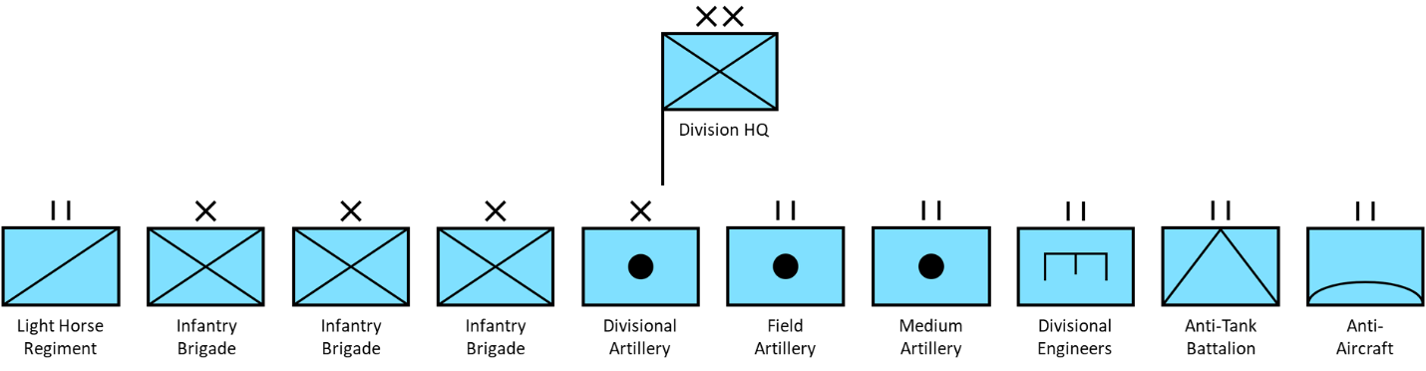
Source: Created by the author[14]
Jumping forward nearly 100 years, the current 1st (Australian) Division’s order for battle looks similar to its predecessor. Figure 2 demonstrates that despite considerable advances in systems, equipment and technology, the overall structural differences are relatively few. The inclusion of an organic combat service support is notable and provides increased control and flexibility to the commander.
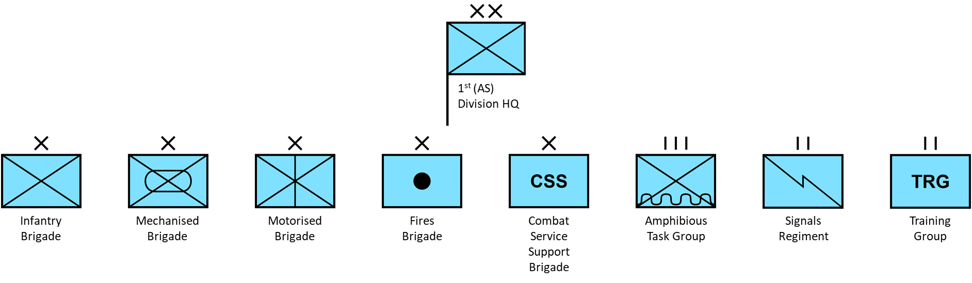
Source: Created by the author[15]
Looking at just Australian divisional structures when considering a ‘Ghost Division’ is also limiting. Consideration should be given to the force structures of allies and partners. This assists in two ways. Firstly, it broadens the understanding of how others are structured to fight. Secondly, it allows visualisation of how Australian units may fit into, or complement, allied and partner Army structures. To that end, Figures 3, 4 and 5 depict British, Ukrainian and United States[16] divisional structures respectively.[17] It must be explicitly stated that the lightest divisional structures are represented from these nations; this has been done as Australia has historically fielded and currently fields a preponderance of light infantry divisions. In part, this has been due to Australia’s industrial capacity to support fielding heavy divisions en masse.
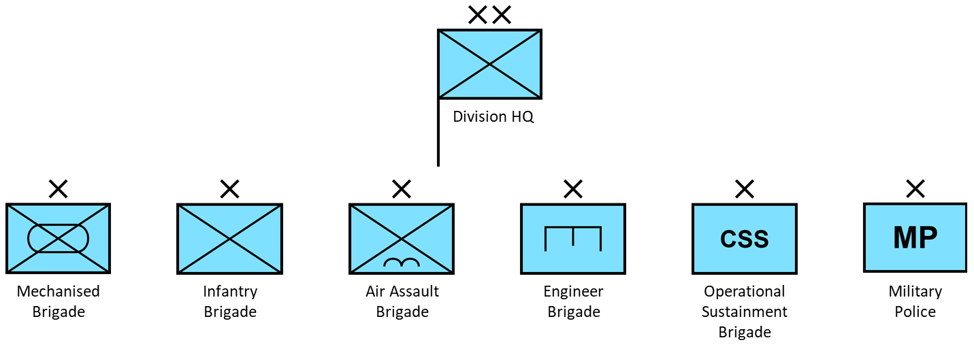
Source: Created by the author[18]
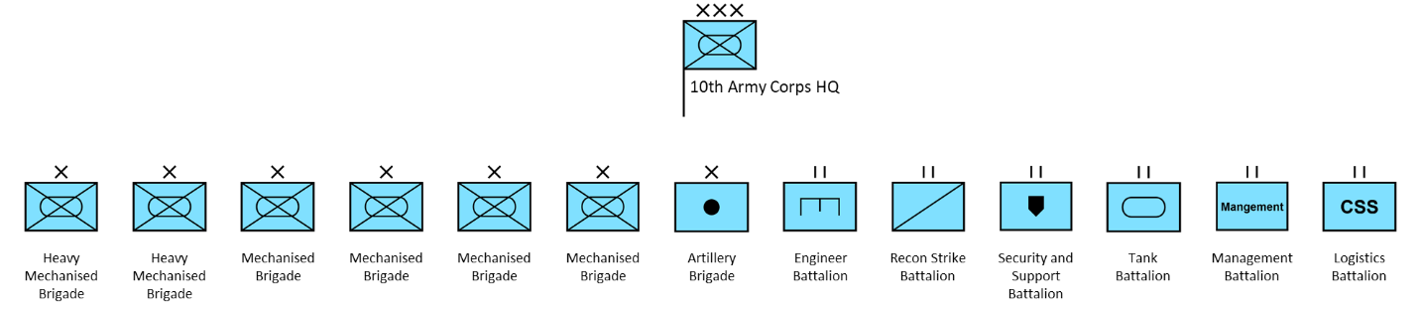
Source: Created by the author[19]

Source: Created by the author[20]
The divisional structures depicted in Figures 1 to 5 are instructive for the purposes of raising a ‘Ghost Division’ in support of rapid mobilisation in the Army. Before proposing what may be required within the ‘Ghost Division’, it is worth noting several similarities in the presented orders for battle. All depict at least three primary manoeuvre elements. Fires, or artillery, brigades are present in the majority of structures and representative of the interdependence between fire and manoeuvre. While different in all structures, there are elements commonly known as divisional troops that enable formation-level effects, such as the know, shape and shield combat functions. Divisional troops are inclusive of reconnaissance, armour, anti-tank, anti-air, signals and engineers. Sustainment or support brigades appear on all of the orders for battle except for Figure 1. Integral sustainment and support is, by virtue of modern inclusion, considered fundamental to a divisional structure. The UK and US orders for battle also include rear-area security/protection forces at the brigade level. This is demonstrative of the requirement to apportion resources to rear-area security and the need to maintain three dedicated manoeuvre elements within the division. Finally, only the US order for battle includes combat aviation. This is probably due to the industrial capacity of the US to raise and sustain aviation platforms at the divisional level.
Below is a proposed divisional structure for Army’s ‘Ghost Division’ (Figure 6). Its order for battle is based on Army’s historical experience of raising and deploying primarily light divisions and a cross-comparison of the divisions displayed in Figures 1 to 5. Critically, the structure supports the new approach to Australia’s defence as outlined in the NDS. Adopting a light divisional structure provides flexible options for defending Australia, defending our immediate region, and contributing with our partners towards the collective security of the Indo-Pacific.[21] Unlike the previous orders for battle, Figure 6 deliberately breaks down into the subordinate regiments and battalions under each brigade. Furthermore, it proposes names against each of the units, which will be explained in more detail later in the paper. Finally, the proposed structure is not intended to be absolute—rather, it is a starting point for commencing thoughts, for conversations and as a tool for visualisation. It is a hypothetical construct that provides the opportunity to further explain how Army may enable rapid mobilisation and expansion for conflict in the future.
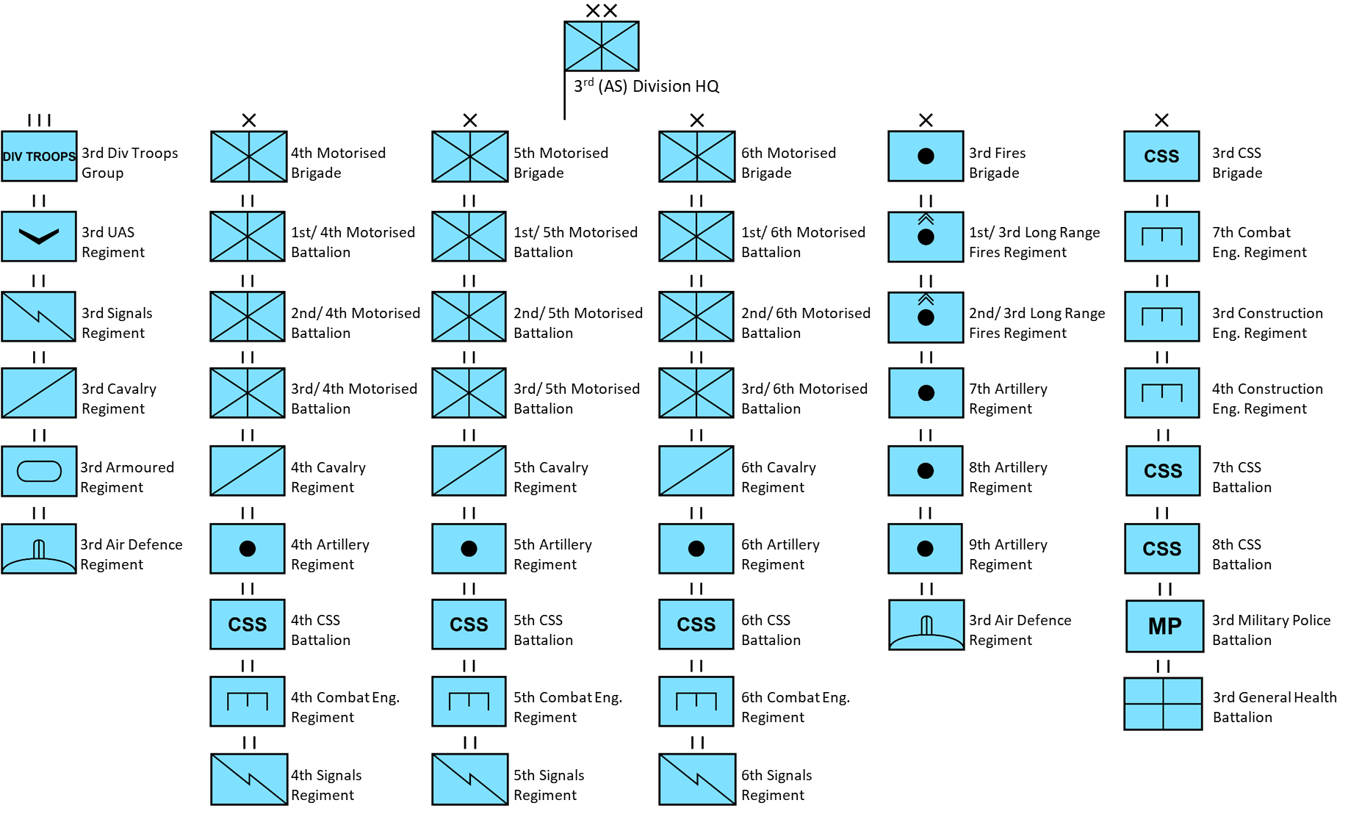
Making Decisions—Easier Said Than Done
The decision to mobilise can be made quickly; however, the consideration and planning that inform it take much longer. In 1994, Robert Leonard made the argument that time is rapidly becoming war’s critical dimension.[22] Leonard’s statement, now three decades old, still holds true. To that point, the presence of a ‘Ghost Division’ within Army would aid rapid decision-making in three ways. Firstly, having a pre-approved and off-the-shelf divisional structure clearly articulates options to the force employer (Chief of Joint Operations) or to the Chief of Defence for force expansion. Secondly, the pre-approval of unit names avoids lengthy, sometimes emotional, debates and processes that would invariably inhibit tempo. Finally, the shadow posting of key individuals to the units within the ‘Ghost Division’ shortens selection processes and activation of the units.
Enabling rapid decision-making is at the core of the ‘Ghost Division’. It provides decision-makers with a clear structure that can respond to partial, defence or national mobilisation requirements.[23] This is important to Army as it increases the responsiveness of the organisation to the threat and reduces time lost to planning activities post contingency event. Key to its utility is its flexibility. It ensures decision-makers can choose between mobilising a battalion, a brigade or the whole division. Furthermore, the structure can be replicated to enable deep planning and analysis of mobilisation requirements should it be necessary.
The Army has a relatively short history in comparison to continental partners. Common though is that these histories are largely based around individual units and their heroic deeds. This being the case, units and their names are important—the 4th Light Horse Brigade at Beersheba, the Nackeroos (officially the North Australia Observation Unit), the 6th Battalion Royal Australian Regiment in Vietnam, and the Special Air Service Regiment during the War on Terror. A key outcome of introducing a ‘Ghost Division’ within Army would be the pre-approved naming of all the subordinate units within the division. Figure 6 displays names for each unit; some readers are likely to have a visceral response to these names and argue for change based on historical connections. In peacetime, naming new or re-raised units can take upwards of 12 to 18 months with no formal process to follow.[24] Much of this time is spent in consultation with lobby groups, veterans groups, and interested parties such as the Army History Unit, before being left for the Chief of Army to make a decision. During a national crisis or conflict this expense in time cannot be afforded. The pre-approval of unit names is therefore an enabler to increase tempo in the decision space—particularly for the Chief of Army.
The Army is arguably better prepared for mobilisation than it ever has been. In 1914, Army had access to 2,989 permanent personnel.[25] In 1938, due to reductions in funding and personnel following the First World War and the Great Depression, numbers had dropped slightly to 2,795.[26] Jumping forward to Army’s current position, it has access to a permanent force of 27,218; of that, 5,479 are officers.[27] Looking at Figure 6, we see that Army has the capacity and capability to shadow-post key personnel against each of the units displayed. To do this, just for commanders and their associated sergeant majors, would affect one major general, five brigadiers, one colonel, 42 lieutenant colonels, and 49 warrant officer class ones. Striking these shadow postings would negate the requirement for decisions regarding whom to appoint as commanders or regimental sergeant majors when the organisation is in crisis or conflict. Working through the selection and shadow-posting process would also be illuminating for Army. It may identify which areas across the organisation can be reduced, or backfilled by additional public servants, to enable warfighting.
Army should focus its efforts now on making as many decisions in advance as it can rather than waiting for the organisation to enter crisis or conflict. Not doing so will increase the risk of the organisation experiencing a period of shock. Decisions made now will enhance speed of decision during the critical period of action—activation of partial, defence or national mobilisation. Timely decisions will support the organisation’s ability to transition to conflict and effect mobilisation.
Transition to Mobilisation—Orient to a New Problem
Orienting to a threat or vector takes time. John Boyd explains that the process of orienting shapes how we observe, decide and act, which in turn illuminates a process for organisation, emergence and selection.[28] The Army orienting and transitioning to mobilisation will be no different. The Army must consider how it best implements systems or processes that will rapidly enable the transition to force expansion, if mobilisation is directed. Introducing a ‘Ghost Division’ will support the rapid transition to mobilisation, among other solutions. It does so in three ways. Firstly, shadow-posted personnel must be tasked with reading into, and accepting, directed tasks and responsibilities, within any mobilisation plan. Secondly, the ‘Ghost Division’ provides a range of options for either force employers or force generators to call forward specific capabilities. Thirdly, it provides a very clear demand to defence industry, allies and partners for what equipment is required and where gaps may need to be covered or complemented.
Shadow posting key personnel to a ‘Ghost Division’ goes some way to gaining tempo during the transition to mobilisation. The real advantage of shadow posting though is the ability for those personnel to read into their roles and responsibilities under any mobilisation plan. Jake Ellwood, in a recent article on The Cove, argues that knowing your specific role directly links to job competence and effective leadership at the tactical level.[29] Beavis also explains that prior to the Second World War, Overseas Plan 401 had district-level plans that enabled subordinate-level planning and actions specific to their geographic region.[30] It is in between Ellwood’s and Beavis’s explanations that tempo can truly be developed through shadow postings. Having key personnel with a detailed understanding of a mobilisation plan that is specific to their unit, how it may be raised, where it may be raised, and where recruits come from, all contribute to Army’s ability to rapidly increase tempo during a transition period. Bringing in people cold, without this knowledge, or trying to develop these plans ‘in stride’ will slow Army’s capacity and capability to mobilise rapidly across a range of options.
The ‘Ghost Division’ provides Army with a range of military mobilisation options that can support partial, defence, or national mobilisation. The design must be flexible and support the rapid transition to any mobilisation event. The establishment of a ‘Ghost Division’ increases tempo by having pre-designed and approved options for the force employer and the force generator. While not exactly, the 6th Division of the 2nd Australian Imperial Force closely resembled that of the construct stipulated within Overseas Plan 401; as a result, the division could be raised on 15 September 1939 and subsequently transported to North Africa just four months later.[31] Army has rapidly transitioned to mobilisation in the past; it can do so again in the future if required. What Army needs though, is a structure to support the rapid transition to mobilisation whether it is for a battalion, a brigade, the whole division, or even specialist units.
Mobilisation is hard; it critically requires both personnel and equipment, both of which are historically in short supply during interwar periods. This shortfall, however, does not prevent Army from providing a demand signal to defence industry and more broadly to our allies and partners. In the first instance, a ‘Ghost Division’ could be fully scoped to include tables of organisation and equipment for each unit.[32] In this way, the personnel and equipment required to activate the division will become known with their respective demand signals and can then be passed to defence industry and recruiting. Doing this early will allow these sectors to plan for and meet Army’s needs when called, thus enabling rapid mobilisation vice protracting it. For allies and partners, communicating the structure of an additional division may yield fruitful efficiencies. For example, in 1912 it was briefly discussed that New Zealand would contribute towards a combined division with Australia in the event of war.[33] It may transpire that New Zealand explores this option again; without proposing the structure though, this avenue may never be explored. Further, our allies and partners may wish to offset capabilities based on our structure or look to link similar formations together (US Light Division or UK 1st Division) for operational reasons. In these ways having a ‘Ghost Division’ on the Army’s order for battle will increase tempo and the ability to rapidly transition to mobilisation and its subsequent execution.
Executing Mobilisation—Expanding in Conflict
A ‘Ghost Division’ on the Army order for battle also supports the execution of rapid mobilisation in conflict. Since the Second World War, most Army professionals have not lived in a strategic environment that may require the force-in-being to expand upwards of 300 per cent (as it did in the First and Second World Wars). Understanding that this future may eventuate is a paradigm shift for the organisation and challenges the mental model for nearly all serving members and veterans. Positively, Army is cognisant of the environment and is in a process of adaptation. Importantly, Army has risen to this very challenge previously and there are lessons to draw out. To support rapid expansion in conflict, the ‘Ghost Division’ must be viewed as replicable, support the mapping of recruiting and force concentration, and demonstrate individual and collective training requirements. Without these elements, tempo during execution of mobilisation will stall and prolong the provision of land capability to the force employer. Indeed, as reinforced at the Imperial Conference in 1937, the earliest phase of any war is the most dangerous (where outcome and survival may be uncertain), and the earlier divisions can be made ready, the more valuable to the war effort they become.[34]
A ‘Ghost Division’ provides Army a template from which to reproduce additional force expansion options during conflict. It is imperative that Army does this, as expansion beyond the current force-in-being of three to five times is realistic in large-scale combat. To illustrate this point, prior to the Second World War the Australian Military Force consisted of an order for battle that included four infantry divisions, three mixed brigades capable of forming a fifth division, and two cavalry divisions—critically this structure was at approximately 25 per cent staffing.[35] By April of 1942, this force had grown to 13 divisions: three divisions within the 2nd AIF and 10 divisions within the militia organised into two field armies and a separate corps.[36] Within three years, the Australian Military Force had doubled its number of divisions but had expanded its number of serving members by nearly 10 times. The sheer volume of personnel entering service also illuminates that recruitment and training must be considered.
Having a ‘Ghost Division’ supports rapid mobilisation by driving recruitment and training demand during execution. Figure 7 shows how the replication of successive ‘Ghost Divisions’ can be used to depict how mobilisation of Army can feed into the force employer for either defence of Australia or use overseas in an expeditionary role. Supporting this timeline is the raising of the 6th and 7th Divisions in the Second World War. The 6th Division deployed approximately 60 days after it was raised, completed collective training in the Middle East and first saw action at Bardia in January 1940. The 7th Division was raised in February 1940, deployed in October (approximately 215 days later) and first saw action in March 1941 at Giarabub. The point here is that these timelines are realistic; Army has achieved them in the past and could be called upon in the future to do it again. Having the ‘Ghost Division’ and associated timelines (as depicted in Figure 7) supports the rapid execution of mobilisation as personnel and equipment can be mapped against demand. Furthermore, facilities for the raising and training of these divisions can be pre-allocated, further building tempo into the execution of mobilisation.
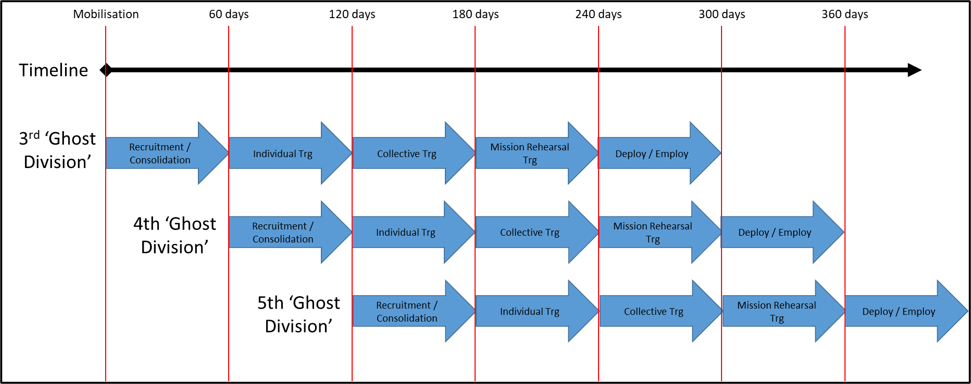
The main counterarguments are that multiple divisions are not required for a specific conflict or that personnel and equipment are not available. Much as was the case with Overseas Plan 401 and the subordinate district plans, Army needs to enable detailed subordinate planning and exposure to industry/recruiting of likely demands. Without such a plan, the organisation risks unnecessarily slowing mobilisation and losing tempo—something that will impact the force employer at the critical ‘deploy/employ’ stage. Figure 7 also has second- and third-order impacts on the force employer—they now have a broad understanding of when additional forces are likely to be made ready and can make assumptions for continued planning. This is undoubtedly a critical opportunity for Army and in contingency planning for the wider ADF. Having a ‘Ghost Division’ on the Army order for battle, and the ability to replicate it, will enable speed of execution during expansion in conflict. Army should not underestimate the value of having forces rapidly mobilised for use early in any conflict; it provides options.
Conclusion
The Army can enable rapid mobilisation and expansion for conflict through the inclusion of a ‘Ghost Division’ on the order for battle. Tempo during mobilisation can be gained by applying the lens of speed of decision, speed of transition and speed of execution towards the justification for a ‘Ghost Division’. Tempo through speed of decision can be gained through pre-naming the division and its subordinate units, and shadow posting personnel to key positions. These actions incur little cost to Army now but pay significant time dividends to Army during mobilisation. Indeed, this approach provides additional decision space to the Chief of Army in a strategic environment where warning is non-existent. Tempo through speed of transition can be gained through shadow-posted personnel being read into the mobilisation plan, the presentation of clear mobilisation options, and demand signals for recruitment and equipment being articulated early. Finally, tempo through speed of execution can be gained by ensuring the ‘Ghost Division’ is replicable and that it considers recruitment, the provision of equipment, and maps training requirements.
The points highlighted throughout this paper have drawn heavily on historical analysis and contemporary organisational analysis of allies and partners. Knowledge within Army on mobilisation beyond the current force-in-being has largely been lost and confined to hyper-specific historic academic papers. As Sir Basil Liddell Hart critiqued, ‘direct experience is inherently too limited to form an adequate foundation either for theory or application’.[37] As a result, any modern approach to mobilisation must start with reviewing what the organisation has achieved in the past. It is also well understood that mobilisation will not occur in exactly the same fashion, but similar characteristics will invariably exist: friction, chance, uncertainty and danger. Having a ‘Ghost Division’ on the Army order for battle can enable rapid mobilisation and expansion for conflict. A division that is unseen comes at low cost with high reward.
Endnotes
[1] Dr Michael Rinella, ‘Rommell’s Ghost Division’, Warfare History Network 9, no. 7 (2010).
[2] Department of Defence, 2024 National Defence Strategy (Canberra: Commonwealth of Australia, 2024), p. 6.
[3] Department of Defence, ADDP 5.0.1 (Canberra: Commonwealth of Australia, 2019), Chapter 4, para. 4.34c. ‘Tempo: is the rate of activity relative to the adversary, and comprises speed of adapting to changing circumstances, speed of decision, speed of execution, and speed of transition from one operation or action to the next. The belligerent that is able to consistently maintain higher tempo than its adversary tends to seize and retain the initiative and develop the campaign or operation on its own terms’.
[4] Samuel Clemens (Mark Twain) and Charles Dudley Warner, The Gilded Age: A Tale of To-Day (Hartford; San Francisco, 1874), p. 430.
[5] Department of Defence, National Defence Strategy, p. 5.
[6] Ibid., p. 11.
[7] Australian Bureau of Statistics, Year Book Australia 1915 (Australian Bureau of Statistics, 1914), pp. 943–944.
[8] John Mordike, An Army for a Nation (Sydney: Allen and Unwin, 1992), pp. 88–90.
[9] Ibid., pp. 96–97.
[10] Charles Edwin Woodrow Bean, The Official History of Australia in War 1914–1918, Volume 1—The Story of ANZAC: From the Outbreak of War to the End of the First Phase of the Gallipoli Campaign, May 4, 1915 (Sydney: University of Queensland Press, 1923), p. 27.
[11] Robert Stevenson, To Win the Battle: The 1st Australian Division in the Great War, 1914–1918 (Melbourne: Cambridge University Press, 2013), p. 14.
[12] Jordan Beavis, ‘Expeditionary Force Mobilisation Planning in an Age of Austerity: Overseas Plan 401 and the Interwar Australian Military Forces (1919–1939)’, Australian Army Journal XX, no. 3 (2024): 113.
[13] Sean Parkes, Hannah Woodford-Smith and John Pearse, ‘Contemporary Plan 401’, Australian Army Journal XX, no. 3 (2024): 55.
[14] Created by the author using information drawn from Beavis, ‘Expeditionary Force Mobilisation Planning in an Age of Austerity’, p. 106.
[15] Created by the author based on social media and other open-source information.
[16] This structure is from Kevin Hadley, Savannah Spencer and Justin Martens, How the Army 2030 Divisions Fight, White Paper (TRADOC Proponent Office—Echelons Above Brigade, 2023).
[17] The Ukrainians do not use a divisional structure. Rather, they employ corps headquarters with 4–8 manoeuvre brigades subordinate.
[18] Created by the author based on information from ‘1st (United Kingdom) Division’, The British Army (website), at: https://www.army.mod.uk/learn-and-explore/about-the-army/formations-divisions-and-brigades/1st-united-kingdom-division (accessed 27 May 2025).
[19] Created by the author based on information from ‘10th Army Corps’, MilitaryLand.net, at: https://militaryland.net/ukraine/armed-forces/10th-army-corps (accessed 10 June 2025).
[20] Created by the author based on information from Hadley et al., How the Army 2030 Divisions Fight.
[21]Department of Defence, National Defence Strategy, p. 7.
[22] Robert R Leonhard, Fighting by Minutes: Time and the Art of War (Westport CT: Praeger Press, 1994).
[23] Department of Defence, Australian Defence Doctrine Publication 00.2: Preparedness and Mobilisation, Edition 2, Executive Series (Canberra: Commonwealth of Australia, 2013), pp. 44–45.
[24] This is based on the author’s professional understanding of Australian Army policy and through discussions with the Army History Unit.
[25] Commonwealth Bureau of Census and Statistics, Year Book Australia, 1915 (Melbourne, 1915), pp. 91, 943–944.
[26] Commonwealth Bureau of Census and Statistics, Year Book Australia, 1939 (Canberra, 1940), pp. 236, 349.
[27] Department of Defence, Australian Defence Force Annual Report 2023–2024 (Canberra: Commonwealth of Australia, 2024), p. 15.
[28] John Boyd, The Essence of Winning and Losing, presentation (1995). Provided by the School of Advanced Military Studies, Fort Leavenworth, USA.
[29] Jake Ellwood, ‘Leading at the Tactical Level’, The Cove, 4 June 2020, at: https://cove.army.gov.au/article/leading-tactical-level.
[30] Beavis, ‘Expeditionary Force Mobilisation Planning in an Age of Austerity’, p. 100.
[31] ‘2nd AIF (Australian Imperial Force) and CMF (Citizen Military Forces) Unit War Diaries, 1939–45 War’, January–February 1940, AWM52 1/5/12, 6 Australian Division General Staff Branch.
[32] A table of organisation and equipment is a document that prescribes the wartime mission, capabilities, organizational structure, and mission-essential personnel and equipment requirements for military units.
[33] Stevenson, To Win the Battle, p. 14.
[34] Excerpts taken from ‘Imperial Conference, 1937, Summary of Proceedings’, in Gavin Long, To Benghazi (Canberra: Australian War Memorial, 1952), p. 21.
[35] Albert Palazzo, The Australian Army: A History of Its Organisation 1901–2001 (Melbourne: Oxford University Press, 2001), p. 101
[36]Dudley McCarthy, Volume V: South-West Pacific Area—First Year: Kokoda to Wau, Australia in the War of 1939–1945, Series 1: Army (Canberra: Australian War Memorial, 1959), pp. 25–28.
[37] BH Liddell Hart, Why Don’t We Learn from History? (New York: Hawthorn Books, 1972), p. 21.
Redefining the Profession for an Integrated Future
Author: Rosemary Woodbridge
Australia’s strategic environment, shaped by intensifying geopolitical competition, is not merely evolving; it is deteriorating at an accelerating pace. The Indo-Pacific is increasingly characterised by great power rivalry, territorial contestation and grey-zone operations, including cyber and information warfare, that test the resilience of state institutions without triggering formal conflict. China’s militarisation of the South China Sea, assertiveness toward Taiwan, and expansion of influence through the Belt and Road Initiative—its global infrastructure and influence strategy—are reshaping the regional security architecture. Simultaneously, non-state actors such as transnational crime networks and cyber operatives continue to erode traditional concepts of security through digital disruption and asymmetric tactics.[1]
In response, the Defence Strategic Review and the National Defence Strategy have reframed Defence’s posture from preparedness for distant wars to readiness for regional deterrence and strategic competition. Their central message is clear: Australia must build an integrated force—one capable of delivering joint effects across the land, sea, air, space and cyber domains. This is not aspirational policy; it is a mandate for institutional transformation.[2]
The Australian Army’s ability to contribute to this integrated force depends not only on technological enhancement or capability uplift but also on the evolution of its professional model. Since the Cold War, the Army’s professional framework has prioritised continuous full-time service, hierarchical rank progression, and segmented workforce structures—an approach increasingly out of step with the integrated, agile posture outlined in the Defence Strategic Review and National Defence Strategy. A professional army cannot meet the demands of a joint, integrated force if it remains institutionally fragmented in structure, culture and tempo. Only a reimagined professional identity—aligned to contemporary strategic demands—can enable the Army to fulfil its role within the integrated force.[3]
Samuel Huntington’s foundational theory of military professionalism, outlined in The Soldier and the State, defines a profession through expertise, responsibility and corporate identity.[4] This framework has long shaped Army’s institutional logic—reinforcing command hierarchy, continuity of service, and the centrality of the permanent force. While historically effective, this model now constrains Army’s adaptability within a dynamic, multi-domain operational environment. It is time to modernise this model to reflect the hybrid nature of today’s threats.
China’s military modernisation, including expansion of the People’s Liberation Army Navy, strategic missile forces, and space capabilities, continues to reshape regional power balances. Information warfare, disinformation campaigns, and cyber intrusions threaten not only military networks but national resilience.[5] This evolution marks a departure from conventional force-on-force conflict, demanding persistent presence and seamless integration across all warfighting domains to contest influence and defend national interests.
But force integration is not simply a matter of structure or systems. Buildings, platforms and task forces do not generate strategic advantage—people do. Integration requires a transformation in Army’s professional identity—one that underpins culture, capability and credibility. Army must value not only the full-time force but also the unique contributions of reservists, civilian Defence personnel, and embedded specialists. These groups bring domain-specific expertise in areas like artificial intelligence, cyber security, and regional engagement—capabilities essential to operating effectively in today’s complex battle space.
Professionalism is no longer about command, tenure or availability. It is about ethical leadership in contested environments, and the ability to operate with initiative, integration and cultural fluency across traditional and non-traditional domains. In the integrated force, leadership must transcend categories of service and embrace a capacity-driven ethos where credibility stems from outcomes—not rank alone. Ethical leadership, forged in complexity and grounded in adaptability, is central to Army’s relevance in a rapidly evolving security context.
To remain credible—to itself, its partners and its adversaries—the Australian Army must redefine what it means to be a professional. This requires a broader conception of service, leadership and expertise—one that reflects the demands of 21st century conflict, not the traditions of 20th century wars.
This essay argues that Army must transform its professional model to fully deliver on the promise of the integrated force. It must integrate permanent, reserve and civilian personnel as equal contributors to capability; reform its career structures to enable flexible, digitally fluent leadership; and demonstrate credibility through persistent regional presence. Professionalism must no longer be defined by time in uniform but by the ability to deliver multi-domain outcomes in environments that demand initiative, collaboration and ethical command.
Redefining the Army Profession
Professionalism has long underpinned military legitimacy and effectiveness. Traditionally, it has been defined by three pillars: expert knowledge, responsibility to the nation, and internal self-regulation. These concepts—shaped by theorists like Samuel Huntington (The Soldier and the State)[6] and Charles Moskos[7]—reflected the needs of industrial-era militaries. Huntington’s model, anchored in hierarchy, obedience and continuity of service, supported mass mobilisation and stability in conventional, state-on-state warfare.
However, the strategic and operational context has shifted dramatically. Conventional warfare has given way to grey-zone conflict, cyber disruption, and multi-domain competition. The 2023 Defence Strategic Review and 2024 National Defence Strategy[8] make clear that legacy structures are insufficient, Instead, the call is for a force integrated across domains and adaptable to hybrid threats.
Despite this shift, the Australian Army’s professional identity remains structured around full-time service, rank-based progression, and command appointments. Career frameworks such as the Total Workforce System[9] continue to reinforce this model—privileging uninterrupted, uniformed service and limiting hybrid career mobility. While this structure suited high-intensity conflicts in the past, it is increasingly incompatible with the complexity of today’s battle space.
Today’s environment requires workforce interoperability across uniformed, part-time, civilian and specialist lines. Reservists bring civilian-acquired expertise in languages, cyber, logistics and health care. Australian Public Service (APS) civilians contribute significantly to strategic policy, sustainment, intelligence, and capability development. Unlike uniformed personnel, they are governed by different legislation, standards and deployment conditions—yet their contributions are no less critical. Contractors and embedded specialists further extend capability in areas like AI, quantum and space. Nevertheless, Army’s definition of professionalism continues to prioritise traditional command experience and continuity of service, failing to reflect the operational reality of integrated capability generation.
This misalignment carries risks. In high-stakes, contested environments, success depends on the ability to deliver rapid, integrated efforts—not rank seniority or service category. Forces that cannot harness broad-based expertise may be outpaced by more agile and integrated adversaries.
International models demonstrate the potential of redefining professionalism. The United States’s Total Force Policy[10] transformed its reserve and National Guard from strategic reserves into operational forces with equal access to professional military education (PME) and command appointments. The UK Strategic Defence Review 2025[11] mandates agile force structures, including the integration of reservists and civilians into leadership roles. Similarly, Canada’s Total Force model[12] ensures that reservists are professionally developed and deployed alongside their regular force counterparts, with equal access to command and leadership structures. In New Zealand, the Defence Capability Plan 2025[13] outlines the development of an integrated, multi-domain force designed to operate as a ‘force multiplier’ with partners reinforcing the need for interoperability, adaptability, and coordinated capability across domains and institutions.
Lessons from recent operations reinforce this imperative. In Iraq and Afghanistan, rigid hierarchies and failure to integrate local knowledge, interpreters, or development experts led to operational setbacks. Australian deployments similarly highlighted the value of flexible civil–military cooperation. More recently, domestic responses such as Operation Bushfire Assist and COVID-19 Assist[14] have demonstrated the effectiveness of integrated, cross-sector teams. These examples reveal not just the feasibility of integration, but its strategic advantage.
Yet Army’s professional recognition systems remain tied to time in service, command-based rank structures, and uniformed leadership. To meet contemporary demands, the Army must shift from a model of service continuity to one of capability-based leadership.
This means embracing a capability-centric model of professionalism that transcends employment type. Three reforms are critical. The first is equitable access to PME for all categories—full-time, reserve, and APS personnel. The second is flexible career structures that allow movement across service types without penalty. And the third is formal recognition of non-traditional contributions, including through leadership roles and honours.
Tomorrow’s battle space will not be won by those most available but by those most adaptable. Professionalism in the integrated force must reflect a broader conception of service—one that values ethical leadership, domain-specific expertise and cross-sector collaboration. If the Army does not reform its professional identity, it risks being eclipsed not by larger forces but by smarter, more integrated ones.
The Role of the Army Reserve in Integration
If Army’s professional model is to evolve beyond rhetoric, it must operationalise inclusion—and the Army Reserve remains its most powerful, yet underleveraged, instrument to do so.
Historically, the reserve has been treated as a strategic supplement—a ‘force-in-being’ to be activated in times of national crisis, not a core component of sustained operational capability. This legacy view relegated reservists to the margins: vital during emergencies, yet often excluded from routine planning, preparedness and leadership development.
Contemporary conflict demands scalability, persistence and agility—attributes inherent in a well-integrated reserve. First, a well-integrated reserve enables scalable force generation without incurring the financial and sustainment burdens of an exclusively full-time force. Second, it provides persistent operational depth, enabling regional presence and tempo without exhausting regular Army capacity. Third, it offers a unique form of agility: the ability to inject deep civilian expertise—cyber security, logistics, engineering, public health, and languages—into mission sets that increasingly demand specialised knowledge. These are no longer support functions; they are mission-critical capabilities in hybrid operations.[15]
Reservists are not merely part-time soldiers; they are dual-profession experts. Their civilian skill sets are often more current and adaptable than those of their full-time peers, particularly in emerging domains such as artificial intelligence, network defence, and crisis coordination. Where strategic advantage increasingly hinges on information, narrative and networks, this duality is not a weakness—it is a competitive edge.[16]
This is not theoretical. Operation Bushfire Assist (2019–2020) mobilised over 6,500 reservists, whose civilian experience in logistics, engineering, infrastructure and health support enhanced interagency coordination during national crisis.[17] Operation COVID-19 Assist (2020–2021) saw reservists lead contact-tracing cells, staff medical clinics and manage large-scale logistics. Their contributions extended across humanitarian assistance and disaster relief deployments in the Indo-Pacific—including Tonga Assist—where cultural fluency, infrastructure experience, and public health acumen reinforced Australia’s regional credibility.[18]
These missions validated three enduring strengths of an integrated reserve: scalability, enabling rapid expansion without compromising readiness; regional persistence, providing sustained presence without undermining full-time force availability; and specialised expertise, delivering capabilities in cyber, health, logistics, and crisis engagement that regular forces cannot replicate.
Army must formally reposition reservists and civilians as core enablers of capability—not contingency options.
Other Five Eyes partners are already doing this. In the United States, the National Guard and reserve forces form the operational backbone of homeland defence and deploy frequently in coalition task forces.[19] The UK’s Reserve 2030 vision integrates reserve forces into domains like cyber and space as full-spectrum contributors, not just surge capacity.[20] Canada’s Total Force model deploys reservists alongside regulars, with parity in access to command, PME, and leadership tracks.[21] These examples succeed because they treat reservists as co-professionals—trained, trusted, and tasked with delivering outcomes.
Australia’s reserve integration remains inconsistent and largely ad hoc, lacking institutional coherence. Despite reforms under the Total Workforce System,[22] significant structural and cultural barriers remain: PME access is limited, often reserved for full-time personnel; leadership development is linear and excludes reservists from promotion pathways; and planning and deployment frameworks seldom incorporate reserve capability early or meaningfully.
If integration is to underpin the future force, this must change. PME must be modular and digitally accessible for all workforce categories. Career pathways must be flexible and capability led—not dictated by uninterrupted service. Structural exclusion from planning and operational leadership must be dismantled.
Just as importantly, cultural change must reinforce the value of dual-profession expertise. Army must move from valuing presence to valuing impact. Leaders must be selected not only for tenure but for the skill sets they bring—whether acquired in uniform or in civilian roles. This is particularly relevant to the Indo-Pacific, where influence relies on cultural literacy, humanitarian capability and civic engagement. Reservists bring deep reservoirs of these competencies, yet remain structurally sidelined.
In this context, reservists are not a stopgap—they are Army’s asymmetric advantage. Their presence in regional operations demonstrates Australia’s whole-of-society approach to security. Their expertise supports not only military objectives but diplomatic, humanitarian and civil–military outcomes.
In an increasingly contested Indo-Pacific, Army’s credibility will not derive solely from platforms or presence but also from integration. The reserve is not Army’s Plan B. It is the foundation of a professional model calibrated for the complexity of 21st century warfare.
Institutional Enablers of Integration
Redefining professionalism cannot be achieved by rhetoric alone. Institutions, not intentions, shape military culture. Without structural reform—across professional education, career pathways, workforce management, and cultural incentives—Army’s vision of integration will remain performative, not transformative.
In Army, culture follows structure. If the institution continues to reward uninterrupted full-time service and command-based leadership, then integration—across workforce categories, domains, and functions—will remain marginal. Current systems reinforce a linear, hierarchical model of professionalism that sidelines hybrid professionals, including reservists, civilians, and those transitioning between categories.
This exclusion is not incidental. Army’s leadership development, promotion systems, and access to PME remain tightly tethered to time in service and full-time availability. These structures dictate who is seen as ‘leadership material’ and who is considered peripheral. In an operational context defined by agility, regional partnerships, and technological complexity, this rigidity is not only outdated—it is strategically limiting.
Modern defence forces have recognised that institutional structures must be redesigned to reflect integrated operations. In the United States, PME reforms have opened joint education and command preparation to guard and reserve officers, mainstreaming their development alongside regulars.[23] The United Kingdom’s Strategic Defence Review 2025 outlines flexible leadership pipelines that integrate reservists and civilians based on capability, not category.[24] Canada’s Total Force 2020 policy embeds reserve personnel in operational planning and command pathways.[25] New Zealand’s approach to defence capability development emphasises integration across domains and partners, reinforcing the importance of coordinated workforce and institutional design.[26]
These allies share a common insight: you cannot build an integrated force with siloed people. Any profession built within exclusionary structures will remain exclusionary by design.
Meanwhile, in Australia capability investment continues to prioritise platforms over people. The Australian Strategic Policy Institute’s 2025–26 Cost of Defence report highlights this imbalance, showing that while Defence’s acquisition budget has increased significantly, investment in training, development and professional education has stagnated.[27] Between 2019 and 2024, acquisition spending rose by 37 per cent, while training expenditure remained flat.27 This widening gap signals a misalignment between strategic aspirations and workforce development.
This disconnect is even more evident when viewed through a whole-of-government lens. The APS Reform Agenda calls for agile, digital-ready, mission-driven public servants.[28] Yet within Defence, APS personnel remain structurally excluded from leadership development, operational planning, and strategic decision-making. The result is a civilian workforce that is present but professionally peripheral—contrary to both national security imperatives and the principles of integration.
Institutional change requires more than updated policy—it demands structural courage. It means challenging long-held assumptions about command, status and the pathways to influence. It means building leadership frameworks that reward adaptability over availability, and cross-domain competence over continuity of service.
As Peter Drucker warned, culture eats strategy for breakfast. But in Defence, structure eats culture for lunch. If Army is serious about building an integrated profession, it must reconstruct the institutions that shape who is developed, who is promoted and who is heard.[29]
Army’s Role in a Regional, Integrated Indo-Pacific Posture
Integration is not an abstract organisational virtue. It is the foundation of strategic credibility—especially in the Indo-Pacific, where Australia’s national interests are most immediately at stake.
The Indo-Pacific is not merely Australia’s strategic backyard; it is the epicentre of a global contest for influence, resilience and regional order. China’s military modernisation, economic coercion and assertive grey-zone tactics—including disinformation, political warfare and paramilitary pressure—are reshaping the strategic calculus. Meanwhile, the United States’s strategic focus, while pivoting to the region, is increasingly stretched by global demands. In this complex theatre regional states are hedging, diversifying partnerships and seeking credible security partners who offer more than episodic deployments—they seek persistent, integrated presence.
Presence matters. But presence without integration is no longer sufficient.
Credibility in the region is not built through flag-waving exercises or brief battalion deployments. It is earned through sustained engagement across domains—military, humanitarian, cyber and informational—delivered by integrated, agile teams capable of adapting to regional needs. These teams must combine tactical capability with language proficiency, cross-cultural agility, public health capacity, infrastructure knowledge, and civil–military coordination.
If Army’s regional posture is to evolve beyond conventional military projection, it must operationalise integration—not just within itself but across the broader ADF and with civilian expertise. The integrated force must be visible not only in doctrine but on the ground, embedded in enduring regional partnerships that reflect shared challenges and priorities. This requires deploying joint, multi-domain teams that include reservists, APS civilians, and embedded specialists as equal contributors to capability.
International examples underscore this shift. New Zealand’s Defence Force deploys integrated teams combining military, police, and developed professionals across the Pacific.[30] Canada’s Disaster Assistance Response Team institutionalises civil–military coordination for regional crisis response.[31] The United Kingdom’s Strategic Defence Review 2025 mandates a pivot to persistent Indo-Pacific engagement through small, scalable teams tailored for partnership—not projection.[32]
Australia cannot afford to lag behind; nor can it rely on Cold War-era concepts of military dominance. Strategic influence is increasingly shaped through collaboration, presence and credibility—not size or spectacle.
The Australia Army is well positioned to deliver this shift—if it redefines its conception of professional contribution. Reservists offer critical civilian-acquired skills in health, infrastructure, law, governance and cyber. Civilian Defence personnel bring continuity, development expertise and enduring regional relationships. These hybrid teams can deliver persistent presence in ways that conventional military deployments cannot—closing the gaps that episodic engagement leaves behind.
A reimagined Army profession—integrated across categories and focused on capability, not continuity—can elevate Australia’s regional posture. Such a force would demonstrate not only tactical readiness but strategic humility, cross-domain fluency, and cultural intelligence. It would embody the ADF’s commitment to shared security outcomes, not just a national self-interest.
In a region where partnerships are built on trust and cooperation, integration is not just an internal reform—it is a strategic necessity. Regional partners demand enduring cooperation, civil–military blending, and sustained engagement to meet the challenges of climate resilience, digital disruption, disaster response, and health security.
Failure to adapt would risk ceding strategic space to more agile, cooperative actors, weakening Australia’s position as a partner of choice. In contrast, a redefined professional Army—credible in its integration, regional in its posture and inclusive in its composition—would place Australia at the forefront of Indo-Pacific security cooperation.
Urgency and the Cost of Delay
Army faces a binary choice: adapt now, or risk strategic irrelevance.
Warning signs are already visible. The 2025–26 Australian Strategic Policy Institute Cost of Defence report identifies critical workforce shortfalls in cyber, logistics and engineering—precisely the areas where reservists, APS personnel and civilian specialists can deliver decisive capability.[33] Rigid career structures, limited access to PME, and inflexible service models are accelerating talent attrition across the uniformed and civilian workforce. The most capable are no longer waiting for reform—they are voting with their feet.
Interoperability with key partners is also under threat. Allies are not standing still. The United States, the United Kingdom, Canada and New Zealand are accelerating reserve and civilian integration into joint operations, building agile workforces and shared leadership pipelines.[34] Without comparable reform, the Australian Army risks becoming a less interoperable, less credible contributor to coalition operations—just as strategic competition intensifies across the Indo-Pacific.
The region is not waiting. Indo-Pacific states now expect persistent, flexible and civil–military integrated partnerships. Episodic deployments and traditional force structures increasingly appear out of step with these expectations. Delay is not a theoretical risk—it is an operational and reputational cost already accruing.
Meanwhile, adversaries are evolving with speed. China’s People’s Liberation Army is pursuing structural reforms centred on joint force integration, cyber dominance, and space capabilities. Grey-zone actors blur traditional boundaries, fusing civilian, paramilitary and digital influence operations. Cyber threats now unfold in milliseconds, not mobilisation timelines.
Victory in this battle space will not go to the best-organised force on paper. It will go to the force that integrates expertise, responds with agility and adapts more quickly than its adversary.
Australia’s allies are already reforming. In the United States, Total Force integration is reinforced through national defence policy, embedding reserve and National Guard components within active force structures and operational planning.[35] The United Kingdom’s Reserve Forces 2030 Review is reshaping its professional model to support flexible, integrated frameworks.[36] Canada’s Total Force approach sees reservists lead, not just support, regional and domestic operations.[37] New Zealand’s civil–military integration model is operationalising hybrid teams across the Pacific.[38]
Inaction is not neutral. It is a decision—a decision to lag behind a fast-moving strategic environment.
Army’s most dangerous adversary is not a foreign power. It is institutional inertia—the subtle but persistent pull towards outdated structures, familiar hierarchies and a narrow definition of professionalism. Without deliberate, courageous reform, integration risks remaining a slogan rather than a structure. Professionalism will remain exclusive rather than enabling. Army will stay reactive, not proactive. Strategic credibility will erode—not with a bang but with silence.
That is the cost of delay. It will appear not in a policy paper but in mission failure, lost influence and missed opportunity.
Yet within this urgency lies a choice—and an opportunity. Army can lead Defence-wide reform by redefining professionalism in terms of capability, integration and adaptability. This would position Army as a central actor in delivering the ADF’s integrated force and as a credible partner for regional security.
Integration is not a burden—it is Army’s opportunity to lead, modernise and remain relevant.
This is not simply a structural issue; it is a matter of credibility, relevance and trust. Army must act not because reform is fashionable but because it is fundamental to the demands of 21st century security and regional partnership. The future will not pause. The Indo-Pacific is not waiting; nor are our adversaries. The Army must choose to evolve—or risk having the future decide for it.
Conclusion: the Army’s Choice
Professionalism has always been the bedrock of Army’s credibility—the foundation upon which soldiers, commanders and coalitions build trust. But professionalism, like strategy, cannot remain static while the world changes around it.
Australia now faces a security environment defined not by predictable battles but by persistent, multi-domain competition. Power is contested not only across the military, cyber and space domains but also across civil society, government, and information systems. The Indo-Pacific is not a theatre waiting for traditional armies—it is a region demanding integrated, adaptable, enduring forces capable of shaping outcomes without firing a shot.
The Army’s legacy model—command-centric, full time, and linear—was built for wars the Army once fought. It is ill suited to the demands of modern warfare. The operational environment now demands that soldiers think critically, lead ethically and operate collaboratively across domains and disciplines. These are not merely tactical adjustments; they are cultural shifts that require rethinking what it means to be a professional in uniform.
Army now faces a pivotal decision: defend a legacy professional identity increasingly misaligned with operational reality, or lead a redefinition of professionalism—one grounded in capability, not contract type; integration, not isolation; and effect, not entitlement.
A modern profession must integrate full-time, reserve and civilian personnel as equal contributors. It must value cross-domain fluency, regional expertise and leadership adaptability. Most importantly, it must recognise that the ability to persist, build relationships and deliver effects across domains is not the true measure of professional excellence. Success in the Indo-Pacific will not be won by mass or hierarchy—it will be won by trust, persistence and the ability to operate as one integrated force.
This is not an administrative adjustment—it is a redefinition of what it means to be a soldier in the era of integrated competition.
Reform will be uncomfortable. It will challenge sacred traditions, disrupt familiar hierarchies and require institutional courage. But if the Army does not lead this transformation, it will not lead the integrated force. It will follow it—reluctantly, reactively and ultimately irrelevantly.
Courage, after all, is not the absence of fear. It is the decision to act despite fear. Professional courage is no different. The most dangerous enemy Army faces is not a foreign adversary—it is the Army’s own inertia. Integration is not a slogan to be repeated; it is a structural, cultural and ethical commitment to be enacted.
Integration is also not a reform to be delayed until it suits traditional timelines or the comfort of established leaders. It is the price of strategic relevance in an age of accelerated change. It is a requirement of partnership with our allies and a necessity for influence in our region.
The Indo-Pacific—and the contests that will define Australia’s future—will not wait. In this environment, integration will not be the competitive advantage; it will be the minimum standard. Strategic credibility will belong to those who evolve more quickly than the threat, integrate across every layer of capability and persist where others withdraw.
Army’s choice is clear: either lead the transformation of military professionalism, or become a force admired for its traditions but abandoned by its future. Leadership now means more than rank; it means having the institutional courage to ask not what Army was but what it must become.
Professionalism is not what Army remembers—it is what Army becomes. And what it becomes will determine whether Australia’s future force is shaped by legacy or led by integration, courage and purpose.
If the Army embraces this transformation, it will not only reinforce its credibility at home and with allies but also project a powerful signal across the Indo-Pacific: that Australia understands the nature of contemporary competition and is willing to lead within it. The world is watching—not for perfect plans but for decisive action.
In a contest where the battlefield is as much digital and humanitarian as it is kinetic, irrelevance is not an abstract risk. It is the enemy. The future integrated force will not wait. Neither will Australia’s security. Its credibility must be earned in every action, every relationship and every decision to lead.
This is not simply a contest of capability but a test of will—of whether Army can evolve with purpose, pace and conviction.
Endnotes
[1] Michael Shoebridge, China’s Strategic Intentions and Australia’s Response (Canberra: Australian Strategic Policy Institute, 2023), pp. 5–8.
[2] Australian Government, National Defence: Defence Strategic Review 2023 (Canberra: Commonwealth of Australia, 2023), pp. 9–14; Australian Government, National Defence Strategy (Canberra: Commonwealth of Australia, 2024), pp. 6–10.
[3] Australian Government, Defence Strategic Review 2023, p. 12; Australian Government, National Defence Strategy, p. 8.
[4] Samuel P Huntington, The Soldier and the State: The Theory and Politics of Civil-Military Relations (Cambridge MA: Harvard University Press, 1957), pp. 8–10.
[5] Ela B Kania and Lorand Laski, Myths and Realities of China’s Military-Civil Fusion Strategy (Washington DC: Centre for New American Security, 2021), pp. 3–6.
[6] Huntington, The Soldier and the State.
[7] Charles C Moskos, ‘From Institution to Occupation: Trends in Military Organization’, Armed Forces & Society 4, no. 1 (1977): 41–50.
[8] Australian Government, Defence Strategic Review 2023; Australian Government, National Defence Strategy.
[9] Australian Defence Force, Total Workforce System: A Guide to Flexible Workforce Management (Canberra: Department of Defence, 2020).
[10] U.S. Department of Defense, Total Force Policy, Department of Defense Directive 1200.7 (Washington DC: Department of Defense, 1973).
[11] UK Ministry of Defence, Strategic Defence Review 2025 (London: UK Government, 2025).
[12] Canadian Armed Forces, Total Force Policy (Ottawa: Government of Canada, 2017).
[13] New Zealand Government, Defence Capability Plan 2025 (Wellington: Ministry of Defence, 2025), https://www.defence.govt.nz/our-work/plan-and-access/capability-planning/.
[14] Australian Army, ‘Operation Bushfire Assist 2019–2020’, Department of Defence (website), accessed May 2025; Australian Army, ‘COVID-19 Assist Summary Report’, Department of Defence (website), accessed May 2025.
[15] Australian Defence Force, Reserve Capability and Reform Overview (Canberra: Department of Defence, 2023), at: https://www.defence.gov.au/sites/default/files/2023-04/Reserve-Capability-Overview.pdf.
[16] Australian Army, Army in Motion: Army’s Contribution to Defence Strategy (Canberra: Department of Defence, 2019), pp. 8–10.
[17] Joint Standing Committee on Foreign Affairs, Defence and Trade, From the Ashes: Review of Defence’s Bushfire Assist Mission (Canberra: Parliament of Australia, 2020).
[18] Department of Defence, Defence Support to the National COVID-19 Response (Canberra: Commonwealth of Australia, 2022).
[19] U.S. Department of Defense, Annual Posture Statement (Washington DC: National Guard Bureau, 2022).
[20] UK Ministry of Defence, Reserve Forces 2030 Review (London: UK Government, 2021).
[21] Canadian Department of National Defence, Total Force 2020 Policy (Ottawa, 2018).
[22] Australian Defence Force, Total Workforce System, pp. 4–6.
[23] U.S. Department of Defense, Annual Posture Statement.
[24] UK Ministry of Defence, Strategic Defence Review 2025.
[25] Canadian Department of National Defence, Total Force Policy 2020 (Ottawa: Government of Canada, 2018).
[26] New Zealand Government, Defence Capability Plan 2025 (Wellington: Ministry of Defence, 2025), https://www.defence.govt.nz/our-work/plan-and-access/capability-planning/.
[27] Australian Strategic Policy Institute, The Cost of Defence: ASPI Defence Budget Brief 2025–26 (Canberra: ASPI, 2025), pp. 10–12.
[28] Australian Public Service Commission, Delivering for Tomorrow: APS Workforce Strategy 2025 (Canberra: Commonwealth of Australia, 2021), pp. 6–9.
[29] This quotation is commonly attributed to Peter Drucker, though no formal written source exists. See Justin Bariso, ‘No, Peter Drucker Didn’t Say “Culture Eats Strategy for Breakfast.” But Here’s Why You Should Still Pay Attention’, Inc., 6 September 2018, at: https://www.inc.com/justin-bariso/no-peter-drucker-didn’t-say-culture-eats-strategy-for-breakfast-but-heres-why-you-should-still-pay-attention.html.
[30] New Zealand Defence Force, Force Development Strategy 2025.
[31] Government of Canada, Disaster Assistance Response Team (DART) Organization, Department of National Defence, 18 July 2019, https://www.canada.ca/en/department-national-defence/services/operations/military-operations/types/dart/organization.html.
[32] UK Ministry of Defence, Strategic Defence Review 2025.
[33] Australian Strategic Policy Institute, The Cost of Defence, pp. 14–15.
[34] See U.S. Department of Defense, Annual Posture Statement; UK Ministry of Defence, Reserve Forces 2030 Review; Canadian Department of National Defence, Total Force Policy 2020; New Zealand Defence Force, Force Development Strategy 2025.
[35] U.S. Department of Defense, Summary of the 2018 National Defense Strategy of the United States of America (Washington, DC: Department of Defence 2018), https://dod.defense.gov/Portals/1/Documents/pubs/2018-National Defence-Strategy-Summary.pdf.
[36] UK Ministry of Defence, Reserve Forces 2030 Review.
[37] Canadian Department of National Defence, Total Force Policy 2020.
[38] New Zealand Defence Force, Force Development Strategy 2025.
Author: Lieutenant Christopher Wooding
In order to respond to the challenges of an unpredictable future, the Army requires strategic agility, a degree of high-precision lethality, pervasive situational awareness, and highly networked sensors and shooters.
Lieutenant General Peter Leahy AO, 2003[1]
The Australian Army must fully adopt reconnaissance-strike tactics (RST)[2] to optimise as a profession for littoral warfare operations. RST is the fusion of intelligence, surveillance and reconnaissance (ISR) capabilities with precision fires as well as electronic warfare (EW) capabilities to create opportunities for manoeuvre forces. As the emerging tactical regime, the Army needs to adapt its culture, tactics, training, organisation and equipment to apply RST and be effective in future combat. Drawing on lessons and observations from recent and ongoing conflicts will be essential to understanding RST; however, it must be applied to Australia’s context: littoral warfare operations. Further, the Army must also recognise where existing tactics remain effective to merge these legacy tactics with RST in what Stephen Biddle calls the ‘modern system’.[3]
This essay will explore the Australian Army’s adoption of RST for littoral warfare operations. It will begin by framing the challenges of the modern battlefield and the emergence of RST. It will then place RST within Australia’s context of littoral warfare operations and provide five scenarios to demonstrate RST in practice. Finally, it will offer five recommendations for Army to pursue in successfully adopting RST to optimise for littoral operations: intellectually adopting RST as its capstone tactical concept; organising for RST in the littoral; improving command, control, communications, computers and intelligence (C4I) systems for RST information management; enhancing defence industry engagement and processes; and increasing experimentation and free-play testing to drive innovation. This essay will focus on the tactical aspects of RST with limited forays into operational and strategic considerations.
Characterising the Modern Battlefield
The modern battlefield is changing, as reflected in recent and ongoing conflicts in Nagorno-Karabakh, Ukraine, Israel-Hamas, and the Arabian Gulf. This changing character of war has been the subject of significant analysis. In The Arms of the Future, Jack Watling analyses the changes facing land forces today. Watling describes five dynamics that are defining the modern battlefield:[4]
- Increasing effectiveness and fidelity of modern sensors limiting manoeuvre and surprise. This dynamic emphasises ambiguity and signature management in military action.[5]
- Contested and congested electromagnetic spectrum constraining information management. This requires militaries to ‘fight for bandwidth’ and rethink information management to ensure effective communication structures that support battlefield coordination.[6]
- Relative improvements in protection versus lethality threatening the ability to concentrate forces at the decisive point. This is also driving an emphasis on active protection to enhance the survivability of ground forces.[7]
- Increasing vulnerability of logistics and enablers threatening to degrade combat forces. This is a product of the increasing ranges of weapons and the increasing porousness of the battlefield allowing infiltration by enemy forces, forcing militaries to find new ways of sustaining and synchronising their forces.[8]
- The need to reconcile the above in rural and peri-rural environments with the requirement to concentrate for inevitable urban operations as cities act as political, economic and human centres of gravity.[9]
Watling argues that these dynamics will force militaries to grapple with fundamental questions about how they organise and operate. Similar dynamics are echoed by other assessments. A 2024 report by the Institute for the Study of War describes the tactical dilemma occurring in Ukraine as a result of extensive use of electronic warfare, pervasive surveillance and first-person-view drones, among other factors.[10] The report contends that this dilemma has led to the loss of manoeuvre, resulting in ‘relatively static frontlines and regular combat that produces little movement’.[11] Similarly, TX Hammes argued in 2021 that new technologies were returning the tactical defence to the dominant form of warfare, as opposed to dominance of the tactical offence of the previous century.[12] Hammes more recently identified three key trends in contemporary war:
- Pervasive surveillance (through satellites, terrestrial sensors and drones)
- Precision mass (through artillery, rockets, drones, loitering munitions and other autonomous systems)
- Advanced C4I systems to coordinate and exploit the above (including artificial intelligence, information warfare and electronic warfare).[13]
Hammes continues to describe the impact of these trends on each warfighting domain. Across all domains, he highlights the essential role of signature management, the increasing range of weapons, and the requirement to fight ‘disconnected’. With respect to the land domain, Hammes emphasises the return of mass to the battlespace and the growing capacity for land power to dominate maritime zones.[14] This latter aspect has important implications for the Australian Army operating as a littoral force, which will be explored later. These trends collectively highlight the limitations of previous and existing methods of land warfare when applied in isolation on the modern battlefield. Instead, they point to the emergence of a new tactical regime: reconnaissance-strike tactics.
Defining Reconnaissance-Strike Tactics
The origins of RST go back to Soviet Union military thought and later Russian organisations.[15] Soviet concepts of the reconnaissance-strike and reconnaissance-fires complexes produced an analysis of future warfare by the United States Office of Net Assessment in 1991, which emphasised the potential of fusing military forces with information technologies.[16] Since then, RST has evolved over the last 40 years and through the Global War on Terror as operational kill chains rather than as a tactical concept.[17] Discussion of RST has increased in recent years, with a number of alternative definitions and labels being suggested. Presently, however, RST appears as primarily an emerging tactical concept within Western military thought. Despite the nascent discussion, many militaries are pursuing capabilities that enable them to conduct RST in some form, predominantly through the acquisition of various drones, loitering munitions, and long-range fires. Maturing the discussion of RST, however, is vital to ensuring its optimal implementation by militaries.
BA Friedman defines RST as ‘the use of advanced [ISR] assets fused with precision-strike munitions and information-related capabilities to identify and create opportunities for maneuver forces’.[18] Kagan et al. describe RST (termed ‘tactical reconnaissance strike complex’ in their paper) as:
the combination of pervasive tactical reconnaissance, primarily by drone; drone-corrected precision artillery fore; precision munitions delivered by fixed- and/or rotary-wing aircraft; drone-launched precision munitions; and large numbers of FPV loitering munitions … to ‘generate windows of vulnerability and opportunity … to make or exploit a breakthrough to achieve operationally-significant objective’.[19]
The common thread to both descriptions of RST, and other descriptions, is the fusion of ISR and fires to create manoeuvre opportunities. Although Watling does not use the term RST in The Arms of the Future, his conception of a future land warfighting system neatly fits the characterisation of RST.[20] Similarly, Mick Ryan’s description of an Australian ‘Reconnaissance-Strike Group’ undertaking ‘a range of precision strike and fire support missions … based on armed reconnaissance and surveillance platforms’ in a single organisation also broadly aligns with RST.[21]
At the heart of RST is the ability to process and share information. While sensors and fires form two critical components of implementing RST, the ability to acquire, analyse and share information between sensors and fires is fundamental to the success of RST. This places a premium on operational art and staffs at all levels, not just at the theatre level, to plan, prepare, synchronise and sustain RST.[22] This includes at unit and below levels, which will need to coordinate internally to achieve RST as well as to contribute to the larger combined arms team. Achieving this requires highly trained personnel to exploit technologies to implement tactical and operational concepts. Notably, the advantage gained from highly skilled warfighters will become increasingly important as technological advantage erodes in implementing RST.[23] Militaries will need to invest in people who can ‘creatively out-think and out-plan potential adversaries’ and ‘offset the growing military, financial, and information capabilities of potential adversaries’.[24]
The significance of information management and operational art to achieve RST means a reliance on the electromagnetic spectrum and C4I systems. As Watling describes, current C4I technologies are constantly producing and sharing immense quantities of information to the point of exceeding the bandwidth available on data networks.[25] This congestion also floods such networks with noise, creating challenges for prioritising information across contexts. Additionally, the volume of information communicated comes with challenges of assurance and detection.[26] Without effective C4I systems, coordinating RST becomes significantly harder, if not impossible—underscoring the importance of EW.[27] While EW will have an offensive function within RST, it is a defensive necessity to protect sensors and fires from detection, as well as to secure C4I systems to enable coordination for successful RST.
As a tactical regime, RST is not a specific set of platforms or even technologies; instead, it represents new ways of organising those platforms and technologies to exploit them effectively on the modern battlefield. In other words, it is better conceived as a conceptual or philosophical change to thinking about the organisation and use of military forces. Importantly, Kagan et al. emphasise the constancy of change within RST systems—RST is defined by the relationships between capabilities to achieve an integrated effect, rather than the platforms themselves. Continuing from this, Friedman describes the reality of military forces as ‘a complex adaptive social system facing an opposing complex adaptive social system’.[28] This reinforces the view that RST, as a tactical regime, is about the philosophical changes to organising and using military force.
Despite RST’s potential, legacy tactics will remain pertinent in future combat. Friedman highlights that RST is additive to existing armour-infiltration tactics (AIT),[29] though they are conceptually distinct from one another. This combining of tactical regimes leads to what Stephen Biddle referred to as the ‘modern system’, which is defined by ‘cover, concealment, dispersion, small-unit independent maneuver, suppression, and combined arms integration’.[30] In practice, this will mean adapting and augmenting existing platforms with new capabilities both lethal and non-lethal. It may also see new organisations to blend AIT and RST systems. Many aspects of AIT will remain relevant, particularly once operating inside the zone of opportunity described by Watling. In this way, RST precedes the concentration of manoeuvre force, which then creates further opportunity to generate operational and strategic effects.
Reconceiving the Modern Battlefield
Implementing RST also requires a new battlefield geometry to interpret battlefield changes in conjunction with how combat forces may interact. In other words, without an updated model of the battlefield as a physical and interactive space, commanders and staffs may struggle to apply RST and other tactics effectively. Watling describes a new battlefield geometry, depicted in Figure 1, in light of the dynamics previously identified, which readily applies to RST.
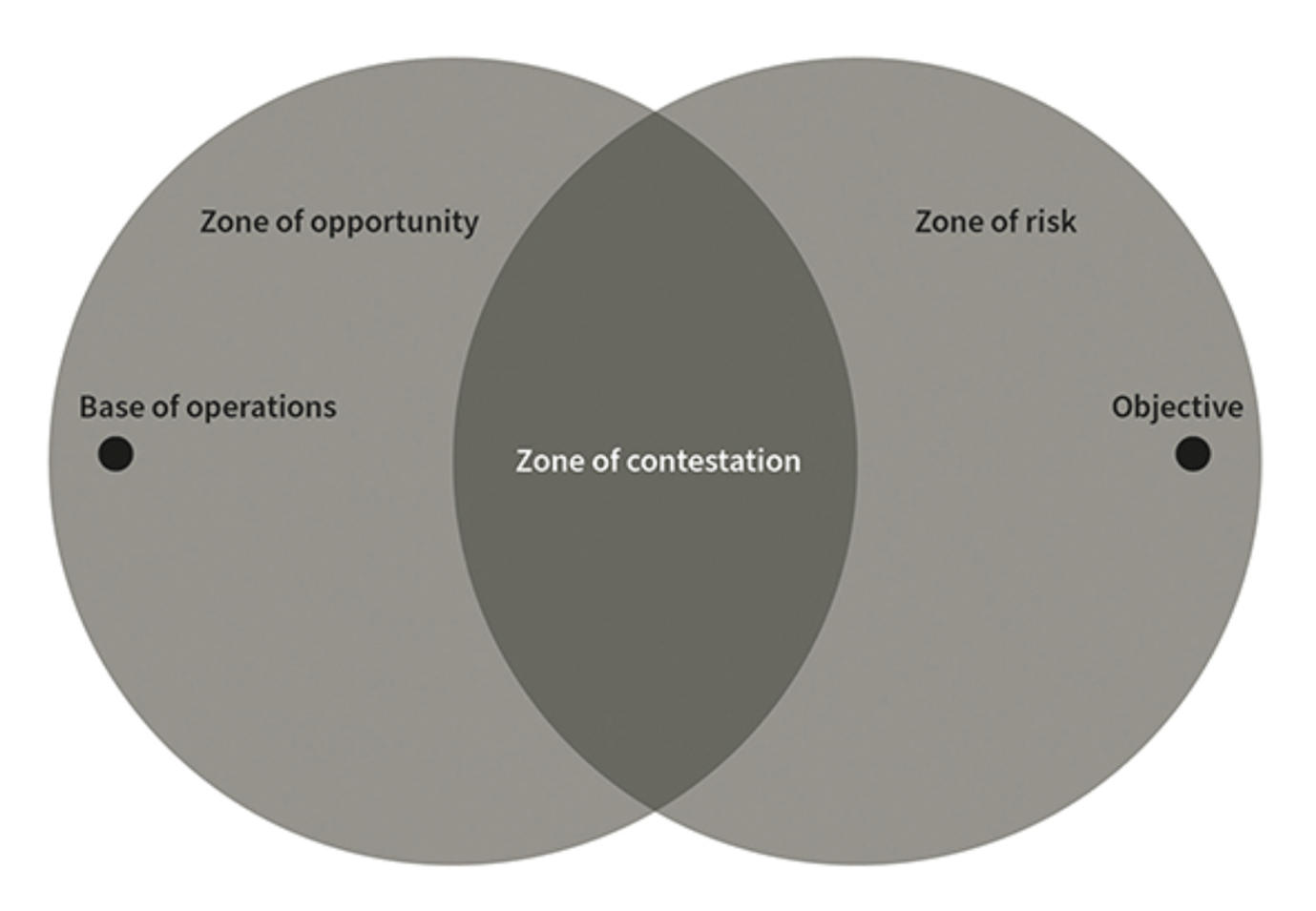
Source: Jack Watling, The Arms of the Future[31]
Watling’s geometry argues for three zones (opportunity, contestation, risk) with each force (friendly and enemy) projecting from a base of operations. The zone of opportunity is the zone within which the enemy is unable to concentrate fires, allowing for friendly concentration and manoeuvre. The zone of contestation is the area covered by both friendly and enemy sensors and fires—in other words, where the reconnaissance battle will occur. The ability to win the reconnaissance battle—a term for the fight to gain situation awareness and deny it to an adversary—will determine the extent to which a force can extend its zone of opportunity and make strategic gains. The zone of risk is the area beyond friendly fires and sensors—their zone of opportunity. This new geometry differs from the existing battlefield geometry of the rear, close and deep, which emphasised the enemy force without reference to geography.[32] Watling’s battlefield geometry shares similarities with the logic of anti-access / area denial (A2AD) zones, albeit focused on the battlefield rather than the theatre. Watling’s geometry, RST and A2AD rely on sensors to detect targets, C4I to share the information between components, and fires to prosecute those targets. In some ways, one might conceive Watling’s geometry when combined with RST as a type of mobile tactical A2AD zone.
Reconnaissance-Strike Tactics in Littoral Operations
Though RST is increasingly discussed as the future of combat, much of its current practice occurs within contexts different to those facing the Australian Army. In optimising Army for littoral operations and implementing RST, the main geographic feature within Australia’s operating environment is the archipelago. This is a series of interconnected littoral zones in South-East Asia and the South Pacific.[33] As Peter Dean highlights, this creates a more prominent role for land-based ISR, strike and presence due to the comparatively shorter distances between land masses in the archipelago versus those across open ocean.[34] Reconnaissance-strike tactics underpin the role proposed by Dean. In littoral operations, RST enables the projection of A2AD zones into land and maritime zones that allow littoral manoeuvre; it also supports the penetration of enemy A2AD zones through the denial of enemy ISR.[35] In other words, RST marries the requirements outlined in Australian strategic documents for Army to be capable of both littoral manoeuvre and long-range strike through a tactical concept. This creates a variety of possible missions for Army to pursue. John Nash summarises these missions into two core sets.[36] The first is traditional amphibious operations, involving the projection of land forces from sea to land. The second is the use of the littorals as an ‘operational manoeuvre space’, including the conduct of land-based sea denial. RST will have a role in both these mission sets, as will be explored in the scenarios below.
Ultimately, Army must be prepared to conduct RST in the archipelagic environment, whether against opposing RST or against a legacy tactical regime, because it enables Australian manoeuvre across all domains. Dean notes the value of land forces to providing access to air and naval forces, writing: ‘The provision of highly mobile land-based A2AD systems is now an essential component of an integrated force.’[37] In optimising Army for littoral operations, RST supports Australia’s strategy of deterrence by denial in providing a coherent tactical construct to defeat an enemy on the battlefield and provide the A2AD system required by Dean.[38] Figure 2 visualises this nested relationship between Australian strategic, operational and tactical concepts. While littoral operations provide the operational context for where and what Army will do to achieve Australian strategy, it is missing the tactical how. This missing element risks disconnecting tactics from strategy through the inability of legacy tactics to achieve the desired strategic effects on the modern battlefield. That is, without appropriate tactical concepts, strategy may overreach on what military forces can achieve on the battlefield. As Friedman notes, ‘Strategy can only ever achieve what tactics can deliver’.[39]
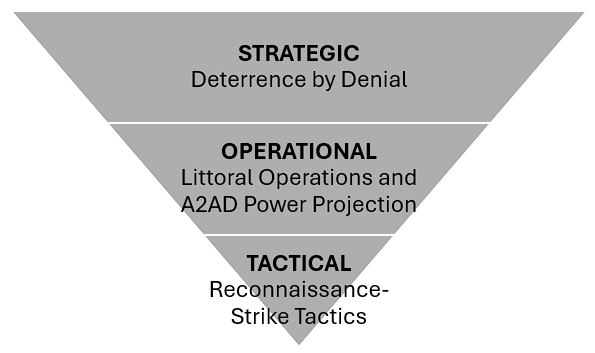
Reconnaissance-Strike Tactics in Practice
The following scenarios are not predictions of how the Army will operate. Rather, they are intended to highlight how adopting RST will support Army’s optimisation for littoral operations. Critically, they seek to highlight that adopting RST is not a simple or quick thing. Developing the right equipment, organisations and people to implement RST will take time and resources—two things that Army might be dangerously short on. This should create a sense of urgency to begin the transformation process so that Army has got it ‘right enough’ should it be committed to combat operations. Whether moving by land or by sea to achieve manoeuvre, RST will inevitably be required to create the zone of opportunity that allows for that manoeuvre by friendly forces. This could be employed to allow the repositioning of land-based sensors and fires that will be utilised for other missions, such as screening and protecting assets employed in land-based sea denial through denying enemy sensors. Alternatively, RST might be used to enable close combat in rural, littoral and urban settings. As the basic application of RST to littoral manoeuvre has already been discussed, the following scenarios will discuss specific missions within Army’s remit where RST is applicable.
Close Combat
The emergence of RST has not removed the need for seize and hold terrain or the close combat required to do so. It is in close combat that the fusion of RST and legacy tactics (like AIT) will be most prevalent. The manoeuvre of AIT systems to assault key terrain inside the relative protection of the zones of opportunity is created by RST. Beyond creating the space to concentrate and manoeuvre for legacy tactics, RST will also operate alongside such tactics by providing fires support. While this is more traditional ‘firing to manoeuvre’, such manoeuvre and close combat enables the positioning of fires to strike targets at long range and generate A2AD zones. The seizure of terrain can also be used to emplace sensors, both stand-in and stand-off, to extend and enhance ISR efforts. While this has operational value in contributing to overall situational awareness, the emplacement of sensors is fundamental to implementing RST—and this will require close combat to seize and hold the physical space for those sensors to operate from, whether those sensors are drones, radar arrays, acoustic sensors or other.
Urban Combat
Within the Indo-Pacific, Dean notes, over 75 per cent of the population live within 200 kilometres of the coast—an area which also includes the majority of the region’s cities, vital infrastructure, trade, industry and military power.[40] Therefore urban combat, which is likely to be an inevitable feature of any future war, may be considered as directly associated with littoral manoeuvre for Australia’s area of operations. RST will be a feature of urban combat but it will be challenged by the unique characteristics of the urban environment: closer engagement distances, canalised terrain and avenues of approach, and constrained mass.[41] RST will continue to enable tactical manoeuvre within urban settings through targeting strong points and high-value threats.[42] RST also enables entire cities to be isolated within the zone of opportunity for an attacker to secure. Alternatively, for a defender, RST might be employed to prevent such isolation by holding an adversary’s forces within the zone of risk and to prevent the interdiction of supply elements into the city.
Deep Strike
The increasing range of weapons extends the zone of contestation that threatens the concentration of enemy forces. This deep strike by land fires can enable littoral and multi-domain manoeuvre while also threatening adversary logistics and support elements to interdict and reduce enemy forces. Deep strike also provides an element of self-protection by holding enemy forces at distance. This capacity is important as the proliferation of sophisticated air defence systems has limited the utility of crewed aircraft and aviation assets in a battlefield air interdiction (BAI) role as well as in more traditional aerial combat.[43] Kagan et al. suggest that land-based strike systems—i.e., long-range and precision fires—can reproduce some of the effects of BAI.[44] Ukraine is an example, with Ukrainian drones and artillery being used to interdict Russian formations far from the front line.[45] This deep strike can also be used against static targets, such as infrastructure.
Sea Denial/Control
Sea denial/control is a clear mission of Army in the littoral and as part of Army’s contribution to the integrated force. RST is effectively the tactical basis that enables Army to achieve this sea denial/control effect. This involves the use of land-based sensors and fires to project an A2AD zone over a maritime space. This seeks to deny the enemy control of that maritime space and limit their ability to project force into it. Ideally, this creates a maritime zone of opportunity for friendly forces to exploit, although at a minimum it should create a zone of contestation that prevents enemy manoeuvre. However, successfully applying RST to achieve sea denial comes with challenges particular to the archipelagic environment. For example, the density and congestion of ports and sea lines of communication will undoubtedly complicate targeting efforts.
Amphibious Assault
As amphibious assault is a joint operation, the application of RST in this scenario will lean heavily on naval and air forces. Applying RST creates an opportunity to project a land force from sea to shore, potentially penetrating A2AD zones. In this, the base of operations described by Watling’s new geometry is the amphibious task force at sea—or, more specifically, the naval vessels. This task force, through RST enabled by naval and air strike, must first suppress or destroy enemy defences to allow an initial force to land and secure the beachhead for follow-on forces. This action extends the zone of opportunity to cover the area between ships afloat and the shore. To enable this, Army will be reliant on stand-off sensors predominantly provided by naval and air forces; however, special operations forces and other pre-landing forces may also be able to provide stand-in sensors as well as delivering limited offensive effects against adversary sensors. It is likely that these initial land forces will be light infantry-centric, meaning they will be reliant on the fires they are directing for their survival. Winning the reconnaissance battle to extend the zone of opportunity will be essential to enabling the successful lodgement of follow-on forces, thus allowing the employment of heavier and larger systems.
Applying RST in Australia’s Context
In the above scenarios, RST enables manoeuvre of land forces, either to conduct traditional close combat in open or urban terrain, or to position other forces for subsequent missions or operational effects, such as sea denial/control or deep strike. Each mission is mutually supporting. As zones of opportunity are extended, they enable further manoeuvre and operations to occur. This, in turn, can enable the integrated force to manoeuvre across all domains. As demonstrated, RST underpins how the Army will conduct not only littoral operations but also other necessary missions to support Australian strategy.
As a result of these varied missions and the geography of Australia’s operating environment, Army’s requirements for and application of RST will differ from those of European powers. Accordingly, it is vital for the Army to draw relevant lessons from current conflicts while noting the distinctions in threat and operating context. This also means avoiding the temptation to fight the last war by copying successful Ukrainian innovations blindly. Each of the scenarios above requires different sensors and platforms to employ RST effectively in the context of each mission. It is not a one-size-fits-all approach. Successfully applying RST in Australia’s context will require the use of a variety of systems that are tailored to our specific circumstances while noting allied developments. This also applies to the implementation of RST in each case. Although RST as a concept remains consistent between the above examples, the techniques, procedures and doctrine will vary between missions. This comes with training requirements to ensure RST can be effectively executed across missions.
The Way Ahead
Although Army has focused its efforts on becoming a littoral manoeuvre force, it is yet to fully adopt RST to support this. Current efforts at embracing RST are reflected in Army’s acquisition of new sensors, such as the Integrator drone, and fires systems, such as HIMARs.[46] However, these efforts risk being too little, too late without further action and without deliberate integration into an RST framework. It is given that Army must understand the missions it is required to undertake, based on guidance from strategic documents and operational plans. It is also given that Army should procure equipment appropriate to achieving these missions and train its people to effectively employ that equipment. Noting that, it is proposed that Army needs to focus on five core areas requiring immediate and sustained attention to integrate RST into the land force.
Adopt RST as the Capstone Tactical Concept for Indo-Pacific Littoral Operations
Army must adopt RST as its capstone tactical concept. As formal doctrine, this provides Army with a clear unifying concept for tactical action and thus informs subordinate doctrine, such as how formations or units fight. It will help guide how new and emerging concepts and forces will work with existing ones to realise new possibilities.[47] In this regard, the adoption of RST is similar to the adoption of ‘AirLand Battle’ by the US Army during the Cold War, which provided an overall framework that informed US Army doctrine for a European war.[48] Further, the adoption of RST as capstone doctrine enhances Army’s capacity to operate in a decentralised and potentially disconnected manner, as well as improving the unity of effort through a common tactical approach. It guides training and transformation priorities within the force to ensure that Army is prepared to fight and win. More broadly, adopting RST as Army’s core tactical concept can serve as an intellectual focal point for practitioners at all levels to think deeply about tactics beyond doctrine. The importance of ambiguity, self-awareness and deception to operating in a transparent battlefield requires deeper thought and more creativity than the rote application of doctrine. Further, adopting RST will complement Army’s current thinking on littoral operations by connecting the what with the how—an element potentially missing from Army’s current intellectual efforts as previously mentioned.
Organise Army for RST in the Littoral
Following the adoption of RST, Army must look beyond merely acquiring the appropriate platforms and equipment—although this is an obvious and essential part of applying RST. Instead, Army must think deeply about how to organise its formations and units to implement RST. Friedman, discussing implementing RST, writes:
The key is organising military forces to efficiently and effectively integrate them into a combined arms concept. The important part of any combined-arms systems is not the arms part but the combined part and combination comes from effective organisations.[49]
For the Australian Army, this means understanding the use cases and necessary capabilities so that land forces can be organised to implement those capabilities effectively. Exploring how to integrate the necessary components of RST, such as ISR and long-range fires, into the appropriate single organisation is not a simple task as it requires imagination and a willingness to break with existing structures and cultural factors, such as risk tolerance and organisational inertia. In this area, however, Australia can lean on the thinking of others—for example, Watling in The Arms of the Future has offered considerable analysis of the future land warfighting system and its organisation. Further, exploring new organisations for Army’s implementation of RST must not ignore legacy tactical regimes and systems where they still have relevance on the battlefield. Instead, Army must seek to augment these legacy systems to operate within the emerging RST paradigm.
Improve C4I Systems and Information Management
Although C4I systems are potentially viewed as a subset of organising Army for RST, the Army must place specific emphasis on improving them for RST. As previously discussed, C4I is a critical enabler to RST as it connects sensors with fires to achieve the desired effects. This is important not only to RST but also to operating as part of an integrated force. Dr Kalloniatis argued in 2022 that existing C4I is an outmoded system for modern warfare and multi-domain operations.[50] While his proposal for a ‘fifth generation’ headquarters structure is more focused on theatre command, exploring how C4I should be organised to support RST at all levels, not just at the senior levels, is vital to implementing RST. A new C4I system also needs to consider how to fuse RST with relevant legacy tactics—as previously mentioned, such tactics are not yet obsolete. Improving C4I will also require updating communications networks to share information between elements. Watling describes current networks as inflexible and vulnerable, constraining the flexibility of task-organised forces and augmentations as well as limiting the coordination of such forces.[51] Instead, communication networks will need to manage large volumes of data, prioritising the relevant information and passing that across various networks of limited bandwidth. Such systems will also need to operate in degraded states, anticipating adversary EW and other effects.[52] This relates back to Hammes’s point that militaries must be able to fight disconnected. Accordingly, Army must develop effective C4I systems that can overcome present-day limitations.
Enhance Defence Industry Engagement and Processes
Over the course of Russia’s invasion, Ukraine has successfully engaged its defence industry to rapidly respond to changes on the front line. This has enabled significant innovation in both hardware and software to sustain the effectiveness of its RST against Russia.[53] Australia must work to develop a similarly responsive defence industry, with sovereign capacity where appropriate, to ensure continued RST effectiveness in a future conflict. Kagan et al. highlight the constant change and evolution of components of the RST system.[54] The capacity to rapidly innovate and introduce new systems underpins Army’s ability to defeat an adversary’s RST or restore friendly RST functionality. Part of this will involve changing Australia’s current approach to military procurement in terms of processes, rules and funding. Special Operations Command provides a model of how the capability acquisition and sustainment system can be used to achieve more flexible and responsive outcomes. Although work is underway in enhancing defence industry engagement and Defence’s approach to procurement, Army must help drive these efforts. In addition, Army must engage with industry to ensure there is sufficient magazine depth and manufacturing capacity to sustain Australian forces for long-term combat. This is particularly important in being able to replace attritted sensors and sustain sufficient precision munitions to target adversary forces.
Increase Experimentation and Free-Play Testing to Drive Innovation
Army should put significant effort into experimentation and testing, especially where free play can be allowed, to drive and continually refine the above recommendations. This would allow for bottom-up insights that inform subsequent procurement and doctrinal development. Army must be careful to avoid standardising solutions too early, as this risks stifling the necessary creativity to solve problems as they emerge.[55] The freedom to experiment enables Army to evolve through the conduct of large-scale, safe-to-fail[56] testing. Trent Hone, in discussing the evolution of US Navy doctrine from 1898 to 1945, describes how organisations that ‘refrain from becoming overly standardised and maintain “clouds” of possible options’ are better placed to ‘survive, or even thrive, in the face of major shocks and disruptions’.[57] Before the start of hostilities, training and exercises can provide an army with the best opportunities to experiment and learn—especially if confronted with an effective opposing force in a free-play environment. The ‘Fleet Problems’ series of exercises conducted by the US Navy during the interwar period are a good example of exercises being used to develop capabilities, organisations and personnel fit for combat.[58]
Conclusion
Victory smiles upon those who anticipate the changes in the character of war, not upon those who wait to adapt themselves after the changes occur.[59]
Though written nearly a century ago, by Italian air power theorist Guilio Douhet, the above words still resonate today. RST represents the latest changes in the character of war. Although the Australian Army is not at the forefront of adapting to this change, it is not too late. The changes to the character of war brought about by RST are still ongoing and still emerging. As Friedman notes, ‘it is not clear that any military force has reached true doctrinal and organisational institutionalisation. … military forces remain in conceptual and experimental phases’.[60] The Australian Army must accelerate its adaptation to these changes by adopting RST as its capstone tactical doctrine. In doing so, the Army will set the conditions to anticipate rather than react to advances in RST.
The adoption of RST as Army’s capstone tactical concept provides both clarity on how Army will conduct littoral operations to support deterrence by denial, and a focal point for intellectual engagement to innovate new organisations and tactics for military effectiveness. This will drive Army to reorganise its forces to conduct RST, not simply direct legacy forces to conduct new tactics which they are not appropriately equipped, trained and organised to conduct. Army will also need to focus explicitly on improving its C4I systems for RST, noting the various limitations of existing systems and technologies. Further, Army must act as a driving force within the ADF to improve how it engages with defence industry. This means ensuring equipment is fit for purpose, updates at the speed of relevance, and exists in sufficient quantities to sustain long-term combat. Finally, Army must exploit its training and exercises for experimentation and testing of new equipment, tactics and organisations to continually innovate and anticipate changes in the character of war. The Australian Army must adopt RST for littoral operations as its capstone tactical concept to optimise the Army profession for future combat and support Army’s contribution to Australian strategy.
Endnotes
[1] Peter Leahy, ‘A Land Force for the Future: The Australian Army in the Early 21st Century’, Australian Army Journal 1, no. 1 (2003): 27.
[2] RST is also referred to as ‘reconnaissance-strike complexes’ after the Soviet/Russian concept or as ‘precision-strike regime’ in other Western writing.
[3] Quoted in BA Friedman, ‘Reconnaissance-Strike Tactics, Defeat Mechanisms, and the Future of Amphibious Warfare’, Journal of Advanced Military Studies 15, no. 2 (2024): 61.
[4] Jack Watling, The Arms of the Future: Technology and Close Combat in the Twenty-First Century (London: Bloomsbury Academic, 2023), p. 9, at: https://doi.org/10.5040/9781350352995.
[5] Ibid., p. 28.
[6] Ibid., p. 43.
[7] Ibid., pp. 58–60.
[8] Ibid., p. 62.
[9] Ibid., pp. 90–92.
[10] Frederick W Kagan, Kimberly Kagan, Mason Clark, Karolina Hird, Nataliya Bugayova, Kateryna Stepanenko, Riley Bailey and George Barros, Ukraine and the Problem of Restoring Maneuver in Contemporary War (Institute for the Study of War, 2024), p. 12.
[11] Ibid., p. 19.
[12] TX Hammes, ‘The Tactical Defense Becomes Dominant Again’, Joint Forces Quarterly 103, no. 3 (2021): 10–17.
[13] TX Hammes, The Changing Character of Warfare: Defense Dominates the Battlespace (Australian Defence College, 2025).
[14] Ibid.
[15] Kagan et al., Ukraine and the Problem of Restoring Maneuver in Contemporary War, p. 12.
[16] Friedman, ‘Reconnaissance-Strike Tactics, Defeat Mechanisms, and the Future of Amphibious Warfare’, pp. 56–57, 63.
[17] Zackery Spear and Michael Culler, ‘How We Fight: The Case for Reconnaissance-Strike Battle’, Modern War Institute at West Point (website), 27 May 2025, at: https://mwi.westpoint.edu/how-we-fight-the-case-for-reconnaissance-strike-battle.
[18] Friedman, ‘Reconnaissance-Strike Tactics, Defeat Mechanisms, and the Future of Amphibious Warfare’, p. 62.
[19] Kagan et al., Ukraine and the Problem of Restoring Maneuver in Contemporary War, pp. 12–13.
[20] Watling, The Arms of the Future, Part Two: ‘The Arms of the Future’.
[21] Ryan, ‘Preparing for Complexity: The Case for an Expeditionary Task Force in the Australian Army of 2020’, Australian Army Journal 1, no. 2 (2003): 87–89.
[22] Friedman, ‘Reconnaissance-Strike Tactics, Defeat Mechanisms, and the Future of Amphibious Warfare’, p. 62.
[23] Ibid., p. 61; Mick Ryan, War Transformed: The Future of Twenty-First-Century Great Power Competition and Conflict (Annapolis MD: Naval Institute Press, 2022), p. 172.
[24] Ryan, War Transformed, 172.
[25] Watling, The Arms of the Future, pp. 41–43.
[26] Ibid., p. 30.
[27] Ibid., pp. 37–41; Kagan et al., Ukraine and the Problem of Restoring Maneuver in Contemporary War, p. 38; Friedman, ‘Reconnaissance-Strike Tactics, Defeat Mechanisms, and the Future of Amphibious Warfare’, p. 72.
[28] Friedman, ‘Reconnaissance-Strike Tactics, Defeat Mechanisms, and the Future of Amphibious Warfare’, p. 67.
[29] The term ‘armour-infiltration tactics’, also referred to as mechanised warfare by some, is used to describe the tactical regime of the 20th century. This is a term used by Friedman when describing the evolution of tactical regimes in Friedman, ‘Reconnaissance-Strike Tactics, Defeat Mechanisms, and the Future of Amphibious Warfare’.
[30] Quoted in ibid., p. 61.
[31] Watling, The Arms of the Future, p. 99.
[32] Ibid., pp. 98–100.
[33] Peter Dean, ‘The (Re)Rise of the Archipelagic Army: Geography, History, and the Ongoing Utility of Land Power in Australia’s Littoral Arc—A Primer’, Australian Army Journal XIX, no. 2 (2023): 9.
[34] Ibid., p. 9.
[35] Sam J Tangredi, Anti-Access Warfare: Countering A2/AD Strategies (Annapolis MD: Naval Institute Press, 2013), p. 252.
[36] John Nash, ‘AAJ Littoral Manoeuvre Collection’, Australian Army Journal XIX, no. 2 (2023): vii–xvi.
[37] Dean, ‘The (Re)Rise of the Archipelagic Army’, p. 20.
[38] Ibid., pp. 20–21.
[39] Friedman, ‘Reconnaissance-Strike Tactics, Defeat Mechanisms, and the Future of Amphibious Warfare’, p. 55.
[40] Dean, ‘The (Re)Rise of the Archipelagic Army’, p. 4.
[41] Watling, The Arms of the Future, pp. 80–81.
[42] Ibid., pp. 146–147.
[43] Watling, The Arms of the Future, pp. 180–183; Hunter Stoll, John Hoehn and William Courtney, ‘Air Defense Shapes Warfighting in Ukraine’ RAND (website), 22 February 2024, https://www.rand.org/pubs/commentary/2024/02/air-defense-shapes-warfigh….
[44] Kagan et al., Ukraine and the Problem of Restoring Maneuver in Contemporary War, 15,
[45] Spear and Culler, ‘How We Fight’.
[46] ‘Tactical Uncrewed Aerial System’, Department of Defence (website), February 2024, at: https://www.defence.gov.au/defence-activities/projects/tactical-uncrewed-aerial-system; Richard Marles and Pat Conroy, ‘Government Delivers First Australian HIMARS’, media release, Defence Ministers (website), 24 March 2025, at: https://www.minister.defence.gov.au/media-releases/2025-03-24/government-delivers-first-australian-himars.
[47] Friedman, ‘Reconnaissance-Strike Tactics, Defeat Mechanisms, and the Future of Amphibious Warfare’, p. 76.
[48] Frank Jones, ‘War on the 21st Century Battlefield: Revisiting General Starry’s Conceptual Framework’, War Room (website), 16 May 2024, at: https://warroom.armywarcollege.edu/articles/conceptual-framework.
[49] Friedman, ‘Reconnaissance-Strike Tactics, Defeat Mechanisms, and the Future of Amphibious Warfare’, p. 72.
[50] Alex Kalloniatis, ‘Achieving Multi-Domain in the 5th Gen HQ’, seminar presentation, at: https://c2coe.org/c2-seminar-22-dr-alex-kallionatis-achieving-multi-domain-in-the-5th-gen-hq-video.
[51] Watling, The Arms of the Future, p. 34.
[52] Ibid., p. 32.
[53] Kateryna Bondar, How Ukraine Rebuilt Its Military Acquisition System Around Commercial Technology (Center for Strategic and International Studies, 2025), at: https://www.csis.org/analysis/how-ukraine-rebuilt-its-military-acquisition-system-around-commercial-technology.
[54] Kagan et al., Ukraine and the Problem of Restoring Maneuver in Contemporary War, p. 12.
[55] Friedman, ‘Reconnaissance-Strike Tactics, Defeat Mechanisms, and the Future of Amphibious Warfare’, pp. 73–74.
[56] ‘Safe-to-fail’ in this context means that although one specific iteration might fail, it does not jeopardise the other iterations simultaneously occurring. That individual iteration might suffer catastrophic consequences, but it remains safe to fail if the overall experiment (or species in a biological context) survives.
[57] Trent Hone, Learning War: The Evolution of Fighting Doctrine in the U.S. Navy, 1898–1945 (Annapolis MD: Naval Institute Press, 2018), p. 9.
[58] Ibid., p. 334.
[59] Guilio Douhet, The Command of the Air, transl. Dino Ferrari (Air University Press, 2019 [1942]), p. 27.
[60] Friedman, ‘Reconnaissance-Strike Tactics, Defeat Mechanisms, and the Future of Amphibious Warfare’, p. 68.