The Military Methods of Guerrillas, Warlords, and Militias
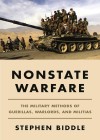
Princeton & Oxford: Princeton University Press, 2021, 464 pp RRP: $US29.95
ISBN 9780691207513
Written By: Stephen Biddle
Reviewed By: Andrew Maher
For the past decade, international relations have been challenged by problems posed by states and non-state actors functioning in unusual ways. Certain non-state actors, such as Islamic State or Hay’at Tahrir al-Sham (HTS), have instituted forms of governance, generated methods to control populations, and have employed blitzkrieg tactics commensurate with the ideals of Western armies. They have also been able to establish complex forms of social services that parallel the key attributes of a state. Conversely, certain state actors, Russia and Assad’s Syria, for example, have at times behaved in ways we would associate with non-state actors, exhibiting flagrant disregard for international norms. These transgressions have included engagement in state-sponsored terrorism, employment of chemical weapons, and the assassination of those with dissenting views. Such disregard has traditionally been associated with the behaviour of non-state actors. Making this confounding picture worse, is the emergence of ‘proto-state’ behaviour from groups like the Taliban and Ansar Allah (the Houthis) that effectively govern an area (like a state), but at times, revert to behaviours that challenge any notion that their authority can be recognised as a legitimate form of state government.
Making sense of this puzzle is a challenge of modern times. Eminently helpful in this regard is Stephen Biddle’s latest work, Nonstate Warfare: The Military Methods of Guerrilla, Warlords, and Militias.[1] Contrary to its title, Biddle’s work does not just focus upon the characteristics and behaviours of non-state actors. This contrasts with his earlier work, Military Power: Explaining Victory and Defeat in Modern Battle, which focussed upon conventional warfighting.[2] Those unfamiliar with Biddle’s earlier work might well benefit from reading both books as a complementary pair.
What is novel about Nonstate Warfare is that Biddle begins by removing the provenance we attribute to the word ‘state’. Instead, he encourages readers to look to the methods employed by both state and non-state actors. In so doing, he provides considerable insight into the tactical choices actors make based upon their strategic circumstances, and provides a lens through which to consider the policy challenges posed when state and non-state actors operate outside of expected international norms.
In short, Biddle’s argument is that the methods employed by any given actor will vary according to the context. In this regard, Biddle proposes two ends of a spectrum: Fabian and Napoleonic methods, defined as follows:
The characteristics of pure Fabian methods include an absolute unwillingness to defend ground via decisive engagement at any point in the theatre; dispersed operations with no local concentrations in excess of the theaterwide combatant density; insistence on concealment obtained via intermingling with the civilian population; exclusive reliance on coercion rather than brute force; and rejection of heavy weapons, even when available, in favour of light arms and equipment more suitable to concealment among the population.
By contrast, the characteristics of pure Napoleonic methods include an insistence on decisive engagement to defend or seize ground that will not be voluntarily relinquished; local concentration to shoulder-to-shoulder densities at a point of attack where ground is contested; use of uniformed forces on battlefields removed from urban population centers; exclusive reliance on brute force rather than coercion; and preferential employment of the heaviest weapons available to maximise firepower and armour protection.[3]
While Biddle makes a logical argument, his insights are nonetheless at odds with how we presently categorise violence perpetrated by state versus non-state actors. Indeed, ‘it is assumed that nonstate actors fight very differently than states do’.[4]
Overcoming present challenges in categorising the activities of international actors is important. This is because hybrid tactics, as Frank Hoffman described in 2007, are becoming more common.[5] For example, the astounding success of Islamic State’s blitzkrieg across northern Iraq in 2014 was accompanied by subversive activities in Mosul itself, more akin to the clandestine actions of a mafia organisation.[6] History repeated itself with the HTS blitzkrieg into Damascus in 2024.
Complicating such analysis has been the Western proclivity to ascribe labels to state and non-state actors—which then stick—inhibiting recognition that the way organisations operate will adapt and evolve. As Biddle points out, the Chinese Communist Party (CCP) began as an underground clandestine network, but over time, Mao’s guerrillas were able to win a sanctuary area of northern China, from which the People’s Liberation Army (PLA) could be established, eventually becoming an Army of two-million-troops in 1945.[7] Dichotomous, static models of state or non-state categorisation struggles to reconcile this twenty-year evolution in CCP structure and methods. The point is that Biddle’s analysis clarifies what is inherently logical; that there are many ways one can fight a war. Organisations are not predetermined to fight a certain way due to being of a particular type—state, non-state, or proto-state.
As a lecturer on irregular warfare—simply defined as the study of violence employed by non-state actors—I found Biddle’s insights remarkable. Taking this work and applying it to my earlier published analysis, Biddle’s work offer greater clarity as to when and where particular methods might be expected. [8] My model—summarised as GRIM (guerrillas, revolutionaries, insurgents, and mafiosi/militia)—characterises the behaviours observed of particular organisations based upon the desired change to a political system that they seek to achieve, and the timeframe within which they seek it. The GRIM model is founded upon practicalities; a clandestine mafia-like organisation, generally speaking, simply cannot attempt to overthrow a government because it is insufficiently strong to succeed. By contrast, a mature insurgency will see ‘People’s Army’ elements that look quite ‘state-like’ due in part, to the strength they have been able to grow over time.
The figure below applies Biddle’s theory to the GRIM model. It illustrates that Fabian methods can be expected from militia and guerrilla organisations when time is an irrelevant variable (i.e., greater red). Meanwhile, Napoleonic methods can be expected from mature insurgencies or revolutionary organisations at a high level of desired change (i.e., greater blue). As figure 1 shows, a spectrum of permutations exists between these extremes.
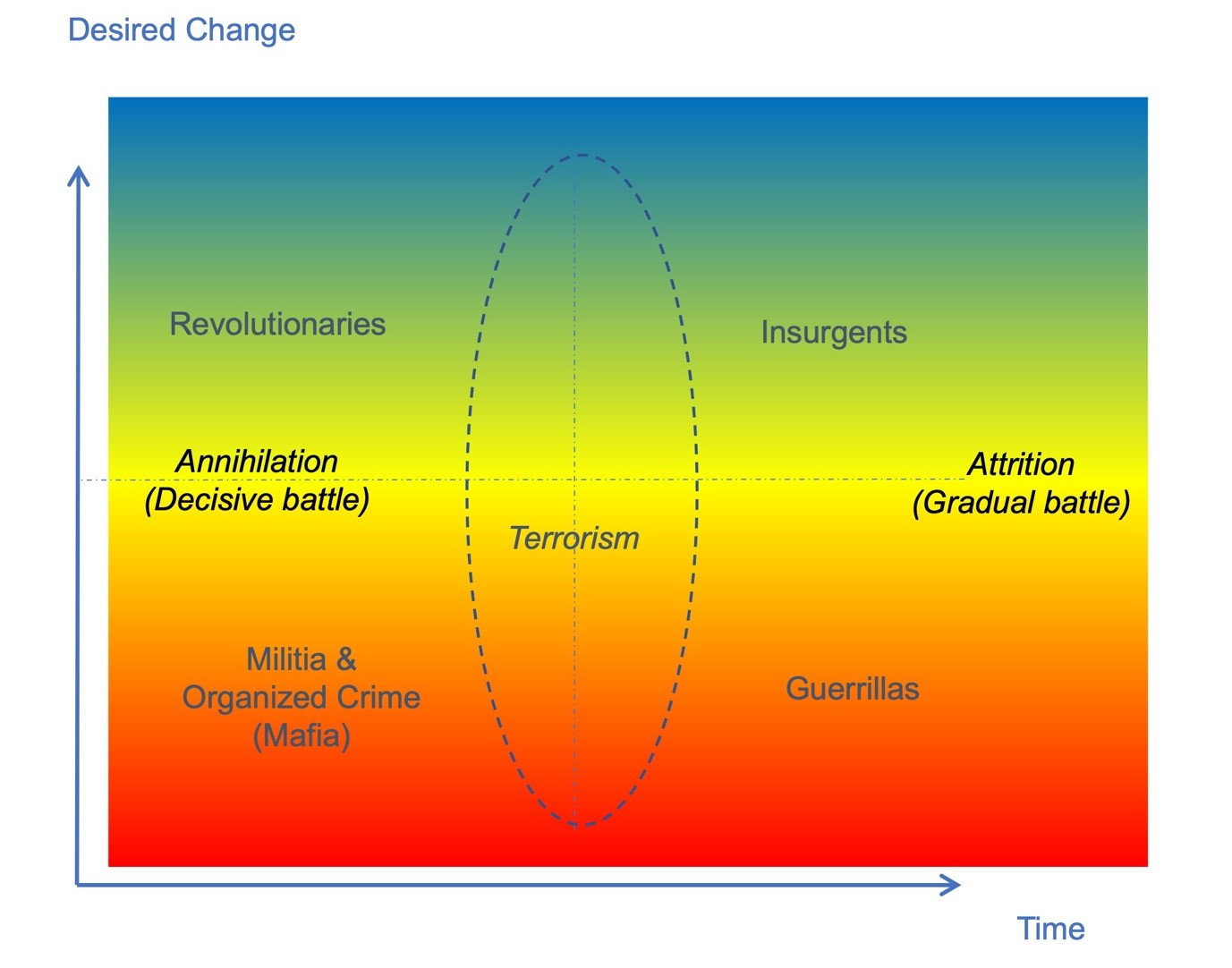
Based on this conceptual model, it can be expected that ‘nonstate combatants with permissive internal politics will be able to exploit modern weapons to wage increasingly state-like mid-spectrum warfare’—what we have typically termed ‘hybrid warfare’.[9] Having said that, there is less certainty around how an adversary in the mid-spectrum of the model may behave. This insight matters as any political or military response must match that of the adversary against which it is directed: one must defeat the adversary’s strategy not just their forces. Consequently:
High-tech, standoff precision forces perform well against massed, exposed, near-Napoleonic foes but perform poorly against better-concealed, mid-spectrum enemies – and the new theory predicts fewer of the former and more of the latter over time as many nonstate actors join astute state militaries in moving toward the middle of the Fabian-Napoleonic spectrum… Conversely, a force transformed for low-tech, low-firepower population security would lack the lethality needed against mid-spectrum enemies, whether these be states or the nonstate actors who will be increasingly capable of such methods in the future.[10]
Non-State Warfare offers valuable insights in any effort to make sense of contemporary violent organisations—whether within the academic community, policymakers tasked with crafting appropriate strategic responses, or military practitioners seeking to train today’s tactical forces. It shows us that ‘mid-spectrum war fighting demands much more extensive training than simpler Napoleonic or Fabian methods’[11] I recommend Biddle’s book for its unique perspective on the intractable challenge of understanding why state and non-state actors behave the way they do, and how best to respond to the violence they perpetrate.
Endnotes
[1] Stephen Biddle, Nonstate Warfare: The Military Methods of Guerrillas, Warlords, and Militias (Princeton & Oxford: Princeton University Press, 2021).
[2] Stephen Biddle, Military Power: Explaining Victory and Defeat in Modern Battle (Princeton and Oxford: Princeton University Press, 2004).
[3] Biddle, Nonstate Warfare, pp. 12-13.
[4] Ibid, p. 2.
[5] Frank Hoffman, Conflict in the 21st Century: The Rise of Hybrid Wars, Potomac Institute for Policy Studies (2007).
[6] James Verini, They Will Have to Die Now: Mosul and the Fall of the Caliphate (London: Oneworld Publications, 2019).
[7] Biddle, Nonstate Warfare, p. 50.
[8] Andrew Maher, ‘Guerrillas, Revolutionaries, Insurgents, and Militias and Mafiosi: The GRIM threats of Irregular Strategy’, Modern War Institute (24 Feb 2022), available at: https://mwi.westpoint.edu/guerrillas-revolutionaries-insurgents-and-militias-and-mafiosi-the-grim-threats-of-irregular-strategy/.
[9] Biddle, Nonstate Warfare, pp. 8-9.
[10] Biddle, Nonstate Warfare, pp. 9-10.
[11] Biddle, Nonstate Warfare, pp. 74-5.