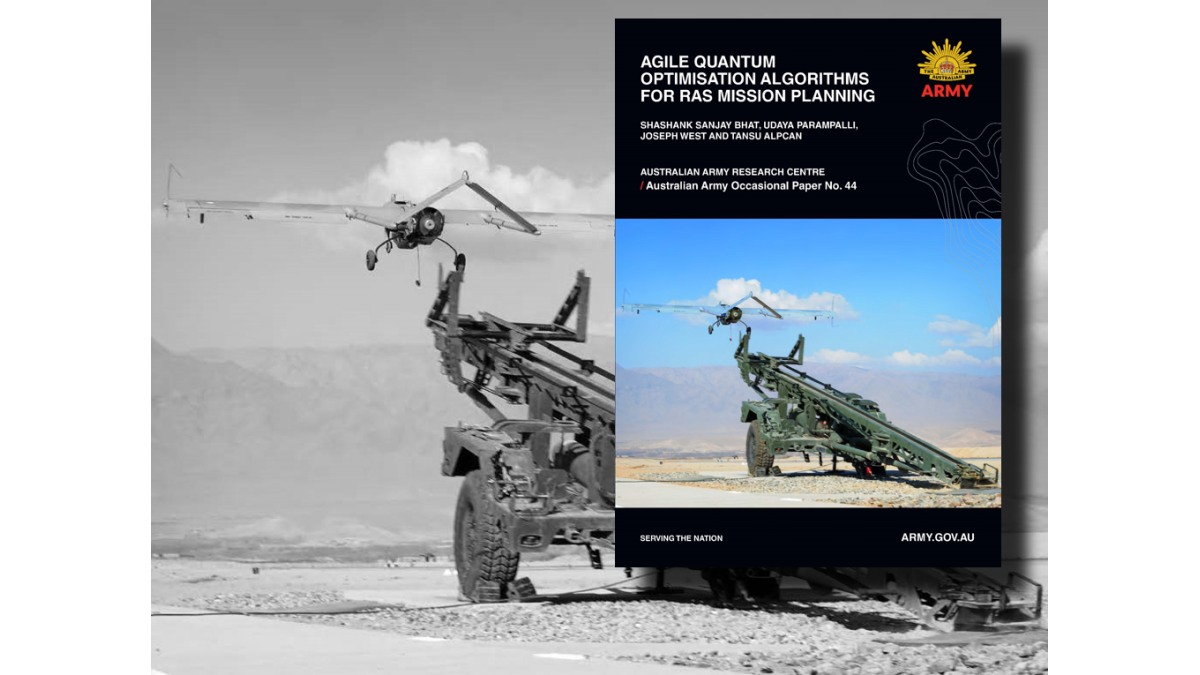
This Land Power Forum Post introduces the concepts addressed in the newly released Occasional Paper 44 Agile Quantum Optimisation Algorithms for the RAS Battle Planning.
Quantum computing is often hailed as the future of computation. The paradigm is rapidly transitioning from laboratory curiosity to critical military capability. Military operations involve autonomous systems which make instantaneous and optimised decisions, thereby minimising risk and maximising the opportunity for mission success. The dynamic nature of the environment and the constraints can often lead to performance bottlenecks in classical algorithms. Quantum computing can offer a complementary path forward by addressing these limitations.
What is Quantum Computing?
Quantum computers use quantum bits or qubits, which can represent multiple states simultaneously based on the principles of superposition and entanglement. In contrast traditional computers process bits as 0s and 1s. The unique ability of quantum computers enable them to solve complex problems faster than classical computers, especially optimisation problems such as logistics resupply and reconnaissance.
Why Quantum for Military Operations?
Military missions demand rapid adaptability, precision and resilience. Be it delivering critical supplies through hostile terrain or conducting reconnaissance missions in risky environments, classical methods often struggle with operational constraints, complexity and the demands of real time decision-making. Quantum computing offers the following possible pathways:
- Quickly compute optimal routes considering vehicle capacities, fuel constraints and risk exposure.
- Efficiently assign surveillance drones with precision routes, optimising coverage while minimising exposure to threats.
How Quantum Optimisation Helps: The Vehicle Routing Problem
The vehicle routing problem (VRP) is a well-known logistical problem. VRP involves determining the most efficient way to route a fleet of vehicles to certain destinations while minimising travel cost and adhering to constraints such as fuel limit, vehicle capacity and time windows.
Both logistic resupply and reconnaissance can be viewed through the lens of VRP. In logistics resupply, vehicles must deliver essential supplies like food, ammunition and fuel to distributed bases. In reconnaissance, unmanned aerial vehicles must visit priority points balancing altitude requirements, sensor coverage and threats. Although different in purpose, both tasks involve the routing and allocation strategies.
Optimisation algorithms such as the Quantum Approximate Optimisation Algorithm (QAOA) and Quantum Annealing are particularly well suited for such types of complex combinatorial problems. These algorithms can effectively explore vast solution spaces more effectively than classical heuristics. While quantum hardware continues to mature, a complete quantum-oriented solution is not feasible due to the qubit limitation. Instead, we propose a hybrid quantum classical strategy for logistics resupply and reconnaissance.
Quantum-Enhanced Logistic Resupply
In the case of logistics resupply quantum optimisation can be used to make the routing decision. The hybrid quantum classical approach breaks down large-scale problems with constraints into multiple sub problems, and then uses quantum subroutines to solve them independently. Classical subroutines are retained as fall back in case the quantum systems are interrupted by scheduled downtime or when system errors prevent the generation of meaningful results at that given instant. The benefits of this hybrid approach with constraints are that it mimics the real-world setting, and it is scalable and modular in nature.
Quantum-Enhanced Reconnaissance
Logistics resupply deals with a two-dimensional environment, whereas reconnaissance deals with a three-dimensional environment. All the constraints such as weather, risk and terrain and the equivalent cost functions are now present in the 3D plane. Here, a hybrid quantum classical approach is used for making the routing decisions for the aerial vehicles. Quantum subroutines make the routing decisions while the classical algorithms perform the rest of the operations. The routing decision balances the altitude and sensor coverage while minimising risk and fuel consumption for every vehicle.
Challenges and Realities of Deployment
While the initial results of our research are promising, integration of quantum computing faces real-world hurdles such as:
- Hardware complexity: Quantum computers currently need specialised environments which are often not battlefield friendly.
- Integration: Successfully incorporating quantum solutions into the existing infrastructure demands careful consideration of cybersecurity, robust communication and data integrity.
Despite all these challenges, hybrid quantum-classical approaches show potential for practical application in military operational settings.
Looking Ahead: Future Directions
Ongoing advancements include explainable quantum decision-making systems, edge-based quantum processors (which operate directly within the autonomous vehicles) and distributed quantum computing.
The Quantum Advantage on Tomorrow's Battlefield
Quantum computing offers a transformative leap in military strategy enabling adaptability in logistics and reconnaissance. As global powers invest in quantum research, the potential rewards include faster decisions and a critical edge in future conflicts. Quantum enhanced military operations are becoming today’s reality.