
Interrogating the Role of Land Forces in the ‘Defence of Australia’
AUTHOR: Stephan Frühling
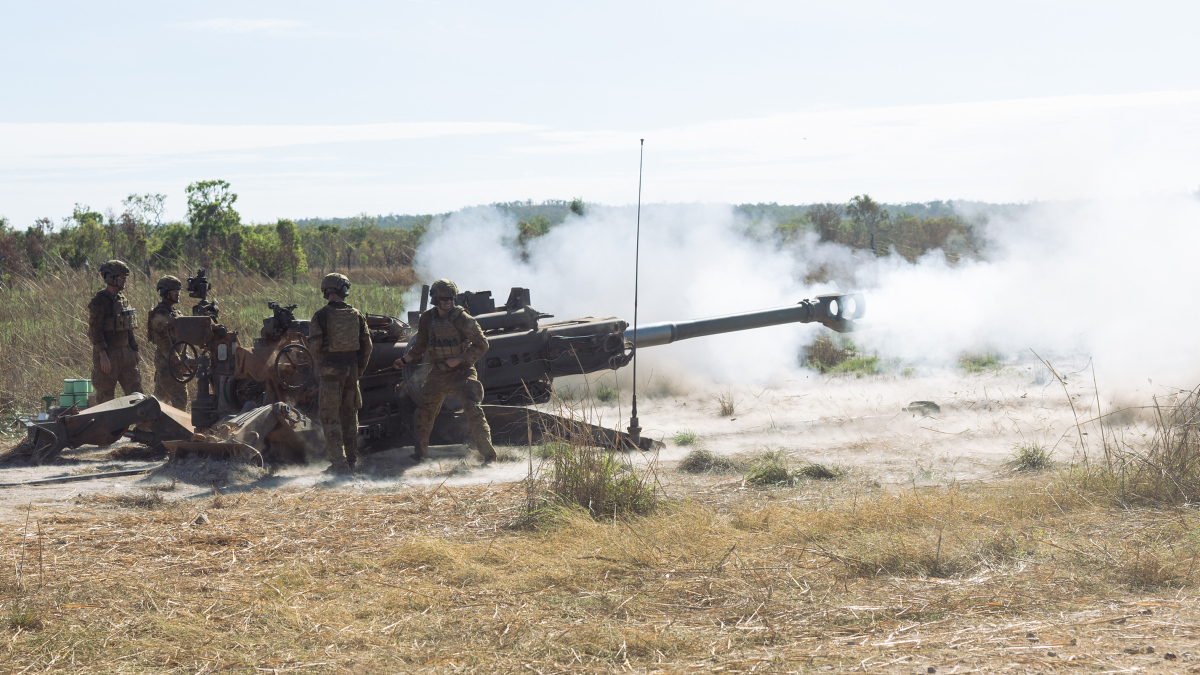
What does the defence of the Australian continent require of the ADF? And what is the role of land forces in that? Six years since the 2020 Defence Strategic Update directed that the ADF focus on deterrence of major power conflict in our region, and three years since the 2023 Defence Strategic Review (DSR) reinforced that it had to become a ‘focused force … to address the nation’s most significant military risks’,[i] the answers to the above questions remain elusive. The key underlying question is ‘what is the strategic centre of gravity that Australia needs to defend?’
Instead of answering this question directly, the 2024 National Defence Strategy (NDS) specified the need for ‘An Army optimised for littoral manoeuvre with a long-range land and maritime strike capability’.[ii] The brigades of 1st (Australian) Division (1 Div) are thus being re-organised and co-located with new amphibious vessels in Australia’s north. This repositioning aligns with the DSR’s call for Army Reserve Brigades to ‘provide area security to the northern base network and other critical infrastructure, as well as providing an expansion base and follow-on forces’, and for ‘select capabilities’ within them to be ‘postured in Northern Australia’.[iii] It is also consistent with 2023 comments by Major General David Thomae that his Division, the 2nd (Australian) Division (2 Div), ‘must generate, deploy, and then sustain security and response task units to protect key areas in Australia’s north’, and ‘be able to do so quickly or at least with minimal warning time’.[iv] But is this focus on operations in the North—which frames the role of 2 Div as largely being in support of 1 Div—an accurate reflection of the strategic role of land power in the defence of the mainland?
On the one hand, a focus on operations in the North is unsurprising. Any country big enough to pose a significant threat lies to our north and, since before Federation, Australian policy has recognised the importance of Australia securing the northern approaches for the defence of the Australian continent. A close association of the defence of the continent with Army operations in the North was the defining feature of the ‘Defence of Australia’ policy in the 1987 White Paper. In 1986, the Dibb Review had defined Army’s core role as protecting the Darwin-Katherine area and other key logistical centres in the North during ‘low’ and ‘escalated low level’ conflict against a regional power. This task was to be shared by both 1 Div and 2 Div and, after mobilisation, the latter would relieve the former for more mobile operations.[v] The fictitious ‘Kamarians’ and ‘Musorians’ that were the training adversaries for generations of the Australian Army reflected aspects of a hypothetical threat from Indonesia.[vi] Army’s role as laid out in the Dibb Review underpinned the ‘Army in the 21st Century’ and the ‘Restructuring the Army’ transformation of the late 1990s,[vii] at a time when the aperture of defence policy was already moving beyond the continent.
By 2000, the White Paper of that year stated that ‘if attacked, Australia would take a highly proactive approach’ and ‘seek to attack hostile forces as far from our shores as possible, including their home bases, operating bases, and in transit’.[viii] Unlike in 1987, this approach now also included the involvement of Army. The subsequent 2009 White Paper made it explicit that ‘[o]ur military strategic aim … is to enable the manoeuvre and employment of joint ADF elements in our primary operational environment, and particularly in the maritime and littoral approaches to the continent’, and that ‘the nature of our strategic geography is such that we will also have to use conventional land forces to control our approaches’.[ix] The association between the defence of the mainland and Army operations in Australia’s north and northern approaches remained. Today, the two are so closely associated that they seem almost synonymous.
But the 1986 ‘turn to the North’ explicitly assumed that Australia was only facing a risk of ‘low’ or ‘escalated low’ level conflict, with a hypothetical regional adversary that had strong parallels with Sukarno’s Indonesia during Confrontation.[x] It was not a posture for conflict with a great power. Political constraints on escalation by both sides—in what would today be called ‘grey zone’ or ‘hybrid’ conflict—would have kept hostilities geographically constrained. Australia’s only contemplated adversaries that lacked long-range force projection capabilities required to operate beyond the North. In such a conflict scenario, Australia’s strategic centre of gravity was the ability to keep both domestic (economic-political) and international (diplomatic) costs of managing the conflict at tolerable levels. The implication for ADF (and Army) was that its strategic role was to protect populations and industry in the North to minimize the political and economic cost of conflict.
In contrast, in a situation of major war against a great power, Australia’s strategic centre of gravity is the political will, economic strength, and military capacity required to stay in the fight, despite direct and indirect attacks on Australia’s centres of population.[xi] A great power that can attack Australia can do so across and around the whole Australian continent. The focus on operations in the North that arose in 1987 was a historical exception. In the 1920s and 1930s, for example, the Army posture for the defence of the continent was focused on the East, South and Southwest, with regulars manning coastal defence batteries at all of Australia’s major port cities, and manoeuvre units aligned to repel raids against main centres of population and industry.[xii]
This does not mean of course that in a conflict with a great power there would not be fighting in the North. In 1914, an Australian expeditionary force evicted the German presence in New Guinea. In 1942-1944, US and Australian forces turned back the Japanese advance through the same islands, and Darwin and other ports and airfields were repeatedly bombed. But despite the intensity of conflict in the North, it is not where Australia’s strategic centre of gravity was in either World War. In the end, Germany’s bases in New Guinea, its commerce raiders in both world wars, and the Japanese push into the southwest Pacific, all threatened Australia’s logistic and economic links to its allies, and to disrupt Australian and allied mobilisation. Ultimately, Japan sought to position itself to attack Australia’s main centres of industry and population with enough force to cause crippling economic and political effects sufficient to end Australia’s participation in the war. Given the technology available at the time, access to bases in Australia’s northern approaches was a prerequisite for any attack on Australia’s main centres of population and industry.
The mantra of the post-Vietnam era that a threat to the continent must come ‘from or through’ the archipelago was not true in either of the World Wars, and is even less true today. Japan mounted major carrier raids against Hawaii in 1941, and against Ceylon in 1942—the latter could easily have devastated Perth. Submarines ranged all around the Australian coastline, laid mines, sunk ships including inside Sydney Harbour, and in mid-1942 shelled Newcastle[xiii] (as well as Ellwood in California).[xiv] In both World Wars, German ‘auxiliary cruisers’—converted civilian vessels with concealed armaments—disrupted maritime communications. Given technology at the time, their ability to attack land targets was limited, but Germany’s KMS Emden landed forces to destroy the cable station at Cocos Islands in 1914.
Today, thousands of container vessels ply the globe’s oceans, many coming directly from overseas ports to Australian waters.[xv] China is developing modern-day versions of Germany’s ‘auxiliary cruisers’ – ostensibly civilian vessels which could wield containerised missile batteries able to be deployed at the outset of a major conflict.[xvi] It is developing growing fleets of SSN and, soon, SSGN, with land-attack capability. Short-range drones can be pre-deployed to target Australian critical infrastructure or defence bases, as demonstrated by Ukraine’s daring ‘Operation Spider’s Web’.[xvii] Real and imagined sabotage will be a threat to critical infrastructure as well as to social cohesion: Russia today is conducting an extensive campaign of sabotage using criminals for hire in Europe,[xviii] and Iran used the same approach to sponsor terrorist attacks in Australia in 2025.[xix]
Future adversaries will thus have far greater ability to attack Australia’s strategic centre of gravity than did Germany, Japan, or any regional adversary. For them, disrupting Australian and allied mobilisation will be a key to winning a short war, and undermining Australia’s political will to stay in the fight in a long one. Australia will need to actively protect its ability to maintain basic services, and to sustain defence rear area support. It will also need to defend against attacks through which the adversary seeks to demonstrate its impunity in being able to carry the war to Australia’s homeland. Australian population centres need air defence capabilities (especially against cruise missiles), and the ability to enforce maritime exclusion zones in excess of the range of long-range drones off all its major harbours. Extensive counter-drone and force protection capabilities will also be required to provide 360° defence for major bases and critical infrastructure. None of these threats will be reduced by a campaign in the North, but addressing them will require persistent presence and mass—traits most closely associated with a land force. This throws into question the current allocation of coastal and air defence assets between 1 Div and 2 Div, so that air and coastal defence of major cities is not, by implication, left to far more expensive, scarce, more vulnerable and less persistent RAAF and RAN assets.
A further consideration is the need for force protection for militarily important infrastructure, industry and bases. 2 Div’s regionally aligned brigades provide the foundation for rebuilding state territorial defence commands. Much of the fixed defence of Australia’s main population centres today however seems left to civilian contractors and police. In a situation of conflict, civilian law enforcement would be in high demand to deal with disruptions of basic public services; and the ADF will need to be able to control force protection capabilities to conduct operations, and the legal basis and practical approach to the use of force by law enforcement and armed forces in wartime is and has to be fundamentally different.
Asset protection against sabotage and special forces attack, and assistance to civilian authorities in case of major disruption, could be tasked to territorial defence units which only need basic infantry skills and limited mobility, whose effectiveness would be enhanced by local knowledge and good links to local authorities. Such units once existed in the Citizen Military Forces (or in the Volunteer Defence Corps in the Second World War), and are also now being re-established in Europe. Given the numbers that may be required, serious consideration needs to be given to re-raising a 3rd (Australian) Division focused on that role.[xx] Current plans seem to only consider raising such units after mobilization, but the implicit assumption that they would not be required at the outset of a conflict seems to lack any clear strategic justification. Given force protection will be needed to protect the mobilization process itself, they are rather capabilities that one would expect to be needed at higher levels of readiness.
Ultimately, a reorientation of Army’s strategic posture is needed to deal with the increasingly complex nature of modern threats. A focus on littoral operations is a sensible answer if the question is ‘what kind of operations should 1 Div be able to conduct in support of the defence of the continent and Australia’s alliance commitments?’ But in regards to the role of land power overall, current plans fall short of the DSR mantra to move beyond a paradigm of ‘low-level conflict’.[xxi] Rather than assuming that, in a major conflict, 2 Div would move north to support 1 Div in littoral operations, we must view 2 Div’s main effort as direct defence of Australia’s population centres and defence installations—in the East, Southeast and Southwest. Today, the organisational and resource priorities across Australia’s land forces continue to reflect the needs of DoA in limited conflict, not in major war.
Endnotes
[i] Department of Defence, Defence Strategic Review 2023 (Canberra: Commonwealth of Australia, 2023), p. 54.
[ii] Department of Defence, National Defence Strategy 2024 (Canberra: Commonwealth of Australia, 2024), p. 40.
[iii] Department of Defence, Defence Strategic Review 2023 (Canberra: Commonwealth of Australia, 2023), p. 58.
[iv] Robert Dougherty, ‘2nd Australian Division transitions to security and response role’, Defence Connect website, 16 October 2023,
[v] Paul Dibb, Review of Australia’s Defence Capabilities (Canberra: Department of Defence, 1986), pp. 84-86.
[vi] Jim Sinclair, ‘The Evolution of Australian Army Training Adversaries: 1948-2018’, Australian Army Journal 15:1 (2019), pp. 95-115. While the Kamarians were most closely resembling Indonesia during Confrontation, Indonesia also received significant Soviet arms supplies and—as is now known—direct aid from Soviet personnel—for possible operations against Dutch West Papua in 1962. See David Easter, ‘Active Soviet Military Support for Indonesia During the 1962 West New Guinea Crisis’, Cold War History 15:2 (2015), pp. 201-220.
[vii] Renee Kidson, ‘Army in the 21st Century and Restructuring the Army: A Retrospective Appraisal of Australian Military Change Management in the 1990s’, Thesis, Australian National University, 2016, http://hdl.handle.net/1885/117069.
[viii] Department of Defence, Defence 2000: Our Future Defence Force (Canberra: Commonwealth of Australia, 2000), p. 47.
[ix] Department of Defence, Defending Australia in the Asia-Pacific Century: Force 2030 (Canberra: Commonwealth of Australia, 2009), pp. 53-54.
[x] This was inherent in the concept of ‘low’ and ‘escalated low’ level conflict and the terms of reference of the Dibb Review, which directed it to be based on the strategic guidance of the 1983 Strategic Basis.
[xi] Noting that as Al Palazzo has pointed out, the main Australian objective in such a conflict has to be not to lose. Albert Palazzo, Planning to Not Lose: The Australian Army’s New Philosophy of War, Australian Army Occasional Paper no. 3 (Canberra: Australian Army Research Centre, 2021).
[xiii] ‘75-year anniversary of night Newcastle was shelled by Japanese submarine during WWII’, ABC News website, 8 June 2017, https://www.abc.net.au/news/2017-06-08/75-year-anniversary-of-night-newcastle-was-shelled-by-japanese/8575490.
[xiv] Vic Cox, ‘Submarine Shelling of Ellwood Oil Field in 1942’, Santa Barbara Independent website, 2 October 2011, https://www.independent.com/2011/10/02/submarine-shelling-ellwood-oil-field-1942/.
[xv] In 2022-23, 6103 vessels made 16,840 trips from overseas directly to Australian ports. Department of Infrastructure, Transport, Regional Development, Communication, Sports and the Arts, Australian Sea Freight 2023-24 (Canberra: Commonwealth of Australia, 2025), p. iv, https://www.bitre.gov.au/sites/default/files/documents/asf-2023-24.pdf.
[xvi] Zane Tremmel, ‘Containing the threat of containerized missiles’, War on the Rocks website, 6 January 2026, https://warontherocks.com/2026/01/containing-the-threat-of-containerized-missiles/; Ethan Gossrow, ‘Container Ship Turned Missile Battery Spotted in China’, NavalNews website, 25 December 2025, https://www.navalnews.com/naval-news/2025/12/container-ship-turned-missile-battery-spotted-in-china/.
[xvii] Daniel Fiott, ‘Enemy in the Crates: The risks of pre-deployed covert payloads for European defence’, CSDS Policy Brief 18/2025, 16 June 2025, https://csds.vub.be/publication/enemy-in-the-crates-the-risks-of-pre-deployed-covert-payloads-for-european-defence/.
[xviii] Piotr Arak, ‘Russia’s shadow war” How the Kremlin uses sabotage to wear down Europe’, Atlantic Council website, 20 Novembre 2025, https://www.atlanticcouncil.org/blogs/new-atlanticist/russias-shadow-war-how-the-kremlin-uses-sabotage-to-wear-down-europe/.
[xix] Kirsty Needham, ‘Iran link to Australian synagogue attack uncovered via funding trail, spy agency says’, Reuters website, 27 August 2025, https://www.reuters.com/world/asia-pacific/iran-link-australian-synagogue-attack-uncovered-via-funding-trail-spy-agency-2025-08-27/.
[xx] Germany established a ‘Heimatschutzdivision’ (homeland defence division) of 500 active and 6500 reserve personnel in 2025, which is to grow to 9,500 active and 128,500 (!!) reserve positions by 2029 (Clemens Speer, ‘Die Zukunft des Heeres – 397.000 Soldaten / über 10.000 Gefechtsfahrzeuge / 5 Divisionen’, Sicherheit & Verteidigung website, 16 January 2026, https://suv.report/die-zukunft-des-heeres-397-000-soldaten-ueber-10-000-gefechtsfahrzeuge-5-divisionen/). Little wonder that, having re-introduced compulsory mustering, Germany is laying the organizational and political groundwork for a re-introduction of conscription in coming years.
[xxi] Department of Defence, Defence Strategic Review 2023 (Canberra: Commonwealth of Australia, 2023), p. 18.