The Australian Army Profession
Theories, Concepts, and Principles
Author: Jordan Beavis
Foreword
The Australian Army exists to fight and win Australia’s war, and are the ADF’s expert in land combat. While the character of war continues to evolve at unprecedented pace, success remains dependent on our people: their professionalism, judgement, character, expertise, and continued willingness to serve.
It is for this reason that the concept of the Army Profession matters.
Recently, under the leadership of my predecessor, the Australian Army has undertaken an important period of reflection about its role in society, its contribution to the strategy of denial, and the standards expected of those entrusted with the nation’s security. . These discussions have challenged us to think more deeply about who we are, what unique service and expertise we provide, and how we maintain the trust of the Australian people.
This Occasional Paper by Dr Jordan Beavis is a notable contribution to this contest of ideas. It provides the most comprehensive examination to date of the theories, concepts, and principles that underpin the Australian Army Profession. Importantly, it does not claim to offer definitive answers. Rather, it establishes a foundation upon which future debate, research, and professional reflection can be built.
One of the paper’s greatest strengths is its willingness to engage with complexity. Concepts such as professionalism, expertise, legitimacy, ethics, and service are neither simple nor static. They must be continually reassessed as strategic circumstances, technology, and societal expectations change. A profession that ceases to question itself risks becoming complacent; a profession that continually reflects upon its purpose remains capable of adaptation and improvement.
The paper also reminds us that professionalism extends far beyond technical competence. While expertise in land warfare is essential, the Army profession depends equally upon character, accountability, ethical conduct, and stewardship. The Army is drawn from the Australian community, serves only in its name, and is accountable to it. Public trust cannot be assumed; it must be earned continuously through service, professionalism, and good conduct.
I commend this paper to ADF leaders, soldiers, to public servants, scholars, policymakers, and to all Australians interested in the nation’s defence. The Australian Army Profession will not be defined by a single document. It will be shaped by the collective standards, actions, and commitment of generations of military professionals. This paper is an important contribution to that endeavour.
Lieutenant General Susan Coyle, AM, CSC, DSM
Chief of Army
2026
Introduction
Throughout its 125-year existence, the image of the Australian Army and its personnel has undergone marked change[1]. As an institution it was born at a time of ongoing conflict; approximately twenty thousand men and eighty women from the Australian Colonies and the new nation of Australia (from 1 January 1901) served in the South African War of 1899-1902, either in colonial contingents (1899-1900), Commonwealth units (1901-1902), British forces, or as auxiliaries. While Australian contingents made a notable contribution to the conflict, their weaknesses were all too clear. They were expensive, they resented discipline, they lacked an understanding of the local physical and human terrain, officers and men were poorly trained and inexperienced, units were clumsy in their movements and deployments, and they could be heavy handed and cruel to the local population.[2] A balanced assessment has suggested that, while they could be good horsemen and useful auxiliaries in this colonial guerrilla war, in actuality they were ‘poor soldiers’.[3] Many British officers who worked closely with the Australian (and other colonial) contingents agreed; they were generally ‘excellent’ soldiery material, but lacked the training, discipline, and efficient officers to be a useful force against a first rate enemy.[4]
Much has changed since 1902 and the Australian Army is now a mature institution. Since its inception, more than two million Australians have worn its uniform. Its personnel are experts in their craft – warfare in the land domain in support of the integrated force – though the changing character of war means there is always more to learn and ways to improve. It is an institution that operates on behalf of the community, draws its strength and resilience from it, and is accountable to it. As part of its responsibilities, the nation expects its soldiers to maintain high standards of behaviour, act ethically in extreme situations, and adhere to a set of values aligned to those held by the mass of society. Each of these aspects is essential to the fulfilment of the Army’s mission, namely to ‘prepare land power in order to enable the integrated force in competition and conflict’ [italics in original].[5] They also serve as the foundation for another aspect – the existence of the Army Profession.
As a concept, the ‘Army Profession’ is both specific and distinct. It is specific in the sense that it refers to a certain sociological idea – that of ‘professions’ as a means of structuring expertise in Western societies. As one scholar has noted, ‘professions’ are particular occupations which utilise:
a theoretical and practical body of theory, a high degree of autonomy and control over the exercise of the activity, an ethic peculiar to the professional group and a sense of corporateness linking together the professional practitioners’.[6]
The Army profession has the further distinction of incorporating unique characteristics not found in other traditional professions such as medicine, law, or engineering. Most notable among these is the requirement to follow the lawful orders of a superior even when that may result in the taking or loss of life.[7]
More practically, however, and at its core, the notion of an Australian ‘Army Profession’ is a means to conceptualise the foundations for service in the Army. It is a statement of intent – a bugle that calls for Army’s people to render their best service on behalf of the community. For ‘in any modern political system, the designation of the label professional is a mark of distinction … [indicating] an exceptional competence, but also a commitment to a particular lifelong career’ that fulfils a ‘public good’.[8] It therefore evokes a high ideal, a standard in expertise and behaviour to be aimed for through the dedication of the individual professional to their craft and their institution. It is also a means to refocus both the professionals themselves and the community on the primary purpose for the Army’s existence – to fight and win the nation’s wars as an element of the Australian Defence Force’s (ADF) integrated force.
Yet, in the context of the Australian Army, the concept of an ‘Army Profession’ is a new but important one.[9] It was introduced by former Chief of Army Lieutenant General Simon Stuart as a means to support the Army’s transformation in the wake of the 2023 Defence Strategic Review and the 2024 National Defence Strategy, to reform Army following the recommendations of the Royal Commission into Defence and Veteran Suicide (2021-2024), and to prepare the institution and its personnel for potential regional war within this decade or the next.[10] To Stuart, the Army Profession is fundamental, ‘a first principal that underpins and shapes all others. We must consider it, understand it, invest in it … but above all we must believe in it’.[11] As a former steward of the Army Profession, Stuart’s words bear significant weight.
Beyond the specific motivations of the Australian Army, there are other conceptual reasons to strengthen professionalism within armies more broadly. In a 2025 exploration of war and national power, Philips Payson O’Brien suggested that, to have a true measure of a state’s military power, one needs to consider not only the usual measures of technological, economic, and industrial strength, but also its military’s ability to use complex systems in complex operations, and its ability to regenerate, adapt, improve after the first battles. In this context, the professional attainments of a force’s personnel are critical:
humans influence war profoundly—through both emotional and professional elements of human interaction. The former is about people’s commitment to the struggle, as well as morale and identity. A willingness to fight, to take risks to the point of death—and keep taking risks even in the face of what seems like large odds – has been a hugely important factor in many victories.
At the same time, the specific role of training and preparation—the professional element of human interaction—can separate two militaries that on paper look quite similar.[12]
As Australia closely monitors the Indo-Pacific region at a time of significant geopolitical turmoil, its leaders need to be conscious of how the professional attainments of Army personnel have the potential to offset its relative disadvantages in other elements of national power.
In September 2024, Stuart addressed the annual Chief of Army Symposium and announced the commencement of a ‘review’ of the ‘state of the army profession’.[13] Since then, the Army has commenced a journey of introspection as to the nature and characteristics of this unique Australian Army Profession. Stuart has further addressed the topic in a number of public addresses and at the 2025 Chief of Army Symposium, ‘Army in Society’, which was themed on the Army’s professional and institutional relationship with society.[14] Concomitant with this, Army’s professionals have been encouraged to contribute to a growing debate, either through themed competitions run by The Cove (Army’s professional development platform) or through the 2025 Chief of Army Essay Competition.[15] More recently, an edition of the Australian Army Journal was themed on the ‘State of the Army Profession’ and attracted several initial academic explorations of the concept in the Australian context, inquiries that have since carried on into subsequent editions.[16]
The perspectives generated through these forums have, however, often focused on specific aspects of the Army Profession, rather than constituting a holistic examination of the concept itself. Indeed, the history of the Australian Army is distinguished by a continuing reluctance to academically investigate and interrogate the foundations (theoretical and practical) of the soldiering profession. Two reasons for this could be suggested. First, it could be reflective of a cultural bias; in 2016 Albert Palazzo suggested that the Australian Army:
tends to prefer ‘doers over thinkers’. It prioritises getting on with the immediate job in hand over deep and brutally honest analysis about its strengths and weaknesses, identification of desired outcomes and end states, [or] consideration of potential second-and-third-order effects.[17]
Second, it may be indicative of another factor, which Jim Storr has attributed to Western military forces generally. In his view, the current pattern of studies in Western staff colleges ‘has not produced a generation of officers who are curious about their profession’.[18]
The purpose of this paper, then, is to provide an academically sound, comprehensive yet accessible introduction to the concept of the Australian Army Profession. It aims to inform Army personnel, members of the broader ADF, Defence public servants, the Australian community and other stakeholders of the theory of the Army Profession, while also exploring some of the as yet undefined aspects of the profession and seeding the ground for future intraprofessional debate and research. To this end, it is structured into two parts. In Part One, we explore the conceptual foundations of modern professions, including their key characteristics and what differentiates them from other vocational groups. Building on this foundation, we then analyse the concept of ‘military professions’ and the ‘Profession of Arms’ as they broadly apply to the armies of the Five Eyes nations, including the degree to which they satisfy the criteria of a ‘profession’. As we will see, due to their unique cultural contexts, there exists substantial differentiation among these nations as to how these terms are defined and used.
Part Two is a comprehensive conceptual analysis of the Australian Army Profession. Here we explore the foundation of the Army Profession in Australia, establishing and articulating aspects such as its purpose, its membership, and its ethos, and offering an initial definition. We then examine Stuart’s conception of the Army Profession, and the three ‘pillars’ of the profession that he defined in his public addresses. Throughout this part, a range of substantive issues and challenges are explored, including the challenge posed by artificial intelligence (AI) and the difficulty in embedding the Army Profession as an element of the Army’s (and its personnel’s) identity. The paper then concludes by reflecting on the ground covered in this analysis, followed by an annex that provides a consolidated list of recommendations.
Before commencing this exploration, it is important to explicitly state for the reader two factors. Firstly, this paper is focused on exploring the Australian Army Profession. As I have argued elsewhere, the nature of professions is such that they operate differently across national boundaries, with factors such as legal and regulatory frameworks, demographics, social and cultural attitudes and educational requirements.[19] Such factors accumulate to render, for example, an Australian lawyer and an American lawyer members of unique legal professions, despite the commonalities in the tasks being performed. The analysis and recommendations of this paper, therefore, are inextricably linked to the Australian context. Nevertheless, due to the understudied nature of professions in Australia generally (and the Australian Profession of Arms and Army Profession more specifically), the analysis relies on much international academic material—this material has been thoroughly interrogated to ensure its relevance. Secondly, this paper does not seek to provide recommendations on the ADF’s ‘Profession of Arms’ as it applies across the force as a whole. Having said that, the ADF context is necessarily explored at length due to the integrated nature of the joint force professional construct and as the overarching profession within which the Army Profession operates. This paper emphasises this ordinate-subordinate relationship and the nature of the Australian Army Profession as a support to the ADF Profession of Arms. The Army Profession concept is a means through which Army can tailor the Profession of Arms construct to support its unique role as the land force expert within the joint integrated force. The Army Profession is not independent of the Australian Profession of Arms, nor does it compete with it.
It will come as no surprise to the reader that this paper covers much contentious ground. Vigorous disagreement exists between academics, professionals, and commentators on each of the subjects and themes outlined herein. How individuals see, define, and characterise professions, the military professions, and the Army Profession is highly subjective. This has always been the case. In 1981 Sam Sarkesian noted that:
the examination of professionalism, its boundaries and the imprecise definitions and measures of substantive professional matters such as honor[sic], ethics, and morals, invite an intuitiveness and subjectivity into the study of professionalism.[20]
What is contained in this paper, then, is not and cannot be the final word on the Army Profession. Indeed, it is to be hoped that this is merely an opening salvo in what should become a vigorous discussion among Army professionals themselves—a debate that should be led by them. For if they seek to be worthy of the title of ‘Army Professional’ then it is their professional responsibility to ‘reflect deeply and with scholarly detachment about the needs of their own institution and its claims for social support’.[21] The unique nature, particularities, and characteristics of the Army Profession in Australia demand to be explored, discussed, and debated – it only benefits the Army to do so. Enhancing Army’s relationship with society will pay dividends in times of peace and war as Army looks to society to provide the people, the materiel, and all other forms of support it requires to succeed in its mission on and off the battlefield. The skill and expertise of Army’s personnel, and their ability to innovate and adapt, will be as critical as it has always been to battlefield victory, while their ability to weather the moral and ethical corruption of war will impact all facets of a war’s prosecution as well the lived experiences of returned soldiers for decades after.
War is the realm of danger, exertion, suffering, and chance.[22] Victory requires soldiers who are prepared (in as far as they can be) for whatever crisis or conflict may arise, and capable of showing nothing less than the highest degrees of courage, intellect, expertise, and resilience when it does come. Inculcating these attributes and preparing our soldiers to fight and possibly die to achieve their mission is at the core of the Australian Army Profession.[23]
Part One - Professions, the Military Professions, and the Australian Professions of Arms
I encourage you to go out into your work and into the world with a firm belief in the proposition that you are professional men of a special kind, with special work to do – work of enormous national importance. Never forget the ethical basis of your profession [of arms], including the duty to help and teach other members of your professions, the duty to keep your knowledge up to date and the duty not to become hidebound and conservative, thinking only of past ways of solving past problems.[24]
Sir John Kerr to RMC – Duntroon graduating class, 10 December 1974
The Characteristics of Professions
Where they have gathered, human communities have always relied upon individuals gaining and exercising specialised knowledge in order to survive. The coming together of groups of humans causes special problems – how to grow or catch and store sufficient food; how to heal the sick or wounded and prevent the spread of disease; how to avoid violence within the group; and how to better understand or survive the world around us. Throughout history, societies have differed in how they have organised individuals with such specialised knowledge, and how they have created environments or processes wherein such knowledge could be learned, maintained, and practiced. In Medieval Europe, for example, the guild system provided an association within which artisans, merchants, and other skilled workers could practice their occupation, protect their economic and social interests, and provide a formalised system for training the next generation of workers (i.e. the apprentice-journeyman-master-grandmaster progression).[25] Following the commencement of the Industrial Revolution in the 18th century, Western societies began to group individuals with specialised knowledge into a new type of association – professions.
The professions shape our modern world. They exist to fulfil a societal need, their tasks being to solve (as noted sociologist Andrew Abbott has observed) ‘human problems amendable to expert service’.[26] They heal the sick and injured, they design and engineer our buildings, they handle our money, support society’s vulnerable people, they teach us, they help us understand the world around us, and they defend us. Modern professions, therefore, include a wide array of occupations such as doctors, lawyers, teachers, accountants, architects, engineers, and the military.
Professionals, by their nature, ‘have knowledge, experience, skills, and know-how that those they help do not’.[27] The holding of such knowledge grants professions and professionals a degree of status in contemporary society, and they occupy positions of social and economic significance – their informed views are sought on prominent issues, and their work often fuels significant sectors of the economy.[28] Additionally, to be a professional is to be seen as being more than just employed – as Susskind and Susskind summarise:
being a professional, for many practitioners, is seen to be a labour of love and not simply labour for a wage. It is considerably more than holding down a job. Many of the most fulfilled professionals refer to their daily activities as a calling or vocation: not so much a job as a way of life.[29]
Hand-in-hand with this is an expectation that the profession and professionals are driven not by monetary considerations, but by the desire to achieve a public good. These professionals are trustworthy, noble, honest, show integrity, act ethically and in good faith, and put the interests of those they help ahead of their own.[30]
While we can point to many professions that exist within modern society, it is fundamentally difficult to define exactly what a profession is, or what the key features of an occupation are that qualify it to adopt the title and status of a profession. Some scholars of the professions have even refused to develop one: in 1988 Abbott argued that ‘a firm definition of [the term] profession is both unnecessary and dangerous’. Far better, in his opinion, is to utilise a loose definition – that ‘professions are somewhat exclusive groups of individuals applying somewhat abstract knowledge to particular cases’. In Abbot’s view, professions are so endemic to Western societies that they are undefinable due to the sheer number of claimants to the word and concept.[31] This position remains popular among many scholars of the professions. Instead of a firm definition, some have focused instead on developing a set of agreed characteristics or features common to the professions which, in any particular case, may be present to differing degrees. A notable example is the 2022 study by Susskind and Susskind where they suggested that modern professions share four overlapping similarities:
- They have specialist knowledge;
- Their admission depends on credentials;
- Their activities are regulated;
- They are bound by a common set of values.[32]
The first of these similarities, specialist knowledge, is simple. To be a professional is to be an expert, and to have gained such expertise through a culturally legitimate pathway, such as formalised education, courses, or practical experience with a qualified mentor. The preservation and utilisation of such expertise is, according to Anthony King, ‘crucial to the maintenance and consolidation of any professional status group’.[33] The second characteristic— admission through credentials—is similarly simple. Professions require new entrants to have achieved a certain qualification or level of skill prior to being admitted into it. For example, in Australia an individual must complete a medical degree at a university and complete a practicing internship to be registered as a doctor and thereby join a medical profession.[34] Many other professions similarly require a higher education degree, such as teaching, accountancy, or law.
Characteristics (3) and (4) are more complex. Regarding the regulation of activities, as Susskind and Susskind note, professions are usually regulated in two primary ways. First, most professions are given a monopoly over the activity that they undertake. For example, only a qualified legal professional who has been registered as a practitioner in their state or territory can practice law in Australia. This monopoly is usually enforced by legislation, making it illegal for non-qualified or non-professionally-registered individuals to work in such roles. Thus there is a bounded domain within which the members of a profession work, an area which has been defined by Abbott as a professional ‘jurisdiction’.[35] Simply stated, a profession’s jurisdiction represents the area or boundary within it operates – a theoretical space in the ‘system of professions’ that encompasses the variety of tasks a profession holds the necessary expertise to accomplish, and usually holds a monopoly of such knowledge. Professional jurisdiction is never static; it evolves as technology and societies change through the adoption of new responsibilities and tasks or the shedding of old tasks or expertise no longer needed for the profession to satisfy its client.[36] Importantly, professionals must maintain an ongoing relationship with their clients, adapting how they work to mirror changing social expectations. Failure to do so forces clients to take their problems to someone who will.
The second means of regulation is through adherence by members to a shared ethical code or common set of values, enforced either internally (self-regulation) or by an independent body.[37] In general, it is expected that all members of a profession ‘remain loyal to the stated professional ideals and … protect the integrity of the corporate body’, with deviation from the professional code ‘not necessarily a crime in society, [but] … a crime in the profession’.[38] While related to this explicit ethical code or standard of conduct, the fourth characteristic – a common set of values – sits above it. This is the aforementioned expectation that members of the profession, generally, act in accordance with the best interests of their clients and society, undertaking their work in an honest, committed and perhaps even an altruistic way so that their work and occupation is held in high esteem by the public.[39]
There are other characteristics that also distinguish professions from other occupational groups, such as bureaucracies or trades. In the classic definition, bureaucracies are defined as those occupations that contain a clear and structured hierarchy and are designed to accomplish a ‘specific purpose by rationally efficient means’.[40] Typically, the work is viewed as being governed by rigid adherence to rules and processes, with little capacity for individuals to apply individual or novel solutions grounded in their subject matter expertise on the work itself.[41] Professionals often work within bureaucracies (i.e., doctors within hospitals), but in doing so can find the use of their expertise hampered by a need to follow established (including potentially outdated) processes or procedures.[42] Trades generally differ from professions in that they are usually undertaken by skilled, semi-skilled, or unskilled individuals whose expertise is more commonly held in society (and not ‘esoteric’), and whose work is not governed by a code of ethics or regulatory culture that requires them to work in the best interests of their client or society as a whole.
It is these shared characteristics that frame the concept of the professions in modern Western societies. For without special knowledge or expertise there is no use for the profession; without credentials neither professional membership nor work quality can be governed; without regulation the work may be carried on for the individual’s benefit rather than the clients’; and without a common set of values and a perception of public good, the community will not sanction the work of professionals. As Sarkesian has established, the ‘essence of professionalism is social legitimacy and service to the state’ – professions cannot bestow legitimacy upon themselves, because it is the community that empowers the profession to operate. Indeed, it is only when society feels that the profession is representative of society, and ‘responsive and accountable to it, that it can achieve a high degree of legitimacy and credibility’.[43] On a fundamental level, then, a profession is only a profession if the community recognises it as such, and only in so long as it successfully undertakes its tasks and acts in accordance with the societal expectations of a profession, noting that these expectations can change as societies change. Indeed, the maintenance of this social contract and a profession’s social legitimacy is of such fundamental importance to a profession’s existence that we contend it should have been included within Susskind and Susskind’s list of characteristics of modern professions. Ultimately, if a profession cannot undertake its professional work in accordance with the expectations and requirements of the society it serves, society will bestow legitimacy on another that can.
The Military Professions and the Professions of Arms – Theoretical Foundations
For as long as there has been the concept of the modern profession, there has been discussion of the ‘military professions’ or the ‘profession of arms’. Military personnel have long sought to have their unique occupations recognised both by the community and by other professional groups as professions. The purpose has often been to attract, into its corps of officers, individuals of suitable intelligence and background. This, in of itself, is nothing new; scholars of many stripes have pointed to the existence of a soldiering occupation throughout history, with extensive variation in the form and means of such employment.[44]
As a term and concept, the ‘profession of arms’ has had long use in the English language. In 1678, a translation of Louis de Gaya’s A Treatise of the Arms and Engines of War (originally published in French) stated that the ‘Profession of Arms hath in all Ages been the most Honourable and Glorious of all Professions.’ This suggests that, by the late 17th century, the phrase ‘profession of arms’ was either in English use or was being drawn from continental Europe.[45] The term gained significantly more popularity in the 18th and 19th centuries when it began to be used as a synonym for ‘army’ or ‘military’, as a means to refer to military matters or warfare, or to describe the action of serving such an institution as a commissioned officer.[46] In his 1810 Military Dictionary, British Major Charles James claimed the ‘Profession of Arms’ as the domain of officers, arguing additionally that there was no other profession with so ‘grave’ a responsibility - being ‘charged with defending the state’ - and none that required ‘greater knowledge and capacity than the army’.[47] In the United States, the phrase became tied to the concept of a standing army, namely ‘a body of men exclusively set apart and employed in the profession of arms, as distinguished from militia’.[48] By the 1850s, officership in the British Army (from which the Australian Army draws its heritage and oldest traditions) was regarded socially as being on par with that of the clergy, law, and medicine, despite being physically isolated (in garrisons or cantonments) from these other professions and ‘society as a whole’.[49]
The cultural and social perspectives that drove these early efforts to conceptualise the military professions have had enduring relevance for their contemporary study. For more than 85 years, there have been various attempts by theorists to delineate and account for the unique role of military professionals and to identify the nature of their expertise, thereby distinguishing who can lay claim to this title and identity. For example, in 1941, Harold D. Lasswell made an early effort to define the expertise of military officers, labelling them as ‘specialists on violence’ and experts in its management, a definition he later simplified into experts in the ‘management of violence’.[50] This definition proved popular, and it formed the basis for subsequent analysis by Samuel Huntington one of the most influential scholars of the military professions and civil-military relations in the 20th century. In The Soldier and the State (1957) Huntington proposed that the military profession was a ‘special type of vocation’. Taking a view that would prevail for at least the next 40 years, he explicitly asserted that only officers could be members of the military profession, labelling enlisted personnel as ‘specialists in the application of violence not the management of violence’ with their role being akin to that of a tradesman and not a professional.[51] Also excluded from the professions were officers or specialists who wore a uniform but whose expertise was not centred on the management of violence, such as medical or legal personnel.
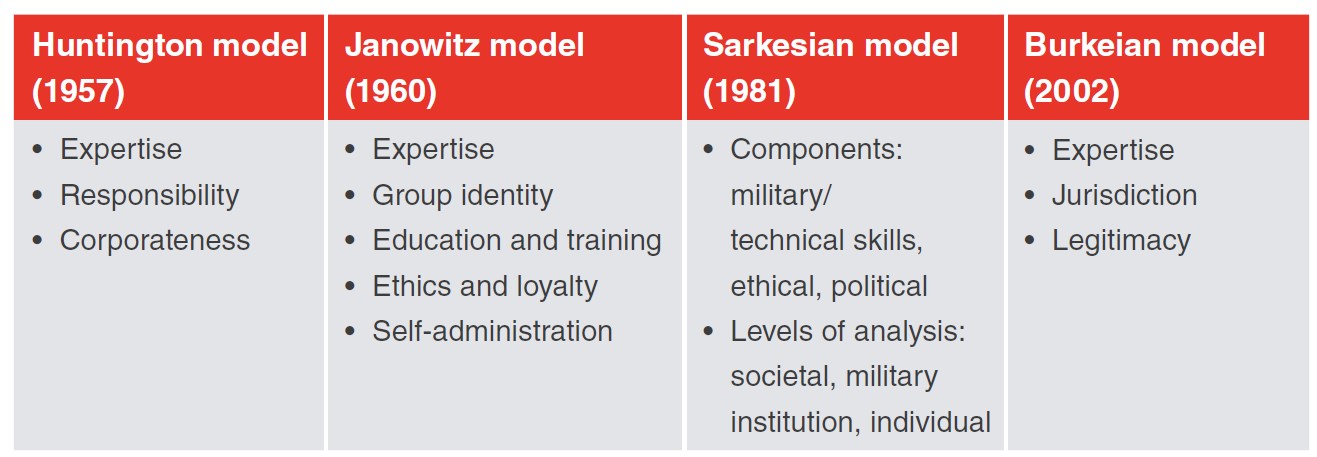
In his opinion, military professionals satisfied the ‘distinguishing characteristics of a profession’, those being expertise, responsibility and corporateness.[52] The special expertise held by military professionals was ‘the management of violence on sea, on land, and in the air’, a function which required significant skill and the devotion of all of an individual’s working hours to the task of generating professional competence.[53] The responsibility of military professionals extended to organising, equipping, planning the activities, and directing the operations of, armed forces in an out of combat.[54]As practicing experts with a monopoly on certain skills and expertise, the military professional had responsibility for the ‘military security of his client’, with their expertise never to be used for their own advantage.[55] As the final characteristic of the military profession, Huntington attributed corporateness to military professionals who existed as an organic group, and who formed a professional organisation which formalised and applied ‘standards of professional competence’ while enforcing ‘the standards of professional responsibility’.[56]
As a framework, Huntington’s model of the military profession was ground-breaking. But it was a model the relevance of which did not extend beyond its context, namely the United States during the Cold War and a conscription-based US armed forces. Huntington’s conception of the military profession was grounded in his analysis on how to maintain democratic, civilian control while maintaining a large and effective military force. His description of the profession, accordingly, ‘neglected many of the actual tasks undertaken by the armed forces during times of war’, and prescribed a ‘military that focuses on battles, not wars’.[57]
Just three years later in 1960, Morris Janowitz offered his own conceptual model for the military professions. Janowitz was similarly as influential as Huntington but took a broader view of the concept of a military professional. Mirroring Huntington is some respects, he also limited membership of the profession to officers and described the US military professional as ‘unique because he is an expert in war-making and in the organized use of violence’. By contrast to Huntington, however, Janowitz saw the military profession as being more than an occupation. Instead, he viewed the military as a ‘complete style of life’[58] and, most significantly, understood that the military had important functions outside that of managing violence. While violence remained a ‘core trait’ of military institutions, Janowitz acknowledged that the military was increasingly involved in a wide variety of technical or operational roles that may, or may not, have a direct combat function. Evidently, Janowitz recognised that the changing characteristics of war required military professionals to adapt their professional characteristics, norms, and skills over time into areas previously not included in the direct management of violence. Indeed, the developing tasks of the modern military required officers (as military professionals) to develop more of the ‘skills and orientations common to civilian administrators and civilian leaders’.[59] Widening the aperture of who could be considered a military professional, Janowitz included those officers whose expertise lay adjacent to or beyond the management of violence.[60]
Consistent with his broader conception of military functions, Janowitz identified five key elements of military professionalism, namely expertise, group identity, education and training, ethics and loyalty, and self-administration. For expertise, Janowitz provided a wider view than that of Huntington, defining the military professional as an ‘expert in war-making and in the organized use of violence’, this being the ‘primary goal of the military establishment’.[61] He stressed the importance of education and training, including the utility of unconventional or unusual careers inside the military and frequent attendance at schools and courses.[62] In Janowitz view, the cohesion developed by shared attendance at such professional locations promoted the development of a group identity, a foundational characteristic as all ‘professions and leadership groups require a sense of social solidarity, and the greater their solidarity, up to a point, the greater their effectiveness’.[63] Such loyalty to a shared group, or ‘professional ethics’ was seen to ground the individual within the group, and to enhance cohesion against external challenges and the rigour of warfare. The final characteristic, self-administration, was said to comprise a body of ethics and standards of performance adhered to by the group, though this might often be supported by state intervention.[64]
Beyond identifying these characteristics of military professionals, Janowitz coined the term ‘constabulary soldier’ to acknowledge that all members of the military – whether officers or soldiers - need to be constantly ready to intervene in any part of the world, to dispense the necessary minimum levels of organised violence and, through this, to achieve an acceptable international outcome.[65] Despite being more progressive in his conceptualisation of military professionalism than Huntington, Janowitz’s five-pronged model of military professionalism has often been overlooked by subsequent commentators, however, his conception of the ‘constabulary soldier’ has had more enduring influence.
Sir John Hackett popularised the term ‘Profession of Arms’ in his 1962 lectures at Trinity College, in his 1983 book, and in a variety of public and professional appearances and writings.[66] Although he offered no ‘model’ of the profession, Hackett’s various writings elucidated characteristics of the profession of arms that he, a scholarly senior British Army officer, identified based on his studies of soldiering over millennia, and which has led one recent analysis to identify him as a ‘foundational twentieth-century [thinker] on military professionalism and one of three (along with Huntington and Janowitz) ‘essential theorists’.[67] Compared to Huntington and Janowitz, Hackett’s contributions to the study of military professionalism were less analytically rigorous, and more romantic, but were presented with a clarity and authority often absent in the works of the political scientists. Hackett, for example, influentially described the function of the profession of arms as the ‘ordered application of force in the resolution of a social problem’, and that while it had been ‘very widely regarded as a profession’ it had also been, ‘less happily, [sometimes seen] as no more than an occupation’.[68] Hackett defended the status of the profession of arms as a profession, noting that it had a ‘distinguishable corpus of specific technical knowledge’ (expertise), an ‘exclusive group coherence’, an educational pattern adapted to its needs, its own career structure, and a distinct place in and relationship with society.[69] More important, however, was Hackett’s articulation and enshrining of the concept of ‘unlimited liability’ into the profession of arms as a unique factor that distinguished it from any other profession.
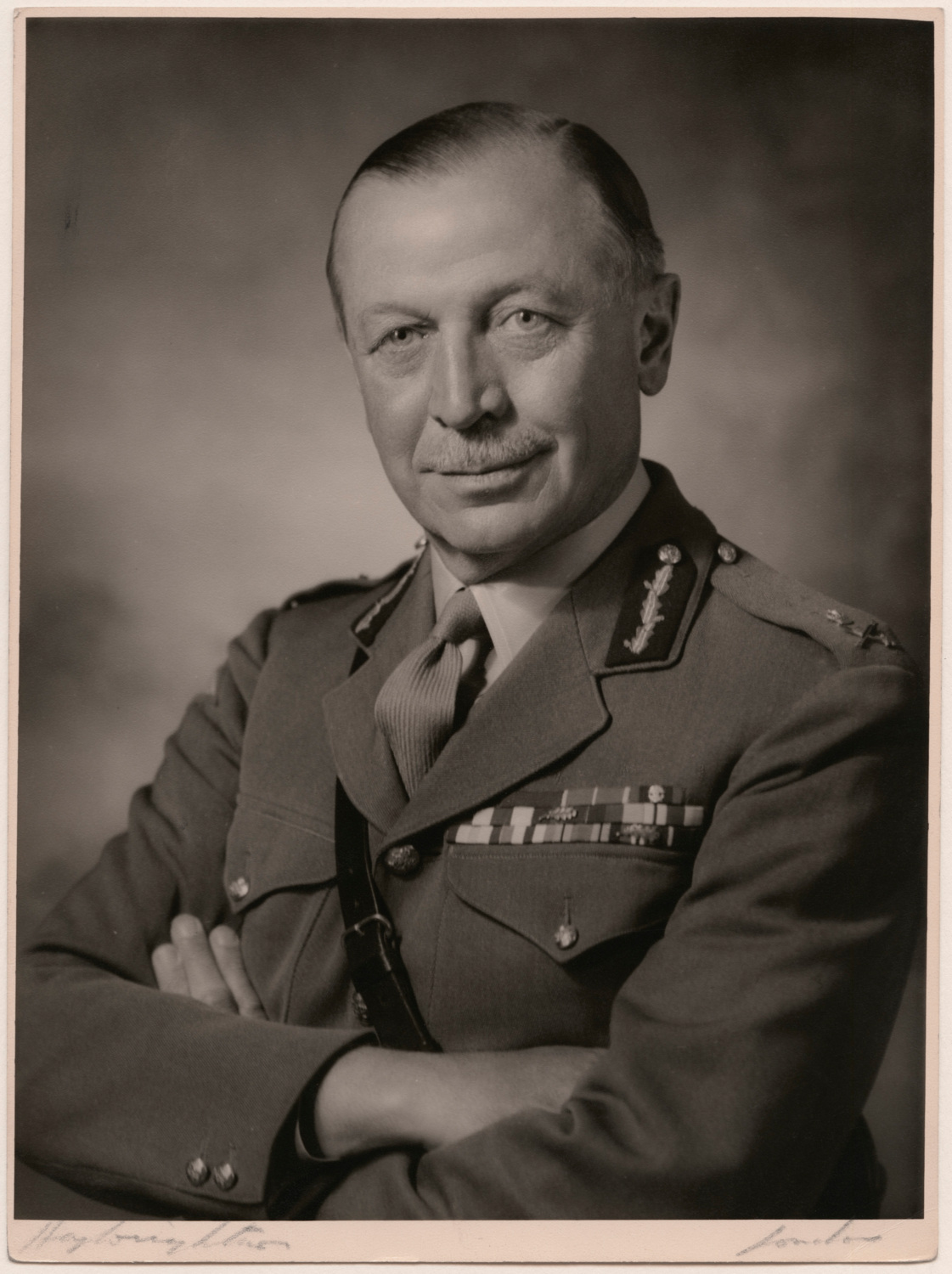
© National Portrait Gallery, London
In the 1970s, further scholarly attempts to identify the theoretical foundations for military professionalism were made. In 1977, noted sociologist Charles C. Moskos made a lasting contribution to the study of military professionalism through the articulation of his institution/occupation model. Moskos suggested that, amid the US military’s post-Vietnam restructuring into an all-volunteer force, that the US military was moving from an ‘institutional format to one more and more resembling that of an occupation’.[70] To Moskos, institutions are driven by a purpose that transcended ‘individual self-interest in favour of a presumed higher good’, whose members were viewed as following a calling, were set part or distinct from broader society, and who controlled their own multi-tiered educational system.[71] This institutional model was the traditional variant of the military profession, and opposed to the occupational model which was grounded in monetary rewards, ample working conditions, contractual obligations, and the implied ‘priority of self-interest’ rather than that of the employing organization.[72] Moskos therefore hypothesised that the traditional foundations of the military profession were changing in line with broader society and would continue to do so. Also in the 1970s, Dutch scholar Jacques Van Doorn investigated the basis of the military professional, and the articulation of their role. Through his various works, Van Doorn identified the dualistic nature of the military as organisation with bureaucratic characteristics, but also one where the officer corps displayed the key characteristics of professionals. As to the role of the military profession, Van Doorn reworked the Huntington conception for the new era, as Giuseppe Caforio and Doo-Seung Hong have summarised:
For Van Doorn, war is an abnormal situation, an interregnum between two periods of normality during which only one institution is suited to act, the armed forces: in the final analysis, a study of military problems is a study of violence. The essential function of the military professional is therefore the control and exercise, tendentially monopolistic, or organised collective violence.[73]
The Sarkesian Model, developed in 1981, is another little-known model of military professionalism that has been subject to very little analysis. Sam Sarkesian identified three primary components of the military professions: military/technical skills, professional ethics, and political perspectives. In his view, the military/technical skills component comprises the ‘special knowledge’ military personnel hold ‘whose wellsprings are skills at war.’ Professional ethics are the ‘regulative code of ethics’ which serve as the norms of behaviour within the military and between it and society.[74] Finally, political perspectives largely comprise the interaction between the civil and military spheres, and the profession’s pursuit of legitimacy and standing through its positive interaction with society and its political processes.[75] Each of these components, Sarkesian explained, must be assessed at three levels—the societal, the institutional, and the individual:
Thus, at the level of the individual, one can study professionalism in terms of the individual officer’s competence as a military technician, his particular attitude and conduct regarding professional ethics, and his political attitudes and perceptions. It is the total of these substantive issues that provide the quality of professionalism at the individual level.[76]
Sarkesian’s model has had little impact on military theory, potentially owing to its relative complexity which has made inaccessible to a broad audience. It is nonetheless a unique attempt to provide a professional model that emphasises the complex interrelationships within which the military operates. It is therefore useful for research purposes, so long as it is extended to include all military personnel and is not limited to officers.
In 2002, US theorist James Burk proposed an alternative model for the military profession. Critically, this was the first attempt to integrate sociologist Abbott’s concept of jurisdiction into a military profession model. It was also the first model to be presented in the context of an Army Profession.[77] For his model, Burk drew on the commonly acknowledged features of the professions, namely expertise, jurisdiction, and legitimacy. To Burk, expertise comprised the ‘mastery of abstract knowledge’, attained through a system of higher education. They exercise jurisdiction through their ‘control’ over ‘the domain within which expert knowledge is applied’.[78] In the US Army’s case, this jurisdiction has not remained static. It evolved from frontier wars and domestic functions in the nineteenth century, through to the ‘management of war’ in the first half of the 20th century, the ‘management of defense’ during the Cold War, to the ‘management of peace’ in the post-Cold war. He acknowledged that this expanding jurisdiction has necessitated the evolution of military expertise and the adoption of a wide variety of new tasks, such as peacekeeping, for the profession.[79] As the final factor, legitimacy comprises the cultural belief or bias that the military profession has the appropriate knowledge to perform its tasks compared to other options – such as that an army is the most appropriate service to conduct land-based search and destroy operations, not the air force or navy.[80]
In more recent years, views as to who and what military professionals are has evolved further. This has occurred in response to factors such as social change, technological developments, changing geopolitical circumstances, the evolving role of militaries, and the changing characteristics of war. As presaged by Janowitz, in the last 65 years militaries have adopted (or been given) a range of tasks which sit outside of their traditional focus on the ‘management of violence’. These have included peacekeeping (or the ‘management of peace’), nation building, domestic or foreign disaster assistance and recovery, and cyber operations. Militaries have also come to undertake highly bureaucratic tasks in garrison and deployed headquarters environments. Such tasks have included public affairs management, procurement, and policy analysis. Today, a range of military personnel have roles that do not principally involve the application or management of violence - such as medical personnel, education officers, legal officers, aviation or technical specialists, or chaplains – but who provide essential inputs into capability and are nonetheless essential to the work of the profession.
Further, since the end of the Cold War, many Western states (and particularly the Five Eyes nations) have transitioned from mass armies towards smaller, volunteer, highly trained, professional forces. This transition has seen a notable increase in the attainments, professionalism, and expertise of enlisted personnel within many Western forces, with many other ranks undertaking service or life-long lengthy careers. Today, many enlisted soldiers can match or exceed an officer in their commitment to their occupation, their level of skill and expertise, and their academic qualifications, while adhering to the same degree of corporateness or regulation as the officer cohort.[81] The extension of the label of ‘military professional’ to individuals outside of the officer corps, gradually adopted over the past two decades, acknowledges this fact.
As a result of such developments, some scholars and militaries have developed more inclusive frameworks to distinguish one as a military professional and to delineate who are members of the ‘profession of arms’. In 2016, retired Admiral James Stavridis and his co-authors highlighted the numerous non-kinetic roles of modern militaries, suggesting that today’s members of the military professions are ‘the managers of effects’ rather than managers of violence.[82] This statement provides a broad conceptual boundary for the military professions and the profession of arms. As such, it can be critiqued for obscuring the primary functions of military forces (namely national defence) and the work military professionals must be prepared to do to achieve this (namely kill or incapacitate the designated enemy). Interestingly, both the ADF and the Canadian Armed Forces (CAF) are aligned in how they view membership within their professional constructs. Australian doctrine explicitly states that ‘[r]egardless of how ADF personnel serve—as full-time, part-time, conscript or professional—all are members of the profession of arms’, with this label being applied to the individual upon enlistment into the ADF.[83]
In a similar vein, the CAF provided the following 2024 definition of the profession of arms and its membership:
The profession of arms comprises all members of the CAF and these military professionals are committed to the defence of Canada and Canadian interests as directed by the Government of Canada. Military professionals specialize in the study and application of military force. Military force means coercive, destructive and deadly force organized and applied in a disciplined manner according to ethics and law in pursuit of the political objectives assigned by the Government of Canada.[84]
Whereas the Canadian definition applies to its armed forces as a whole, the US has tended to use service-specific definitions. For example, in 2010 the US Army defined the profession of arms as:
a vocation comprised of experts certified in the ethical application of land combat power, serving under civilian authority, entrusted to defend the Constitution and the rights and interests of the American people.[85]
This definition was superseded following substantial intra-professional debate. The US Army Profession of Arms is now seen as forming a ‘community of practice’ within the US Army Profession, which is itself defined as:
a trusted vocation of Soldiers and Army civilians whose collective expertise is the ethical design, generation, support, and application of land power; serving under civilian authority; and entrusted to defend the constitution and the rights and interests of the American people.[86]
Characteristics of the Military Professions
The previous section has shown the considerable extent of scholarly analysis and debate around the concept of military professionalism. Despite the various views, however, a common thread runs through the theories that have been outlined above, and these have endured even in the face of today’s emerging technologies and changing geopolitical realities. Notably, these characteristics and features align with the theory of professionalism as described by Susskind and Susskind.
Specialist knowledge. Members of the military professions hold a particular body of expertise which is the purview of them and them alone, expertise which they monopolise, pass on to new members of the profession through formal education and training pathways, and which they update and refresh as technologies and the character of warfare changes. This expertise is applied within a specific professional jurisdiction or field of endeavour. War is conducted by military professionals across all of its domains and in all its facets below that of supreme command (which, in many nations, is the prerogative of the civilian leadership alone). While militaries are often called upon to perform non-warlike tasks at the direction of civilian leaders, such tasks are outside the primary expertise and jurisdiction of military forces.
Admission based on credentials. Historically, entry into the military professions has required completion of a commissioning course at an accredited officer training institution (i.e. Royal Military College – Duntroon, Royal Military College – Sandhurst, the United States Military Academy West Point, or the United States Naval Academy). In the past three decades, however, the gradual inclusion of other ranks into national military professions has meant that a credential for admission could potentially be achieved simply by completion of recruit training courses.
Regulation of activities. Military professions enact measures to ensure continuous professional self-regulation. For example, militaries are guided by ethical principles (usually outlined in official doctrine),[87] codes of conduct and doctrine which provides the written rules of the profession. This guidance is reinforced through military law through which individuals can be punished or sanctioned for conduct that does not align to that of the institution or that contravenes national legislation.[88]
Common values. Military professions usually cohere around several key values that they frequently espouse and which drive their activities. These can include notions of duty, sacrifice, loyalty, and excellence. Military professionals may also identify their occupation as a unique ‘calling’, where they are seen to transcend individual self-interest in favour of a higher good.[89] The degree to which, in contemporary society, individuals are motivated to join the military profession as a ‘calling’ has long been questioned.[90] Modern studies have concluded that individuals have multiple co-existing and competing motivations for joining Western militaries, though the idea (and value) of national service remains a common one.[91]
Beyond these commonly recognised characteristics of professions, the military professions have a further unique characteristic – that of ‘unlimited liability’. As Patrick Mileham noted, the ‘uniqueness of the physical, intellectual, legal and moral liability of military persons is a fundamental supposition underlying the profession of arms in all nation states.’[92] The term ‘unlimited liability’, however, has long been poorly defined across the military professions leading to considerable confusion regarding its meaning and applicability.[93] In the Australian context, for example, one 2019 study observed that the term ‘unlimited liability’ was ‘foreign to a vast majority of the Officers and Soldiers of the Australian Army’.[94] Since this study, the term has now been included within the ADF’s capstone doctrine, Australian Military Power, where it refers ‘to the expectation and possibility of death and injury during armed conflict’. As such, unlimited liability represents ‘the most honourable part of a commitment to serve others for the common good’.[95] Arguably, a more useful definition has been developed by the Canadian Armed Forces (CAF):
Unlimited liability means the legal requirement for CAF members to accept that, in the process of their duties, they may have to risk their lives or the lives of those they lead to achieve success in the military missions assigned by the Government of Canada. While other first responder professions like firefighters or police officers share certain aspects of liability and risk to their lives, the military is unique in that this unlimited liability also includes the legitimate use of force to injure or kill combatants in the name of national defence. Not only can soldiers, sailors, aviators and special operations forces be lawfully ordered to risk their life, but they can also order others to do the same. In addition, CAF members can be ordered to kill combatants or issue such orders to other CAF members, in accordance with applicable Canadian and international law’.[96]
While the concept of unlimited liability has much in common with the burden to give and take life experienced by law enforcement personnel, it differs in that military personnel can apply violence outside of self-defence or assessment of an imminent risk to life, and in pursuit of a larger mission and objectives. In return for this unlimited service there is an expectation that the community will treat these professionals equitably and with ‘good faith’ following their service.[97] Seen in this way, unlimited liability serves to remind serving military professionals that their occupation may result in their death, the death of their personnel, and/or the taking of life. In the words of Stuart, it represents ‘a willingness to give one’s life for the nation and for one’s mates’.[98]
Products of the Military Professions
If professions exist to provide a product that society cannot generate by itself, then what are the product/s of the military professions? Analysts have tendered various suggestions. For instance, Huntington proffered that military professions provide ‘successful armed combat’ in service to the state.[99] To Hackett, the function of the profession of arms is ‘the ordered application of force in the resolution of a social problem’. This service is ordinarily provided external to the nation but also internal to it in ‘abnormal’ times.[100] Another analysis has suggested that the military professionals are involved in the ‘production of destruction’.[101]
Given the many varied roles of modern militaries, especially in the realm of humanitarian assistance and disaster response, definitions centred on the generation of destructive effects are no longer apt. Instead, at the highest level, we can conceive of military professionals, through their expertise and their institutions, as producing national defence. During periods of peace, this involves the generation of a deterrence effect by virtue of a nation’s military posture, its military capabilities and the manifest professionalism of its members. During periods of war, it involves the generation of a physical and kinetic bulwark between the nation’s territory and citizens, and enemy forces.
In 2015, one analysis suggested that military professions had been displaced as the sole or primary means of organising and maintaining expertise in military affairs. In this view, the military is just one among several sources of ‘security experts’ that also include private security companies, and the coterie of inputs to modern military missions from the diplomatic, economic, humanitarian, and civilian spheres.[102] While the concept of the ‘security expert’, ‘security expertise’, or ‘national security professional’ has garnered some support in recent years, most nations still regard the military as primarily responsible for national defence, while acknowledging the criticality of whole-of-government and whole-of-nation support to future and contemporary military operations.
Branches, Joint Forces and Subordinate Professions
The concept of the profession of arms has rarely existed as a singular and uncontested construct and the context within which the concept is used has altered significantly over time. Military organisations and scholars have long recognised distinctions within it, as well as degrees of applicability depending on the domain (maritime, land, air, space or cyber) within which it is applied. This situation is broadly reflective of the existence of sub-professions or sub-groups among other professions. For example, Engineers Australia, the peak professional body for engineers in Australia, divides its members between ‘College Boards’ (i.e. Chemical College, Electrical College, Civil College, Mechanical College), each of which has the responsibility for setting their groups’ professional standards, providing professional development opportunities, hosting conferences, and publishing papers.[103] This example is directly relevant to the present discussion because, just as the expertise required to undertake biomedical engineering or civil engineering can differ remarkably, so too does the nature, character, and expertise required for war differ significantly across the military domains and its strategic, operational, and tactical levels.
Since the 19th century it has been a commonly held view that the profession of arms comprises ‘branches’ (i.e. a navy branch or an army branch) or other sub-groupings (based on corps or enlistment type such as a ‘volunteer’ branch).[104] Over subsequent decades, scholars within the US and Britain began to highlight the existence and unique characteristics of these naval and army professions, either within the broader profession of arms or separate to it.[105] Initially, such analysis did not extend to the characteristics of emerging independent air forces. In the US context, Huntington’s 1957 definition of the military profession did account for ‘subprofessional specialization’, stating that ‘just as there are heart, stomach, and eye specialists within medicine’ so too are the specialists in the ‘management of violence on sea, on land, and in the air’.[106] Indeed, the use of ‘subordinate groups’ within professions can be very beneficial – the distinction provides for a division of labour and accompanying specialisation – though it can have also have drawbacks in the development of rigid professional hierarchies and in public messaging regarding differing degrees of expertise held by each group.[107]
For the military professions, this situation changed, however, in the post-Vietnam era, when the armies, navies, and air forces of the Five Eyes nations experienced significant institutional and organisational change. Across these nations, the military services were reorganised and grouped into single ‘joint’ or ‘integrated’ organisations, known as the Australian Defence Force, the United States Armed Forces, the British Armed Forces, the New Zealand Defence Force, and the Canadian Armed Forces. This reorganisation was often accompanied by the establishment of common legislative frameworks, shared disciplinary codes, joint bureaucracies, and combined ministerial oversight (in the form of a single Defence Minister rather than separate ministers for each service). Of particular relevance to the topic of this paper, these joint forces adopted the concept of the ‘profession of arms’ as a means to bind all services into a joint occupation with common values and ethos, a factor that remains particularly important for the conduct of integrated operations.
Despite the establishment of the joint force construct, fundamental differences remain in respect to the type of expertise required to prosecute war across the different domains. The characteristics of war on land, sea, or in the air, cyberspace or space (and the nature of service regulations) can also differ remarkably. This situation led some to question whether the scope of these variations could be adequately accommodated within the conceptual construct of a single, joint profession of arms. Instead, several commentators espoused the existence of sub-professions such as the ‘army profession’, the ‘air force profession’ or the ‘navy/naval profession’. For example, by the 1990s, US military scholars were theorising the existence of such service-level professions leading Snider and Watkins to conclude, in 2002, that the United States had ‘three military professions: army, maritime, and aerospace.’ These professions were said to exist generally, but not wholly, within their own military departments, supported by the Department of Defense, Congress, and the Executive that operated simultaneously as both professions and government bureaucracies.[108] Consistent with this view, in 2018 one scholar argued that the US armed services (then navy, army, air force, and marines) formed separate professions with distinct corporate identities, different jurisdictions of work, individual bureaucratic departments, and unique customs and traditions.[109] In parallel, theories began to emerge as to the existence of a US ‘space profession,’ and a ‘joint special operations profession’[110].
Until 2024, the US military was alone among Five Eyes nations in formally articulating and exploring service-level constructs for their military professions. This situation changed in September 2024, however, when the former Chief of Army, Lieutenant General Simon Stuart announced a ‘review’ into the ‘Army Profession’ in Australia (see Part 2 below).
The Profession of Arms in Australia
As both a term and a concept the ‘profession of arms’ has been used for a long period in Australia, having be adopted and adapted from the British military. While used in many different guises (mostly colloquially), the phrase was formally applied in Australia from the 1960s after Hackett’s popularisation of the term. In 1968, advertisements encouraging men to join the ‘Profession of Arms’ appeared, the slogan being used principally to support recruitment into the Australian Regular Army.[111] In 1971, the idea that military officership in Australia constituted a recognisable profession was pushed by members of the services, and accepted by government, in order to better their pay and conditions during the ‘Committee of Inquiry into Financial Terms and Conditions of Service for Male and Female Members of the Regular Armed Forces’, led by John Kerr (later Governor-General of Australia). Here the term was specifically used in the context of officers. The sixth report of the Committee noted that:
- The concept that all officers are members of the Profession of Arms has not, in our view, been developed solely for the purpose of seeking higher salaries. It is more broadly based. It stems from a desire for status in the community and for recognition of the character of their calling. There have been, over the years, many claims that particular occupations are professional occupations. These claims are general accompanied by demands for special recognition based either on professional training at the tertiary level or the possession of particular experience and qualifications.
- Officers need to master a body of professional knowledge and keep themselves up to date. They participate in the educational training activities necessary to pass on this body of knowledge to juniors and they have codes of ethics and conduct which are special to their profession and which are firmly enforced. These are criteria often found in other professions.
- We have no doubt that because of these factors, they can fairly be said to be members of a professional class and the ‘Profession of Arms’ is an adequate title for the military profession.[112]
From this point, use of the ‘profession of arms’ concept in Australia became more regular, though it remained a term that was poorly defined or explained. Some discussion of the concept in the Australian context began to appear in official documents or publications such as the Australian Army Journal and its successor, the Defence Force Journal (which adopted the sub-title of Journal of the Australian Profession of Arms when it commenced publication in 1976), though the analysis was often highly variable in context and quality.[113]
In 1978, the Australian Army’s Regular Officer Development Committee (RODC) arguably set the Australian tone for several decades. In line with the conception of the principal scholars of military professions of the time (Huntington, Janowitz, Hackett), the Profession of Arms was seen as the sole domain of a limited body of officers, namely those ‘officers whose occupation is the study and practice of strategy, tactics and logistics, and who are employed in a wide array of Corps and non-Corps, staff and regimental appointments’. Those officers who were members of another profession (i.e. medicine, law) were not members of the profession of arms, but ‘close affiliates’.[114] Women officers, at this time employed solely within the Women’s Royal Australian Army Corps (WRAAC), were categorically ‘neither members of, nor affiliates to, the Profession of Arms … [they] are best classified as sub-Professional’.[115]
The 1978 RODC report identified the roles and responsibilities of officers within the profession of arms. Specifically, they were to continuously maintain and improve their professional knowledge, pursue ‘high capability’, be prepared for ‘great responsibility’, and ‘strike a sensible balance in the attitudes required to meet the field [capabilities] and the bureaucratic military requirements’.[116] The report was particularly influential given that, as R G Funnell stated two years later, there has been ‘very little writing and even less research of substance on the military profession in Australia’.[117] While he held the view that the military profession in Australia was under strain and had to adjust to continuing strategic, political, technological, and organisational changes (a uniquely practical and focussed perspective for its time), he struggled to provide a more comprehensive definition of the constituent elements of the military profession and profession of arms.
In reality, for many years the components of the Australian Profession of Arms went largely undefined, existing more as a ‘vibe’ then as a written and definable term. It is somewhat ironic, then, that the 2002 ADF publication The Australian Approach to Warfare asserted that the Australian community ‘understands and accepts the requirements of the unique ‘profession of arms’ of the Australian Defence Force’.[118] In reality, this common understanding did not exist leading at least one senior officer, Major General Craig Orme, to recommend in 2011 that the ADF:
commence the development of an operations-focused culture underpinned by the profession of arms construct, to provide professional focus on both Service success as well as an institutional focus, by articulation of “the Australian profession of arms” concept.[119]
Today, the concept forms not only part of the ADF Capstone Doctrine Australian Military Power, but is also explored in a Philosophical-level doctrine series entitled The Ethos of the Profession of Arms, and which comprises publications such as ADF-P-0 Character in the Profession of Arms and ADF-P-0 Culture in the Profession of Arms. As of 2024, the following definition appears within Australian Military Power:
The Australian profession of arms consists of people practiced in the ethical application and exercise of lethal force to defend the rights and interests of the nation.
It further continues that:
The profession of arms and the unique nature of military duty form the basis for service to the nation and the conduct that governs a professional military force … Regardless of how ADF personnel serve—as full-time, part-time, conscript or professional—all are members of the profession of arms with a non-negotiable obligation to adhere to its standards and practices.
Distinguishing features of the profession of arms include direction by command, notions of mission, military expertise, service-orientated character, objective analysis and consideration, ethical and moral conduct, regulation via military law and discipline, the use of lethal force and the individual obligation of unlimited liability. The special knowledge and skills of military professionals vary by Service and mustering, but all have the principal role of warfighting in common.[120]
As a definition this is fairly comprehensive, but the degree to which it is understood throughout the ADF varies considerably. Given the historical evolution of the concept of the military profession, several key points are particularly worthy of note. These include: that membership includes the whole of the serving ADF regardless of service or service category, the importance of ethical and moral conduct, and that the purpose of the military is to exercise lethal force in the defence of Australia and its interests. It is undoubtedly true that the ADF needs to become more adept at educating its personnel on what comprises the profession of arms, their place within it, and the unlimited liability concept.
Critiques of the Military as a Profession
It warrants emphasis that much of the literature on the ‘profession of arms’ and the ‘military professions’ suffers from a looseness in terminology. The two terms have often been used interchangeably. This is problematic given how widely various militaries have adopted and nationalised the term ‘profession of arms’ for their militaries, ascribing to it features or characteristics which, while generally similar, are unique to their national context. It is therefore possible to discuss, as specific and differentiated doctrinal concepts, the ‘Australian Profession of Arms’, the ‘Canadian Profession of Arms’, a US ‘Profession of Arms’ (as well as a US Army ‘Profession of Arms’), or the ‘British Profession of Arms’.[121] If we are to discuss the ‘Profession of Arms’ in a transnational way, then, it is more useful to specify that this language relates to the grouping category of ‘military professions.’ This is the highest level of analysis for discussing the general characteristics of military professions, shared across international borders, though largely still from an Anglophone, Western-centric perspective.
While the concept ‘military professions’ and ‘the profession of arms’ can be broadly understood in this way, questions nevertheless remain as to whether either warrant a status that equates to that of, for example, law or medicine. To some degree this continued debate is a reflection of the fact that there is no exact definition of what a ‘profession’ constitutes, nor widespread agreement of the characteristics of one. Such debate in Australia is further complicated by the reluctance (until recently) of serving personnel and academics to rigorously investigate the foundations of the Australian military profession and the profession of arms.[122]
A significant issue is, as Reed Robert Bonadonna has argued:
[the] ‘military vocation may stretch past, as well as fall short of, the outlines of professionalism… [i]t arguably possesses elements of the historical, tragic, and sublime that transcend the sociologists’ professional model.[123]
In other critiques, it has been observed that military professionals may not, in their professional life, actually ply their trade in conflict. In their landmark 1933 study of the professions, A M Carr-Saunders and P. A. Wilson explicitly rejected the military as a profession on the basis that ‘the service which soldiers are trained to render is one which it is hoped they will never be called upon to perform.’[124] Similarly, noted historian Michael Howard has observed that, for a military commander, ‘his profession is almost unique in that he may have to exercise it only once in a lifetime, if indeed that often’.[125] This objection can be simply articulated through a comparison – is a surgeon a medical professional if they have never operated on someone?
In the contemporary global strategic environment, deterrence theory offers a basis upon which to answer to this critique. In times of peace or competition short of war, modern militaries are nevertheless engaged in producing national defence, through their real or perceived ability to resist aggression. This ‘deterrence by denial’ concept is defined by Lawrence Freedman as the ‘credible ability to stop aggression in its tracks’ and thereby prevent gains of a real of potential opposing force.[126] It is achieved through the maintenance and continuous development of military forces and their professionals, meaning that even outside of the application of their expertise in war or war-like conflict, military professionals are still delivering a service - national defence.
The fact that militaries have been called upon to perform tasks outside of their traditional jurisdiction has also been an area of contention. In 2020, Meredith Kleykamp observed that, for some years, new tasks have been ‘pulling modern militaries away from their traditional areas of expertise, leading to strain at the seams of the military profession’. In her view, when paired with the rise of private military contractors in the first two decades of the 21st century and significant societal concerns regarding widely publicised scandals and ethical lapses by military professionals, this trend has operated to undermine the legitimacy and foundation of the military professions.[127]
In the aftermath of the coalition withdrawal from Afghanistan in 2021, this critique has been keenly felt by some Western militaries. Canada, the US and Australia especially have sought to ensure that their militaries and their military professions remain anchored in what they define as core business – war and conflict. To this end, they have moved to realign their doctrine, and societal narrative, towards warfighting, distancing themselves from (but remaining capable of) the nation and security building tasks that have predominated since the end of the Cold War.[128] As observed by former Chief of Army Lieutenant General Stuart in May 2026, ‘We understand our purpose, the endeavour in which we must always succeed … [w]e exist to fight and win our nation’s wars’.[129]
A recent and thorough criticism of the idea that militaries operate as a profession was offered by Philip Hoglin in 2025. He argued that, while the ADF and its Army comprise people whose conduct is ‘professional’, it does not follow that the profession of arms shares the essential characteristics of ‘regular professions’. In this view, deviations include the ‘ambiguity around the regular daily public good’ provided by the military, the fact it uses lethal and violent force in its work, the lack of an independent professional body, the frequent use of personnel in non-specialist roles (i.e. as a labour force in disaster relief and recovery), the non-enduring nature of its membership, and ambiguity around the status of reserve service.[130] He also pointed to ambiguity around the point at which an individual enters the military profession. If we are to accept Susskind and Susskind’s suggestion that admission to a profession is based on credentials, does graduation from a military academy or from recruit training satisfy this requirement?
It is not within the purview of this paper to answer this or other relevant critiques in detail, though some are briefly explored in Part Two. Indeed, to some, the debate as to whether the military constitutes a profession is of lesser importance than is the attitude of military members towards their occupation. From this perspective, the essential thing is:
to see professionalism in the military as an aspiration—a continuous process to be undergone to varying degrees by all members, not as a description of a static, universal reality.[131]
In other words, professionalism is not something that can ever really be achieved, for the goalposts of what constitutes a military professional are always changing as societies, technologies, cultures, and methods of war change over time. It is important to note that critiques such as those provided by Hoglin are grounded in—and symptomatic of—neglect of rigorous study and debate on the military professions in recent years, both within Australia and internationally. In the absence of deep analysis, military personnel themselves have become the most consistent advocates for the ‘profession of arms’. As observed by Bonadonna ‘the status of the military as a profession is more often acknowledged within the armed forces than without’.[132] Further research and intraprofessional debate is undoubtedly required, however, to fully explore each of Hoglin’s critiques in the Australian context, and thereby provide a firmer intellectual foundation for the profession of arms in Australia.
Part Two – The Australian Army Profession
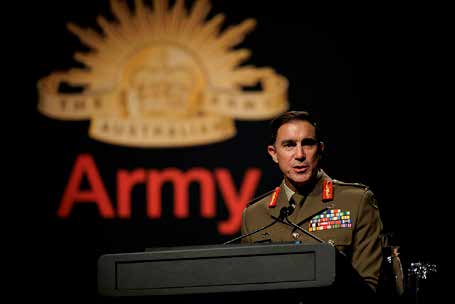
Melbourne, Victoria
When in 2024 Lieutenant General Stuart announced a review into the ‘state of the army profession’,[133] he instigated a period of Army introspection as to the nature and characteristics of this unique profession. Stuart pursued this review for multiple reasons, including to effect Army’s transformation in the wake of the 2023 Defence Strategic Review, the 2024 National Defence Strategy (which warned of the dangerous strategic circumstances facing Australia), and the Royal Commission into Defence and Veteran Suicide. As Stuart stated in May 2026 shortly before leaving his appointment as Chief of Army:
The Government’s direction to our Army was … unambiguous. Transform to meet the demands of these new circumstances. Be focused. Optimise for littoral manoeuvre, and long-range strike. We have taken a deliberately, comprehensive approach to our transformation. Our circumstances demand nothing less.
This is why, two years ago, I commissioned a review of the state of the Army profession. We needed to examine our fundamentals, the visceral centre of our character and of our purpose.[134]
The Australian Army has now formally adopted Stuart’s service-level professional construct, including through its incorporation as ‘a fourth line of operation in the Army’s campaign plan’.[135]
In Australia then, the ‘Army Profession’ is the term used to describe service in the Australian Army, a standard or status that Army’s officers and soldiers should aspire to attain, and a means by which the Army contributes to the defence of a nation.[136] It has begun to appear in materials bearing the Army brand (such as the 2024 and 2026 editions of The Australian Army Contribution to the National Defence Strategy and the Australian Army Journal), and in its public-facing web content and social media. Despite such usage, there is generally little understanding among officers, soldiers, commentators, and academics as to what the term actually means; very few are able to confidently articulate what the Army Profession is, its purpose, its membership, its ethos, or any number of other aspects.
Before the Army Profession, as both an identity and concept, can be fully adopted and integrated into the identity of Army personnel, it is necessary to first establish a firm foundation for it. This Part, therefore, explores and further develops this foundation. It proposes an initial, definition of the term ‘Army Profession’ analyses its role and purpose, its relationship to the Australian Profession of Arms, its membership and its ethos. It then outlines the conceptual basis for the Army Profession as articulated by Stuart (and others). It concludes by highlighting some contemporary and future challenges it faces. All of these aspects are essential to understanding the theory of the Army Profession, to support its dissemination as a concept, and to provide a solid foundation from which it can be used as an element of Army’s identity.
Foundations and Characteristics of the Australian Army Profession
To date, there exists no formal definition of the Australian Army Profession. As is the case with any effort to define a term, it can be a difficult and may well result in an uninspiring statement. It is a nonetheless a critical activity as it provides a baseline from which informed discussion can be launched. With this in mind, and with the understanding that the definition offered here just a starting point for further discussion, the Australian ‘Army Profession’ can be defined as:
An occupation comprising experts in the theory and application of land power and warfare in the land domain, who serve Australian society, regulate their conduct and activities in accordance with its expectations, and support the Profession of Arms in the defence of Australia and its interests.
As a definition, this statement captures the key features of the Australian Army Profession, including some of the boundaries of membership. These include the expectation that its members have expertise, and that the subject of this expertise is the theory and application of land power and warfare in the land domain. It identifies the basis of this expertise as being land power and warfare in the land domain. It specifies the existence of a unique relationship between the Army profession and the australian society it serves. It also acknowledges and expectation that it will self-regulate its professionals. Lastly, it identifies that the Army Profession has a relationship with the ADF-level Profession of Arms concept, being subordinate to it and supportive of it.
This definition can help clarify both the purpose of the Army Profession as a concept and the role of the profession itself. In relation to the former, the Army Profession serves as the Army’s unique professional construct within the broader Australian Profession of Arms. Secondly, it is a statement of identity for Army personnel who operate within the ADF’s integrated force. In doing so, it serves as an aspirational goalpost as they strive enhance their professionalism against the combined metrics of land warfare expertise, service to society, and conduct. The fundamental purpose of the profession, then, can be summarised as being:
To provide the integrated force and the Australian Profession of Arms with personnel who are experts in the theory and application of land power and warfare in the land domain, and who support the ADF’s joint operations to win Australia’s wars across all domains.
This is a clear statement of intent for the Army Profession. It identifies Army’s role in raising, training, and sustaining forces for the ADF’s Integrated Force, as well as its responsibility to generate and maintain the ADF’s expertise in land warfare and land power. This expertise is the core of the profession.
As can be seen from these two definitional statements, the relationship between the Australian Army Profession and the Australian Profession of Arms is a unique one. In Australia, the ‘Army Profession’ exists wholly and firmly within the Australian Profession of Arms.[137] Given national legal imperatives and the importance of ‘jointery’ in modern military operations, the time has long past when the ‘Army Profession’ can exist separate to and apart from the ADF’s joint profession. From a legislative perspective, it is important to note that the Defence Act 1903 provides that the Australian Army is but an ‘arm’ of the ADF, with the Chief of the Defence Force having ‘command’ of the total force. This relationship is further reinforced by the fact that approximately 11% of Army personnel from a variety of service categories are posted to non-Army groups or joint roles at any given time. Secondly, as Christopher Tuck has observed, joint warfare has continually grown in importance since 1900, and in the aftermath of the wars in Iraq and Afghanistan it has become increasingly decisive to the delivery of modern military capability effects.[138] Indeed it is for this reason that the 2023 Defence Strategic Review recommended that the ADF transition from a ‘joint force’ into a ‘genuine Integrated Force, which harnesses effects across all of the five domains’[italics in original], namely domains of sea, land, air, space and cyber.[139] Within this context, the concept of an Army Profession must be viewed as the means by which the Australian Army can most effectively prepare its personnel for service in integrated operations as the ADF’s experts in land power. This relationship between the Australian Army Profession and the Profession of Arms is well grounded in academic theory and in the experience of long-standing sub-professions in non-military professions. It is illustrated in Figure 2.
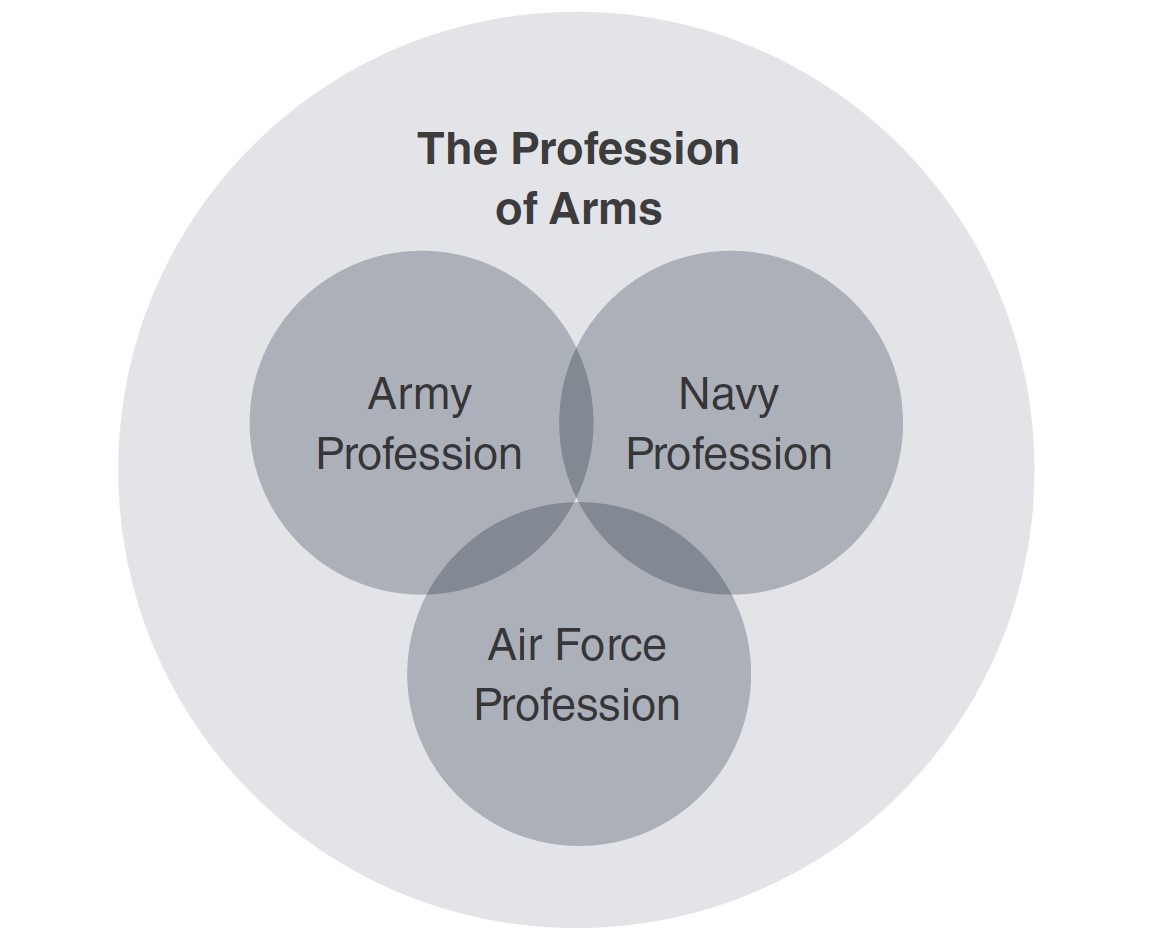
Image source: [140]
Membership of the Army Profession
As we have seen, the question of who belongs to the military professions and the Profession of Arms has been the subject of significant debate. So too, the question of who belongs in the Australian Army Profession is likely to be contested. From the first public articulation of the Army Profession concept, Stuart emphasised that it was to be inclusionary, noting in September 2024 that ‘[e]very soldier must be considered, and consider themselves, to be part of our profession.’[141] Indeed, in this same address, Stuart explicitly stated that the Huntingtonian interpretation of military professionalism as being synonymous with ‘officership’ did not apply to the Army Profession.
Despite Stuart’s inclusive statement, it is important to consider the relevant factors that might shape membership of the Army Profession. Drawing on the characteristics of military professionalism discussed above, these may include whether the member provides full-time or part-time service, and the role in which they are employed. When discussing the concept of specialist expertise, can only commissioned or enlisted members of the Australian Army claim a place within the Army Profession? While it outside the scope of this paper to consider the continuing status of Army members who transfer to another service, or who leave the Army and are subsequently work for the Australian Defence Organisation (ADO) in a contractual capacity, we will consider the status of Australian Public Servants (APS) who work within Army formations.
As I have argued elsewhere, Australian Army Reservists should be recognised as full members of the Army Profession, identify themselves as such, and be wholly and fully incorporated into its professional framework.[142] This may be considered a controversial claim. But it is entirely consistent with evolving military theory outlined in Part One, including ADF doctrine that explicitly includes reservists within the ADF Profession of Arms.[143] Given the interdependent relationship between the Australian Profession of Arms and the Army Profession already explored, these factors alone strongly support the inclusion of Army reservists within the Army Profession. Further supporting this position, individuals now joining any ADF service, whether as full-time or part-time members, all join the Australian Defence Force, under the same oath of service, and agree to a common legislative and disciplinary framework, acknowledging that they may be liable to perform combat or combat-related duties to a common ethical standard.[144] Further, under the ADF’s Total Workforce System, individuals do not join a specific reserve organisation, but instead join the ADF in a specific reserve service category – an employment classification, not a delineator of capability, role, or professionalism. Indeed, existing research indicates that many reservists deliberately pursue a professional standard equivalent to that of their regular counterparts, are motivated principally by service to the community, and often structure civilian employment and personal lives around Army obligations and not vice versa.[145]
Admittedly, members of the Army rendering part time service face enduring challenges in sustaining the specific expertise required of the Army Profession. Nonetheless it should be remembered that Army reservists are often able to generate impressive capability in limited training time, are frequently fully capable of operational service provided they are given the opportunity to undertake pre-operational training and workups, and many reservists bring to the Army a range of unique skills, derived from their civilian employment, which are critical to Army (and ADF) operational requirements.[146]
Acknowledging that Australian Army reservists are members of the Army Profession is consistent with the position taken by a significant military partner, the US Army. The modern definition of the US Army Profession explicitly includes the National Guard and the US Army Reserves. In developing this definition, it was found that exclusivity in membership of the profession was ‘divisive and not helpful in enabling the Army to achieve its mission and exercise its core competencies’. Each of these groups were an ‘indispensable contributor to the Army Mission’ and this deserved recognition.[147] Similarly, Australian Army reservists today fill many key functions for Army and the ADF as a whole. They are embedded throughout every part of Army and are relied upon for the organisation to achieve even ‘business-as-usual outcomes’.[148] Indeed, the 2nd (Australian) Division largely comprises a part-time military workforce but nevertheless has significant responsibilities for the defence of Australia and its major population centres. A recent Royal Australian Infantry Corps paper, for example, explicitly emphasised the contributions of the ‘part-time professional Army’ to capability, labelling its ‘part-time infantry soldiers’ as ‘an indispensable component of the Infantry Corps’ future combat power’.[149] Like their full-time counterparts, reservists must be certified in their roles and ranks through the completion of professional development and training. Further, supported by a Total Workforce Model, many members of the Australian Army transition (some relatively regularly) between the full-time and part-time workforce. These factors combined warrant the recognition and the inclusion of all Army reservists into the Australian Army Profession.
The degree to which a small body of civilians—for example, members of the APS working in Army formations and headquarters—should be included as members of the Army Profession in some form is a pertinent one. Over the past 15 years, the number of APS members employed by the ADO has remained relatively static, numbering (as of 30 June 2025) approximately 20,545 personnel. This is the second largest workforce cohort in the ADO workforce, second only to the officers and soldiers of the Australian Army.[150] Many of these civilians work throughout Army, undertaking a wide variety of roles including administrative tasks, capability development, experimentation and testing, maintenance and repair, training, education, research, and regulatory governance. They may work closely with uniformed members as part of an integrated workforce, either supervised by, or supervisors of, ADF personnel.[151] Further, these public servants fill a variety of essential roles that make the application of land power and violence in the land domain possible. In exercising their roles, over a period of time numerous public servants develop a deep understanding of, and expertise in, the theory of land power and warfare in the land domain.
Despite the degree of specialisation that members of the APS may have in Army land power, there remains an important distinction between them and their uniformed colleagues. Specifically, APS personnel have no obligation or authority relating to the concept of ‘unlimited liability’. Certainly some APS personnel are deployed on operations where they encounter potentially dangerous environments. But, unlike a member of the Army, they cannot be given an order to lethally target another human being, they do not otherwise have the authority to do so, and they cannot order anyone into a situation in which that person may take lives or lose their own.
This distinction is fundamental and highly relevant to whether a civilian APS can ever properly claim membership of the Army Profession. But it is not determinative. As we shall see in the next section, the US Army has recognised the considerable contribution made by defence civilians to land capability by including the category of ‘Army Civilians’ in its professional construct. The development of such an auxiliary place for Australian defence civilians within the Australian Army Profession should be considered as a means to enhance civil-military cooperation in all areas of business, though the degree to which such an identity may entail the symbolic forfeiture of civilian status (especially in wartime) and render them a legitimate target should also be weighed.
Also yet to be considered is at what point in time the title or identity of ‘Army Professional’ is assumed by the individual. As we have already noted in Part One, credentials and qualifications attained through a culturally legitimate pathway are a key feature of the modern professions. The nature of envisaged credentials has evolved over the years,[152] opening the way for modern militaries to claim professional status for both officers and other ranks. For the contemporary ADF, no specific experience or qualifications are required for General Entry, while Officer Entry (General Service Officer) requires completion of Year 12 and Special Service Officer commissions (Mid-Career Entry) require a relevant tertiary degree or skills and experience that can immediately fill an ADF workforce capability shortfall.[153] Despite this, ADF doctrine specifically states that ‘[m]embership within the ADF and its profession of arms begins with swearing an oath during enlistment or appointment’.[154] Given the relationship between the Australian Profession of Arms and the Army Profession, does this also mean that upon rendering the oath of service Army members are also simultaneously inducted into the Army Profession?
It is here that the proposed definition included in this paper is of some use. If it is agreed that the Army Profession is composed of ‘experts in the theory and application of land power and warfare in the land domain’, then a higher barrier to entry for the Army Profession than simple admission to the ADF may be required. For officers this could involve completion of a commissioning course at the RMC Duntroon or through an associated course in a university regiment. For other ranks it could be sufficient complete the Army Initial Foundational Training course.[155] The second-order effects of such a barrier to entry, such as the messaging officer cadets or recruits are subjected to during their initial training, should be considered before such a boundary to entry is decided upon. Another means of delineating membership of the Army profession could consider time served. Writing in 1975, Sarkesian argued in relation to officers in the military professions that the true military professionals were those who ‘decide to stay in the military service beyond their immediate obligation’, as:
[p]rofessionalism does not imply more expertise, knowledge, or skill, but rather a commitment to the profession measured in years served. This can only be tested when the officer is faced with a choice between remaining in the service or getting out.[156]
If the Army Profession is to be both an inclusive and uncomplicated statement of identity, useable in a wide variety of contexts, then such ‘time served’ barriers to entry should be avoided.
Ethos of the Army Profession
The Army Profession also needs to be grounded in an ethos (or common set of values) that is agreed upon and followed by all members. An ethos comprises a set of written and unwritten rules that guide professional practice. In effect, it is the guarantee that the professional will act correctly and the state’s guarantee that the professional work will be undertaken in accordance with the formal and informal rules that regulate their practise. In modern Western societies, a military’s stated values tend to align with the prevailing national cultural identity. This helps promote the military’s legitimacy in the eyes of the nation it serves. Not surprisingly, therefore, the elements of ethos vary considerably across the world’s militaries. For example, the ethos of the CAF’s profession of arms encapsulates ‘the ideal culture of that profession, expressed by clear principles, values and expectations’. [157] These are stated as:
- Ethical Principles: Respect the Dignity of All Persons, Serve Canada Before Self, Obey and Support Lawful Authority
- Military Values: Loyalty, Integrity, Courage, Excellence, Inclusion, Accountability, and
- Professional Expectations: Duty, Accepting Unlimited Liability, Fighting Spirit, Leadership, Discipline, Teamwork, Readiness, Stewardship.[158]
The US Army Profession is also explicitly grounded in an ‘Army Ethic’ which serves as the ‘basis for our mutual trust with each other and the American people.’ It is articulated in the attributes of ‘loyalty—duty—respect—service—honor—integrity—courage’.[159]
For the Australian Army Profession, the ethos of the ADF Profession of Arms provides a baseline through a series of capstone doctrinal publications covering the topics of command, leadership, ethics, character, and culture.[160] These publications are informed by standards that reflect Australian community values and the unique demands of military service in an Australian context. While useful, these documents and the values they articulate can be further enhanced for the unique context of the Army Profession and the challenges of land combat through the adoption of an Army Profession-specific ethos. Indeed, Army already has such an ethos available, namely the ‘Good Soldiering’ ethos developed during the tenure of Lieutenant General Rick Burr as Chief of Army. Simply stated, ‘Good Soldiering’ is the means through which the ‘Defence Values’ of service, courage, respect, integrity, and excellence are effected throughout Army. This ethos emphasises the importance of a positive and strong culture, the importance of Army’s people and their connection with the community, and the attainment of the highest standards of physical conditioning, morals, intellect, character and adaptability. As Burr noted;
Good Soldiering is who we are; it is our culture. It guides how we conduct ourselves, how we interact with our teams and partners, how we make decisions and how we go about our core business now and into the future. This is owned and reinforced by every member of Army.[161]
‘Good Soldiering’ offers a readily available conceptual ethos for the Army Profession, albeit one that needs to be synthesised into a more accessible form. The extant ‘Australian Soldiers’ Oath’ goes some way to fulfilling this, but it is a parochial formulation and does not sufficiently emphasise the profession’s contract with the community or the other foundational features of the profession. Development of a simpler statement of values would enhance the reception of the ‘Good Soldiering’ professional ethos across both Army and the community.
A Model for the Australian Army Profession
How these characteristics and features of the Army Profession are modelled has considerable relevance for how they are received, accessed and used by Army professionals, other members of the ADO, and whole-of-government stakeholders alike. For the Australian Army, Stuart advocated a three-pillar model of the profession drawing on the conceptual work of Huntington, Janowitz, Hackett, and Burk that was discussed in Part One. This ‘Stuart Model’ sees the Army Profession founded upon three pillars (or supports)—Jurisdiction, Expertise, and Self-Regulation (See Figure 3).[162] The pillars in the Stuart Model are mutually supporting. In other words, the weakening of one undermines the viability of the profession writ large, causing it to collapse beneath its own weight.
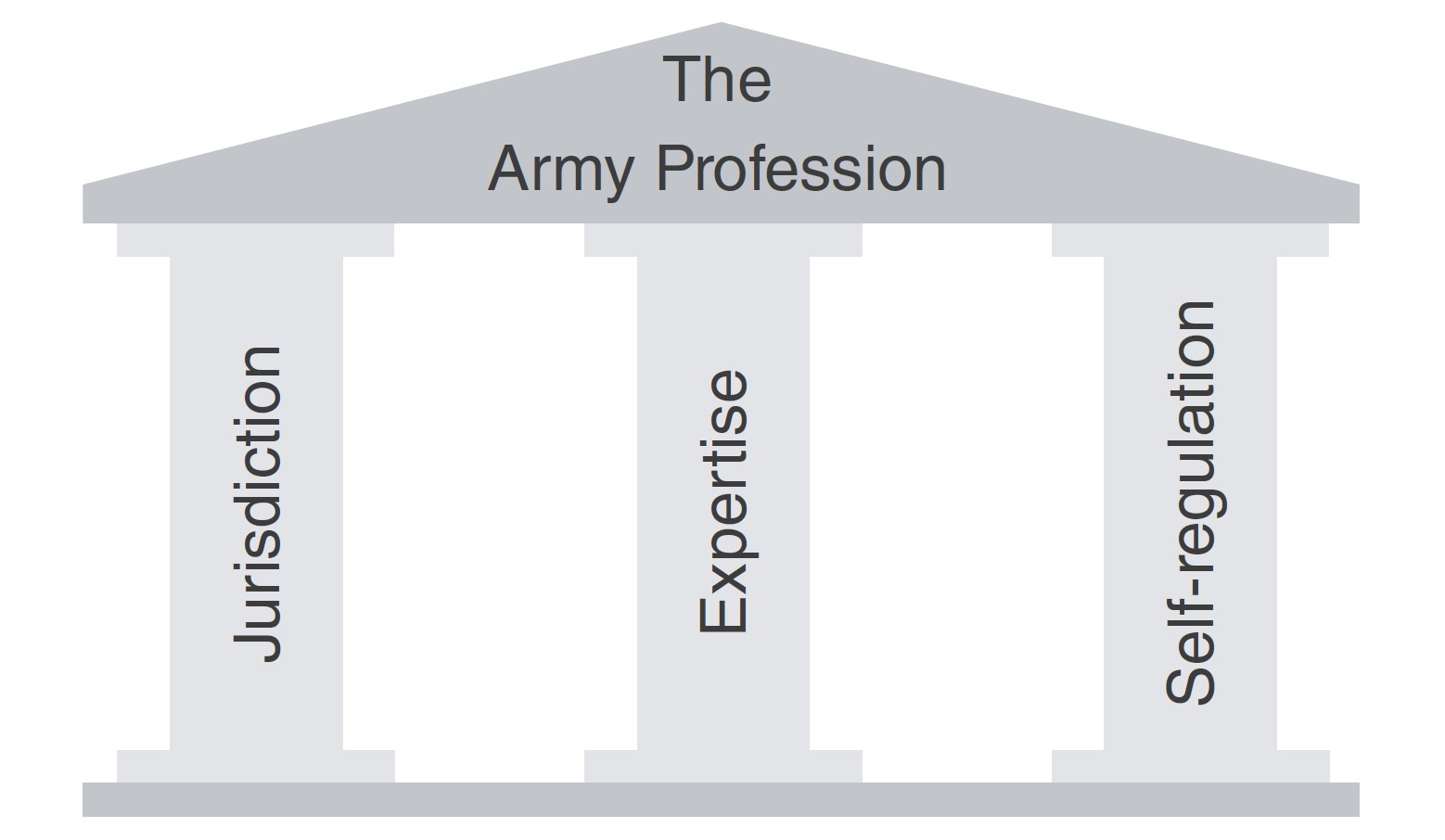
Elements of the Model
The simplicity of the Stuart model makes it particularly accessible to both practitioners and researchers, thereby encouraging consideration and debate among those invested in the professional attainments of Army personnel. The scope and breadth of these pillars, however, require further elaboration.
For his jurisdiction pillar, Stuart has drawn heavily on James Burk’s model. Stuart attributes precedence to the concept of jurisdiction as the ‘primary pillar, that which defines us and our purpose’.[163] ‘Jurisdiction’ summarises the particular service Army provides to the Australian community, its relationship with that community, and the resulting legitimacy that underlies Army’s activities and operations. The concept of jurisdiction is centrally relevant because it conceptualises the cooperative relationship that exists between Army and Australian society, from which it draws its workforce and which it serves. As Stuart noted in November 2024, the Army ‘exists only to serve society, and we can only provide our unique service when our society requires and directs us to do so’.[164] If such a relationship becomes unhealthy, then, as Risa Brooks has argued, it becomes ‘more difficult to build and maintain an appropriately resourced, responsive, tactically adept and strategically minded army’ and thereby undermines Army’s capacity to deter foreign aggression and protect society.[165] Beyond issues of operational capability, jurisiction include concepts such as social and legal legitimacy, social licence, Army’s interactions with the community, and public perceptions of Army’s role and purpose. As Sarkesian stated in 1975, ‘the military cannot bestow legitimacy upon itself’, and
only when society feels that the military institution and the profession are representative of society, and are responsive and accountable to it … [can it] achieve a high degree of legitimacy and credibility.[166]
For the Australian Army Profession, Stuart asserted, expertise comprises the ‘maintenance of our distinctive body of professional knowledge, and the ability to teach it and evolve it and adapt it’.[167] The criticality of expertise to the Army Profession is all-encompassing, and in Stuart’s words, is ‘central to our ability to fight and win’.[168]
Army personnel are expected to be the masters of their field—ethical land combat. This is only natural:
Just as a client wants a lawyer who has kept up with the latest court decisions, and a patient wants a surgeon who is skilled in the latest techniques, so too a government wants a military that has made every effort to prepare for a phenomenon as deadly, uncertain, and meaningful as war’.[169]
This pillar is supported by the continuum of professional development within Army, which includes opportunities for both training and education. Also fundamental is Army’s capacity to innovate and adapt in the face of changing technologies, tactics, and procedures.
As Matthew A Tattar has argued, such innovation rests on the degree of organisational flexibility inherent in a military instution, not merely on emphasising innovation and adapation in planning.[170] For the Australian Army, this pillar will involve Army professionals developing expertise in the operation of a range of new systems currently under acquisition, such as large landing craft and self-propelled howitzers. The Army’s ability to generate, maintain and, where necessary, forget redundant expertise is—and will remain—an enduring challenge.[171]
As a pillar, self-regulation is the broadest and encompasses a vast breadth of pertinent aspects in the Australian Army Profession context. As we have already seen, within any professional group there is a need to regulate behaviour to ensure that the institution maintains a positive relationship with the client, and that expertise is applied in an ethical manner. This is especially so in the military professions, where individuals are expected to apply violence ethically and in a manner acceptable to the community they serve. This pillar therefore includes considerations regarding the Army’s ‘virtue ethic’,[172] ‘philosophy as a fighting force’, its professional culture and ethos, its system of command and control, and the concept of command accountability. A further emerging consideration is the ability of Army professionals to resist the moral ‘corruption of war’.[173] Arguably, it is the difficulty of this latter aspect that delineates the self-regulatory requirements of land forces from those of air or sea forces. By their very nature, armies have historically been the closest witnesses to the harrowing results of violence and lethal force inflicted by a nation’s armed forces on its enemies. For Army members, as the ADF’s experts in land warfare and close combat, this situation will not change in future wars, despite the introduction of long-range missile systems.[174] As Michael Evans has observed, the resilience and endurance of the human spirit is fundamentally important in modern warfare despite the prospect of almost bloodless victory that has long been promised by futurists and technologists.[175] No matter how great an individual’s personal resilience, they may nevertheless find it hard to resist the corruption of the battlefield, particularly when poor leaders ‘fail to restrain themselves and others from ugly impulses’ or if they become intoxicated by the power and authority vested in them.[176] Officers and soldiers are generally aware that ‘at the heart of their profession lies a set of ethical responsibilities that above all else are functional to their purpose’.[177] But it is an open and pressing question how Army’s culture and capacity to self-regulate might fare in a conventional conflict, whether in our near region or beyond. Indeed, according to one scholar, Army is already tackling new intellectual and moral problems that it ‘is not currently equipped to overcome’.[178]
Application of the Stuart Model
Taken together, the three pillars of the Stuart Model are a useful, simple and accessible formulation. The model offers a practical framework through which Army personnel (serving and retired), supported by academics and other stakeholders, can articulate and investigate the unique nature and characteristics of the Australian Army Profession. Indeed, the sole critique that can be made of the model is that it perhaps does not give sufficient emphasis to the importance of culture to the profession and the military as an institution. While culture is incorporated by implication in the self-regulation pillar (and is expressly included within the ‘Good Soldiering’ ethos), it ‘has an enormous influence on military organizations and institutions and their success or failure in the ultimate arbitration of war’.[179]
Culture underlies the effectiveness of all three pillars of the Stuart Model. Specifically, a healthy Army Profession will foster a culture that respects its clients and ensures its specialised work is in line with their best interests; an effective teaching and learning culture is fundamental to developing and maintaining the expertise required of the Army profession; and self-regulation is only possible in a professional culture that supports transparency and accountability. The opportunity evidently exists for further research and debate as to whether the concept of ‘culture’ warrants its own pillar within a revised Stuart Model of the Australian Army Profession, or if it is best articulated as an integral element of each of the three existing pillars.
It is important to note that the Stuart Model is being adopted by the Australian Army instead of an available US model. As outlined earlier in this paper, the US Army Profession is defined in doctrine as:
A trusted vocation of Soldiers and Army civilians whose collective expertise is the ethical design, generation, support, and application of landpower; serving under civilian authority; and entrusted to defend the Constitution and the rights and interests of the American people.[180]
The profession is composed of two communities of practice: the Profession of Arms (officers and soldiers of the Regular Army, Army National Guard, and Army Reserve) and the Army Civilian Corps (Army civilians in the Department of the Army). Unlike Stuart’s three-pillar model, the US Army profession has five foundational characteristics which ‘establish the Army as a profession’; these form the foundation of the profession in a similar manner to Stuart’s three pillars. They are:
- Trust: the ‘foundation of the Army’s relationship with the American people’, as they rely on the US Army to ‘ethically, effectively, and efficiently serve the Nation’. Trust between members of the profession is also essential.
- Honorable service: supporting and defending the US Constitution, the American people and the national interest while obeying the laws of the nation and all legal orders.[181]
- Military expertise: the ‘ethical design, generation, support, and application of “landpower[sic]”, and the associated capabilities essential to accomplishing missions in defense of the American people’.[182]
- Stewardship: the responsibility of professionals to strengthen their profession and care for the Army’s people and resources.
- Esprit de corps: a collective ethos of camaraderie, mutual trust, and cohesive teamwork.[183]
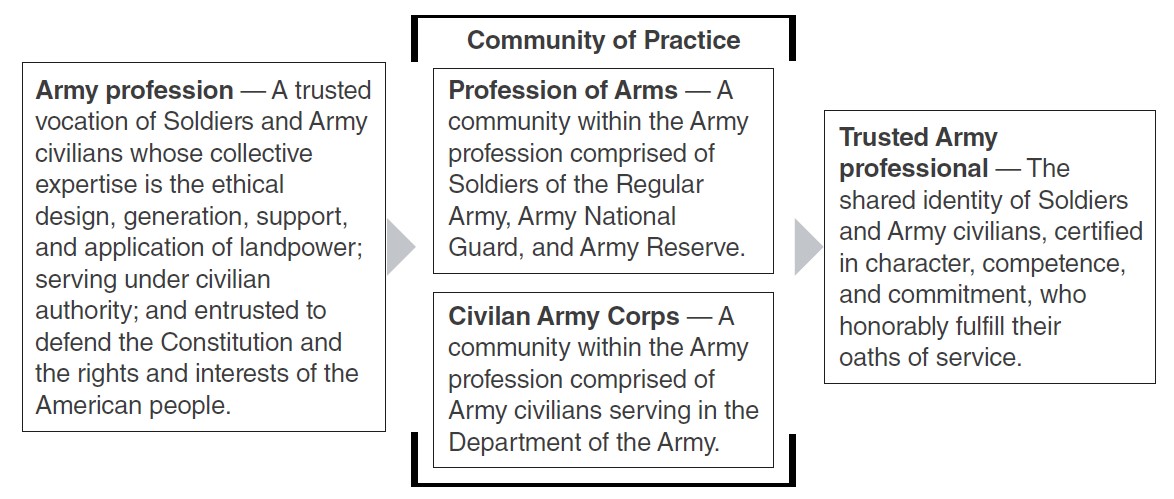
Image source: [184]
The US Army has an excellent profession model. It is cohesive as a concept, includes all fundamental inputs to capability, and has clearly defined and mutually supportive characteristics that uphold the Army’s status as a profession. Yet it is one especially suited to the context of the US Army and reflective of the United States’ unique civil-military relationship, cultural deference to the US constitution, and the employment of ‘Army Civilians’ within and by the Department of the Army. It is also reflective of the more (compared to Australia) decentralised administrative and regulatory structure within which the US services operate and where the US armed services are seen to form separate professions with distinct corporate identities, different jurisdictions of work, individual bureaucratic departments, and unique customs and traditions.[185] Therefore, while the US model offers significant inspiration to the Australian Army Profession as it develops, it would be inappropriate to rely on it too heavily given the significant differences in societal, legislative, and cultural contexts that underlie service in the US Army and in the Australian Army.
There is evidently scope for further research around the characteristics of the Stuart Model, including whether the three pillars offer the ‘final word’ in conceptualisation of Army professionalism. Nevertheless, one of the Model’s particular strengths is the simplicity of its three pillars, a characteristic that enhances the likelihood of its dissemination and uptake among Army personnel.
Further, being firmly rooted in military theory, it offers a strong conceptual baseline from which the Australian Army can seek to enhance its professionalisation within a uniquely Australian context. It also beds neatly within the existing principles that underpin the Australian Army Profession more broadly, emphasising the integrated nature of the modern ADF while maintaining a focus on the elements of land power that distinguish Army from the rest of the ADO. Combined as shown in Table 1, and juxtaposed with the characteristics of the integrated force’s Profession of Arms construct, the interrelationships are evident.
| Characteristics | Australian Profession of Arms (Ordinate Profession) | Australian Army Profession (Subordinate Profession) |
|---|---|---|
| Definition | The Australian profession of arms consists of people practised in the ethical application and exercise of lethal force to defend the rights and interests of the nation | An occupation comprising experts in the theory and application of land power and warfare in the land domain, who serve Australian society, regulate their conduct and activities in accordance with its expectations, and support the Profession of Arms in the defence of Australia and its interests |
| Role of the concept | The ADF’s integrated professional construct | The Army’s professional construct, as a part of the Australian Profession of Arms, a statement of identity within the integrated force and an aspirational model of professionalism |
| Purpose of the profession | To provide the nation with capable and credible experts in integrated operations for the defence of Australian territory, citizens, and interests | To provide the integrated force and the Australian Profession of Arms with experts in the theory and application of land power and warfare in the land domain, and personnel who are also able to support the ADF’s joint operations across all domains |
| Jurisdiction | The military defence of Australia, its territory, and interests | Raising, training, sustaining land forces, and ethical land combat on behalf of the integrated force |
| Membership | All actively serving members of the ADF (SERCAT 3-7) | All actively serving members of the Australian Army (SERCAT 3-7) |
| Ethos | Command, Leadership, Ethics, Character, and Culture | Good Soldiering |
| Responsible steward | Chief of the Defence Force | Chief of Army |
| Entry into the profession | Upon enlistment into the ADF | Upon completion of RMC Duntroon or associated commissioning course, or Army Initial Foundational Training |
Note: The items contained in the Army Profession column are recommendations based upon the research conducted for this paper and are consolidated here from the text.
Incorporating these definitional statements into Stuart’s three-pillar model, it is possible to form a cohesive visual representation of the Australian Army Profession (see Figure 4).
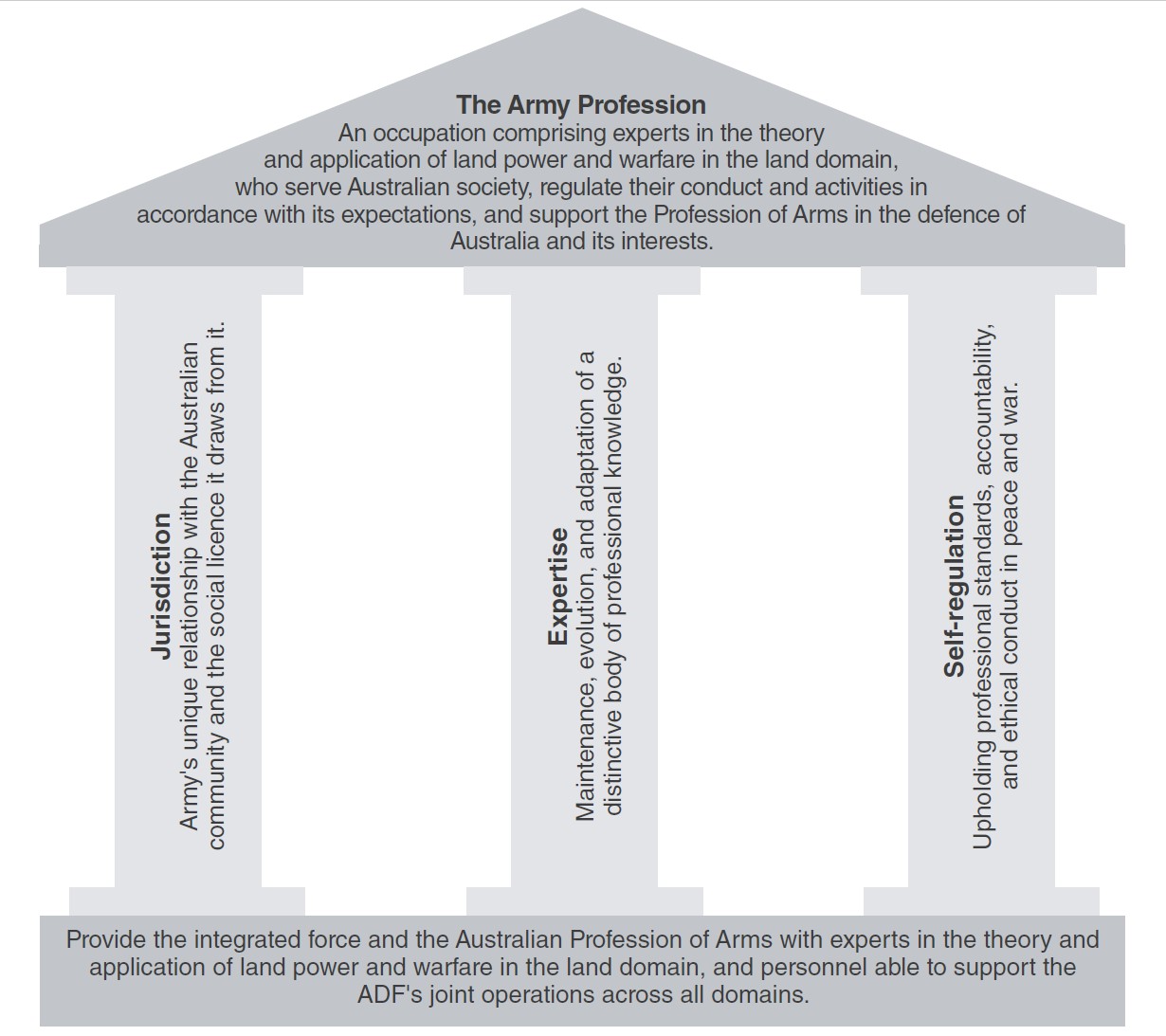
the profession and the three pillars, on a foundation of the profession’s unique purpose.
Challenges to the Australian Army Profession
Before concluding this paper, it is necessary to highlight several specific challenges facing the Australian Army Profession as of mid-2026. These challenges threaten the viability of the professional construct proposed by Stuart and elaborated upon here. This author assesses the following as the most significant such challenges.
Professional Centralisation
Owing to the subordinate nature of the Australian Army Profession to the Australian Profession of Arms as outlined above, the Army Profession is unique in that it exists at the discretion of the Chief of the Defence Force (CDF) as the professional head of the ADF and simultaneous steward of the Australian Profession of Arms. This is an inevitable outcome of the fact that the Army is a single institution wherein all Australian Army professionals are centrally employed, unlike, for example, the Australian medical profession, whose members are found throughout Australia and employed by a wide array of different organisations. This situation renders the Army Profession uniquely vulnerable to jurisdictional competition or even wholesale absorption within the Australian Profession of Arms, as the serving CDF of the day may order the abolition of the concept as inimical to the ADF-wide Profession of Arms or the integrated force. Such an outcome could hamper the capacity of Army’s workforce to adapt land power capability in response to the evolving social, technological and geopolitical context.
Mitigating this risk is the responsibility of Army’s senior leaders. They must continually advocate the critical role and demands of Australia’s land power capability to the ADF’s strategic centre. The concept of an Army Profession has unique value to the integrated force, especially with regard to its ability to enhance the professionalism, expertise, conduct, and preparedness of Army’s personnel and formations. In an environment of finite resources, intellectual and practical commitment to the concept of an Army Profession is an inexpensive means to continually develop the professionalism and capability of Army’s personnel. In this regard, the Army Profession does not operate in competition with the joint Australian Profession of Arms. Instead, it is the means through which Army can best attain and exceed its professional standards to deliver land power in the national interest. This Army Profession concept would be complemented by the existence of a comparable Navy Profession or Air Force Profession as a means to enhance ADF capability as a whole, and to enrich each service’s relationship with the Australian community it serves and from which it recruits.[186]
Embedding the Concept of an Army Profession
To date, the concept of an Army Profession has been a top-down initiative implemented by senior leaders and disseminated across the organisation from above. As such, many Army personnel may regard it as having little relevance to their day-to-day roles or responsibilities. While Army’s leadership has delivered sustained and cohesive messaging, embedding the Army Profession as more than a hypothetical or academic concept will require sustained effort from all of Army’s senior leaders, as well as practical institutional and organisational adaptations.
Annex A proposes a range of initiatives to support efforts to embed the Army profession within the Army as an institution and among its personnel as individuals. For example, Army must consider adapting its suite of doctrine (as well as some ADF doctrine such as ADF-I-3 ADF Land Power) to incorporate the Army profession as a foundational concept. At all ranks and in all contexts, Army members should be encouraged to adopt and use the language of the Army profession, emphasising how their activities relate to and support it.
Implementing the measures identified in Annex A will require substantial effort (but few financial resources). It will depend on the support of individuals with deep knowledge of the professional construct who can provide Army members with a thorough grounding in it. It will also require the development of comprehensive public affairs guidance to ensure consistent messaging to external stakeholders. Army must also consider developing widely accessible documents akin to the CAF’s Fighting Spirit: The Profession of Arms in Canada (2024), Canadian Armed Forces Ethos: Trusted to Serve (2022), or the US Army’s ADRP-1 The Army Profession (2015) or FM 1 The Army: A Primer to our Profession of Arms (2025). As of mid-2026, such an effort has been initiated by Army Headquarters through the development of a multi-volume work The Essentials of Land Warfare.[187] Ensuring that these volumes are intellectually grounded, informed in their content by the theory of the Army Profession espoused here or subsequently, and widely accessible to those within and outside of the Army will be key to their effectiveness.
To be fully institutionalised, the Australian Army Profession must be a persistent line of effort within the Army’s campaign plan.[188] This has occurred as of May 2026, but we recommend that the Chief of Army reinforce its continued implementation by establishing an Army Profession Analysis and Coordination Cell (APAC) in Army Headquarters. The APAC could report quarterly to the Army Board concerning ongoing challenges to the Army Profession across the three pillars. The Army Board is the principal regular assemblage of the Army’s senior leaders who are most able to direct reforms across Army. As such, it could empower the APAC to coordinate action concerning the Army Profession, to oversee the development of Army Profession materials and educational initiatives, to provide semi-independent quarterly reports to the Army Board on ongoing challenges to the Army Profession across the three pillars and holistically, and to be generally responsible for actions carried out under the Army Profession line of effort.
In the event that Army were to establish an APAC, its personnel would have several areas of focus. Frequent liaison would be conducted with regional Army formations to better understand the challenges and opportunities faced by Army professionals of all service categories. Cell members would analyse developments in the military professions of close allies and partners (especially Canada and the United States). The cell would also need to maintain close relationships with directorates and areas across Army, including the Chief of Army’s Initiatives Group, Army Communications, the Australian Army Research Centre, Forces Command, the wider ADF, Military Professional Mastery Branch, and the Australian Defence College. This organisational adaptation, and the subsequent work of the cell, would lay a firm foundation for an Army Profession that is conceptually healthy, responsive and adaptable to changing strategic and societal contexts, and an enduring element of Army’s identity.
Inclusivity
Some Army members may seek to limit membership of the Army Profession to a select few. The issue of exclusivity has already been discussed at length in this paper, but it bears reiterating. To ensure its longevity and viability, the Army Profession must be sufficiently inclusive to incorporate a wide membership. All members of the profession must guard against the perspective that they represent the ‘true’ Army Professionals by virtue of their specific task, role or rank. On the modern battlefield, the infantryman, the logistician, the gunner, the drone operator, the cyber specialist, and the medic all contribute to the combined arms fighting system and can be targeted, incapacitated or killed while contributing to the outcome of the battle. As Ben Connable has clearly shown, modern ground combat still relies on the contributions of a variety of supporting arms and effects, and will continue to do so for the foreseeable future.[189] Such battlefield capabilities require substantial reachback and entail real contributions from a variety of non-frontline personnel. Arguably, the boundary of the Army Profession should extend at least as far as the unlimited liability contract extends, while also incorporating other elements with expertise in the theory and application of land power on the modern battlefield.
The Relevance of Artificial Intelligence
It is difficult to understate the degree to which the Army profession (and the military professions writ large) are under threat from the growth and development of modern AI systems. As Susskind and Susskind have indicated, globally AI is transforming the work of the professions and of professionals and undermining their legitimacy. They even have hypothesised that ‘in the end, the traditional professions will be dismantled, leaving most (but not all) professionals to be replaced by less expert people and high performing systems’.[190]
Currently, AI systems are being systematically integrated into militaries worldwide. For example, in the 2026 Iran War, AI has been used consistently by the US, Israel, and Iran to support targeting, air strikes, and statecraft.[191] The military utility of AI systems in such tasks cannot be doubted, and their potential in speeding and supporting the military decision-making cycle is significant.[192] The difficulty, however, is in ensuring that the use of AI systems does not undermine the unique expertise of professional military personnel, or break the covenant of trust and legitimacy that, for hundreds of years, has underpinned the relationship between Western militaries and the societies they serve. A research team at the US Army War College has already established that current AI systems can pass the college’s oral comprehensive examination. This being the case, the imperative exists for the ADF, including Army, to consider how it views the nature of its expertise and how it assesses professional competence among its serving men and women.[193] To maintain its relevance and legitimacy in the eyes of the Australian public, Army must be able to convincingly advocate for (and show examples of) the wide array of expertise held within the Army Profession that cannot be replicated or applied by AI.
While remaining responsive to the potential offered by AI technologies, Army must remain equally attuned to the risks they pose. Specifically, the expertise that underlies military decision-making must not be supplanted by an artificial system which cannot be held accountable by the community. Army must always remind itself—and the community it serves—that the ethical use of military capabilities will continue to require a professional-in-the-loop. As Jack Watling has observed, there is a clear relationship between the technology a military uses and the professionalism and skills needed to operate it effectively and remain competitive. The expertise, skill, and professionalism of the operator unlock the potential of technology. A profession needs to balance its purpose, its expertise, its relationship with its client, its regulatory apparatus and its ethos with the requirement to undertake its work effectively.
With this observation, we conclude Part Two. In this part we have explored the foundation of the Australian Army Profession, and understanding it as a distinct, viable professional construct and a potential element of Army’s collective identity. As has been argued, much remains to be researched, debated, and analysed about the profession. Without conceptual clarity—an agreed definition, purpose, membership, ethos, and professional model—the Army Profession risks remaining an academic concept instead of a real-world influence. The observations provided throughout this part provide a baseline for further refinement and discussion. This promises to be a significant task and one that should be led by the professionals themselves, both serving and retired, to ensure that their legacy is profession that continues to effectively contribute land capability in support of the defence of Australia, its community, and its national interests.
Conclusion
The concept of a distinct, unique Australian Army Profession is a new one. But its youth does not detract from the utility it has in supporting the continued development of the Australian Army and its personnel in the face of rapid, sustained technological, geopolitical, and societal change.
As the 2026 National Defence Strategy stated, ‘[c]oercion and the use of force are again becoming more prominent features of statecraft’ and, in response, Australia ‘must seek military advantage in innovative ways, including through developing asymmetric advantage’.[194] Such asymmetry will not necessarily be found in technology. In war, the advantage provided by a particular technology or piece of equipment is often fleeting—opposing forces rapidly adapt or innovate to meet the new threat, rendering it but a temporary advantage. [195] Instead, it rests on the professionalism and adaptability of Australia’s military personnel. These characteristics will be generated through membership of the Australian Profession of Arms and the Australian Army Profession.
This paper has ranged widely in its effort to explore the theories, concepts and principles that underpin the unique professional construct that is the Army Profession. As we saw in Part One, professions are society’s method to structure expertise and to undertake tasks that the general population cannot perform itself. Professions generally share a number of common characteristics, including a monopoly on specialist knowledge, admission through credentials, the regulation of its members’ activities, and an identifiable common set of values. Over the past 450 years, the idea that the military is one of these identifiable professions has been a common one, especially within the British-Anglo tradition. From this have emerged the concepts of ‘military professions’ and the ‘profession of arms’, notions that have driven significant theorising, introspection, reform, and analysis across multiple continents. As we have argued, the degree to which even the armed forces of the Five Eyes nations have formalised the Profession of Arms concept within their militaries differs remarkably.
In Part Two we moved beyond this important contextual grounding to explore the fundamental aspects of the Australian Army Profession as a subset of the profession of arms. Here we proposed an initial definition of the profession, suggesting that it is:
An occupation comprising experts in the theory and application of land power and warfare in the land domain, who serve Australian society, regulate their conduct and activities in accordance with its expectations, and support the Profession of Arms in the defence of Australia and its interests.
Because the Australian Army Profession is a new concept, it requires elaboration. To this end, we have analysed its key features, including the purpose of the profession, its relationship with the Australian Profession of Arms, who is entitled to membership, at what point they enter into the profession, and the profession’s ethos (‘Good Soldiering’). How we conceptualise and model the profession has great significance for both its accessibility and reception. Since 2024, the Stuart Model of the profession—characterised by three pillars: jurisdiction, expertise and self-regulation—has been used by Army to pursue a high-level review of the concept. While there exist alternative models that could be used to conceptualise the Australian Army Profession, the Stuart Model is a particularly useful one given its simplicity and accessibility. A number of key challenges lie ahead of the Army Profession, including its vulnerability to centralisation in the ADF, the difficulty of embedding the concept into Army’s culture and identity, and the challenge posed to it by AI. Despite these challenges, the Army Profession can serve as a basis for introspection, reform, and adaptation during a dangerous geopolitical period.
As has been shown throughout this paper, there are a great many questions left unanswered regarding the Army Profession, and they warrant deeper consideration. As a priority, further research should be conducted to establish whether ‘culture’ should form its own pillar within the Stuart Model of the Army Profession, given its importance to both professions themselves and all facets of military organisations. Additional research should also be focused on the challenges posed by AI to the Army Profession and the means through which they can be mitigated. There is also scope to more firmly establish the internal ecology of the Australian Profession of Arms including whether the establishment of three service-centric sub-professions (army, navy and air force) is the most appropriate model to support the demands of expertise that exist across the five domains and the strategic centre.
For the Army Profession to endure, both as a concept and an identity, it must be embraced across the organisation, from the most senior leader to the most junior private soldier. This will take time and significant intellectual effort. It will also rely on the willingness of the professionals themselves to engage with the fundamental questions that underlie their service to society, their institution and their purpose. If the only immediate outcome is that more Army personnel become interested in analysing and debating the foundations of their profession, then Stuart’s effort to review the ‘state of the Army profession’ will have been a success.
About the Author
Dr Jordan Beavis is an Academic Research Officer at the Australian Army Research Centre (AARC), having formally worked as a Researcher for the Australian War Memorial’s Official History of Australian Operations in Iraq and Afghanistan. His research focuses on the militaries of the British Empire/Commonwealth in the interwar period (1919–1939), international engagement, professional military education, and mobilisation. Since 2024 he has been the AARC’s lead researcher on the ‘State of the Army Profession’ research priority.
Annex A – Consolidated list of Recommendations
Recommendation One
Using the initial definition provided in Part Two, refine or develop a clear and comprehensive definition of the Australian Army Profession and use this in both internal and external messaging.
Recommendation Two
Adapt Army and ADF doctrine, where possible, to incorporate references to the Australian Army Profession, its characteristics and other fundamental features. Such doctrine should also clearly articulate the profession’s membership, ethos, entry point, purpose, and relationship with the Australian Profession of Arms.
Recommendation Three
Prepare and deliver formalised professional military education resources on the foundations of the Australian Army Profession throughout all areas, formations and units of Army to ensure a baseline understanding of the profession across the institution.
Recommendation Four
Consider and direct the creation of an Army Profession Analysis and Coordination Cell within Army Headquarters which will be required to provide quarterly semi-independent reports to the Army Board on challenges related to the Army Profession. This cell will also be responsible for the creation of the suit of documents outlined in Recommendation Five, and provide input into Recommendations One, Two, and Three.
Recommendation Five
Develop and produce a suite of documents which provide an accessible introduction to and overview of the Australian Army Profession. These documents should be modelled on the CAF’s Fighting Spirit: The Profession of Arms in Canada (2024), Canadian Armed Forces Ethos: Trusted to Serve (2022) and the US Army’s ADRP-1 The Army Profession (2015) and FM 1 The Army: A Primer to Our Profession of Arms (2025), and grounded in the theories, concepts, and principles explored in this paper.
Recommendation Six
Develop comprehensive public affairs guidance for officers and other ranks that supports them in adopting the language of a profession and consistent messaging on the importance and characteristics of the Army Profession in their internal and external messaging. Ensure this language and messaging is also integrated into the entirety of the Army education and training continuums.
Recommendation Seven
Support or encourage further research into the model of the Army Profession, to determine if ‘culture’ should be included as its own pillar in the Stuart Model.
Recommendation Eight
Refine the definition and articulation of the ‘Good Soldiering’ concept to enhance its relevance to the Army Profession, and its utility as an ethos.
Endnotes
[1] Completion of this paper would not have been possible without the support and contributions of my colleagues in the Australian Army Research Centre, particularly Dr John Nash, Dr Andrew Richardson, Ms Kim Philpot, and Ms Luisa Powell. I am also continuingly grateful for the love, support, and patience of Renee Beavis and Cassandra Beavis.
[2] Craig Wilcox, Australia’s Boer War: The War in South Africa, 1899-1902 (Oxford University Press, 2002), pp. 345-346. Wilcox provides a figure of 20,000 to account for a wide variety of ways personnel from the Australian colonies could render service in the South African War. A figure of approximately 16,000, which represents the total number sent to South Africa in formed contingents, is more common. See, for example, ‘Australia and the Boer War, 1899-1902’, Australian War Memorial (website), at: https://www.awm.gov.au/articles/atwar/boer.
[3] Wilcox, Australia’s Boer War, pp. 345-46.
[4] Report of His Majesty’s Commissioners Appointed to Enquire Into the Military Preparations and Other Matters Connected with the War in South Africa (His Majesty’s Stationery Office, 1903), pp. 79-81.
[5] The Australian Army Contribution to the National Defence Strategy (Australian Army, 2026), p. 1.
[6] Marina Nuciari, ‘The Study of the Military: Models for the Military Profession’, in The Handbook of the Sociology of the Military, ed. Giuseppe Caforio and Marina Nuciari, 2nd edition. (Springer, 2018): p. 42.
[7] This requirement is shared by the Army Profession with the other military professions in Australia, including the ADF-level ‘Profession of Arms’.
[8] Sam C. Sarkesian, Beyond the Battlefield: The New Military Professionalism (Pergamon Press, 1981), p. 5.
[9] As explored below, while the concept of the ‘Army profession’ is a new one in Australia, it has been discussed in the context of the US Army for almost three decades. See Lloyd J. Matthews (ed.), The Future of the Army Profession (McGraw-Hill Primis Custom Publishing, 2002).
[10] National Defence: Defence Strategic Review (Commonwealth of Australia, 2023); National Defence Strategy (Commonwealth of Australia, 2024).
[11] Simon Stuart, ‘The Human Face of Battle and the State of the Army Profession’, speech, Chief of Army Symposium, Melbourne, 12 September 2024, transcript available at: https://www.army.gov.au/news-and-events/speeches-and-transcripts/2024-0….
[12] Phillips Payson O’Brien, War and Power: Who Wins Wars - and Why (Viking/Penguin, 2025), 221-222.
[13] Stuart, ‘The Human Face of Battle and the State of the Army Profession’.
[14] Simon Stuart, ‘The Challenges to the Australian Army Profession’, speech, National Security College, Australian National University, Canberra, 25 November 2024, transcript available at: https://www.army.gov.au/news-and-events/speeches-and-transcripts/2024-1…; Simon Stuart, ‘Strengthening the Australian Army Profession’, speech, Lowy Institute, Sydney, 3 April 2025, transcript available at: https://www.army.gov.au/news-and-events/speeches-and-transcripts/2025-04-03/strengthening-australian-army-profession; Simon Stuart, ‘Army in Society’, speech, Chief of Army Symposium, Parliament House, Canberra, 26 August 2025, video available at: https://youtu.be/UN2CdYR8dRo?si=UBnM3kvAoIqIBnXo; Simon Stuart, ‘State of the Army: Strategy, Culture, and Professional Mastery’, speech, The Cove, uploaded 28 October 2025, video available at: https://youtu.be/k-4Rg_Iy704?si=jVkLu29Vu75DxOHk; Simon Stuart, ‘The Future of the Australian Army Profession’, speech, Australian War Memorial, Canberra, 20 May 2026, transcript available at: https://www.army.gov.au/news-and-events/speeches-and-transcripts/2026-0….
[15] See ‘Cove Challenge 2025’, The Cove, 7 July 2025, https://cove.army.gov.au/article/cove-challenge-2025-what-being-army-profession-means-me; ‘’The Chief of Army Essay Competition – The Chauvel Essay Prize, 2025’, Australian Army Journal XX, no. 3 (2024): 317-318.
[16] Jordan Beavis, ‘Introduction: Debating the Army Profession’, Australian Army Journal XXI, no. 3 (2025): 3-15; Cate Carter, ‘Cultural Jurisdiction and the Future of the Army Profession’, Land Power Forum, Australian Army Research Centre, 25 February 2026, https://researchcentre.army.gov.au/library/land-power-forum/cultural-jurisdiction-and-future-army-profession; Dayton McCarthy, ‘The Concept of Jurisdiction in Domestic Security and Response Operations’, Land Power Forum, Australian Army Research Centre, 10 March 2026; Beau Hodge, ‘Army Jurisdiction: Its intersection with ‘Defence Assistance to the Civil Community’, and ‘Humanitarian Assistance and Disaster Relief’, Land Power Forum, Australian Army Research Centre, 12 March 2026; Jordan Beavis, ‘State of the Army Profession – A Reserve Infantry Perspective’, Australian Army Journal 22, no. 1 (2026): 174-189; Matthew L.M. Jones, ‘The Profession of Arms in an AI-Enabled World’, Australian Army Journal 22, no. 1 (2026): 70-87.
[17] Albert Palazzo, ‘Postscript’, in On Ops: Lessons and Challenges for the Australian Army Since East Timor, ed. Tom Frame and Albert Palazzo (UNSW Press, 2016), 302
[18] Jim Storr, Something Rotten: Land Command in the 21st Century (Howgate Publishing, 2022), 198.
[19] Beavis, ‘Introduction’, 6-7.
[20] Sarkesian, Beyond the Battlefield, 21.
[21] James Burk, ‘Thinking Through the End of the Cold War’, in The Military in New Times: Adapting Armed Forces to a Turbulent World ed. James Burk (Routledge, 1994), 14.
[22] Carl von Clausewitz, On War, trans. Michael Howard and Peter Paret (Princeton University Press, 1989), 101
[23] In this the Army Profession is intrinsically linked to the Australian Profession of Arms concept. See Mick Ryan, The Ryan Review: A study of Army’s education, training and doctrine needs for the future (Australian Army, 2016), 50
[24] John Kerr, ‘Address by His Excellency the Honourable Sir John Kerr, K.C.M.G., K.St.J., Q.C., Governor-General of Australia, At the Graduation Parade of The Royal Military College, Duntroon, Canberra’, Australian Army Journal no. 315 (August 1975): 23
[25] As Sheilagh Ogilvie notes, while the guild system was endemic throughout Western Europe in the Middle Ages, the guilds themselves could differ remarkably between trade, towns, regions, and kingdoms. See Sheilagh Ogilvie, ‘The Debate about Guilds’, in The European Guilds: An Economic Analysis (Princeton University Press, 2019), 1-35.
[26] Andrew Abbott, The System of Professions: An Essay on the Division of Expert Labor (The University of Chicago Press, 1988), 35.
[27] Richard Susskind and Daniel Susskind, The Future of The Professions: How Technology will Transform the work of Human Experts, 2nd ed. (Oxford University Press, 2022), 5.
[28] In February 2026 ‘Health & Education’ comprised 13.9% of the output of the Australian Economy. See ‘Composition of the Australian Economy’, Reserve Bank of Australia, last modified 3 February 2026, https://www.rba.gov.au/education/resources/snapshots/economy-composition-snapshot/.
[29] Susskind and Susskind, The Future of the Professions, 13.
[30] Susskind and Susskind, The Future of the Professions, 14.
[31] Abbott, The System of Professions, 318.
[32] Susskind and Susskind, The Future of the Professions, 19.
[33] Anthony King, The Combat Soldier: Infantry Tactics and Cohesion in the Twentieth and Twenty-First Centuries (Oxford University Press, 2013), 217.
[34] ‘How to become a doctor,’ Australian Medical Association, accessed 16 February 2026, https://www.ama.com.au/resources/how-to-become-a-doctor.
[35] Abbott, The System of Professions, 59.
[36] See Abbott, The System of Professions. For a succinct explanation of this in the context of the US Army’s history, see James Burk, ‘Expertise, Jurisdiction, and Legitimacy of the Military Profession’, in The Future of the Army Profession, ed. Lloyd J. Matthews (McGraw-Hill Primis Custom Publishing, 2002), 29-30.
[37] Susskind and Susskind, The Future of the Professions, 22.
[38] Sam C. Sarkesian, The Professional Army Officer in a Changing Society (Nelson-Hall Publishers, 1975), 12.
[39] Susskind and Susskind, The Future of the Professions, 22-23.
[40] For a classic definition of bureaucracies, see Walter I. Wardwell, ‘Social Integration, Bureaucratization, and the Professions’, Social Forces 33, no. 4 (1955): 356-359.
[41] More recently, some scholars have begun to differentiate between types of bureaucracies depending on how much latitude they provide their personnel. Paul S. Adler and Bryan Borys suggested in 1996 the existence of ‘coercive’ bureaucracies and ‘enabling’ bureaucracies; the former comprises rigidly structured organisations where deviation from establish processes is deemed suspect or punished where identified, while ‘enabling’ bureaucracies are those that provide latitude for personnel to adapt processes and responses to meet changing requirements, even where they may deviate from the norm. For a fuller examination, see Paul S. Adler and Bryan Borys, ‘Two Types of Bureaucracy: Enabling and Coercive’, Administrative Science Quarterly 41, 1 (1996): 61-89.
[42] It is here that the dual character of militaries as professions and institutions exists within a tension. As large, complex, hierarchical organisations militaries have to adopt certain bureaucratic processes for their own administration and regulation, all the while the professionals must be able to apply their expertise to new situations. Finding a balance between the bureaucratic and professional natures of a profession can be ‘elusive’, but the tension itself is, according to Don M. Snider and Gayle L. Watkins, ‘unavoidable and healthy’. See Don M. Snider and Gayle L Watkins, ‘Introduction’, in The Future of the Army Profession, ed. Lloyd J. Matthews (McGraw-Hill Primis Custom Publishing, 2002), 8-12.
[43] Sarkesian, The Professional Army Officer, 3, 240-41; Sarkesian, Beyond the Battlefield, 6.
[44] See John Hackett, The Profession of Arms: The 1962 Lees Knowles Lectures, reproduced in The Profession of Arms: Officer’s Call (Center for Military History, 2007)
[45] Louis de Gaya, A Treaties of the Arms and Engines of War, of Fire-works, Ensigns, and Military Instruments, both Ancient and Modern; with the Manner they are at present used as well in French Armies, as amongst other Nations, trans. unknown (Robert Harford, 1678), 1, available at: https://www.google.com.au/books/edition/A_treatise_of_the_arms_and_engines_of_wa/vaRkAAAAcAAJ?hl=en&gbpv=0. Note: this source’s use of the archaic ‘ʃ’ instead of the more modern ‘s’ has been corrected for accessibility, with capitalisation remaining as appears in original.
[46] See William Guthrie, A New Geographical, Historical, and Commercial Grammar; and the Present State of the Several Kingdoms of the World (J. Knox, 1771), 263;
[47] Charles James, A New and Enlarged Military Dictionary, in French and English, Vol. 2, 3rd ed. (T. Egerton, Military Library: 1810), Officer. Use of the term ‘Profession of Arms’ in Australia can be traced to as early as 1816. See: ‘From the Late London Papers’, The Sydney Gazette and New South Wales Advertiser, 20 April 1816, 2.
[48] William Darby, Mnemonika or the Tablet of Memory (Edward J. Coale, 1829), 24.
[49] Ian F.W. Beckett, A British Profession of Arms: The Politics of Command in the Late Victorian Army (University of Oklahoma Press 2018), 3-4.
[50] Harold D. Lasswell, ‘The Garrison State’, American Journal of Sociology 46, no. 4 (1941): 455; Harold D. Lasswell and Myres S. McDougal, ‘Legal Education and Public Policy: Professional Training in the Public Interest’, The Yale Law Journal 52, no. 2 (Mar. 1943): 208.
[51] Huntington, The Soldier and the State, 18.
[52] Huntington, The Soldier and the State, 8.
[53] Huntington, The Soldier and the State, 12-13.
[54] Huntington, The Soldier and the State, 11-12.
[55] Huntington, The Soldier and the State, 9-10, 14-15.
[56] Huntington, The Soldier and the State, 10.
[57] Nadia Schadlow and Richard A. Lacquement Jr, ‘Winning Wars, Not Just Battles: Expanding the Military Profession to Incorporate Stability Operations’, in American Civil-Military Relations: The Soldier and the State in a New Era, ed. Suzanne C. Nielsen and Don M. Snider (John Hopkins University Press, 2009), 114.
[58] Morris Janowitz, The Professional Soldier: A Social and Political Portrait (Free Press, 2017), 15, 175.
[59] Janowitz, The Professional Soldier, 9.
[60] Gwyn Harries-Jenkins, ‘The Concept of Military Professionalism’, Defense Analysis 6, no. 2 (1990): 120-121
[61] Janowitz, The Professional Soldier, 15.
[62] Janowitz, The Professional Soldier, 11-12, 22.
[63] Janowitz, The Professional Soldier, 221.
[64] Janowitz, The Professional Soldier, 6.
[65] Giuseppe Caforio and Doo-Seung Hong, ‘Some Historical Notes’, in The Handbook of the Sociology of the Military, ed. Giuseppe Caforio and Marina Nuciari, 2nd ed. (Springer, 2018): 18.
[66] See Hackett, The Profession of Arms: The 1962 Lees Knowles Lectures; John Hackett, The Profession of Arms (Macmillan, 1983); John Hackett, ‘The Profession of Arms’, Proceedings (United States Naval Institute) 93/4/770 (1967): 82-92.
[67] Nathan K. Finney and Tyrell I. Mayfield, ‘The Modern Military Profession’, in Redefining the Modern Military: The Intersection of Profession and Ethics, ed. Nathan K. Finney and Tyrell O. Mayfield (Naval Institute Press, 2018), 222, 227.
[68] Hackett, The Profession of Arms, 9.
[69] Hackett, The Profession of Arms, 9-10.
[70] Charles C. Moskos, ‘From Institution to Occupation: Trends in Military Organization’, Armed Forces and Society 4, no. 1 (1977): 41-42.
[71] Moskos, ‘From Institution to Occupation’, 42-43.
[72] Moskos, ‘From Institution to Occupation’, 43-44.
[73] Caforio and Hong, ‘Some Historical Notes’, 23.
[74] Sarkesian, Beyond the Battlefield, 9-10.
[75] John A. Nagl, C. Anthony Pfaff, and Don M. Snider, Army Professionalism, the Military Ethic, and Officership in the 21st Century (United States Army War College Press, 1999), 12-13.
[76] Sarkesian, Beyond the Battlefield, 10.
[77] Burk has sometimes been erroneously labelled as the originator of this term. This is incorrect, as the first exploration of the term and the concept of jurisdictional competition was presented in Andrew Abbott’s 1988 The System of the Professions. Burk, however, was the first to apply the term to a military profession model.
[78] Burk, ‘Expertise, Jurisdiction, and Legitimacy’, 23, 29.
[79] Burk, ‘Expertise, Jurisdiction, and Legitimacy’, 29-30.
[80] Burk, ‘Expertise, Jurisdiction, and Legitimacy’, 23.
[81] See, for example, Anthony King’s commentary on the professionalism and infantry soldiers: King, The Combat Soldier, 221.
[82] James G. Stavridis, Ervin J. Rokke, and Terry C. Pierce, ‘Crafting and Managing Effects: The Evolution of the Profession of Arms’, Joint Force Quarterly 81 (2016): 5.
[83] ADF-C-0: Australian Military Power (Canberra: Commonwealth of Australia, 2024), 70-71.
[84] Fighting Spirit: The Profession of Arms in Canada (Canadian Defence Academy, 2024), 34.
[85] The Profession of Arms: An Army White Paper (U.S. Army, 2010), 4.
[86] ADP 6-22: Army Leadership and the Profession (Department of the Army, July 2019), pg. 1-2
[87] See, for example, ADF-P-0 Military Ethics (Australian Defence Force, 2021).
[88] In the Australian context, see: Defence Force Discipline Act 1982, available at: https://www.legislation.gov.au/C2004A02711/latest/text; Defence Force Discipline Act Law Manual: Interim Edition (Department of Defence, 2022).
[89] Charles C. Moskos Jr., ‘The All-Volunteer Military: Calling, Profession, or Occupation’, Parameters 7, no. 1 (1977): 2.
[90] Moskos, for example, suggested as early as 1977 that trends in the United States were moving towards an occupational model for the military, away from seeing it as a calling, with their motivations becoming more about extrinsic factors (remuneration, benefits) than that of service. See Moskos, ‘The All-Volunteer Military’; Giuseppe Caforio and Doo-Seung Hong, ‘Some Historical Notes’, in The Handbook of the Sociology of the Military, ed. Giuseppe Caforio and Marina Nuciari, 2nd ed. (Springer, 2018): 22-24.
[91] For analysis on this within the Australian context, see: Brad West and Josh Healy, Drawing on Reserves: Assessing Civilian Employer/Manager Support for Employees’ Part-Time Military Service, Australian Army Occasional Paper No. 28 (Australian Army Research Centre, 2024), pp. 35–36; Jodie Lording, ‘Paid Volunteers: Experiencing Reserve Service and Resignation’, Australian Army Journal XII, no. 1 (2015): 90-106.
[92] Patrick Mileham, ‘Unlimited Liability and the Military Covenant’, Journal of Military Ethics 9, no 1 (2010): 24.
[93] Mileham, ‘Unlimited Liability and the Military Covenant’.
[94] Naomi Shephard, ‘Leadership for the profession of arms: an unlimited liability’, Smart Soldier 57 (August 2019): 27.
[95] Australian Military Power (2024), 71.
[96] Fighting Spirit, 36.
[97] See Mileham, ‘Unlimited Liability and the Military Covenant’.
[98] Stuart, ‘Challenges to the Australian Army Profession’
[99] Huntington, The Soldier and the State, 12.
[100] Hackett, The Profession of Arms, 3, 25.
[101] Andrew Abbott, ‘The Army and the Theory of Professions’, In The Future of the Army Profession, ed. Lloyd J. Matthews (McGraw-Hill Primis Custom Publishing, 2002), 523.
[102] See Trine Villumsen Berling and Christian Bueger (eds.), Security Expertise: Practice, Power, Responsibility (Routledge, 2015); Tamir Libel, ‘From the sociology of the (military) profession to the sociology of (security) expertise: the case of European national defence universities’, Defence Studies 19, no. 1 (2019): 62-84.
[103] ‘Colleges and College National Committees’, Engineers Australia, updated 25 July 2025, https://www.engineersaustralia.org.au/engineering-communities/colleges-and-college-national-committees
[104] See, for example, Observer [psud.] ‘The Sunday Parade: To the Editor of the Mercury’, The Mercury (Hobart), 9 January 1879, 3; ‘The M’ilwraith Banquet’, The Telegraph (Brisbane), 26 August 1884, 4; ‘Editorial’, Army and Navy Gazette, 23 June 1883, 1-2, available at: https://www.google.com.au/books/edition/Army_and_Navy_Gazette/5vh3t7mCO0wC?hl=en&gbpv=0
[105] EK Rawson, ‘The Naval Profession’, A. B. N. Churchill, ‘The Army as a Profession’, Journal of the Royal United Services Institution 54, iss. 384 (1910): 166-198.
[106] Huntington, The Soldier and the State, 12.
[107] Abbott, The System of Professions, 72-3.
[108] Snider and Watkins, ‘Introduction’, 6-7.
[109] William M. Beasley Jr., ‘The Rise, Fall, and Early Reawakening of US Naval Professionalism’, in Redefining the Modern Military: The Intersection of Profession and Ethics ed. Nathan K. Finney and Tyrell O. Mayfield (Naval Institute Press, 2018), 106.
[110] See Bryan M. Titus, ‘Establishing a Space Profession within the US Space Force’, Air & Space Power Journal 32, no. 3 (2020): 10-28; Isaiah Wilson III and C. Anthony Pfaff, ‘Making the Case for a Joint Special Operations Profession’, Joint Force Quarterly 105 (2022): 44-54.
[111] O.H. Becher, ‘The profession of arms’, The Canberra Times, 11 June 1968, 12.
[112] Committee of Inquiry into Financial Terms and Conditions of Service for Male and Female Members of the Regular Armed Forces: Report No. 6 – Officers’ Salaries, December 1971, p. 32, National Archives of Australia, A5908, 467, 4295355.
[113] See, for example, Senate Standing Committee on Foreign Affairs and Defence, ‘Report on the Australian Army’ (Government Printer of Australia, November 1974), available at https://nla.gov.au/nla.obj-1745313661; Kerr, ‘Address by His Excellency’; Arthur Tange, ‘Departmental Organisation and the Profession of Arms – A Civilian Perspective’, Australian Army Journal 316 (1975): 3-18; John Kerr, ‘Address by His Excellency the Honourable Sir John Kerr, K.C.M.G., K.St.J., Q.C., Governor-General of Australia and Commander-in-Chief, At the Graduation Parade of The Royal Military College, Duntroon, Canberra, Tuesday 9 December 1975’, Australian Army Journal no. 321 (1976): 5-6; .
[114] P. J. Norton, Report of the Regular Officer Development Committee (Australian Army, 1978), paras. 102-104.
[115] Committee members did note, however, that this comment did not ‘imply that WRAAC officers apply themselves to their training and duties in other than a professional manner’. P. J. Norton, Regular Officer Development Committee: Study Five – Women Officers and ‘Specialized Corps’ (Australian Army, 1978), 8.
[116] Norton, Report of the Regular Officer, paras. 106, 236.
[117] R.G. Funnell, ‘The Professional Military Officer in Australia: A Direction for the Future,’ Defence Force Journal no. 23 (1980): 23.
[118] Public Affairs & Corporate Communication, Department of Defence, The Australian Approach to Warfare (Department of Defence, June 2002).
[119] C. W. Orme, Beyond Compliance: Professionalism Trust and Capability in the Australian Profession of Arms (Commonwealth of Australia, 2011), 6.
[120] Australian Military Power, 70-71
[121] See ADF-C-0 Australian Military Power, 2nd ed (Australian Defence Force, 2024); Joint Doctrine Publication 0-01: British Defence Doctrine, 3rd ed. (Ministry of Defence, 2008), 5-1; Army Regulation 600-100 – Army Profession and Leadership Policy (Department of the Army, 27 April 2025); Fighting Spirit: The Profession of Arms in Canada (Canadian Defence Academy, 2024), 34; Future Land Operating Concept 2035: Integrated Land Missions (New Zealand Defence Force, 2026), 72.
[122] Some scholars and practitioners have, at times, bucked this trend, notably Alan Ryan, Craig Orme, Mick Ryan, and Michael Evans, though their valuable contributions have rarely commenced the widespread intraprofessional debate they deserve.
[123] Reed Robert Bonadonna, Soldiers and Civilization: How the Profession of Arms Thought and Fought the Modern World into Existence (Naval Institute Press, 2017), 7.
[124] A. M. Carr-Saunders and P. A. Wilson, The Professions (Oxford University Press, 1933), 3.
[125] Michael Howard, ‘The Use and Abuse of Military History Parameters 11, no. 1 (1981): 13.
[126] Lawrence Freedman, Strategy: A History (Oxford University Press, 2013), 159.
[127] Meredith Kleykamp, ‘Foreword’, in Rethinking Military Professionalism for the Changing Armed Forces, ed. Krystal K. Hachey, Tamir Libel and Waylon H. Dean (Springer, 2020), v-vii.
[128] In Australia, the integration of concepts such as the Australian Profession of Arms and ‘Unlimited Liability’ into capstone doctrine is the clearest example of this. In 2021, for example, the 4th edition of ADF-C-0 Foundations of Australian Military Doctrine for the first time included explicit discussion of both the Profession of Arms and Unlimited Liability. Oddly, the first edition of Australian Military Power, released this same year, contained no reference to these topics, but the subsequent 2nd edition (2024) does. See ADF-C-0 Foundations of Australian Military Doctrine (Australian Defence Force, 2021); ADF-C-0 Australian Military Power (Australian Defence Force, 2021); Australian Military Power (2024).
[129] Stuart, ‘The Future of the Australian Army Profession’.
[130] Philip Hoglin, ‘Does the Profession of Arms Exist?’, Australian Army Journal 21, no. 3 (2025): 125-126.
[131] Pauline Shanks-Kaurin, ‘Questioning Military Professionalism’, in Redefining the Modern Military: The Intersection of Profession and Ethics ed. Nathan K. Finney and Tyrell O. Mayfield (Naval Institute Press, 2018), 20.
[132] Bonadonna, Soldiers and Civilization, 7.
[133] Stuart, ‘The Human Face of Battle and the State of the Army Profession’.
[134] Stuart, ‘The Future of the Australian Army Profession’.
[135] Stuart, ‘The Future of the Australian Army Profession’.
[136] See: Stuart, ‘The Human Face of Battle’; Stuart, ‘Challenges of the Army Profession’, Stuart, ‘Strengthening the Army Profession’; Stuart, ‘The Future of the Army Profession’; The Australian Army Contribution to the National Defence Strategy (Australian Army, 2024); The Australian Army Contribution to the National Defence Strategy (Australian Army, 2026).
[137] By comparison, in the United States Army, the US Army Profession comprises two distinct communities of practice, namely the Profession of Arms and the Army Civilian Corps. See ADP 6-22: Army Leadership and the Profession (Department of the Army, July 2019), pg. 1-2
[138] Christopher Tuck, ‘Conclusion’, in Understanding Modern Warfare, by David Jordan, James D. Kiras, David J. Lonsdale, Ian Speller, Christopher Tuck and C. Dale Walton, 2nd ed. (Cambridge University Press, 2016), 449.
[139] National Defence: Defence Strategic Review, 54.
[140] The overlap between the Army Profession, the Naval Profession, and the Air Force Profession comprises aspects of their respective professions they share (such as expertise in specific tasks) not shared by all, i.e. both Army and Navy operate significant maritime vessels while the RAAF does not. Currently unclear, however, is where the expertise required for ADF operations in the Space and Cyber domains most appropriately reside within this Australian Profession of Arms.
[141] Stuart, ‘The Human Face of Battle’.
[142] See: Beavis, ‘State of the Army Profession – A Reserve Infantry Perspective’.
[143] Australian Military Power (2024), 70-71
[144] Australian Military Power (2024), 70-71
[145] Samantha Crompvoets, ‘Exploring future service needs of Australian Defence Force Reservists’, report, Australian National University, 2013, 40-41, available at https://www.dva.gov.au/documents-and-publications/exploring-future-service-needs-of-australian-defence-force-reservists; Brad West and Josh Healy, Drawing on Reserves: Assessing Civilian Employer/Manager Support for Employees’ Part-time Military Service (Australian Army Research Centre, 2025), 35-36
[146] Jodie Lording, ‘Paid Volunteers: Experiencing Reserve Service and Resignation’, Australian Army Journal XII, no. 1 (2015): 95; Department of Defence, Strategic Review of the Australian Defence Force Reserves (Commonwealth of Australia, 2024), 24, 65; Eyal Ben-Ari and Edna Lomsky-Feder, ‘Epilogue’, Armed Forces & Society 37, no. 2 (2011): 364
[147] Charles D. Allen, ‘Assessing the Army Profession’, Parameters 41, no. 3 (2011): 78.
[148] Department of Defence, Strategic Review of the Australian Defence Force Reserves, 20, 58.
[149] Infantry Plan 2030 (Australian Army, 2026), p. 22.
[150] Department of Defence, Defence Annual Report: 2011-12 (Commonwealth of Australia, 2011), 22; Department of Defence, Defence Annual Report: 2024-25 (Commonwealth of Australia, 2025), 128.
[151] Irina Goldenberg and Angela R. Febbraro, ‘Civil-Military Relations in Our Own Backyard: Partnership between Military Members and Defence Civil Servants’, in Total Defence Forces in the Twenty-First Century, ed. Joakim Berndtsson, Irina Goldenberg and Stefanie von Hlatky (McGill-Queen’s University Press, 2023), 98-100.
[152] Susskind and Susskind, The Future of the Professions, 19.
[153] ‘Ways to Join’, ADF Careers, accessed 14 April 2026, https://www.adfcareers.gov.au/careers/joining/ways-to-join
Australian Military Power (2024), pp. 70.
[155] Compared to the traditional professions, completion of a 9-13 week course is an exceptionally low bar for entry into a profession.
[156] Sarkesian, The Professional Army Officer, 19.
[157] The Canadian Armed Forces Ethos: Trusted to Serve (Canadian Defence Academy, 2022), 15.
[158] The Canadian Armed Forces Ethos: Trusted to Serve, 14-43.
[159] Army Regulation 600-100 – Army Profession and Leadership Policy, 3.
[160] See ADF-P-0 Culture in the Profession of Arms (Australian Defence Force, 2024); ADF-P-0 Command (Australian Defence Force, 2024); ADF-P-0 Character in the Profession of Arms (Australian Defence Force, 2024); ADP-P-0 ADF Leadership, 3rd ed. (Australian Defence Force, 2021); ADF-P-0 Military Ethics (Australian Defence Force, 2021).
[161] Rick Burr, ‘Army in Motion: Good Soldiering Statement’, available at https://www.army.gov.au/sites/default/files/2023-06/Good-Soldiering.pdf
[162] In Stuart’s initial version of this model, the pillars comprised Expertise, Self-Regulation, and ‘service to society’. In subsequent iterations the ‘service to society’ pillar has been altered to ‘Jurisdiction’. See Stuart, ‘The Human Face of Battle’.
[163] Stuart, ‘Strengthening the Australian Army Profession’.
[164] Stuart, ‘Challenges to the Australian Army Profession’.
[165] Risa Brooks, ‘Keogh Chair Address – Chief of Army Symposium 2025, Australian Parliament House, 26 August 2025,’ Australian Army Journal XXI, no. 3 (2025): 297.
[166] Sarkesian, The Professional Army Officer, 241.
[167] Stuart, ‘Strengthening the Australian Army Profession’.
[168] Stuart, ‘Strengthening the Australian Army Profession’.
[169] Richard H. Kohn, ‘First Priorities in Military Professionalism’, Orbis 57, no. 3 (2013): 388-89.
[170] Matthew A. Tattar, Innovation and Adaptation in War (The MIT Press, 2025), 7.
[171] As B. H. Liddell Hart once famously quipped, ‘the only thing harder than getting a new idea into the military mind is to get an old idea out’. Basil Liddell Hart, Thoughts on War, quoted in Peter G Tsouras (ed.), The Greenhill Dictionary of Military Quotations (Greenhill, 2000), 75.
[172] For a recent exploration of the Army’s virtue ethic, see Benjamin Gray, ‘Military Virtue in Practice: Embedding Virtue Ethics in the Army Profession’, Australian Army Journal XXII, no. 2 (2026): 20-40.
[173] ‘Stuart, ‘The Human Face of Battle’; Stuart, ‘The Challenges to the Australian Army Profession’. The idea that war corrupts the moral and ethical values of the soldier is not new. See, for example, Stephen Coleman, Military Ethics: An Introduction with Case Studies (Oxford University Press, 2012).
[174] The Soldier: Essentials of Land Warfare Vol. 1 (Army Headquarters, 2026), 9-10.
[175] See: Michael Evans, ‘Conclusion: the eternal human face of warfare’, in The Human Face of Warfare: Killing, Fear & Chaos, ed. Michael Evans and Alan Ryan (Allen & Unwin, 2000); Michael Evans, ‘Captains of the Soul: Stoic Philosphy and the Western Profession of Arms in the Twenty-first Century’, Naval War College Review 64, no. 1 (2011): 30-58.
[176] Jeffrey J. Matthews, Generals and Admirals, Criminals and Crooks: Dishonourable Leadership in the U.S. Military (University of Notre Dame Press, 2023), 303.
[177] Kohn, ‘First Priorities in Military Professionalism’, 381.
[178] Benjamin Gray, ‘Aristotelian Battle Ethics: An examination of the utility of Aristotelian Virtue Ethics for the Australian Army at the tactical level of war’ (masters’ thesis, UNSW Canberra, 2025), 10,
[179] Peter R. Mansoor and Williamson Murray, ‘Introduction’, in The Culture of Military Organizations, ed. Peter R. Mansoor and Williamson Murray (Cambridge University Press, 2019), 1.
[180] Army Leadership and the Profession, 1-2.
[181] Army Leadership and the Profession, 1-2.
[182] Army Leadership and the Profession, 1-2.
[183] Army Leadership and the Profession, 1-2.
[184] Army Leadership and the Profession, 1-2
[185] Beasley, ‘The Rise, Fall, and Early Reawakening of US Naval Professionalism’, 106.
[186] Some use of the terms ‘naval profession’ or ‘maritime profession’ and ‘Air Force profession’ or ‘Air Force profession of arms’ is already evident in the Australian context, suggesting fertile ground for the exploration of such professional concepts. See ‘About ANI’, Australian Naval Institute, accessed 16 April 2026, https://navalinstitute.com.au/about-ani/; ‘FAQs’, The Runway – Air Force, accessed 16 April 2026, https://runway.airforce.gov.au/help;
See: The Soldier; The Sword and Baton: Essential of Land Warfare Volume 2 (Australian Army, 2026).
[188] Stuart, ‘The Future of the Army Profession’.
[189] See Ben Connable, Ground Combat: Puncturing the Myths of Modern War (Georgetown University Press, 2025).
[190] Susskind and Susskind, The Future of the Professions, 405.
[191] Jean-Michel Valantin, ‘The Iran War: A War With or Against the AI Sector?’, Small Wars Journal, 10 April 2026, https://smallwarsjournal.com/2026/04/10/the-iran-war/.
[192] Michael S. Silver, Kellen D. Sick, Matthew A. Snyder, and Justin E. Farnell, ‘Cognitive Warfare and Organizational Design: Leveraging AI to Reshape Military Decisionmaking’, Joint Force Quarterly 119 (2025): 23-32.
[193] Keven M. Boyce, John A. Nagle and Kristan J. Wheaton, ‘Can AI Pass the US Army War College?’, Parameters Now (April 2026): 1-26, available at https://ssi.armywarcollege.edu/SSI-Media/Recent-Publications/Article/44…
[194] National Defence Strategy (Australian Government, 2026), p. 11.
[195] National Defence Strategy (Australian Government, 2026), p. 11.