Note from Director, Australian Army Research Centre: This address was provided by Colonel/Dr Dayton McCarthy to an AARC-run seminar on the ‘State of the Army Profession’, held at Royal Military College – Duntroon on 20 November 2025, as part of a panel exploring the ‘Jurisdiction’ pillar of the Army Profession. It is published here in full to inform and spur a wider conversation of the topic.
I wish to examine the concept of jurisdiction as one of the three pillars that make up the army profession and how that jurisdiction specifically relates to domestic security and response operations in a homeland defence context. First, I will frame the term jurisdiction so I can relate to it this discussion this morning. Then I will detail just what I mean by security and response operations. With these definitional foundations in place, I aim to illustrate the very necessary alignment between strategic direction and the concept of jurisdiction within the Army profession. Such an alignment constitutes, as the military analyst Jim Storr described it, the ‘golden thread of purpose’.[1] Let us begin to see how this ‘golden thread’ is woven through the Army profession.
Now I did Latin at school, so on one level, understanding jurisdiction is simple – it translates quite literally to speak the law. However, this literal translation would be incorrect if we left it at that. Without context, this translation could suggest that anyone could take it upon themselves to ‘speak the law’ in any circumstance and without any parameters. We know that this is not the meaning of jurisdiction. Instead, the term as applied in a legal sense, requires an authority bequeathed to someone before that person can ‘speak the law’. What is more, that authority is limited and bounded to a defined area of responsibility. The important aspects of jurisdiction therefore is the notion of authority granted and the limits of that authority.
The latest Australian Army Journal deals with several aspect of the army profession, but there are two quotes from two articles that I want to draw out. The first is from Major Robert Bruce, who, using the work of sociologist James Burk, noted that ‘jurisdiction is defined by “the boundaries of the domain within which expert knowledge is applied”’.[2] Therefore, Bruce surmises, jurisdiction is prone to expansion and contraction in line with the societal requirements, the changing character of war and strategic circumstance.
The second is from Dr Jordan Beavis who noted that domain (as it relates to military jurisdiction) ‘goes far beyond that to also include concepts such as social and legal legitimacy, social licence, Army’s interactions with the community, and public perceptions of Army’s role and purpose’.[3]
Bruce and Beavis therefore build upon the basic idea of authority granted upon a bounded area of endeavour by adding the notions that both the authority and the bounded area themselves may change and therefore the profession must respond accordingly or risk losing that social licence.
With this understanding of jurisdiction in place, let us go back to domestic security and response operations within a homeland defence context. What are they? The Defence Strategic Review provides this explicit but broad guidance:
Enhanced domestic security and response Army Reserve brigades will be required to provide area security to the northern base network and other critical infrastructure.[4]
Nested beneath the DSR was the National Defence Strategy. In response to the NDS The Australian Army Contribution to the National Defence Strategy states that the 2nd (Australian) Division will be responsible for ‘domestic security and response operations’ which support ‘civil authorities with homeland security including the northern base network and other critical infrastructure’.[5]
Although security and response operations, within the context of homeland defence, will be joint and interagency, there is a very clear focus on land forces, and the 2nd (Australian) Division in particular. In other words, domestic security and response operations will be a key part of the land force’s contribution to the integrated force.
What tasks or missions might comprise these security and response operations as part of homeland defence?
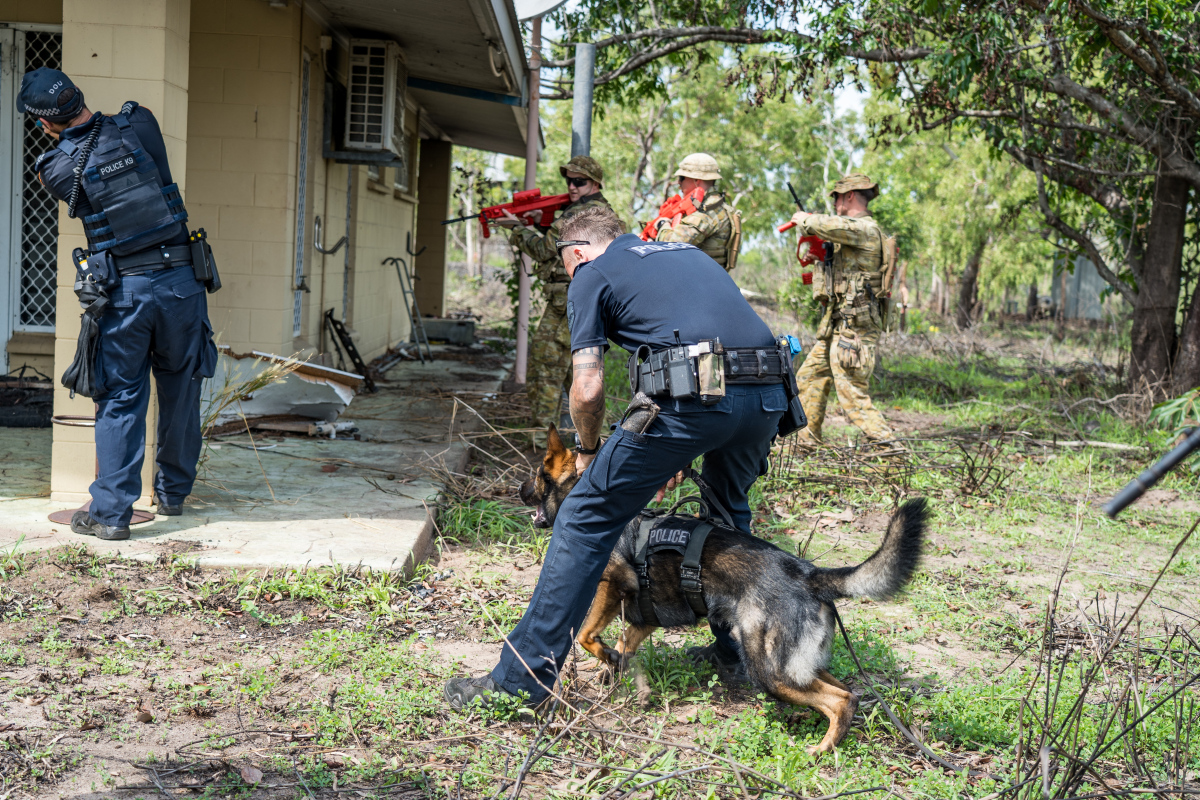
The 2nd Division, operationalised as the homeland joint task force (JTF) 629, may be required to conduct ‘wide area security’, which entails the protection of populations, forces, infrastructure and activities to deny the adversary positions of advantage. Related actions may include screen and guard patrolling; the establishment of checkpoints, access control and cordons; and the conduct of decisive engagement to deter, repel and defeat hostile acts. The Army might conduct tasks unilaterally, or as is more likely, acting in concert with civilian police forces. Remember also that these actions will take place on Australian soil, potentially in and around Australian cities and towns and, possibly conducted against Australian citizens or residents. Australian and international media will be ever-present. Our soldiers will require the ‘Wisdom of Solomon’ as they juggle an operational task, working among the diverse Australian population and under scrutiny of the media. A mistake made in such a febrile environment could result poor public perceptions of the Army or at worst, a revocation of its social licence.
I would see that in addition to the tasks just described, the Government would expect more of the Army during security and response operations. Homeland defence is a holistic concept, and contributing to the resilience of the civilian population is a task that is every bit as essential as protecting assets. In this regard, the 2nd Division and the Army as a whole has a wealth of recent experience in conducting DACC (Defence assistance to the civil community) tasks over the last five years. However, we must not assume that society will have the same level of resilience during a conflict. A calculated threat actor would seek to exploit fissures within our society through grey zone actions, while undertaking other forms of coercive measures to disrupt and divide our society. How would the Army contribute to building resilience or maintaining social cohesion? It may be as simple as presence patrolling; a few soldiers on a street corner or walking the neighbourhood. Perhaps, as during Covid, it may involve contributing to the business continuity of government services with an aim of infusing a ‘keep calm and carry on’ mind-set into Australian society.
Let us consider some of the ‘so whats’. The first is that civil authorities will retain primacy for policing and security within state and territory jurisdictions. State and territory boundaries and equities do not simply disappear when conducting security and response operations. In other words, the Army may demonstrate the nature of its ‘professional jurisdiction’ by recognising and working with the legal jurisdiction of the nation’s police and emergency services.
The second is that deployment of armed ADF elements domestically requires specific legal authority; such authority may be derived from extant legislation such as the Defence Act 1903 or from within the executive power inherent in the Constitution. One may assume that, in time of war, the Australian Government might exercise its executive power to widen the employment of, and the authorities given to, the ADF. Despite the existence of such provisions, legal and jurisdictional concerns are likely to be an ever-present characteristic of security and response operations - even during the most benign use of the Army. Expanding on this, the Army might have the legal authority to conduct certain missions on Australian soil - but what if these legal actions unintentionally undermined the Army’s moral authority and thus the jurisdiction bequeathed it by society?
We would expect a manifold mix of interagency challenges, political sensitivities, legal ambiguity and competing demands for finite capabilities during such homeland defence operations. This supports Major Bruce’s observation on the evolving nature of jurisdiction, expanding and contracting in line with the societal requirements, the changing character of war and strategic circumstances.[6] Domestic security and response operations will challenge Army’s jurisdiction and will therefore demand the same high standards of professional mastery and organisational acumen as offshore operations.
The 2nd Division, the home to most of the Army’s part time reservists, is proud that it is ‘of and from the community’. The division views this symbiotic relationship with the Australian people as one of its key strengths but we would be naïve to expect such a relationship to remain unchallenged during a homeland defence context. The Army is really only starting to understand the multitudinous tasks, linkages and importantly, potential consequences within domestic security and response operations. Nevertheless, what we understand already is the criticality of the Army’s relationship with Australian society. The Government will task Army to protect Australia and its people but we cannot afford – to paraphrase a well-known trope- to ‘destroy society in order to protect it.’
In other words, Beavis’s cautionary remarks ring very true. Army’s jurisdiction – as it relates to security and response operations – is beholden to ‘social and legal legitimacy, social licence, Army’s interactions with the community, and public perceptions of Army’s role and purpose’.[7]
When conducting domestic security and response operations, we must remember this always.
Endnotes
[1] Jim Storr, Something Rotten: Land Command in the 21st Century, Howgate, 2022, p 4.
[2] Robert Bruce, ‘Preparing the Army as a Profession for Mobilisation’, Australian Army Journal 21, No. 3 (2025): 283.
[3] Jordan Beavis, ‘Introduction - Debating the Army Profession’, Australian Army Journal 21, No. 3 (2025): 8
[4] Commonwealth of Australia, National Defence: Defence Strategic Review (Canberra: Commonwealth of Australia, 2023), p. 58
[5] Australian Army, The Australian Army Contribution to the National Defence Strategy 2024 (Canberra: Department of Defence, 2024), p. 16.
[6] Bruce, ‘Preparing the Army as a Profession for Mobilisation’, 283-285.
[7] Beavis, ‘Introduction – Debating the Army Profession’, 8.