2025 G.L. Maitland Lecture, Royal New South Wales Regiment Conference, Holsworthy Barracks, 13 September 2025
Introduction
Good morning Your Excellency, Sirs, Ma’ams, and colleagues. Before commencing my remarks, I would like to extend my sincerest thanks to Major General Brereton for his very kind invitation to present the Maitland Lecture to you all today. It is a privilege to follow other presenters of this lecture such as David Leece, Garth Pratten, Ron Lyons, Albert Palazzo, and Craig Stockings. I hope what I have to say today comes close to the high standard they have set. I would also like to extend my thanks to Lieutenant Colonel Tony Ang for his organisation of today’s program and to my colleagues in the Australian Army Research Centre (AARC) for their support and feedback as I prepared my remarks.
I must emphasise that the content of my lecture today reflects the views only of myself as an academic researcher, and not necessarily those of the AARC, the Australian Defence Force (ADF), or the Department of Defence. My hope is that my remarks spur further discussion, research, and debate among service members of all service categories, as well as among academics and the public.
Today I will explore the state of the Army Profession, doing so though the lens of the Reserves and the reserve infantry. Almost exactly a year ago today, during the 2024 Chief of Army Symposium in Melbourne, Lieutenant General Simon Stuart noted his intent for a ‘review’ and reassessment of the ‘Army Profession’ and how it pertains to all aspects and dimensions of Army’s preparation for the challenges of today and tomorrow.[1] In subsequent discussion, little exploration of the unique association between the Army Profession, the reserves, and reserve service has occurred. This is reflective of a broader theme in military studies: as Vincent Connelly and Eyal Ben-Ari attested in 2023, little research is done on reserve components of armed forces compared to regular forces.[2] The findings from research on regular force military personnel are also regularly assumed to apply to reservists, ‘despite notable differences in their employment’ and context.[3]
That so little scholarly attention is given to reserve forces is additionally problematic due to their increasing importance in national force structures and defence policies globally, including in Australia. Government, society, and the Army as an institution, have long relied upon the contribution of reservists and part-time soldiers to facilitate the defence of Australia, and to meet operational demands. Indeed, apart from the period 1945–1949 when the Citizen Military Forces (CMF) underwent a post-Second World War reorganisation, it was only in 1972 that the Regular Army began to consistently surpass the numerical strength of the reserve forces.[4] Reliance upon an army largely composed of citizen soldiers was at the heart of Australian defence policy following Federation. Today, reservists serve in every part of Army, with many undertaking specialist work and giving the institution the benefit of their military and civilian expertise.[5] It is somewhat popular today to talk of the utility of the ‘total defence force’ concept—a move away from a focus on regular forces and towards a more holistic and collaborative use of the entire defence workforce including reserves, defence civil servants, and contractors—as the future operating concept for many Western defence forces.[6] While the adoption of such a model for the ADF is a matter for our highest leadership, I would suggest that the ADF is already some way down this road with the implementation of the Total Workforce System and the operationalisation of reserve formations in the 2nd (Australian) Division under JTF 629. It is the important nature of the tasks assigned to Army’s reserve formations and members that makes it all the more essential that we explore the place of the reserves in the modern Army Profession.
I will be presenting my lecture today in two parts. First I will outline what it is we mean by the Australian ‘Army Profession’, and how this relates to the broader Australian Profession of Arms. For those who have had the opportunity to read my introduction to the AARC’s upcoming ‘State of the Army Profession’ themed Army Journal, some of what I have to say here may be familiar[7].
In the second part we will consider the place of Army’s reservists within the Australian Army Profession. There does exist substantial debate among academics, military members, and the public as to what constitutes an ‘Army Professional’, and there has been little analysis undertaken in Australia of whether part-time or reserve service qualifies reservists to hold such a title. Here I will make no grand declarations, but explore some of the factors that lead me to suggest that, on balance, reservists and the reserve infantry should be more readily identified as members of the profession in both the public and vocational spheres.
The Profession of Arms and the Army Profession
In the history of the Australian Army there has been no significant, holistic study of the Australian Army profession, past, present or future. There have been excellent studies and scholars of Army’s unique history, its relationship to society and government, its methods of discipline, its culture, ethos, and expertise. However, these too-often siloed specialisations have not been combined to form a cohesive foundation for what constitutes the Australian Army profession. Its key characteristics and features have not been debated, how it differs from or relates to the other military professions and the broader ‘profession of arms’ has not been explored, and its claim for its status as a ‘profession’ has not been adequately proven. Together, all these factors form a theory of the profession—a foundation for its application on behalf of society.
Two factors account for this lack of investigation. First is the relationship between the ‘army profession’ and the broader ‘profession of arms’. As a term, ‘profession of arms’ has a long history but in the 19th century it began to be used as a synonym for ‘army’ or ‘military’ or to describe the action of service in such an institution as a commissioned officer.[8] In an 1810 definition, British Major Charles James claimed the profession of arms as the domain of the officers, and noted that there was no other profession with so ‘grave’ a responsibility as being ‘charged with defending the state’, and none that required ‘greater knowledge and capacity than the army’.[9] It is important to note that British Army officers of this period would scarcely meet the definition of what a modern audience would call professional: commissions and promotion were largely attained through purchase and far less often through merit; few passed through standardised officer training such as at the Royal Military College or the Royal Military Academy; pay was poor; and unless on active operations officers hardly devoted their full time to military matters, instead actively engaging in other business or aristocratic pursuits.[10] As an aside, there was one sense in which their experience is very familiar to us today, with the military administration system of the time being described as labyrinthine.[11] It was in the American context that the term ‘profession of arms’ became more clearly tied with a full-time force. One 1829 definition of the term ‘standing army’ stated that it comprised ‘a body of men exclusively set apart and employed in the profession of arms, as distinguished from militia’.[12]
It is from this intellectual and linguistic heritage that the term ‘profession of arms’ grew in popularity in the 20th century, spurred on by individuals such as General Sir John Hackett.[13] Hackett’s definition of the term became the standard one. He considered that it comprised ‘the ordered application of force in the resolution of a social problem’. It was further characterised as ‘an occupation with a distinguishable corpus of specific technical knowledge and doctrine’, a coherent group with a complex of institutions peculiar to itself, and with an educational pattern adapted to its own needs.[14] Australia was not immune from such linguistic spread. On the eve of war in 1939, The Cairns Post suggested that Army’s permanent soldiers comprised ‘a profession which within the Commonwealth for many years [had] been an indifferent one’, though the rapid growth of the Army at this time saw it take on ‘new promise’.[15] In the 1960s the profession of arms became synonymous with Army’s permanent soldiers, partly due to the term’s use in recruiting campaigns for the Regular Army and in post-Vietnam War discussions on military reform.[16]
The term ‘army profession’ has, comparatively, a much shorter lineage, both internationally and in Australia. The terms ‘army’ and ‘profession’ have often been linked and have been used for a similar length of time as ‘profession of arms’—and were often synonymous with it.[17] However, the modern concept of the ‘army profession’ is much younger, being developed in the late 20th century. It has come to the fore as a result of the integration of Western armies, navies and air forces into unified organisations, à la the Australian Defence Force, the United States Armed Forces or the British Armed Forces. With such centralisation it is perhaps natural that the ‘profession of arms’ becomes a term used to bind all services into a joint ‘profession’ with common values or ethos. Yet fundamental differences in the expertise required, the manner of regulation and the character of war across the military domains count against such a combination, and have led some to espouse the existence of sub-professions within this broad ‘profession of arms’, such as the ‘army profession’, the ‘air force profession’ or the ‘navy/naval profession’. While discussion of the particularities of the army profession has been evidenced in the American context since 2002, it took 22 years for the Australian Army to consider if such terminology has utility to its own practices. We should be careful, however, of assuming that international literature on the army profession or the profession of arms applies to the unique institution, and legal and cultural context, of the Australian Army. Such material should be used cautiously, as the nature of professions is such that they operate differently across national boundaries. Factors such as legal and regulatory frameworks, demographics, social and cultural attitudes, and education requirements culminate to render, for example, an Australian lawyer and an American lawyer members of unique professions, despite commonalities in the task being performed.[18]
The Three Pillars of the Profession
On multiple occasions in 2024 and 2025, Stuart has provided clear guidance on what he, as the lead steward of the Australian Army profession, views as the profession’s key characteristics. Drawing upon the work of Samuel Huntington, Morris Janowitz, Hackett, and James Burk, Stuart has identified ‘three pillars of the modern Army profession’, namely jurisdiction, expertise and self-regulation. Jurisdiction comprises the unique service Army provides to society. Expertise refers to Army’s capacity to maintain and develop new knowledge to achieve its tasks as directed by the society it serves. Self-regulation comprises Army’s ability to uphold professional standards in its conduct in both peace and war.[19] Together, these three pillars form the foundation of Army’s considerable capability as the ‘integrated force’s experts in land combat’.[20] Yet beyond this conception of the pillars of the profession remains a critical question that is yet to be explored—who is an ‘Army Professional’ and how far does this label and identity extend? While on the surface this may seem a relatively simple question, the further one digs the more nuance, exceptions, and divergence of opinion one can find. It is a thorny problem and one rendered all the more difficult, as Professor Meredith Kleykamp has stated, by the fact that ‘[m]odern militaries must embrace new and varied kinds of missions that stretch them beyond their [traditional] expertise in the management of violence’.[21] Let us now turn to a key facet of this question—the place of the reserves in the profession.
Reserves in the Profession—Historical Association
In Army’s history, the relationship between reserve elements and the Army’s full-time soldiers has been, at times, a contentious one. From Federation through to the end of the Second World War, the Army’s principal force for the defence of the nation was its militia. On 9 July 1901 the Minister for Defence, Sir John Forrest, stated in parliament that Australia looked to the ‘services of our citizens’ to provide for its defence. This, he believed, was not only the most ‘economical’ and ‘efficient’ course for the new nation but was due to a wide-ranging belief that in the ongoing war in South Africa ‘our citizen soldiers … have proved themselves worthy to fight and do their duty under difficulties and privations side by side with the trained veterans of the Empire’.[22] The Defence Act 1903 reflected such attitudes—the Permanent Forces were limited to a small core of officers and NCOs who would carry out administrative, instructional, and technical duties, with citizen soldiers forming the Army’s field force and providing its commanders.[23]
The conscious division of Army into two forces—permanent and part time—left an indelible imprint upon it. In the decades following Federation, both groups competed for scarce resources, equipment, training opportunities, the attention of the public and government, and chances to use their capabilities. This internal rivalry sometimes spilled over into the public sphere. In November 1937, Major-General Gordon Bennett (who would later command the 8th Division in Malaya and Singapore) took to the newspapers to publicly decry the fact that two of Australia’s six divisions were being commanded by regular officers and not citizen soldiers. ‘Experience has proved’, Bennett declared, ‘that citizen officers can handle our Citizen Army more efficiently than permanent officers’, as it was only they that possessed ‘the capacity to lead’.[24] This article, in the major Sydney paper The Sun, was accompanied by a second a week later where Bennett claimed that the condition of the Army made him feel ‘ashamed of my Australian citizenship’.[25] Unsurprisingly, such public statements caused considerable and lasting ill will between him and many permanent officers.[26] During the Second World War, and especially while on operations, the distinction between permanent soldiers and part-timers decreased markedly. Some decisions, however, still caused friction. Prime Minister Robert Menzies’s 1939 declaration, for example, that all commands of the 6th Australian Division would go to militiamen rankled many permanent officers seeking opportunities to command.[27]
Despite the creation of the Australian Regular Army in November 1947, there was still a widely acknowledged belief that Australia required a strong body of citizen soldiers. Yet, as Dayton McCarthy has shown, the years 1947–1974 were hardly happy ones for citizen soldiers in Australia, as they were faced with government apathy, military-bureaucratic disinterest, and societal ambivalence, and were unable to adapt to changing defence environments.[28] This period marked yet a further period of competition for primacy within the Army between regulars and CMF personnel. Indeed, that they competed here and previously is somewhat to be expected. According to noted sociologist Andrew Abbott, intra-professional competition—where defined groups within a profession compete for organisational, bureaucratic and status primacy—constitutes a normal aspect of professional life.[29] In this instance, and by the withdrawal of the Army from Vietnam, this was a battle which the regulars won.
It was in the 1960s that the regular Army began to adopt and use the terminology of the ‘profession of arms’ to support recruiting. Yet there was some attempt to broaden the utility of this term within Army. In April 1974 a committee under Thomas Millar (an academic and former permanent and CMF officer) submitted a report to parliament advising on the future of the CMF and its potential transition into an ‘Army reserve’. The role of a CMF-like force to supplement regulars was articulated, and it has remained since a model that Army has employed to maximise its national defence capacity. Throughout this report the authors did identify a place within the Australian profession of arms for members of such a reserve force. The report acknowledged that not only did the CMF undertake some of the peacetime functions of the regular Army but reservists brought with them ‘special skills’ that the Army had not paid for, with the ‘voluntary, amateur enthusiast’ also able to achieve ‘remarkable levels of professionalism, perhaps higher than are achieved by some people occupationally engaged in the same pursuit’.[30] Both regular and reservist needed to come to understand that they were part of a single team—‘one Australian army’ or a ‘total force’—while acknowledging and understanding the differences in service of each. In the 30 years since the end of the Second World War, the report noted, Australia had developed a profession of arms—the ‘place of the citizen soldier in the total context of this profession is different from what it was in the past, but it is still essential and honourable’.[31]
Yet such exhortation fell on barren soil. Only seven months later, in November 1974, a report on the Army by the Senate Standing Committee on Foreign Affairs and Defence ignored such rhetoric. While acknowledging that the citizen soldier remained vital to a major Army expansion, it nonetheless concluded that they would only ‘complement rather than [be] a substitute for the highly trained and professional corps of regular soldiers’.[32] It is here, most plainly, that the regular Army claimed sole jurisdiction over both the title ‘professional’ and the profession of arms, a rhetorical ground and aspect of professional identity that it subsequently held for many years. This had many lasting consequences—in 2013 some reserve members reported they faced a ‘deeply ingrained’ hostility from regulars, while also accusing some of ensuring they were ‘deliberately misinformed’ on exercises to ensure they appeared ‘unprofessional’.[33] Further research is necessary to assess, beyond anecdotes, if this is still the case. Such tensions between reservists and regulars are, as Vincent Connelly has shown in a British context, ‘an enduring challenge to the [total defence force] concept’.[34] They are also a challenge to a unified Army Profession that incorporates reservists into its ranks.
Reserves in the Army Profession: Employment and Doctrine
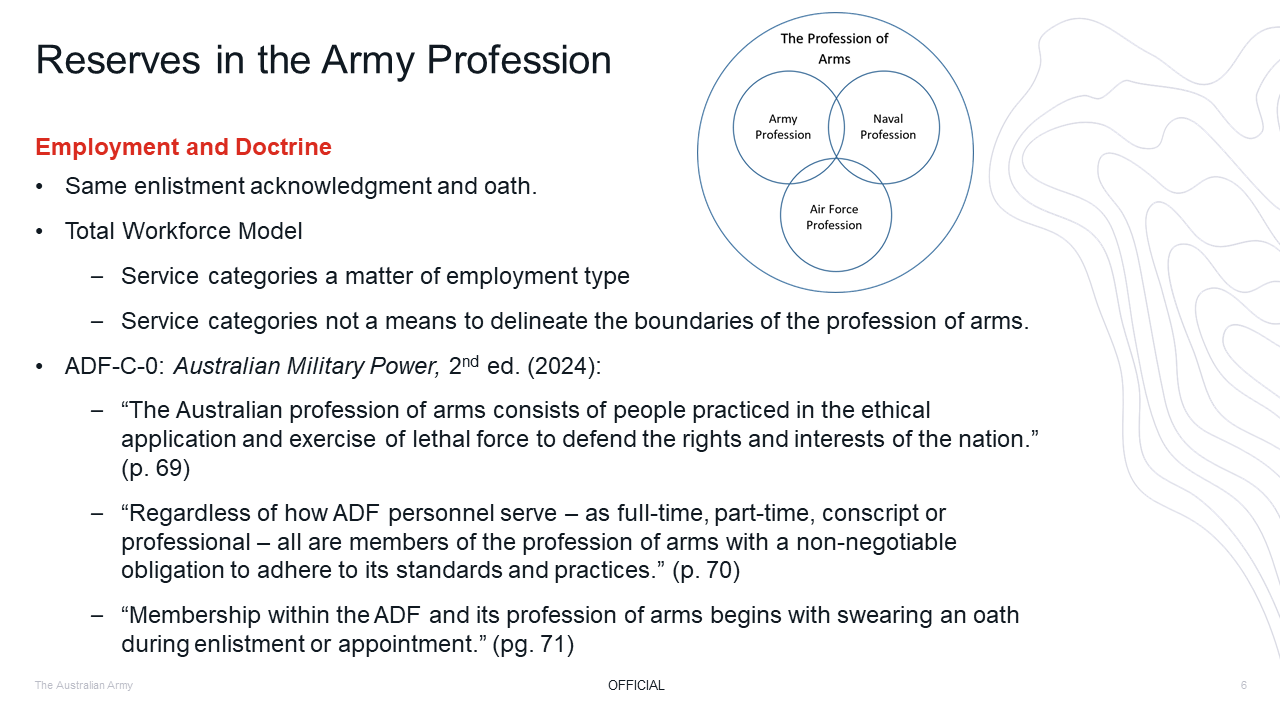
It is with this conceptual and historical foundation in mind that we can turn to some of the contemporary factors bearing on the place of the reserves and the reserve infantry in the Army Profession. Let us begin at the highest level, namely that of employment and doctrine. It is, I think, important to remember that individuals now joining the ADF as full-time or part-time members join the same institution, under the same oath of service, and in doing so agree to adhere to a common legislative and disciplinary framework. Both reservists and full-timers acknowledge that they may be liable to perform combat or combat-related duties, as well as peacekeeping, humanitarian assistance, or disaster relief either within or beyond Australia’s territorial limits.[35] Further to this, under the Total Workforce System, individuals do not join a reserve organisation, but instead join the ADF in a specific reserve service category. This is an employment classification, not a delineator of capability, role, or professionalism. This is supported by the capstone document in the ADF’s suite of doctrine—Australian Military Power. I will not read verbatim each of the quotes on the slide I am showing (Figure 1), but I will draw your particular attention to the second one, which attests that all ADF personnel—be they full time, part time, conscript or professional (this should be altered to ‘permanent’)—are members of the profession of arms. Such membership begins with the swearing of the oath during enlistment or appointment.[36] If we are to accept the model whereby the Australian Army Profession exists as a subset of the Australian profession of arms, then the suggestion that reservists belong within the Army profession is a strong one.
Reserves in the Army Profession—Perceptions of Identity, Time and Commitment
Yet despite such a sweeping declaration by this doctrine, there is the issue of perception. As Sam C Sarkesian noted in 1975, ‘to be called a professional is to be qualified and perceived of as an expert. The word identifies a person as one who has more than an occupational commitment to [their] speciality’.[37] ‘Time’ and ‘perceptions of time served’ are used by many full-time professionals in many professions ‘to dismiss the professionalism of those members who violate the norms of long hours [and] the blurred boundaries between work and home’, and to call into question the commitment of individuals who elect to undertake part-time work regardless of their competence.[38] Indeed, the 24/7 nature of the permanent soldier’s commitment is fundamental to many full-timers’ identity as military professionals.[39] Many, both in the public and internally in the ADF, therefore have had a tendency to disregard the role of reservists, viewing them as non-authentic military members largely motivated by tax-free pay or the desire for a hobby.[40] This is a not altogether unexpected outcome of the dual military and civilian lives of the reservist. By positioning themselves simultaneously in both the civilian and military worlds, reservists face the unenviable situation of usually being defined by the half that differentiates them from whichever context they happen to be in.[41]
Such perceptions do not withstand scrutiny. Significant research in both Australia and Britain has shown that reservists occupy a unique form of employment, one used by many to pursue two or more careers simultaneously.[42] While we should not presume that this attitude reflects the motivation of all reserve members, I would support the contention that many Australian Army reservists take a ‘professional approach’ to their reserve roles and aim to be able to do their job to the same standard as the regular soldier, this being a means through which they judge their competency and professionalism.[43]
The accusations that reservists lack the commitment required of a profession are also ill founded—Defence relies upon the commitment of reservists to achieve even business-as-usual outcomes.[44] Some reservists have been reported as structuring their relationships and civilian employment around their reserve service, and not vice versa as one might expect.[45] In the UK this has led some Army Reservists, as a means to show their commitment to their service, to more actively demonstrate sacrifices made regarding their civilian career or family time while also undertaking extra hours of unpaid work.[46]
Motivations for reserve service should also not solely be reduced to a desire for tax-free pay or to play soldier. Indeed, if service to society is a fundamental aspect of modern professions, then many Army Reservists also fulfil this requirement. In a paper published this year by the Australian Army Research Centre, a survey of reservists demonstrated that the most common motivations for service are a volunteer ethic, a desire to serve the community, and a sense of patriotism.[47] Again, this is reflective of the motivations of many reservists in partner nations such as Canada.[48] As to the suggestion that reservists are motivated by financial remuneration, this cannot and should not be disregarded. We should, however, note that the recent Strategic Review into the reserves emphasised that the pay and financial benefits of reserve service were increasingly being seen as uncompetitive against alternative forms of part-time employment, with a disparity of approximately 30 per cent between SERCAT 5s and SERCAT 7s.[49] Again, further research is needed to provide additional hard data on perceptions of ADF reserve service both within and without.
Reserves in the Army Profession
We must also consider another factor that can complicate the reservists’ place in the Army Profession: that is, whether reservists can attain and maintain the expertise expected of the ‘Army Professional’. There is a view that the ‘practice of military skills demands a degree of expertise that can only be acquired through extensive training in the highly institutionalized settings of the standing army’ and therefore the reserves cannot be considered truly professional.[50] But is this necessarily true? Militaries have long struggled with the problem of generating capability from reserves and part-time soldiers, an issue particularly acute in the combat arms. Whereas the lawyer, doctor, or cyber specialist may be able to practise core aspects of their reserve role through a civilian career, the reserve infanteer cannot unless they are employed in specialised police roles related to counterterrorism or tactical response, and even here they will use different tactics, techniques, and procedures. To this, I would suggest consideration of three factors.
Firstly, we should not disregard the often impressive capability that reserve soldiers are able to generate in the limited training time and opportunities they have, in spite of the ‘part-time army; full-time admin’ burden.[51] Over the past 25 years, reservists have proven themselves fully capable of operational service, especially after the usual pre-operational training with regular counterparts.
Secondly, where a reservist may lack proficiency in a military-specific skill, they often bring into Army a wider base of skills and experience derived from their civilian employment that, some feel, can make up for less frequent military training. This is perhaps most notable in deployments involving substantial civil–military engagement. However, some British reservists have reported that regular soldiers do not value or see as relevant expertise or experience gained in a non-military context.[52] This dismissal of civilian experience is replicated in ADF bureaucracy—the Strategic Review of the Australian Defence Force Reserves noted that many reservists provide the ADF with ‘extensive civilian or commercial experience that does not match an ADF qualification but provides a level of expertise necessary for an ADF outcome’.[53] The engineering, intelligence, medical, and technical trade skills that some reservists bring with them into service are critical to meeting ADF operational requirements, are of significant use in the application of violence in the land domain, and can be expensive to generate and maintain internally.[54]
Thirdly, the ADF has come a long way in providing opportunities for education and training to its reserve cohort. For example, there are now part-time courses at the Australian War College and reserve iterations of the Combat Officers Advanced Course. Further progress in this area is needed, however, to ensure that reservists are provided the same access to training and professional development courses as regular personnel. To ensure maximum integration, further opportunities for realistic exercises incorporating both reserve and regular formations must also be developed.
Reserves in the Army Profession—the US Army Reserve and the National Guard
We have already acknowledged that professions differ across national boundaries owing to different social, cultural, regulatory, and legislative frameworks. Notwithstanding this, it may be useful to consider how a key ally and partner, in this case the United States, conceptualises the place of its reserve forces in its military profession. In 2010 the US Army commenced its own journey of introspection into the nature of its army profession and profession of arms, acknowledging that in preceding years the institution had sometimes ‘struggled’ to ‘maintain the highest standards of the Profession of Arms’.
One of the critical questions posed in commencing this review was this: ‘What does it mean to be a professional soldier?’[55] A draft definition was provided, articulating that an American professional soldier was:
an expert, a volunteer certified in the Profession of Arms, bonded with comrades in a shared identity and culture of sacrifice and service to the nation and the Constitution, who adheres to the highest ethical standards and is a steward of the future of the Army profession.[56]
As a definition of membership within the profession, this was not sufficient. In subsequent discussions it was rapidly identified that the multiple cohorts with a stake in the profession of arms (civilians, soldiers and officers at all levels and employment statuses) found exclusivity in membership to be ‘divisive and not helpful in enabling the Army to archive its mission and exercise its core competencies’, as each was an ‘indispensable contributor to the Army mission’.[57] This was a point forcefully reinforced by General (ret.) Fredrick Franks in the pages of the US Army’s Military Review. Here, Franks suggested that the operationalisation of the US Army Reserve and National Guard, and their continuing contribution to force generation for dangerous overseas deployments, fitted them to be incorporated into the profession.[58] Both justifications were embraced. Subsequently, Army Doctrine Reference Publication No. 1—The Army Profession, published in 2013, allowed no space for interpretation, declaring that ‘[t]he Profession of Arms is the uniformed members of the Army Profession. This category includes the Regular Army, Army National Guard, and Army Reserve’.[59] The National Guard and the US Army Reserves remain within the Army Profession and the Profession of Arms, each being acknowledged as a key component of the ‘Total Army’ construct.[60]
Reserves in the Army Profession—Additional Considerations
There do remain, however, additional considerations that must be borne in mind regarding the place of the reserves in the Army Profession. The first is a matter of an alternative categorisation. In 1990, noted US sociologist Charles Moskos suggested that, instead of just the delineation between regular and reservist, there could exist a category of ‘professional reservists’ or ‘part time professionals’ who, in terms of the capability, commitment, and time served, occupied the middle ground between the professional regular and the traditional ‘weekend warrior’ reservist.[61] As a model, this is a limited one, and the potential ramifications of further sub-categorising Army’s soldiers based on perceived capability would be significant and negative.
Important consideration also needs to be given to the role of unlimited and limited liability in the Army Profession. Where regular soldiers use the concept of unlimited liability as a key aspect of their identity, this can marginalise the reservist. Unless subject to a call-out order from the Governor-General, reserve service is inherently more conditional, more flexible, and more easily withdrawn on the basis of a lack of fulfilment.[62] Further research and debate on how far the unlimited or limited liability concepts apply to service in the modern ADF is necessary, as this could have ramifications should some seek to ensure the Army Profession is a tightly bounded and exclusive professional body and identity.
Lastly, we must consider how far we are able to stretch the boundaries of the Army profession. Professions are, by their nature, designed and developed to deal with a particular problem or provide a certain service. Annexation by a profession of additional tasks or groups has risks. As Abbott has shown, as the boundaries of a profession expand, the central ideas unifying it necessarily become more abstract.[63] This can weaken the control of the profession over the tasks being undertaken, diminish its status and make it vulnerable to inter-professional competition. In public and vocational discussions regarding the place of the army’s reserves in the army profession, commentators must be sure to highlight through rigorous and empirical arguments how their presence in the profession strengthens it.
Conclusion
As already noted, there has been little exploration in Australia of the unique association between the Army Profession, the reserves, and reserve service. For many years, the doors of the profession were held closed to reservists. Times have changed, and the role of the reserves has changed. On balance, and considering many of the factors I have discussed today, it is my hope that many reservists do conceive of themselves as members of the Army Profession, fully and wholly incorporated into its framework. This, I feel, is only reasonable—it is an acknowledgment of the very real contribution of the reserves to Australian defence and security. We must also consider the perception of any resistance to Reserve inclusion. Given the critical mission provided to Army’s reserve formations under Theatre Mission One, it would not benefit Army’s relationship with society if homeland defence were being seen as led by non-professionals, weekend warriors, and hobbyists who lack the expertise to fulfil their mission.
Yet there still do exist a wide variety of interpretations of what the Army Profession comprises and how far its membership extends. This can range from seeing it as a highly exclusive body solely comprising only full-time regulars of the combat corps, through to incorporating Army’s entire workforce, including public servants and contractors. Understanding the boundaries to the profession will be an important area of research and discussion as we continue to review the current state of the Army profession. As with all other cohorts within the Army Profession, and in line with standard practice in other professions more generally, reservists must continue to publicly and vocationally advocate for and defend their place in the profession. Regulars, I would also suggest, also have a part to play by ensuring they acknowledge the important contributions of reservists to the profession, Army, and defence. Army will only benefit if all reservists and regulars come to feel and to understand that they are colleagues in a single profession—the Australian Army Profession—working together with other members of the Australian Profession of Arms, in service to Australian society.[64]
Endnotes
[1] Simon Stuart, ‘The Human Face of Battle and the State of the Army Profession’, speech, Chief of Army Symposium, Melbourne, 12 September 2024, transcript at: https://www.army.gov.au/news-and-events/speeches-and-transcripts/2024-09-12/chief-army-symposium-keynote-speech-human-face-battle-state-army-profession.
[2] Vincent Connelly and Eyal Ben-Ari, ‘Introduction: Negotiating Reservists—Transmigration and Multiple Contracts’, in Eyal Ben-Ari and Vincent Connelly (eds), Contemporary Military Reserves: Between the Civilian and Military Worlds (Routledge, 2023), p. 1.
[3] Joakim Berndtsson, Irina Goldenberg and Stefanie von Hlatky, ‘Introduction’, in Joakim Berndtsson, Irina Goldenberg and Stefanie von Hlatky (eds), Total Defence Forces in the Twenty-First Century (McGill-Queen’s University Press, 2023), p. 19.
[4] Jeffrey Grey, The Australian Army (Oxford University Press, 2001), pp. 166, 169–171; Joan Beaumont, Australian Defence: Sources and Statistics (Oxford University Press, 2001), pp. 127–128.
[5] Department of Defence, Strategic Review of the Australian Defence Force Reserves (Commonwealth of Australia, 2024), pp. 21, 24.
[6] Berndtsson, Goldenberg and von Hlatky, pp. 3–5.
[7] Jordan Beavis, 'Introduction', Australian Army Journal XXI, no. 3 (2025): 3-15. 8
[8] William Guthrie, A New Geographical, Historical, and Commercial Grammar; and the Present State of the Several Kingdoms of the World (J. Knox, 1771), p. 263.
[9] Charles James, ‘Officer’, in A New and Enlarged Military Dictionary, in French and English, Vol. 2, 3rd edition (T. Egerton, Military Library, 1810).
[10] Ian FW Beckett, The British Army: A New Short History (Oxford, 2023), pp. 45–47.
[11] Ibid., p. 74.
[12] William Darby, Mnemonika or the Tablet of Memory (Edward J. Coale, 1829), p. 24.
[13] See John Hackett, The Profession of Arms: The 1962 Lees Knowles Lectures, reproduced in The Profession of Arms: Officer’s Call (Center for Military History, 2007); John Hackett, The Profession of Arms (Macmillan, 1983); John Hackett, ‘The Profession of Arms’, Proceedings (United States Naval Institute) 93/4/770 (1967).
[14] Hackett, The Profession of Arms (2007 [1962]), p. 3.
[15] ‘New Promise—Profession of Arms’, The Cairns Post, 24 March 1939, p. 12.
[16] OH Becher, ‘The Profession of Arms’, The Canberra Times, 11 June 1968, p. 12; Senate Standing Committee on Foreign Affairs and Defence, ‘Report on the Australian Army’ (Government Printer of Australia, November 1974), at: https://nla.gov.au/nla.obj-1745313661.
[17] See, for example, ABN Churchill, ‘The Army as a Profession’, The Journal of the Royal United Service Institution LIV, no. 384 (1910): 166–198.
[18] For an examination of this, utilising the framework of the differing roles of universities in educating members of professions in the United States, Britain, France and Germany, see Andrew Abbott, The System of Professions: An Essay on the Division of Expert Labor (University of Chicago Press, 1988), pp. 195–211.
[19] Simon Stuart, ‘The Challenges to the Australian Army Profession’, speech, National Security College, Australian National University, Canberra, 25 November 2024, transcript at: https://www.army.gov.au/news-and-events/speeches-and-transcripts/2024-11-25/challenges-australian-army-profession; Simon Stuart, ‘Strengthening the Australian Army Profession’, speech, Lowy Institute, Sydney, 3 April 2025, transcript at: https://www.army.gov.au/news-and-events/speeches-and-transcripts/2025-04-03/strengthening-australian-army-profession.
[20] Australian Army, The Australian Contribution to the National Defence Strategy (Australian Army, 2024), p. 1.
[21] Meredith Kleykamp, ‘Foreword’, in Krystal K Hachey, Tamir Libel and Waylon H Dean (eds), Rethinking Military Professionalism for the Changing Armed Force (Springer, 2020), p. vi.
[22] Commonwealth of Australia, Parliamentary Debates, House of Representatives, 9 July 1901, 2161.
[23] Conceiving of the Australian Military Forces (AMF) to the end of the Second World War as comprising just citizen soldiers and permanents is simplistic, with Roger Lee noting that, for example, during the Second World War the AMF comprised some seven different forces of varying conditions of service. For simplicity, however, this presentation utilises the permanent soldier / citizen soldier differentiation. See Roger Lee, ‘A Minute’s Worth of History’, Despatches Magazine: The Newsletter of the Australian Army History Unit (March 2011): 8–13.
[24] H Gordon Bennett, ‘“No More Monashes”: General Hits Staff Corps’, The Sun (Sydney), 28 November 1937, p. 3.
[25] H Gordon Bennett, ‘War—Our Air Hopes Nil: Midget Ill-Found Army Would Face Murder’, The Sun (Sydney), 5 December 1937, p. 7.
[26] See David Horner, ‘Staff Corps Versus Militia: The Australian Experience in World War II’, Defence Force Journal (January/February 1981): 13–26.
[27] Grey, The Australian Army, pp. 111–112.
[28] Dayton McCarthy, The Once and Future Army: A History of the Citizen Military Forces, 1947–74 (Oxford University Press, 2003), pp. 246–247.
[29] Abbott, The System of Professions, pp. 150–152.
[30] Committee of Inquiry into the Citizen Military Forces, Report of the Committee of Inquiry into the Citizen Military Forces (Government Printer of Australia, 1974), pp. 4, 6.
[31] Ibid., pp. 49, 127.
[32] Senate Standing Committee on Foreign Affairs and Defence, ‘Report on the Australian Army’, pp. 97–98.
[33] Samantha Crompvoets, Exploring Future Service Needs of Australian Defence Force Reservists: Final Report (Australian National University, 2013), pp. 40–41, at https://www.dva.gov.au/documents-and-publications/exploring-future-service-needs-of-australian-defence-force-reservists.
[34] Vincent Connelly, ‘Understanding and Explaining the Tensions between Full-Time Regulars and Part-Time Reservists within the British Army’, in Joakim Berndtsson, Irina Goldenberg and Stafanie von Hlatky (eds), Total Defence Forces in the Twenty-First Century (McGill-Queen’s University Press, 2023), p. 226.
[35] Department of Defence, AD 304 ‘Acknowledgement of the Requirements of Service in the Royal Australian Navy, Australian Army or Royal Australian Air Force’, form, revised 29 October 2024.
[36] Australian Defence Force, ADF-C-0—Australian Military Power, 2nd edition (Canberra, 2024), pp. 70–71.
[37] Sam C Sarkesian, The Professional Army Officer in a Changing Society (Nelson-Hall Publishers, 1975), p. 9.
[38] Connelly, ‘Understanding and Explaining’, pp. 228–229.
[39] Ibid., p. 228.
[40] Brad West and Josh Healy, Drawing on Reserves: Assessing Civilian Employer/Manager Support for Employees’ Part-Time Military Service, Australian Army Occasional Paper No. 28 (Australian Army Research Centre, 2024), pp. 35–36; Crompvoets, Exploring Future Service Needs, p. 18.
[41] For more on this aspect, see Laura Masson, ‘Motivations of the Argentinian Reservists to Join the Army’, in Eyal Ben-Ari and Vincent Connelly (eds), Contemporary Military Reserves: Between the Civilian and Military Worlds (Routledge, 2023), p. 118.
[42] Jodie Lording, ‘Paid Volunteers: Experiencing Reserve Service and Resignation’, Australian Army Journal XII, no. 1 (2015): 95; Irina Goldenberg and Eyal Ben-Ari, ‘Transmigration, Voluntary Service and Complementary Careers: A Comparison of Canadian Regular and Reserve Force Military Members’, in Eyal Ben-Ari and Vincent Connelly (eds), Contemporary Military Reserves: Between the Civilian and Military Worlds (Routledge, 2023), p. 53.
[43] Goldenberg and Ben-Ari, ‘Transmigration, Voluntary Service’, p. 56; Patrick Bury, ‘The Changing Nature of Reserve Cohesion’, Armed Forces & Society 45, no. 2 (2019): 321–322.
[44] Department of Defence, Strategic Review of the Australian Defence Force Reserves, p. 58.
[45] Crompvoets, Exploring Future Service Needs, p. 31.
[46] Connelly, ‘Understanding and Explaining’, p. 233.
[47] West and Healy, Drawing on Reserves.
[48] Goldenberg and Ben-Ari, ‘Transmigration, Voluntary Service’, pp. 50–51.
[49] Department of Defence, Strategic Review of the Australian Defence Force Reserves, p. 25.
[50] Eyal Ben-Ari and Edna Lomsky-Feder, ‘Epilogue’, Armed Forces & Society 37, no. 2 (2011): 363.
[51] Lording, ‘Paid Volunteers’, p. 104.
[52] Connelly, ‘Understanding and Explaining’, pp. 234–235.
[53] Department of Defence, Strategic Review of the Australian Defence Force Reserves, p. 65.
[54] Ibid., p. 24; Ben-Ari and Lomsky-Feder, ‘Epilogue’, p. 364.
[55] U.S. Army, The Profession of Arms: An Army White Paper (United States Army Training and Doctrine Command, December 2010), p. 1.
[56] Ibid., p. 4.
[57] Charles D Allen, ‘Assessing the Army Profession’, Parameters 41, no. 3 (2011).
[58] Frederick Franks, ‘The Army Profession of Arms’, Military Review (September 2011): 30.
[59] ADRP-1: The Army Profession (Headquarters, Department of the Army, June 2013), pp. 3–5.
[60] FM1: The Army: A Primer to Our Profession of Arms (Headquarters, Department of the Army, May 2025), p. 35.
[61] Charles C Moskos, The Sociology of Army Reserves: An Organizational Assessment (United States Army Research Institute for the Behavioural and Social Sciences, 1990), pp. 14–15.
[62] Goldenberg and Ben-Ari, ‘Transmigration, Voluntary Service’, p. 54.
[63] Abbott, The System of the Professions, pp. 102–103.
[64] Committee of Inquiry into the Citizen Military Forces, Report, p. 84.