Australia is relearning an old lesson: strategic vulnerability is rarely announced by an adversary’s physical arrival; it is often revealed when everyday systems begin to strain under pressure. The present war involving Iran and the subsequent disruption of tanker traffic through the Strait of Hormuz have not just shifted global oil prices; they have reached Australia through fuel scarcity talk, distribution stress, and renewed anxiety about how quickly normal life can be disrupted by events well beyond the continent.[1] In that environment, familiar terms—resilience, preparedness, mobilisation, security of supply—are used at speed, usually with good intent, but often without consistent meaning. This can result in discussion and policy that is rhetorically ambitious but institutionally vague.
This is where Total Defence (TD) provides conceptual discipline and a model that can be imported or adapted. The more credible contemporary literature treats TD as a family of approaches designed to deter coercion and endure disruption across the peace–crisis–war spectrum by integrating military defence with civil preparedness, continuity of essential functions, and the psychological and informational conditions for societal resistance.[2] ‘Total’ is not aiming for perfect control, but rather recognising that modern coercion targets the connective tissue of society—logistics, energy, information, governance—as much as it targets units and platforms.[3] In that sense, TD is primarily a problem of integration: aligning the state’s security posture with the way the nation actually functions.[4]
Any Australian TD lexicon becomes useful only once three basic distinctions are made:
First: preparedness versus response. ‘Preparedness’ is the deliberate creation of capability ex ante—authorities, plans, rehearsed coordination, trained people, stockholdings, and redundancies—so that response is possible under degraded conditions. ‘Response’ is what happens once disruption begins. Nordic and Baltic practice, and the scholarship analysing it, is blunt: States cannot surge preparedness at the moment it discovers it needs it.[5] A strong crisis response culture is valuable, but it cannot substitute for the unglamorous work of building whole-of-nation preparedness as routine.
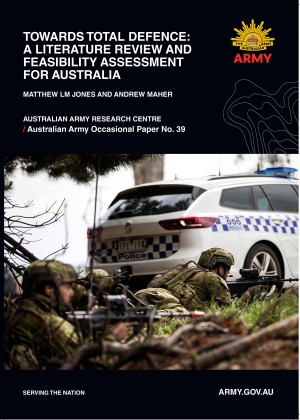
Second: resilience as recovery versus resilience as deterrence by denial. In Australian popular discourse, resilience often means ‘bouncing back’.[6] In TD’s strategic logic, resilience also denies an adversary the payoff of coercion by keeping society functioning, politically coherent, and able to sustain collective action under pressure.[7] Analysing the differing strategic logics embedded in TD is useful precisely because it shows that ‘total defence’ is not a single strategic system. As detailed through Occasional Paper 39 serving as a literature review on TD, some systems emphasise denial through robust continuity; others emphasise endurance through resistance; and most blend deterrence, societal cohesion, and continuity of government.[8] Australia’s lexicon should therefore avoid treating TD as a slogan and instead treat it as a menu of functions that can be weighted differently.
Third: mobilisation versus force generation. Mobilisation is still commonly treated as synonymous with conscription or rapid expansion of a standing force. A more useful Australian conception, beyond just the mobilisation of people, is the scaling and prioritisation of national systems under stress: energy, freight, repair capacity, communications, and the domestic delivery of essential services.[9] That conception aligns with Australia’s re-emerging national strategic language regarding the ‘Strategy of Denial’, as denial is sustained as much by logistics and continuity as by the presence of combat power.
A lexicon also needs to be domain-literate and anchored in the language Australia is already using in policy and regulation. The ‘Security of Critical Infrastructure’ framework is one example of this conceptual work: it defines ‘critical infrastructure’ in terms of its effects on national well-being, defence, and national security; and treats interdependencies as a core vulnerability.[10] Likewise, the national cyber threat picture is now routinely described as persistent, scalable, and strategically consequential—precisely the kind of threat environment TD is designed to handle.[11] A TD lexicon should not replace these languages; it should bridge them, so Defence planning, critical infrastructure regulation, and civil preparedness do not drift into parallel conversations.
In current context, the debate regarding Australia’s fuel supply illustrates why lexicon matters now. ‘Energy security’, ‘fuel security’, ‘operational energy’, ‘sovereign refining’, ‘stockholding’, ‘resilience’, and ‘transition’ are often collapsed into one rhetorical bundle. Yet they are separable policy problems. An oil market shock is not the same as a domestic distribution shock; a minimum stockholding obligation is not equivalent to modernising Defence fuel infrastructure; and electrifying parts of the civilian economy is not the same as ensuring aviation fuel and diesel for combat and sustainment.[12]
The payoff of an Australian TD lexicon, then, is clarity in governance. Clear terms enable clear ownership—what sits with the Commonwealth, what sits with states and territories, what must be required of industry under law, and what depends on voluntary civic participation. They also enable measurement: preparedness can be audited, exercised, and tracked over time. That is the basic intellectual benefit a TD lexicon may offer Australia: it turns the whole-of-nation aspiration into a vocabulary that can be operationalised, tested, and improved. Understanding the value of a consistent, universally recognised, and applied TD vocabulary is the first step in harmonising civilian and defence mechanisms across whole-of-government and private-sector efforts to improve national resilience, while also contributing to deterrence.
This post is the first of two Land Power Forum pieces to discuss the recently released Occasional Paper on Total Defence co-written by the author for the Australian Army Research Centre. A second (forthcoming) Occasional Paper will develop and test options for Australia’s specific context; outlining sequenced policy pathways, cost/risk trade-offs, legal instruments and governance arrangements, and evaluation measures. Collectively, this series aims to support the AARC’s ‘Defence of Australia’ 2025-26 Research Priority and the wider National Defence agenda.
Endnotes
[1] International Energy Agency, "Oil Market Report—March 2026 (Analysis)," (12/03/2026 2026), https://www.iea.org/reports/oil-market-report-march-2026.
[2] James J Wirtz, "Total defence forces in the twenty-first century," International Affairs 100, no. 3 (2024), https://doi.org/10.1093/ia/iiae107, https://doi.org/10.1093/ia/iiae107.
[3] Joakim Berndtsson, "Total Defence for the 21st Century?," Australian Institute of International Affairs (05/04/2024 2024), https://www.internationalaffairs.org.au/australianoutlook/total-defence….
[4] Jan Angstrom and Kristin Ljungkvist, "Unpacking the varying strategic logics of total defence," Journal of Strategic Studies 47, no. 4 (2024/06/06 2024), https://doi.org/10.1080/01402390.2023.2260958, https://doi.org/10.1080/01402390.2023.2260958.
[5] James Kenneth Wither, "Back to the future? Nordic total defence concepts," Defence Studies 20, no. 1 (2020/01/02 2020), https://doi.org/10.1080/14702436.2020.1718498, https://doi.org/10.1080/14702436.2020.1718498.
[6] Anne M. Leitch and Erin L. Bohensky, "Return to ‘a new normal’: Discourses of resilience to natural disasters in Australian newspapers 2006–2010," Global Environmental Change 26 (2014/05/01/ 2014), https://doi.org/https://doi.org/10.1016/j.gloenvcha.2014.03.006, https://www.sciencedirect.com/science/article/pii/S0959378014000545.
[7] Arjen Boin, "The Transboundary Crisis: Why we are unprepared and the road ahead," Journal of Contingencies and Crisis Management 27, no. 1 (2019), https://doi.org/https://doi.org/10.1111/1468-5973.12241, https://onlinelibrary.wiley.com/doi/abs/10.1111/1468-5973.12241.
[8] Matthew L M Jones and Andrew Maher, "Towards Total Defence: A Literature Review and Feasibility Assessment for Australia," Australian Army Research Centre Occasional Paper (29 April 2026), DOI: 10.61451/2675160
[9] David Kilcullen, "Mobilisation and Australia’s National Resilience," Australian Army Journal 20, no. 3 (2024), https://doi.org/10.61451/2675155.
[10] Susanne L. Lloyd-Jones, "Ensuring Digital Resilience in Australia: From Resilience to Security in Critical Infrastructure Protection," in Digital Resilience: International and Domestic Legal Responses to Cyber Security and Artificial Intelligence, ed. Dale Stephens, Matthew Stubbs, and Samuel White (Singapore: Springer Nature Singapore, 2025).
[11] Australian Cyber Security Centre, Annual Cyber Threat Report 2024-2025, Australian Signals Directorate (cyber.gov.au, 2025).
[12] "Australia's fuel security," updated 20 March 2026, 2026, accessed 28 March 2026, https://www.dcceew.gov.au/energy/security/australias-fuel-security.