Marine Corps Observations for Australia's Future Force
Having served as a Marine officer across the globe, and now as the Program Manager for Combat Support Systems at Portfolio Acquisition Executive Marine Corps, I have seen modernisation from the field and from the acquisition enterprise responsible for delivering it.
The observations that follow are presented from that perspective.
Presently, I oversee a portfolio of more than 200 capabilities spanning expeditionary logistics, advanced manufacturing, munitions, expeditionary medical systems, engineering and EOD surface and underwater systems, ballistic protection, signature management, clothing, and other combat support functions.[1] One simple lesson has emerged: military modernization succeeds only when a concept is translated into carefully considered requirements, resourcing, risk management, and a procurement plan that won't lead to the fielding of empty capabilities.[2] These variables determine the ability to accelerate and gain acquisition velocity.
Having reviewed Australia’s 2026 National Defence Strategy and Integrated Investment Program, it appears that our longstanding, sovereign partner in the Pacific has reached similar operational conclusions, recognising the importance of ‘prioritising capability acquisition and sustainment plans to deliver the Strategy of Denial’, a concept similar to the ‘deterrence by denial’ articulated in Washington’s own defence strategy.[3][4]
Early in Washington’s strategic shift to the Pacific, the Marine Corps recognized that confronting our pacing challenge along the First Island Chain would require force modernisation and a reimagination of how forces conduct littoral combat. From there, Force Design – the Corps’ blueprint for modernisation – was born.[5] Love it or hate it, it serves as a timely case study for a force trying to move at the speed of innovation.
To be sure, Australia's geography, force structure, industrial base, and sovereign priorities will inevitably lead it to different solutions. What Force Design offers is therefore not a model to replicate, but a case study in how a force translates strategic warning into a fielded capability. Decisions made throughout the acquisition lifecycle ultimately determine whether allies merely operate alongside one another or can unite as a truly interchangeable fighting force.
Before a force embarks on modernisation, it should first conduct a gap analysis – a process which should precede the purchasing of new equipment, testing of a prototype, or responding to an industry pitch.[6] This allows the force to define what the future fight demands and where the current force falls short. Done correctly, this prevents modernisation from becoming a chase for shiny objects: the newest drone, the most compelling vendor briefing, or the capability that looked decisive in the last conflict.
The Marine Corps’ modernisation campaign began with that kind of hard assessment. Confronted by China’s growing military capabilities, unmatched industrial strength, and increasing physical aggressiveness across the Pacific, the Corps asked what Marines would need to sense, shoot, move, survive, and sustain forward in a dispersed and heavily contested maritime theatre. That answer drove modernisation toward long-range fires, sea denial, unmanned systems, signature management, distributed operations, and contested logistics.
For any institution, the hardest test is maintaining strict discipline as investments are realigned. Translating a bold strategic pivot into fielded capability requires relentlessly tying every dollar back to the core operational problem. Australia will undergo those same challenges as they undertake a generational modernisation effort like the 2026 Integrated Investment Program.
That same discipline must drive experimentation. Force Design called for increased prototyping and experimentation, but experimentation without requirements and acquisition discipline can create pointless results or vendor-driven momentum. A prototype may look promising in a demonstration, but if a requirement is shaped around a single vendor’s design, the government can lose leverage across several program variables, leading to negative outcomes ranging from increased cost to vendor lock. Ultimately, experimentation should sharpen requirements and inform competition—not lead to a loss of choice.
Yet, technical maturity is a separate test. A well-established industry partner may brief an impressive Technology Readiness Level (TRL), but technical promise is not a predictor of full rate production success.[7] The harder question is whether the capability can be manufactured at scale; Manufacturing Readiness Level (MRL) is generally the harder test. Don’t fall in love with a vendor after witnessing a single demonstration; you might very well fall victim to a high-level marketing ploy.[8] Even if an industry partner can build a prototype once for a demonstration, that doesn’t mean they can build it 1,000 times when scaling up production becomes necessary.
Modern capabilities are only as credible as the industrial base behind them. Recent reporting on U.S. efforts to combat Chinese drones shows that the challenge is not only designing better systems, but also building the batteries, motors, components, supply chains, and production capacity needed to field and sustain them at scale.[9] Recent use of the Defense Production Act to expand munitions output underscores the same point.[10] As retired Marine Corps four-star Gen. Jim Mattis often says, ‘production is deterrence.’[11]
The pace of the threat also matters. As Pete Modigliani and Matt MacGregor recently argued: ‘The war in Ukraine demonstrated that mass, adaptability, and speed of production matter as much as individual platform sophistication. The commercial tech sector, which once lagged behind defence in most relevant domains, now leads in many of them.’[12]
It is becoming increasingly evident that modernisation cannot afford to wait for perfect solutions. That is, in part, why acquisition velocity only works when risk – defined here as the process to identify impacts to cost, schedule, and performance of a program – is isolated to increments.[13] Increments can be understood as distinct capability upgrades delivered over time following an initial, minimal product release.[14]
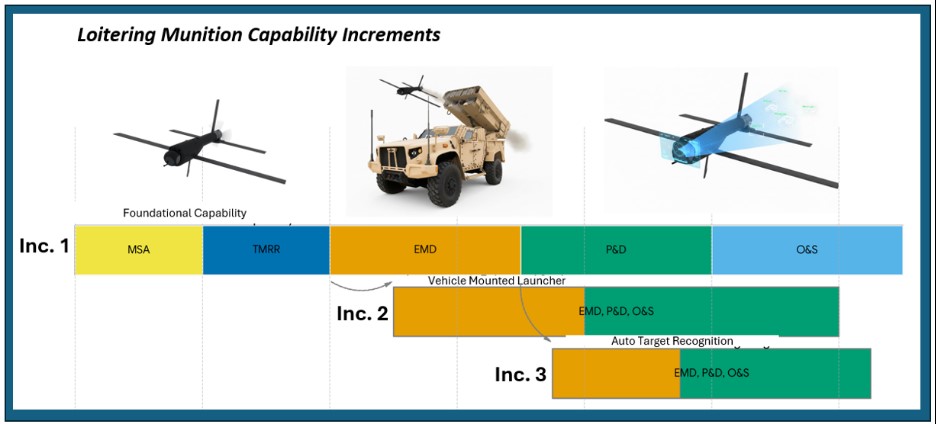
Source: Illustration assembled by author.
For example, think of it as producing a basic loitering munition with the initial fielding increment focused on ground launch, acquiring a target, and terminal effects, while assigning less mature capabilities – like a vehicle-mounted launcher and auto-target recognition – to later iterations. In that scenario, a minimal viable product is fielded to the Fleet and provides relative advantage against an enemy while those less mature capabilities are developed. Increments therefore bound technical risk while allowing capabilities to be fielded. Within this framework, the first increment need not be the final answer; the risk, however, becomes visible and understood by all stakeholders until future increments begin to close any gaps.
Decision makers are right to demand speed, but speed must be translated into executable program guidance with clearly delegated decision authorities: faster by what margin, against which requirement, cost, and with what residual risk?
Done well, speed does not mean cutting corners, but rather making deliberate trades offs, documenting risk, and becoming comfortable accepting that some gaps may remain when the operational value of fielding a lethal capability outweighs the cost of waiting for a more complete solution.
A well-articulated risk – segmented by increments – allows capability to be fielded quickly to the end user.
According to retired Australian Air Vice-Marshal Andrew Dowse AO and his colleagues at RAND, ‘Cooperating when setting requirements instigates discussions that help align strategic objectives from the outset and ensure that national investment decisions contribute to a coherent allied force posture.’[15]
That is the practical test facing Australia as it implements its latest National Defence Strategy and Integrated Investment Program. The IIP points in the right direction: long-range strike, littoral manoeuvre, guided weapons, autonomous systems, missile defence, theatre logistics and health, northern bases, cyber, space, and command and control. The question, however, remains: Can Australia translate strategy into fielded, sustainable capabilities?
At the end of the day, Force Design is not a template for Australia to copy, but it is a useful illustration in what modernization demands. Combat power is built when gaps are identified, requirements are disciplined, solutions are competed, and risk is deliberately accepted.
For the United States and Australia, that is also where the move from interoperability to interchangeability begins. If both forces want to deter through denial in the Pacific Command area of responsibility, they must develop and sustain the capabilities that allow them to fight tonight – side by side as we have for generations – before the shooting starts. Ultimately, this is the level of mateship facing a peer adversary will demand in the Pacific: not just trust between long-time allies, but the practical ability to support each other in the fight.
Endnotes
[1] Paul Gillikin, “We Fight Tonight’: Corps Capabilities for a Contested Indo-Pacific,” Seapower, April 25, 2025, https://seapowermagazine.org/we-fight-tonight-corps-capabilities-for-a-contested-indo-pacific
[2] AcqNotes, “Risk Management Overview,” updated July 22, 2021, https://acqnotes.com/acqnote/tasks/risk-management
[3] Australian Government, Department of Defence, 2026 National Defence Strategy and 2026 Integrated Investment Program (Canberra: Department of Defence, 2026), https://www.defence.gov.au/about/strategic-planning/2026-national-defence-strategy-2026-integrated-investment-program
[4] U.S. Department of Defense, 2026 National Defense Strategy (Washington, DC: Department of Defense, January 2026), https://media.defense.gov/2026/Jan/23/2003864773/-1/-1/0/2026-NATIONAL-DEFENSE-STRATEGY.PDF
[5] Headquarters, U.S. Marine Corps, Force Design 2030 (Washington, DC: Headquarters, U.S. Marine Corps, March 2020), https://www.marines.mil/Force-Design/
[6] “Acquisition Testing and Deployment Phase,” Adaptive Acquisition Framework, accessed August 25, 2026, https://aaf.waru.edu/aaf/dbs/acquisition-testing-and-deployment-phase/
[7] Marine Corps Warfighting Laboratory, “Technical Readiness Level (TRL) Chart,” accessed August 25, 2026, https://www.mcwl.marines.mil/Portals/34/Documents/S_T/TisoTRLInfoGraphic.pdf?ver=3RJpvegpN7B0-3yM9n98xA%3D%3D
[8] U.S. Department of Defense, “Manufacturing Readiness Level and Technology Readiness Level Definitions,” accessed August 25, 2026, https://at.dod.mil/Portals/129/Atch%202_MRL_TRL_Definitions.pdf
[9] Josh Chin, Merrill Sherman, Jason French, and Ievgeniia Sivorka, “The U.S. Wants to Break China’s Drone Dominance. Here’s Where It Will Struggle,” Wall Street Journal, May 2, 2026, https://www.wsj.com/politics/national-security/the-u-s-wants-to-break-chinas-drone-dominance-heres-where-it-will-struggle-39e69e18
[10] Alexandra G. Neenan, The Defense Production Act of 1950: History, Authorities, and Considerations for Congress, Congressional Research Service Report R43767 (Washington, DC: Congressional Research Service, October 6, 2023), https://www.congress.gov/crs-product/R43767; Dylan Malyasov, “Pentagon Bets $820M on Domestic Drone Component Production,” Defence Blog, August 2, 2026, https://defence-blog.com/pentagon-bets-820m-on-domestic-drone-component-production/
[11] James N. Mattis, remarks in “Diplomacy, Deterrence, and the Defense of Democracy,” discussion with Stephen Kotkin, PolicyEd, September 24, 2024, https://www.policyed.org/lessons-hoover-policy-boot-camp/allies-enemies/video-1
[12] Pete Modigliani and Matt MacGregor, “The 20-Year Machine: How the Legacy Acquisition System Works,” Defense Tech and Acquisition, June 16, 2026, https://www.defensetechacquisition.com/p/the-20-year-machine-how-the-legacy
[13] AcqNotes, “Risk Management Overview,” updated July 22, 2021, https://acqnotes.com/acqnote/tasks/risk-management
[14] Robert F. Mortlock, “Studying Acquisition Strategy Formulation of Incremental Development Approaches,” Defense Acquisition Research Journal 27, no. 3 (July 2020): 264–311, https://doi.org/10.22594/dau.19-845.27.03
[15] Andrew Dowse, Daniel Marns, Austin Wyatt, Sachini Kadaoluwa, Megan McKernan, Stephen M. Worman, and Lucia Retter, Optimizing Defense Requirements Cooperation Among the United States and Its Allies, PE-A3510-1 (Santa Monica, CA: RAND Corporation, 2026), https://doi.org/10.7249/PEA3510-1