The USMC, Australia, and the Demands of Strategic Denial
Current wars in Europe and the Middle East matter, but the central pacing challenge for the United States and its Pacific partners remains China. Beijing is modernising its military, expanding its maritime reach, and using coercive activity below the threshold of open conflict to shape the battlespace before a shot is fired.
A recent Wall Street Journal report captured the pattern clearly: Chinese fishing vessels pushed within 150 miles of a U.S. naval base in Japan.[1] Rather than an isolated incident, it reflected a decades-long campaign using fishing fleets, coast guard vessels, and artificial outposts to extend Chinese power, test allied reactions, normalize Beijing's presence, and through asymmetric means, build the conditions for a future Pacific conflict on the Chinese Communist Party’s (CCP's) terms.
As Col. David Maxwell, a 30-year U.S. Army Special Forces veteran with considerable experience in the Pacific, recently argued,
The problem is not that China operates in a grey zone. The problem is that the free world continues describing warfare in terms China itself does not recognize.[2]
But Washington cannot meet this challenge alone. As the 2026 National Defense Strategy makes clear, our allies have “an essential role to play,” not simply as a matter of burden sharing, “but out of their own interests.”[3] Working together, the U.S. and its allies and partners can more effectively deter revisionist powers across the globe and generate the combined capability necessary for success—from the tactical to the strategic level.
Meeting that challenge will not only require new platforms and sharper strategies, but also allies that know each other, trust each other, and can fight together under pressure-- as they have so many times before. For the United States, no Pacific partner fits that description more naturally than Australia: a country with whom we have long shared a history of similar values and democratic DNA.[4]
As Australians and Americans from all walks of life have demonstrated across generations, those values are worth defending.
The U.S.-Australia military relationship reaches back before federation in 1901, when men born in the Australian colonies served in Union forces during the American Civil War. Among them was Australian-born Union Navy seaman Thomas Jenkins, who received the Medal of Honor for his actions aboard the USS Cincinnati at Vicksburg: an early indication that ties between the two peoples preceded formal alliance structures.[5] Yet the modern partnership was forged after federation, as Australians and Americans fought together in every major conflict of the twentieth century and beyond, from World War I to the Global War on Terrorism, across trenches, jungles, deserts, and mountains.[6][7]
In the Pacific, strength begins with lethality and positional advantage— and, from a logistics perspective, manufacturing capacity and supply chain resilience. For the United States, a crisis in the region is an away game fought across thousands of miles of ocean against a peer competitor (possessing equal or better technology) with the ability to contest movement, communications, logistics, and access at every point along the way.
Every round, battery, radio, replacement part, gallon of fuel, and medical supply must either be in theatre before crisis begins or survive a contested journey across the Pacific. Put plainly, if it is not there before the shooting begins, there is a good chance it will not make it at all.
Recognizing that the future fight would be against a sophisticated, Pacific adversary in a theatre defined by the tyranny of distance, the Marine Corps rethought how it would fight after two decades of counterterrorism operations in the Middle East.[8] Force Design modernization and Expeditionary Advanced Base Operations (EABO) emerged from this logic: small, dispersed, low-signature forces operating forward to sense, shoot, move, survive, and sustain inside a contested maritime theatre.[9][10]
That geography also makes Australia indispensable. As key terrain in the Pacific, Australia’s northern bases, ports, training areas, and industrial capacity make it central to any serious strategy of denial, especially if American forces cannot rely solely on trans-Pacific resupply.
These operational realities are clear to me every day as a Program Manager overseeing capabilities including 3D metal printers, fuel, munitions, expeditionary medical equipment, and maintenance programs.[11] The daily demand for our systems to support testing and bilateral training in Darwin and during major exercises like Talisman Sabre highlights how closely our logistics must align. Fortunately, the strategic documents guiding our two nations now point in a similar direction. Australia’s 2026 National Defence Strategy establishes the strategic framework, while the accompanying 2026 Integrated Investment Program funds the capabilities needed to implement it.[12]
As retired Australian Air Vice-Marshal Andrew Dowse AO recently noted, the 2026 Australian NDS “maintains the approach of a focused force and deterrence by denial.”[13]
That emphasis aligns with the United States’ own shift toward Pacific denial. The Pentagon’s 2018 National Defense Strategy reoriented the Joint Force toward great power competition; Force Design modernization translated that shift into a Marine Corps optimized for stand-in forces, sea denial, long-range fires, distributed operations, and contested sustainment; while the 2026 US National Defense Strategy reinforces the same logic.[14][15]
Parallel strategies are a good start. Dowse and his co-authors at RAND recently argued that early requirements cooperation can help allies “identify options to intermesh complementary capabilities” where partners “may have differing capability strengths and rely on each other for provision of support or to lead various aspects of operations.”
That is precisely the point: strategic alignment is most enhanced when two nations develop, procure, build, field, stockpile, and sustain capabilities together.
America’s alliances remain a key pillar of U.S. power, and the 2026 NDS calls for their adaptation to an era of great-power conflict through greater burden sharing, deeper integration, and the ability to generate combat power when called to fight tonight.
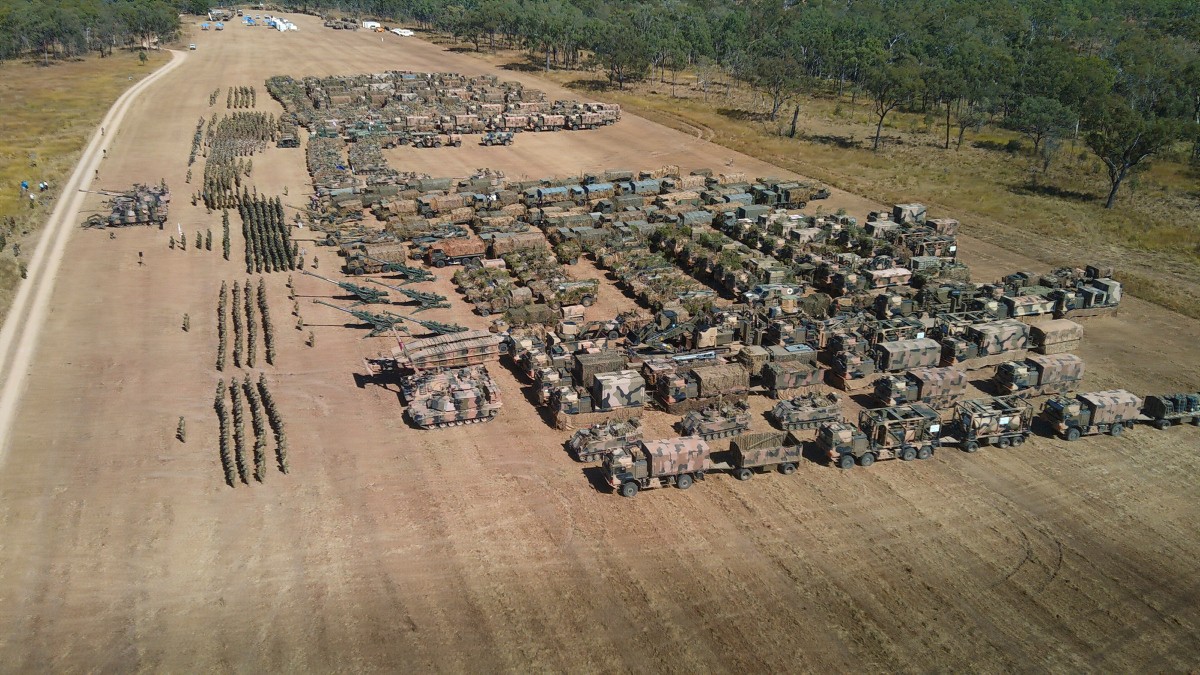
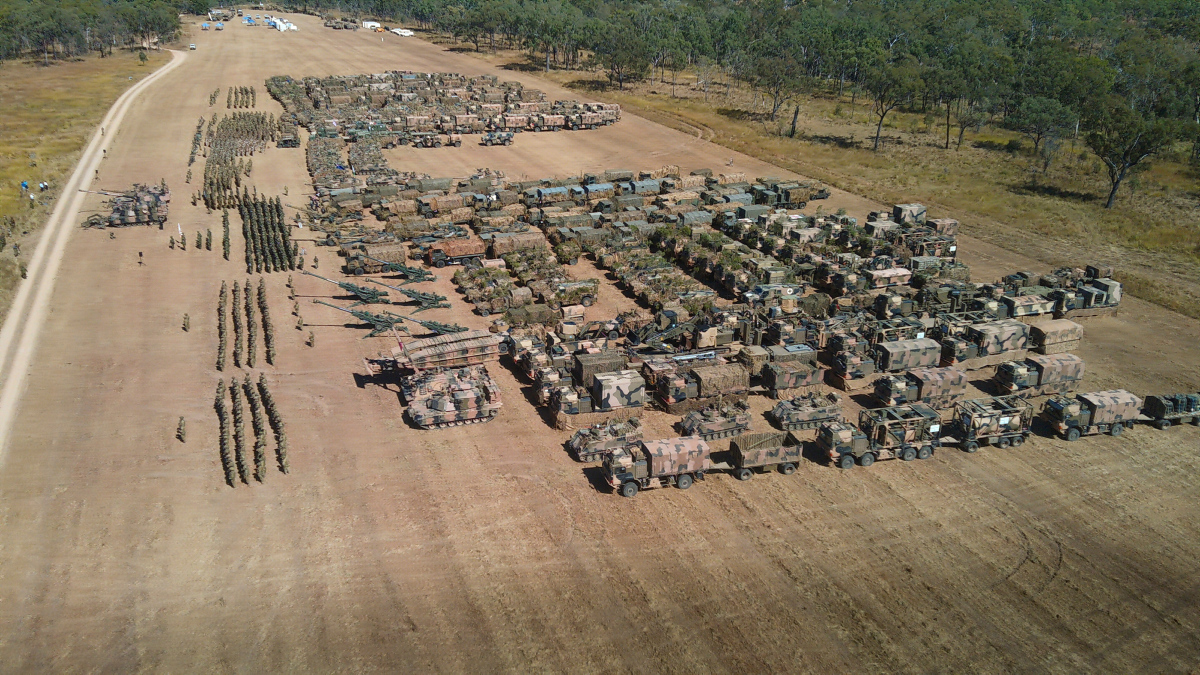
AUKUS, Five Eyes, Marine Rotational Force-Darwin, combined exercises like Talisman Sabre, long-range fires cooperation, amphibious modernization, expanded defence investment, and shared Pacific planning all point to the same conclusion: the United States and Australia are preparing to once again fight side by side in the Pacific. The objective is not dependence, but complementary strength: two sovereign militaries capable of acting independently when required and together when it matters most.
But such a shift demands more than interoperability. While interoperability allows our forces to communicate, coordinate, and operate together, we must now shift our conceptual focus toward true interchangeability. This deeper level of integration means moving beyond basic cooperation to a state where we can sustain one another: drawing from shared stockpiles, utilizing each other's repair networks, moving data through compatible systems, sharing approved medical support, and keeping the fight going when national supply chains are disrupted.
As Australian Major General Mick Ryan told me in a recent conversation, “Interchangeability is really simple stuff that you need to think about in the design phase for any capability. Whether it’s food, drones, weapon systems, or digital command and control systems... All of these things that help us fight together are critical to reduce internal friction and make sure we generate friction for the enemy.”[16]
Industry sits at the centre of that shift. Strategic denial requires production, repair, stockpiles, sustainment, and industrial depth. As Dowse observed in a recent conversation, the logic of AUKUS Pillar II is "not about everyone duplicating each other," particularly when it comes to development costs.[17]
Rather, the objective is to identify where each nation can contribute most effectively to a more resilient combined industrial base by leveraging comparative advantage, allowing each to specialize where it can generate the greatest military effect while reducing unnecessary duplication. Interchangeability must be built before crisis begins. ITAR, classification, foreign disclosure, allied medical equipment approval, local procurement authorities, digital C2, shared stockpiles, mutual support arrangements, and combined sustainment exercises are not bureaucratic details, but rather key warfighting necessities.[18]
The US-Australia alliance is historically strong, strategically aligned, and focused on the same operational problem: how to deter through denial in the Pacific. But denial must be practical, resourced, and executable. American and Australian forces must be able to sustain, repair, communicate, treat casualties, and endure together. Achieving this level of interchangeability requires innovative solutions from across both our industrial bases.
I will be at the Land Forces conference in Perth this October actively seeking out industry partners ready to tackle these shared logistical challenges. Ultimately, that is what mateship under pressure now requires: building the collective capacity to endure, long before we're called to fight tonight, shoulder to shoulder, as always.
Endnotes
[1] Anika Arora Seth and Daniel Kiss, “See How China Is Gaining Power in Contested Waters,” Wall Street Journal, May 15, 2026, https://www.wsj.com/world/asia/see-how-china-is-gaining-power-in-contes…
[2] David Maxwell, “Stop Calling It the ‘Gray Zone’: How China Exploits the Language of Ambiguity,” Irregular Warfare Initiative, May 17, 2026,
[3] U.S. Department of War, 2026 National Defense Strategy (Washington, DC: Department of War, January 2026), [4], https://media.defense.gov/2026/Jan/23/2003864773/-1/-1/0/2026-NATIONAL-…
[4] Lloyd Cox and Brendon O’Connor, “That ‘Special Something’: The U.S.-Australia Alliance, Special Relationships, and Emotions,” Political Science Quarterly 135, no. 3 (Fall 2020): 409–438, https://doi.org/10.1002/polq.13068
[5] Congressional Medal of Honor Society, “Thomas Jenkins,” accessed August 24, 2026, https://www.cmohs.org/recipients/thomas-jenkins
[6] Lloyd Cox and Brendon O’Connor, “That ‘Special Something’: The U.S.-Australia Alliance, Special Relationships, and Emotions,” Political Science Quarterly 135, no. 3 (Fall 2020): 409–438, https://academic.oup.com/psq/article-abstract/135/3/409/6848534
[7] Paul Dibb, U.S.-Australia Alliance Relations: An Australian View, Strategic Forum no. 216 (Washington, DC: National Defense University Press, August 2005), 1, https://digitalcommons.ndu.edu/strategic-forums/16/
[8] Paul Gillikin, “‘We Fight Tonight’: Corps Capabilities for a Contested Indo-Pacific,” Seapower, April 25, 2025, https://seapowermagazine.org/we-fight-tonight-corps-capabilities-for-a-….
[9] U.S. Marine Corps, Force Design 2030 (Washington, DC: Headquarters, U.S. Marine Corps, March 2020), https://www.marines.mil/force-design/
[10] Headquarters, U.S. Marine Corps, Tentative Manual for Expeditionary Advanced Base Operations, 2nd ed. (Washington, DC: Department of the Navy, May 9, 2023), https://www.marines.mil/Portals/1/Docs/230509-Tentative-Manual-For-Expe…
[11] U.S. Department of Defense, “Department of Defense Announces the Regional Sustainment Framework,” news release, May 15, 2024, https://www.war.gov/News/Releases/Release/Article/3776541/department-of….
[12] Australian Government, Department of Defence, 2026 National Defence Strategy and 2026 Integrated Investment Program (Canberra: Department of Defence, 2026), https://www.defence.gov.au/about/strategic-planning/2026-national-def-d….
[13] Andrew Dowse, “The 2026 National Defence Strategy: Well Designed, Poorly Timed?,” Perth USAsia Centre, May 1, 2026, https://perthusasia.edu.au/research-and-insights/the-2026-national-defence-strategy-well-designed-poorly-timed/.
[14] U.S. Department of Defense, Summary of the 2018 National Defense Strategy of the United States of America: Sharpening the American Military’s Competitive Edge (Washington, DC: Department of Defense, 2018), https://media.defense.gov/2020/May/18/2002302061/-1/-1/1/2018-NATIONAL-….
[15] U.S. Department of Defense, 2026 National Defense Strategy (Washington, DC: Department of Defense, January 2026), https://media.defense.gov/2026/Jan/23/2003864773/-1/-1/0/2026-NATIONAL-DEFENSE-STRATEGY.PDF.
[16] Maj. Gen. Mick Ryan, conversation with author, April 2, 2026.
[17] Air Vice Marshal Andrew Dowse, conversation with author, March 3, 2026.
[18] International Traffic in Arms Regulations, 22 C.F.R. pts. 120–130 (2026).