Intelligence, Surveillance and Reconnaissance in Support of Sea Denial in the Red Sea
Author: Carl Rhodes
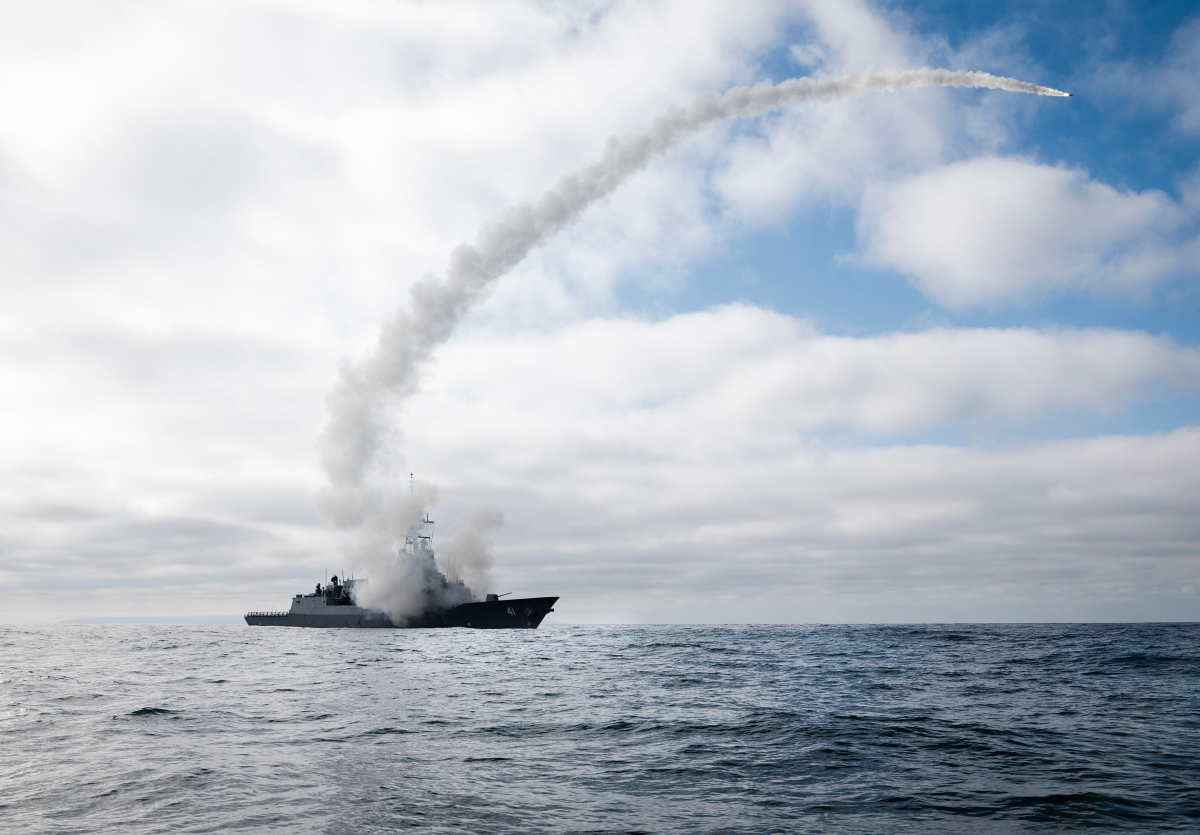
On 14 November 2023, Houthi rebels based in Yemen released a menacing graphic depicting a commercial Israeli vessel in flames, accompanied by the statement, ‘We will sink your ships’.[1] This marked the beginning of a nearly two-year campaign by the Iranian-aligned group against much of the commercial shipping in the region.
The campaign was successful when judged against several metrics. Cargo traffic through the Red Sea, a corridor that handles roughly 12 percent of global trade, fell by 70 percent.[2] By March 2025, the Houthis had reportedly conducted 170 strikes against U.S. warships and 145 against commercial vessels.[3] By the end of 2025, at least four commercial ships had been sunk.[4]
The group also endured Operation Rough Rider, an extended U.S. military campaign that involved more than 1,100 strikes over 52 days, concluding in May 2025.[5] U.S. forces expended over US$1 billion in munitions in the first month of the operation. Two F/A-18s were lost, one because of carrier manoeuvres to evade an incoming Houthi missile.[6] Houthi air defences also proved more capable than many expected. They downed seven MQ-9 Reaper drones in the first 30 days of U.S. operations and reportedly came close to striking several F-16s and F-35s. At the conclusion of operations, U.S. government reporting stated there had been “some degradation” of Houthi capability, but assessed that the group could readily reconstitute.[7]
How was this battle-tested but modestly funded militia able to sustain a prolonged, globally disruptive campaign against shipping and survive an extended U.S. bombing campaign? Operationally, several factors stand out: the ability to conduct coordinated, multi-domain attacks using ballistic missiles, cruise missiles, drones, unmanned surface vessels and manned small boats; the integration of diverse supply chains to enable the production of increasingly advanced weapons inside Yemen; and, critically, the maintenance of sufficient situational awareness to enable maritime targeting while defending against attacks from the sea and air.[8] The final element warrants closer examination.
For sea denial operations, external assistance played an important role in enabling Houthi situational awareness. Reporting in October 2024 indicated that Russia had provided satellite data via Iran’s Islamic Revolutionary Guard Corps to assist in targeting commercial shipping, with the apparent aim of stoking instability in the Middle East. [9] In April 2025, U.S. officials also accused Chang Guang Satellite Technology, a China-based firm, of supplying imagery used to target U.S. warships and international vessels in the Red Sea. The company, assessed to be part of China’s military-civil fusion ecosystem, had over 100 satellites in orbit at that time.[10] What matters is not simply the provision of imagery itself, but its exploitation. The provision of high-quality imagery focused on potential targets would have significantly enhanced the Houthis’ capacity to detect and track high-value maritime targets. It would also enable the more efficient and effective use of other local sources such as monitoring Automatic Identification System (AIS) broadcasts, gathering information from civilian spotters, and collecting imagery from drones and other sources.[11]
To assist in the final stages of an attack against a ship, the Houthis employed the Simrad Halo24, a widely available radar designed for recreational boaters with an advertised range of 48 nautical miles. Rather than employing radars at sea, the Houthis deployed the system by truck to coastal locations, mounting it on a pole to provide sensing and targeting support. After an attack, the system was quickly disassembled and moved to safety, sometimes in populated areas, before an adversary could respond. These ‘shoot and scoot’ tactics proved sufficiently effective that the U.S. Marine Corps has also experimented with the Halo24.[12]
For air situational awareness, there is less certainty about the specific systems employed, but they proved quite successful at downing MQ-9s and threatening fighter aircraft. It is suspected that passive sensors were important for cueing, including radiofrequency, electro-optical and infrared systems. Visual observers likely played a role as well. Such systems could be used to coordinate pop-up attacks by surface-to-air systems employing passive or radar guidance.[13]
While the ADF would never recreate the ideology or the illegal actions carried out by the Houthis, there are lessons that the Army, like the U.S. Marine Corps, can apply from these operations in developing littoral concepts. Three are particularly relevant to surveillance and reconnaissance.
First, to maintain a survivable, long-term presence it is essential to minimise the signature of the deployed forces. This may involve the selection of passive over active sensors, the use of denial and deception techniques, and tactics that emphasise mobility. The simple presence of a credible threat, even if it doesn’t engage every potential target, compels an adversary to adopt defensive actions.
Second, there are opportunities to leverage commercial technologies such as the Halo24 radar or commercial space-based imaging systems. While these systems may have vulnerabilities and may not meet all high-end requirements for Army operations, the Houthis have demonstrated that a non-state group combining off-the-shelf technology with disciplined tactics can challenge a major military power.
Lastly, there are significant advantages in conducting elements of the intelligence mission associated with sea denial outside the immediate littoral area of operations. Russia, China, and Iran appear to have provided target cueing support to the Houthis.[14] External intelligence analysis can enable a smaller forward-deployed footprint and allow forward elements to focus on mission execution. A large intelligence cell positioned forward, with its associated high-bandwidth connectivity to multiple sensors and systems, would present an obvious and vulnerable target.
There are few examples of littoral warfare at this scale and duration since the Second World War. As the Army designs concepts and acquires systems for littoral operations, it should closely examine both the tactical challenges and operational successes demonstrated by the Houthis. Their campaign underscores a new reality: the most technically advanced military systems are no longer required to meaningfully challenge the world’s leading navies. Widely available commercial technology, combined with adaptive tactics and external intelligence support, can enable a land-based force to impose persistent and disproportionate costs on naval forces. Similar dynamics have been evident in Iranian efforts to threaten maritime transit in the Strait of Hormuz during Operation Epic Fury, reinforcing the growing accessibility of effective sea denial capabilities.
For land-based forces engaged in littoral operations, survivability will depend less on mass and more on signature management, dispersal, deception, and mobility. In an era of proliferating sensors, communications systems and space-based capabilities, the side that can see, move, and conceal itself most effectively may hold the decisive advantage.
Endnotes
[1] VOA News, “Yemen’s Houthi Rebels Seize Cargo Ship in Red Sea,” Voice of America, November 19, 2023, https://www.voanews.com/a/yemen-s-houthi-rebels-seize-cargo-ship-in-red-sea-/7361568.html.
[2] “Houthi Inc: The Pirates Who Weaponised Globalisation,” The Economist, January 16, 2025, https://www.economist.com/leaders/2025/01/16/houthi-inc-the-pirates-who-weaponised-globalisation.
[3] C. Todd Lopez, “U.S. Punches Back at Iran-Backed Houthi Terrorists in Yemen,” U.S. Department of War, March 17, 2025, https://www.war.gov/News/News-Stories/Article/Article/4122757/us-punches-back-at-iran-backed-houthi-terrorists-in-yemen/.
[4] Claire Parker and Heba Farouk Mahfouz, “Egypt Revives the Suez Canal after Conflict Sank Traffic: Red Sea Attacks by Houthi Rebels Scared off Many of the Shipping Firms That Used the Waterway, Depriving Nation’s Ailing Economy of Vital Revenue,” News, The Washington Post (Washington), January 22, 2026, Final Edition, 3296290753, p. A9, ProQuest Recent Newspapers: The Washington Post.
[5] Gregory Johnsen, “Feature Commentary: An Assessment of Operation Rough Rider,” CTC Sentinel (West Point, NY) 18, no. 6 (June 2025): 1–6.
[6] Helene Cooper et al., “Why Trump Suddenly Declared Victory Over the Houthi Militia,” U.S., The New York Times, May 12, 2025, https://www.nytimes.com/2025/05/12/us/politics/trump-houthis-bombing.html; Howard Altman, “F-35 Had to Maneuver to Evade Houthi Surface-to-Air Missile: U.S. Official,” The War Zone, May 13, 2025, https://www.twz.com/air/f-35-had-to-maneuver-to-evade-houthi-surface-to-air-missile-u-s-official.
[7] Cooper et al., “Why Trump Suddenly Declared Victory Over the Houthi Militia.”
[8] Benoit Faucon and Lara Seligman, “Two Ships Desperately Tried to Fight off Houthi Attacks. Help Never Arrived,” World, Wall Street Journal, July 10, 2025, https://www.wsj.com/world/middle-east/two-ships-desperately-tried-to-fight-off-houthi-attacks-help-never-arrived-c400a2a8; Noam Raydan and Farzin Nadimi, “Lethal Attacks Show Strengthened Houthi Control Over Red Sea Transit,” Policy Analysis Blog, The Washington Institute for Near East Policy, July 16, 2025, https://www.washingtoninstitute.org/policy-analysis/lethal-attacks-show-strengthened-houthi-control-over-red-sea-transit; Peter Salisbury, Henry Thompson, and Veena Ali-Khan, From Smugglers to Supply Chains: How Yemen’s Houthi Movement Became a Global Threat (Century International, 2026), https://tcf.org/content/report/from-smugglers-to-supply-chains-how-yemens-houthi-movement-became-a-global-threat/.
[9] Benoit Faucon and Thomas Grove, “Russia Provided Data for Houthi Assault on Global Shipping,” World, Wall Street Journal, October 24, 2024, https://www.wsj.com/world/russia-provided-targeting-data-for-houthi-assault-on-global-shipping-eabc2c2b.
[10] Demetri Sevastopulo, “US Says Chinese Company Is Helping Houthis Target American Warships,” Financial Times, April 18, 2025, https://www.ft.com/content/628b404b-2a24-4853-8f3c-9caad408ef8f.
[11] Gard, “Red Sea Update: Resumption of Houthi Campaign | Gard’s Insights,” Gard, July 11, 2025, https://gard.no/en/insights/red-sea-update-resumption-of-houthi-campaign/; Capt Tyler C. Gunn, “Lessons from an Unlikely Enemy,” Marine Corps Association, November 15, 2025, https://www.mca-marines.org/gazette/lessons-from-an-unlikely-enemy/; Sam Cranny-Evans and Sidharth Kaushal, “Securing the Red Sea: How Can Houthi Maritime Strikes Be Countered?,” The Royal United Services Institute for Defence and Security Studies, January 10, 2024, https://www.rusi.org/explore-our-research/publications/commentary/securing-red-sea-how-can-houthi-maritime-strikes-be-countered.
[12] Peter Swanson, “Houthis Are Using an Off-the-Shelf Simrad Boat Radar; Marines Take the Hint,” Substack, Loose Cannon, March 27, 2025, https://loosecannon.substack.com/p/houthis-are-using-an-off-the-shelf.
[13] Joseph Trevithick, “What Air Defenses Do the Houthis In Yemen Actually Have?,” The War Zone, April 23, 2025, https://www.twz.com/news-features/what-air-defenses-do-the-houthis-in-yemen-actually-have; Chris Gordon, “Life or Death over Yemen: How F-16 Pilots Survived Houthi Ambush,” Air & Space Forces Magazine, February 22, 2026, https://www.airandspaceforces.com/life-death-yemen-f-16-pilots-sambush/.
[14] Russia is reportedly providing satellite imagery to Iran to help target U.S. forces during Operation Enduring Fury. Thomas Grove, Milàn Czerny, and Benoit Faucon, “Russia Is Sharing Satellite Imagery and Drone Technology with Iran,” World, Wall Street Journal, March 17, 2026, https://www.wsj.com/world/russia-is-sharing-satellite-imagery-and-drone-technology-with-iran-0dd95e49.