Assessing US Military Discipline and Responses to Law of War Violations, 1943–2006
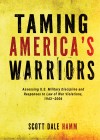
Marine Corps University Press, 2025, 266 pg. (open access)
Author: Scott Dale Hamm
Reviewed By: David Mason
The title of Scott Dale Hamm’s book, Taming America’s Warriors, suggests that soldiers are wild: unruly and reckless, needing to be brought under a firm hand. In truth, they are educated, guided, and most importantly led to make sound decisions in complex and often hostile environments. To ‘tame’ a soldier is to diminish their effectiveness and to invite defeat both on the battlefield and as a fighting force. In this book, derived from his 2023 doctoral thesis, retired United States Marine Corps Sergeant Major Dr. Scott Dale Hamm undertakes a comprehensive examination of war crimes in the context of the US land force. His analysis spans multiple conflicts, and includes chapter-length case studies from the European and Pacific theatres of World War II, progressing through the Vietnam War and covering My Lai and Son Thang, and culminating in the Iraq War, where he addresses incidents including Abu Ghraib, Haditha, Mahmudiyah, and Hamdania.
Hamm’s engagement with this subject matter is informed by direct operational experience and is deeply personal. He served in Iraq during the height of the insurgency (2006–2009) as a member of Alpha Company, 1st Battalion, 6th Marine Regiment—the unit to which this work is dedicated. His professional background as a Marine, coupled with combat deployments to both Iraq and Afghanistan, confers a level of authenticity and practitioner insight unusual in a work like this. This is not merely theoretical; Hamm has lived it. Taming America’s Warriors therefore poses a central question: To what extent is continued violence against non-combatants influenced by factors within the military or by external forces beyond its control, including public opinion? A substantial portion of his work focuses on assessing the effectiveness of the United States military justice system and its capacity - or more accurately lack thereof - to hold accountable those who violate the laws of armed conflict. This emphasis is underscored by the second part of the book’s title: Assessing US Military Discipline and Responses to Law of War Violations, 1943–2006.
The case studies, spanning World War II through the Iraq War, are presented in a clear and measured tone, allowing the reader to readily engage with the material without rhetorical bias. Each account provides not only a detailed understanding of the events themselves but also the operational and cultural context in which they occurred. Crucially, Hamm guides the reader through the investigations into law of war violations and, where applicable, the military prosecutions that followed. As Hamm shows, while the US military rigorously trains its personnel in the law of armed conflict and assigns expert legal advisors to operational staffs and commanders, they have a historically poor record in prosecuting service members for war crimes. If there is a fault with Hamm’s analysis, it is perhaps in the suggestion that factors such as ‘lawyers seeking to make their names’ through pro bono defence work exert any causal influence on soldiers’ decisions to commit war crimes.[1] One must also question Hamm’s assertions that war crimes occur because the realities of combat fail to align with romanticised expectations drawn from Cold War-era media depictions of femme fatales and willing damsels in distress,[2] or that his suggestion that international law is inherently unfair, the latter being a highly contentious claim which many scholars have studied deeply.[3]
Yet many of Hamm’s recommendations and assessments, drawn from his research, are balanced and worthy of endorsement in the context of the Australian Defence Force. Three such assessments are equally compelling. First, Hamm recommends units undertake periodic refresher training during periods of heightened stress on operations, so as to enhance compliance with the law of armed conflict—even if such measures ‘still may not be able to overcome the negative effect of poor leadership attitudes’ toward these norms.[4] Secondly, Hamm’s observation that, in cases of laws of war violations examined, had a lieutenant or senior non-commissioned officer ‘more diligently discharging their duties’ could have just as easily prevented such incidents, has a ring of truth to it.[5] Finally, Hamm’s analysis of Abu Ghraib and Vietnam underscores a critical theme: that when breakdowns in discipline are left unaddressed or tacitly condoned by leadership they seem to ‘foreshadow’ future violations of the laws of war.[6] This insight reinforces the centrality of command responsibility and leadership culture in preventing breaches of the law of war.
In a 1997 analysis of the Son Thang atrocities, W. Hays Parks—a former colleague of this reviewer—offered observations and conclusions even more emphatic than those presented by Hamm. Parks argued that Son Thang exemplifies an incident precipitated by systemic failures at virtually every level of the chain of command, rendering what did occur almost inevitable. At the unit level, he posed a critical question: Where is the balance between motivating Marines to ‘close with, engage, and destroy’ enemy forces, and using language that risks encouraging atrocities such as those committed at My Lai and Son Thang? Parks further noted that the Vietnam veterans who assumed leadership roles in the 1980s and 1990s wisely rejected the ‘body-count’ mentality championed by United States Secretary of Defense Robert S. McNamara. Parks contended that a more precise doctrinal line is both possible and necessary: fostering aggressive combat motivation while unequivocally delineating actions that will not be tolerated.[7]
The issue is not binary: destroy the enemy or obey the nation’s orders. As Hamm reminds us through General Douglas MacArthur’s words, ‘every soldier, whether he be friend or foe, is charged with the protection of the weak and unarmed.’[8] This principle lies at the heart of international humanitarian law and, where war crimes occur, the issue of command responsibility inevitably arises. Indeed, while the Chief of Army acknowledged, ‘the long shadow of Afghanistan,’ he reminds us that we have a duty and are compelled to reinforce the professional standards of ADF members, including our leaders at every level. We must do everything necessary to prevent the fracturing of professional standards in ‘the crucible of combat’ and ensure that the trust of the Australian people is not compromised.[9]
The themes of leadership, responsibility, and accountability explored in Taming America’s Warriors remain as urgent today as they were in 1943, or the subsequent conflicts analysed in this book. Hamm’s work usefully illuminates the operational contexts in which war crimes have arisen and underscores systemic weaknesses in law and failures in prosecution. Yet laws - and even punishments - do not prevent war crimes. Leadership does, and must. It is the duty of leaders to uphold discipline and enforce the law of armed conflict. Hamm’s contribution is valuable for reminding us that accountability begins at the top.
Endnotes
[1] Scott Dale Hamm, Taming America’s Warriors: Assessing US Military Discipline and Responses to Law of War Violations, 1943–2006 (United States Marine Corps, 2025), 86.
[2] Hamm, Taming America’s Warriors 85
[3] Hamm, Taming America’s Warriors,36
[4] Hamm, Taming America’s Warriors,95
[5] Hamm, Taming America’s Warriors, 103
[6] Hamm, Taming America’s Warriors, 115
[7] W Hays Parks, May There be No More US War Crimes, US Naval Institute Proceedings, November 1997 May There Be No More U.S. War Crimes | Proceedings - November 1997 Volume 123/11/1,137,
[8] Quoted in Hamm, Taming America’s Warriors, 4.
[9] Chief of Army Symposium Keynote, The Human Face of Battle and the State of the Army Profession, 21 Sep 24 https://www.army.gov.au/news-and-events/speeches-and-transcripts/2024-09-12/chief-army-symposium-keynote-speech-human-face-battle-state-army-profession