A New Short History
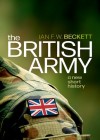
Oxford University Press, 2023 ISBN: 9780198871040, pp 240 Hardback
Written by: Ian F.W. Beckett
Reviewed By: Andrew Stewart
From John Fortescue to Richard Holmes and more recent additions by Lord Dannatt, Alan Mallinson, Gordon Corrigan and Simon Akam, there is a heavy shelf of writing about the British Army. For readers who have engaged with this body of work, much of Ian Beckett’s excellently written and comprehensively researched ‘short history’ will be familiar. The five chapters of The British Army: A New Short History deliver exactly as the book cover claims. Read a little closer and it will offer something more. The author is to be congratulated for producing what on first view appears to be a concise addition to an expanded literature but, on closer study, reveals itself to be a superior foundation for anyone who wants to better understand this fighting organisation and its link to modern Britain.
With its broad chronological approach, this book examines a number of significant themes. This begins with the opening chapter with its reflective ‘origins story’ tracing the Army’s evolution from 1689 when parliamentary controls were established with the Bill of Rights, but as an English rather than British fighting force. Political disputes and tensions, both home and abroad, provide the context for growth and transformation and the emergence of a military organisation which had foundations sufficiently strong to ensure that the six major wars which it fought in during the eighteenth century left it “the most successful imperial power in Europe.” Perhaps more significant is the claim that, in the process, “it assisted in the creation of British identity”.[1] This remains a key theme throughout, highlighting - and later questioning - the degree to which there is a synergy between the Army and the state. It also reinforces that this is as much a cultural and social history as an examination of battles, bullets and bombs, one which emphasises the diverse links between the military and those whom it seeks to protect.
There are a number of other key themes which run through the story of 350 years of successes and failure. Amongst them is identity and how, as the Napoleonic War moved to its conclusion, the British Army became a truly national force in which more than one-third of the men and half of the officers were Scots or Irish. The ending of this long regional conflict’s also “paved the way for unparalleled expansion and prosperity”, and another important discussion throughout is the linkage between war and economics.[2] The introduction of income tax to sustain the military is traced to 1798, the associated growth of national debt and the impact both good and bad of sanctions are all touched upon as is the degree to which the wars fought by the British Army have encouraged domestic investment and encouraged growth. Of course, as colonial campaigns and expeditions became the norm, a resulting limited approach to major conflicts had an important role to play. The Stanhope Memorandum of December 1888 listed the British Army’s five duties in order of priority, the maintenance of an expeditionary force to respond to any European conflict being the last of these and between 1815 to 1914 only one war – the Crimean – was fought against a global power.[3]
The author notes in the introduction, “An army exists to fight … and the army’s story cannot be divorced from those wars and conflicts that have punctuated its evolution” and, consequently, there is “attention … paid to the battlefield”.[4] While there is mention of the intricacies of fighting, but these appear to be ‘supporting rather than supported’, constructed around often familiar stories which link together easily. The abilities of Marlborough, for example, a commander who forced his opponents to fight or retreat on eighteen occasions between 1702-1711 but fought only four pitched battle, the costliest at Malplaquet resulting in 36,000 casualties. Also, the Army’s activities and role in the American Revolution, the Peninsular War – which Beckett compares to the World War Two North African campaign in terms of helping to shape subsequent campaigning in Russia – and on to the victory at Waterloo. It was the latter which resulted in the British Army’s first campaign medal, and the battlefield subsequently became Europe’s first mass tourism attraction in addition to a considerable source of agricultural enhancement. In any case, the author argues that an early wartime tradition of the Army – first seen in the Wars of Spanish (1701-1714) and Austrian Succession (1740-1748) – was for emergency expansion as a reactive measure followed by dramatic post-conflict reduction back to the original core. Faced by recruitment and retention issues, and wars fought at limited ranges, battles were lethal and avoided where possible. This pragmatism could be said to have remained as an enduring consideration into the modern day.
The final chapter brings the story to a conclusion, and explores the creation of a ‘global army’. The opening pages further reinforce not just the book’s scope but also the research involved and the skill applied at synthesising and compressing at every opportunity. This is illustrated in paragraphs explaining the post-World War Two experience and in which it is explained that from the end of that major global conflict to the beginning of the Second Gulf War in 2003, the British Army was deployed for just 82 days of conventional warfare. Yet between 1945 and 2020 there were only two years – 1968 and 2016 – when military personnel did not die on operations. These stark figures are employed to return to two recurring key points. Other than a formative initial 125 years following its creation, along with the two global conflicts of the twentieth century, fighting in regular wars has not been the organisation’s default activity. But as Beckett also argues, at a popular level there is a broad lack of awareness as to what the British Army does and ‘where’, ‘who’ and ‘why’ it has fought during the most recent 80 years of its existence. As he writes in the introduction: “There is a much wider popular sympathy for the army than previously, but this does not fill the ranks; nor does sympathy equate to understanding”.[5] As he also argues, and with some force, this societal ignorance begins at a political level. The last UK Prime Minister to have served in the military was Jim Callaghan during the 1970s and his successors have not always demonstrated knowledge or enthusiasm for defence matters; the author, highlights the “self-righteous” Tony Blair and his “interpretation of an international community upholding universal rights”.[6] At the same time, there have also been many Ministers of Defence who “were less than distinguished, some truly pitiful”.[7] As the Cold War ended and new conflicts emerged, such deficiencies can be seen to have contributed to the breadth and pace of change experienced by the British Army and not just at a structural level but also in terms of culture, identity and ethos.
This final chapter also explores what can be viewed as a struggle between two mind-sets and priorities, one contributing to European security and thinking about high intensity conflict, and the other “quasi-imperial” and consumed by a toxic mix of counter-insurgency followed by peace support and stabilisation operations. Along the way, the author explains in some detail the British Army’s experience of Northern Ireland with more passing reference to the Falklands War and implicit undertones of good fortune and unnecessary and even ineffective actions. The final ten pages of the chapter, and the book, are devoted to Iraq and Afghanistan and the many military and political challenges they presented. As Beckett concludes: “… [both] provided salutary lessons for an army that has not consistently shown itself a learning organisation”.[8] It ends with the then Secretary of State for Defence Ben Wallace’s reference in 2023 to a “hollowed out and under-funded” army with significant capability gaps as a result of almost unlimited support for Ukraine resulting in a size that no longer allows it to match its global ambitions and unable to embrace institutional learning.[9] Of greatest concern is the suggestion that the connection between the organisation and the society it protects might now be irrevocably broken, a consequence of “perceived deceit” prior to the 2003 Iraqi intervention, although not explicitly stated, this in part might also be a reflection on how the world has changed around it and the impact this has had on its identity. This is particularly relevant in light of current often tense operational discussions driven by the continuing conflict in Ukraine, including notably much needed drives to strengthen reserve and territorial forces.
With its insightful yet serious tone, The British Army: A New Short History is also honest in its, at times, disheartening account of how the British Army has evolved into its current form. There is no conclusion as such but one is not really needed. The author makes his case powerfully in this final chapter and with a warning that “Future governments might find it exceedingly difficult to go to war when British interests are really at stake”. It is up to the individual readers to determine if this is overstated or entirely plausible. The question remains as to the degree which the organisation truly reflects the society it serves and protects and if it remains truly fit for purpose in the modern security environment with its multiple complexities and uncertainties. It can only be hoped that both the recommendations made as part of the British strategic defence review published in June 2025 and the subsequent political responses to worsening global security challenges will eventually lead to some greater clarity.
Note: A shortened version of this review was published previously by the Centre for Historical Analysis and Conflict Research, the British Army’s think tank: https://chacr.org.uk/2024/11/15/british-army-a-new-short-history/
Endnotes
[1] Ian Beckett, The British Army: A New Short History (Oxford University Press, 2023), 33.
[2] Beckett, The British Army, 71.
[3] Beckett, The British Army, 165.
[4] Beckett, The British Army, 3.
[5] Beckett, The British Army, 3.
[6] Beckett, The British Army, 165.
[7] Beckett, The British Army, 161.
[8] Beckett, The British Army, 194.
[9] Beckett, The British Army, 195.