Civil-Military Relations during Competition and War
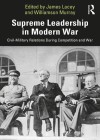
Routledge, New York, 2023 ISBN: 9781032451534, 322 pages
Edited by: James Lacey and Williamson Murray
Reviewed By: Charles Weller
Supreme Leadership in Modern War focuses on the highest level of civil–military relationships, those between the prime minister or president, chancellor or chairman and their most senior general as they lead their nation towards—and during—war. Through this lens, it examines the nexus that exists between national policy and grand strategy[i] on the one hand and military strategy and campaigns on the other. Both editors are eminent in the field of War Studies and History: James Lacey is the Horner Chair at the United States Marine Corps University and has written over a dozen books; and the late Williamson Murray was the Professor Emeritus at Ohio State University who wrote more than 20 books on strategy, war, and military adaption. Under their guidance, Supreme Leadership in Modern War identifies concepts and principles to enhance aspiring and current strategic leaders’ understanding of the civil-military interface. In light of the world’s fraught geopolitical landscape, the book is particularly timely.
Unlike Eliot Cohen’s masterful Supreme Command,[ii] which examines only successful partnerships in democratic countries, this book considers both unsuccessful and successful pairings within both democratic and authoritarian systems. It illuminates the importance of the military’s engagement with politicians, such as the need to understand the political implications of their command decisions and campaigns, and conversely for politicians to consider how military objectives fit within, affect and are affected by policy. It also considers how political structures and political-military decision-making affect a war’s progress and its outcome. Finally, it shows how the capacity to adapt to civil-military systems (in light of experience) can provide for better results the next time around.
The book’s 11 essays examine great power conflicts and the relationship between a prime minister, president, or dictator with their most senior military commanders. Two essays consider the American Civil War, three cover World War One, four World War Two, and the book closes with two essays on Korea. Because the author of each chapter is an expert in their field, the essays are revealing even for those who have foreknowledge of the topics covered. Each essay addresses the topic of civil-military relations thoroughly as it relates to the particular war under consideration.
James Lacey’s valuable introduction frames the ensuing 11 chapters by providing five lessons that are useful to consider when reading each of the subsequent essays. Murray’s superb conclusion, ‘The Complexities of High Command,’ is worth reading both within the context of the book’s overarching theme and on its own. Indeed, this reviewer would suggest that the best way to read Supreme Leadership in Modern War is to commence with the introduction and then skip to Murray’s conclusion. This approach provides the opportunity to engage with each of the essays with Lacey’s and Murray’s framing at the forefront of your mind.
Indeed, there are a range of ways readers can engage with the essays themselves. For example, they may be read in the order of publication, or the reader may prefer to select a particular war, nationality, or political leadership type (i.e. democracy, dictator) to focus on. Regardless of how one approaches the book, each essay is a valuable study that reveals pitfalls, successful approaches, and underlying principles as they relate to civil-military relations. A comparative analysis between different leaders, their styles and the resulting relationships shows that there is no one system that leads to victory, and that the ability to adapt during and between wars is vital. Personality matters, but so do the committees, cabinets, and meetings that form policy and that take decisions and ensure action. A chaotic approach such as the Kaiser Wilhelm II’s Germany created marked disadvantage against that of French with Ferdinand Foch and Georges Clemenceau, or the British with Prime Minister David Lloyd George and Sir Douglas Haig.
The essays illuminate how differing (even confrontational) personalities matter less than whether individuals can work effectively together, share a vision and adapt to circumstances. For instance, Richard Toye, the author of six books on Churchill, explores how, during World War Two, Prime Minister Winston Churchill and General Alan Brooke (Chief of the Imperial General Staff) met daily, argued often (and sometimes ferociously), but Churchill never overruled him on military matters when Brook’s position was firm. By comparison, Richard B. Frank—who is known for his extensive work on the Asia-Pacific War and World War Two—argues that US President Franklin D. Roosevelt and George Marshal (Chief of Staff of the US Army) could go weeks without talking. Unless the Joint Chiefs of Staff directly opposed him or diverged from his seven core principles,[iii] Roosevelt left them alone on military matters, ruling with a light hand. These principles included: the Anglo – American coalition must be maintained, Germany is the primary enemy, the Soviet Union must be given all possible support, and China must be kept in the war. However, when opposed (for example over Operation BOLERO—the concentration of US troops in the UK in preparation for a cross-channel invasion), Roosevelt acted swiftly and decisively to impose his control and emphasise his authority.
There are other fascinating comparisons between the leadership styles of historical political figures. For example, USSR’s Josef Stalin and Nazi Germany’s Adolf Hitler, appeared to have similar command approaches but they diverged when listening to their generals’ advice. Hitler listened to their counsel during initial campaigns and was successful, but subsequently he accreted military authority and surrounded himself with supplicant generals. By contrast, in the years before the war, Stalin purged over half all senior officers; a costly approach that saw massive Russian casualties during immediate months of Germany’s invasion. Yet Stalin grew to listen to and work through his generals such as Marshal Georgi Zhukov, though he was careful to avoid the Marshall developing political power. As Alexander Hill shows, following the war, Zhukov even grudgingly complimented Stalin on his leadership of the war.
Chapters 6 and 8 illuminate Germany’s ineffectual strategic leadership and ineffective political strategic mechanisms during the World Wars. Chapter 6 deals with World War One and is written by Holger Afflerbach who previously authored On a Knife Edge which examines how Germany lost that war. Meanwhile, in Chapter 8 Williamson Murray covers Germany during World War Two. In both wars, German conducted expansive operations that lacked strategic purpose and needlessly wasted manpower. Even when successful, the German efforts constituted Sun Tzu’s “noise before defeat.”[iv] Under the Kaiser, decision-making was chaotic; effort applied by various political elements towards the war suited their narrow interests, not necessarily those of the nation. The result was tactics disconnected from strategy that over-extended and diluted Germany’s forces, leading to enormous and ultimately unsustainable casualties.
The German experience during World Wars One and Two can be contrasted with that of the United Kingdom. For the British under Lloyd George, decision making during the Great War was iteratively refined with lessons carried further by Churchill when Prime Minister during World War Two and Minister for War. Britain harnessed political policy and military strategy to draw more from their available resources than their enemy; Freedman’s epitome of good strategy.[v] This approach offered Churchill a mechanism (if not always the means) to impose his will on the military then to guide those efforts such that the various military forces worked at least passably together, and on occasions, almost in harmony.
The two chapters on Korea by Christopher D. Yung (who has written extensively on China) and Richard B. Frank, compare Mao Zedong and his generals with President Harry Truman and General Douglas MacArthur. Mao knew his generals well, having fought with them over many years and having selected them on that basis with him as primus inter pares. By contrast, Truman had never met MacArthur, felt the general’s gravitas, and was wary of his popularity with the American public. When Truman first met MacArthur, the general had not visited the US for 14 years and believed he owned the US’s Asia strategy. By comparison, Mao and his generals possessed a shared vision, were well known to each other, and all knew Mao was in charge.
Supreme Leadership in Modern War should be read by those who are—or who aspire to be— senior military and defence leaders or those who are involved at the nexus of political-policy- military-strategy. Those studying, teaching or otherwise interested in strategic leadership, decision-making in war or civil-military relations would also find the book most beneficial. Finally, anyone interested in military history (especially Great Power conflicts) will enjoy it. Further valuable resources on the topic of civil-military relations at the strategic level include: Eliot Cohen’s well-known Supreme Command; Sir Lawrence Freedman’s Command[vi] (which includes 15 case studies exploring the interplay between command and politics); and Henry Kissinger’s Leadership: Six Studies in World Strategy[vii] (which examines six political figures several who are little known but fascinating in their approach and success). But start with Supreme Leadership in Modern War.
Endnotes
[i] A grand strategy may be defined as a nation’s conscious effort to employ all elements of national power to advance and fulfil its security-related objectives in the foreign sphere. Colby, Eldridge. Grand Strategy Contending Contemporary Analyst Views and Implications for the U.S. Navy. CRM D0025423.A2/Final November 2011
[ii] Cohen, Eliot A. Supreme Command: Soldiers, Statesmen, and Leadership in Wartime. New York: Free Press, 2002.
[iii] Lacey, James, “Roosevelt and Marshall”, In Supreme Leadership in Modern War, Editors James Lacey and Williamson Murray, London, Routledge, 2024 p. 202.
[iv] Sun Tzu, The Art of War, trans. Lionel Giles (London: Luzac and Co., 1910), chap. 3 – this maxim refers to tactics when disconnected from strategy being merely noise.
[v] Lawrence Freedman, Strategy: A History (New York: Oxford University Press, 2013), p. xii.
[vi] Palazzo, Albert. "Book Review - Command: The Politics of Military Operations from Korea to Ukraine." Australian Army Journal 20, no. 1 (2023). Australian Army Research Centre.
[vii] Kissinger, Henry. Leadership: Six Studies in World Strategy. New York: Penguin Press, 2022.