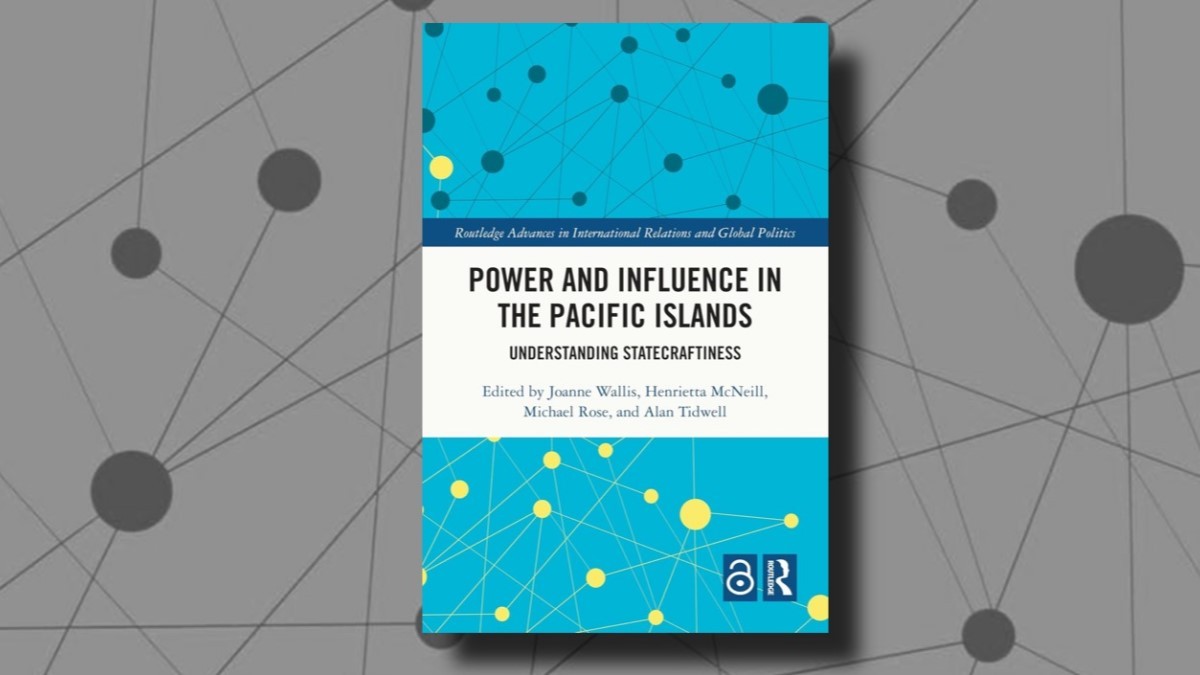
Understanding Statecraftiness
Routledge, London, 2025, ISBN 9781003496441 https://doi.org/10.4324/9781003496441
Editors: Joanne Wallis, Henrietta McNeill, Michael Rose, Alan Tidwell
Reviewed By: Carl Janz
On a recent trip to Vanuatu, I was struck by the clear signs of strategic competition in the country. Buildings labelled ‘Australia Aid’ and ‘China Aid’ stared each other down amidst the backdrop of Port Vila’s earthquake reconstruction efforts; conversations with locals revealed grievances with both China and Australia; and billboards towered overhead reassuring ‘Vanuatu will not surrender its sovereignty to anyone’. All this made clear that strategic competition is not an abstract policy problem, but a lived reality in a dynamic region. Had I read Power and Influence in the Pacific Islands: Understanding Statecraftiness prior to my trip, I would have been better placed to interpret what I was seeing within the broader strategic context.
Power and Influence in the Pacific Islands is a collection of self-contained academic essays written by experts in their fields. It seeks to provide a succinct yet comprehensive overview of the various forms of statecraft employed in and by Pacific Islands Countries, before assessing which approaches have been effective, which have floundered, and the reasons why. This is a lofty goal which the book largely achieves. The volume does not feature an explicit overarching argument consistent across chapters. Instead, each chapter is a deep dive on a particular state actor or an aspect of its statecraft. However, across the wealth of case studies explored and methodologies employed, key lessons for how to effectively engage with the Pacific ‘in general’ emerge.
The first chapter defines statecraft as an interconnected web of economic, diplomatic, military, soft power, and covert methods used to gain influence within a particular state. These webs of statecraft can prove ineffective and even harmful, as states can get ‘caught’ in their own complex webs of statecraft without catching the actual target state. This analytical framework is the common glue that binds the book and is one of the few links between otherwise independent chapters. The remaining twelve chapters focus on describing and evaluating a wealth of national approaches in the Pacific—covering Australia, New Zealand, the United States (US), China, Indonesia, India, Japan, South Korea, France, the European Union, the United Kingdom, as well as the Pacific Island Countries themselves. Particular attention is given to Australia, with different aspects of its statecraft featuring as the topic of four of the book’s thirteen chapters.
For example, Chapter Three discusses the effectiveness of the Australia Awards university scholarship program as a tool of Australian soft power in the region. The authors—all of whom are themselves former or current recipients of an Australia Awards scholarship from the Pacific—argue the awards are an effective tool of statecraft which successfully build the people-to-people connections so valued in the region. However, they cite concerns over strict visa requirements, experiences of racism, and a relatively low stipend as aspects which detracted from their experience in Australia. Chapter Four examines Australia’s economic statecraft in the Pacific, arguing it remains rooted in ‘colonial logics’ which are more focused on resource extraction than genuine two-way trade, generating a degree of resentment towards Australia.
Chapter Five explores the efficacy of Australian and US defence diplomacy and is more complimentary of Australia’s efforts. It argues that Australian defence diplomacy initiatives (such as humanitarian assistance and disaster relief) build both goodwill and effective interpersonal linkages between the Australian military and local populations. On the other hand, the authors contend that much of Australia’s current defence diplomacy should be carried out via civilian agencies, arguing that a large military presence may generate security anxiety and could create an opening for escalation with China as forces inadvertently cross paths on deployments. Chapter Eight discusses Australian statecraft and strategic narratives in the Pacific holistically and argues that Australia is overwhelmingly seen as the partner of choice in the South Pacific. The authors also identify constraints on Australian statecraft such as the existence of a more crowded ‘playing field’ that limits Australia’s relative influence. Further, Australia’s Indo-Pacific strategy sometimes clashes with its Pacific Islands interests—with AUKUS a key example of a policy that was received negatively in the region.
Chapter Seven on US statecraft appears to have been written in late 2024 prior to the second Trump administration. So while the chapter paints a clear and engaging picture of US involvement in regional strategic competition over the last several decades (with US engagement waxing and waning depending on the region’s perceived strategic relevance), it neglects more recent developments.
The book’s final two chapters examine China’s strategic narratives in the region and how they are received. This focus sets these chapters apart from the book’s other sections (which analyse countries’ statecraft across multiple domains). These closing chapters offer a fascinating deep dive into a potentially understudied area and it is particularly interesting to read about are the mixed results of China’s strategic narratives directed against Australia. Given China’s dominant strategic position within the Asia-Pacific, it is disappointing that the book does not cover China’s multifaceted statecraft more comprehensively.
A key theme which permeates the book is that effective statecraft in the Pacific Islands requires the building and maintaining of strong trust-based interpersonal relationships at government, business, and community levels. Such relationships have often proven more effective at generating influence than monetary investment and outright coercion. Further, regional solidarity is seen as paramount by Pacific Islands Countries, and any attempts to make a strategic agreement should be approached collectively by negotiating with the Pacific as a bloc. For Pacific Islands Countries, their solidarity is the lifeline with which they can advocate for key national interests such as climate action with a louder voice on the international stage. Ergo, a threat to Pacific solidarity is seen as potentially existential.
The principle of solidarity and the primacy of relationships are explored through a case study example provided in Chapter Two. In 2022, China sought to negotiate a regional Pacific security pact bilaterally with individual states and falsely told each state that it was the last one holding out. This subterfuge was received very negatively within the Pacific, resulting in the deal falling through. Instead, the Pacific Islands signed-on to a US-led joint statement later that same year which was negotiated collectively and which heavily favoured Pacific interests and strategic narratives. This example demonstrates the importance of negotiating with the Pacific as a bloc, and shows how Pacific Islands Countries collectively and capably employ their own webs of statecraft—leveraging potential ties with China to maximise gains from US negotiations.
Power and Influence in the Pacific Islands largely succeeds in providing an expansive overview of statecraft in the region. The reader will walk away understanding the nature and aims of Australia’s defence diplomacy and statecraft, the methods which have (and have not) proven effective on the ground, and how these efforts fit within the broader strategic landscape. This contribution makes the book relevant for on-the-ground practitioners as well as policymakers and strategists. However, the absence of discussion concerning the second Trump administration and the relatively limited analysis of Chinese statecraft are notable omissions that warrant further study beyond this book. Power and Influence in the Pacific Islands would also have benefitted from a conclusion that draws together its fundamental insights. While the book often signposts common features of successful and failed statecraft, it is ultimately up to the reader to keep track and draw their own conclusions. Despite this, the book succeeds in framing a wealth of strategic approaches holistically, succinctly, and from fresh perspectives, making it a worthy addition to the bookshelf of both the novice and the veteran of Pacific statecraft.
About the Reviewer
Carl Janz is a Research Intern at the Australian Strategic Policy Institute’s Defence Strategy Program. Previously, Carl worked at the Australian National University’s National Security College in professional development and policy. Carl holds a Bachelor of International Studies with Honours Class I in the Field of Russian from the University of Queensland, and a Graduate Diploma in Information Technology majoring in cyber security and networks from the Queensland University of Technology. In addition to English, Carl speaks German, Russian, Italian and Swedish.