
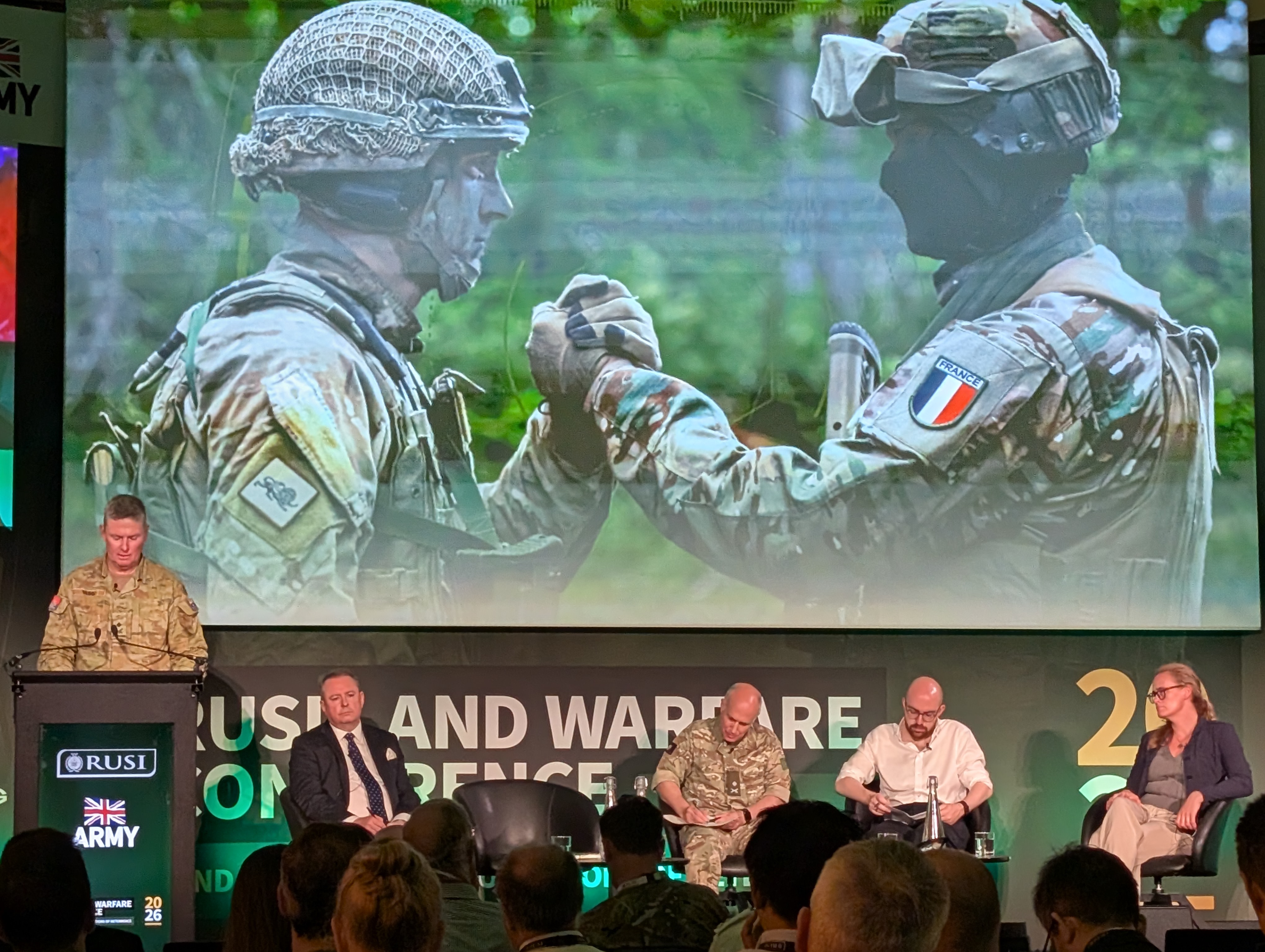
In Part 1, the AARC’s observations and reflections from Day 1 of the 2026 RUSI Land Warfare Conference focused on the enduring value of land power in deterrence strategy. Sessions addressed the specific strategic environment of Russia’s grey zone activities across Europe, the readiness of European armies to deter a future land war, and of the particular force design transformations and aspirations of increased lethality across NATO to meet the challenge of modern industrial warfare. On Day 2, speakers provided a framework by which to analyse the ways and means of generating and delivering combat power from the land. Topics included the integration of novel capabilities with core capacities, concepts for new capabilities, air defence, industrial rearmament (as the foundation for deterrence), and a reconceptualisation of land power.
As with Day 1, the war underway on Europe’s eastern edge loomed over all the discussions and panels, with Ukraine’s manufacturing lessons, military structural changes and battlefield adaptation providing both the inspiration and model for rapid transformation across the alliance. Ukraine was acknowledged as the expert in all conversations concerning the practice of contemporary industrialised land-based warfare, and since 2022, has been the exemplar of how maintaining a technological edge can generate asymmetry to counter an adversary’s greater mass.
Opening proceedings on Day 2 was Ukraine’s then-Minister for Defence, Mykhailo Fedorov, who provided a real-time update on his country’s defence against Russia. The gravitas of his comments, delivered live via video link from an undisclosed location in Ukraine, underscored the immediacy and seriousness of Russia’s threat to European security. Delivered as a Q&A-style presentation, Fedorov moved effortlessly from administrative reforms in the Armed Forces of Ukraine (AFU), the recent landmark figure of inflicting an estimated 30,000 casualties on Russians forces per month, to the strategic challenge of disrupting Russia’s logistics networks.[1]
The four years of war since the illegal full-scale invasion of Ukraine has strained Ukrainian personnel reserves. In particular, there are ongoing challenges with recruitment, retention and morale. Improvements to pay and conditions (or what Fedorov termed, ‘human capital reform’), has led to a recent increase in salaries for infantry and assault troops, with these positions also opened to international personnel.[2] A further newly introduced reform gives troops greater flexibility to choose their area/place of service. All changes are intended to maximise combat power and keep Ukraine ‘in the fight’ by establishing a more sustainable basis to attract and retain personnel, many of whom are exhausted from four years of constant war. In another positive development, Fedorov shared that the late-February 2026 cut to unauthorised Russian access to Starlink in Ukraine had been ‘a game changer’ with the Russians unable to fully replace this communications capability.[3] It is possible that the recent increase in Russia’s monthly casualty numbers is linked to this development.
The Minister acknowledged that too many Russian Shahed drones have been penetrating Ukraine’s air defences, calling on the need for the AFU to both ‘stop the enemy on land and also defend from the sky’, while also closing Russia’s economy.[4] This latter demand has recently borne fruit. Specifically, the interdiction of Russian economic activity via deep strike—termed ‘long-range kinetic sanctions’ by Fedorov—signals a shift in Ukrainian strategy beyond a focus on destroying the adversary’s military assets, into direct attacks at the civil-military nexus. For example, civil-military logistics infrastructure (such as oil refineries, and warehouses of e-commerce giant, Wildberries) support Moscow’s war effort and so their targeting by Ukraine diminishes Russia’s capacity to resupply and thus fight. Simultaneously, such events bring the war to the attention of average Russians, which ‘complicates Moscow’s messaging about the war’s distance from everyday life’.
The combined effects of Ukraine’s evolving military strategies impose new material costs on the Russian Federation, and forces it to reconsider the spread of its air defences away from the frontline and key cities.[5] Ukraine’s intent is to make Russia think about every action,[6] and shift the conflict for Russian citizens from one that is ‘over there’ to a war that impacts them directly. These developments also demonstrate the Ukrainian leaderships’ growing confidence in the capacity of AFU operators to successfully deliver payloads many hundreds of kilometres from the front lines, and in the existence of the requisite technical innovations to achieve this. It is not a one-way vector, of course; Russia is similarly inflicting long-range strikes on critical Ukrainian infrastructure and military capabilities in a grim struggle to generate a decisive advantage.
In his closing reflections, Fedorov revealed that the AFU had moved away from short-range artillery, with only long-range capabilities (firing 30+ kms) being ordered and used. The ubiquity of the drone kill zone had made shorter-range tube artillery irrelevant. Meanwhile, reinforcing air defence and increasing interceptor acquisition remained further priorities. A domestic ballistic missile industry is being developed in Ukraine, while 2024’s Unmanned Systems Force has been successfully deployed against enemy personnel and equipment.[7] These remarks highlighted the constant adaptation battle that runs parallel to the frontline combat, and which is every bit as important to the survival of soldiers from both sides.
The remainder of Day 2 explored the integration of novel capabilities and concepts from the Ukrainian front to NATO’s own plans for implementation. Air Chief Marshal Sir Johnny Stringer (Deputy Supreme Allied Commander Europe, NATO) outlined the major tenets of NATO’s operational concept/design,[8] recognising that greater resilience had to be built into the Organisation’s structures due to it being ‘too reliant’ on US capabilities.[9] Reflections on the ‘enormous’ volume of ordnance consumption, calculated from Ukrainian usage rates, led Stringer to argue that 30 days of supply merely equated to ‘readiness’, not sustainability.[10] He claimed the need, across NATO’s members, for a resilient, distributed industrial base that was scalable, dispersed and survivable, with replenishment required in 30 days. Brigadier Nick English (Commander, 1 Aviation Brigade, British Army), emphasised the necessity of cultural change to embrace the rapid adoption of novel capabilities. Getting such technologies into use and acceptance takes a generation, he argued, citing the British Army’s Phoenix UAV as a case in point.[11] Meanwhile, Major General Micky Edelstein (ELBIT Systems, former Israel Defense Force (IDF)), provided insights about the rapidity of the learning curve from the IDF’s ground war in Gaza. Over the course of the conflict, Edelstein observed that the efficiencies realised through improved processes saw the time between request and delivery of fire support fall from an initial 40-50 minutes to between 1-7 minutes.[12] This was yet further evidence of learning in contact.
The presentation by Ukrainian Private Dmytro Zhluktenko (413th Unmanned Systems Regiment (RAID)) provided Ukrainian insights from the operational level. A member of the ‘lessons learned’ cell, Zhluktenko revealed that Ukraine has changed its doctrine in wartime to adapt to the new reality of modern peer level warfare. He reflected that the innovation for which Ukraine is now renowned needs ‘freedom’ and ‘room to occur’.[13] The maturing of the Unmanned Systems Force has seen drone battalions and platoons organised as part of each mechanised brigade, with old positions—such as grenadiers—traded for drone operators. Concerned that NATO’s armies should adopt Ukrainian lessons as fast as possible, Zhluktenko revealed that signals intelligence, open source intelligence, and command and control capabilities, were combined to achieve the best outcome with drones. This has led to a situation where the AFU is now killing Russians some 20 kms from the front, ‘before they even fire their rifle’.[14] Sam Bendett (Center for Naval Analysis, USA) provided the Russian perspective on its war of adaptation. Following Ukrainian practice, the Russian Armed Forces has established its own Unmanned Systems Force.[15] All Russian ground units are now trained to use unmanned ground vehicles (UGVs), which are small, cheap and attritable. Russian UGVs are used in combat, logistics and casualty evacuation roles, and are being constructed in modular units so they can be adapted to different roles/functions.[16]
Ukrainian Minister Fedorov highlighted air defence as an area requiring improvement, RUSI had given this topic its own panel. For land forces—as practitioners well understand—defence against a range of aerial threats now includes everything from so-called first-person view (FPV) drones to ballistic missiles. The examples presented during this panel centred on the experiences and lessons of Gulf countries from the ongoing Iran war. Professor David Des Roches (Professor, Thayer Marshall Institute), discussed developments in the Saudi Defence Force. Out of the Yemen War, the Saudis had improved their air defence capacity, applying a mix of high quality training of the workforce and new Patriot interceptors to help reduce the damage achieved by Iranian strikes.[17] Roches reminded the audience that even successful air defence interdiction generates debris that must fall to earth, sharing photos of crushed cars and building damage from missile wreckage. Meanwhile, Brigadier General Sheikh Nawaf Bin Mubarak Al-Thani (President of the Council on International Mediation) claimed that Qatar’s anti-ballistic missile defence against Iranian missile attacks is amongst the ‘best in the Middle East’. In his view, well-trained and resilient crews are a key to that success. He also emphasised that Qatar’s capacity to defend itself was held as a key national achievement that demonstrates to the US that it is a genuine security partner, and able to provide intelligence to coalition partners.[18]
Colonel Sabah Al-Sabah (Deputy J5, Armed Forces of Kuwait) provided a gripping account from inside Kuwaiti Headquarters when he discussed the waves of ballistic missiles fired at his country. Al-Sabah’s observations were insightful for planners and practitioners defending against air attack. He reflected that Iran had tried to saturate and overwhelm Kuwait’s air defence, at a scale that Kuwait had not trained for. Kuwait had successfully defended itself in response.
In other remarks, Al-Sabah raised the issue of technical capacity versus scale—specifically, Patriots would win every tactical fight against Shahed drones, but economics dictated they could lose the industrial war. The ‘tactical scoreboard’ could very easily be overwhelmed by the ‘industrial scoreboard’ because mass represents a quality of its own. Al-Sabah added that magazine depth was calculated not just in rounds, but also in the numbers of computes (computing processes) and algorithms, meaning that digital systems have to process the mass of sensor information to determine targets and enact a kinetic response, repeatedly. Not all targets are able to be spoofed, so militaries have to be prepared for hard kinetic responses. In observations relevant to both Ukraine and the Middle East, Al-Sabah reflected that the proliferation of drones and long range fires means that a brigade deployed without the capability to counter unmanned aerial systems (C-UAS) ‘is just a target’.[19]
Australia’s Major General Richard Vagg DSC, AO contributed to the session on industrial rearmament. As then-Head Land Capability in the Australian Army, Vagg outlined Army’s transformation into a force optimised for littoral manoeuvre, including the numerous large capability acquisitions already delivered or arriving imminently.[20] Vagg’s presentation demonstrated that Australia is well advanced in its own transformation, with concurrent changes to the Army’s operating concepts and the Land Domain Concept. Vagg shared a panel with Major General Mark Purves (Director Digital, Security and Intelligence, British Army), who emphasised that defence industry is part of the fighting system, rather than ‘sitting outside the wire’. Industry’s capacity and potential forms a key part of the deterrence piece through its role in converting intent into fighting power.[21]
The Director of Helsing UK, James Lawson, provided an industry perspective to partner Purves’ evaluation, and gave a stark update on both the rapid expansion of Russia’s industrial capacity, and of its own efforts in upscaling defence industry in preparation for a possible continental war. Between now and 2029 (the year Lawson claimed Russia would be confident in challenging NATO), he forecast that NATO’s collective defence industry needs to demonstrate it can generate industrial capacity to deter Moscow. In 2025, Russia spent 7.5 per cent of its GDP on its war,[22] and in 2026 is on track to manufacture more than 7 million drones.[23] According to Lawson, such figures require a response from NATO’s defence industry, and noted his own company’s conversion of civilian factories to military production as part of that effort.[24]
Modern militaries need the right combination of humans, data and machines, to integrate their strengths for fast, lethal strikes.[25] According to Lawson, those machines need to be developed and manufactured by defence industry and this needs to occur now. Money alone will not help, he told RUSI, if it is spent ‘yesterday’ on legacy systems that will not add combat power for a future fight. Sovereignty is important; where nations buy internal components from matters. At the same time, arsenals cannot stockpile products they do not make, or iterate a product they do not buy, or train soldiers and write doctrine on systems they do not have. ‘Deterrence’, Lawson asserted, ‘is built, not declared’.[26]
In the same session, Emma Winberg of the Centre for Strategic Advantage spoke of her work analysing adversary military supply chains. She identified advantages that Russia seemingly holds over the West, such as a lack of environmental restrictions on industrial expansion or civilian protests; yet Winberg also highlighted vulnerabilities that offer opportunities for interdiction. For example, she observed a high degree of centralisation in Russian industrial innovation and production (to offset the impact of Western sanctions), with that pressure on Russia’s supply chain generating identifiable points of targetable strain.[27] It is notable that, since Winberg’s presentation to RUSI, Ukraine has exploited some of those vulnerabilities through its concerted attacks on Russian oil and logistics nodes. Her session demonstrates how the Australian Army (and the wider defence ecosystem) can draw enduring landpower lessons from European examples. These include the benefits of upscaling production as a deterrent, the dispersal of manufacturing infrastructure and logistics networks to challenge attempts at disruption, and the incorporation of defence industry as part of the fighting system, rather than as a separate input to it.
The conference’s final session provided perspectives on reconceptualising combat power in the immediate future, drawing on philosophies of systems, the combining of systems to increase lethality, and the rise of the ‘military marketplace.’ Using Ukraine’s Brave1 military-industry coordination mechanism as the context, Nick Reynolds (Research Fellow, RUSI) challenged delegates to think clearly about weapons systems, the mix of weapons in systems (systems of systems), the cost-to-target equation, and to consider those impacts on force design.[28] These remarks certainly invited application to General Walker’s discussion on Day 1 of a bold 20:40:40 Fighting System, where, in efforts to increase lethality, 80 per cent of the British Army’s capabilities will comprise consumable and attritable options. Colonel Perry Bishop (Assistant Head Concepts, British Army) applied Reynolds’ logic to the force design decisions the British Army is currently making. He outlined the British Army’s revised approach to force design (and lethality) through experimentation with systems war gamed against NATO’s needs and applied to the most likely adversary. He reflected that electronic war game data has generated an ‘immense amount of information about lethality’, making it possible to calculate a cost for increments in lethality.[29] Of particular note, Bishop claimed their modelling had calculated that the introduction of two new consumable capabilities quadrupled lethality, while an extra attritable sensor increased that by orders of magnitude more. These calculations and force design inputs were then applied electronically to the exact geographic frontage that NATO required the Allied Ready Reaction Corps (ARRC) to fight on, running numerous scenarios to trial different systems and force structure combinations. This innovation, he argued, was key to winning any future fight. Constant adaptation through combat was critical, with a recent 2026 Hudson Institute report finding that even a highly lethal force, after a few cycles, loses out to a force that is three-times more adaptive.[30]
With Ukraine currently the largest military laboratory in the world, Andriy Hrytseniuk (Director, Brave1) outlined how real-time battlefield data is used to identify trends and the most lethal combination of capabilities.[31] In the AFU, battlefield video and data on kills is submitted to Brave1 where it generates ‘e-points’. The destruction of targets is incentivised as each target has a different ‘points value’, with the points earned able to be used to purchase new capabilities from the Brave1 marketplace. These Brave1 drones are supplied in addition to the usual Army-supplied stock. Meanwhile, the uploading of video footage is a vital learning and adaptation tool, providing evidence of the effectiveness of different systems and tactics. Hrytseniuk revealed that recent developments on the battlefield have seen a massive increase in drone interceptions, 20+ kilometre strikes, and in the use of UGVs. As with Russia’s adoption, the transparency of the modern battlefield has driven Ukraine’s shift to UGVs for the delivery of logistics to reduce risk to human operators. Further, the linkages between adaptation, development and procurement have become intertwined in a rapid cycle, with the AFU’s experience showing that procurement cycles have to keep pace with the speed of defence innovation.
The vast data analysis undertaken via the Brave1 portal has led to more than just improvements in tactics, training and procedures (TTPs). Defence industry innovators are also able to improve their products as a consequence of the live data collected from the battlefield. Brave1 runs a rating system that identifies the most efficient defence technologies so manufacturers are able to see the results of their own products. This system is informed by monthly unit rankings filtered by points scored, with the highest performing teams evidently the most successful. Their practices are analysed and circulated to improve the baseline across the force, thus increasing the identification and destruction of more targets.[32] Astonishingly, Hrytseniuk claimed that some 80 per cent of the AFU’s drone demand is generated automatically from battlefield data[33] without human bias, corruption or subjective assessment, using a secure and separate Palantir large language model to support data processing and targeting. What emerged from the Brave1 presentation was a firm conviction that the real-time analysis currently employed by Ukraine represents the most accurate data-driven means to assess the battle worthiness of individual and collective military technologies, tactics and systems for combat. From its basis – which involves collecting data across the entire AFU combat ecosystem – this database is a living census tracking the developmental evolution of Ukraine’s warfighting effectiveness across space and time. Decisions to pivot and focus effort on certain areas, to inform force structures, develop specific units, or to accelerate different capabilities or platform types, is driven by objective data. While the data collection behind Brave1 represents an exciting tool to assess constant adaptation, the journey to reach this point has cost the lives of tens of thousands of Ukrainians.
In closing the 2026 RUSI Land Warfare Conference, the Chief of the Defence Staff (CDS), Air Chief Marshal Sir Richard Knighton KCB ADC FREng, reiterated General Walker’s opening conference statement that ‘Land power is fundamental to deterrence’. In this regard, Knighton issued four challenges for the British Army:
- Build the system, not just the teeth.
- Consider the role of the Army in multi-domain operations in the alliance, including how all the domains contribute to achieving the NATO Supreme Allied Commander Europe (SACEUR) vision for NATO’s preparations.
- Ask how a peacetime Army adapts and procures to the pace needed to keep ahead (i.e. not in contact with the enemy).
- Question whether the British Army has been bold enough in its reforms.
He reflected that the British Army came from a culture of demonstrated innovation, having ‘invented’ Blitzkrieg-style operations in late 1918 (specifically, at Amiens on 8 August), then, in his words, ‘ignored it’.[34] In CDS’ estimation, Britain needs an army that can stop a war from starting, one that is integrated, transforms in peacetime, tests itself, asks itself what its constraints are and addresses them, and delivers SACEUR’s vision.[35]
Reflections and Observations
The RUSI Conference provided a finger-on-the-pulse of the latest land power developments and future thinking by advanced Western militaries, with valuable real-world contributions from arguably the most battle-hardened army on the planet. Its relevance to Australia, the ADF and Army in particular, was evident throughout. Army’s purpose is to generate land power by developing and possessing capabilities to ‘credibly hold at risk forces that could attempt to project power against Australia’.[36] Army is already experimenting with combinations of systems to increase its lethality as part of an integrated ADF, working with allies and partners, to strengthen collective deterrence, just as the British Army’s leadership exhorted its own force to do as part of NATO. Ukraine’s experience demonstrates how domain boundaries are blurred in modern warfare. Sea drones are piloted from the land, via space, to strike maritime targets. The Australian Army is now a force optimised for littoral operations where it must be comfortable fighting on, beside, over and through maritime environments. But more needs to be done. The lessons on industrial sovereignty, defence industry’s close linkages with the end user, and scalability, are all insights that Australia acknowledges, but are only just starting to pursue. Other observations, such as adjustments to force design to prioritise particular systems (e.g. drones) or refinement to capability settings (such as platform/equipment specifications), will require careful consideration of Australia’s particular circumstances and future adversary and theatre of operation.[37]
In his opening Keynote Address on Day 1, General Sir Roly Walker argued that land power begins in society rather than the battlefield. It comes from the connection an army has with society, because while armies win battles, it is society where wars can be won and lost through industrial output, national support, and manpower. For Walker, ‘readiness’ and ‘transformation’ are not an either/or, but rather, are one and the same thing. The British Army’s transformation is an indicator or improved readiness, just as it is for the Australian Army’s pivot to littoral warfare. Those changes to the mission have driven force design changes to maximise the value of new capabilities introduced across both armies. The corresponding structural changes by Ukraine’s and Russia’s armies to develop and implement their respective unmanned systems forces represents a compelling argument for similar adoption by other militaries, including the ADF.
The scope of industrial rearmament advocated at RUSI represents a profoundly challenging proposition for governments everywhere. It is difficult to envisage that rapid capability changes and industrial expansion can be achieved without unambiguous political leadership and firm societal resolve. Accomplishing this will be difficult for Western democracies facing reductions in public trust in political institutions,[38] the rise of mis- and dis-information,[39] increasing cost of living pressures, and the growing uncertainty of the global economy. Ironically, security against a number of these issues lies in the development of credible military capabilities and the formation of alliances with trusted partners to deter aggression and the further destabilisation of the global order. It is the path both Australia and Great Britain is investing in, and it is the single biggest takeaway from the 2026 RUSI Land Warfare Conference.
Other notable AARC observations include:
- There was no official participation or attendance by representatives of the US Department of War, nor most Indo-Pacific militaries/armies.
- There was frequent acknowledgement that Europe must do more for its self-reliance, and that the over-reliance on US capabilities must be reversed.
- NATO was the dominant narrative; AUKUS barely rated a mention.
- The conference advocated the need for clear national and collective strategic goals, political investment in strong defence capabilities to deter, and appropriate resourcing to achieve that strategy.
- Fighting in alliances (NATO) magnifies the contribution and strength of the British Army. For the Australian Army, it too will leverage partnerships and fight with its allies and partners—a recurring theme from former CA, LTGEN Simon Stuart.[40]
Endnotes
[1] Presentation by Mykhailo Fedorov (Minister for Defence, Ukraine), RUSI Land Warfare Conference, Session 6: Keynote Address, 24 June 2026; Ukrainian attacks on Russian logistics nodes ramped up since Fedorov delivered his 24 June remarks, with Moscow acknowledging strikes on at least 20 warehouses belonging to the e-Commerce retailer, Wildberries, since 18 July 2026. Reuters staff, 'Russia says it struck 7 Ukrainian warehouses storing drone components', Reuters, 5 August 2026, https://www.reuters.com/business/aerospace-defense/russia-says-it-struck-7-ukrainian-warehouses-storing-drone-components-2026-08-05/ [Accessed 7 August 2026]
[2] Presentation by Mykhailo Fedorov (Minister for Defence, Ukraine), RUSI Land Warfare Conference, Session 6: Keynote Address, 24 June 2026.
[3] Presentation by Mykhailo Fedorov (Minister for Defence, Ukraine), RUSI Land Warfare Conference, Session 6: Keynote Address, 24 June 2026.
[4] Presentation by Mykhailo Fedorov (Minister for Defence, Ukraine), RUSI Land Warfare Conference, Session 6: Keynote Address, 24 June 2026.
[5] 'Ukrainian Drone Strike on Russian Logistics Hub Shows Deep‑Rear Vulnerability', Hamer Intelligence Services, 5 August 2026, https://hamerintel.com/data/articles/13132 [Accessed 7 August 2026]
[6] Presentation by Mykhailo Fedorov (Minister for Defence, Ukraine), RUSI Land Warfare Conference, Session 6: Keynote Address, 24 June 2026. Inflicting hardship on Russian society places pressure on the political level, which is problematic for regimes that do not enjoy popular support.
[7] See ‘Myth 3’, in Oleksandra Molloy, ‘Drone Warfare in Ukraine: From Myths to Operational Reality – Part 1’, Land Power Forum Insight, Australian Army Research Centre, 11 March 2026.
[8] Stringer outlined these tenets as: the protection of access for NATO/friendly forces; fires and manoeuvre; long range fires; a mix of forces (a range from high end and exquisite, through to ‘good enough’); the generation of an electro-magnetic spectrum advantage; and the evolution of C2, ISR and targeting. Presentation by Air Chief Marshal Sir Johnny Stringer (Deputy Supreme Allied Commander Europe, NATO), RUSI Land Warfare Conference, Session 7: Integrating Novel with Core Capabilities, 24 June 2026.
[9] Presentation by Air Chief Marshal Sir Johnny Stringer (Deputy Supreme Allied Commander Europe, NATO), RUSI Land Warfare Conference, Session 7: Integrating Novel with Core Capabilities, 24 June 2026.
[10] Presentation by Air Chief Marshal Sir Johnny Stringer (Deputy Supreme Allied Commander Europe, NATO), RUSI Land Warfare Conference, Session 7: Integrating Novel with Core Capabilities, 24 June 2026.
[11] Presentation by Brigadier Nick English MBE PhD (Commander, 1 Aviation Brigade, British Army), RUSI Land Warfare Conference, Session 7: Integrating Novel with Core Capabilities, 24 June 2026; The BAE System Phoenix UAV had its maiden flight in 1986, yet only entered operational service in 1999 – a decade after it was planned, due to development delays. 'Phoenix UAV’, Rochester Avionic Archives, https://rochesteravionicarchives.co.uk/categories/phoenix-uav [Accessed 7 August 2026]
[12] Presentation by MAJGEN Micky Edelstein (ELBIT Systems, former Israel Defense Forces), RUSI Land Warfare Conference, Session 7: Integrating Novel with Core Capabilities, 24 June 2026.
[13] Presentation by PTE Dmytro Zhluktenko (413th Unmanned Systems Regiment (RAID), AFU), RUSI Land Warfare Conference, Session 8: New Concepts for New Capabilities, 24 June 2026.
[14] Presentation by PTE Dmytro Zhluktenko (413th Unmanned Systems Regiment (RAID), AFU), RUSI Land Warfare Conference, Session 8: New Concepts for New Capabilities, 24 June 2026.
[15] For a precis of Russia’s USF, see, Hlib Parfonov, ‘Russia’s Unmanned Systems Forces Become Wildcard in Moscow’s Military Modernization’, Jamestown, 4 February 2026, https://jamestown.org/russias-unmanned-systems-forces-become-wildcard-in-moscows-military-modernization/ [Accessed 12 August 2026] The Russian USF has necessitated adjustments to logistics and procurements processes, as it has for the Armed Forces of Ukraine. The Ukrainians, however, designed and implemented this change before Russia adopted it.
[16] Presentation by Sam Bendett (Center for Naval Analysis, USA), RUSI Land Warfare Conference, Session 8: New Concepts for New Capabilities, 24 June 2026.
[17] Presentation by Professor David Des Roches (Professor, Thayer Marshall Institute), RUSI Land Warfare Conference, Session 9: Air Defence from Complex Threats, 24 June 2026.
[18] Presentation by Brigadier General Sheikh Nawaf Bin Mubarak Al-Thani (President of the Council on International Mediation), RUSI Land Warfare Conference, Session 9: Air Defence from Complex Threats, 24 June 2026.
[19] Presentation by COL Sabah Al-Sabah (Deputy J5, Armed Forces of Kuwait), RUSI Land Warfare Conference, Session 9: Air Defence from Complex Threats, 24 June 2026.
[20] Presentation by MAJGEN Richard Vagg (Head Land Capability, Australian Army), RUSI Land Warfare Conference, Session 10: Industrial Rearmament as the Foundation for Deterrence, 24 June 2026.
[21] Presentation by MAJGEN Mark Purves (Director Digital, Security and Intelligence, British Army), RUSI Land Warfare Conference, Session 10: Industrial Rearmament as the Foundation for Deterrence, 24 June 2026.
[22] Julian Cooper, ‘A Budget for a Fifth Year of War: Military Spending in Russia’s Budget for 2026’, Stockholm International Peace Research Institute (SIPRI), Stockholm, March 2026. https://doi.org/10.55163/BVBD7912 This equates to 17 trillion rubles, or AUD$292.3 billion.
[23] ‘Russia's Aircraft Output More Than Doubles as Drone Production Surges’, The Moscow Times, 2 June 2026. https://www.themoscowtimes.com/2026/06/02/russias-aircraft-output-more-than-doubles-as-drone-production-surges-a92905 [Accessed 10 August 2026]
[24] Presentation by James Lawson (Director, Helsing UK), RUSI Land Warfare Conference, Session 10: Industrial Rearmament as the Foundation for Deterrence, 24 June 2026.
[25] Presentation by BRIG Jim Hadfield OBE (Commander-designate, 20 Armoured Brigade, British Army), RUSI Land Warfare Conference, Session 8: New Concepts for New Capabilities, 24 June 2026.
[26] Presentation by James Lawson (Director, Helsing UK), RUSI Land Warfare Conference, Session 10: Industrial Rearmament as the Foundation for Deterrence, 24 June 2026.
[27] Presentation by Emma Winberg (Executive Director, Centre for Strategic Advantage), RUSI Land Warfare Conference, Session 10: Industrial Rearmament as the Foundation for Deterrence, 24 June 2026.
[28] Presentation by Nick Reynolds (Research Fellow, RUSI), RUSI Land Warfare Conference, Session 11: Reconceptualising Combat Power, 24 June 2026.
[29] Presentation by COL Perry Bishop (Assistant Head Concepts, British Army), RUSI Land Warfare Conference, Session 11: Reconceptualising Combat Power, 24 June 2026.
[30] Bryan Clark, Ian Crone & Dan Patt, 'The Quick and the Dead: How Adaptation in Contact Drives Military Advantage', The Hudson Institute, 16 March 2026, p. 20. https://www.hudson.org/defense-strategy/quick-dead-how-adaptation-contact-drives-military-advantage-bryan-clark-dan-patt-ian-crone [Accessed 11 August 2026] The report’s authors seemingly overlook the adaptation race on the Western Front, consigning it to ‘trench stalemate’, only acknowledging the late German development of proto-‘blitzkrieg’ tactics in Spring 1918. However, the succession of (for example) British Stationary Service (S.S.) pamphlets codified the continued learning and adaptation underway after each attack and training breakthrough, applying those lessons into combat in a constant cycle of improvement that contributed to the ultimate allied victory in the war. See, Aimée Fox, Learning to Fight: Military Innovation and Change in the British Army, 1914–1918, Cambridge University Press, 2017.
[31] Presentation by Andriy Hrytseniuk (Director, Brave1), RUSI Land Warfare Conference, Session 11: Reconceptualising Combat Power, 24 June 2026.
[32] The outline of the Brave1 process, plus analysis and recommendations for the Australian Defence Force and government is in: Oleksandra Molloy, Drones in Modern Warfare (2024-2026): Lessons Learnt from the War in Ukraine, Australian Army Research Centre Occasional Paper No. 45, 3 August 2026, pp. 128-134. doi.org/10.61451/2675166
[33] This data is collected from Delta, Mission Control, Brave1 and DOT-Chain defence to feed the algorithm from which analysis and insights are drawn.
[34] Presentation by Air Chief Marshal Sir Richard Knighton KCB ADC FREng (Chief of the Defence Staff), RUSI Land Warfare Conference, Session 12: Closing Keynote – Chief of the Defence Staff on the Future of British Land Power in NATO, 24 June 2026.
[35] Presentation by Air Chief Marshal Sir Richard Knighton KCB ADC FREng (Chief of the Defence Staff), RUSI Land Warfare Conference, Session 12: Closing Keynote – Chief of the Defence Staff on the Future of British Land Power in NATO, 24 June 2026.
[36] Commonwealth of Australia, The Australian Army Contribution to the National Defence Strategy 2026, p. 20.
[37] Mick Ryan, Translating Ukraine Lessons for the Pacific Theatre, Australian Army Research Centre Occasional Paper No. 33, 19 August 2025, DOI: 10.61451/267533
[38] M. Prats, S. Smid and M. Ferrin, ‘Lack of trust in institutions and political engagement: An analysis based on the 2021 OECD Trust Survey’, OECD Working Papers on Public Governance, No. 75, OECD Publishing, Paris, 2024, https://doi.org/10.1787/83351a47-en; ‘Trust in Australia’s National institutions is Declining’, Demos AU, 3 May 2026, https://demosau.com/news/trust-in-australias-national-institutions-is-declining/ [Accessed 7 August 2026]
[39] Alita Larson, ‘Rise of misinformation (International)’, 2023, https://www.ebsco.com/research-starters/communication-and-mass-media/rise-misinformation-international [accessed 7 August 2026];
[40] See, for example: Mid Year Video Message from Chief of Army, 7 July 2023, https://www.army.gov.au/news-and-events/speeches-and-transcripts/2023-07-07/mid-year-video-message-from-chief-army-07-july-2023; National Security Podcast, 'In conversation with Chief of Army, Lieutenant General Simon Stuart', National Security College, Australian National University, 7 November 2024. https://nsc.anu.edu.au/podcast/conversation-chief-army-lieutenant-general-simon-stuart; Robbin Laird, ‘The Australian Army in Strategic Transition: Lt General Stuart Simon on the Way Ahead’, Defense Info, 22 June 2025. https://defense.info/interview-of-the-week/the-australian-army-in-strategic-transition-lt-general-stuart-simon-on-the-way-ahead/