John Boyd, The U.S. Marines, and Maneuver Warfare
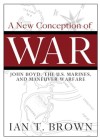
Marine Corps University Press, Quantico VA, 2018, 360 pp
DOI https://doi.org/10.56686/9780997317497
Author: Ian T. Brown
Reviewed By: Christopher Wooding
The ideas of John Boyd have often been the focus of debate, as has the United States Marine Corps (USMC) throughout its history. Ian T. Brown, a USMC officer, discusses both topics in his book A New Conception of War: John Boyd, The U.S. Marines, and Maneuver Warfare. The book is, in essence, a history of how the Marine Corps adopted Boyd’s ideas, specifically what came to be known as ‘maneuver warfare’, through the 1970s and 1980s. In charting this material, Brown provides valuable insights that make his book than a simple history.
The introduction of the book lays out Brown’s goals of which there are four. First, he seeks to clarify where the intellectual foundations of ‘maneuver warfare’ originated. Second, Brown aims to make more extensive use of primary material from the original ‘maneuver warfare’ movement, Boyd himself, and from the Marine Corps Gazette to provide a fuller picture of the ‘maneuver versus attrition debate’. Third, Brown undertakes to provide a detailed story of the development of ‘maneuver warfare’ from its genesis in Boyd’s mind and experience through to its expression in Marine Corps doctrine as Warfighting. Finally, Brown seeks to explain ongoing relevance of Boyd and his ideas to military affairs. In doing so, Brown also seeks to address misconceptions in Boyd’s ideas.
Chapter One is a concise biography of John Boyd, from childhood through his service in the United States Air Force (USAF) to his writing of ‘Destruction and Creation’ – one of the only essays Boyd wrote. The main theme of this chapter is how Boyd’s experiences as a fighter pilot instructor and an aircraft engineer shaped him and his ideas.
Brown then turns to the Marine Corps after the Vietnam War. Chapter Two discusses how the Corps reflected on its purpose in the latter half of the 1970s and how it was subject to external scrutiny by the American military establishment. Brown describes a Corps that was uncertain of how it might remain useful in a post-Vietnam world but determined to adapt to the future while retaining its unique Service character. A particular focus was searching for a defining purpose to focus the USMC’s future and the debate over the relevance of amphibious operations. This chapter sets the scene for the Marines’ search for answers and the subsequent ‘maneuver versus attrition’ debate.
Chapter Three continues from this foundation to discuss how the Marines sought to answer what the Corps would do on the (then) modern battlefield and how it would do it. Brown discusses the mechanisation of amphibious forces and the USMC’s role on NATO’s northern flank in a European war against the Soviet Union. An important theme to this chapter is how the Marines’ own thinking on these questions mirrored aspects of Boyd’s ideas, notably the primacy of people in warfare. Brown also introduces the ‘maneuvre versus attrition’ debate – a debate over how the Marine Corps could win while outnumbered and outgunned.
Brown returns to Boyd in the late 1970s in Chapter Four and further elaborates on his evolving theory of war. Brown describes Boyd’s essay ‘Destruction and Creation.’ In this essay, Boyd combined several concepts, such as the Second Law of Thermodynamics and Heisenberg’s Uncertainty Principle, to understand how perception and decision making enabled individual survival. From these intellectual foundations came Boyd’s hours long presentation called ‘Patterns of Conflict’. This presentation was a collection of thoughts and arguments about winning and losing in war based on Boyd’s study of military history from Sun Tzu and ancient Greece to both World Wars, Korea, and Vietnam. Brown spends time explaining Boyd’s ideas and addressing common misconceptions about them. The most notable of these misconceptions relates to Boyd’s thinking on attrition and his ‘observe, orient, decide, act’ (OODA) loop decision making model.
Though the early chapters of the book relate Boyd to the Marines, Chapter Five is where Brown fuses the two stories together. The focus is on the ‘maneuver versus attrition’ debate. Occurring throughout 1980s, the debate went back and forth between the proponents and critics of ‘maneuver warfare’. Brown makes an effort to represent both sides of this debate and the role of Boyd’s in influencing it. One of the key points raised in this chapter is that even Boyd’s supporters didn’t always understand his ideas fully, and it was these misunderstandings that became popularised and shared.
The final chapter focuses on the individuals who worked to give Boyd’s ideas the Marine Corps official seal of approval. Brown highlights four people: civilian William Lind and USMC Colonel Mike Wyly, General Alfred Gray Jr., and then-Captain John F. Schmitt. Each of these individuals played a key role in sharing and embedding Boyd’s ideas within the Marine Corps ethos and official doctrine. The result of this work was a new philosophical doctrine for the Marine Corps, originally published as FMFM-1 Warfighting. Brown highlights Schmitt’s efforts as the author of Warfighting, who had the towering task of synthesising the ideas of Boyd and ‘maneuver warfare’ into an accessible document. Brown seeks to give Schmitt greater recognition for his role as he has previously received little official acknowledgement of his efforts in histories of Boyd and ‘maneuver warfare’.
The book’s epilogue attempts to answer two final questions: “1) Did maneuver warfare actually prove useful when applied on the battlefield?; and 2) Has the Marine Corps followed through on the subsequent changes necessary to make it an organisation truly based on maneuver warfare?” Brown presents both sides of the argument in answering the first question. To answer the second, Brown highlights criticisms of the Marine Corps’ ability to totally adopt ‘manuevre warfare’. However, Brown argues that ‘while Marines have not always fought using maneuver warfare tenets, many times they have.’ Brown goes on to conclude that ‘maneuver warfare’ is not a static idea, but rather an ideal that constantly evolves.
Overall, Brown provides a useful history of the intertwined stories of John Boyd and the US Marine Corps to produce a philosophy that the Marines continue to apply today. A New Conception of War is professionally relevant to the Australian Army and generally accessible. Brown tells a story of organisational change that focuses on people and ideas over technology and hardware. This story is also an inspiration to all military professionals to think and debate ideas within the profession of arms. In these respects, A New Conception of War is relevant and accessible to most Defence members, particularly senior officers seeking a case study for how ideas can shape the Army as it optimises for littoral operations and deterrence by denial. However, as an introduction to Boyd’s ideas, the book may be better suited to those who have had some prior exposure to those ideas. This is particularly the case regarding Brown’s discussion of manoeuvre warfare. While Brown notes manoeuvre warfare is constantly evolving, there is increasing discussion over the utility of the phrase.[1] A New Conception of War is not a must-read, but this observation should not be confused with an assessment that the book lacks value – Brown has done an outstanding job of weaving together the various aspects of Boyd, the U.S. Marines, and ‘maneuver warfare’ to clarify and inspire others to continue thinking about and applying Boyd’s ideas.
Endnotes
[1] See B.A. Friedman, Reconnaissance-Strike Tactics, Defeat Mechanisms, and the Future of Amphibious Warfare in the Journal of Advanced Military Studies, Vol.15, No.2 for an introduction to the discussion over the utility of the phrases ‘attrition’ and ‘manoeuvre’.