Operational Thinking from Moltke the Elder to Heusinger
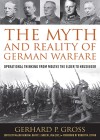
University Press of Kentucky, 2016, ISBN: 978-0-8131-6837-1, 464 pp USD$50.00, Hardcover
Written by: Gerhard P. Gross (Trans. by David T. Zabecki)
Reviewed By: Chris Wooding
The German Army, particularly during the period of both world wars, has been an enduring object of fascination for military professionals and historians alike. Though the subject of much scholarly work, the broad interest in the German military has also led to the rise of several myths – particularly related to the ideas and performance of Germany’s operational thinking.
In The Myth and Reality of German Warfare: Operational Thinking from Moltke the Elder to Heusinger, Gerhard P. Gross, a Bundeswehr colonel and department head at the Bundeswehr Center of Military History and Social Sciences, addresses many of these myths by tracing “the development of operational thinking against the background of German military history during the world wars period.”[1] In doing so, Gross covers the period from the 1860s through to 1962 and provides insightful analysis on the development and failure of Germany’s operational thought. Originally written in 2012, the book reviewed here is a 2016 translation edited by David T. Zabecki, a retired US Army major general and noted military historian.
In Chapter One, Gross lays out his definitions for the terms tactics, strategy, and operations. In doing so, he defines operational thinking as “the leadership of large formations in a theater of war”[2] – thus as an echelon of command. This brief chapter on military theory establishes the terms used by Gross for the remainder of the book. Chapter Two, Factors and Constants, lays out the context for Germany’s development of operational thought. Gross focuses this on three enduring aspects – space, time, and force. These are persistent themes in Gross’s work as they formed the foundations of the problems that the development of German operational thinking sought to resolve.
Chapter Three is the beginning of Gross’s history of German operational thinking, focusing on Moltke the Elder, the first Chief of the German General Staff, 1871-1888. Gross discusses Moltke’s contributions to the rise of operational thinking as new technologies (such as telegraphy and rail) enabled the command and control of multiple armies in a single theatre. Notably, Gross addresses the myth of an all-powerful German General Staff, that controlled all military resources, demonstrating instead that the General Staff during this period lacked many such resources and competencies. Instead, Gross reveals the General Staff as “merely the highest planning authority, and in time of war it was the operational command and control center” rather than a replacement for the German Military Cabinet or the War Ministry.[3]
Chapter Four discusses the period from Moltke the Elder up to the beginning of World War Two. This chapter focusses on Alfred Graf von Schlieffen and (to a lesser extent) Moltke the Younger – both successive Chiefs of the German General Staff, 1891-1906 and 1906-1914 respectively. This chapter addresses several myths surrounding Schlieffen and his operational concepts. In particular, Gross argues Schlieffen was “more flexible and thought more politically than the historical literature to date” suggests.[4] It also discusses the evolution of operational thought under Moltke the Younger in the period immediately preceding World War One.
Chapter Five, titled Bitter Awakening, describes the performance of German operational thought during World War One. It examines the three iterations of the Oberste Heeresleitung (Supreme Command of the Army) under Moltke the Younger, and his successors Falkenhayn (1914-1916), and finally Hindenburg and Ludendorff (1916-1919). Despite impressive tactical innovations by the German Army, Gross highlights the many weaknesses of German operational thought and its ultimately poor performance in the Great War. Some examples of these weaknesses include the difficulty the German military faced in applying pre-war plans to operational realities. This was due to inadequate command, control, and communications mechanisms as well as the deficit of mobility required to enact and sustain the operational aspirations held by Germany.
In Chapter Six, Gross examines the effect on operational thought of various personalities within Germany’s General Staff during the interwar years. He contends that German operational thought was not significantly revised during this period despite its demonstrated failings during World War One and despite ongoing internal debates around the reasons why. Intent on attributing personal blame to particular political and military leaders, the General Staff took a selective approach to post-operational analysis. This narrow outlook played a major role in its failure to recognise and address how the limits of its operational thought had contributed to its battlefield failures – despite initial successes from technological advances in mobility and communication.
As Gross goes on to show in Chapter Seven, a key weakness was the General Staff’s tendency to emphasise the conduct of operations at the cost of logistics and strategy. Despite Germany’s early successes in Poland and France, the military risks of this skewed operational thinking became starkly obvious during Operation BARBAROSSA.[5] This chapter focuses on the German campaigns in Poland, France, and Russia, with little discussion of other campaigns and theatres.
Gross’s history of German operational thought ends with the rise of the atomic age. Following its defeat in World War Two, Germany again made efforts to rationalise (rather than address) the failures that had afflicted operational thought during the War. Despite the Cold War introducing a radically new international world order, many of the operational principles and ideas applied by Germany (and the North Atlantic Treaty Organisation) retained the same characteristics as had been applied since the time of Moltke the Elder. As Gross describes, there is, then, a continuity within German operational thought through to 1962, the year where Gross ends his analysis.
As the Australian Army renews its interest in large-scale combat operations, The Myth and Reality of German Warfare has much to offer military professional readers. For those interested in the German military during both World Wars, it offers an interesting history of the ideas that underpinned Germany’s operational successes and failures. Gross’s handling of the myths adds depth to (what might otherwise be viewed as) one-dimensional assessment. For those readers with interests beyond German history, the book will be useful for those interested in further developing their understanding of military theory, as Gross’s work offers many insights. Indeed, The Myth and Reality of German Warfare complements several books included on the 2025 Chief of Army Professional Study Guide, in particular Robert M. Citino’s The German Way of War: From the Thirty Years’ War to the Third Reich – as Citino himself notes in the foreword to Gross’s work.
This book is not an introductory text to military theory. It is best read by those who have been exposed to operational art – making it most suitable for Command and Staff Course graduates and beyond. While many aspects of German command, control and warfare continue to influence Western military thought, the idea of an operational ‘level of war’ is increasingly being challenged by today’s military theorists.[6] In this regard, Gross’s work is useful in its contribution to understanding the history of those ideas and their practice, but it should also be approached with an understanding that those ideas are incomplete and imperfect. Therefore, Gross’s work is primarily a history, one that can be a supplement to understanding theory.
Gross’s The Myth and Reality of German Warfare is an excellent history of Germany’s operational thought. It is well-researched and thorough in its treatment of its topic. Gross’s work also makes a strong contribution to a more rounded understanding of the German military during the period of two World Wars, successfully addressing many of the myths of an innate German ability for war that surround those years.
Endnotes
[1] Gerhard P. Groß, The Myth and Reality of German Warfare: Operational Thinking from Moltke the Elder to Heusinger, ed. David T. Zabecki (University Press of Kentucky, 2016), 6.
[2] Groß, The Myth and Reality of German Warfare, 16.
[3] Groß, The Myth and Reality of German Warfare, 55.
[4] Groß, The Myth and Reality of German Warfare, 95.
[5] See, for example David Stahel, Operation Barbarossa and Germany’s Defeat in the East (Cambridge University Press, 2009). My thanks to an anonymous reviewer for this recommendation.
[6] B. A. Friedman, On Operations: Operational Art and Military Disciplines (Naval Institute Press, 2021); Justin Kelly and Michael James Brennan, Alien: How Operational Art Devoured Strategy (United States Army War College Press, 2009). For a recent discussion of this in the Australian context, see Matthew Jones, ‘Beyond Labels: Conceptual Reframing of the Operational Level of War’, Land Power Forum, Australian Army Research Centre, 24 July 2025, https://researchcentre.army.gov.au/library/land-power-forum/beyond-labels.