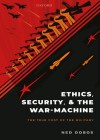
Oxford University Press, Oxford, 2020, Online ISBN: 9780191892554; Print ISBN: 9780198860518, 184 pp
Author: Ned Dobos
Reviewed By: Matthew Malcolm
Even allowing that a ‘just war’ is possible, the existence of a permanent national military may remain unjustifiable, because of its extraordinary social and cultural costs. This is the central argument of Ethics, Security, & the War-Machine, by Ned Dobos. While the author holds back from arguing that the existence of a permanent military is always unjustifiable, he succeeds in making the case that it should be an open question.
No reader interprets a book without bringing their own context to bear, and given the particular argument of this book, it is worth foregrounding my own vantage point: I review this book as a committed full time military member. Nevertheless, in what follows, I will draw attention to what is most persuasive in the book, as well as summarising and occasionally responding to its arguments.
In chapter 1, Dobos begins laying out the social and cultural ‘risks and costs’ associated with maintaining a permanent military. Here, he argues that the reduction of sensitivity to killing achieved in combat training constitutes moral degradation of military members. This is worth considering. There are undoubtedly dangerous impacts of combat training that need to be taken seriously. If combat training desensitises military members, such that they experience moral injury, this does seem to be a significant cost. At the same time, an analogy may be worth exploring: would we consider an emergency department doctor to be morally degraded because they have learned not to be immobilised by the experience of intentionally cutting human flesh? The deferral of emotional engagement is an acceptable psychological strategy to deal with trauma in this and other situations. Could we not extend this acceptability to those who are preparing to face combat? I offer this not as a clinching rebuttal, but as an open engagement with the book’s concerns.
In chapter 2, Dobos argues that the existence of a standing military raises the likelihood of a coup, resulting in society experiencing a loss of self-definition, akin to what is experienced in situations of foreign domination. This risk is exacerbated by a growing civil-military gap, such that there is distrust and reduced common ground between military members and civilians. Dobos does note that some societies are more coup-prone than others, but argues that for all societies, the existence of a military heightens the risk. The conclusion is necessarily modest: the existence of a standing military might result in a military coup. Given that the book as a whole advocates weighing different risks against each other, one cannot help but ponder how Australia might most appropriately weigh the risk of military coup against risks associated with having no permanent military.
Chapter 3 posits that a permanent military, even if postured for deterrence, may provoke preventive aggression by fear-sensitive adversaries – especially if international norms move further toward acceptance of preventive military intervention. This is the strongest chapter of the book, both because it compellingly presents a potentially severe risk of maintaining a military, and because this risk is highly pertinent to the Defence posture of Australia and its allies. Of all the ‘risks and costs’ outlined in the book, this one is especially worthy of contemplation: is it possible that our well-advertised readiness to ‘respond with credible military force when required’ might be misinterpreted and pre-emptively engaged?
In chapter 4, Dobos argues that political decision makers may be tempted to embark on unjust wars, because of the combination of various cognitive biases, coupled with their access to a permanent military as a political instrument. This carries some weight: the existence of a permanent military may allow political decisions that would not otherwise be considered. Again, the conclusion is modest, because it is a matter of possibility. For example, in relation to one bias, Dobos writes, ‘My claim is only that we cannot rule it out’ (p90). It remains imaginable, then, that such bias might be reduced, and that there might be a degree of external threat that justifies the bearing of this risk. The author’s concern, however, is that this justifiability should not be assumed, and must be argued.
According to chapter 5, aside from positive ‘advertised’ values, there are negative ‘suppressed martial values’ (such as domination and toughness) that are fostered by a permanent military. These can penetrate and negatively affect society. Some of the military and societal characteristics that Dobos identifies are unarguably terrible, such as mistreatment of women and excessive police violence. If ‘cultural militarisation’ advances these evils, it is to be deplored. However, I found this to be the weakest chapter. It is not clear that all of these evils turn on the existence of a standing military. Some identified evils seem so distinctive to certain countries, and so relatively absent in other countries with permanent militaries, that it raises the question: could there be factors other than a permanent military that are more decisive? As an Education Officer, with a previous career in education in Australia, Britain, and Indonesia, I am hesitant to accept the author’s argument that military culture significantly penetrates education – at least in those countries.
In the book’s epilogue, Dobos argues that it is possible to conceive of a viable non-violent alternative to a permanent military, which could still feasibly serve national security. This is a fitting destination for the book, and provides food for thought.
Dobos has achieved the main goal of this book, which is at once modest and significant. It is modest in that it seeks only to argue that the need for a permanent military should not be a foregone conclusion. It is significant, because for many of us, the existence and necessity of a permanent military have never been seriously questioned.
His argument does allow the possibility that there will be a security threat so terrible that the risks and costs of a permanent military might be worth bearing. As Australia contemplates the possibility of war, it is not a limited state versus state affair that is foreseen, but an enormous engagement of alliances and partnerships, to be played out in our immediate vicinity. Given this potential threat, and the milder experience of some of the book’s identified risks in an Australian context, there is a case to be made that the costs of maintaining a permanent military are worth bearing. But this is not to dismiss the key achievement of this book, which is to point out that there are indeed social and cultural costs being borne, and these must be squarely faced.