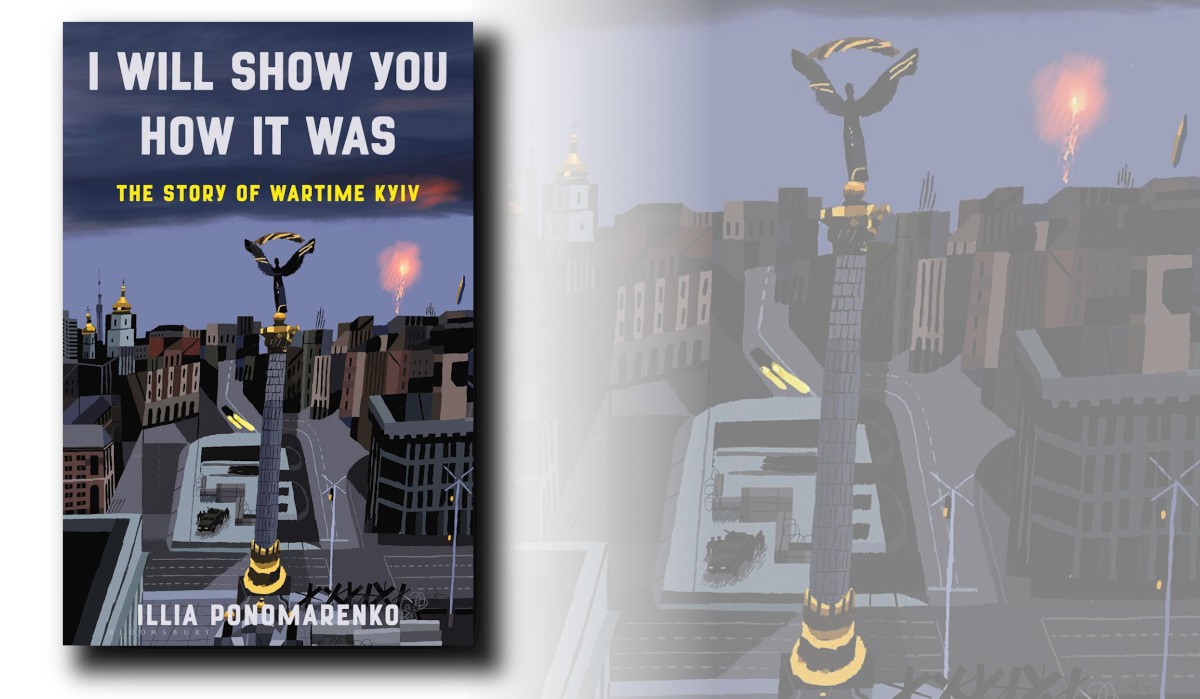
The Story of Wartime Kyiv
Bloomsbury Publishing, 2024, ISBN 9781639733873, 288 pp, (AUD) $35.99 (hardback)
AUTHOR: Illia Ponomarenko
REVIEWED BY: John Nash
Many books have been written about Russia’s invasion of Ukraine in 2022. Illia Ponomarenko is a well-known and well-regarded Ukrainian journalist who has covered Ukraine’s conflict with Russia for many years, including before the full-scale invasion. I Will Show You How it Was is a very personal account of the build up to invasion, and as the subtitle indicates, the battle for Kyiv in the first few months of the war.
The first half of the book narrates the lead-up to invasion, combining overarching political and diplomatic narratives with a personal view and the experiences of Illia as he navigates a new job as a founding member of the Kyiv Independent and the build-up of tensions in Kyiv as war draws closer. He vividly describes the feeling on the ground, an oft-overlooked Ukrainian perspective on what it was like, including the desensitising effect of living under the shroud of Kremlin propaganda, something he describes as a ‘toxic media environment, with hateful propagandistic stink always wafting from the east’.[1] Ponomarenko deftly tracks the information war waged by Russia, controlling the narrative and dictating the tempo of the West’s weak response. He tracks as tensions in Kyiv continue to rise, like with the publication of an air raid shelter map by the government, an early and concerning sign that things were not well.[2] With this foreboding in mind, he visits the city of Mariupol where he studied at university. With the reader knowing full well the sad fate of the city and its brave defenders after a long and bloody siege ending in May 2022, it is a dark foreshadowing of a war that would take so much from so many.
Attention then turns to the cast of characters within the Ukrainian government. Ponomarenko is brutally honest with his views on these various figures, tracking the scandals and public perceptions of leading generals and politicians. His initial view of President Volodymyr Zelensky is far from favourable. Nevertheless, in another act of foreshadowing he reflects upon the fact that war brings out a person’s character, with Zelensky coming to represent wartime transformation most of all.[3] His insights into Kyiv’s society at the time are incredibly valuable. For instance, his description of the first arrivals of Western arms is fascinating, mentioning how the Ukrainian military posted videos on how to operate the Next Generation Anti-Tank Weapon (NLAW) and then describing the actual steps on how to use one.[4] These examples contrast with the infamous German decision to send Kyiv helmets instead of weapons, and even to block other countries from sending German-made weapons to Ukraine.[5]
Ponomarenko’s insights on the ground are continually refreshing, from the personal to the strategic. He describes the formation of Territorial Defence Guard units and the evacuation of Western embassies from Kyiv. He notes the bitter irony of a Kyiv subway system designed to protect its citizens from the ‘evil capitalist warmongers of the West’, only to see them used to defend against Russia.[6]
Chapter 12 deals with the opening of the war proper, and it expertly tells the story of the confusion and mania of war, especially in a large city like Kyiv. Ponomarenko is able to weave a narrative that covers personal observations as well as wider events; from the experience of covering his apartment windows with cardboard to explaining the (now infamous) Russian practice of painting tactical signs – such as the ‘Z’ – onto their vehicles. As a war reporter by trade, he is keenly aware of military matters in and around the city. Moreover, he uses his journalistic training to remind the reader of salient historical points as he travels through the now war-torn city of Kyiv. A drive through the Maidan invokes a flashback to 2013 and 2014 and the ouster of the Russia-aligned President Viktor Yanukovych. It is not a nostalgia trip, but serves to remind readers – western readers in particular – that the events of 2014 were a decisive rejection of Russian-alignment and an embrace of the West by Ukraine: a reminder that the Ukrainians were fighting for a say in their future.[7] Soon after this, Ponomarenko returns the reader to the present day as he and his housemate (and driver) move around the city delivering food aid to people in need. Such efforts are evidently just one part of a grassroots campaign by citizens to provide for those people unable to feed themselves, like the elderly, and the military. He explains that restaurants and fast food outlets donated free meals to the citizenry, and how establishments that were shut allowed free-use of their kitchens.[8] It is a fascinating account of the resilience and willpower of the Ukrainian people, organising for self-defence and ensuring that life in Kyiv could go on as the Russian military closed in.
The final chapters see Ponomarenko moving to the outskirts of Kyiv in his capacity as a reporter for the Kyiv Independent, and providing an overview of the operations there to halt the Russian advance. Here, the book relates the collective sigh of relief let out by the residents of Kyiv in early April 2022 as Russian forces are defeated and pushed back, retreating to the border and ending the ground threat to the city. The book finishes with an epilogue that reflects on the sadness of the war as spring blooms in Kyiv in May 2022, and of the lives lost by Ukrainian defenders, fighting to preserve their right to determine their future.
I Will Show You How it Was is a very personal account of the war. Ponomarenko writes honestly and vividly about what he sees, about the mood of those he knows, and about the experiences of others he speaks to in the city of Kyiv. He paints a vivid picture of the lead up to the Russian invasion and of the populations’ response to the first fateful weeks. The narrative flows easily, and Ponomarenko uses many pop-culture references from television, film, and books, all of which are particularly relatable to a Western audience. This prose style is another not-so subtle reminder that many Ukrainians, especially those who are younger and middle-age, see their future within a Western political and cultural paradigm. Perhaps the most salient take-way from this book is not so much how Ukraine fought in those first few weeks, but why they fought and died, and continue to do so to this day.
Endnotes
[1] Ponomarenko, Illia, I Will Show You How it Was. The Story of Wartime Kyiv, Bloomsbury, 2024, p. 23.
[2] Ponomarenko, I Will Show You How it Was, 2024, p. 32.
[3] Ponomarenko, I Will Show You How it Was, 2024, pp. 48-54.
[4] Ponomarenko, I Will Show You How it Was, 2024, pp. 74-77.
[5] Ponomarenko, I Will Show You How it Was, 2024, pp. 77-78.
[6] Ponomarenko, I Will Show You How it Was, 2024, p. 159.
[7] Ponomarenko, I Will Show You How it Was, 2024, pp. 194-196.
[8] Ponomarenko, I Will Show You How it Was, 2024, pp. 208-209.