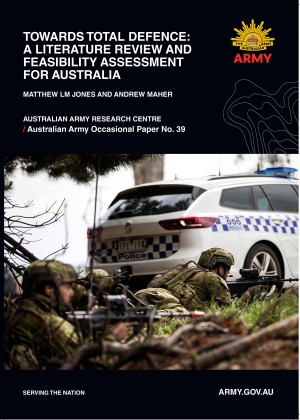
The most common error in Australian discussions of Total Defence (TD) is to treat foreign models as shortcuts: either templates to copy or symbols to borrow. The more defensible proposition—developed in the recent Occasional Paper 39 on TD[1]—is that Australia should translate what TD systems do into arrangements that fit Australian geography, federal governance, infrastructure ownership patterns and civic culture.[2]
Recent events make that translation task hard to ignore. The war involving Iran has disrupted traffic through the Strait of Hormuz and produced a systemic oil‑and‑shipping shock. The International Energy Agency (IEA) has linked the price volatility and supply disruption in March 2026 directly to strikes on Iran and the cessation of tanker traffic through the Strait, while Reuters has documented spill-over effects across exporters and global crude markets.[3] Australian reporting has captured the domestic implications in real time: fuel anxiety, patchy shortages, and the rapid creation of national coordination mechanisms to stabilise distribution and mitigate panic buying.[4] Those measures seem rational in the moment, but TD logic would treat them as evidence of a deeper issue: critical functions need standing coordination arrangements, not improvised ones.
A credible Australian TD agenda, therefore, has to start with the federation. The Commonwealth sets national defence strategy and holds major regulatory levers, but substantial civil protection capacity sits with states and territories, while significant critical infrastructure is privately owned or operated. The 2024 National Defence Strategy’s adoption of a Deterrence by Denial approach implicitly relies on that distributed system working under stress;[5] the Chief of the Defence Force has similarly warned that Australia must be prepared to conduct combat operations from its own soil and has linked that requirement to infrastructure and supply chains.[6]
This is where the Security of Critical Infrastructure (SOCI) regime becomes more than a compliance story: it needs to be an institutional signal that Australia already recognises ‘shared responsibility’ and systemic interdependence in law, held up by stronger legislation than the ‘toothless’[7] SOCI Act of 2018.[8] TD logic would press the key operational question: do Defence planning assumptions, SOCI obligations, and state‑level emergency management arrangements align on what must keep functioning first, under what conditions, and through what standing coordination mechanisms?
Energy resilience is the clearest stress test for that alignment. As part one of this series noted,[9] the Iran war has highlighted that crude imports, refined fuel imports, and ‘domestic resources’ are distinct issues. Australia can be a hydrocarbons exporter and still be strategically exposed if refining capacity, storage, distribution, legislated reservations for Australian use and critical inputs remain fragile. In the near term, the hard problem is liquid fuel continuity. Baseline stockholding, distribution planning and prioritisation for Defence and essential services must be enabled through a coherent national fuel security framework, rather than by episodic crisis measures.[10] Defence is already investing in its own fuel and operational energy resilience, but its energy dependence is embedded in national systems and subject to the same fragilities that expose the rest of the country to strategic shortages – it is not separable from them.[11]
In the medium term, resilience also means shrinking vulnerability. That is where electrification and renewables matter for defence energy resilience, even while the ADF remains liquid‑fuel-dependent: broad-scale demand reduction in the civilian economy can create strategic headroom, freeing liquid fuels for Defence, emergency services and freight. A March 2026 analysis by the Australian Broadcasting Corporation argued this directly, framing the energy transition as an ‘off-ramp’ from import dependence and volatile global oil markets.[12] Strategically, the strongest version of that argument is conditional: demand reduction helps, but only if the transition is itself hardened against disruption and coercion.
That long‑run trade‑off is increasingly visible in Australia’s cyber threat picture. A digitised, more distributed energy system may provide redundancy and local generation options, but it also creates new attack surfaces and component supply chains, not to mention complexity and cost. Australia’s recent cyber threat reporting shows why this matters: malicious activity is persistent and increasingly affects the systems that underpin essential services and economic function.[13] TD applied to energy, therefore, is not ideology (i.e. ‘fossil’ versus ‘green’); it is a portfolio problem to assure energy under coercion, across multiple supply chains and manifold threat vectors.
TD in Australia also requires psychological and information resilience that is compatible with a multicultural democracy. The fuel shock has shown how scarcity narratives can amplify disruption through panic behaviour and strained distribution networks. Former Chief of the Defence Force, Chris Barrie, has argued publicly that climate and energy disinformation is itself a national security threat because it distorts resilience choices, undermines trust, and constrains strategic autonomy.[14] In TD terms, this is not a distraction from ‘real defence’; rather it is part of the terrain on which coercion succeeds or fails.
For Australia, TD is not a foreign model to be adopted wholesale, but a framework for translating selected functions into Australian conditions. The examples highlighted here—federal coordination, energy resilience, and information resilience—are not the sum of an Australian TD agenda, but only a few of the more immediate and visible issues sharpened by the present Iran conflict, and the shortages caused by the opening phases of the Ukraine war before it. The broader argument, developed in the forthcoming AARC Occasional Paper, is that Australia should draw pragmatically from overseas models while building its own approach around local geography, federal arrangements, critical infrastructure dependencies, and civic culture. Doing so would establish a sounder base for national resilience than is currently practised, and strengthen Australia’s position in a region and world marked by increased geopolitical and economic volatility.
This post is the second to discuss the recently-released Occasional Paper 39 on Total Defence co-written by the author for the Australian Army Research Centre. A second (forthcoming) Occasional Paper will develop and test options for Australia’s specific context; outlining sequenced policy pathways, cost/risk trade-offs, legal instruments and governance arrangements, and evaluation measures. Collectively, this series aims to support the AARC’s ‘Defence of Australia’ 2025-26 Research Priority and the wider National Defence agenda.
Endnotes
[1] Matthew L M Jones and Andrew Maher, "Towards Total Defence: A Literature Review and Feasibility Assessment for Australia," Australian Army Research Centre - Occasional Paper (2026), https://doi.org/10.61451/2675160.
[2] Joakim Berndtsson, "Total Defence for the 21st Century?," Australian Institute of International Affairs (05/04/2024 2024), https://www.internationalaffairs.org.au/australianoutlook/total-defence….
[3] International Energy Agency, "Oil Market Report—March 2026 (Analysis)," (12/03/2026 2026), https://www.iea.org/reports/oil-market-report-march-2026.
[4] Maani Truu, "Albanese unveils new national fuel supply taskforce to steer response to Middle East war," ABC News, 19 March 2026 2026, https://www.abc.net.au/news/2026-03-19/new-national-fuel-supply-taskfor…; Samantha Dick and Shari Hams, "PM announces new powers to boost fuel supply amid Middle East tensions," ABC News, 28 March 2026 2026, https://www.abc.net.au/news/2026-03-28/government-backs-delivery-of-ext….
[5] For direction and detail of the Strategy of Denial, see Australian Government, National Defence Strategy (Commonwealth of Australia, 2024), pp. 7, 22.
[6] Olivia Caisley and Stephen Dziedzic, "ADF chief warns Australia must be ready to launch combat operations from home," ABC News, 04 June 2025 2025, https://www.abc.net.au/news/2025-06-04/defence-chief-warns-australia-mu….
[7] Ry Crozier, "Australia's critical infrastructure security laws "toothless"," itnews, 25 March 2026 2026, https://www.itnews.com.au/news/australias-critical-infrastructure-secur….
[8] Department of Home Affairs, Independent Review of the Security of Critical Infrastructure Act 2018 (SOCI Act), Government Document (24 March 2026 2026), https://www.aph.gov.au/Parliamentary_Business/Tabled_Documents/15638.
[9] Matthew Jones, “Total Defence: Building an Australian Lexicon,” Land Power Forum, 30 April 2026.
[10] "Australia's fuel security," updated 20 March 2026, 2026, accessed 28 March 2026, https://www.dcceew.gov.au/energy/security/australias-fuel-security.
[11] "Operational energy transition," DEF 8191—Defence Fuel Resilience Program, 2025, https://www.defence.gov.au/business-industry/industry-capability-progra….
[12] Jo Lauder, Alex Lim, and Fran Rimrod, "Renewable energy is Australia’s off-ramp from global fuel shocks," ABC News, 24 March 2026 2026, https://www.abc.net.au/news/2026-03-24/fuel-security-exposed-by-iran-wa….
[13] Australian Cyber Security Centre, Annual Cyber Threat Report 2024-2025, Australian Signals Directorate (cyber.gov.au, 2025).
[14] Gareth Hutchens, "Former defence leaders outline already-present fossil fuel dependence, climate disinformation threats," ABC News, 24 March 2026 2026, https://www.abc.net.au/news/2026-03-24/fossil-fuel-climate-disinformati….