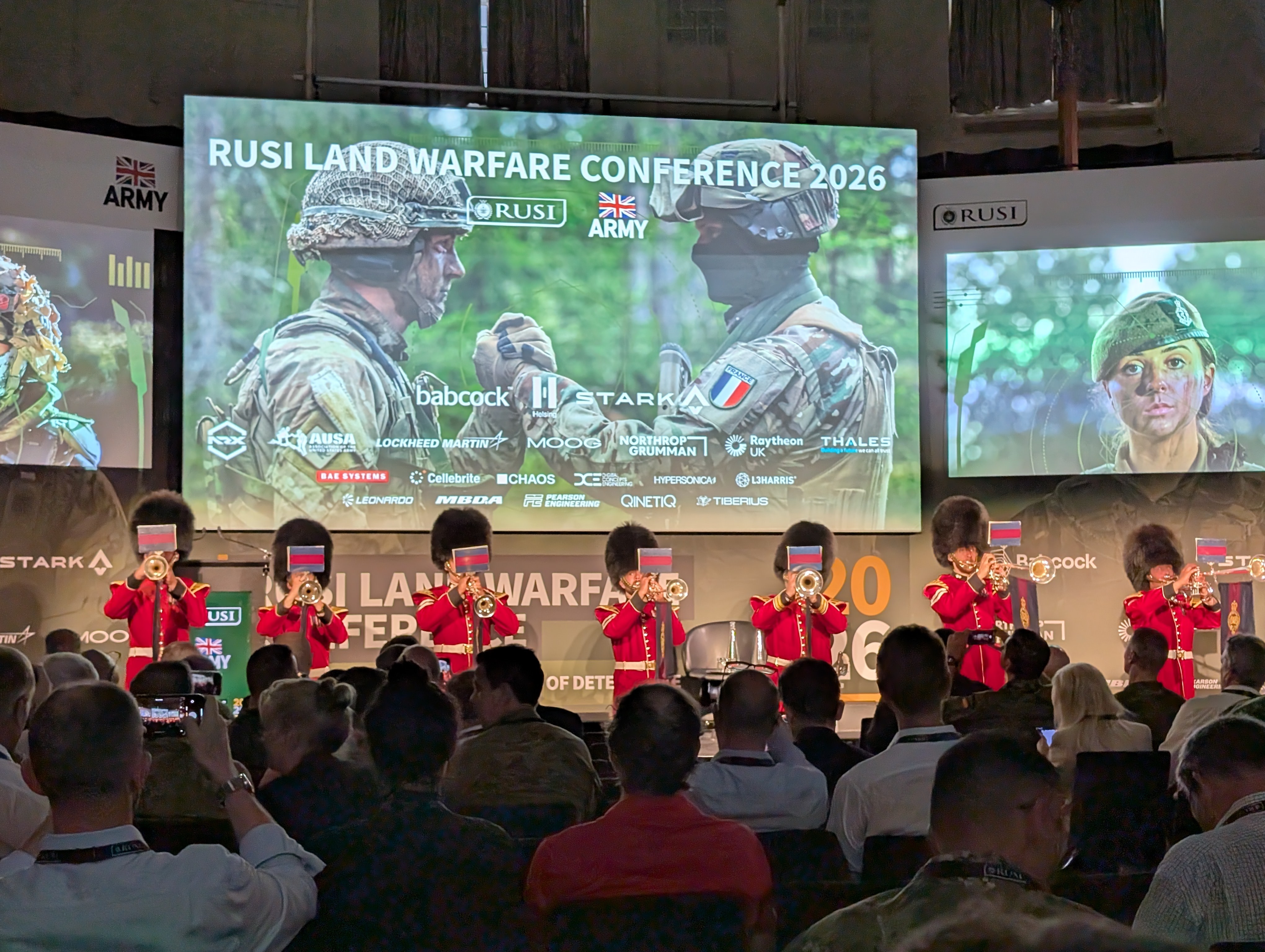
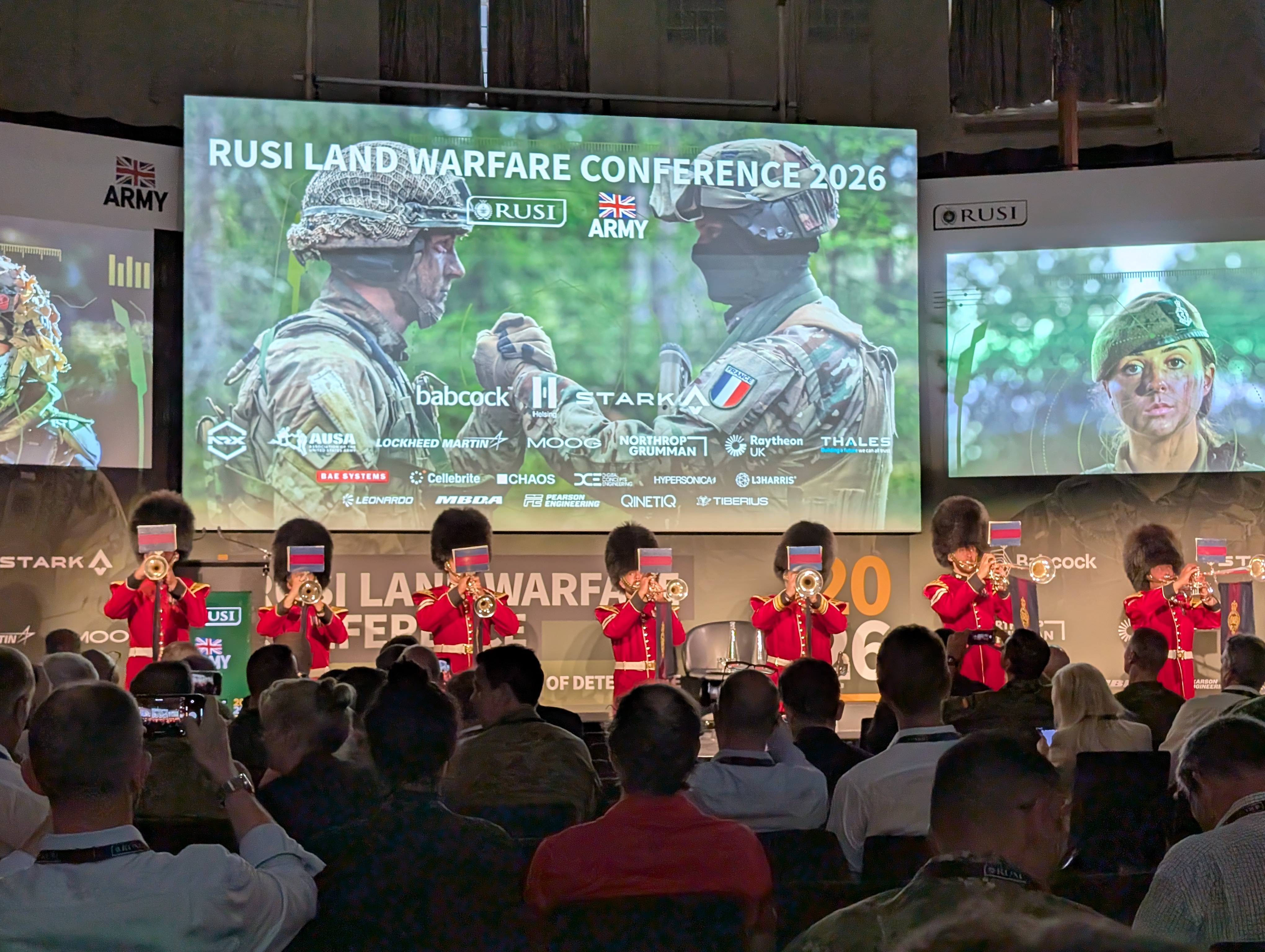
Over 23-24 June 2026, representatives from the Australian Army Research Centre (AARC) attended the 2026 Royal United Services Institute (RUSI) Land Warfare Conference in Westminster, London. RUSI’s annual conference is amongst the world’s most influential international land warfare conferences, and attracts speakers from around the globe to share insights on developments in land warfare preparedness, lessons, capability development, training and integration with other domains and peer partners. For 2026, the RUSI conference —coordinated by Dr Jack Watling (the 2024 Australian Army Keogh Chair)—partnered with the Chief of the General Staff (General Sir Roly Walker, KCB, DSO) to deliver a conference to address the major challenges, and opportunities, of land warfare in Europe. Combined, they welcomed a broad panel of speakers across key military, political and industry positions to—in the Institute’s words—‘discuss the land forces’ contribution to NATO's deterrence posture, the process of modernisation underway across the continent, and the resilience of the defence industrial base’.[1] Credible land capabilities and force structures, modernisation, and national resilience in industrial bases are recurring themes in Australia’s own national security trajectory, ensuring these discussions were acutely relevant to current Indo-Pacific defence concerns. What follows here is a synopsis of Day 1’s key discussions on land warfare, from the European perspective, that resonate with Australia’s context. A second Land Power Forum Insight post will outline Day 2’s reflections.
The theme for the 2026 conference was ‘Land Power – the Foundations of Deterrence’. It comprised two days of presentations that unpacked multifarious perspectives on land power’s capacity to deter adversaries. The spectre driving discussion across the entire conference was Russia’s illegal invasion of Ukraine. With Ukraine four years into the war, its experiences informed all conversations regarding capability acquisition and development, resourcing, force structure and industrial expansion. To NATO’s member states, the Russian threat to European peace and stability cannot be understated, and is energising the Alliances’ rearmament efforts. Illegal, aggressive, coercive and disruptive Russian (grey zone) activities across Europe have become the new normal, with almost continuous cyber, information warfare, and drone and missile incursions.[2] In the week prior to the conference alone, a Russian warship fired across the bow of a private British yacht in the English Channel.[3] Meanwhile since the conference, a Russian warship undertook a live fire exercise some 74 kilometres off the coast of Plymouth on 20 July.[4] There have also been claims over the past two years that Russia’s ‘shadow fleet’ have dragged their anchors to rip up undersea cables connecting the UK with the rest of the world.[5] It is against this background that the conference was conducted.
General Walker opened the plenary. He delivered an energetic exposition of the value of land power in national defence, and of the British Army as a key contributor to NATO’s deterrence posture. He reminded the audience of the truism that only land forces can seize terrain, hold ground, and after conflict, remain the force to occupy and therefore shape the settlement. Armies also bring political heft to the holding of ground and—since the proliferation of ground-based long-range precision strike and the explosion in drone technology—land forces now do what used to be the preserve of air forces; to strike targets at distance. Their aperture of action is exponentially wider, with the dual challenge of needing to dominate the 400 metres-to-four-kilometre zone of the immediate front, as well as to deliver deeper strike.[6] This articulation of the value of land forces aligns closely with that espoused by former-Chief of Army, Lieutenant General Simon Stuart.[7]
General Walker outlined the British Army’s current transformation, which parallels that of the Australian Army after the 2023 Defence Strategic Review (DSR). The British 1st and 3rd Divisions comprise NATO’s Allied Rapid Reaction Corps (ARRC), and its contribution to NATO’s strategy gives the British Army its singular focus. Walker aims to ensure the ARRC is fit to fight through improvements in lethality, the adoption of a 20:40:40 Fighting System,[8] an expansion in the implementation of ASGARD (AI digital targeting web) to support decision-making,[9] and the scaling of Taskforce RAPSTONE.[10] The UK, as with all NATO alliance members, acknowledges the need to do more of the heavy lifting in European security. This has been motivated by recent US signalling of an intent to reduce its presence in continental defence, which is expected to have concomitant impacts on European societies.[11] There is also a strong determination to learn the lessons of Ukraine’s military and industrial transformation.
Following General Walker’s opening comments, the Conference attracted a representative canvas of senior military officers within the NATO alliance. They included the Commander, ARRC (Lieutenant General Mike Elviss), Commander of the Swedish Army (Major General Jonny Lindfors), Finland’s Chief of Logistics (Brigadier General Jyri Raitasalo), and France’s 1st Corps Commander (Lieutenant General Benoit Desmeulles) to discuss NATO’s readiness to deter. The main thread emerging from the panel’s remarks was the clarity of focus and determination of all alliance members to counter the Russian threat through credible deterrence measures. All of Europe’s militaries are rapidly transforming to adapt to the reality of a defensive war against Russia, the principles and strategies of which have been established and validated by Ukraine’s success in its protracted defensive efforts against Russian aggression. These lessons are forcing substantial changes to force design, posture, readiness and industrial capacity. Mass and the ability to scale are important considerations in all national plans, but they cannot be achieved without political and national will. They require a whole of nation effort for, as Jyri Raitasalo observed, long-range fires now mean that there are no rear areas in Europe if Russia attacks.[12]
On the issue of adjustments to force design, the approaches taken in Europe mirror that of the Australian Army’s recent transformation. All speakers on the matter emphasised that people are the determining factor. Technology must serve the soldier, according to Lieutenant General Sir Simon Hamilton (Deputy Chief of the General Staff, British Army), rather than the other way around. While technology can enable decision making, he argued that the soldier is the one that decides.[13] For the British Army, Hamilton concluded, the mission is in charge of the force design, with an emphasis away from platforms-focused design to consider instead how everything works as a system. Once that system is made to work, the challenge and opportunity is to scale it.[14] The German Army, meanwhile, is focused on achieving five objectives, many of which parallel the re-capitalisation currently underway for the Australian Army. Lieutenant General (Dr) Christian Freuding (Commander, German Army) advised the audience that Germany was pursuing air defence and anti-drone capabilities; incorporating long-range and indirect fires; looking to introduce electro-magnetic warfare at troop level; deepening the integration of uncrewed systems to be the first contact with the enemy; and implementing digital C2, which would include AI.[15] These developments, backed by a substantially increased defence budget, reflects a growing awareness across NATO that Germany is transitioning to become a major military power in Europe once again, even comparative to the growth in continental remilitarisation more broadly.[16]
Rupert Pearce, the National Armaments Director at Britain’s Ministry of Defence, shared highly relevant insights for Australia’s own sovereign industrial manufacturing industry. His perceptions were drawn from both history, and observations of Ukraine’s recent wartime experience. So far as national armaments are concerned, Pearce identified three key areas of focus for the UK that apply to wider rearmament efforts. He described this effort as: to start treating the supply chain as a strategic enabler, to invest in multiple procurement models, and to start innovating at a much more rapid pace.[17] The onset of war would require the existing supply chain to scale within days, so ensuring that supply chain is robust and has the capacity to expand exponentially, is ‘the work of now’ to avoid the system choking and faltering in the opening phases of conflict.[18] Pearce also reflected that the risk appetite within national procurement models needs to change, and that these models need to be streamlined as the traditional process adopted by most Western militaries is far too slow to react in time of need. Interestingly, he noted that there were companies in the current marketplace that do not know they are (or will likely become) defence companies. Nonetheless, he observed that such companies need to be identified and brought into defence industry now. Testing the market and identifying expertise now allows for faster decisions to be made in the event of war. This, and other sobering assessments, will certainly fall within the range of national preparedness considerations to be explored by the Australian parliament under the establishment of a new, bipartisan parliamentary committee assessing Australian national war preparedness.[19] The lessons of industrial Ukraine’s ascendency should not be ignored.
To close out Day 1 of the conference proceedings, the UK’s then-Secretary of State for Defence, Dan Jarvis, acknowledged the challenges ahead for the Ministry of Defence and the importance of handing down the Defence Investment Plan to fund the reforms necessary, and to address the commitments made to NATO on funding as a proportion of GDP. While the large media contingent at the conference was focused on the budgetary and political angles, by the end of Day 1, the RUSI Land Warfare Conference had established a number of compelling arguments for delegates to digest. The first was the value of land power to deterrence, while the second—a recurring clarion—was of the need to absorb the right lessons from Ukraine’s survival and the elements it had innovated to remain in the fight against an adversary with mass. There were also manifold moves across the UK and Europe to transform land power from a rigid, platform-based way of thinking, to one that prioritised NATO’s mission. Speakers advocated for solutions are platform agnostic, with force structures designed against mission need. The need to have all of these elements in place before war breaks out was a key takeaway, but redefining a nation’s risk appetite on defence procurement will require a cultural change amongst most Western nations present (a hangover of the post-Cold War peace dividend). With governments around the world needing to fund health, education, law and order, and infrastructure, increasing defence budgets represents political risk. However, based on the growing instability of the international rules-based order outlined over the course of Day 1, the risk of not doing so may be greater.
The synopsis of the second day of the 2026 RUSI Land Warfare Conference follows in Part 2.
Endnotes
[1] RUSI Land Warfare Conference 2026, Overview: https://my.rusi.org/events/land-warfare-conference-2026.html [Accessed 22 July 2026]
[2] See, for example, AARC research reports on European and Ukrainian resistance to Russian information warfare and cyber activities: Oleksandra Molloy, Drones in Modern Warfare: Lessons Learnt from the War in Ukraine, Occasional Paper No. 29, Australian Army Research Centre, 22 October 2024; Matthew Warren and Valerii Paziuk, ‘The IT Army of Ukraine’, Land Power Forum Insight post, Australian Army Research Centre, 22 April 2026; Matthew Warren, Adam Bartley and Aiden Warren, Cyber Security—Partnership between Defence, Society and Private Companies: Lessons from Ukraine, Occasional Paper No. 35, Australian Army Research Centre, 22 April 2026; Matthew L M Jones and Andrew Maher, Towards Total Defence: A Literature Review and Feasibility Assessment for Australia, Occasional Paper No. 39, Australian Army Research Centre, 22 April 2026. A new Occasional Paper by Warren, Bartley and Warren on the lessons to be learned from Information Warfare in Ukraine is forthcoming.
[3] In 16 June 2026, the Russian vessel, the Admiral Grigorovich, fired shots across the bow of a privately owned British yacht in the English Channel. Russia’s Defence Ministry claimed that the yacht had been on a ‘dangerous approach’. See: Rachel Flynn & Victoria Derbyshire, ‘”It was surreal”: British couple describe having warning shots fired near them by Russian warship’, BBC, 17 June 2026. https://www.bbc.com/news/articles/c20yzm84r7lo [Accessed 22 April 2026]
[4] Jonathan Beale, 'Russian warship carried out firing exercise off Plymouth coast', BBC, 22 July 2026. https://www.bbc.com/news/articles/ce970jryrk3o [Accessed 22 July 2026]
[5] James A. Wondrasek, ‘How Russia’s Shadow Fleet and China’s Deep-Sea Submersibles Target the World’s Undersea Cables’, Softwareseni, 22 June 2026, [ac https://www.softwareseni.com/shadow-fleets-and-deep-sea-submersibles-how-russia-and-china-target-undersea-cables/ [Accessed 5 August 2026]; Erik Brown, ‘The Baltic Sea at a Boil: Connecting the Shadow Fleet and Episodes of Subsea Infrastructure Sabotage’, Carnegie Endowment for International Peace, 5 June 2026 https://carnegieendowment.org/research/2025/06/baltic-russia-maritime-cable-sabotage [accessed 5 August 2026]; Doug Dingwall, ‘Why Pacific Islands are rapidly de-flagging Russia’s ‘shadow tankers’, Australian Broadcasting Corporation, 21 February 2026, https://www.abc.net.au/news/2026-02-21/pacific-islands-flags-of-convenience-shadow-vessels/106357172 [accessed 5 August 2026]; Witold Stupnicki, ‘Russia’s shadow fleet presents a sustained hybrid war threat at sea’, 22 May 2026, https://acleddata.com/report/russias-shadow-fleet-presents-sustained-hybrid-war-threat-sea [Accessed 5 August 2026].
[6] General Sir Roly Walker, KCB, DSO, ADC, Chief of the General Staff, British Army, Keynote Address, 2026 RUSI Land Warfare Conference, 23 June 2026. https://www.youtube.com/watch?v=96ApuNt7m6s
[7] Stewart noted the value proposition provided by land forces – that they offer presence, persistence, asymmetry, versatility and value. Chief of Army, ‘Opening Address’, speech, Chief of Army Symposium, 29 August 2023, transcript at: https://www.army.gov.au/news-and-events/speeches-and-transcripts/2023-08-29/opening-address-chief-army-symposium-2023
[8] This is: 20 per cent survivable platforms (e.g. crewed), 40 per cent attritable (somewhat expendable), and 40 per cent consumable (e.g. one-way drones).
[9] https://www.gov.uk/government/news/fundamental-lethality-shift-for-british-army-spearheaded-by-novel-targeting-tech-asgard
[10] According to the Ministry of Defence, RAPSTONE is ‘an Army initiative intended to speed up the delivery of new equipment and technology’. See, Lisa West, ‘Army fast-tracks drones and loitering munitions via Rapstone’, UK Defence Journal, 11 February 2026, https://ukdefencejournal.org.uk/army-fast-tracks-drones-and-loitering-munitions-via-rapstone/ [Accessed 5 August 2026]
[11] The presentation by French academic, Élie Tenenbaum (Director, Security Studies Centre, IFRI – French Institute of International Relations), touched upon the three main scenarios forecast by his institute. All three scenarios saw reduced US presence/involvement in European defence.
[12] Presentation by BRIG-GEN Jyri Raitasalo (Chief of Logistics, Finnish Defence Command), RUSI Land Warfare Conference, Session 3: Readiness to Deter, 23 June 2026. For an assessment of whole-of-nation ‘total defence’ principles applied to the Australian context, see: Jones and Maher, Towards Total Defence.
[13] Presentation by LTGEN Sir Simon Hamilton KBE (Deputy Chief of the General Staff, British Army), RUSI Land Warfare Conference, Session 4: Force Design for a Competitive Edge, 23 June 2026.
[14] Presentation by LTGEN Sir Simon Hamilton KBE (Deputy Chief of the General Staff, British Army), RUSI Land Warfare Conference, Session 4: Force Design for a Competitive Edge, 23 June 2026.
[15] Presentation by LTGEN (Dr) Christian Freuding (Commander, German Army), RUSI Land Warfare Conference, Session 4: Force Design for a Competitive Edge, 23 June 2026.
[16] Timothy Garton Ash, ‘Germany’s military power is on the rise. This time it must be firmly embedded in Europe’, European Council on Foreign Relations, 7 May 2026, https://ecfr.eu/article/germanys-military-power-is-on-the-rise-this-time-it-must-be-firmly-embedded-in-europe/ [Accessed 12 August 2026]
[17] Presentation by Rupert Pearce (National Armaments Director, UK Ministry of Defence), RUSI Land Warfare Conference, Session 4: Force Design for a Competitive Edge, 23 June 2026.
[18] Presentation by Rupert Pearce (National Armaments Director, UK Ministry of Defence), RUSI Land Warfare Conference, Session 4: Force Design for a Competitive Edge, 23 June 2026.
[19] Stephen Dziedzic, ‘New parliamentary committee to examine how Australia can prepare for war for first time since World War II’, Australian Broadcasting Corporation, 6 August 2026, https://www.abc.net.au/news/2026-08-06/new-plan-proposed-to-prepare-australia-for-impacts-of-war/107001286 [Accessed 6 August 2026]