
The Army Reserve and the Strategic Value of Polymathy for National Defence
Authors: Major (Dr) Matthew LM Jones and Major Samuel P Miller
Introduction
Australia’s defence problem can no longer be solved by the force-in-being alone.[1] The 2024 and 2026 National Defence Strategies extend this logic, directing the ADF towards an integrated, focused force built on self-reliance, sovereign industrial resilience and civil preparedness.[2] Concept Apex gives this sharper military expression: it describes integrated campaigning as the mechanism by which the ADF contributes to a united whole-of-government effort, and is explicit that military power must be integrated with the other tools of national power, including industry and academia.[3] Read together, these point to the same conclusion: national defence increasingly depends on people who can move between military and civilian systems, not only on capability that sits inside Army alone.
The Reserve has often been discussed in the language of force generation: force allocation, reinforcement, round-out, rotation, mobilisation and surge.[4] While these functions remain necessary, they treat the reservist as a less available version of the full-time soldier rather than as a distinct form of military human capital: someone who brings professional networks, civilian technical expertise and community legitimacy that the permanent force cannot readily reproduce from within itself.[5] In this context, the Australian Army Reserve should not be understood only as a part-time supplement to the permanent force; it is also one of Army’s most important institutional interfaces with Australian society.[6] This is already visible in Army’s direction for 2nd (Australian) Division, whose largely part-time brigades are now focused on security response, domestic support operations with partner agencies and Theatre Mission One: Defend Australia.[7] This homeland defence mission (operationalised through Joint Task Force 629 and shaped by Concept Aspire and Concept Lantana) requires 2nd Division’s brigades to work with civil authorities, infrastructure operators and communities across Australia, a task that depends as much on civil-institutional understanding as on warfighting competence.[8] It is a mission that also raises a deeper question about what the Army profession requires of its largely part-time division—a question that recent debate about the state of the profession has begun to examine, but that has not yet been fully resolved for a Reserve force whose members swear the same oath and serve under the same legislative and ethical framework as their full-time counterparts.[9]
Recent Army and international professional debate has begun to use terms such as the ‘polymath soldier’ to describe cross-domain contribution.[10] This article takes up that idea and narrows it to a specific claim: that Reserve service creates the conditions from which a distinct form of military-civilian polymathy (not simply broad exposure or dual professional experience, but disciplined integrative competence across military and civilian domains) could be deliberately identified and developed. This is offered as a conceptual proposition for Army to test: the article argues that the Reserve plausibly contains the raw conditions for this kind of person and sets out what could be tested and instituted to make that potential a reliable capability.
The article first defines military-civilian polymathy and distinguishes it from generalism, T-shaped professionalism and boundary spanning.[11] It then examines whether Reserve service creates plausible conditions for such a capability, why this matters for national defence, what comparative practice suggests, and how Army could test the concept without diluting readiness or military professionalism.
This article adopts a practitioner-informed conceptual analysis methodology, supported by doctrinal reference and narrative synthesis. Defence policy, Army concepts, and literature on Reserve service, boundary spanning, T-shaped professionalism, polymathy, organisational ambidexterity and scalability were examined through the lens of three linked questions: what kind of integration national defence requires; how knowledge moves across professional and institutional boundaries; and whether Reserve service may create conditions for selected personnel to perform that integrative function. These themes were then synthesised into a conceptual model of the military-civilian polymath reservist. The article does not attempt to empirically validate the concept; its purpose is to establish whether the concept is a coherent and useful framework for Army to test further.
The authors write as Army Reserve practitioners. That position provides practical insight into the opportunities and frictions of dual professional service but it also creates a risk of institutional bias. The arguments presented here should therefore be read as a practitioner-informed proposal for Army consideration, but constrained appropriately.
Why ‘Polymath’
The word ‘polymath’ carries risk. Used carelessly, it can sound inflated, nostalgic or unserious: a decorative term for clever people with varied interests. It also risks encouraging exactly the wrong institutional behaviour.[12] Army does not need officers and soldiers who mistake breadth for mastery or who treat civilian credentials as a substitute for military competence. If the term is to be useful, it must be disciplined. In this article, polymathy does not mean omniscience, dilettantism or professional exceptionalism. It means integrative competence: the ability to draw on meaningful knowledge across more than one domain and apply it to problems that no single profession can adequately define or solve.[13]
The adjacent concepts should therefore be treated as related but distinct. The reservist-as-transmigrant literature is useful because it treats reserve service not merely as part-time military labour but as lived movement between civilian and military worlds, involving identity, belonging, obligation and competing social roles.[14] This article adapts this insight for a narrower functional question: whether sustained movement between civilian and military institutions may, in selected cases, create the conditions for a form of integrative capability useful to Army. In this framing, transmigration describes the reservist’s social position and identity work. Boundary spanning describes function: moving knowledge across institutional seams.[15] Specialist expertise describes depth within a particular professional field. T-shaped professionalism describes depth in one domain combined with working literacy across adjacent domains.[16]
Military-civilian polymathy, then, does not replace the transmigrant framework so much as build on the structural position it describes: while transmigration explains why reservists sit at the seam between military and civilian worlds, polymathy names a narrower and more demanding capability that may emerge from that position in some individuals. It is proposed here as an exploratory capability framework: the potential of selected reservists to integrate competing military and civilian professional logics into judgement, plans or institutional arrangements that can be acted on under command. The term ‘polymath soldier’ has been used to describe personnel developed through diverse experience, critical thinking, interdisciplinary collaboration and conceptual skill.[17] This article does not treat this as evidence of an established professional consensus. Rather, it takes the emerging idea as a useful starting point and narrows it to the Reserve context, where the citizen soldier’s movement between systems may create conditions for a specific form of military-civilian polymathy.
In this setting, polymathy is not synonymous with omniscience. No modern officer, soldier or civilian professional can master the full complexity of contemporary national defence. The accumulation of knowledge across modern society has made total mastery impossible, yet this does not make cross-domain competence obsolete.[18] Epstein’s argument in Range is useful here as contextual support: breadth and analogy may help in complex environments.[19] The practical military value of the polymath is the ability to recognise relevant knowledge across domains, understand enough of its assumptions to use it responsibly, and translate it into judgement, advice or action.
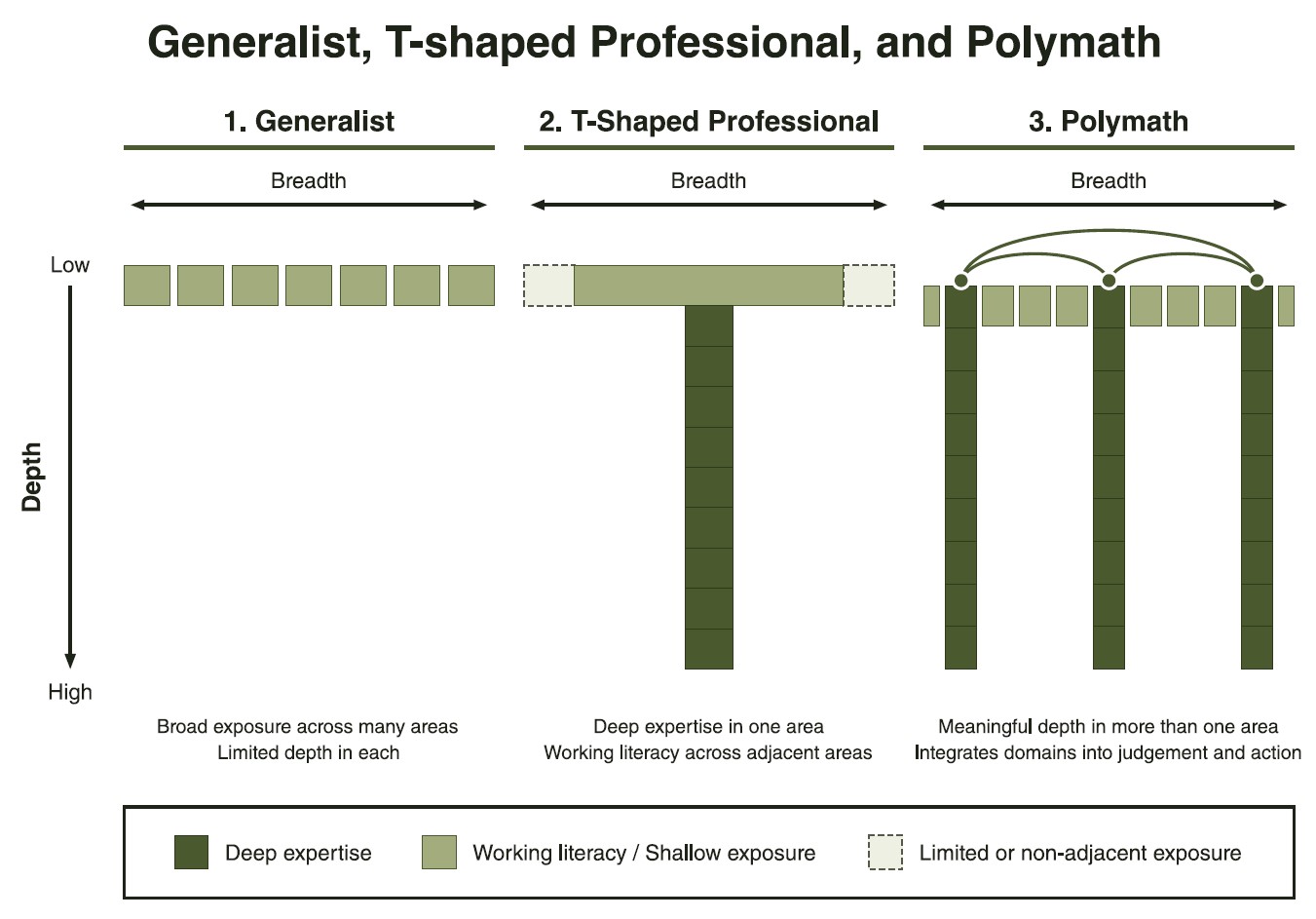
Note: This figure distinguishes breadth from depth across three professional archetypes. A generalist has broad but shallow exposure, a T-shaped professional combines deep expertise in one area with broader adjacent literacy, while a polymath has meaningful depth in more than one domain and integrates those domains into judgement and action.
Generalism and T-shaped professionalism, introduced above, show why military-civilian polymathy needs its own definition.[20] A shallow generalist is exposed to many domains without being meaningfully competent in any of them; a polymath has usable depth in more than one.[21] The distinction between T-shaped professionalism and military-civilian polymathy is qualitative, not merely quantitative: a T-shaped reservist can explain a civilian system to Army or explain Army requirements to a civilian system, and that dual literacy is valuable (in many roles, it may be all Army requires). Military-civilian polymathy, as earlier defined, describes a more specific and demanding form of integrative capability.[22] Furthermore, sustaining meaningful depth in two demanding professional domains simultaneously is not merely a matter of effort or aptitude. Ambidexterity theory predicts that exploitation and exploration compete for the same finite resources: time, attention, institutional reward and professional identity.[23] Without deliberate structural support, the gravitational pull towards one domain tends to erode competence in the other.
For this reason, ‘polymath’ is the right word only if it is used with discipline. It should not imply genius, omniscience or shallow generalism. Its value lies in synthesis, not simply possession: a ‘highly capable reservist with relevant civilian expertise’ describes two facts sitting side by side and says nothing about whether they have ever been integrated. A T-shaped reservist may be recognised by dual literacy alone; a military-civilian polymath should be recognised by the capacity to turn that dual literacy into disciplined military effect. That distinction is what Army should select for, develop and evaluate, and it is why the recommendations that follow test for demonstrated translation rather than simply cataloguing capable people.
Each of these concepts captures something real: transmigration explains where the reservist sits; boundary spanning explains what they can do across seams; T-shaped professionalism explains the shape of their expertise. But none of them, individually or in combination, captures the integrative act itself: the conversion of competing professional logics into a military recommendation, plan or institutional arrangement that can be acted on under command. That act is what military-civilian polymathy proposes to name, select for and test. The next question, then, is whether the Army Reserve already contains the conditions from which such people can be identified and developed.
The Existing Evidence
The evidence does not support a suggestion that reservists are, by definition, polymaths. It supports a more modest but strategically useful claim: Reserve service creates conditions in which some personnel may develop dual professional literacy, boundary-spanning habits and, in selected cases, integrative judgement. Its members maintain civilian lives and professions while serving within a military institution. They are exposed to Army’s command structures, planning processes, doctrine, fieldcraft, logistics, discipline and institutional culture, while also participating in civilian workplaces, professions and communities. The result is a cohort with dual professional literacy.[24] That dual literacy provides a plausible foundation for Army to investigate whether selected reservists can be developed into military-civilian polymaths.
This duality is built into the Reserve model. Reservists are not simply inactive military labour waiting to be mobilised; they balance civilian employment, family, community and education with part-time military service. They serve across the Navy, Army and Air Force alongside full-time colleagues on exercises and operations, and contribute to border security, domestic disaster relief and emergency support tasks. Reserve sociology has described this position as a form of movement between civilian and military worlds: reservists are neither wholly outside the military institution nor wholly separated from civilian society.[25] In institutional terms, this means the Reserve is not only a force structure; it is also a civil–military bridge, connecting Army to the society, economy, employers, communities and local institutions within which Defence must operate.[26]
The civilian side of this structure matters, and Operation Bushfire Assist 2019–20 illustrates why. Reservists deployed with skills drawn directly from civilian careers (including logistics, engineering, health, and emergency management), and that primary-employment expertise was assessed as material to the operation’s effectiveness.[27] More importantly, that contribution extended beyond discrete technical skills. Regionally based reservists brought local knowledge and habitual relationships with civil authorities; Reserve facilities became staging, evacuation and emergency support nodes; and Reserve brigade headquarters coordinated ADF preparation for and response to the disaster. Together, these functions illustrate the integrative potential at issue here: military capability was made more usable because Reserve personnel and institutions were already embedded within, and connected to, the civilian systems through which the response had to operate.
Many reservists may fit the pattern of the T-shaped professional:[28] their civilian profession forms one vertical stroke, while military service provides breadth and, where sufficiently developed, a second form of depth.[29] This does not mean that all such reservists are effective boundary spanners[30] but rather that Reserve service may create the conditions from which boundary-spanning capability can emerge. The progression is therefore conceptual rather than empirically proven in this article: civilian professional depth may provide knowledge of non-military systems; military service may provide command literacy and operational discipline; and the interaction between the two may enable some reservists to move more readily across professional boundaries than can personnel formed entirely within one institutional setting.[31] In a narrow tactical context, this may matter little. In mobilisation, domestic support, industry engagement, civil preparedness, cyber resilience, health planning, logistics or infrastructure protection, it may matter greatly.
There are also potential cognitive advantages, though these should not be overstated. Reserve members regularly shift between different decision cultures. Cognitive-flexibility theory suggests that exposure to multiple representations and ill-structured problems can support adaptive reasoning,[32] while boundary-spanning scholarship shows that knowledge often has to be translated and transformed, not simply transferred, across institutional boundaries.[33] This is consistent with Epstein’s broader argument that diverse experience can improve analogical reasoning and adaptation where problems are uncertain, novel and poorly bounded.[34] This repeated movement between military and civilian systems may create conditions in which some reservists become better practised at recognising which assumptions travel between contexts and which do not.[35] A reservist who has planned in a military headquarters and managed a civilian project may have encountered different ways of allocating resources, communicating intent, accepting risk and measuring success. A reservist who has worked in clinical governance and field command may understand that risk can be simultaneously technical, ethical, legal and operational. However, these examples should be read as plausible pathways for integrative judgement, not as evidence that cognitive advantage automatically follows from Reserve service.
A related possibility is that Reserve service may help Army test and challenge institutional insularity. Professional military organisations require strong internal cultures. Without them, they lose discipline, coherence and fighting power.[36] Yet any strong institution risks path dependency, doctrinal echo chambers and a narrowing of what counts as relevant expertise.[37] Organisational learning literature suggests that institutions must balance exploitation of established routines with exploration of external knowledge, while absorptive capacity depends on the ability to recognise, assimilate and apply knowledge from outside the organisation.[38] Reservists cannot solve institutional insularity by virtue of their status alone. As a minority workforce, they may be just as likely to conform to prevailing organisational norms as to challenge them.[39] Their value depends on whether Army places selected reservists in roles where their civilian expertise is relevant, their military competence is credible, and their alternative perspective can positively influence planning and decision-making. Under those conditions, reservists may help expose Army to external assumptions, constraints and forms of knowledge that are otherwise less visible inside the full-time force.
Some reservists will remain principally part-time soldiers. Others will remain civilian professionals whose military contribution is narrow but valuable. The institutional opportunity lies in recognising those who have, or can develop, genuine dual literacy and integrative judgement. The Reserve plausibly contains latent T-shaped boundary spanners, though their prevalence and the practical effect of developing them further remain open questions rather than established findings. The task for Army is to test which of them can develop towards military-civilian polymathy, then determine where that higher form of competence contributes to national defence. Properly understood, tested and employed, this concept could serve as a practical response to a strategic environment in which Australia’s security problems increasingly sit at the intersection of professions, agencies, sectors and levels of war.
National Defence and Polymathy
The argument for Reserve polymathy becomes strategically significant because national defence shifts the problem from military capability alone to national integration. The 2024 National Defence Strategy made a strategy of denial the cornerstone of Defence planning and directed the ADF towards an integrated, focused force.[40] The 2026 National Defence Strategy extended this logic by emphasising self-reliance, sovereign defence industrial resilience, stronger industrial partnerships, civil preparedness and national resilience.[41] These priorities alter the character of the problem itself. They require Defence to operate across systems it does not own, work with institutions it does not command, and generate deterrent effect from national capabilities that sit outside the permanent force.
Concept Apex makes the same point in operational terms.[42] It frames integrated campaigning as the ADF’s contribution to united and focused whole-of-government approaches, achieved through the potential of people, ideas and materiel, combined with allies and partners. It is a deliberate and persistent method of generating deterrent effect. As Australia’s competitors increasingly exploit the seams between peace and war, military and non-military power, and government and civil society, the importance of integration increases. Apex warns that compartmentalised thinking creates opportunities in the grey zone and that military power alone is inadequate for conflict, just as national power without military power is inadequate for competition.[43] This implies that Defence must anticipate the friction points in a whole-of-nation approach before crisis. It must identify where industry, infrastructure, government, academia, civil society and the ADF will need to connect, and it must build the human mechanisms to make those connections work under pressure. One possible mechanism is the selected military-civilian polymath reservist.
However, military-civilian polymathy is not the only mechanism through which Army can pursue this integration; specialist advice, civil–military cooperation, liaison officers, Australian Public Service (APS) expertise, contractors and conventional boundary-spanning roles all remain necessary. However, these mechanisms are usually organised around coordination, advice or translation: connecting organisations, advising on a defined problem, or moving knowledge across a particular institutional or professional boundary.[44] The military-civilian polymath reservist is proposed as a complementary mechanism. Its distinctive value lies in combining military status, command literacy and civilian professional depth within the same person. Where specialist advice may tell Army what a civilian system requires, and liaison may connect Army to that system, the military-civilian polymath may be able to integrate both logics earlier in planning: identifying where military assumptions will fail in civil settings, where civil constraints will affect military options, and how plans can be adapted before crisis so that they remain lawful, feasible and executable under pressure.
The link between integration and Reserve service is sharpened by Colonel Renée Kidson’s recent occasional paper on scalability.[45] She argues that accelerated preparedness requires Defence to think not only about mobilisation as an exceptional act but about scalability as a standing organisational property: the ability to redirect, activate and augment capacity as demand changes. This analysis identifies the importance of ‘sense-makers’ and ‘interconnectors’: people who can understand internal organisational constraints, external support systems, and the relationships required to scale across government, industry and the national support base. These are functions rather than personnel categories. A specialist adviser may perform them in a defined technical area, a liaison officer may perform them through coordination, and an organisational boundary spanner may perform them by moving information across institutional seams. The military-civilian polymath reservist is proposed as a narrower and complementary pathway: a selected reservist whose civilian professional depth, military competence and integrative judgement allow them to interpret where capacity exists, where constraints lie, and how Defence can connect to the civil systems on which scalability depends.
A strategy of denial depends on platforms, weapons, sensors and trained formations, but it also depends on the systems that make their use possible. Ports, roads, information technologies, rail, fuel, power, data, maintenance, industry, workforce, hospitals, stockpiles, contracting mechanisms and public confidence all shape the credibility of military power.[46] Therefore, military effectiveness increasingly depends on civil systems being understood, protected, integrated and mobilised before crisis. This is where the logic of total defence becomes relevant. Total defence, in its various national forms, is a way of thinking about the relationship between military defence, civil preparedness, economic resilience, information resilience and social trust.[47] Australia should not import a foreign total defence model uncritically; its geography, federation, political culture, strategic warning assumptions and volunteer military tradition are different.[48] But the underlying design problem is similar: how does a democratic state generate credible national resilience without militarising society or assuming that Defence can solve whole-of-nation problems by itself?
The answer lies in translation between Defence, government, industry and society. Sovereign industrial resilience requires people who understand both military requirements and commercial incentives. Civil preparedness requires credibility with state agencies, local communities, health systems, employers and volunteers. The Army Reserve is plausibly positioned at this junction. This does not mean all such problems require military-civilian polymaths rather than specialists, liaison officers or established boundary-spanning mechanisms. It means that some national defence problems may require personnel who can integrate these perspectives before they harden into separate military, commercial, legal, technical or community constraints. The Reserve is one of the parts of Army most routinely distributed through civilian employment, local communities and domestic institutions while still remaining within the military profession.
If national defence is a whole-of-nation problem, then the Reserve is one of Army’s few institutions distributed through Australian society. The Reserve should not be diverted from warfighting or treated as a generic civil-support workforce; military credibility remains fundamental. Nor is the Reserve the only part of Defence connected to industry, government, academia or community organisations. APS personnel, contractors, liaison officers, specialist advisers and full-time Army personnel also perform important integrative functions. The Reserve’s distinctive potential lies in the combination of military membership and continuing civilian embeddedness. Properly identified, developed and employed, selected reservists may help Army understand and access the national systems on which denial, mobilisation, domestic response and resilience depend.
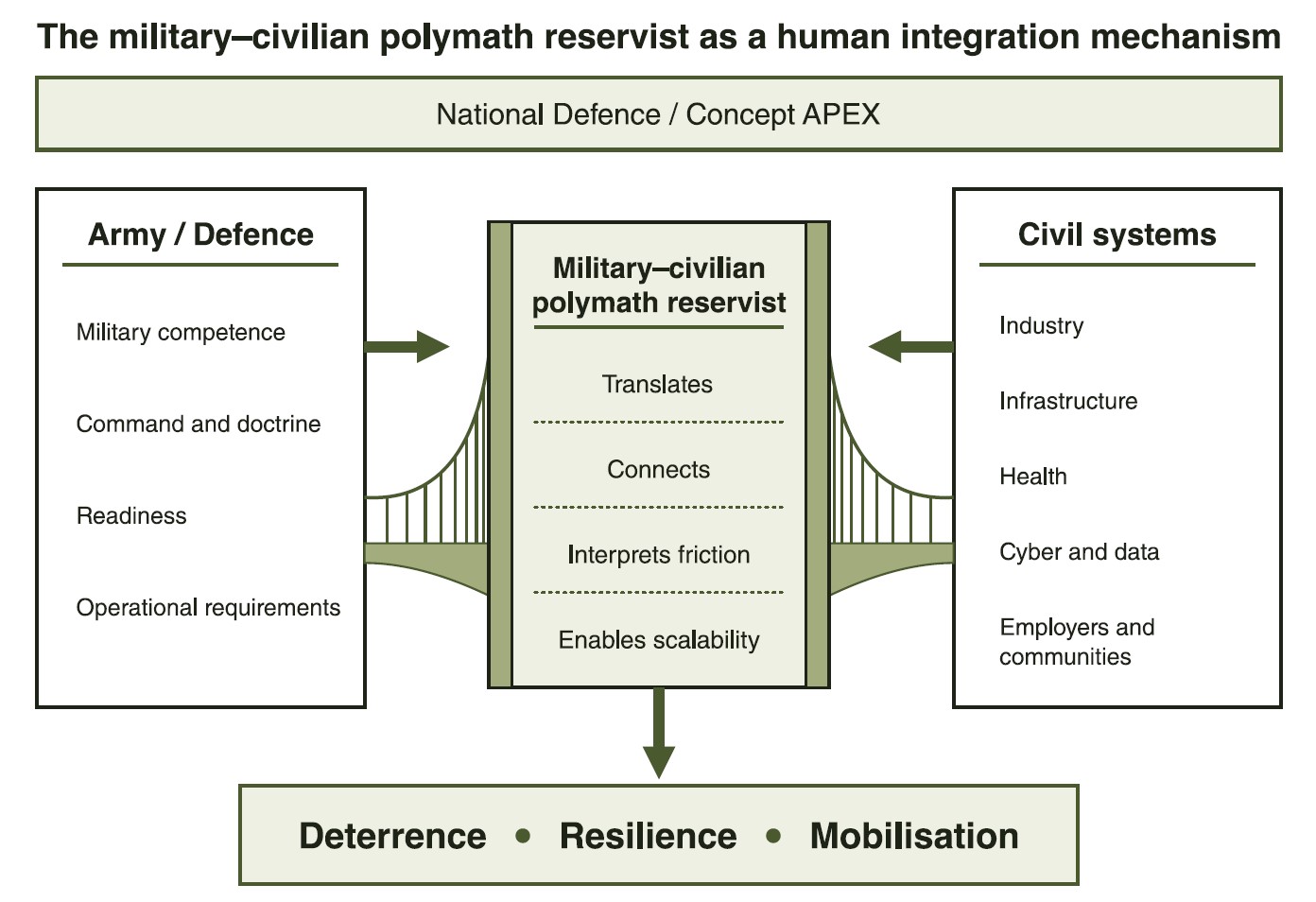
Note: The figure depicts the potential value of selected reservists whose dual professional literacy can be translated into disciplined military effect. The proposition is that some reservists may be able to connect Army requirements with the civilian systems on which national defence depends.
Military-civilian polymathy is therefore not offered as a decorative label. It is proposed as a human-capital framework for a strategic problem Australia has already recognised in policy but has not yet fully solved in practice. National defence requires people who can integrate military purpose with civilian systems, and the Reserve may contain the setting from which those people can be identified and developed. Army’s task is to test that proposition, identify suitable personnel, and employ them where the best evidence supports doing so.
The Comparative Evidence
Comparative examples should be used cautiously. Australia does not need to copy another state’s reserve model, and analogies can mislead when they ignore geography, political culture, threat perception, strategic warning time and force structure. Yet comparison remains useful because other militaries have already recognised that reserve forces can do more than merely provide latent force generation. In different ways, the United States and the United Kingdom show that reserve service can connect military institutions to civilian expertise, national mobilisation systems and broader society.
Allied militaries have long used reserve-heavy civil–military roles to draw on civilian skills in complex environments, particularly where the military must operate with local authorities, civilian agencies, industry and communities.[49] Canada, Australia and the United States have each integrated reservists into civil–military cooperation, civil affairs or equivalent roles partly because reservists can bring civilian expertise, local knowledge and professional networks into military planning and execution.[50] This does not demonstrate military-civilian polymathy in itself. In most cases, it demonstrates specialist civilian contribution or boundary-spanning function. However, these examples show that comparable forces have recognised the operational utility of personnel who can move between military and civilian systems.
The United States offers the clearest example of reservist identity as dual professional service. The US Army Reserve’s long-standing motto, ‘Twice the Citizen’, captures the idea that the reservist is both citizen and soldier rather than merely a less available regular.[51] However, this claim describes position and belonging, not necessarily integrative capability. More recent American initiatives show how civilian expertise can be deliberately connected to military transformation problems. The emergence of initiatives such as the Executive Innovation Corps similarly reflects a willingness to draw senior technology expertise into part-time military service for targeted transformation problems.[52]
Furthermore, the 75th US Army Reserve Innovation Command (which frames its mission around Army transformation, experimentation and collaboration across components, services, academia and industry, and publicly emphasises the Army Reserve’s ‘unique blend of civilian acquired skills’)[53] provides an example of how a military can create structures that convert civilian expertise into military utility. At Cyber Quest 25, the command deployed a tailored multidisciplinary team of 14 reservists to evaluate emerging cyber, electromagnetic warfare and information-advantage technologies in an operationally relevant Army experiment.[54] These personnel combined operational experience across Army cyber, signal and other technical branches with civilian expertise in artificial intelligence, data science and cybersecurity, drawn from sectors including technology, energy, financial services and academia. They assessed prototypes against warfighting requirements, tested their integration with Army systems, identified capability gaps, and structured evidence used to inform requirements development, acquisition risk reduction and future experimentation. The Army explicitly attributed the value of these assessments to the soldiers’ ‘dual civilian-military expertise’,[55] which allowed industry knowledge and operational understanding to be applied together to questions of usability, resilience and military utility.
The United Kingdom provides a different lesson. Its Sponsored Reserve arrangements show one way of formalising the relationship between civilian employment and military requirement. Under the Reserve Forces Act 1996, the use of sponsored reservists allows specialist tasks to be performed by trained professionals whose civilian employer has entered into a contract with the Ministry of Defence.[56] This is not polymathy in the fullest sense; it is closer to contracted specialist integration. Even so, it shows that Defence can create mechanisms for moving civilian competence into military service without pretending that all capability must be generated organically inside the uniformed force. The UK experience also shows the friction. Future Reserves 2020 and subsequent reform programs were concerned not only with capability but also with employer support, mobilisation, readiness and the credibility of part-time service within an integrated force.[57] Specialist integration is possible, but it is administratively and culturally demanding.
The comparative conclusion is therefore restrained. The international examples do not prove that reserve forces are inherently polymathic; nor do they provide a model that can be imported directly into Australia. They show something narrower but still important: allied militaries have created structures that make civilian expertise, dual professional identity and boundary-spanning functions militarily useful. An Australian model of military-civilian polymathy must be suited to the nation’s own scale, federation, geography, industry base, volunteer military tradition and strategic warning assumptions. The common lesson is that Reserve forces can provide pathways through which selected personnel may integrate military purpose with civilian expertise, where that integration is deliberately identified, authorised, developed and tested.
Counterarguments
The argument for military-civilian polymathy must not become special pleading for the Reserve, as there are serious counterarguments to contend with.
The first counterargument is decisive if ignored: readiness matters more than breadth. A reservist who cannot perform their military role is not strategically useful simply because they possess civilian expertise. As already stated, polymathy cannot excuse poor soldiering. Fieldcraft, fitness, discipline, lawful command, tactical competence and collective readiness remain foundational. The answer is not to lower military standards in order to celebrate civilian breadth; it is to define readiness more intelligently. Recent Army direction reinforces this point. The decision to discontinue the Army Individual Readiness Notice does not dilute readiness; it reflects concern that a narrow administrative proxy for individual deployability can obscure the more demanding requirements of contemporary war, collective preparedness and commander judgement about employability.[58] The same logic should apply to Reserve value. The question is not whether civilian breadth can substitute for military competence but whether particular Reserve roles require additional forms of preparedness because their task involves civil–military translation or access to civilian systems. Polymathy should therefore be understood as a complement to military professionalism, not a substitute for it.
The second counterargument is that Reserve service may produce divided attention rather than polymathy. This is the central developmental risk, as a person can be mediocre in two professions rather than excellent in one.[59] Part-time military service competes with civilian employment, family, study and community responsibilities;[60] military skills require repetition and reinforcement;[61] and civilian professional success may reduce availability for military development.[62] These tensions are consistent with military sociology’s treatment of the military, family and civilian employment as competing institutional demands, as well as Reserve sociology’s account of reservists moving between civilian and military worlds. True polymathy requires deliberate cultivation, not merely the accidental possession of multiple roles. Army should not treat a civilian job and a uniform as evidence of integrative capability. It should identify those with genuine dual literacy (and ongoing commitment to dual professional development), match them to appropriate roles, and provide professional development that integrates rather than merely alternates between their domains.
The third counterargument is that civilian skills do not automatically transfer into military utility. A lawyer, surgeon, engineer, academic, executive or software developer does not become militarily useful simply by importing civilian credentials into Army. Civilian expertise can be distorted if applied without understanding command, doctrine, operational risk or the ethical demands of military service.[63] Equally, Army can misuse civilian expertise if it treats credentials as interchangeable with competence in a military context. The value lies in translation, not credentialism. A medical executive/reservist may understand health system fragility but still require significant military understanding to contribute to deployed health planning. A cyber professional may understand technical vulnerability but must understand command responsibility and operational authorisation. An engineer may understand infrastructure but must understand military mobility, survivability and sustainment. For Reserve roles that depend on civil–military integration, Army should identify which civilian skills are relevant, train personnel to apply them in military settings, and employ them deliberately where that translation has operational value.
The fourth counterargument is cultural. Reservists can be marginal inside Army, but this should be treated as a recurring risk rather than a universal condition.[64] They may be judged primarily by availability, by resemblance to full-time service patterns, or by whether their civilian expertise can be translated into a recognised military task.[65] Some scepticism is legitimate. Full-time personnel carry the daily burden of force generation, command climate, training risk and institutional continuity, and claims that part-time service confers superior judgement would rightly be resisted. The answer is not to elevate reservists above the permanent force but to specify different forms of contribution. Some Reserve roles should be measured principally against permanent-force equivalence—for example, a rifle platoon, crew-served weapon detachment or headquarters staff role expected to integrate directly with a formed force. Others should be measured by role-specific utility: a cyber reservist contributing to cyber resilience, a logistics professional mapping industry supply, a health professional advising on health system dependencies, or an engineer supporting infrastructure and mobilisation planning. This distinction does not lower military standards. It asks which standard is relevant to the task. Without it, Army risks expecting all reservists to mimic full-time service patterns while overlooking roles in which civilian expertise, military credibility and boundary-spanning utility may add distinct value.
The fifth counterargument is that employers bear real costs. This is perhaps the most important practical constraint. Reserve service removes people from civilian workplaces, sometimes at short notice, and the burden is unevenly distributed. Small businesses can be hit particularly hard when a key employee or owner is absent, but the problem is not confined to small enterprises. Large organisations may absorb absence more easily in aggregate, yet still depend on senior executives, technical specialists, scarce trades, project leads, middle managers or personnel occupying unique organisational functions. In those cases, Reserve service may be experienced less as a national contribution than as an operational disruption.[66] Legal protections and employer-support schemes are therefore necessary, but they do not remove the friction—they manage it.
This employer problem is, therefore, central to the article’s thesis. If national defence requires civil preparedness, mobilisation, industry resilience and access to civilian expertise, then employers are not merely external stakeholders. They are part of the capability ecosystem through which Reserve value is generated, protected and sustained. A broader national compact would differ from existing employer-support arrangements by treating employer tolerance, workforce depth and flexible service design as mobilisation issues rather than administrative afterthoughts. In practical terms, this would mean earlier engagement with critical employers, clearer notice and predictability where possible, role design that recognises civilian scarcity, and support arrangements that protect the civilian relationships Army depends upon. Army cannot ask more of reservists while ignoring the workplaces that make their dual professional service possible.
A final risk to discuss is governance. The same dual professional position that makes military-civilian polymaths valuable can also create ambiguity. Reservists who work across industry, government, health, infrastructure, cyber or commercial sectors may hold knowledge that is useful to Army but be constrained by professional obligations, employer interests, security requirements, commercial confidentiality or procurement probity. Army should therefore avoid treating civilian access as informal entitlement. If reservists are to operate as translators between Defence and civil systems, their roles must be properly authorised, bounded and supervised. The value of military-civilian polymathy lies not in bypassing institutional safeguards but in helping Army understand external systems while remaining disciplined by law, ethics, security and command.
To conclude, if Army wants to test the benefits of military-civilian polymathy, it should consider and design for them. It must protect readiness, respect employers, train for translation, distinguish specialist value from general availability, and place reservists where their dual literacy is actually relevant. Polymathy is best treated as a capability hypothesis and, like any capability, must be appropriately organised, resourced, tested and employed.
What Army Could Do
If Army treats military-civilian polymathy as a capability hypothesis worth testing, it should stop treating Reserve dual professional literacy as incidental. These recommendations offer a way to test the personnel implications of Concept Apex rather than assuming them. Apex directs the ADF to build integration expertise; integrate nationally, including with industry and academia; build resilient supply chains; develop agile logistics; mobilise the ADF; defend the homeland; and fight disinformation.[67] The Army Reserve may be one of the practical human mechanisms through which Army contributes to those deductions, but that proposition must be first evaluated.
First, Army should establish a Reserve integration register, not merely a skills database. A skills database would record qualifications, occupations and civilian experience. An integration register would go further by identifying reservists whose civilian expertise, military competence and demonstrated integrative performance make them suitable for national defence tasks. Such a register should not treat credentials as proof of polymathy. It should use a staged assessment: first, whether the reservist has credible military performance and current civilian professional depth; second, whether their civilian expertise is relevant to a Defence problem; third, whether they have demonstrated (through performance reporting) translation ability, including outputs such as mobilisation planning, civil–military coordination, industry engagement, infrastructure resilience, health planning, cyber resilience, emergency management, logistics, regional engagement or employer networks; and fourth, whether commanders judge that contribution to be usable under military authority. Ownership should sit with Army personnel and capability authorities—that is, centralised with the Army’s Directorate of Officer Career Management or with the G1 (Personnel) section of Australian Army Headquarters or 2nd (Australian) Division—with access available to formations and headquarters engaged in national defence planning.
Second, Army should pilot a small number of designated integration roles for selected reservists. These should not be honorary appointments, informal advisory positions or a new workforce category. They should be time-limited, task-linked roles within headquarters, planning teams, mobilisation cells, liaison structures or professional military education (PME) organisations where the reservist’s purpose is to test whether dual professional literacy can be converted into usable Army output. Selection should be based on the same criteria used for the integration register, and such roles should have clear terms of reference, reporting chains, security boundaries, conflict-of-interest controls and performance expectations. Their value should be assessed against existing alternatives: whether the role adds something beyond a capable staff officer, liaison officer, planner, engagement officer or specialist adviser. The test is not whether the reservist is impressive but whether they can integrate military and civilian logics in ways that improve planning, reveal hidden constraints, accelerate access to relevant expertise or make national defence activity more executable.
Third, Army should use these roles to generate an evidence base. The concept should be tested through pilots, after-action reviews and structured evaluation. Evaluation should ask whether this contribution was distinguishable from that of a capable staff officer, liaison officer, specialist adviser or well-networked reservist. Useful measures would include whether they identified civil constraints not visible in the original plan, translated those constraints into militarily usable options, improved the feasibility of civil–military planning, accelerated access to relevant expertise, strengthened employer or industry engagement, or produced plans that were more executable across military and civilian systems. The key test is attribution: whether the value came from demonstrated integration of civilian professional depth with military judgement rather than from credentials, personality, seniority or networks alone. In this way, military-civilian polymathy would remain an assessable capability proposition, not an aspirational label.
PME could represent one pilot-testing setting for this concept. Selected reservists with relevant civilian expertise could help develop case studies, exercises and planning problems that require officers to integrate commercial incentives, legal authorities, infrastructure constraints, workforce depth, public trust, emergency management, information resilience and command responsibility. The value would lie not only in importing civilian subject-matter expertise but in testing whether dual professional literacy can improve how Army thinks across military and civilian systems.
Finally, Army should treat employer partnership as a capability requirement. Employer support is not simply human resources administration; it is part of mobilisation architecture. If Army seeks to draw more deliberately on reservists’ civilian expertise, it must also protect the civilian relationships that make that expertise current, credible and available. This has implications for workforce design, retention and preparedness. Reserve roles that depend on scarce civilian skills should be designed with greater attention to predictability, employer tolerance, professional currency and the risk of stripping personnel from the very sectors Defence may need during crisis. For strategically important sectors such as health, infrastructure, logistics, cyber, emergency management and industry, employer engagement should occur before mobilisation pressure. The aim is not to privilege employers over military requirements but to recognise that Reserve capability is sustained through a three-way relationship between Army, the reservist and the civilian institution that enables their service.
Taken together, these measures should not create a new class of privileged reservists or dilute military standards. They would provide a disciplined way to test whether selected reservists can convert dual professional literacy into military value. The practical question is not whether a reservist has impressive civilian credentials but whether they can remain credible members of the Army profession while helping Army understand, plan and act across the civilian systems on which national defence depends.
Conclusion
Australia does not have the mass to solve its defence problem by scale alone. Nor can it assume that a small professional military, however capable, can integrate the national systems on which deterrence and resilience depend. National defence recognises that military power now rests on more than the force-in-being. It depends on industry, infrastructure, cyber resilience, logistics, civil preparedness, public trust and the ability of national institutions to act coherently under pressure. These are not peripheral enablers; they are part of the strategic problem.
The Army Reserve sits at this seam. It is not only a pool of trained soldiers who may be called upon in crisis. It is also a standing interface between Army and Australian society. Reservists move between military service and civilian professions, between command systems and commercial systems, between doctrine and regulation, between operational requirements and the constraints of ordinary national life. That movement does not automatically produce strategic value but, when properly cultivated and tested, it may produce people who can understand, translate, and integrate across the boundaries that national defence now makes central.
This is why the language of polymathy matters. The argument is not that every reservist is a polymath or that breadth is inherently superior to depth. Nor is it that civilian expertise can compensate for poor military competence. Instead, military-civilian polymathy only matters when it is disciplined by readiness, command, doctrine, ethics and operational credibility. A reservist who cannot soldier remains a weak instrument, and a civilian expert who cannot translate their knowledge into military utility remains an unused credential. The value lies in integration. Some scholars may reasonably interpret this phenomenon through established constructs such as transmigration, dual professional identity, T-shaped professionalism or boundary spanning. This article does not claim to displace those explanations; it proposes military-civilian polymathy as a more specific framework through which Army can identify and test the integration of civilian and military professional competence.
The Army Reserve appears to contain some of the foundations of that integration. Whatever conceptual framework one uses to describe it, the Reserve demonstrably contains people who move between military command and civilian professions, who understand both institutional worlds, and who can see where military intent meets civilian friction. In a national defence model, that friction is not a nuisance; it is where much of the real work will occur. Army should therefore treat the Reserve as more than a force-generation hedge. Reinforcement, mobilisation and operational employment remain essential but they are not the whole story. The Reserve should also be examined and developed as a national human-capital institution: a place where military professionalism and civilian expertise are deliberately integrated rather than kept in parallel. That requires better mapping of civilian expertise, clearer Reserve career pathways, serious recognition of translation work, stronger employer partnerships, and a clearer account of Reserve contribution that reflects the realities of national defence and integrated campaigning.
The future value of the Army Reserve may lie not only in how many soldiers it can provide in a crisis but also in the kinds of people it can develop before a crisis arrives. Properly cultivated, tested and employed, selected citizen soldiers may become strategic integrators: disciplined military-civilian polymaths able to fight, connect, translate and mobilise across the boundaries of Australian national power.
Endnotes
[1] Australian Government, National Defence: Defence Strategic Review 2023 (Canberra: Commonwealth of Australia, 2023).
[2] Australian Army, Australian Army Contribution to the National Defence Strategy 2024 (Canberra: Australian Government, 2024), at: www.army.gov.au/our-work/strategy/australian-army-contribution-national-defence-strategy-2024; Australian Government, 2026 National Defence Strategy (Canberra: Commonwealth of Australia, 2026), at: www.defence.gov.au/about/strategic-planning/2026-national-defence-strategy-2026-integrated-investment-program.
[3] Australian Defence Force, ADF Capstone Concept APEX: Integrated Campaigning for Deterrence, 3rd edition (Canberra: Commonwealth of Australia, 2025).
[4] Mark Armstrong, Every Possible Capability: Some Implications of the Army Reserve Call Out for Operation Bushfire Assist 2019–2020, Australian Army Occasional Paper (Canberra: Commonwealth of Australia, 2020), at: https://researchcentre.army.gov.au/library/occasional-papers/every-possible-capability-some-implications-army-reserve-call-out-operation-bushfire-assist-2019-2020; Peter Leahy, ‘The Australian Army Reserve: Relevant and Ready’, Australian Army Journal 2, no. 1 (2004), at: https://researchcentre.army.gov.au/library/australian-army-journal-aaj/volume-2-number-1-2004/australian-army-reserve-relevant-and-ready.
[5] Timothy Edmunds, Antonia Dawes, Paul Higate, K Neil Jenkings and Rachel Woodward, ‘Reserve Forces and the Transformation of British Military Organisation: Soldiers, Citizens and Society’, Defence Studies 16 (2016): 118, at: https://research.ebsco.com/linkprocessor/plink?id=97cdceef-6cf3-3be9-b405-4961dbc6f645; Alistair Edgar, Rupinder Mangat and Bessma Momani, Strengthening the Canadian Armed Forces Through Diversity and Inclusion (University of Toronto Press, 2019).
[6] ‘Benefits of Employing Reservists’, ADF Reserves and Employer Support (website), at: www.reserveemployersupport.gov.au/employers/benefits-of-employing-reservists.
[7] Jon Stewart, ‘A Shift of Focus to the North’, Department of Defence (website), 13 October 2023, at: www.defence.gov.au/news-events/news/2023-10-13/shift-focus-north; Adrienne Goode, ‘Joint Task Group Leads on Homeland Defence’, Department of Defence (website), 12 August 2025, at: www.defence.gov.au/news-events/news/2025-08-12/joint-task-group-leads-h….
[8] ‘Seminar on “Reflections as Commander of the 2nd (Australian) Division and as Commander of Joint Task Force 629”’, Australian Army Research Centre (website), 20 November 2024, at: https://researchcentre.army.gov.au/library/land-power-forum/seminar-reflections-commander-2nd-australian-division-and-commander-joint-task-force-629.
[9] Jordan Beavis, ‘Introduction—Debating the Australian Army Profession’, Australian Army Journal 21, no. 3 (2025), at: https://researchcentre.army.gov.au/library/australian-army-journal-aaj/volume-21-number-3/introduction-debating-australian-army-profession; Jordan Beavis, ‘State of the Army Profession—A Reserve Infantry Perspective’, Australian Army Journal 22, no. 1 (2026), at: https://researchcentre.army.gov.au/library/australian-army-journal-aaj/state-army-profession-reserve-infantry-perspective.
[10] Chris Field, ‘The Polymath Soldier: Cove Comp ’25’, The Cove, 4 December 2025, at: https://cove.army.gov.au/article/polymath-soldier-cove-comp-25; Bill DeMarco, ‘Polymaths in the Pentagon: The Polymath and Innovation, A Key to Conceptualizing and Winning Tomorrow’s Wars’, Mastermind Century Group, 15 January 2025, at: https://m100group.com/2025/01/15/polymaths-in-the-pentagon-the-polymath-and-innovation-a-key-to-conceptualizing-and-winning-tomorrows-wars-demarco-banter.
[11] Morten T Hansen and Bolko von Oetinger, ‘Introducing T-Shaped Managers: Knowledge Management’s Next Generation’, Harvard Business Review 79, no. 3 (2001): 106–116; Deborah G Ancona and David F Caldwell, ‘Bridging the Boundary: External Activity and Performance in Organizational Teams’, Administrative Science Quarterly 37, no. 4 (1992): 634–665.
[12] Peter Burke, The Polymath: A Cultural History from Leonardo da Vinci to Susan Sontag (Yale University Press, 2020).
[13] Michael Araki, ‘Polymathy: A New Outlook’, Journal of Genius and Eminence 3, no. 1 (2018): 66–82; Robert Scott Root-Bernstein and Michele Root-Bernstein, Sparks of Genius: The Thirteen Thinking Tools of the World’s Most Creative People (Houghton Mifflin Harcourt, 2001).
[14] Eyal Ben-Ari, Edna Lomsky-Feder and Nir Gazit, ‘Reserve Soldiers as Transmigrants—Two Decades On: A Research Note’, Armed Forces & Society 51, no. 2 (2025): 492–500.
[15] Ancona and Caldwell, ‘Bridging the Boundary’.
[16] Hansen and von Oetinger, ‘Introducing T-Shaped Managers’.
[17] Field, ‘The Polymath Soldier’; DeMarco, ‘Polymaths in the Pentagon’.
[18] Tamir Libel, ‘From the Sociology of the (Military) Profession to the Sociology of (Security) Expertise: The Case of European National Defence Universities’, Defence Studies 19, no. 1 (2019): 62–84.
[19] David Epstein, Range: Why Generalists Triumph in a Specialized World (New York: Riverhead Books, 2019).
[20] Alexander Kalloniatis and Wesley McTernan, ‘Rethinking the Perennial Problem of Generalists vs Specialists: Applications in a 5th Generation Headquarters’, 26th International Command and Control Research and Technology Symposium (2024); Shannon Nicole Conley, Rider W Foley, Michael E Gorman, Jessica Denham and Kevin Coleman, ‘Acquisition of T-Shaped Expertise: An Exploratory Study’, Social Epistemology 31, no. 2 (2017): 165–183.
[21] Charles A O’Reilly and Michael L Tushman, ‘Organizational Ambidexterity: Past, Present, and Future’, Academy of Management Perspectives 27, no. 4 (2013): 324–338, at: https://doi.org/10.5465/amp.2013.0025.
[22] Araki, ‘Polymathy: A New Outlook’.
[23] O’Reilly and Tushman, ‘Organizational Ambidexterity’.
[24] Rachel Woodward, Antonia Dawes, Timothy Edmunds, Paul Higate and K Neil Jenkings, ‘The Use of Military Reservists’ Civilian Skills in the UK Armed Forces’, in Eyal Ben-Ari and Vincent Connelly (eds), Contemporary Military Reserves (London: Routledge, 2022), pp. 146–164.
[25] Ibid.; Edna Lomsky-Feder, Nir Gazit and Eyal Ben-Ari, ‘Reserve Soldiers as Transmigrants: Moving Between the Civilian and Military Worlds’, Armed Forces & Society 34, no. 4 (2008): 593–614; Ben-Ari, Lomsky-Feder and Gazit, ‘Reserve Soldiers as Transmigrants—Two Decades On’.
[26] Edmunds et al., ‘Reserve Forces and the Transformation of British Military Organisation’.
[27] Armstrong, Every Possible Capability.
[28] Hansen and von Oetinger, ‘Introducing T-Shaped Managers’.
[29] Hise O Gibson, T-Shaped Managers—One Size Does Not Fit All: Exploratory Study from the Military, Working Paper 22-003 (Harvard Business School, 2021).
[30] Joshua L Glazer, Matthew Shirrell, Megan Duff and Dryw Freed, ‘Beyond Boundary Spanning: Theory and Learning in Research-Practice Partnerships’, American Journal of Education 129, no. 2 (2023): 265–295.
[31] Franklin C Annis, ‘Future Army Leaders: Expert Specialists or Master Generalists?’, From the Green Notebook, 5 June 2018, at: https://fromthegreennotebook.com/2018/06/05/future-army-leaders-expert-specialists-or-master-generalists.
[32] Rand J Spiro, Paul J Feltovich, Michael J Jacobson and Richard L Coulson, ‘Cognitive Flexibility, Constructivism, and Hypertext: Random Access Instruction for Advanced Knowledge Acquisition in Ill-Structured Domains’, in Leslie P Steffe and Jerry Gale (eds), Constructivism in Education (Routledge, 2012), pp. 85–107.
[33] Paul R Carlile, ‘Transferring, Translating, and Transforming: An Integrative Framework for Managing Knowledge Across Boundaries’, Organization Science 15, no. 5 (2004): 555–568, at: https://doi.org/10.1287/orsc.1040.0094.
[34] Epstein, Range.
[35] Wesley M Cohen and Daniel A Levinthal, ‘Absorptive Capacity: A New Perspective on Learning and Innovation’, Administrative Science Quarterly 35, no. 1 (1990): 128–152; Peter Suedfeld, Philip E Tetlock and Sandra Streufert, ‘Conceptual/Integrative Complexity’, in Charles P Smith (ed.), Motivation and Personality: Handbook of Thematic Content Analysis (Cambridge: Cambridge University Press, 1992), pp. 393–400.
[36] Joseph Soeters, ‘Organizational Cultures in the Military’, in Giuseppe Caforio (ed.), Handbook of the Sociology of the Military (Springer, 2018), pp. 251–272.
[37] Eliot A Cohen, Citizens and Soldiers: The Dilemmas of Military Service (Cornell University Press, 2019); Sean Collins Murray, ‘Review: Groupthink: Psychological Studies of Policy Decisions and Fiascoes by Irving L Janis’, Presidential Studies Quarterly 13, no. 4 (1983): 654–656.
[38] Andrew Hill and Stephen Gerras, ‘Systems of Denial: Strategic Resistance to Military Innovation’, Naval War College Review 69, no. 1 (2016): 109–133; Cohen and Levinthal, ‘Absorptive Capacity’.
[39] James Griffith and Eyal Ben-Ari, ‘Reserve Military Service: A Social Constructionist Perspective’, Armed Forces & Society 47, no. 4 (2021): 635–660.
[40] Australian Army, Australian Army Contribution to the National Defence Strategy 2024.
[41] Australian Government, 2026 National Defence Strategy.
[42] Australian Defence Force, ADF Capstone Concept APEX.
[43] Australian Defence Force, ADF Capstone Doctrine ADF-C-0: Australian Military Power (Canberra: Commonwealth of Australia, 2024); Australian Defence Force, ‘Expanding Integration’, ADF Capstone Concept APEX.
[44] Henrique Garbino, Jonathan Robinson and João Valdetaro, Civil-Military What?!: Making Sense of Conflicting Civil-Military Concepts (Providence: Center for Human Rights and Humanitarian Studies, 2004).
[45] Renée Kidson, Accelerated Preparedness: Scalability Insights for Defence, Australian Army Occasional Paper No. 22 (Australian Army Research Centre, 2024), at: https://doi.org/https://doi.org/10.61451/267505.
[46] Australian Defence Force, ADF-C-0: Australian Military Power.
[47] Matthew LM Jones and Andrew Maher, Towards Total Defence: A Literature Review and Feasibility Assessment for Australia, Australian Army Occasional Paper No. 39 (Australian Army Research Centre, 2026), at: https://researchcentre.army.gov.au/library/occasional-papers/towards-total-defence.
[48] Matthew Jones, ‘Australia and Total Defence: Not a Nordic Clone’, Land Power Forum, 7 May 2026, at: https://researchcentre.army.gov.au/library/land-power-forum/australia-and-total-defence-not-nordic-clone.
[49] John E Lapham, Exploring the Complexities of Army Civilians and the Army Profession (U.S. Army War College, 2013).
[50] Graham M Longhurst, ‘The Evolution of Canadian Civil-Military Cooperation (CIMIC)’, Canadian Military Journal, Winter 2006–2007 (2007): 55–64.
[51] Richard B Crossland and James T Currie, Twice the Citizen: A History of the United States Army Reserve, 1908–1983 (Office of the Chief, Army Reserve, 1984).
[52] U.S. Army Public Affairs, ‘Army Launches Detachment 201: Executive Innovation Corps to Drive Tech Transformation’, U.S. Army (website), 13 June 2025, at: www.army.mil/article/286317/army_launches_detachment_201_executive_inno….
[53] ‘75th U.S. Army Reserve Innovation Command: About Us’, Army Reserve (website), at: www.usar.army.mil/Commands/Functional/75th-Innovation-CMD/About-Us (accessed 23 May 2026).
[54] Matthew Chlosta, ‘75th U.S. Army Reserve Innovation Command Evaluates Emerging Army Technologies at Cyber Quest 25’, Army Reserve (website), 18 November 2025, at: www.usar.army.mil/News/News-Display/Article/4334647/75th-us-army-reserve-innovation-command-evaluates-emerging-army-technologies-at.
[55] Ibid.
[56] UK Ministry of Defence, Reserve Forces Act 1996, at: https://www.legislation.gov.uk/ukpga/1996/14.
[57] Woodward et al., ‘The Use of Military Reservists’ Civilian Skills in the UK Armed Forces’.
[58] Simon Stuart, Chief of Army Decision to Discontinue the Army Individual Readiness Notice (AIRN), 1 June 2026 (Canberra: Australian Army, 2026).
[59] Oksana Koryak, Andy Lockett, James Hayton, Nicos Nicolaou and Kevin Mole, ‘Disentangling the Antecedents of Ambidexterity: Exploration and Exploitation’, Research Policy 47, no. 2 (2018): 413–427, at: www.sciencedirect.com/science/article/pii/S0048733317302093.
[60] Mady Wechsler Segal, ‘The Military and the Family as Greedy Institutions’, Armed Forces & Society 13, no. 1 (1986): 9–38, at: www.jstor.org/stable/45305754.
[61] Winfred Arthur Jr, Winston Bennett Jr, Pamela L Stanush and Theresa L McNelly, ‘Factors That Influence Skill Decay and Retention: A Quantitative Review and Analysis’, Human Performance 11, no. 1 (1998): 57–101, at: https://doi.org/10.1207/s15327043hup1101_3.
[62] Woodward et al., ‘The Use of Military Reservists’ Civilian Skills in the UK Armed Forces’.
[63] Ibid.
[64] Pamela Schulz, ‘Who Is Defending Defence?’, in Nigel Starck (ed.), Legacies of War (Melbourne: Australian Scholarly Publishing, 2012), pp. 163–174; Samantha Crompvoets, Exploring Future Service Needs of Australian Defence Force Reservists, Australian Government report (Canberra: Australian National University, 2013).
[65] Brad West, ‘The Future of Reserves: In Search of a Social Research Agenda for Implementing the Total Workforce Model’, Australian Army Journal 14, no. 1 (2018), at: https://researchcentre.army.gov.au/library/australian-army-journal-aaj/volume-14-number-1-autumn/future-reserves-search-social-research-agenda-implementing-total-workforce-model; Alex Douglas, ‘Reclaiming Volunteerism: How a Reconception Can Build a More Professional Army Reserve’, Australian Army Journal 9, no. 1 (2012): 13–24.
[66] Brad West and Josh Healy, ‘Drawing on Reserves: Assessing Civilian Employer/Manager Support for Employees’ Part-Time Military Service’, Australian Army Occasional Paper No. 28 (Australian Army Research Centre, 2025), at: https://researchcentre.army.gov.au/library/occasional-papers/drawing-reserves.
[67] Australian Defence Force, ADF Capstone Concept APEX, Table 1.