
A Framework for Reserve Force Design in Contemporary Australia
Abstract
Australia’s National Defence Strategy has repositioned northern Australia at the centre of national defence while placing greater emphasis on deterrence by denial, mobilisation and sustained force generation. These developments raise a fundamental question for the Australian Army Reserve: how should reserve capability be designed to generate operational effect under conditions of compressed strategic warning? This article argues that the principal challenge is no longer reserve size but the ability to convert available personnel into timely military capability.
The article develops a mobilisation-to-effect framework that reframes reserve capability through the temporal and geographic demands of contemporary strategy. It advances three propositions. First, Australia faces a structural mobilisation challenge because reserve capacity remains concentrated in southern population centres while operational demand is increasingly focused on northern Australia. Second, reserve effectiveness should be assessed by time-to-effect, the time required to generate, move, integrate and sustain operational capability, rather than by the establishment of strength alone. Third, ongoing reforms, including the Reserve Force Level Framework (RFLF), provide the basis for aligning differentiated readiness with operational tasks, but require a stronger focus on mobilisation, strategic movement and force generation to realise their full potential.
Drawing on Australian policy, professional military literature and comparative analysis of reserve systems, the article argues that reserve reform should build on, rather than replace, current Army initiatives. Its principal contribution is the mobilisation-to-effect framework, which provides an analytical lens for evaluating whether reserve force design, readiness, workforce policy and mobilisation arrangements collectively generate operational capability within the timeframes demanded by Australia’s contemporary strategic environment. By shifting attention from reserve numbers to operational outcomes, the framework offers a practical basis for assessing reserve effectiveness in support of Australia’s evolving defence strategy.
Keywords: Army Reserve; mobilisation; northern Australia; force posture; readiness; disaster relief; rear-area security; total defence; part-time service.
Introduction: The Reserve Question Australia Can No Longer Avoid
Australia faces a hard reserve question. What should Army Reserves do, and how quickly must they do it? Every other issue follows from that question. Recruitment, training, employer support, force structure, domestic support tasks, specialist capability programs and mobilisation law all matter, but none of them can compensate for strategic ambiguity about purpose.
Australia has entered an era in which military effectiveness depends not only on advanced platforms but on the nation’s ability to generate, sustain and rapidly expand combat power under conditions of compressed strategic warning. The 2024 National Defence Strategy (NDS)[1] adopted deterrence by denial as the organising logic for Australian force design, placing the defence of Australia’s northern approaches at the centre of national strategy. The 2026 NDS reinforced this strategic direction by reaffirming northern Australia’s central role in Australia’s defence.
Contemporary strategic scholarship reflects this shift by treating force posture, mobilisation, contested logistics and national resilience as integral components of military capability rather than its enabling functions.[2] Military effectiveness is increasingly understood to depend not only on the quality of platforms but also on the capacity to generate, move, sustain and integrate forces at the speed required by modern conflict. This represents a broader transition from platform-centric conceptions of military power towards readiness, adaptability and force generation.[3]
This intellectual shift is reflected in the Army’s evolving approach to mobilisation. Recent work on the role of the 2nd Division increasingly conceptualises mobilisation not as the delayed expansion of the force after conflict begins but as the continuous generation of operational capability able to respond to compressed strategic warning.[4] Likewise, contemporary Australian Army literature recognises that mobilisation serves different purposes depending on the strategic problem being addressed and cautions against treating mobilisation as a single or uniform concept.[5]
This article builds on that emerging literature but also addresses a related and distinct question. It does not seek to define mobilisation, develop a mobilisation model or prescribe specific call-out arrangements. Instead, it examines how reserve capability is translated into operational effect across a range of contingencies. The central question is not whether individuals, units or the institution are mobilised, but how quickly reserve capability can generate operational outcomes once required.
To address this question, the article develops a mobilisation-to-effect framework that shifts attention from force structure and preparedness metrics alone towards the practical challenge of converting reserve capacity into timely operational capability. The framework treats readiness, workforce availability, geographic alignment, strategic movement, sustainment, command integration and mobilisation arrangements as interdependent determinants of operational effect rather than discrete workforce or preparedness issues.
Methodology
This article employs an exploratory qualitative research design combining documentary analysis, comparative case study analysis and applied policy analysis to examine the relationship between reserve force design, mobilisation and operational effect. Rather than testing a formal hypothesis, the article develops a conceptual framework for analysing how reserve capability contributes to operational outcomes under Australia’s contemporary strategic circumstances. The objective is explanatory rather than predictive: to identify the principal factors that influence the generation of operational capability and to assess their implications for reserve force design.
The analysis draws on Australian Government policy documents, Defence publications, parliamentary and audit reports, Army doctrine, professional military literature, peer-reviewed academic research, international studies of reserve forces, and publicly available workforce and demographic data. These sources are used to examine reserve capability across strategic, institutional and operational levels rather than to evaluate the implementation of individual Defence programs. The analysis is situated in Australia’s contemporary strategic environment, particularly the shift towards deterrence by denial, compressed strategic warning and the increasing strategic importance of northern Australia.
The research proceeds in seven stages. First, it synthesises contemporary Australian defence strategy, mobilisation literature and reserve policy to identify the principal challenges affecting reserve force design and mobilisation. Second, it develops a mobilisation-to-effect framework that integrates readiness, workforce availability, strategic movement, sustainment and command integration into a single analytical construct focused on the generation of operational effect. Third, it examines four structural, organisational and societal factors influencing mobilisation-to-effect: demographic geography, workforce availability and readiness, employer integration, and competing domestic operational demands. Fourth, it traces the evolution of Australian reserve force design, from the Ready Reserve through the Total Workforce System to contemporary reforms, including the transformation of the 2nd (Australian) Division and the Reserve Force Level Framework. Fifth, it undertakes a structured comparative analysis of reserve systems in Singapore, Finland, Sweden, Norway, the United Kingdom and the United States to identify transferable design principles rather than advocate institutional replication. Sixth, it applies these findings to northern Australia as the decisive test of whether reserve capability can generate timely operational effect under demanding geographic and strategic conditions. Finally, it considers the implications for Australian reserve force design, identifying how the mobilisation-to-effect framework can complement existing reforms by strengthening the alignment between readiness, force generation and operational requirements.
These international cases were selected because they represent democratic states employing reserve forces under differing combinations of territorial defence, expeditionary operations, conscription, national service and volunteer service. Their value lies not in providing models for institutional replication but in illustrating alternative approaches to mobilisation, readiness, force generation and civil–military integration that illuminate the Australian case.
The mobilisation-to-effect framework constitutes the principal analytical contribution of the article. Rather than proposing an alternative reform agenda, the framework provides a means of evaluating whether existing and future reserve reforms, including differentiated readiness, workforce integration and mobilisation arrangements, collectively generate operational capability within the timeframes demanded by Australia’s contemporary defence strategy.
The Mobilisation-to-Effect Framework
Defence acknowledges the reserve workforce challenges it faces in delivering the force required to implement the national strategy endorsed by the government and is calculating ways to slice the workforce pie to deliver the mission.
It is exactly here where Army could consider a mobilisation-to-effect framework. The framework asks one practical question: How long does it take to convert a named reserve capability into operational effect at a specified location, under specified conditions and with specified sustainment?
For the purposes of this article, mobilisation refers to the process by which Defence converts reserve personnel and capability from peacetime availability into operationally effective military capability. Mobilisation exists on a spectrum ranging from routine force-generation activities and voluntary reserve service through to formal call-out arrangements under Part IV of the Defence Act 1903. The focus of this article is not the legal mechanism used to activate reserve service but the time required to generate operational effect once a decision has been made to employ reserve capability.
The mobilisation-to-effect framework applies across partial, defence and national mobilisation scenarios. While mobilisation type influences authority, scale and resource allocation, the framework focuses on the common force-generation challenge of converting available capability into operational effect within required timelines.
The framework presented here does not replace established concepts such as readiness, preparedness, mobilisation or force generation. Rather, it integrates them through a common temporal lens focused on operational effect. Readiness describes the capability immediately available to Army. Mobilisation describes the process of preparing and activating that capability. Force generation describes the assembly and preparation of forces for operational employment. The mobilisation-to-effect framework asks a complementary question: How long does it take to translate available reserve capability into operational effect at a specified location under specified conditions?
Figure 1 illustrates this process as three sequential and interdependent stages. Although presented linearly for analytical clarity, the stages are mutually reinforcing, and delay or failure at any stage extends the overall time required to generate operational effect.
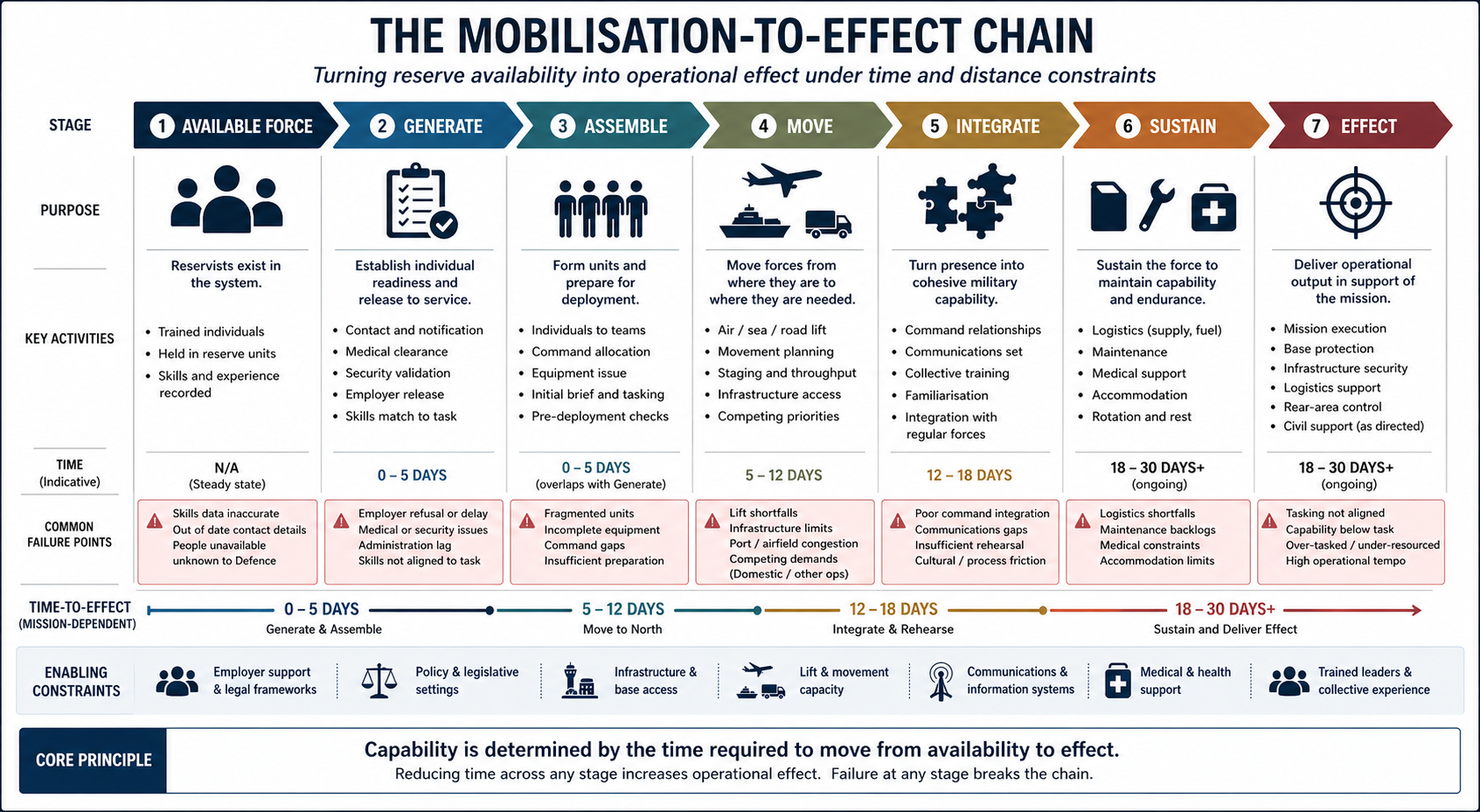
The first stage is generation. Reservists must be contactable, medically current, administratively ready, legally deployable and released from civilian obligations. Individual competence must align with task requirements, including qualifications, trade currency, security clearances and physical readiness. The second stage is movement, in which personnel and equipment are transported from population centres to operational locations through often constrained air, road, rail and maritime networks. The final stage is effect. Reserve elements must arrive as functioning teams, equipped, sustained and integrated into command structures with sufficient collective training to perform their assigned tasks immediately. Arrival alone does not constitute operational effect; without integration, sustainment and command relationships, it represents presence rather than capability. Northern Australia amplifies each stage of mobilisation. Distance turns force generation into a logistics problem. Sparse population limits local reserve mass. Movement depends on constrained lift and vulnerable transport corridors, utilising national highways that are subject to northern Australia’s spectacularly destructive climate. Sustainment relies on infrastructure, fuel, maintenance and communications systems that define what a force can do after arrival. Defence has committed significant investment to northern infrastructure, but infrastructure alone does not produce trained, integrated capability at speed. The constraint lies in the interaction between workforce, movement and sustainment.
Building on existing preparedness frameworks, a mobilisation-to-effect model would allow Army to classify reserve capability not only by readiness level but also by the time required to generate operational effect at a specified location and for a specified task. Immediate tasks would rely on local presence and access, including liaison, surveillance, infrastructure support and civil–military coordination. Short-notice tasks would include rear-area security, logistics augmentation and base support. Medium-notice tasks would involve formed sub-units for protection, sustainment and follow-on roles. Long-notice tasks would provide depth of expansion and replacement capacity following deliberate collective training. The value of each capability depends not simply on whether personnel exist or can be legally activated but on how quickly they can be assembled, equipped, moved, integrated and sustained to generate operational effect.
The framework also forces explicit trade-offs. A reservist available within 48 hours requires different preparation, employer arrangements and sustainment planning than one available after 30 days. Specialist capabilities, including medical, engineering or technical roles, require different readiness pathways from combat elements. Geographic alignment matters. A locally based reserve element differs from one requiring interstate movement, as it knows the physical and human terrain and can plug into networks and connections already established by its personnel.
Defence already uses service categories in the Total Workforce System (TWS) to describe service types; however, those categories do not address the operational question of time-to-effect. Mobilisation-to-effect should become a planning and reporting metric. Army needs to be able to know, by region and capability, how many reservists can generate effect within defined timeframes (and under what legal frameworks), including 24 hours, 72 hours, seven days, 14 days, 30 days and 90 days. The metric should incorporate movement and sustainment, not just availability. It should distinguish between individual augmentation, specialist teams and formed elements. It should also account for employer risk. Reservists embedded in essential civilian sectors may face competing national demands during a crisis. Mobilisation planners already account for these constraints, but that understanding must be codified and communicated across policy, industry and supporting agencies before mobilisation, not rediscovered under operational pressure.
Factors Influencing Mobilisation-to-Effect
Reserve capability is determined by more than authorised strength or workforce numbers. The mobilisation-to-effect framework developed in this article demonstrates that operational capability emerges from the interaction of multiple constraints that collectively determine how rapidly reserve personnel can be converted into military effect. These constraints are structural, organisational and societal. They influence not only the availability of individual reservists but also the ability to generate, move, integrate and sustain formed capability under operational conditions. Four factors are particularly significant: demographic geography, workforce availability, employer integration and competing domestic operational demands. Examining these factors together provides a more accurate assessment of reserve effectiveness than workforce statistics alone because each directly affects the time required to generate operational capability.
Demographic and Geographic Constraints
Australia’s strategic geography creates the first and least malleable constraint on mobilisation-to-effect. The NDS places northern Australia at the centre of Australia’s defence posture, yet the distribution of reserve capability continues to reflect national population patterns rather than operational geography. Consequently, the principal challenge confronting Army is not the willingness of Australians to serve, but the geographic separation between where reserve capability is generated and where strategy increasingly requires military effect.[6]
This distinction reframes a longstanding policy debate. Northern and remote communities consistently demonstrate strong participation in reserve service relative to their population size, suggesting that commitment to service is not the limiting variable.[7] Rather, the constraint is demographic scale. Northern Australia simply does not possess, nor is it projected to possess, the population necessary to generate the reserve mass required for sustained operations independently of southern Australia. Even substantial increases in regional recruitment would produce only marginal improvements in operational capacity.
The implication is that Defence faces a mobilisation challenge rather than a recruitment challenge. Strategic success depends less on increasing reserve numbers than on designing a mobilisation system capable of rapidly translating reserve capability concentrated in Australia’s southern population centres into operational effect in the north. The question is not whether sufficient reservists exist nationally, but whether they can be generated, transported, integrated and sustained within the timelines demanded by Australia’s contemporary defence strategy.
Recent workforce trends reinforce this conclusion. Although reserve numbers have increased over the past decade, growth has occurred largely in the major population centres where Australians already live rather than in those northern regions now assuming greater strategic importance.[8] Headline workforce growth provides only limited insight into operational capability. A reserve establishment concentrated in Sydney, Melbourne or Brisbane contributes differently to Australia’s defence posture than capability already positioned in Darwin, Townsville or other northern locations. Geography changes the operational value of identical workforce numbers because distance directly influences mobilisation timelines, lift requirements, sustainment demands and command integration.
The mobilisation-to-effect framework shifts attention from establishment strength towards geographic responsiveness. Capability should not be measured solely by the number of reservists available in the force structure, but by the time required to generate operational effect at specified locations under defined operational conditions. In this context, northern Australia functions as the decisive design test. It magnifies every component of mobilisation by combining long distances, limited infrastructure redundancy, constrained strategic movement and sparse population into a single operational problem. Reserve force design must acknowledge demographic reality and build systems that compensate for it rather than assume it can be overcome through recruitment alone.
Workforce Availability and Readiness
The second determinant of mobilisation-to-effect is workforce availability. Unlike a standing force, a volunteer reserve cannot be assumed to exist in a constant state of readiness. The mobilisation of reserve capability depends on the interaction of individual availability, collective preparedness and institutional readiness. These factors are related but distinct. Individual reservists may satisfy administrative and training requirements yet still be unavailable because of civilian employment, family commitments or competing professional obligations. Equally, units composed of individually qualified personnel may lack the collective proficiency required to generate operational effect within the timeframe demanded by a contingency. The critical question is not simply how many reservists are available but how rapidly they can be assembled, integrated and employed as functioning military capability.
This distinction highlights an enduring limitation of establishment-based measures of reserve capability. Workforce statistics describe the size of the reserve but provide only a partial indication of operational capacity. Capability is ultimately generated through trained individuals operating in cohesive teams, supported by established command relationships, communications, logistics and collective training. Readiness is an emergent characteristic of the force rather than the aggregate of individual qualifications. Measuring reserve effectiveness through authorised strength alone risks overstating the capability immediately available to government during periods of compressed strategic warning.[9]
Australia’s traditional reserve training model reflects the historical expectation that mobilisation would occur over extended periods. Weekly parade nights, periodic weekend exercises and annual continuous training remain effective mechanisms for maintaining military identity, core competencies and community connection. They are less well suited, however, to developing the collective proficiency required for complex combined-arms operations or for generating formed capability at short notice.[10] Contemporary operations require reserve elements capable of integrating rapidly with regular Army formations, operating sophisticated equipment and sustaining operations across extended distances. These demands place increasing emphasis on collective readiness rather than on individual competence alone.
The challenge is compounded by the changing character of Australia’s reserve workforce. Many reservists possess highly specialised civilian skills that are increasingly valuable to Defence, particularly in cybersecurity, engineering, health, logistics and information technology. Yet these same individuals often occupy critical civilian positions during national crises, creating competing demands for their expertise. A mobilisation system that assumes unrestricted access to specialist personnel risks overlooking the interdependence between Defence capability and broader national resilience. Workforce planning should account not only for military availability but also for the strategic value of reservists in Australia’s essential civilian systems.[11]
Recent reforms acknowledge these realities. The Strategic Review of the Australian Defence Force Reserves recognises that reserve capability exists across a spectrum of readiness and proposes the Reserve Force Level Framework (RFLF) to align training commitments, availability and preparedness with operational purpose.[12] The significance of this approach lies in recognising that readiness is not a uniform condition but a deliberate design choice. Different operational tasks require different levels of preparation, notice to move and employer support. Attempting to maximise readiness across the entire Reserve would be prohibitively expensive and unnecessary; conversely, assuming all reserve capability can be generated within similar timeframes understates the diversity of operational requirements.
Viewed through the mobilisation-to-effect framework, readiness becomes a temporal concept rather than a purely administrative one. The relevant question is not whether reservists satisfy prescribed readiness standards, but whether those standards enable individuals, teams and formed units to generate operational effect within the decision window created by the strategic circumstance. High-readiness reserve elements require more than additional training days. They require predictable availability, current qualifications, established command relationships, collective training, assured access to equipment and mobilisation arrangements that enable rapid integration with the broader force. Lower-readiness elements remain equally valuable but contribute differently by providing specialist capability, reinforcement, replacement personnel and expansion depth over longer mobilisation periods.
Accordingly, workforce availability should be understood as a continuum rather than a binary condition. Individual willingness to serve, while fundamental, represents only one component of operational readiness. Mobilisation effectiveness depends equally on the collective preparedness of units, the institutional mechanisms that support rapid activation and the capacity of Defence to align differentiated readiness with clearly defined operational tasks. Reserve capability is generated not through workforce numbers alone but through the interaction of people, preparedness and time.
Employer Support and Civil–Military Workforce Integration
The effectiveness of a volunteer reserve ultimately depends on relationships that extend beyond Defence. Unlike a standing force, reserve capability is generated through a partnership between the individual, Defence and civilian employers. Employer support is more than a workforce management issue; it is a critical determinant of mobilisation-to-effect. The willingness and ability of employers to release personnel influences not only the availability of individual reservists but also the speed with which Defence can generate collective capability under conditions of strategic warning.
Australia’s legislative framework provides an important foundation for this relationship. The Defence Reserve Service (Protection) Act 2001 protects reservists from discrimination arising from their military service and provides mechanisms to safeguard civilian employment during periods of Defence duty.[13] Complementary initiatives, including the Employer Support Payment Scheme and the work of the Defence Reserves Support Council, have sought to reduce the financial and organisational burden placed upon employers while encouraging recognition of the broader benefits reserve service can provide through leadership, resilience and technical expertise.[14] These arrangements have contributed to generally positive employer attitudes towards reserve service during routine training and limited operational commitments.
However, contemporary strategic circumstances expose the limitations of viewing employer support primarily through a peacetime workforce lens. Research demonstrates that employer support is neither uniform nor unconditional. While most employers express broad support for reserve service, that support becomes increasingly contingent as the duration, frequency and operational consequences of employee absence increase.[15] Small and medium-sized enterprises, regional businesses and organisations employing highly specialised personnel often experience disproportionate operational and financial impacts when key employees are mobilised. These pressures are likely to intensify during a national crisis, when the same civilian sectors supporting Defence, including transport, logistics, health, engineering, communications, energy and critical infrastructure, are simultaneously required to sustain essential national functions.
This creates a fundamental mobilisation dilemma. Many of the reservists whose civilian skills are most valuable to Defence are also indispensable to the resilience of Australia’s economy and critical infrastructure. Mobilisation requires balancing competing national priorities rather than simply maximising Defence workforce availability. A cyber specialist employed by a major telecommunications provider, a logistics manager supporting national freight networks or an engineer responsible for critical energy infrastructure may contribute as much to national resilience through their civilian employment as through military service. Mobilisation planning must consider the broader national consequences of transferring specialised personnel from civilian industry into Defence.
The mobilisation-to-effect framework suggests that employer integration should be understood as a component of national preparedness rather than merely an administrative support function. Higher-readiness reserve capability requires predictable arrangements that extend beyond legal protection to encompass sustained engagement between Defence, industry and government. Formal employer partnerships, sector-specific mobilisation planning and workforce continuity arrangements are likely to become increasingly important as Defence seeks to generate capability within compressed strategic warning periods. These arrangements should not seek to eliminate the tension between civilian and military demand, which is inherent in any volunteer reserve system; rather, they should manage it transparently through deliberate planning before a crisis emerges.
Viewed in this way, employer support becomes an operational variable rather than a peripheral personnel issue. The speed with which Defence can generate reserve capability is directly influenced by the strength of its relationships with civilian employers and by the degree to which mobilisation planning accounts for the interdependence between military capability and broader national resilience. Employer integration should be regarded as a strategic enabler of mobilisation-to-effect, linking Defence workforce policy to Australia’s wider system of national preparedness.
Domestic Operations and Readiness Trade-Offs
Domestic operations represent the fourth major influence on mobilisation-to-effect because they compete directly with the readiness, availability and force-generation requirements necessary for high-intensity operations. Reserve forces have become an increasingly important component of Australia’s response to bushfires, floods, cyclones, pandemics and other emergencies through Defence Assistance to the Civil Community. These operations demonstrate the flexibility of the Reserve and reinforce its contribution to national resilience, strengthening relationships with emergency services, governments and local communities while providing reservists with valuable operational experience.[16]
However, domestic operations also create opportunity costs. Reserve capability is finite, and time committed to one task is unavailable for another. Extended domestic commitments consume training time, equipment availability, command capacity, employer goodwill and individual availability. Although many domestic operations develop leadership, logistics and command skills that are transferable to military operations, they do not necessarily generate the collective warfighting proficiency required for operations under contested conditions. The issue is not whether domestic operations have value—they clearly do—but how their demands are balanced against the readiness required to support Australia’s contemporary defence strategy.
This tension has become increasingly apparent as Australia’s strategic environment has deteriorated. The Defence Strategic Review reaffirmed that the ADF should remain the force of last resort for domestic disaster response, recognising that routine domestic tasking can reduce preparedness for the ADF’s primary function of defending Australia and contributing to deterrence.[17] The NDS reinforces this shift by placing greater emphasis on force generation, sustained operations and the defence of Australia’s northern approaches under conditions of compressed strategic warning. Reserve force design must account for the possibility that future domestic emergencies and strategic crises may occur concurrently rather than sequentially.
The mobilisation-to-effect framework provides a means of understanding these competing demands. Domestic operations affect each stage of mobilisation. Personnel committed to disaster response may be unavailable for immediate military deployment. Equipment employed in civil support tasks may require maintenance or redistribution before operational employment. Command elements engaged in domestic operations may require reconstitution before undertaking military tasks. Consequently, the operational cost of domestic commitments cannot be measured solely by the duration of the deployment itself but by their effect on the time required to generate military capability for subsequent contingencies.
These trade-offs do not suggest that reserve forces should withdraw from domestic operations. Rather, they reinforce the importance of differentiated readiness and clearly defined operational roles. Reserve elements primarily assigned to domestic resilience require different readiness standards, equipment scales and training priorities from units intended to provide rapid reinforcement, rear-area security or operational sustainment. Attempting to optimise every reserve element simultaneously for both domestic support and high-readiness warfighting would dilute capability across both missions. Conversely, explicitly differentiating readiness allows Defence to preserve valuable contributions to national resilience while ensuring that designated high-readiness reserve elements remain capable of generating operational effect within the timeframes demanded by Australia’s defence strategy.
Viewed collectively, the factors examined in this section demonstrate that mobilisation effectiveness is determined by the interaction of demographic realities, workforce availability, employer integration and competing operational demands rather than by establishment strength alone. Each influences the time required to generate operational capability, and each contributes directly to mobilisation-to-effect. Reserve reform should consequently focus less on increasing workforce numbers than on reducing the practical constraints that delay the conversion of reserve potential into operational capability. This provides the analytical foundation for the comparative analysis that follows.
Evolution of Australian Reserve Force Design
Australia’s approach to reserve force design has evolved significantly over the past three decades in response to changing strategic circumstances, operational experience and workforce realities. While the specific policy settings have varied, successive reforms have sought to balance the competing demands of readiness, affordability, workforce sustainability and operational utility. Rather than representing disconnected initiatives, these reforms demonstrate an ongoing effort to determine how reserve capability can best contribute to national defence. Examined through the mobilisation-to-effect framework, they reveal a gradual shift from viewing the Reserve primarily as a source of augmentation towards recognising its role in force generation, mobilisation and operational preparedness.
The Ready Reserve and High-Readiness Mobilisation
The Ready Reserve scheme, introduced in 1991, represented Australia’s most ambitious attempt to create a high-readiness reserve force capable of rapid mobilisation. Established under the Defence Legislation Amendment Act 1991 (Cth), the scheme required recruits to complete 12 months of continuous full-time military training before transitioning to a four-year period of part-time reserve service, followed by a period in the Standby Reserve.[18] Unlike the traditional reserve model, which relied primarily on periodic evening and weekend training, the Ready Reserve sought to generate a force capable of immediate operational employment by investing heavily in initial collective preparation.
The underlying philosophy reflected a recognition that operational readiness cannot be generated instantaneously. Concentrated full-time training provided reservists with greater individual proficiency, unit cohesion and familiarity with Army procedures than could be achieved through dispersed part-time training. The scheme represented an early acknowledgement that the speed with which reserve capability could be generated depended on sustained investment before mobilisation rather than on accelerated preparation after a crisis emerged. In contemporary terms, it sought to reduce mobilisation-to-effect by increasing the proportion of capability already prepared for operational employment.
Although the Ready Reserve demonstrated considerable success in producing highly capable reservists, it also exposed enduring policy trade-offs. The model required substantial financial investment, imposed significant opportunity costs on participants through prolonged separation from civilian employment or education, and demanded a continuous training pipeline capable of sustaining annual intakes.[19] These requirements proved difficult to reconcile with the fiscal constraints and strategic assumptions of the post Cold War period. Following the election of the Howard government, the scheme was discontinued in 1996 as Defence shifted towards a more flexible reserve model based on individual augmentation and part-time service rather than maintaining a dedicated high-readiness reserve component.[20]
Its abolition should not be interpreted as a rejection of the readiness principle that underpinned the scheme. Rather, it reflected the competing workforce, financial and strategic priorities confronting Defence at the time. Subsequent operational experience, including Timor-Leste, Iraq, Afghanistan and increasingly frequent domestic support operations, continued to demonstrate the value of reservists while simultaneously highlighting the challenges associated with generating formed capability at short notice.[21] As Armstrong argues, Australian reserve policy since the 1990s has largely sought to reconcile this enduring tension between maintaining affordable part-time capability and generating operational readiness when required.[22]
Viewed through the mobilisation-to-effect framework, the Ready Reserve remains significant because it demonstrated that readiness can be deliberately created through concentrated investment in training and preparedness before mobilisation. Equally, it demonstrated that such readiness carries significant financial, workforce and institutional costs. The central policy challenge has never been whether readiness matters, but how Defence should balance readiness, affordability and sustainability in a predominantly volunteer reserve system. That challenge continues to shape contemporary reforms, including the TWS, the transformation of the 2nd (Australian) Division, and the RFLF.
From Augmentation to Total Workforce
The abolition of the Ready Reserve did not signal the abandonment of reserve reform. Rather, it marked the beginning of a prolonged period in which Defence sought to integrate reserve capability more closely with the regular Army while balancing operational effectiveness against workforce sustainability. Successive reforms increasingly shifted the Reserve away from its traditional role as a strategic mobilisation base towards a more flexible workforce capable of supporting domestic operations, specialist capability, individual augmentation and expeditionary deployments. This evolution reflected the operational demands of the post Cold War period and Australia’s sustained commitments in Timor-Leste, Iraq, Afghanistan and domestic disaster response.[23]
During this period, the distinction between the regular Army and the Reserve became progressively less rigid. Operational deployments demonstrated that reservists could make valuable contributions across a broad spectrum of activities, particularly as individual specialists and augmentees embedded in regular units. At the same time, Defence increasingly recognised that maintaining separate workforce systems constrained flexibility and limited its ability to respond to changing operational and personnel requirements. Reserve reform shifted from creating a distinct high-readiness component towards developing a more integrated total workforce capable of moving personnel between different forms of service as operational demand changed.[24]
This transition culminated in the introduction of the TWS, which fundamentally reframed the relationship between full-time and part-time military service. Rather than treating reserve service as a discrete workforce category, the TWS established a continuum of service through which members could transition between permanent, part-time and inactive service according to Defence requirements and individual circumstances.[25] The reform recognised that contemporary military capability depends increasingly on workforce agility rather than on rigid personnel structures. By reducing institutional barriers between service categories, the TWS sought to improve retention, increase workforce flexibility and provide Defence with greater access to specialist skills distributed across Australian society.
The TWS represented a significant institutional advance because it acknowledged that military capability extends beyond the permanent force. However, its principal focus remained workforce management rather than mobilisation. The system provides Defence with greater flexibility to manage personnel across service categories but it does not, by itself, determine how rapidly those personnel can be generated, organised, moved and integrated into operational formations during a strategic crisis. Workforce flexibility and mobilisation effectiveness are related concepts but they are not synonymous.
Operational experience during this period further reinforced the need to distinguish between individual contribution and formed capability. Reservists consistently demonstrated their value across overseas operations and domestic support tasks, yet these contributions were predominantly delivered through individual augmentation or specialist employment rather than through the routine deployment of formed Reserve combat units.[26] This distinction is important because the mobilisation challenge confronting Australia today extends beyond generating individual personnel. Under the NDS, Defence must increasingly consider how reserve formations can contribute to force generation, protection, sustainment and rear-area security within compressed strategic warning periods.
Viewed through the mobilisation-to-effect framework, the TWS should be understood as an enabling reform rather than a complete solution. It provides the workforce flexibility necessary to support modern force generation, but mobilisation effectiveness ultimately depends on how that workforce is translated into operational capability. Questions of readiness, geographic alignment, strategic movement, command integration and sustainment remain critical determinants of the time required to generate military effect. These issues have become the focus of more recent reforms, particularly the transformation of the 2nd (Australian) Division and the development of the RFLF.
Contemporary Reform: The 2nd Division and the Reserve Force Level Framework
Australia’s contemporary reserve reforms reflect a significant shift in strategic thinking. Rather than viewing the Reserve principally as a workforce available for augmentation after conflict begins, recent reforms increasingly position reserve capability as an integral component of mobilisation, force generation and national preparedness. This evolution has been shaped by a deteriorating strategic environment, reduced warning time and the NDS’s emphasis on deterrence by denial, integrated force design and the defence of Australia’s northern approaches.[27] Together, these developments have redirected attention from the size of the Reserve towards its ability to generate operational capability within compressed decision and mobilisation timelines.
The transformation of the 2nd (Australian) Division illustrates this evolution. Recent professional military literature argues that the division should no longer be understood primarily as an administrative headquarters responsible for managing reserve units, but as Army’s principal mobilisation formation responsible for generating and integrating capability during periods of strategic warning.[28] Under this approach, mobilisation is conceived as a continuous force-generation activity rather than the delayed expansion of the Army following the commencement of conflict. The emphasis shifts from maintaining a latent reserve force to preparing an organisation capable of generating operational effect across multiple contingencies.
This conceptual shift is reinforced by the Strategic Review of the Australian Defence Force Reserves (2024), which concluded that reserve capability should be differentiated according to operational purpose rather than managed through a single, uniform readiness model.[29] The review’s proposed RFLF recognises that reserve forces contribute across a spectrum of operational tasks requiring different levels of readiness, availability, training commitment, equipment, notice to move and employer support. Rather than seeking to maximise every reserve unit across every dimension, the framework explicitly aligns preparedness with operational requirement, acknowledging that strategic effectiveness depends on matching readiness to task.
The significance of the RFLF extends beyond workforce management. It represents an important conceptual recognition that reserve capability cannot be evaluated through establishment strength alone. Different reserve elements are expected to deliver different operational outcomes within different mobilisation timelines. High-readiness elements require sustained investment in collective training, equipment, employer engagement and mobilisation planning if they are to generate rapid operational effect. Conversely, lower-readiness elements provide strategic depth, specialist expertise, replacement personnel and expansion capacity over longer mobilisation periods. Differentiated readiness reflects a deliberate allocation of resources against operational priorities rather than unequal treatment of reserve capability.
The mobilisation-to-effect framework developed in this article complements, rather than challenges, this direction of reform. Whereas the RFLF differentiates workforce readiness according to operational purpose, mobilisation-to-effect provides an analytical lens for assessing whether those differentiated readiness levels generate operational capability within the timeframes demanded by Australia’s contemporary strategy. It shifts the focus from the readiness of individual reserve categories to the interaction of readiness, mobilisation, strategic movement, sustainment and command integration in producing operational outcomes.
Viewed together, the RFLF and the transformation of the 2nd Division represent the most significant evolution in Australian reserve policy since the introduction of the TWS. They demonstrate that Army has already recognised many of the challenges examined in this article. The remaining task is not to develop an entirely new reform agenda, but to ensure that existing reforms are evaluated against the operational problem they are intended to solve. The mobilisation-to-effect framework provides one means of doing so by assessing reserve capability according to its capacity to generate timely military effect under the strategic conditions envisaged by the NDS.
Lessons for Mobilisation-to-Effect
Australia’s reserve reforms over the past three decades reveal a consistent pattern of institutional adaptation rather than episodic policy change. While individual reforms differed in emphasis, each sought to reconcile the same enduring challenge: how to generate operationally relevant military capability from a predominantly part-time force within the financial, workforce and political constraints of a liberal democracy. The evolution from the Ready Reserve, through the TWS, to the transformation of the 2nd (Australian) Division and the development of the RFLF reflects a progressive shift in thinking from reserve administration towards mobilisation and force generation. This trajectory mirrors broader developments in Australian defence policy, where mobilisation has increasingly been recognised as a central component of national defence rather than a contingency undertaken only after conflict begins.[30]
Four lessons emerge from this evolution. First, readiness cannot be generated solely after strategic warning is received. The Ready Reserve demonstrated that operational readiness is created through sustained investment in people, collective training and preparedness before mobilisation, even if maintaining such capability carries significant financial and workforce costs. Subsequent reforms have sought to preserve this principle while adopting more sustainable workforce models that better accommodate part-time service and civilian employment.[31]
Second, reserve capability has become increasingly differentiated rather than uniform. Operational experience and contemporary workforce policy have demonstrated that a single readiness model cannot efficiently satisfy the diverse roles expected of the Reserve. Individual augmentation, specialist capability, domestic resilience, rear-area security and formed operational units each require different levels of readiness, training, notice to move and employer support. The RFLF formalises this reality by recognising that preparedness should be aligned with operational purpose rather than distributed uniformly across the force.[32]
Third, mobilisation should be understood as a whole-of-system function rather than simply the activation of reserve personnel. Contemporary Australian mobilisation literature increasingly emphasises that military capability depends on the interaction of workforce availability, strategic movement, sustainment, command integration and national resilience. The transformation of the 2nd Division similarly reflects an institutional recognition that mobilisation is a continuous process of force generation rather than the delayed expansion of the Army following the outbreak of conflict.
Finally, Australia’s contemporary strategic environment alters the standard against which reserve capability should be assessed. Under the NDS, compressed warning times and the demands of deterrence by denial reduce the relevance of establishment strength as the principal measure of reserve effectiveness. The more important question is whether reserve capability can be generated, deployed and integrated quickly enough to influence operational outcomes before strategic opportunities are lost. This shifts analytical attention from workforce numbers towards the temporal relationship between readiness, mobilisation and operational effect.
The mobilisation-to-effect framework developed in this article builds on these lessons rather than proposing an alternative reform agenda. It complements existing reforms by providing a common analytical lens through which readiness, workforce design, strategic movement, sustainment and command integration can be assessed against a single criterion: the time required to generate operational effect. In doing so, the framework extends current thinking beyond workforce management and force structure to consider whether Australia’s evolving reserve system is capable of delivering the operational outcomes envisaged by the NDS. The following section broadens this analysis through a comparative examination of selected international reserve systems, identifying design principles that may further inform Australia’s continuing reserve transformation.
International Models: Lessons Without Imitation
International reserve models offer useful lessons, but they operate under different strategic conditions. Geography, demography, threat perception, legal frameworks and political culture shape reserve design. Australia should not copy foreign models. It should extract principles that improve mobilisation-to-effect under Australian conditions.
Singapore provides the clearest example of a reserve system built on continuity of service.[33] Operationally Ready National Service places former full-time personnel into a structured training cycle following initial service. Singapore’s national service framework typically involves a defined period of recurrent training over approximately 10 years. The model relies on conscription, legal obligation and social acceptance of national service, which are politico-social conditions Australia does not share. The transferable lesson lies in continuity. Reserve readiness improves when part-time service operates as a structured continuation of full-time service rather than as a discretionary add-on.
Finland demonstrates the scale and clarity of a mobilisation-focused reserve. The Finnish Defence Forces report a reserve of approximately 900,000 personnel and a wartime strength of around 280,000.[34] That system reflects conscription, territorial defence doctrine and intergenerational cultural conditioning predicated on a direct existential land threat. Australia cannot replicate the Finnish scale or compulsory service model. However, it can adopt the underlying principle: reserve design should align clearly with national defence tasks, and mobilisation systems should enable the timely generation, integration and employment of trained capability. Finland’s strength lies not simply in the size of its reserve but in the fact that personnel, units, readiness arrangements and mobilisation processes are designed as part of a coherent wartime system.
Sweden illustrates the integration of military reserve design within a broader total defence system. The Swedish Civil Contingencies Agency emphasises societal preparedness, including the roles of households, businesses and local authorities in crisis and conflict.[35] The military reserve depends on that system. Infrastructure protection, mobilisation and sustainment require civilian cooperation.
Norway offers a practical territorial model. The Norwegian Home Guard comprises approximately 40,500 personnel distributed across the country with responsibilities for territorial security and infrastructure protection.[36] The force provides rapid mobilisation capability through local presence and defined responsibilities. Norway’s geography differs from Australia’s, but the principle applies: distributed reserve elements with clear territorial tasks can protect key nodes and support mobilisation.
The United States illustrates both scale and complexity. The National Guard operates under a dual state and federal mission, supporting domestic emergencies while contributing to the national defence.[37] The model embeds military capability in communities and links domestic response to military readiness. It also creates tension, as domestic demands can compete with warfighting preparation.
The United Kingdom provides a contemporary reform case. The Reserve Forces Review 2030 found that UK reserves had improved under a whole-force approach but required clearer demand signals, stronger integration and deeper relationships with employers and government.[38] UK experience also highlights the risk of treating former personnel as a passive pool rather than an actively managed capability. Effective reserve systems require visibility of skills, availability and roles before mobilisation.
Across these models, consistent principles emerge despite significant differences in strategic circumstance. Finland, Sweden and Norway organise their reserve forces primarily around territorial defence and homeland mobilisation, whereas Australia has historically maintained an expeditionary force designed to deploy beyond its borders. The relevance of these examples lies not in their force structures but in the principles they demonstrate. Reserve effectiveness depends on a clear purpose aligned with national strategy, continuity between full-time and part-time service, integration with civilian systems, defined responsibilities where geography demands, and realistic management of domestic and operational roles.
Northern Australia as the Decisive Design Test
The comparative analysis suggests that no single reserve model is directly transferable to Australia. Nevertheless, common principles emerge across successful systems: reserve purpose must align with national strategy; readiness should be differentiated according to operational task; mobilisation depends on integration with civilian institutions; and capability must be assessed by its ability to generate operational effect rather than establishment strength alone. Northern Australia provides the most demanding test of these principles. It is here that Australia’s strategic priorities, demographic realities and mobilisation challenges converge.
The NDS positions northern Australia at the centre of Australia’s defence posture. The region hosts critical bases, training areas and logistics infrastructure, supports international force posture initiatives, and anchors Australia’s northern approaches. At the same time, it presents significant operational constraints. Vast distances, sparse population, limited transport redundancy, extreme climatic conditions and dispersed infrastructure collectively compress the time available to generate and sustain military capability. Consequently, northern Australia provides the most rigorous environment in which to assess whether reserve force design can translate mobilisation into operational effect.
Viewed through the mobilisation-to-effect framework, northern Australia highlights that reserve capability is fundamentally a temporal problem. The operational question is not whether reserve forces exist but whether they can generate the required effects within the decision window created by a particular contingency. This challenge extends beyond workforce numbers to encompass strategic movement, sustainment, command integration and geographic alignment. A reserve force concentrated in Australia’s southern population centres may provide substantial latent capability, but its operational value ultimately depends on the speed with which that capability can be generated, moved and integrated into operations in the north.
The analysis suggests that northern Australia requires reserve capability across multiple mobilisation timelines rather than a single uniform readiness model. Immediate capability is required to provide local situational awareness, civil–military liaison and support to the reception of follow-on forces. Short-notice capability is required to protect bases, ports, logistics nodes and critical infrastructure while supporting movement control, sustainment and rear-area security. Longer-notice capability provides reinforcement, specialist expertise and expansion capacity as operations become sustained. These functions differ in readiness, training and workforce requirements, but together they illustrate how differentiated readiness can support a coherent mobilisation system.
This interpretation aligns with the RFLF by linking differentiated readiness to operational purpose rather than to workforce administration alone. High-readiness reserve elements require assured access to strategic lift, equipment, command relationships and sustainment if they are to generate timely operational effect. Conversely, lower-readiness elements contribute through specialist capability, replacement personnel and expansion depth over extended mobilisation periods. The analytical value of the mobilisation-to-effect framework lies in evaluating whether these differentiated capabilities collectively reduce the time required to generate operational outcomes rather than simply increasing the number of available reservists.
The northern Australian case also reinforces an important implication arising from the international comparison. Effective mobilisation cannot be assessed through personnel readiness alone. It depends on the performance of the wider mobilisation system, including employer participation, transport networks, infrastructure, logistics, communications and coordination with civilian agencies. Consequently, mobilisation exercises should be evaluated not simply as tests of military preparedness but as assessments of system performance. Their purpose is to determine whether reserve capability can be generated, moved, sustained and integrated under the degraded conditions likely to characterise contemporary conflict. Such an approach shifts the emphasis from validating individual components of mobilisation towards evaluating whether the mobilisation system as a whole can deliver operational effect within the timeframes demanded by Australia’s contemporary defence strategy.
Implications for Reserve Force Design
The mobilisation-to-effect framework developed in this article provides an analytical lens for assessing reserve capability against Australia’s contemporary strategic requirements. Rather than proposing a separate reform agenda, the framework complements current Army initiatives by focusing attention on the relationship between workforce design, readiness, force generation and operational effect. The preceding analysis suggests several implications for the continuing evolution of reserve force design.
First, the analysis indicates that reserve capability should be evaluated through operational outcomes rather than workforce measures alone. Establishment strength, recruitment targets and participation rates remain important indicators of workforce health but they provide only a partial assessment of military capability. The more relevant measure is the extent to which reserve personnel, teams and formations can generate operational effect within the timeframes required by specific contingencies. Readiness should increasingly be understood as a temporal characteristic of force generation rather than solely an administrative measure of preparedness.
Second, the framework suggests that differentiated readiness should become the organising principle for reserve capability development. The RFLF recognises that different operational tasks require different levels of availability, training, notice to move and employer support. The analysis presented here reinforces that proposition by demonstrating that a uniform readiness model cannot efficiently support the diverse demands of deterrence, domestic resilience, specialist capability, reinforcement and sustained mobilisation. Aligning readiness with clearly defined operational roles provides a more effective basis for force design than seeking to maximise preparedness uniformly across the Reserve.
Third, the analysis indicates that mobilisation should be considered as a whole-of-system capability rather than simply a workforce function. The time required to generate operational effect is influenced not only by the readiness of reservists but also by strategic movement, sustainment, command integration, employer participation and supporting national infrastructure. Reserve capability is generated through the interaction of multiple systems rather than through personnel availability alone. Assessing mobilisation through this broader lens encourages greater integration between workforce planning, logistics, infrastructure, industry engagement and operational planning.
Fourth, the framework suggests that Australia’s strategic geography should become a more explicit consideration in reserve force design. The concentration of population and reserve capability in the south, combined with the increasing strategic importance of northern Australia, means that geographic distribution will continue to influence mobilisation timelines. This demographic reality cannot be resolved through recruitment policy alone. Instead, force design should increasingly consider how reserve capability can be generated, moved and sustained across Australia’s vast distances within compressed strategic warning periods.
Finally, the analysis indicates that reserve reform should continue to build on, rather than replace, the substantial reforms already underway in Army. The transformation of the 2nd (Australian) Division, implementation of the TWS and development of the RFLF collectively represent a significant evolution in Australian mobilisation thinking. The mobilisation-to-effect framework complements these initiatives by providing a common analytical basis for assessing whether they reduce the time required to generate operational capability. In this sense, the framework is intended not as an alternative model of reserve reform, but as a means of evaluating the effectiveness of existing reforms against the operational demands of Australia’s contemporary defence strategy.
Taken together, these implications suggest that the effectiveness of reserve reform should ultimately be judged not by the size of the Reserve, the number of reforms implemented or the complexity of workforce arrangements, but by the ability of the Reserve to generate timely and sustainable military effect under operational conditions. This shifts the focus of analysis from organisational inputs towards operational outcomes and provides a coherent basis for evaluating future force design decisions as Australia’s strategic environment continues to evolve.
Conclusion
Australia’s strategic circumstances have fundamentally altered the question confronting the Army Reserve. The central issue is no longer simply the size of the Reserve or the number of personnel available for mobilisation, but how rapidly reserve capability can be translated into operational effect under conditions of compressed strategic warning. As the NDS places increasing emphasis on deterrence by denial, force generation and the defence of Australia’s northern approaches, the effectiveness of the Reserve will depend less on workforce statistics than on its contribution to operational outcomes.
This article has argued that mobilisation should be understood not as a discrete event but as a continuous process through which reserve capability is generated, moved, integrated and sustained to produce military effect. Building on contemporary Australian mobilisation literature, the evolution of the 2nd (Australian) Division, the TWS and the RFLF, it has developed a mobilisation-to-effect framework that integrates readiness, workforce availability, strategic movement, sustainment and command integration through a common temporal lens. The framework does not replace existing concepts of readiness, preparedness or force generation. Rather, it provides a means of understanding how these concepts interact to determine the time required to generate operational capability.
The analysis demonstrates that reserve effectiveness is shaped by the interaction of multiple factors. Australia’s demographic geography constrains where reserve capability can be generated. Workforce availability and differentiated readiness influence the speed with which personnel and formed units can be prepared for operations. Employer participation affects mobilisation flexibility, while competing domestic operational demands shape the availability of reserve capability during periods of national crisis. These constraints are interdependent. Improving any single element in isolation is unlikely to produce a proportionate increase in operational capability unless the broader mobilisation system is similarly strengthened.
The historical evolution of Australian reserve policy further demonstrates that many of these challenges are already recognised in Army. From the Ready Reserve through to the contemporary transformation of the 2nd Division and the development of RFLF, successive reforms have progressively strengthened the Reserve’s contribution to force generation and mobilisation. Rather than proposing an alternative reform agenda, this article has argued that these initiatives can be better understood and evaluated through a mobilisation-to-effect framework that focuses on operational outcomes rather than organisational inputs.
The principal contribution of this article is conceptual rather than prescriptive. It proposes a common analytical framework for assessing reserve capability against the operational demands of Australia’s contemporary strategic environment. By shifting attention from establishment strength to the time required to generate operational effect, the framework provides a basis for evaluating existing reforms, informing future force design and assessing reserve capability against the strategic objectives established in the NDS.
Ultimately, the question facing the Australian Army is not whether the Reserve can contribute to national defence, but whether it can generate the right capability in the right place and at the right time to influence operational outcomes. Answering that question requires more than measuring workforce numbers or readiness categories. It requires understanding mobilisation as a system whose success is determined by its ability to translate reserve potential into timely military effect. The mobilisation-to-effect framework offers one means of undertaking that assessment and, in doing so, contributes to the continuing evolution of Australian reserve force design in an increasingly contested strategic environment.
Endnotes
[1] Department of Defence, 2026 National Defence Strategy (Canberra: Commonwealth of Australia, 2026), at: www.defence.gov.au/about/strategic-planning/2026-national-defence-strat….
[2] James J Wirtz and Jeffrey A Larsen, ‘Wanted: A Strategy to Integrate Deterrence’, Defense & Security Analysis 40, no. 3 (2024): 361–378, at: https://doi.org/10.1080/14751798.2024.2352943.
[3] David Thomae, ‘The Evolving Role of the 2nd Division Within Australia’s Defence Mobilisation Strategic Framework’, United Service 72, no. 4 (2021): 5–9, at: https//www.rusinsw.org.au/Papers/20210831.pdf.
[4] Ibid.
[5] David Thomae, ‘Focusing the 2nd Division’, speech, Defence Reserve Association conference, 12 August 2023; Wirtz and Larsen, ‘Wanted’, pp. 361–378.
[6] Department of Defence, 2026 National Defence Strategy; Department of Defence, 2024 National Defence Strategy (Canberra: Commonwealth of Australia, 2024), at: https://www.defence.gov.au/about/strategic-planning/2024-national-defen….
[7] Iris Reinhold and Raelene Lockhorst, ‘Australia’s Reserves Are Growing—But Not Where the Strategy Needs Them’, The Strategist, 17 April 2026, at: https://www.aspistrategist.org.au/australias-reserves-are-growing-but-n….
[8] Department of Defence, Annual Report 2024–25 (Canberra: Commonwealth of Australia, 2025); Reinhold and Lockhorst, ‘Australia’s Reserves Are Growing’.
[9] Department of Defence, Strategic Review of the Australian Defence Force Reserves (Canberra: Commonwealth of Australia, 2024), at: https://www.defence.gov.au/about/reviews-inquiries/strategic-review-of-…; Mark Armstrong, ‘Historical Legacy to National Asset: The Australian Army Reserve in the 21st Century’, PhD thesis, Deakin University, 2024.
[10] Mark Armstrong, ‘The Australian Army Reserve’; David Thomae, ‘Focusing the 2nd Division’.
[11] Department of Defence, 2024 National Defence Strategy; Department of Defence, 2026 National Defence Strategy.
[12] Department of Defence, Strategic Review of the Australian Defence Force Reserves; Thomae, ‘The Evolving Role of the 2nd Division’.
[13] Defence Reserve Service (Protection) Act 2001.
[14] Department of Defence, Defence Reserves Support (Canberra: Commonwealth of Australia); Department of Veterans’ Affairs, Employer Support Payment Scheme (Canberra: Commonwealth of Australia).
[15] Brad West and Joshua Healy, Drawing on Reserves: Assessing Civilian Employer/Manager Support for Employees’ Part-Time Military Service, Australian Army Occasional Paper No. 28 (Canberra: Australian Army Research Centre, 2025).
[16] Department of Defence, Defence Assistance to the Civil Community Manual (Canberra: Commonwealth of Australia, 2024); Australian National Audit Office, Defence’s Assistance to the Civil Community, Auditor-General Report no. 30 of 2020–21 (Canberra: Australian National Audit Office, 2021).
[17] Department of Defence, Defence Strategic Review (Canberra: Commonwealth of Australia, 2023), pp. 54–56; Department of Defence, 2024 National Defence Strategy.
[18] Defence Legislation Amendment Act 1991; Australian National Audit Office, Army Ready Reserve Scheme, Audit Report no. 18 (Canberra: Australian National Audit Office, 1994).
[19] Australian National Audit Office, Army Ready Reserve Scheme; Department of Defence, Army Ready Reserve Scheme: Implementation Papers (Canberra: Commonwealth of Australia, 1991).
[20] Department of Defence, Australia’s Strategic Policy (Canberra: Commonwealth of Australia, 1997).
[21] Department of Defence, The Australian Army Contribution to INTERFET (Canberra: Commonwealth of Australia, 2000); David Horner, The Australian Army: From Whitlam to Howard (Melbourne: Oxford University Press, 2001).
[22] Armstrong, ‘The Australian Army Reserve’.
[23] Horner, The Australian Army; Armstrong, ‘The Australian Army Reserve’.
[24] Armstrong, ‘The Australian Army Reserve’; Department of Defence, Adaptive Army: Public Information Paper (Canberra: Commonwealth of Australia, 2008).
[25] Department of Defence, Total Workforce System: Overview (Canberra: Commonwealth of Australia, 2016); Department of Defence, Defence People Strategy 2018–2028 (Canberra: Commonwealth of Australia, 2018).
[26] Department of Defence, The Australian Army Contribution to INTERFET; Armstrong, ‘The Australian Army Reserve’.
[27] Department of Defence, 2024 National Defence Strategy; Department of Defence, 2026 National Defence Strategy.
[28] Thomae, ‘The Evolving Role of the 2nd Division’; Thomae, ‘Focusing the 2nd Division’.
[29] Department of Defence, Strategic Review of the Australian Defence Force Reserves.
[30] Stephan Frühling, Richard Brabin-Smith and Graeme Dunk, ‘The Concept of Mobilisation and Australian Defence Policy Since Vietnam: Lessons and Cautions for Army in the Post-DSR World’, Australian Army Journal 20, no. 3 (2024): 215–244, at: https://doi.org/10.61451/2675158.
[31] Mark Armstrong, ‘Historical Legacy to National Asset: The Australian Army Reserve in the 21st Century’, PhD thesis, Deakin University, 2024.
[32] Department of Defence, Strategic Review of the Australian Defence Force Reserves.
[33] Matthew LM Jones and Andrew Maher, Towards Total Defence: A Literature Review and Feasibility Assessment for Australia, Australian Army Occasional Paper No. 39 (Canberra: Australian Army Research Centre, 2026).
[34] ‘In the Reserve’, Finnish Defence Forces (website), at: https://intti.fi/en/in-the-reserve (accessed 5 May 2026).
[35] Swedish Civil Contingencies Agency, In Case of Crisis or War (Stockholm: Swedish Civil Contingencies Agency, 2024).
[36] ‘The Norwegian Home Guard’, Norwegian Army (website), updated 19 September 2024, at: www.forsvaret.no/en/organisation/home-guard.
[37] United States National Guard Bureau, National Guard Fact Sheet (Arlington: National Guard Bureau, 2006), at: https://www.nationalguard.mil/About-the-Guard/Army-National-Guard/Resou… (accessed 5 May 2026).
[38] United Kingdom Ministry of Defence, Reserve Forces Review 2030 (London: Ministry of Defence, 2021), at: https://www.gov.uk/government/publications/reserve-forces-review-2030.