
Energy Independence and Microgrid Deployment
Examining the Implications for Defence Operations and Supply Chain Resilience
Authors: Khalil Gholami, Ali Azizivahed, Li Li and Dylan Lu
Abstract
The increasing reliance on a centralised, privately operated power grid in Australia poses significant security risks, particularly for critical defence operations. This research explores the potential for the Australian Defence Force (ADF) to enhance energy resilience through the adoption of decentralised energy systems, specifically military-grade microgrids. The study evaluates a range of alternative energy sources and examines their integration into microgrid configurations, with an emphasis on operational reliability, security and adaptability in remote or high-risk environments. Key areas of analysis include system vulnerabilities, cyber and physical threats, and the strategic implications of global supply chain dependencies. The research identifies microgrids as a viable and resilient solution, capable of ensuring uninterrupted power supply during grid failures. It also underscores the importance of local energy technology development, secure design standards, and the integration of hydrogen and artificial intelligence to support future energy autonomy. By addressing both technological and strategic dimensions, this study provides a framework for the ADF to strengthen its energy infrastructure in support of national defence objectives.
Introduction
Electricity plays a critical role in supporting modern defence operations, forming the foundation upon which military readiness, communication, logistics, and command systems rely. In an era where military capabilities are increasingly driven by technology, a stable and secure energy supply is essential for ensuring continuous operations under all conditions.[1],[2] This is because conventional utility electrical power relies heavily on centralised grids or imported fossil fuels which are susceptible to attack and system-wide failures. A single incident, such as the sabotage of a power station, can cause blackouts that leave critical military infrastructure powerless, severely limiting operational capabilities.[3] At the same time, environmental considerations and global pressure to reduce carbon emissions are driving a shift toward cleaner energy sources. Solar, wind, hydrogen and other renewable technologies offer promising alternatives, but they must be evaluated carefully within the defence context.[4],[5]
Independent energy systems play a critical role in enhancing energy security by overcoming the above concerns. By enabling localised generation (microgrids) through technologies such as solar arrays, energy storage systems, and advanced control systems, these systems ensure the continued functionality of critical infrastructure during crises, whether caused by natural disasters, cyber attacks or armed conflicts. Importantly, storage does not need to be static; it can be battery on wheels—for example, electric vehicles (EVs)—adding flexibility and mobility to energy supply. For military applications, independence from national grids allows bases and forward operating locations to maintain mission-critical operations without relying on external energy sources that may be compromised or inaccessible. This independence also provides strategic benefits by reducing logistical vulnerabilities, enabling greater operational flexibility, and supporting sustained deployments in contested or remote environments. Additionally, independent systems can reduce long-term operational costs, increase energy efficiency, and support sustainability goals by integrating renewable resources.[6],[7] However, the defence industry depends on a broad and interconnected web of suppliers to deliver essential equipment and components of independent energy systems. Therefore, global instability, natural disasters, and cyber threats can easily disrupt these supply chains. Without a secure electricity infrastructure, even the most advanced defence systems can become ineffective during emergencies.[8],[9] Therefore, evaluating supply chain vulnerabilities and exploring alternative solutions require significant investigation to ensure reliable energy independence.[10]
Electricity is critical to all countries for myriad crucial functions within military and defence operations. This research provides the Australian Defence Force (ADF) with vital information to make informed decisions and effective strategies, and to position it to adopt the most suitable technologies to mitigate risks during the transition to global alternative power and energy solutions for defence operations. Ultimately, the research will strengthen the Army's energy resilience and ability to adapt to the changing landscape of energy technologies and security challenges. Briefly, the following items are covered throughout this investigation:
- The research evaluates the current state of electrical utility grids and assesses their vulnerabilities during emergencies such as armed conflicts and natural disasters.
- It investigates both the limitations and the potential of distributed energy resources (DERs) in military contexts, particularly their ability to support mission-critical operations and achieve independent energy systems.
- The logistical feasibility of deploying and sustaining independent energy systems in military applications is explored, considering factors such as mobility, maintenance, scalability, and compatibility with existing infrastructure.
- A comprehensive risk and vulnerability assessment is conducted for independent energy systems, identifying technical, operational and cyber security challenges that may affect their reliability.
- The research examines the context of supply chain resilience, identifying key vulnerabilities to reduce reliance on foreign energy and technology sources.
- Finally, the study explores the integration of artificial intelligence (AI) in independent military energy systems, particularly its role in enabling autonomous decision-making, system optimisation, and real-time response during critical missions.
Existing Military Electric Grids and Their Vulnerability in the Case of Emergencies
Electric Grid Structure in Australia
Australia’s grid, shown in Figure 1 and known as the National Electricity Market (NEM), covers the eastern and south-eastern regions. It supplies approximately 200 TWh of electricity each year, roughly 85 per cent of the nation’s total electricity generation. With a length of 5,000 km, it holds the record as the world’s longest alternating current (AC) system. Given this, renewing the NEM’s infrastructure would be a significant financial burden and could also lead to considerable indirect emissions of greenhouse gases.[11] Such a centralised, interconnected electricity network is referred to as the utility grid, which is further elaborated as follows.
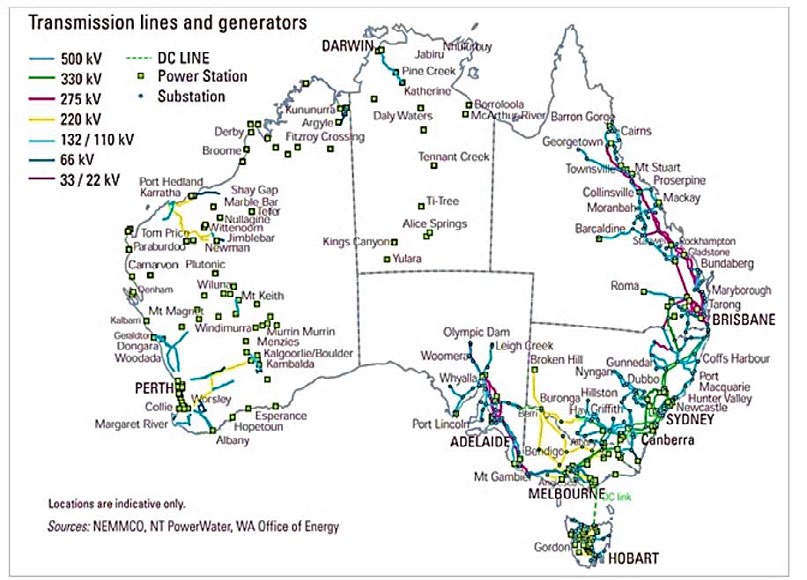
Image source: Berlin Institute of Technology[12]
The utility grids in Australia consist of five main sections, as depicted in Figure 2. These sections are elaborated as follows:[13],[14],[15]
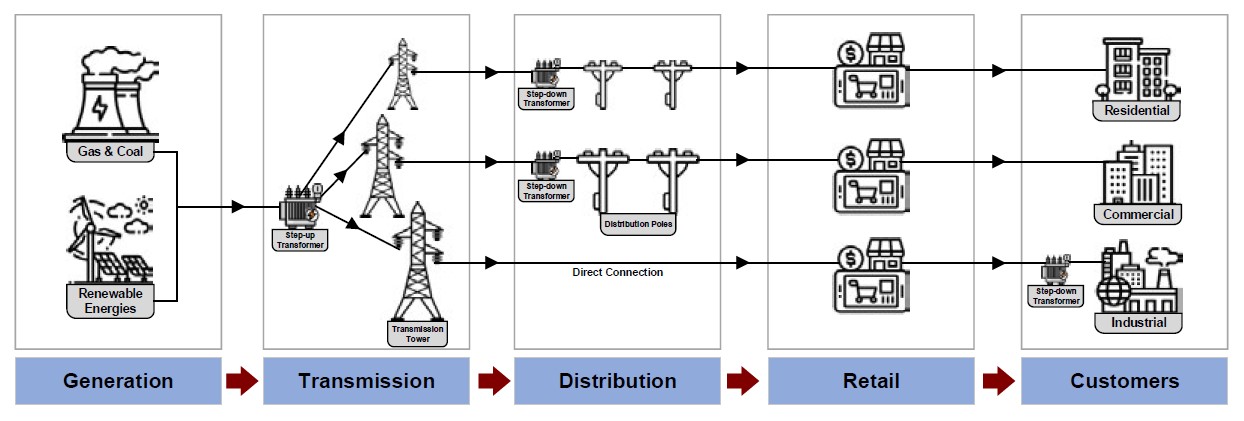
- Generation: Electricity is generated from thermal sources (coal, natural gas) and renewable energy sources (solar, wind).
- Transmission: Power is transmitted via networks, using step-up transformers to increase voltage and minimise costs, especially for operations in diverse areas.
- Distribution: Electricity is delivered to infrastructure through distribution networks, using step-down transformers to reduce voltage to levels suitable for customers’ equipment.
- Retailers: They serve as intermediaries, purchasing electricity from markets and selling to customers while managing billing and customer service.
- Customers: They include residential, commercial and large-scale industrial users. Customer operations may opt for a connected set-up or direct transmission for reliable and safe power delivery, depending on their needs.
Market Operators and Service Providers of Utility Grids in Australia
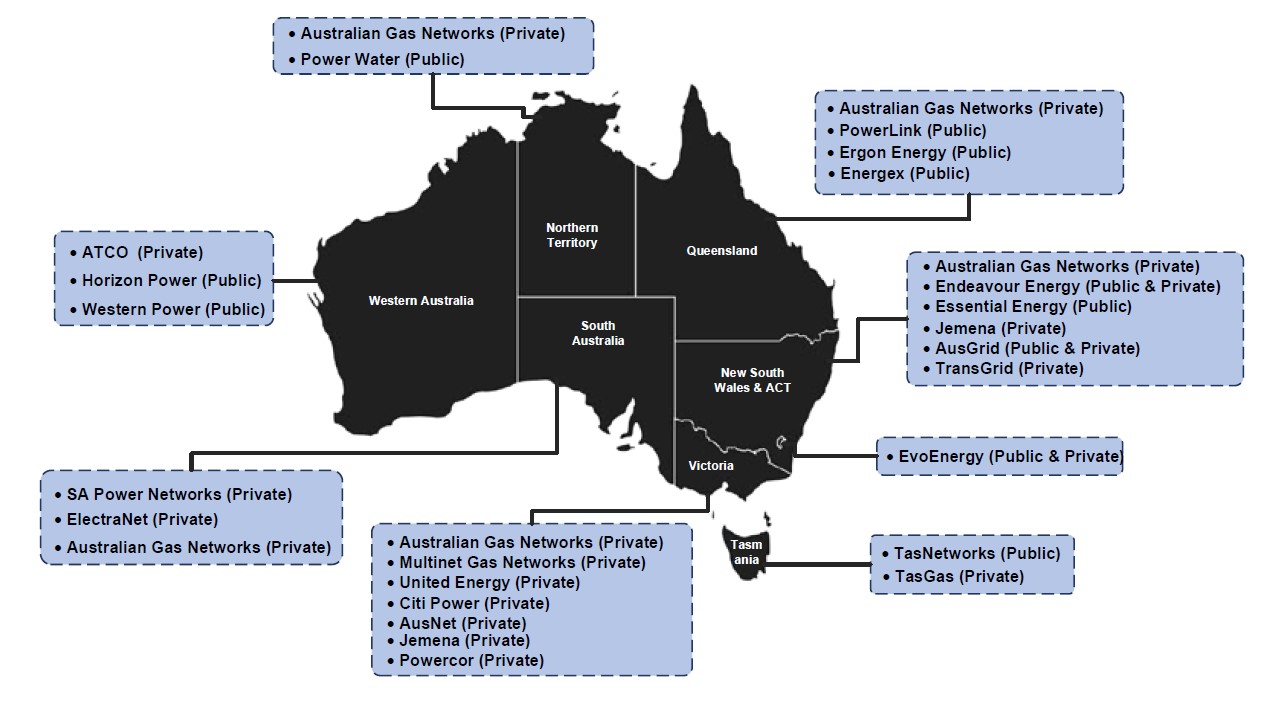
Due to the expansive nature of Australia's electricity grids, it is impossible for a single organisation or company to manage and operate entire grids individually. Consequently, Australia’s electricity and gas grids are operated through public, private, or combined public-private ownership forms, as depicted in
Figure 3 and outlined below:[16]
- Victoria and South Australia operate fully privatised electricity networks.
- Tasmania, Western Australia, the Northern Territory and Queensland have fully government-owned electricity networks.
- In New South Wales, one electricity grid is under private ownership, two are partially (50.4 per cent) privately owned, and one is entirely government owned. The Australian Capital Territory (ACT) electricity network operates as a partnership between public and private ownership.
- Gas distribution providers across Australia are all privately owned, except for the ACT’s network, which is partially government owned.
Electric Grid Structure in the Military
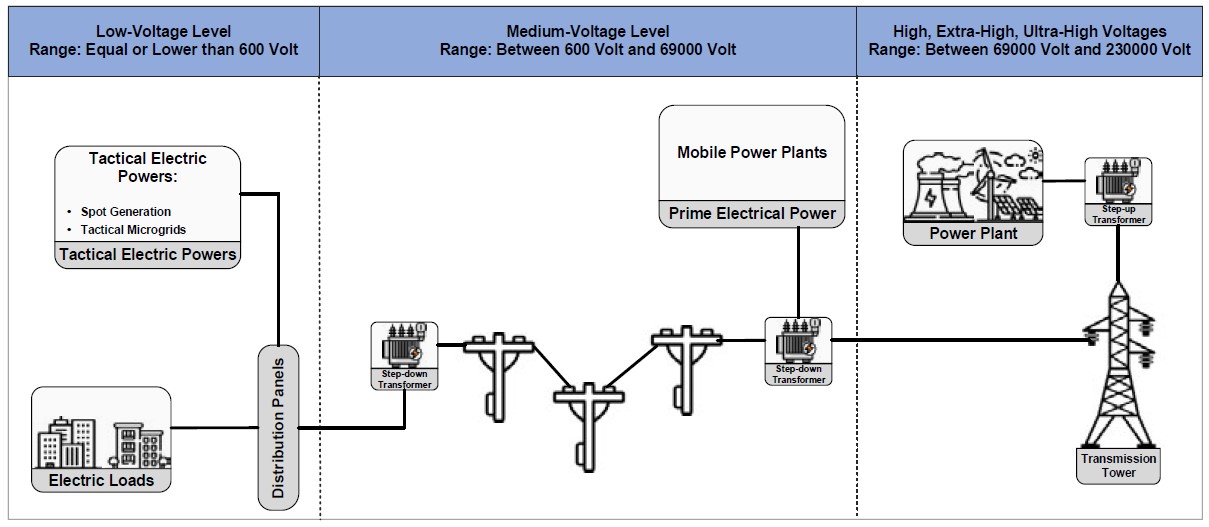
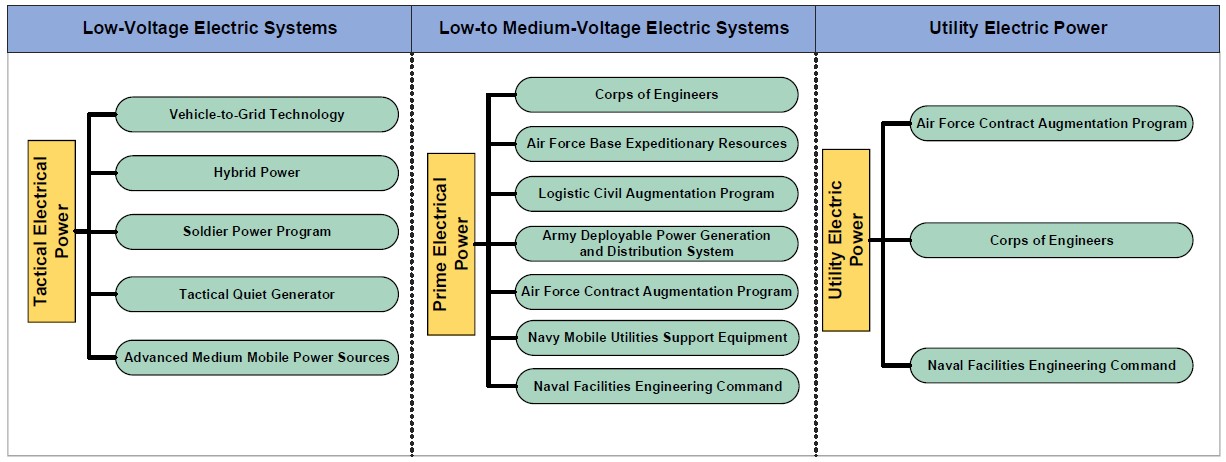
As shown in Figure 4, military electrical services encompass three main categories: tactical electrical power, prime electrical power and utility electrical power. Tactical power, found at the individual level (close to the electric loads over missions), includes batteries and small unit power sources producing under 1 kW, typically operating at voltages of 600 V or lower, and extending up to 200 kW in capacity. In contrast, prime power systems exceed 200 kW, providing medium voltage outputs ranging from 600 V to 69 kV. Utility electrical power, managed and supplied by civilians or contractors, stands as a separate category.[17] Each power source varies in complexity, efficiency and reliability; all are aimed at meeting diverse mission requirements, as discussed below.
Tactical Electrical Power
At the start of military operations, units rely on tactical electrical power systems tailored to their specific needs, including batteries, renewable energy sources, and low-voltage generators. These systems enhance mobility despite their limited capacity. Tactical electrical power systems are generally divided into distinct categories.
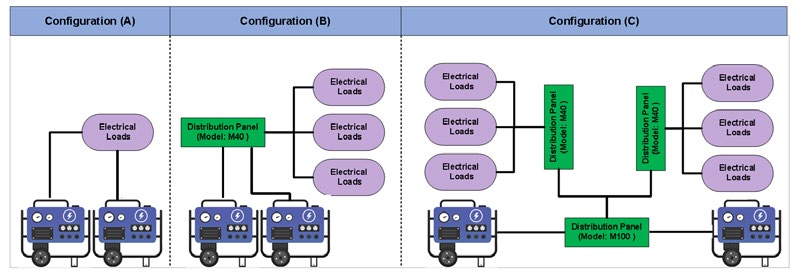
- Spot generation: It is employed to link a group of generators to a set of loads. Spot generation with two generators is advantageous for powering outlying radar units or delivering energy to services and shelters with mission equipment.[18] Figure 5 displays three examples of spot generation and distribution.
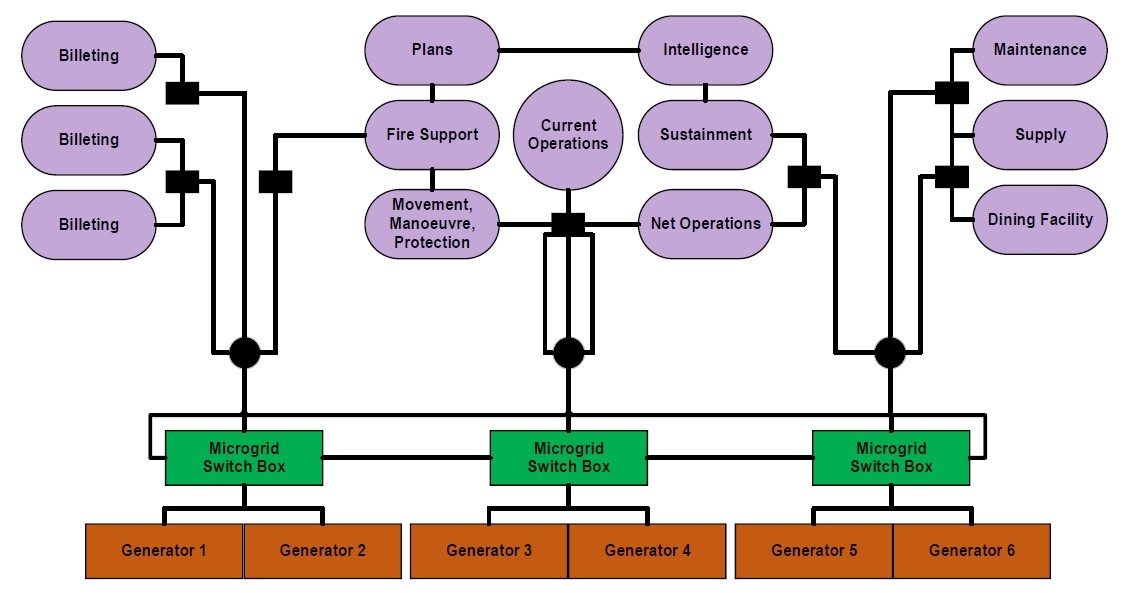
- Tactical microgrids: Tactical microgrids rely on on-site power generating and distribution technology, including optimised portable electricity sources. As demonstrated in Figure 6, these microgrids could control functions integrated into the generator set, allowing automatic adjustment of generator activity as demand changes. This design ensures that power production matches demand closely, reducing excess production and labour needs.[19],[20] Furthermore, microgrids may expand by adding generators and shifting to prime power or utility grids when mission requirements change.
The benefits of consolidating power generation and distribution (like microgrids) are numerous and include:
- enhanced security for power generation assets
- improved reliability of the power system
- increased cost efficiency
- reduced fuel dependency
- less stress on machinery that is not developed to run constantly
- simplified maintenance processes.
Prime Electrical Power
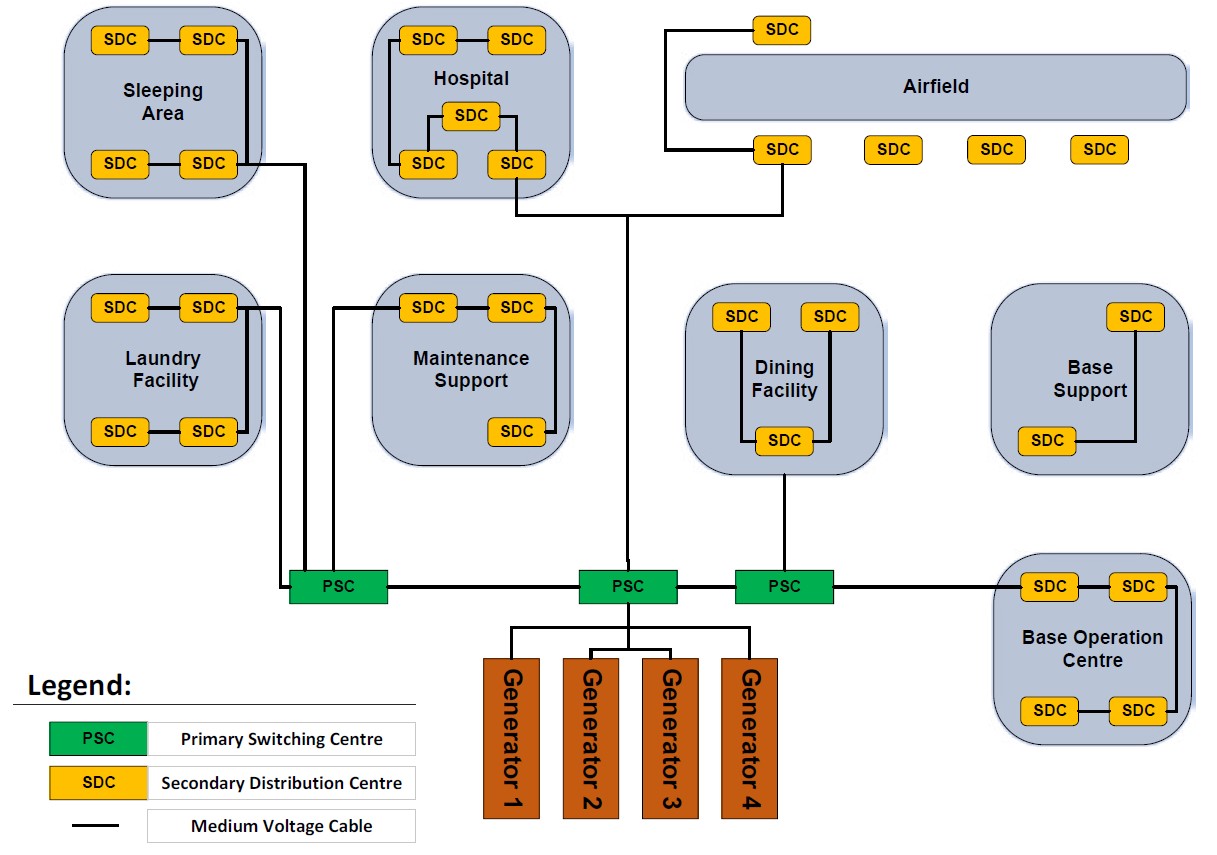
As illustrated in Figure 7, the term ‘prime power sources’ refers to centralised power plants operating at medium voltage levels, capable of consistently supplying reliable power exceeding 200 kW. To reduce the medium voltage to levels appropriate for the device, these sources employ transformers. They can generate and transmit power over long distances via transmission lines, often supporting critical infrastructure. Prime power installations are preferred when tactical generators are impractical or when utility electrical power is unavailable or unreliable.
Utility Electrical Power
Deciding whether to use utility electrical power depends on how well it works with mission equipment and its reliability to meet operational needs. Utility electrical power is mainly delivered through civilian power grids, which vary widely in sophistication and reliability worldwide. Trained personnel manage connections to commercial distribution networks, ensuring proper coordination and obtaining necessary approvals as required. Alternatively, they may collaborate with local utility organisations to establish connections. Once connected, utility electricity provides continuous service with minimum maintenance. Operating on a utility grid usually needs a contractual or host-nation agreement.
Figure 8 illustrates the adaptability of tactical electrical power, prime electrical power, and utility electrical power to various mission-critical scenarios and operational environments.[21]
Vulnerabilities of Electric Utility Grids in Military and Defence Applications
Figure 9 illustrates the average weekly number of cyber attacks per organisation across select industries from 2020 to 2022. As shown, the government/military sector experiences the highest number of cyber attacks, posing a significant risk to critical infrastructure and potentially compromising military and defence services,[22],[23],[24],[25] as discussed in
Table 1. Additionally, utility grids remain vulnerable to various physical attacks, which threaten their stability and security,[26],[27],[28],[29],[30] as detailed in Table 2. Cyber security is another critical challenge in the energy sector, where the integration of digital technologies increases vulnerability to a wide range of cyber attacks.
Table 3 provides an overview of significant cyber security threats and their potential impacts on energy infrastructure.[31],[32],[33],[34],[35],[36],[37],[38],[39],[40],[41]
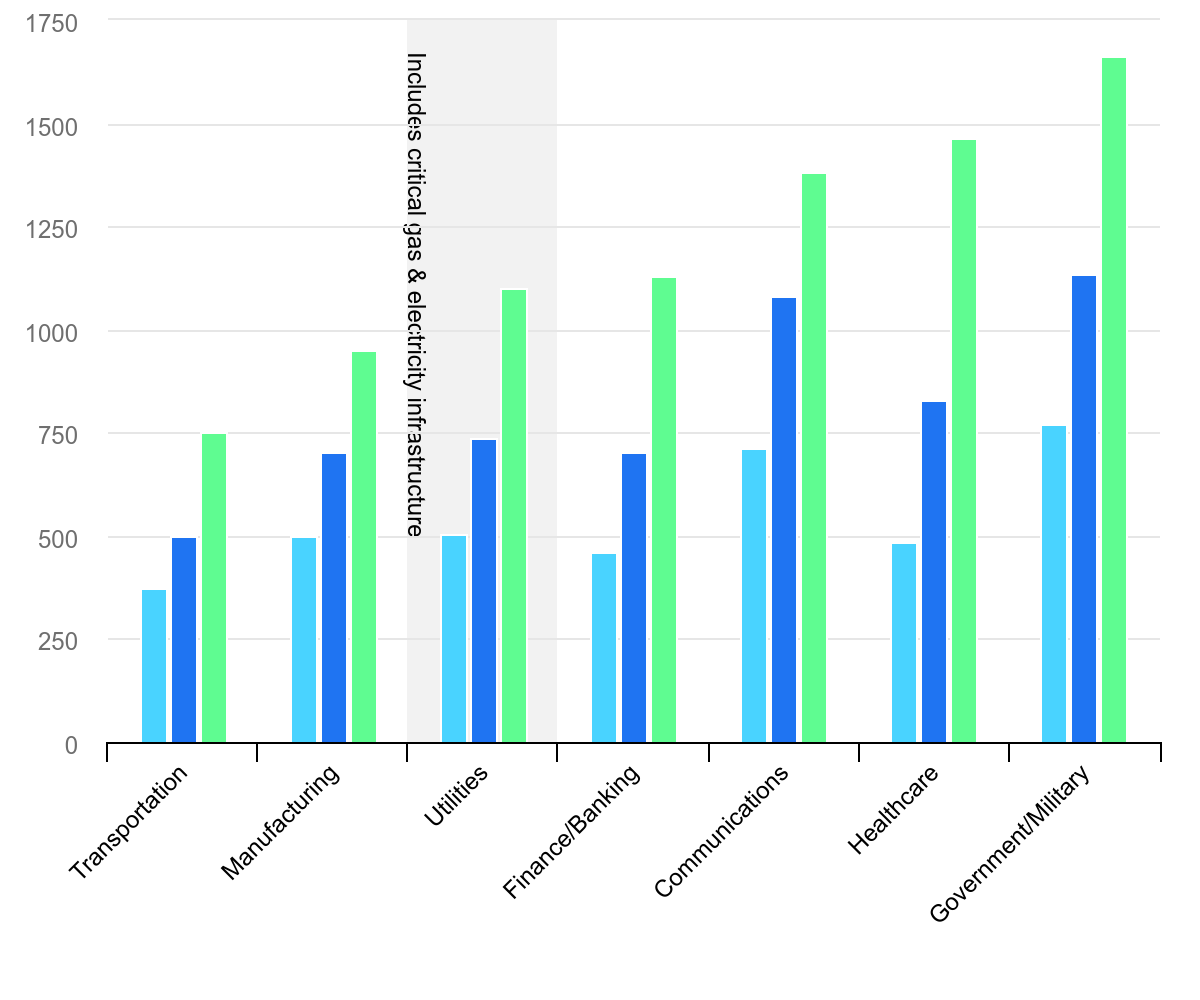
Image source: International Energy Agency (IEA)[42]
| Threat | Description | Impacts |
|---|---|---|
| Power networks and components | Critical components in energy systems include programmable logic controllers, digital relays, remote terminal units, and supervisory control systems such as supervisory control and data acquisition (SCADA). All these components are vulnerable to unauthorised access. | Unauthorised intrusion could threaten network operations, causing major interruptions in energy delivery and increasing supply chain risk. This emphasises the importance of tight supply chain security. |
| Control system | Energy flow management requires industrial control systems, such as SCADA and protection systems. It is essential to secure these systems and their interfaces to prevent system vulnerabilities from being exploited. | The stability and effectiveness of gas and electricity distribution networks could be compromised by energy management errors resulting from breaches in control systems. |
| Privacy jeopardisation | Large amounts of sensitive data, including operational and consumer data, are processed by service providers of networks. Strong data protection techniques are needed to stop data tampering, theft, and unauthorised access. | The performance of the network could be severely impacted by breaches that result in the loss of private and financial information, legal problems because of privacy violations, and disruptions in operational data. |
| Distributed energy resources | There are new cyber security vulnerabilities associated with the increasing usage of DERs, such as battery storage, rooftop solar panels and EVs. An internet of things (IoT) environment connects many of these devices. | The presence of security vulnerabilities in DERs and IoT devices may impede the ability to manage energy in real time, hence increasing the risk of energy supply disruptions, system instability, and a general decline in grid safety and reliability. |
Distributed Energy Resource Challenges and Capabilities for Military Applications
Exploring the Types of Distributed Energy Resources
This section considers the different sorts of DERs that exist.[43],[44] As Figure 10 illustrates, there are three main types of DERs: dispatchable energy sources, renewable energy, and energy storage systems.
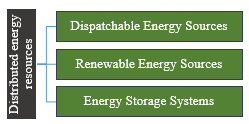
Dispatchable Energy Sources
Dispatchable sources are equipment/devices that consume fuel to generate electricity. There are different types of dispatchable generators, as follows:
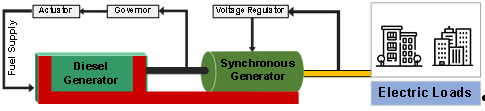
- Diesel generators: As shown in Figure 11, they consume diesel fuels to generate electricity and are considered to be the primary backup power technology utilised by the military services.[45] In broad terms, there are three models of diesel generators. The first type is known as building-scale diesel generators, which are sized based on assessments of the facility’s peak electrical demand with a focus on supplying individual buildings. The second type is the centralised diesel generators that supply a set of facilities/equipment, along with different operational modes emphasising continuous or standby backup operation. Mobile diesel generators represent the third model, characterised by their portability to various locations, making them particularly useful for temporary military operations.[46]
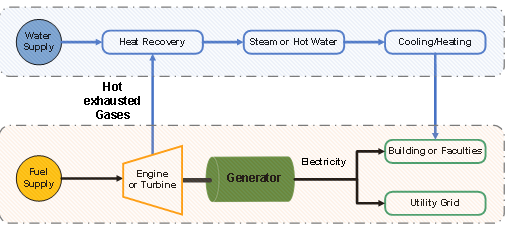
- Combined heat and power (CHP): In CHP systems, the heat that is typically wasted during electricity generation is effectively utilised for both heating military facilities and supplying electrical power. By implementing CHP systems, military installations can achieve energy independence, ensuring a continuous power supply even if disconnected from utility grids. Furthermore, integrating CHP units into military microgrids allows multiple facilities to operate autonomously, reducing reliance on expensive backup systems usually needed during grid failures.[47],[48] Figure 12 illustrates the high-level procedure by which CHP deploys to generate heat and electricity simultaneously.
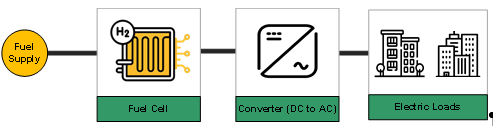
- Fuel cells: Fuel cells convert the chemical energy of fuels, such as gas and hydrogen, into electrical energy through an electrochemical process. Fuel cells provide superior efficiency and lower emissions. However, to establish hydrogen infrastructure in military settings, it is necessary to address challenges related to storage, transportation, and the unique properties of hydrogen.[49],[50],[51],[52],[53] The high-level procedure for generating electricity through fuel cells is shown in Figure 13.
Renewable Energy Sources
Renewable energy plays a crucial role in advancing broader sustainability objectives by minimising the military’s carbon footprint and mitigating environmental impacts.[54],[55] The most common renewable resources are listed below:
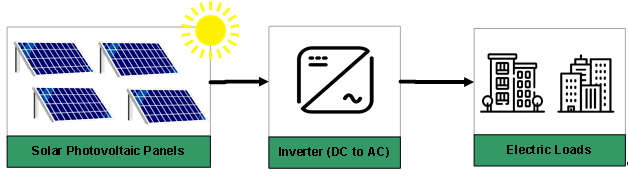
- Solar energy system: Photovoltaic (PV) cells, typically made of semiconductor materials like crystalline silicon, directly convert sunlight into direct current (DC) electricity, which is one type of solar energy system. This DC power is either used to supply DC loads or converted into standard alternative current (AC) for connection to AC loads through an inverter. The PV panels are modular and can be arranged into larger arrays to accommodate various load requirements.[56],[57]
- Figure 14 shows the process of generating electricity from solar PV panels and delivering it to customers.
Various types of PV systems are utilised within military installations. Small-capacity PV panels are often installed on facility rooftops, providing localised power generation that supports critical operations.[58],[59] In contrast, large-capacity PV systems, known as grid-scale solar PV, are deployed in open areas across the installation. These systems are integrated with the active electrical grid.[60],[61],[62],[63],[64]
- Wind turbines: In military applications, wind turbines can range from individual units providing localised power to extensive wind farms with hundreds of turbines. Wind turbines can be deployed in both onshore and offshore environments, with efficiency largely influenced by factors such as air density and wind speed. As wind turbines generate power based on varying wind speeds, converters are employed to adjust the output frequency to the standard grid frequency, typically 50 Hz or 60 Hz.[65] [66],[67] Figure 15 shows the procedure for delivering electricity to the loads generated by wind turbines.

- Biomass energy: It is derived from plant and animal sources and captures solar energy through photosynthesis, making it a renewable and versatile energy resource. In military and defence contexts, biomass can be harnessed in several ways to enhance energy security and sustainability. Direct combustion of biomass can produce heat for military installations, supporting both heating and electricity needs. Thermochemical processes, such as pyrolysis, gasification and torrefaction, convert biomass into solid, gaseous or liquid fuels, which can be used to power equipment and vehicles in the field. Chemical processes, including transesterification, generate biodiesel from oils and fats, offering an alternative fuel source for military operations. Additionally, biological processes such as anaerobic digestion and fermentation produce biogas and bioethanol, which can be utilised for various applications, including energy supply and waste management. These methods collectively provide a sustainable and renewable energy solution, crucial for maintaining operational effectiveness and energy resilience in defence settings.[68],[69],[70],[71],[72]
- Geothermal energy: This energy taps into the Earth’s innate heat, originating from depths where core temperatures surpass approximately 5,273.15 K. This thermal energy gradually permeates through layers, heating underground rocks and water. Utilising hydrothermal convection systems, cooler water infiltrates the Earth’s crust, undergoes heating and emerges as steam, which then serves as a potent energy source for electric generators. Geothermal power plants streamline this process by drilling into rock formations to access steam more efficiently.[73],[74] There exist three primary designs for geothermal power plants,[75],[76] each involving the extraction of hot water and steam from subterranean reservoirs, employing them for energy production, and reintroducing them as warm water to sustain the heat source. The simplest design entails directing steam through a turbine and then condensing it into water. Alternatively, high-pressure hot water can be depressurised to produce steam for driving a turbine. In a binary cycle system, hot water heats a secondary liquid, such as isobutane, which vaporises at a lower temperature, thus fuelling the turbine. Geothermal power plants are particularly advantageous for military and defence operations due to having a smaller ecological footprint, requiring less land and causing fewer ecosystem impacts, though groundwater concerns may arise.[77]
Energy Storage Systems
Energy storage systems are devices designed to store energy to be used for periods when generation is not available. There are several types of energy storage systems commonly used in military services, as follows:
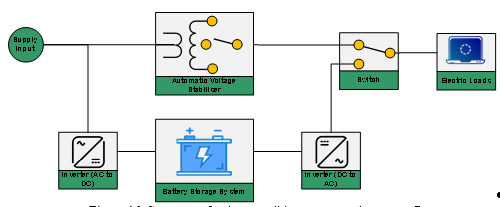
- Uninterruptible power supply (UPS) systems: These systems consist of battery storage units that are installed between power generation sources (such as electric utility grids or microgrids) and critical electrical loads within a facility. Under normal conditions, the facility’s power demands are met by the grid while the UPS batteries are charged. In the event of a power outage, the UPS provides immediate backup power from its batteries, ensuring that critical systems continue to operate without interruption. UPS systems in military applications are designed to support either the entire facility’s power needs or specific critical loads for a brief period, typically ranging from 15 to 40 minutes. UPS systems are not intended to provide long-term power but are vital for bridging the gap during the transition to generator power, ensuring the continuity of essential operations and the functioning of key equipment during emergencies.[78],[79],[80] Figure 16 demonstrates the structure of UPS systems.
- Battery storage systems: Large-scale battery systems are deployed to supply all critical loads on military and defence missions.[81],[82],[83] However, the growing interest in using intermittent renewable resources to meet electrical demand and the subsequent need for storage to manage fluctuations throughout the day and night have increased the potential for their adoption.[84] Compared to UPS systems, batteries offer prolonged power delivery to devices and equipment, making them suitable for extended periods of power provision.
- EVs: EVs, particularly hybrid- and battery-electric models, play a crucial role in military logistics and operations. Equipped with vehicle-to-grid technology, they serve as mobile energy storage for short-term applications. Hybrid-electric light tactical vehicles offer enhanced mobility and survivability with efficient generators and adaptable batteries. Similarly, hybrid-electric main battle tanks utilise strong electric motors and battery banks for improved acceleration and fuel savings. Lightweight and quick to recharge, battery-electric medium vehicles excel in logistical delivery.[85],[86]
High-Level Advantages and Disadvantages of Distributed Energy Resources
The capabilities and limitations of DERs[87],[88],[89] such as CHP,[90],[91],[92],[93] hydrogen-based fuel cell systems,[94],[95] UPS,[96],[97] biomass energy,[98],[99] geothermal energy,[100],[101],[102] battery storage[103],[104],[105] and EVs[106],[107] are summarised in Table 4.
| DER type | Advantages | Disadvantages |
|---|---|---|
| Diesel generators |
· Widely used for critical load backup · Capable of providing backup power during grid outages · Available in various sizes to suit different applications · Controllable electricity generation · Liquid fuel, making it easy to refuel, with a less flammable rate |
· High complexity because of various components like engines, alternators and fuel systems · Generate carbon dioxide by consuming diesel fuel · High-maintenance practices significantly affect their reliability and performance · Make noise when generating electricity · Dependency on diesel fuel |
| Combined heat and power (CHP) |
· CHP generates both electricity and heat, reducing the need for separate equipment · CHP systems decrease greenhouse gas emissions and air pollutants by consuming less fuel · CHP reduces expenses and offers protection against rising energy prices · CHP systems reduce dependence on the energy grid, ensuring greater energy security · CHP systems are utilised in district heating plants to supply energy and heat to local facilities |
· Substantial investment and ongoing maintenance expenses · Complex operation and maintenance requirements · Fixed capacity may limit adaptability, particularly for energy demand growth · Availability and cost of fuel can impact cost-effectiveness, especially if the fuel source is scarce or costly · Complex regulatory requirements may present obstacles, including regulations on energy production and emissions |
| Fuel cells |
· Hydrogen fuel cells offer a significant 25 per cent reduction in operational energy demand, especially beneficial for fully electric forces · The commercial availability of fuel cell technology allows for easy adaptation to military applications, particularly for unmanned systems · Hydrogen's non-toxic nature and rapid dispersal mitigate environmental risks, enhancing safety in inadvertent releases · Private industry initiatives are addressing safety and supply chain risks, potentially benefiting military operations · Ongoing research focuses on improving storage and transportation methods, promising enhanced efficiency and safety in hydrogen usage |
· Despite its environmental safety, hydrogen’s high flammability poses ignition risks and safety concerns · Limited energy density of hydrogen necessitates costly storage and distribution methods, increasing overall expenses · Corrosive properties of hydrogen can degrade existing pipelines, requiring expensive mitigation · Dependence on specific energy sources for hydrogen generation and feedstock availability introduces supply chain vulnerabilities · Current hydrogen production heavily relies on fossil fuels, necessitating the development of low-carbon production methods · Electrolysis, while promising, accounts for a small fraction of global production and requires substantial policy support for expansion · Transitioning hydrogen supply chains to renewable sources poses logistical challenges despite ongoing global efforts |
| Solar PV systems |
· Widely deployed as they are environmentally friendly · Available in various sizes, suitable for different applications · Established reliability in high-scale commercial and utility grids · Noise-free power generation. · Generate DC power that can be deployed to supply DC equipment · Modular design allows for flexible arrangement into larger arrays · Can reduce reliance on costly and logistically challenging fuel deliveries, especially in remote locations |
· Vulnerable to weather conditions, causing stochastic output fluctuations · Component failures, particularly inverters which convert DC to AC power · Impossibility in standalone operations · Need inverters to convert DC to AC power · High investment costs · Need to occupy significant land to install PV panels · Limited applicability in specific geographical areas and seasons |
| Wind turbines |
· Rapid deployment globally, indicating their eco-friendly nature · Potential for both onshore and offshore applications · Mitigate dependency on fuel-based generators · Produce significant electricity if weather conditions are desirable · Facilitate the development of off-grid microgrids in challenging logistical areas
|
· Variable or intermittent power output dependent on weather conditions, limiting reliability · Offshore deployment adds complexity, particularly in maintenance · Complex systems are prone to more failures · Need electronic-based converters to regulate the frequency · Vulnerable to natural disasters, including typhoons that can cause significant damage to their infrastructure · Require specific foundations for installations, which can increase installation complexity and expenditures |
| Biomass energy |
· Biomass energy, while reliant on organic matter that diminishes upon use, can be quickly regenerated · Unlike wind and solar energy, biomass provides a consistent energy supply, making it more reliable · Abundant organic materials contribute to the availability and sustainability of biomass energy · Biomass energy utilises waste materials, reducing landfill accumulation and benefiting the environment · As biomass fits into the natural carbon cycle, it is considered carbon neutral, contrasting with fossil fuels, which contribute to carbon dioxide emissions and climate change |
· Biomass energy production entails substantial initial costs, including constructing biomass energy plants and expenses associated with harvesting and transporting biomass materials · Biomass energy plants require considerable space, primarily for storage, which restricts their potential locations for construction · Burning biomass fuels emits various greenhouse gases, including nitrogen oxides, carbon monoxide and methane, contributing to environmental pollution · Dependence on biomass energy raises concerns about deforestation · Currently, biomass energy lacks efficiency compared to other energy sources |
| Geothermal energy |
· Geothermal energy, derived from natural Earth processes, offers long-term sustainability · Geothermal power plants provide continuous electricity, unlike solar and wind sources, ensuring reliability · Nations with geothermal resources can lessen reliance on imported fuels, promoting energy independence · Geothermal infrastructure requires minimal land use, suitable for diverse urban and rural settings · Modern geothermal plants emit minimal greenhouse gases, with significantly lower emissions compared to natural gas |
· Geothermal energy relies on specific regions with accessible energy reservoirs, limiting its widespread use · It is the second most expensive renewable energy source to install due to deep well drilling, with payback periods ranging from five to 20 years · Geothermal operations carry risks to ecosystems and groundwater, and may induce gas emissions · Seismic activity risks, particularly from activities like water injection into the Earth’s crust, underscore the importance of proper site management to prevent adverse consequences |
| UPS systems |
· Portable to different sites, requiring no specific set-up, as they can link to utility electrical power · No special safety measures are needed for operating and maintaining UPS installations · Ensure uninterrupted power supply, guaranteeing continuous functionality of essential equipment · Protect sensitive equipment from power disruptions, averting potential damage or data loss |
· Due to the inclusion of batteries, they are susceptible to weather conditions · The up-front costs during procurement and installation are significant · Routine upkeep and sporadic battery replacements are obligatory · The generated electromagnetic interference may interfere with the operation of nearby electronic and radio systems |
| Battery storage systems |
· Provide backup power support, enhancing grid resilience · Integration with renewable energy sources like solar and wind contributes to sustainable power provision · Modular design with multiple battery modules allows for scalability and flexibility in system configuration · Wind and solar energy intermittency underscores the necessity for energy storage remedies · By hybridising with renewable resources, they reduce reliance on coal-powered sources and increase energy independence · Battery integration results in reduced electricity bills during peak demand periods |
· Lithium-ion batteries are commonly used in battery systems, offering high energy density and efficient energy storage. However, lithium-ion battery incidents like fires and explosions, although rare, pose safety concerns · Lithium-ion batteries encounter performance decline, recycling complexities and material sourcing dilemmas, alongside safety and environmental concerns. Conversely, solid-state batteries present safety advantages and design adaptability but confront obstacles like elevated expenses and market reception issues · Lead-acid batteries necessitate cautious handling due to their corrosive sulfuric acid content · Proper disposal of batteries is crucial to mitigate negative environmental impacts associated with their limited lifespan · The initial cost of battery storage can be substantial |
| EVs |
· Mobile energy storage by deploying vehicle-to-grid concept · Reduction of greenhouse gases and pollutants by minimising emissions contributing to climate change and air pollution · Simplified mechanics with fewer moving parts, resulting in potentially lower maintenance and repair costs · Reduced reliance on imported oil and other resources, thereby enhancing national security · Noise reduction through quieter operation, decreasing urban noise pollution |
· No capability for long-term power delivery · Charging infrastructure limitations with insufficient availability of charging stations and slow charging speeds · High costs of chargers and lack of standardisation hinder adoption · Battery vehicles face challenges regarding longevity and charging accessibility · Necessity to reduce the size and weight of power delivery systems to lower overall costs |
Harnessing Capabilities of Distributed Energy Resource Integration in Defence and Military Operations
DERs can be beneficial for military and defence applications. These include diesel generators,[108] CHP,[109],[110] solar energy,[111] wind turbines,[112],[113] biomass energy,[114] fuel cells,[115] [116],[117],[118] geothermal energy,[119],[120],[121] battery storage[122] and EVs.[123],[124] A summary of these technologies and their defence-related capabilities is provided in Table 5.
| DER type | Capabilities |
|---|---|
|
Diesel generators |
· Diesel fuel’s high energy density allows diesel generators to deliver substantial power in a compact size, suitable for space-constrained applications · Diesel generators can store fuel long term without significant degradation, making them reliable for remote and extended outage situations · Diesel generators are fuel-efficient, consuming less fuel per power output compared to natural gas generators, resulting in lower operational costs · Diesel engines are robust and durable, ensuring reliability in demanding conditions, ideal for mission-critical applications |
| Combined heat and power (CHP) |
· Engineered and maintained for continuous operation to ensure sustained performance · Natural gas infrastructure is typically resilient against extreme weather conditions, ensuring continuous operation · It can be configured for switching from grid connection to islanded mode operation without interruption · Capable of generating electricity and thermal energy (heating, cooling, hot/chilled water) simultaneously, maximising efficiency · Produces lower emissions compared to conventional power generation methods · Fuel-flexible, utilising renewable fuels, low-carbon waste fuels, and hydrogen when available, with future readiness for higher levels of biogas, renewable natural gas, and hydrogen · Renewable/hydrogen-fuelled CHP systems can decarbonise thermal end-uses in facilities that are difficult to electrify, such as those in remote areas · Provides reliable, long-duration on-site power for critical facilities, ensuring resilience and operational reliability |
| Fuel cells |
· Hydrogen fuel cells operate silently, offering a tactical edge during field operations · They deliver efficient energy, enabling extended mission duration · Demonstrated to perform consistently well in demanding military environments · Engineered for easy portability, reducing logistical hurdles · Simple to use and set up with a plug-and-play design · Automatically recharge existing batteries and switch to standby mode when fully charged, ensuring consistent energy availability and longer battery lifespan · Guarantee uninterrupted power through seamless switching between battery and fuel cell, with continuous monitoring and automatic charging · Provide reliable power in all weather conditions throughout the year · Reduce battery weight by up to 80 per cent, allowing soldiers to carry more essential supplies or extend mission time · More cost-effective than batteries as they require only methanol, cutting down on costs for primary batteries, recharging, and related logistics · Operate with no detectable signatures, noise, or emissions, making them ideal for maintaining stealth and camouflage · Potential to power a wide range of devices, from cellular phones to entire homes and large buildings, which helps decrease dependence on imported oil and mitigates pollution and global warming · Promotion of fuel cells as a sustainable energy solution that could create new business opportunities and contribute to environmental sustainability · Extended operational lifespan (>10,000 hours) with minimal performance decline (<0.5 per cent per 1,000 hours) · Robust performance in harsh environments and under mechanical stress · Proven reliability in extreme conditions, including testing on Mars · Modular design facilitates easy scalability and customisation for various applications · Enhanced security and reliability through on-site power generation, decreasing dependence on electrical transmission infrastructure · Highly compact and lightweight design, making them ideal for mobile and portable applications · Hydrogen represents the future of air domain energy, offering high energy density and zero-emission potential. It holds promise for powering next-generation aircraft and support systems, enabling longer missions with reduced environmental impact · Hydrogen offers transformative potential for naval energy needs. With its high energy density and clean-burning characteristics, it could enable extended range and endurance for ships and submarines while significantly reducing carbon and acoustic footprints |
| Solar PV systems |
· Off-grid solar energy powers remote satellite ground stations and high-altitude communications relay infrastructure · Solar aircraft enable extended reconnaissance missions with unlimited flight endurance · Silent watchtowers and sensors integrate solar panels for continuous surveillance while remaining undetectable · Solar systems provide fuel-free propulsion for unmanned vessels, enhancing sustainability · Wearable solar fabrics and thin-film chargers keep individual operators powered during extended missions · Solar-enabled innovations offer warfighters expanded reach and flexibility across various environments |
| Wind turbines |
· Reduce dependence on fossil fuels, resulting in lower greenhouse gas emissions and pollutants · Offer a renewable and cost-effective energy source, promoting sustainable development · Wind is available in many locations worldwide, with extensive data to optimise turbine placement · Useful in remote areas without access to the main power grid, saving on infrastructure costs · Provide a reliable energy source over the medium to long term, despite short-term variability · Convert 40 to 50 per cent of wind energy into electricity, close to maximum theoretical efficiency · Require minimal land, allowing concurrent use for activities like farming or grazing · Have a lower environmental impact compared to many other energy sources, with reduced emissions and resource use · Installation and operational costs are relatively low, with construction times ranging from a few months to two years · Advances in technology and government incentives have further decreased costs and improved accessibility · Minimal maintenance needed, with turbines typically lasting over 20 years with only occasional adjustments · Can be disassembled and recycled, with land restored to its original condition, supporting a circular economy · Small-scale systems can provide energy for homes or buildings, often combined with other renewables · Built to withstand tough conditions, making them suitable for disaster-stricken areas and conflict zones · Can be packed into a standard military shipping container for easy transport and rapid assembly · Reduce reliance on diesel generators, cutting fuel costs, lowering emissions, and minimising risks to personnel · Integrate with microgrids alongside solar panels and energy storage, providing a reliable power source in various conditions · Designed for straightforward operation and quick deployment in emergency situations |
| Biomass energy |
· Elimination of sulphur dioxide emissions, maintaining balanced carbon dioxide levels, reduced release of airborne toxins, and improved waste management · Lower expenses for waste disposal and fossil fuels, increased energy security at home and abroad for military bases, and promotion of technology for export · Flexible and transportable technologies, use of standard components, and effective deployment of small-scale innovative energy conversion methods · Support for developing countries in addressing energy and waste management challenges, with added potential for obtaining financing from global financial institutions |
| Geothermal energy |
· Utilising geothermal power offers military bases an environmentally sustainable method to conserve energy and water, cut down on operational costs and reduce reliance on imported fossil fuels · Geothermal energy ensures that military bases have a reliable and continuous power supply, capable of operating independently from the grid when needed · Adopting geothermal solutions modernises military energy systems and enhances national competitiveness in future energy markets · Geothermal power supports environmental sustainability and improves living conditions for both on- and off-base communities · Clean geothermal energy decreases reliance on conventional fossil fuels, aligning with fuel demand reduction goals and decreasing supply chain dependency |
| Battery storage systems |
· Batteries are increasingly vital in military technology, enhancing capabilities in unmanned systems and submarines · Lithium-ion batteries support economic and environmental goals by facilitating the shift to renewable energy sources and reducing carbon emissions · Battery technology improves the efficiency of military systems such as diesel-electric submarines and drones, offering quieter operations and longer operational duration · Portable battery systems reduce reliance on diesel generators, cutting down on fuel costs and minimising logistical challenges in conflict zones · The development of advanced batteries, like solid-state batteries, promises significant improvements in energy density and safety, benefiting both military and civilian uses · Enhancing and diversifying battery supply chains, especially for essential materials, strengthens energy security and reduces susceptibility to geopolitical disruptions · Battery designs can be tailored to specific applications by adjusting capacity and discharge rate · Incorporating smart battery technology improves safety and efficiency by managing charge and discharge rates and monitoring battery health · Batteries provide reliable, efficient and quiet power for current energy needs in air operations, supporting ground equipment, unmanned aerial vehicles and base facilities with clean and readily deployable energy · Batteries also play a key role in naval operations, delivering silent, efficient energy for onboard systems, unmanned surface and underwater vehicles, and shore-based infrastructure. Their low acoustic signature is especially valuable in maritime environments |
| EVs |
· Electric motors enable swift acceleration, facilitating climbing steep slopes and escaping threats. They also enhance stealth by minimising heat and noise emissions · Hybrid EVs can produce over 500 kW of power, comparable to nine standard generators, making them capable of powering field hospitals or aiding in disaster relief operations · Adopting EVs helps reduce greenhouse gas emissions, addressing a major way the military impacts global climate change · EVs produce less heat and noise than conventional vehicles, making them more difficult for adversaries to detect, enhancing operational stealth and safety · EVs can decrease fuel consumption, particularly when stationary—a common scenario in military operations—leading to potential cost savings and simplified logistics · Transitioning to EVs aligns with broader goals of modernising the military, advancing technological capabilities, and improving energy efficiency and sustainability |
Identifying the Risks of Distributed Energy Resource Integration for Defence and Military Operations
The risks of different DERs, such as diesel generators, CHP,[125],[126] renewable sources (wind turbines and solar energy),[127] ,[128] ,[129] ,[130] ,[131] biomass energy,[132],[133] geothermal energy,[134],[135] fuel cells,[136],[137] battery storage[138],[139] and EVs[140] are summarised in Table 6.
| DER type | Risks |
|---|---|
|
Diesel generators |
· Diesel generators emit higher levels of pollutants, including nitrogen oxides and particulate matter, leading to stricter emissions regulations due to negative environmental and health impacts · Diesel generators are noisier than natural gas generators, posing concerns in noise-sensitive areas · Diesel fuel can be more expensive and subject to price fluctuations, with large-scale storage posing safety and environmental risks · Diesel generators require more frequent maintenance, increasing overall ownership costs |
| Combined heat and power (CHP) |
· Higher volatility of natural gas prices affects CHP projects, making it less appealing compared to grid power · Significant initial investment can be difficult to finance · Potential for system disruptions makes CHP systems less attractive than traditional boilers and grid electricity · Larger CHP units face challenges and costs related to multiple permits and varying local regulations, such as environmental emissions and noise · Dependency on fossil fuels may make CHP impractical in regions with state conflicts or unstable conditions |
| Fuel cells |
· Hydrogen/air mixtures, driven by hydrogen’s combustible nature, present a highly explosive combination · Hydrogen’s combination of low ignition energy (0.017 mJ) and broad flammability range (4 to 75 per cent volume in air) renders it highly susceptible to explosion · Enclosed spaces with potential ignition sources, such as electrical equipment, become potential hotspots for explosions if hydrogen leaks occur · The presence of high barriers like ceilings and impermeable surfaces amplifies explosion risks in the presence of an ignition source · Hydrogen leaks not only pose explosion risks but also have the potential to displace oxygen in confined spaces, leading to asphyxiation · The fuel cell stack’s ability to generate high voltages (200–400 V) and currents (500 A) poses significant electrical hazards · Automatic shutdown machinery becomes imperative in gas-hazardous situations to ensure a swift and effective response to potential dangers · Due to hydrogen’s molecule size, it can escape from sealed pipework or containers, necessitating careful management of compressed hydrogen discharge to mitigate explosion hazards · Storage of cryogenic liquid hydrogen mandates materials capable of withstanding extremely low temperatures · Spills of cryogenic liquid hydrogen have the potential to harm ship hulls and generate cold vapour clouds, increasing the risks of both asphyxiation and explosion · Although formic acid serves as a viable hydrogen carrier, it possesses corrosive properties and can induce severe burns · Solid-state storage systems for hydrogen carriers require protection from air and moisture to prevent potentially dangerous reactions · Existing regulations concerning hydrogen safety in maritime transport need to be harmonised with specific safety criteria · Further investigation is essential to assess the safety implications of hydrogen fuel cell equipped vessels and to legislate pertinent safety guidelines and standards · While they are modular, the fuel cell systems still need robust protection against potential physical and cyber threats · Ensuring a consistent supply of fuel and materials is crucial, although flexibility helps mitigate this issue · Managing risks associated with dangerous substances and electrical hazards requires stringent safety measures |
| Solar PV systems |
· Solar thermal plants can emit high thermal signatures, potentially interfering with infrared sensors used in military operations · The type of solar energy technology used can affect special use airspace, military training routes, and areas utilised for ground manoeuvrability training · Large solar farms using panels may decrease available ground training space for military exercises · Solar projects with towers reaching heights over 610 m above ground level can impact various types of airspace, requiring assessment by aviation authorities · Solar energy facilities employing wireless control systems may interfere with or be interfered with by defence systems · Solar facilities can cause glint and glare, posing safety risks and potential eye exposure concerns for personnel on defence ranges · Solar thermal plants may consume substantial amounts of water, impacting both installation and regional water supplies, especially in arid regions · Solar plants necessitate habitat destruction through vegetation levelling and eradication, potentially leading to increased restrictions on military operations under environmental regulations |
| Wind turbines |
· Wind farms create avoidance areas, forcing pilots to navigate above lower altitudes and disrupting low-altitude training and missions · Large wind farms can block helicopter routes and other non-standard flight paths · Electrical transmission lines can disrupt low-level flight paths and create areas that must be avoided · Wind turbines cause radar issues, including false signals, clutter, and Doppler effects, which complicate tracking and detection · Turbines can disrupt radar processing functions, including airborne radar and range-tracking instrumentation · Spinning turbine blades can create false weather patterns, complicating weather detection · Wind turbines can affect both military and civilian drones, including those used for inspecting situations · The lights on wind turbines can interfere with night vision training for pilots · Wind turbines may affect weapons and communications systems through electromagnetic interference · Wind turbines can interfere with military equipment used for tracking and communication during training · Wind projects can lead to bird and bat mortality, habitat fragmentation, and disruption of migration patterns, potentially increasing restrictions on military operations · Wind turbines near airfields can disrupt navigation systems, affecting take-off and landing procedures · Wind turbines could impact sea lanes, submarine transit lanes, and coastal test and training ranges, potentially disrupting sonar operations · Wind farms used for military training may necessitate finding new manoeuvre space and require additional environmental documentation |
| Biomass energy |
· Biodiesel may solidify at higher temperatures than petroleum diesel, which could lead to operational problems in colder environments · Biodiesel has the potential to damage elastomers, rubbers and certain metals, possibly resulting in maintenance issues and system failures · Challenges exist in acquiring and storing biodiesel, and there is a lack of international standards for marine-grade biodiesel · There are doubts about the actual environmental impact and economic feasibility of biofuels compared to traditional petroleum-based fuels · Differences in biofuel properties can impact engine performance, requiring adjustments or additives to overcome these issues · The commercialisation of algae-based biofuels involves high costs, even though they offer benefits and require minimal agricultural inputs · Biofuels offer a potential reduction in reliance on fossil fuels, but adopting them may necessitate substantial adjustments to infrastructure and integration with current systems, which could heighten military dependence · Ensuring the sustainability and certification of biofuels can be intricate and inconsistent across various geographical areas · Producing biofuels from crops can result in environmental issues like deforestation and other ecological impacts |
| Geothermal energy |
· Geothermal projects face significant challenges in securing adequate funding and investment compared to other energy technologies · Geothermal power production is currently confined to areas with accessible hydrothermal systems, limiting its broader application · There is a notable deficiency in dedicated research and development funding for geothermal innovations, which impedes technological progress · Geothermal energy is at a developmental phase akin to early oil production, necessitating increased policy support to foster innovation and technology deployment · While geothermal energy delivers a steady power supply, integrating it with intermittent renewable sources can be challenging for achieving a well-balanced energy mix |
| Battery storage systems |
· Risks of fires or explosions from damaged, overcharged or overheated batteries necessitate the use of proven battery technologies and simple cooling systems. · There is potential for environmental damage from chemicals and metals; use of lead-acid and lithium batteries should be avoided · Vulnerability to cyber attacks that could disrupt operations or share sensitive data means that these systems need strict cyber security measures · Complex systems require skilled technicians to manage and maintain batteries · Disruptions from geopolitical tensions or trade issues could challenge the supply chain for batteries |
| EVs |
· Present EV technology cannot adequately fulfil the demanding needs of military applications, due to insufficient battery energy density and difficulties with fast recharging in battlefield conditions · To recharge EVs quickly in the field, enormous amounts of power would be required, which is not available in combat zones · Mobile nuclear power solutions for charging EVs are not expected to be developed in the foreseeable future, and EV technology is unlikely to advance sufficiently by 2035 to address these issues · Military vehicles must endure harsh conditions and combat scenarios, making it difficult to adapt commercial EV technology without extensive modifications · Using multiple fuel types, such as diesel and biofuels, introduces logistical challenges and potential issues with fuel storage and functionality, making it difficult for the Army to maintain a preference for a single fuel type |
Suggested Prioritisation Strategy for Deploying Distributed Energy Resources
After describing the different DERs, Table 7 presents a prioritised list based on strategic importance, deployment feasibility, and operational impact.
| DER type | Case focus | Priority | Rationale/considerations |
|---|---|---|---|
| Battery storage + diesel generators |
· Tactical/mobile power · Uninterruptible power supply (UPS) · Remote operations |
· High (short term) |
· Rapid deployment · High reliability; effective in austere environments · Diesel supply chain is well established · Batteries reduce fuel consumption and noise |
| Solar PV + wind |
· Semi-permanent bases · Hybrid microgrids · Remote surveillance sites |
· High (medium term) |
· Abundant in most operational areas · Reduces diesel dependency · Complements mobile generators and storage |
| Hydrogen + fuel cells |
· Silent/mobile operations · Future forward operating bases |
· Medium (long term) |
· Promising for stealth, weight reduction, and logistics-lite operations · Currently limited by hydrogen production and storage constraints |
| Biomass |
· Remote base support (with local biomass) · Waste-to-energy concepts |
· Low |
· Not viable for tactical mobility · Requires consistent feedstock · Complex logistics and maintenance profile |
| Geothermal | · Fixed installations (e.g., training bases or headquarters in geologically viable areas) | · Low |
· Very limited applicability · High set-up cost and low mobility · Suitable only for a few static locations |
Comparative Analysis of Distributed Energy Resource Integration Technologies from the Army’s Perspectives
Delving into Architectures for Integrating Distributed Energy Resources in Military Installations
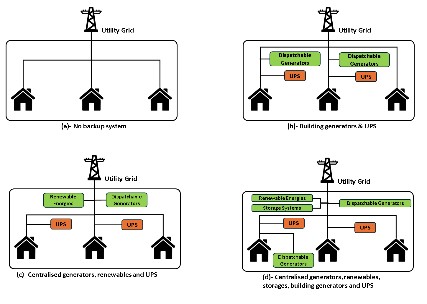
Energy system architectures consist of strategic combinations of DERs to meet the installation’s power requirements. As seen in
Figure 17, they range from configurations that rely solely on the utility grid, to those utilising multiple generation sources to achieve self-sufficient local power.[141]
Comparing the Features of Distributed Energy Resources
As summarised in Table 8, the applications of DERs can be compared by considering the following variables.[142]
- Backup power: This term stands for a backup power source that is utilised if the main power source fails to supply the equipment/devices.[143],[144],[145],[146],[147],[148],[149]
- Cost-efficient technology: Technology that is cost-efficient is defined as having lower investment costs.[150],[151],[152],[153],[154],[155]
- Standalone operation: This denotes DERs’ capacity to run autonomously without the aid of other resources.[156],[157],[158],[159],[160]
- Producing power or heat: This indicates if the device can generate electricity, heat, or both.[161],[162],[163],[164],[165]
- Power quality issues: These problems include harmonics, voltage swings, frequency changes, and interruptions that can impair the functionality of electrical devices and equipment.[166],[167],[168],[169],[170],[171]
- Fuel dependency: This indicates whether the DER requires fuel for electricity generation or if it harnesses natural sources to produce electricity.[172],[173],[174],[175]
- Noise generation: Some devices are sensitive to noise, so it is crucial to determine if the DER generates noise during electricity generation.[176],[177],[178],[179],[180],[181],[182],[183]
- Mobility: This means that the resource is portable and can be easily transported to different locations, which is particularly beneficial for military and defence missions.[184],[185],[186],[187],[188],[189],[190],[191],[192],[193]
- Thermal detectability: This indicates if DER could be detected by thermal imagers/cameras, which are extensively used for military purposes.
| DER type | Backup power | Cost-efficient technology | Stand-alone operation | Delivering heat or power | Power quality issues | Fuel dependency | Noise generation level | Mobility | Thermal detectability |
|---|---|---|---|---|---|---|---|---|---|
|
Diesel generators |
Yes | Yes | Yes | Power | Yes | Yes | High | Yes | Yes |
| Combined heat and power | Yes | Yes | Yes | Heat and power | Yes | Yes | High | Yes | Yes |
| Fuel cells | Yes | No (*) | Yes | Heat and power | No | Yes | Silent | Yes | Yes |
| Solar PV systems | No | No (*) | No | Heat and power | Yes | No | Silent | Yes | No (night), Yes (day) |
| Wind turbines | No | No (*) | No | Power | Yes | No | High | Yes | No |
| Biomass energy | Yes | No | Not applicable | Heat and power | Not applicable | Yes | Yes | Yes | Yes |
| Geothermal energy | Yes | No | Yes | Heat and power | Not applicable | No | Low | No | No |
| UPS systems | Yes | No | Yes | Power | No | No | Very low | Yes | No |
| Battery storage systems | Yes | No | Yes | Power | No | No | Very low | Yes | No |
| EVs | Yes | No (*) | Yes | Power | Yes | No | Very low | Yes | Not applicable |
* While fuel cells, PVs and wind turbines may not be the most economical power solutions, their environmental adaptation footprint significantly increases worldwide.
Evaluating the Performance and Safety of Distributed Energy Resources
In Table 9, the performance of different DERs is evaluated based on several criteria:
- Efficiency: This criterion assesses the energy conversion efficiency of each resource.[194],[195],[196],[197],[198],[199],[200],[201],[202],[203]
- Lifespan: This highlights the expected operational lifespan of each DER.[204],[205],[206],[207],[208],[209],[210],[211],[212],[213]
- Fuel type: This illustrates the type of fuel.[214],[215]
- Safety: This criterion assesses the safety aspects and risks associated with each resource fuel.[216],[217],[218]
- Environmental concern: This shows if the resource emits emissions or not.[219],[220],[221],[222],[223],[224]
| DER type |
Approx efficiency (%) |
Lifespan (year) | Fuel type | Fuel safety |
Emissions (kg/kWh) |
|
|---|---|---|---|---|---|---|
| NOX | CO2 | |||||
|
Diesel generators |
40 | 20–25 | Liquid diesel | Diesel fuel is less flammable and less explosive | 0.007711 | 0.7711 |
| Combined heat and power | 60–90 | 10–15 | Natural gas is the most widely used | Natural gas is flammable and explosive | 0.002678 | 0.43999 |
| Fuel cells | 60 | 10–20 | Hydrogen is the most widely used | Hydrogen is more flammable and explosive | Depends on its production method[225],[226] | |
| Solar PV systems | 7–24 | 30–35 | - | - | - | - |
| Wind turbines | 40–50 | 20–25 | - | - | - | - |
| Biomass energy | 25–60 | 20–30 | Biomass materials like plants and waste | Biogas is explosive | 0.000118 | - |
| Geothermal energy | 12 | 24–50 | - | - | - | 0.08165 |
| UPS systems | 92–95 | 8–15 | - | - | - | - |
| Battery storage systems | 80–95 | 5–15 | - | - | - | - |
| EVs | 70–80 | 8–12 | - | - | - | - |
Utilisation and Implementation of Distributed Energy Resources in Military Operations
Diesel generators: In its publication Standard Family of Mobile Electric Power Generating Sources, the US Department of Defense has implemented a standardised set of electrical power sources and distribution gear to supply mobile electrical power.[227]
Fuel cells: Hydrogen-based fuel cells could be deployed in several military applications, such as energy storage, hydrogen-powered drones, unmanned aerial vehicles, and missile propulsion.[228],[229],[230],[231] For example, the partnership between the US Army and General Motors led to the development of the Chevrolet Colorado ZH2, an off-road pickup truck fuelled by a hydrogen fuel cell, providing stealth and potential benefits for military use.[232] The US Army has developed hydrogen-fuelled tanks.[233] The US Army sought the creation of a hydrogen fuel cell system to power soldiers’ electronic devices, with the goal of enabling mobile battery charging and enhancing compatibility with current soldier equipment.[234] Despite the mentioned small-scale use of hydrogen systems, they have nevertheless been adopted by several US government and commercial entities; some examples are listed in Table 10.[235]
| Sites | Capacity | Application |
|---|---|---|
| Camp Parks Reserve Forces Training Area, CA | 300 kW | Provides electrical power for three years under a demonstration program to enhance energy security at the facility |
| Naval Submarine Base, Groton, CT | 2 x 300 kW | Supplies base load electricity, with byproduct heat used to preheat boiler water, increasing system efficiency |
| Pacific Missile Range Facility, Kauai, HI | 300 kW | Meets about 35 per cent of the facility’s electricity demand; the high-grade waste heat is utilised for air conditioning |
| Sysco Distribution Centres, Grand Rapids; Canton, MI | Class 3 fuel cell forklifts | Demonstration of hydrogen-powered forklifts under federal fuel cell programs at commercial distribution centres |
| Fort Jackson, SC; Los Alamitos Joint Forces Training Base, CA; Marine Corps Logistics Base Barstow, CA | 5 kW and 15 kW units | Deployed as backup power sources under federal interagency agreements; monitored for performance and lifecycle cost analysis |
| Santa Fe and Rio Rancho, NM | 20 Plug Power GenCore units | Used for backup power to support communication and computer infrastructure at New Mexico National Guard sites |
|
Multiple sites: - Aberdeen Proving Ground, MD - Fort Bragg, NC - Fort Hood, TX - Ohio National Guard - Picatinny Arsenal, NJ - Twentynine Palms, CA - West Point, NY - Cheyenne Mountain AFB, CO - NASA Ames Research Center, CA |
217 kW in total (proton exchange membrane fuel cells) |
Installed under a broad agency announcement to demonstrate fuel cell backup power systems for critical military and federal infrastructure |
Although large-scale hydrogen generation is not yet economically viable in Australia, several pilot and small-scale projects are underway. Figure 18 shows the locations of current hydrogen projects, including a scenario for hydrogen generation from renewable sources using coastal water, constrained by the existing electrical network. The project in the Gippsland Basin is a world-first initiative to demonstrate the feasibility of producing clean liquid hydrogen from brown coal in the La Trobe Valley and exporting it to Japan.[236]
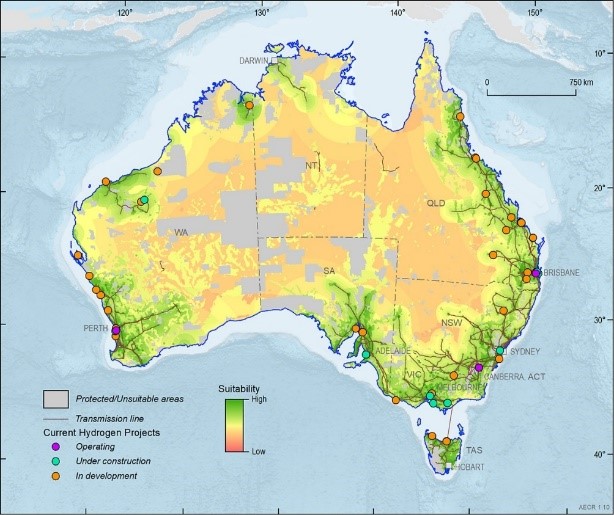
Image source: Geoscience Australia, 2021[237]
Combined heat and power: There are 39 military bases in the US which have already implemented CHP systems, providing a total capacity of 247 MW (illustrated in Figure 19).[238] US Department of Defense facilities that currently possess or previously had CHP installations are presented in Table 11 for each state.[239] Assessment of two military support facilities in Maine showed that they significantly reduced their energy and carbon emissions through the implementation of CHP systems.[240]
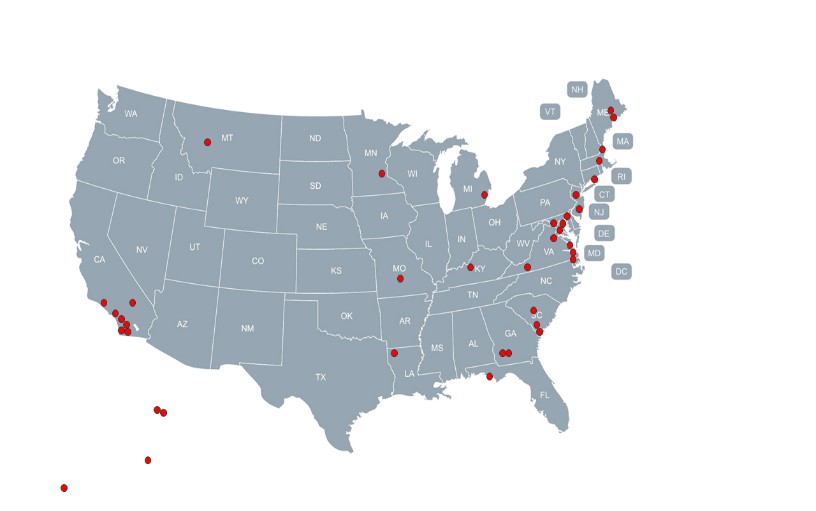
Image source: [241]
| Facility | Location | Federal agency | Technology | Capacity |
|---|---|---|---|---|
| Brooklyn Naval | Kings County, NY | Navy/Marines | Gas turbines | 315 MW |
| Argonne National Laboratory | Idaho Falls, ID | Department of Energy | Not applicable | 19.5 MW |
| Naval Medical Center | San Diego, CA | Navy/Marines | Gas turbine | 2.3 MW |
| VA Medical Center | San Diego, CA | Department of Veterans Affairs | Gas turbine | 880 kW |
| Naval Air Station, Point Mugu | Port Hueneme, CA | Navy | Gas turbine | 1.6 MW |
| Naval Air Station, Point Mugu | Port Hueneme, CA | Navy | Steam turbine | 775 kW |
| Naval Station | San Diego, CA | Navy/Marines | Steam turbine | 2.54 MW |
| Fort Dix | Burlington County, NJ | Army | Spark ignition | 30 kW |
| Naval Submarine Base | New London, CT | Navy/Marines | Combined cycle | 20 MW |
| Naval Surface Warfare Center | Indian Head, MD | Navy/Marines | Steam turbine | 10 MW |
| Naval Shipyard | Norfolk, VA | Navy/Marines | Steam turbine | 60 MW |
| Naval Training Center | Great Lakes, IL | Navy/Marines | Steam turbine | 3 MW |
| Marine Corps Base | Parris Island, CA | Navy/Marines | Steam turbine | 3 MW |
| North Island Naval Air Station | San Diego, CA | Navy/Marines | Combined cycle | 36 MW |
| Naval and Marine Corps Recruit Training Center | San Diego, CA | Navy/Marines | Combined cycle | 30 MW |
Renewable sources and battery: The US has also been a pioneer in military solar energy integration aimed at reaching the ‘Net Zero’ target. For example, a list of previous solar/wind energy integration in the military services of the US is shown in Table 12.[242]
| Installation | Land use agreement | Generating capacity (MW) | Generating technology |
|---|---|---|---|
| Department of the Army: | |||
| Fort Benning, GA | Easement | 30 | PV resource |
| Fort Bliss, TX | Access licence or permit | 1 | PV resource |
| Fort Campbell, KY | Not applicable | 2 | PV resource |
| Fort Detrick, MD | Lease | 15 | PV resource |
| Fort Huachuca, AZ | Easement | 18 | PV resource |
| Department of the Navy: | |||
| Naval Air Weapons Station China Lake, CA | Access licence or permit | 14 | PV resource |
| Navy and Marine Corps sites, HI | Access licence or permit, site occupancy agreement | 17 | PV resource |
| Marine Corps Air Ground Combat Centre Twentynine Palms, CA | Access licence or permit | 1 | PV resource |
| Marine Corps Base Camp Lejeune, NC | Lease | 17 | PV resource |
| Department of the Air Force: | |||
| Cape Cod Air Force Station, MA | Not applicable | 3 | Wind |
| Davis-Monthan Air Force Base, AZ | Lease | 16 | PV resource |
| Edwards Air Force Base, CA | Easement | 3 | PV resource |
| Luke Air Force Base, AZ | Lease | 10 | PV resource |
| Nellis Air Force Base, NV | Lease | 19 | PV resource |
In Australia, the federal government is investing $64 million in energy security to equip 10 Defence sites with solar energy generation and battery storage systems. The program aims to increase energy independence, reduce reliance on diesel fuel, and diversify energy sources. It will deliver a total of 60 MW of solar energy capacity and 25 MWh of storage capacity across the sites, enhancing energy resilience and capability while saving costs for the ADF.[243]
Geothermal energy: It holds promise in Australia, yet its feasibility faces hurdles, for three main reasons:[244],[245]
- Locating suitable geothermal reservoirs
- Extracting hot fluid from these reservoirs at a sufficient rate
- Addressing the substantial initial expenses linked with advanced geothermal system technologies and the transmission of electricity from remote areas.
Logistic Prospects for Independent Energy Systems with Army Applications
High-Level Description of Microgrids
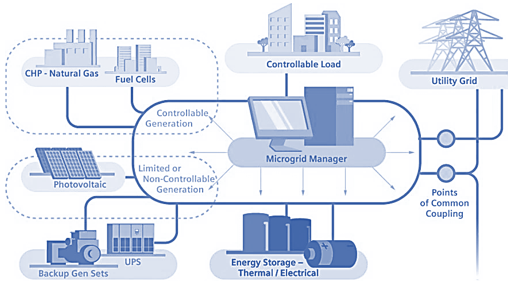
As depicted in Figure 20, a microgrid is a localised electrical system that typically incorporates a combination of power generation sources, loads, and storage devices, all managed from a central control point. The microgrid operator serves as this central controller, optimising and coordinating power generation and controllable loads to maintain autonomous operation. This set-up allows microgrids to disconnect from the main electrical grid (utility electrical power) and function independently, a process known as islanding.[246]
Generally, microgrids have five principal parts:
- Distributed energy resources, such as generators and storage units
- Power consumption points, known as loads
- A connection/disconnection interface with the main power grid
- Control systems for managing microgrid operations
- Protection systems to ensure safety.
The key characteristics of microgrids include:
- the ability to autonomously restart the microgrid after a total outage or blackout (islanding mode)
- the capacity to handle large power surges when specific loads are activated, necessitating a significant burst of power
- the ability to maintain voltage and frequency within standard limits.
Comparison of Standalone Generators and Microgrids
Figure 21 illustrates the operation of standalone generators and microgrids on the infrastructure of utility grids.[247] A detailed comparison between these systems is presented in Table 13.[248],[249]
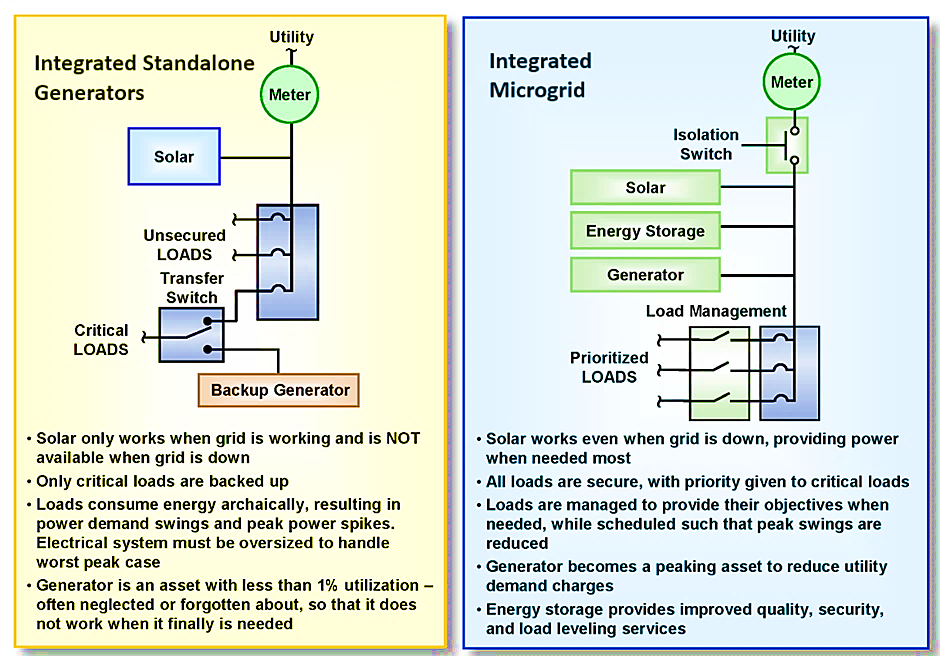
Image source: Marqusee, Schultz and Robyn[250]
| Criteria | Standalone generator | Microgrid |
|---|---|---|
| Capacity | Capacity must be oversized, typically at twice the peak demand, which often results in reduced efficiency in practice | By integrating various resources, is optimally sized and benefits from fluctuating peak power demands |
| Maintenance | High operational and maintenance costs; insufficient testing; numerous generators on large bases often suffer from inadequate maintenance | Easier and more cost-effective to maintain; relies on a few large, standardised and centralised generation units |
| Dependability | Often unreliable due to poor maintenance and testing; achieving reliability is uncommon and costly | Highly reliable configurations; cost-effective due to a networked structure |
| Adaptability | Cannot adapt to changing requirements; specifications are fixed at procurement | Can adapt to changing electricity demands, even during outages, without extra costs |
| Service scope | Provides a binary solution for loads (either critical or non-critical), with limited flexibility | Can serve any connected load with excess generation capacity; supports intermediate loads |
| Sustainability and security | Traditional fossil fuel based generators are commonly used, resulting in substantial emissions | By integrating various storage systems, can incorporate diverse renewable energy sources, thereby reducing overall emissions |
| Islanded mode | Capable of black starting and functioning in islanded mode, but only serves loads connected to the transfer switch | Can independently start and operate in islanded mode, delivering power over extended periods |
| Utility grid integration | Does not operate in parallel with the grid; standby systems can only disconnect loads from the grid | Operates in sync with the grid, allowing for full output utilisation and financial compensation for excess energy |
Configuration of AC and DC Military Microgrids
Microgrids can be classified as either DC or AC systems, and they can differ greatly depending on their energy sources, loads and converters. The characteristics of the ideal military microgrid depend entirely on its specific application and geographical location. However, an advanced military microgrid should encompass the following elements:[251]
- Eliminate the need for fuel resupply
- Include a diverse array of power generation sources
- Feature extensive energy storage capabilities
- Offer or absorb high power levels on demand
- Incorporate resilient distribution systems while maintaining mobility.
Considering an example of a battalion command post is a helpful way to elaborate on how conventional systems can transition to AC and DC microgrids. Figure 22 illustrates a traditional battalion command post schematic that relies solely on a single-direction AC diesel generator, lacking battery storage and renewable energy sources. This configuration is prone to failure, as any issue with the diesel generator can incapacitate the entire system. Conversely, Figure 23 presents an enhanced AC microgrid set-up featuring a PV resource and energy storage systems. This improved configuration maintains the core function of a battalion command post and is prepared for the future integration of directed energy weapons (DEWs) and electric combat vehicles (ECVs), as shown by the dashed lines.
While an enhanced AC microgrid could serve as a blueprint for power systems supporting ECVs and DEWs, modern US Army command posts also require DC power for their dense array of computers and communication equipment. In this regard, current AC-to-DC and DC-to-AC conversions are about 90 per cent efficient, while DC-to-DC conversions reach around 95 per cent efficiency. Other factors are also driving defence and army initiatives towards adopting DC-based power networks. To begin with, the substantial power demands of DEWs and ECVs make a DC-based distribution system more cost-effective. Besides, conversion from AC to DC and vice versa generates harmonics due to the switching characteristics of power electronic devices, which have destructive impacts on defence and military equipment.[252] It is also notable that the US Army typically uses a 24 V DC standard for most equipment, but this low voltage is not suitable for long-distance power transmission within command posts.
Given the complexity of military demands, one solution could involve a 250 V DC distribution and generation system, stepped down to 24 V at the point of use via DC-DC conversion. This higher voltage ensures efficient transmission while maintaining safety and facilitating rapid connections. Future devices, including ECV chargers, could also employ DC-DC converters to achieve the necessary voltages. The schematic for this proposed enhanced DC microgrid is depicted in Figure 24.
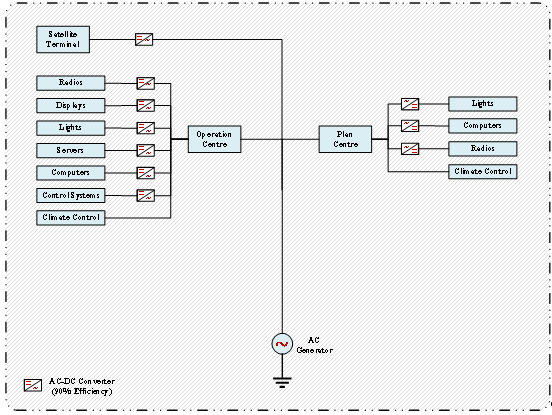
Image source: Barry and Santoso[253]
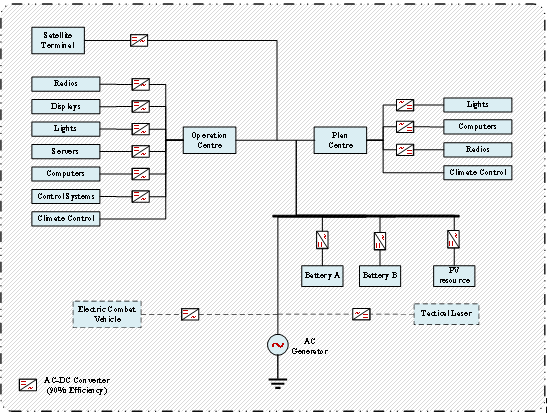
Image source: Barry and Santoso[254]
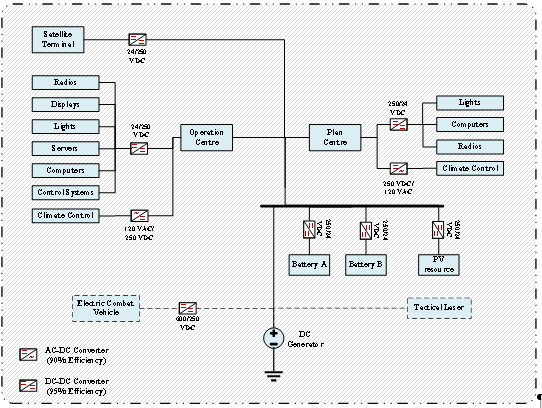
Image source: Barry and Santoso[255]
Comparison between AC and DC Microgrids
Each AC or DC microgrid presents distinct advantages and limitations depending on the application.[256],[257],[258],[259] These are summarised in Table 14.
| Type | Benefits | Limitations | Applications |
|---|---|---|---|
| AC microgrids |
· AC generators are very efficient. · Easily connected to existing grid infrastructure and can be operated in grid-connected mode or independently · Compatible with AC-based equipment and resources (suitable for systems where AC power is standard) · No need for inverters for AC loads · Cost-effective in terms of power protection · Support a higher availability of AC loads · Lower initial costs with no need for retrofitting · Less prone to short-circuit and ground faults
|
· Lower efficiency in power conversion · High cost for converters (e.g., DC-AC) · Controlling issues due to frequency and voltage regulation · Reliability may be lower because of their complexity, affecting performance-critical equipment · Less efficient in power transmission compared to DC systems · Power quality issues arise due to power conversion processes · Less efficient when integrating renewable energy sources like PV arrays · May require centralised control, creating a potential single point of failure |
· Best suited for applications requiring substantial power and reliability, such as industrial facilities and hospitals · Effective for general use cases like lighting, household appliances and commercial and residential applications · Suitable for non-mission-critical environments and general power distribution purposes |
| DC microgrids |
· More efficient power conversion, ideal for high-performance equipment · Lower cost for converter systems · Better transmission efficiency with no reactive power losses · Reliable power supply, even in remote areas · Reduced cabling needs due to high voltage at low current · Simplified control without complex requirements for synchronisation or reactive power management leading to power quality issues · High efficiency in power conversion, especially with PV arrays and energy storage systems. · Improved energy resilience due to smoother power transition · Better suited for integration with renewable energy sources |
· Less mature power protection systems, posing risks · Higher up-front costs · Limited market familiarity and less compatibility with AC loads. · Potential for voltage drops in large systems without reactive power · More complex and costly to retrofit from AC to DC conversion · DC generators are less efficient than AC, and rectifiers may be required · High up-front costs for retrofitting and infrastructure · More prone to short-circuit and ground faults, requiring additional safety measures · Decentralised control systems can result in more independent failure points |
· Ideal for applications like critical infrastructure in the military (servers, communication devices) and remote or DC power needs · Effective for rural electrification, telecom installations, and data centres · Support integration with energy storage solutions and EVs · Suited for spacecraft power systems · Facilitate renewable energy integration in isolated or off-grid areas |
Design and Operation Criteria for Military Microgrids
This section identifies the key factors in designing military microgrids.[260]
Guidelines for Designing Microgrids within Power System Infrastructure
Defining a microgrid boundary requires a customised approach, considering factors such as the location of critical assets, the proximity and capacity of DERs, and the layout of the local distribution network. Table 15 summarises a straightforward process for selecting a portion of the power system that can be configured as a microgrid.[261]
| Step | Guideline for defining microgrid boundaries |
|---|---|
| 1. Identify essential power assets and their locations | Ensure the microgrid area covers all vital assets, taking into account their physical location and power demand |
| 2. Evaluate local DERs | Design the microgrid with local DERs for critical loads, and expand or add new units if needed during outages |
| 3. Select an isolatable feeder section | The microgrid boundary should include essential assets, DERs, and a feeder that can disconnect from the main grid during outages. Additional switches may be needed for effective islanding |
Design Criteria for Microgrids Focused on Robustness, Resilience and Security Needs
The design of a microgrid is shaped by the system’s need for robustness, resilience and security.[262]
- Robustness refers to the system’s ability to continue operating under disruptions or uncertain conditions.
- Resilience describes the system’s ability to recover quickly from failures or disturbances.
- Security is the system’s capacity to remain intact following outages or equipment failures.
Table 16 summarises key microgrid design criteria intended to enhance robustness, resilience and security according to the specified technical and operational requirements.
| Requirement | Suggested design criteria |
|---|---|
| Enhancing system robustness | · Implement alternative power feeds to enable selected loads to receive energy from multiple utilities |
| Enhancing system resilience | · Deploy intelligent switches and the required communication technologies to facilitate automatic restoration from alternate power sources |
| Enhancing power system security |
· Integrate DERs, including renewable energy and energy storage, to power critical assets during grid outages · Determine the type and capacity of DERs based on the size and needs of mission-critical assets · Install load-shedding mechanisms to disconnect non-essential loads during emergencies when supply is limited · Set up a microgrid master controller and communication technology to manage and coordinate all microgrid components |
Selecting the Types and Sizes of Distributed Energy Resources Based on the Needs of Mission-Critical Facilities
The selection of a system will be influenced by the nature of the mission-critical facilities. In this regard, Table 17 provides an overview of suggested design criteria for determining the appropriate types and sizes of DERs in accordance with the requirements of these essential facilities.[263]
| Type of critical load | Recommendations for DER types and sizes |
|---|---|
| Mission-critical facilities requiring uninterrupted operation |
|
| Mission-critical facilities with tolerable brief interruptions |
|
Potential Criteria for Prioritising Load Shedding in Microgrids
In many microgrids, the selected capacity of DERs is typically only enough to meet the demands of critical loads. As a result, it may be necessary to reduce or disconnect certain non-essential loads. Table 18 outlines the procedures for prioritising loads within a microgrid.[264]
| Procedures for load prioritisation | Anticipated outcomes |
|---|---|
| 1. Carry out a comprehensive inventory of loads (i.e., identifying building functions and their kW capacities) within the defined microgrid area |
|
| 2. Assess and rank the loads based on their building functions |
|
Describing the Strategies for Microgrid Operations in Grid-Connected and Islanded Modes
Table 19 outlines the suggested operational strategies for microgrids in both grid-connected and islanded states, including the procedures for transitioning between these modes.[265],[266],[267]
| Operation mode | Strategies for microgrid operation |
|---|---|
| Grid-connected mode |
|
| Transition to islanded mode |
|
| Islanded mode |
|
| Reconnection/ resynchronisation mode |
|
Key Standards and Necessary Criteria for the Design and Operation of Microgrids
Table 20 outlines the necessary criteria and standards for assessing the design and operational capability of a microgrid, focusing on its ability to function in an islanded mode by detailing required system studies, essential data collection from site assessments, and key standards for effective microgrid development.[268],[269],[270],[271],[272],[273],[274]
| Criteria/standards | Details/description |
|---|---|
| System studies needed for islanded functionality |
· To evaluate if the designed microgrid (including its boundary, DER specifications, and load prioritisation/shedding strategies) can operate in islanded mode, the following system studies are required: § Load-flow analysis § Short-circuit analysis § Protection coordination analysis § Transient stability analysis |
| Data collection from site assessments |
· Load inventory: Information on the size, function and location of all loads · Internal generation inventory: Details on the location, size, type, characteristics, fuel sources, and black-start capabilities of internal generators · Distribution circuit component inventory: Specifications for distribution line length, characteristics, capacitor banks, voltage regulation devices, protection mechanisms, and transformers · Operating parameters: Acceptable values for frequency, voltage, phase imbalance, and harmonic distortions · Protection devices and their settings: Parameters for overcurrent, short circuits, and other faults to protect the system from damage |
| Key standards for microgrid development |
· AS/NZS 61000.2.2:2003 (identical adoption of IEC 61000-2-2:2002): Standard for permissible levels of frequency in low-voltage power supply systems · AS/NZS 4777.1:2016: Standard for grid connection of energy systems via inverters, Part 1 · AS/NZS 4777.2:2020: Standard for grid connection of energy systems via inverters, Part 2 · AS/NZS 60255.127:2025: Standard for measuring relays and protection equipment: functional requirements for over/under voltage protection · AS/NZS IEC 60904.1:2023: Standard for photovoltaic devices, Part 1: Measurement of photovoltaic current-voltage characteristics · AS/NZS IEC 60331.2:2021: Standard for testing electric cables under fire conditions · AS/NZS IEC 60947.4.2:2015: Standard for low-voltage switchgear and controlgear, Part 4.2: Contactors and motor-starters—AC semiconductor motor controllers and starters · ANSI/NEMA MG 1-2006: Standard for motors and generators · IEEE Std 399™-1997: Recommended practices for industrial and commercial power systems analysis (known as the IEEE Brown Book™) · IEEE Std 446™: Recommended practices for emergency and standby power systems for industrial and commercial uses (the IEEE Orange Book™) · IEEE Std 519™: Recommended practices and requirements for harmonic control in electrical power systems · IEEE Std 1100™: Recommended practices for powering and grounding electronic equipment (the IEEE Emerald Book™) · IEEE Std 1547™-2003: Standard for connecting distributed resources to electric power systems · IEEE Std 1547.2™: Application guide for the integration of distributed resources with electric power systems · IEEE Std 1547.3™-2007: Guide for monitoring, information exchange, and control of distributed resources connected to electric power systems · IEEE Std 1547.4™-2011: Guide for the design, operation, and integration of distributed resource island systems with electric power systems |
Identifying Key Challenges and Priorities for Advancing Military Microgrid Technologies
Current military microgrids encounter issues such as voltage fluctuations, system instability, and reduced reliability due to aging systems and insufficient updates with new technologies. Table 21 and Table 22 offer an overview of capability categories, essential enabling technologies, and insights into specific identified limitations.[275]
| Functional part | Sub-functional part | Facilitating technology | Statement/challenge | Plan |
|---|---|---|---|---|
| Demand management | Plug-level | Information networking (e.g., wire mesh, programmable logic controller) | Essential for creating a dynamic, reconfigurable and self-healing microgrid, which means this technology facilitates point-to-point communication without the need for physical data cables. | Long term |
| DER management | Legacy generators | Advanced controls (prognostic and diagnostic) | The integration of real-time prognostic and diagnostic systems significantly enhances microgrid control, but leveraging modelling and simulation for cost-benefit analysis is vital to fully determine the actual advantages of prognostic and diagnostic technology. | Long term |
| Decreased human involvement | Self-operated control capability | This technology empowers microgrid control systems to automatically respond to equipment malfunctions by employing pre-programmed contingencies and sequencing protocols. | Short term | |
| Communication systems | Peer to peer | Rapid send-receive methods | Modelling and simulation are required to develop strategies for managing the growing volume of data in low-bandwidth settings. Developing effective protocols and techniques to mitigate latency challenges is essential. | Short term |
| Ad hoc reconfiguration | Recovery from communication failures | These are technologies that allow microgrids to maintain operations during communication disruptions. They should efficiently handle and prioritise essential data to ensure timely coordination of resources. | Short term | |
| Demand management | Distribution sides | Energy storage systems | Widespread energy storage systems are essential for integrating renewable energy sources into the microgrid effectively. | Long term |
| Functional part | Sub-functional part | Facilitating technology | Challenge/suggestion | Plan |
|---|---|---|---|---|
| Power distribution | Managing transients | Frequency / renewable integration | The existing modelling and simulation are directed towards renewable energy source integration for static utility grids, while neglecting to assess their impact on reconfigurable networks. | Short term |
| Communications | Peer to peer | Integration and security of mobile devices | A significant number of mobile devices and nodes connecting to a microgrid via a mesh network could overwhelm the system, necessitating a strategy for communication security. | Long term |
| Ad hoc reconfiguration | Reliability in lost communication | There is a need for research to enhance the reliability of reconfigurable information networks in dynamic environments. | Long term | |
| Ad hoc reconfiguration | Mesh networking | The configuration of the microgrid network can significantly influence data transmission, including challenges related to frequency, signal length, and electromagnetic fields. Modelling and simulation will help identify resilient technological solutions. | Long term | |
| Smart controls | Components | Component metadata | Utilising metadata could provide solutions for simplifying intricate challenges in reconfigurable networks. | Short term |
| Power distribution | Storage facilities | Vehicle-to-grid technology | To explore tactical applications, it is essential to invest in modelling and simulation to comprehend the dynamic interactions between various DERs (EVs, batteries etc.). | Long term |
| Managing transients | Fault identification and isolation | While many utilities have modelled these for power distribution, tactical grids generally function under low-voltage, high-current conditions, making it challenging to apply high-voltage utility electrical power models effectively. | Short term |
Implemented Military Microgrid Configurations
The examples of microgrid configurations presented below identify which DERs are used in their development and illustrate the layouts of implemented microgrids.
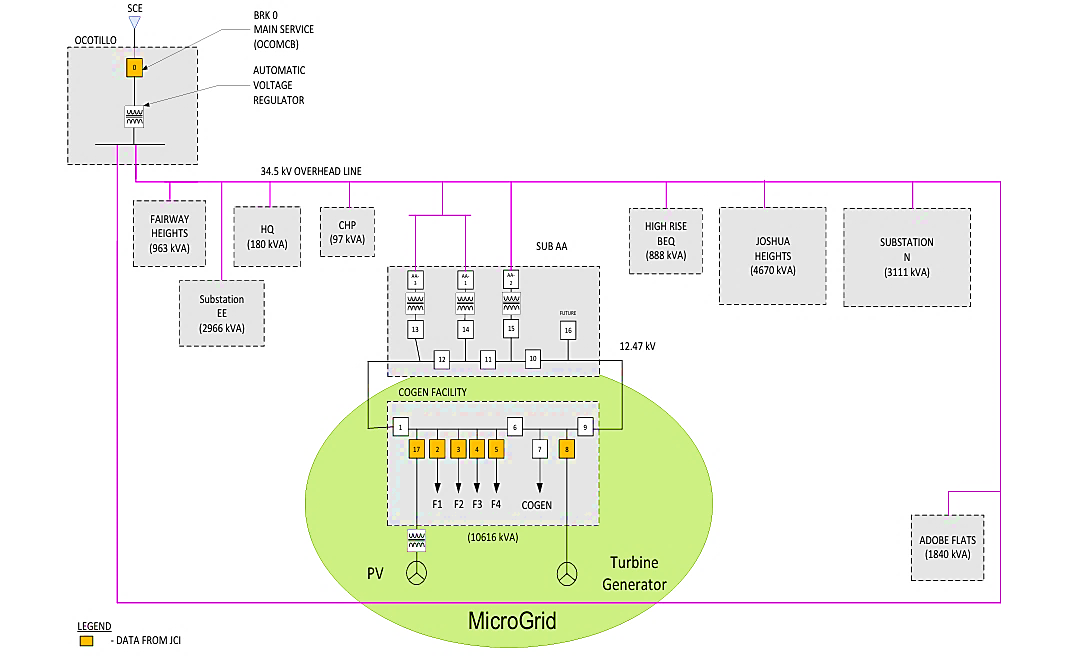
Image Source: Alexandria VA: Environmental Security Technology Certification Program, 2013[276]
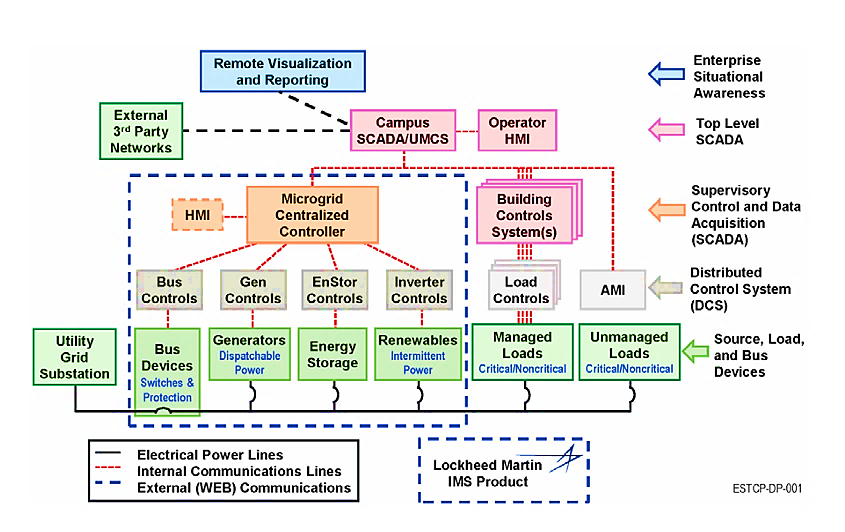
Image Source: Alexandria VA: Environmental Security Technology Certification Program, 2014[277]
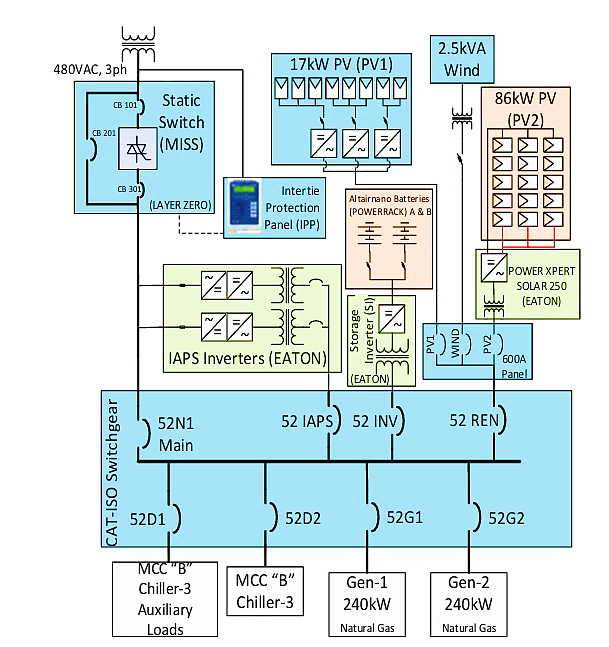
Image Source: Menomonee Falls WI: Eaton Corporation, 2015[278]
Geographical Distribution of Microgrids
Figure 28 indicates that the US is a leading pioneer in deployment of microgrids, which are located in many of its states.[279] Figure 29 illustrates that many remote regions in Australia, which are located far from the central power grids, rely on off-grid microgrids for their electricity needs.[280] In Brazil, many microgrids are predominantly powered by diesel generators (shown in Figure 30). The available microgrid demonstrations in China are illustrated in Figure 31.[281] Remote areas in Canada are not connected to the North American grid,[282] so these parts are supplied by fossil fuels, as shown in Figure 32. Europe deploys different resources to supply the load demands, as shown in Figure 33.[283] These figures focus on the geographical distribution of microgrids in general, whereas Figure 34 specifically illustrates the geographical distribution of military-based microgrids in the US.[284]
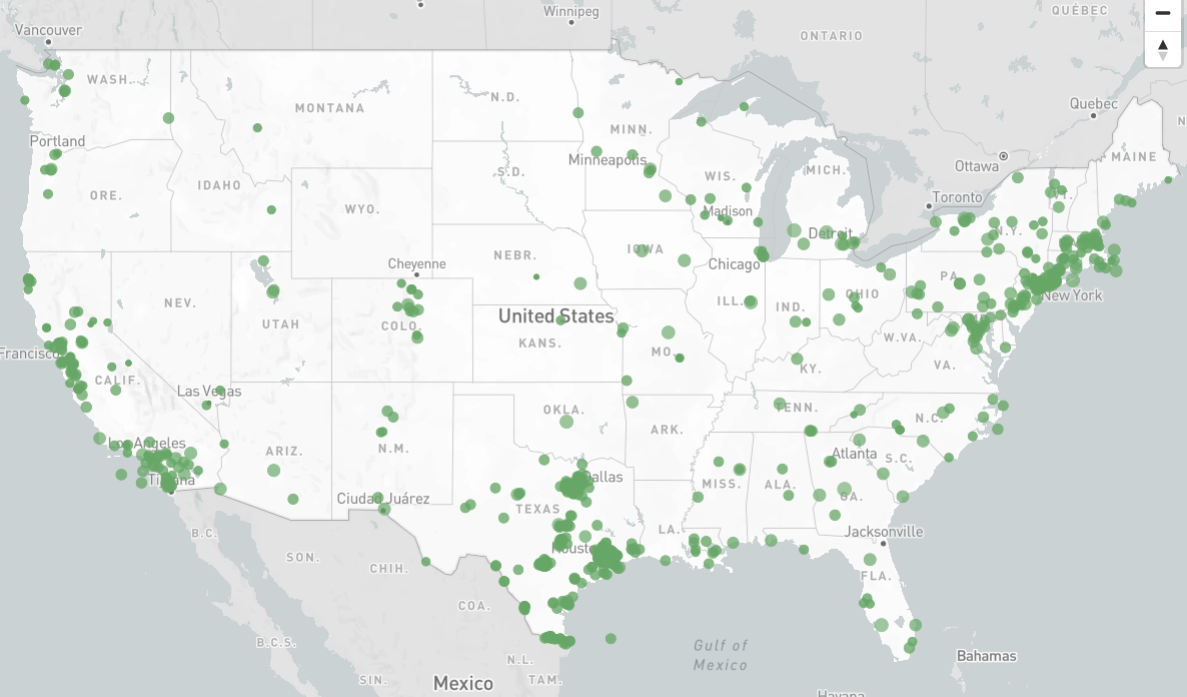
Image Source: [285]
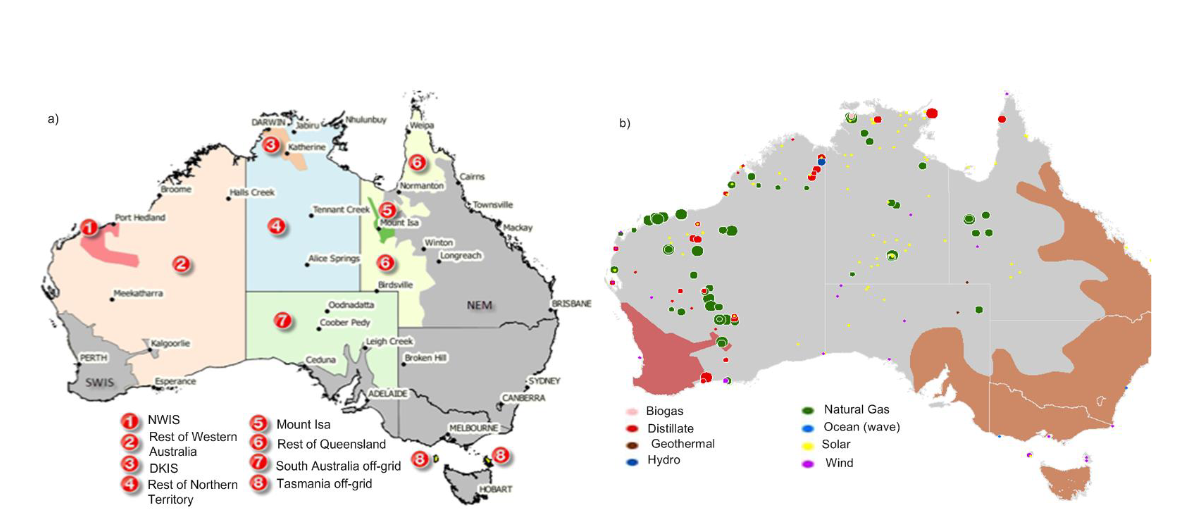
Image Source: [286]
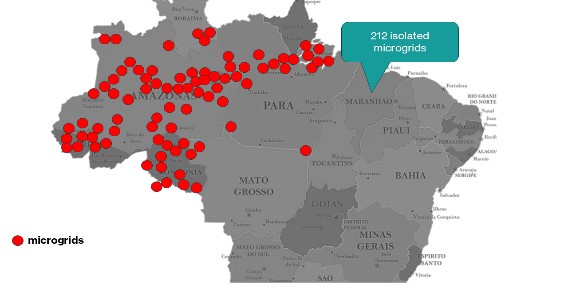
Image Source: [287]
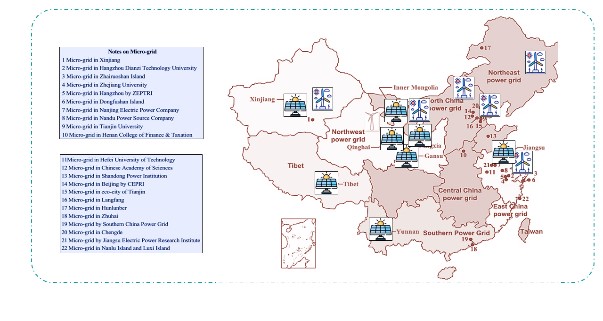
Image Source: [288]
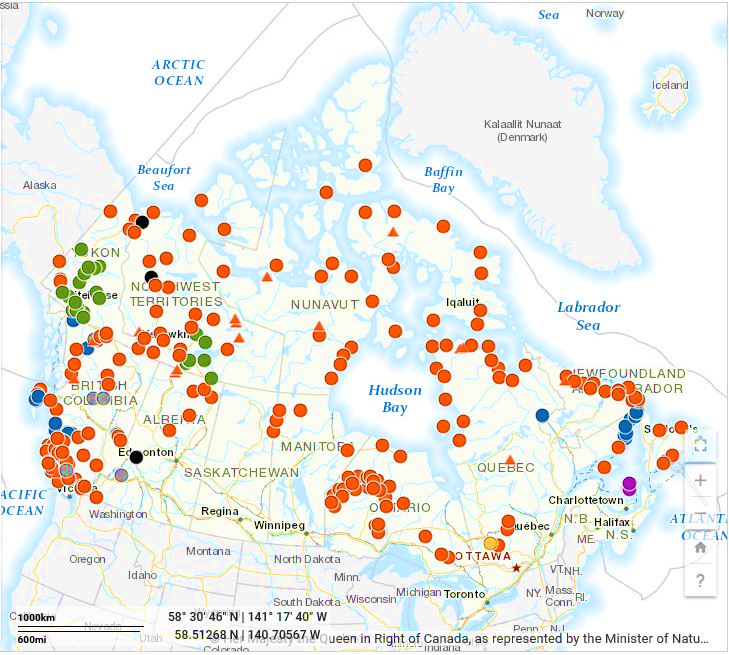
Image Source: [289]
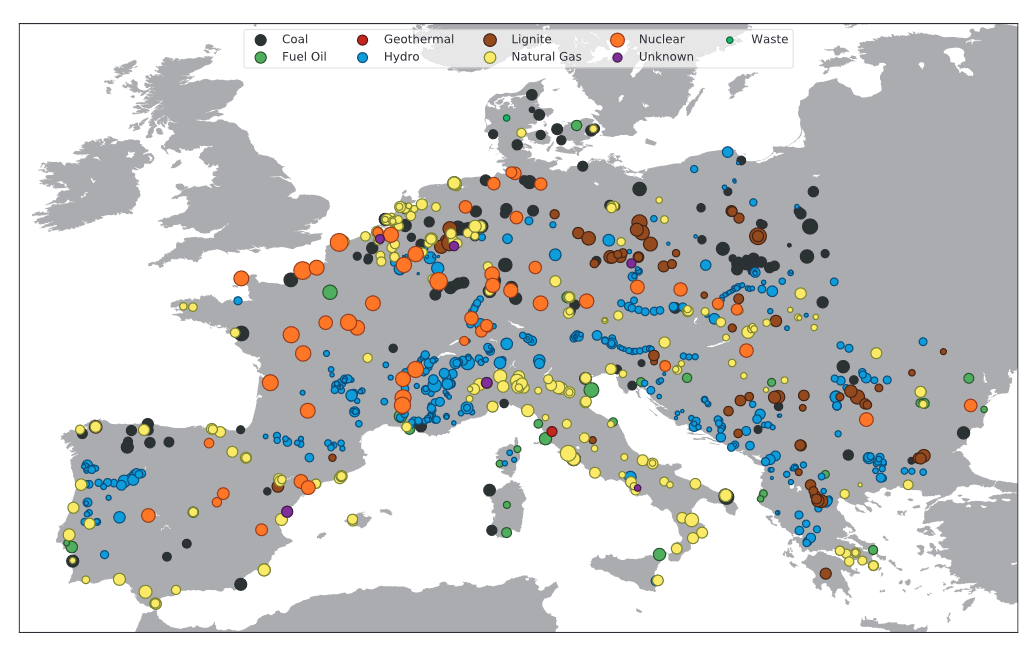
Image Source: [290]
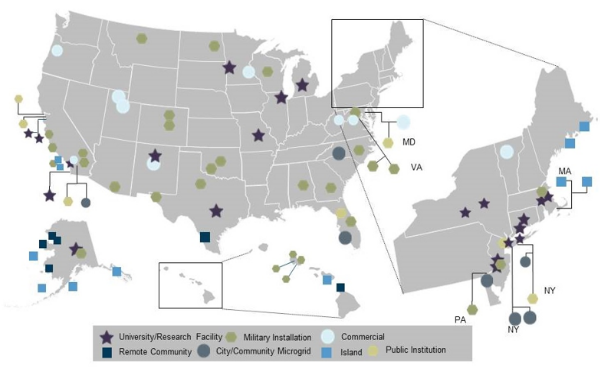
Image Source: [291]
Risk and Vulnerability Assessment of Independent Energy Systems
Cyber-Physical Description of Smart Microgrids
To interface DERs, microgrids heavily depend on power electronics converters—energy storage, EVs etc. In these systems, physical and electrical components are closely integrated and interconnected through information and communication technologies. Their functionality is intricately linked to the operation of cyber systems, elaborated as follows.[292]
Figure 35 depicts a typical power electronics intensive microgrid that showcases these cyber-physical interactions. In this scenario, the cyber-physical framework of a smart microgrid is organised into four primary layers: the physical power system layer, the sensor and actuator layer, the communication layer, and the management and control layer.
- Physical layer: It includes essential power components such as transformers, generators, power electronics converters, circuit breakers, and loads.
- Sensor and actuator layers: These feature devices that monitor system states such as voltage, frequency, current and circuit breaker status, alongside control mechanisms that implement decisions made in the management layer, which encompass generator controllers, distributed generation controllers, and circuit breaker relays.
- Communication layer: It facilitates the exchange of information among the various layers through devices such as routers, switches and communication mediums, which can be either wired or wireless, depending on system needs.
- Management layer: It serves as the central control unit, coordinating the microgrid’s operations under different conditions. It processes data from the sensor and actuator layer via the communication layer and generates control signals for optimal performance, which are then sent to the actuators.
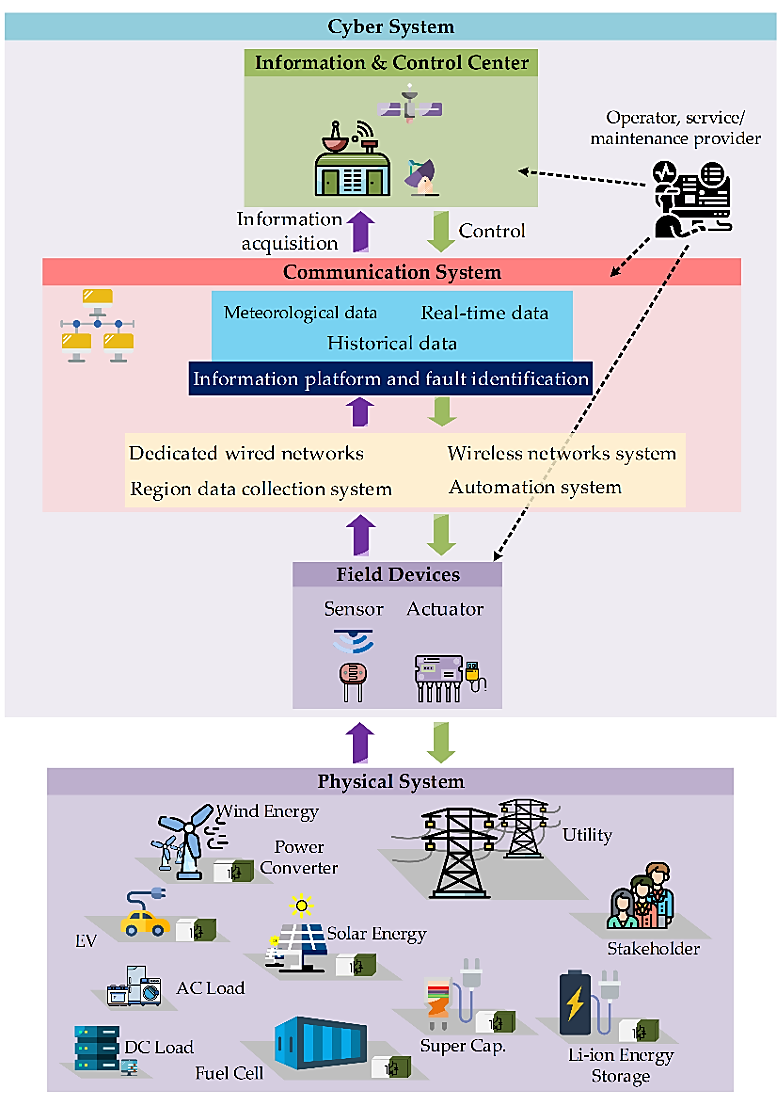
Image source: [293]
Targets of Cyber Attacks on Smart Microgrids
Cyber attacks are deliberate attempts to disrupt, damage or gain unauthorised access to digital systems, and they pose a growing threat to smart microgrids.[294] These attacks can affect all layers of the cyber-physical framework by corrupting control logic in the management layer, intercepting or jamming signals in the communication layer, and sending false data through sensors. This section lists the components of microgrids that are most targeted by cyber attacks.
Targeting State Estimation
State estimation is vital for monitoring smart microgrids, involving the analysis of bus voltage and phase angles from measurements. Cyber attacks aim to disrupt this process by manipulating sensor data, leading to inaccuracies in state variables. Accurate state estimation supports microgrid management, including contingency assessments, load forecasting, and optimal power dispatch. Any false data injection (FDI) attacks that affect state estimation can cause significant disruptions in microgrid operations.[295],[296],[297]
Targeting Voltage of Microgrids
Voltage regulation in smart microgrids is controlled via power electronics linked to distributed and conventional generators. These systems monitor voltage and reactive power, allowing the control system to adjust reactive power references. Transformer tap changers can also regulate voltage. FDI attacks that manipulate sensor readings or control parameters can disrupt voltage regulation. Additionally, attackers may access the microgrid’s control system, altering signals and introducing errors into power reference signals for generators and transformer tap changers.[298],[299],[300],[301]
Targeting Frequency of Microgrids
Attacks on microgrid frequency, referred to as attacks on transient stability,[302],[303] involve manipulating control signals, sensor measurements or power source outputs, which can disrupt frequency stability. Microgrid frequency control is particularly sensitive to variations in active power, frequency measurements and reference signals. Typically, frequency regulation is achieved using rotating machines, so attacks on rotor speed or angle measurements can affect stability. Energy storage systems are increasingly used to improve transient stability,[304] and securing their measurement and control signals is essential to maintaining stable operations.
Targeting Protection Systems of Microgrids
One of the primary challenges confronting microgrids is the design of protection systems that operate reliably in both grid-connected and islanded modes. Relay settings must be appropriately adjusted based on the operational mode to ensure responsive protection against current levels. Adaptive protection strategies that comply with the IEC 61850 communication standard are frequently utilised, necessitating a secure, fast and reliable communication network.[305] However, any communication link failures or FDI cyber attacks can severely compromise the performance of these protection systems, potentially leading to catastrophic outcomes for microgrids.[306]
Strategic Priorities for Advancing Cyber Security Research and Development in Military Microgrids
A comprehensive review of cyber security research and development is crucial to pinpoint critical areas that demand intensified focus. Progress in the prioritised areas outlined in Table 23 is fundamental to advancing cyber security.[307]
| Research area | Description | Required research |
|---|---|---|
| Authentication mechanisms | Developing secure, scalable authentication methods for devices and users within microgrids to ensure proper access control and data integrity |
· Infrastructure for secure, distributed identity management across microgrid components · Management of certificates and revocation for microgrid assets · Integrating biometric and physical token authentication for operators and service personnel · Separating authentication from identification to enhance privacy and prevent unauthorised access in decentralised grid environments |
| Securing core internet protocols | Enhancing the security of communication protocols used in microgrid networks to prevent attacks such as spoofing, data corruption or denial of service |
· Security solutions for communication protocols within microgrid systems (e.g., SCADA, IoT protocols) · Secure communication for distributed energy resources and control systems · Balancing trade-offs between performance (e.g., latency) and security in energy systems |
| Software security engineering | Addressing gaps in software development practices specific to microgrid systems, ensuring resilience and reliable operation |
· Security-focused programming for control software in microgrids · Secure, adaptable software for diverse microgrid environments (e.g., rural, urban) · Tools for defining and verifying security requirements in microgrid control systems · Verification and validation of control software for secure operation during faults or attacks |
| Integrated system security | Securing the interconnected systems that make up microgrids, ensuring they are resilient to attacks or failures |
· Securely integrating renewable energy sources, storage systems and backup power into microgrid control networks · Proactive vulnerability reduction strategies for microgrid systems · Security for systems operated under adversarial conditions (e.g., grid manipulation or cyber attacks) · Handling insider threats from operators or maintenance personnel · User-centred security interfaces for grid operators |
| Network monitoring and incident detection | Real-time monitoring and detection systems to ensure microgrid resilience against cyber threats |
· Dynamic defence mechanisms in microgrids that adjust based on detected threats or attacks · Real-time intrusion detection systems for microgrid communication networks · Ensuring security policies are adhered to in grid operations and monitoring · Improved behavioural models for anomaly detection in energy usage and control systems |
| Rapid response and system recovery | Developing methods for microgrids to quickly detect disruptions and recover from cyber incidents, ensuring system continuity |
· Automated detection of energy outages, cyber attacks or malfunctions in microgrid operations · Architectures for fast recovery of microgrid functions after a cyber attack or failure · Simplified, automated recovery systems to reduce human error during system restoration · Fault-tolerant designs to ensure that critical grid functions continue during incidents |
| Cyber forensics and crime deterrence | Building tools for tracing cyber attacks and improving forensics within microgrid environments to track threats |
· Tracing the origin of cyber attacks on microgrid systems · Identifying cyber attackers based on behavioural patterns in energy management systems · Evidence collection and analysis within distributed microgrid networks · Improving forensics tools for energy theft or malicious tampering with grid data |
| Modelling and testing new cyber technologies | Simulating and testing cyber security measures within microgrid environments to improve resilience and effectiveness |
· Creating simulation environments for testing cyber security in microgrids, including interactions with the main grid · Validation of security systems and protocols in large-scale microgrid simulations · Data collection for improving threat models specific to microgrid architectures · Creation of confidential testbeds for validating cyber defences in microgrids |
| Security standards and best practices | Establishing cyber security standards and best practices tailored for microgrid systems |
· Development of security benchmarks and metrics for evaluating microgrid cyber security · Risk analysis and economic impact evaluations of potential cyber attacks on microgrid operations · Tools for assessing compliance with microgrid-specific security standards · Documentation of best practices for securing microgrid configurations and operations |
| Human and societal cyber security factors | Exploring human and societal factors that affect the cyber security of microgrids |
· Raising awareness about cyber security risks and best practices for microgrid operators · Addressing privacy concerns related to the data collected by microgrids and their integration with smart grid systems · Studying human factors in energy management software and interactions within microgrid environments · Analysing how societal perceptions of energy security impact the adoption of secure microgrid technologies · Understanding legal and regulatory concerns surrounding the cyber security of decentralised energy systems |
Examples of Real-World Cyber Attacks on Energy Infrastructure
Table 24 presents some examples of cyber attacks conducted against energy infrastructure around the world.[308],[309],[310] As can be seen, Australia is among the countries to have experienced significant cyber incidents within the energy sector in recent years.[311],[312],[313]
| Location | Incident description | Impact |
|---|---|---|
| Washington State, US | Four substations near Tacoma were targeted to cut power for burglary | Significant power disruption |
| Moore County, NC, US | Intruders breached gates and opened fire on two substations | Outage affecting nearly 50,000 people |
| Clackamas County, OR, US | Two intruders cut the fencing and shot at the equipment, causing significant damage to the substation | Significant equipment damage |
| Maryland, US | Authorities foiled a conspiracy to attack multiple substations around Baltimore | Intended to create chaos and unrest |
| Ohio, US | An extremist plot to attack power infrastructure was blocked | Prevented potential attacks |
| San Jose, CA, US | A man detonated explosives at two transformers, cutting power for thousands. Additional explosives were found at his home | Power disruption for thousands; potential for more damage |
| Ukraine (2015) | Remote hackers compromised Ukrainian energy grid operators, seizing control of substations | Power outage affecting 225,000 customers for several hours |
| Ukraine (2016) | Hackers deployed malicious code targeting a Kiev transmission station | Major blackout in the capital lasting over an hour |
| United Kingdom | Leaked reports indicated that hackers may have infiltrated Britain’s energy grid | Potential exposure of critical infrastructure to cyber attacks |
| Sweden | Cyber attack on the Swedish transport network caused delays | Significant disruption to train schedules and travel services |
| Australia | The company of CS Energy was disrupted in 2021 by an attack on the company’s IT systems by the Conti ransomware group | Disruptions to the production of electricity, affecting the safety of Australia’s vital infrastructure |
| Australia | A breach at Energy Australia resulted in the exposure of hundreds of its customers’ personal information | Weaknesses in the cyber security of the energy industry jeopardised client data |
Strategic Exploration of Supply Chain Resilience: Challenges and Alternatives
Supply Chains and Critical Products within the Defence Sector Landscape
In Australia, major global defence corporations, known as ‘primes’, manage complex supply chains for government, while small and medium-sized enterprises have also developed their own capabilities within the industry.[314] Supply chains are not just a simple flow of goods but are characterised by three key interdependent flows: material flows (movement of goods), capital flows (commercial relationships), and knowledge flows (intellectual property and expertise transfer). These flows create long-term, institutionalised relationships among nations and firms. Modern supply chains should be viewed as complex webs rather than linear sequences, with interconnected nodes and overlapping connections, as shown in
Figure 36. Criticality plays a pivotal role in the resilience of global supply chains. Supply chains with critical nodes, such as diamond or hourglass structures, are less adaptable to disruptions, whereas branching models without critical nodes offer more flexibility. These critical nodes are often hidden from downstream users, as seen in Figure 37, which depicts the global battery production supply chain. China dominates key midstream components, even though the upstream and downstream stages involve a diverse range of suppliers.
Defence supply chains are particularly complex due to several factors:
- High economic importance for national security
- Increased concentration due to strict design and security requirements
- Reliance on imports by smaller nations
- Intellectual property needs for long-term relationships
- Geopolitical risks that disrupt the flow of critical components
- Longer supply chains with advanced technology requiring multiple tiers.
These unique challenges make defence supply chains more prone to risk and require tailored risk management strategies beyond standard commercial practices.
Branching supply chains: This supply chain model, sourcing inputs from multiple suppliers, is competitive and resilient, as it reduces dependency on any single participant, thereby lowering vulnerability at critical points. |
Diamond supply chains: In this supply chain model, downstream users rely on various suppliers, each depending on a single upstream source. This concentration creates a critical node at the upstream level, making it a vulnerability for the entire chain. |
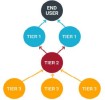
Hourglass supply chains: In this supply chain model, numerous downstream users and upstream suppliers are involved, yet the system is heavily reliant on a single pivotal player at the midstream stage. This concentration of control at the midstream creates a critical node, making both ends of the value chain dependent on its smooth operation. |
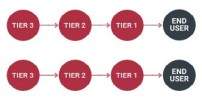
Linear supply chains: In this supply chain model, each downstream user oversees its own network of midstream and upstream suppliers, with every link acting as a critical node. This structure is the least resilient, making it rare and typically limited to highly specialised products where such intricate control is necessary. |
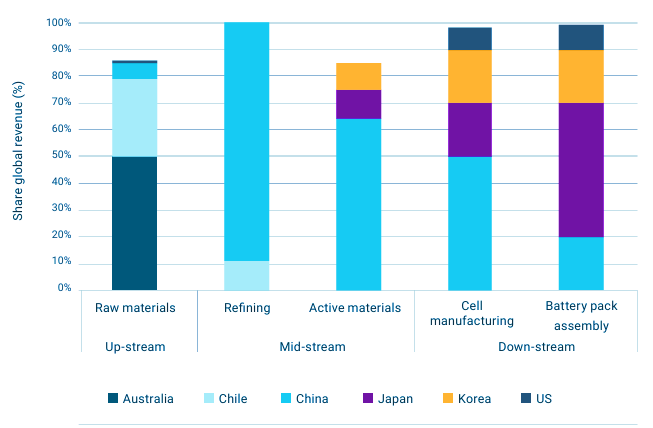
Identifying and Addressing Supply Chain Vulnerabilities in the Defence Sector
Mapping a supply chain’s framework is an essential initial step in pinpointing potential risks, particularly when attempting to identify crucial nodes that could lead to disruptions. The next phase of supply chain vulnerability involves assessing the probability that these risks will result in actual interruptions. Various factors can trigger such disruptions, and these can be divided into two broad categories: traditional and strategic supply chain risks.[315]
Traditional supply chain risks have long been present and affect industries universally. These include:
- Economic risks: Abrupt changes in demand or technological innovations that create short-term shortages of vital products. A recent example is the global semiconductor shortage in 2021, which led to production halts in the automotive industry and contributed to a worldwide shortage of cars.
- Infrastructure and connectivity risks: Delays in logistics, customs clearance, or transportation that disrupt the flow of goods. Examples include the six-day blockage of the Suez Canal in 2021, ongoing congestion at US ports, and COVID-19-related disruptions at key Chinese ports.
- Natural disaster risks: Events such as fires, floods, droughts and pandemics that interfere with normal business activities. The COVID-19 pandemic and natural disasters in Taiwan and Japan, which exacerbated the semiconductor shortage, are prime examples.
- Societal conflict risks: These include large-scale protests, civil unrest, and industrial strikes, often affecting resource-based industries. For instance, civil unrest in Kazakhstan disrupted oil and uranium supplies, while labour strikes at Fremantle Ports in Western Australia threatened the building sector.
These risks are recurring and inherent in the global economy, and businesses typically manage them with established practices such as inventory control and supplier diversification. Though significant, these risks are not unique to the defence sector and affect all industries. They tend to be random events that companies must be prepared to address when they arise.
On the other hand, strategic supply chain risks have emerged more recently and are particularly relevant to the defence industry. These risks arise from shifts in the broader geopolitical landscape. They include:
- Geopolitical intervention risks: Government actions that deliberately disrupt supply chains for political or strategic reasons, such as trade sanctions or embargoes—for example, China’s sanctions in response to diplomatic tensions with Australia or the US’s security-related restrictions on Chinese tech firms.
- Geopolitical demand risks: These risks arise when geopolitical events swiftly alter supply chain demands, such as the exclusion of specific suppliers due to political conflicts or a sudden surge in demand for defence goods during times of geopolitical instability.
- Security risks to intangible assets: These risks encompass cyber attacks, intellectual property theft, and breaches of sensitive information, targeting the flow of knowledge within the supply chain rather than physical goods.
Strategic risks differ from traditional risks because they are intentional, politically driven, and often designed to undermine the integrity of the supply chain. While these risks exist in all industries, they are particularly concerning for defence-related sectors, which are primary targets for politically motivated attacks. Additionally, strategic risks are becoming more prevalent due to growing digitalisation and intensifying global tensions.
To manage these risks, companies in global industries typically implement a range of supply chain management strategies, which can generally be divided into two categories:
- Efficiency-driven models, which focus on minimising costs and maximising speed to stay competitive. Examples include offshoring and ‘just-in-time’ (JIT) strategies.
- Resilience-oriented models, which prioritise flexibility and risk management, often at the expense of efficiency. This includes strategies like ‘just-in-case’ (JIC), where companies maintain larger inventories to buffer against disruptions.
These strategies are not mutually exclusive but lie on a spectrum. Companies select their approach based on the likelihood and impact of potential risks. In industries where disruptions are rare and their consequences are minimal, efficiency-oriented strategies like JIT are favoured. However, in sectors facing more frequent or severe risks, resilience-focused strategies are preferred.
When companies seek to strengthen resilience in their supply chains, they can implement various risk mitigation strategies, each with different costs and effectiveness:
- Strategic inventories: Keeping additional stock to manage temporary disruptions. This is cost-effective for risks that resolve quickly but may not be suitable for products with limited shelf life or low demand.
- Supplier diversification: Broadening the supplier network to reduce dependency on any one source, ideally across different regions to mitigate risks associated with national-level disruptions.
- Friend-shoring: Collaborating with trusted partners who are less likely to introduce supply risks, either at a national or a corporate level. This strategy is useful when critical nodes cannot be removed from the supply chain but reliable partners can help secure them.
- Onshoring/in-housing: For essential supply chain components, companies may opt to produce goods domestically or within their organisation to minimise reliance on external suppliers. Although resource intensive, this strategy ensures greater control over critical elements.
Supply Chain Characteristics of the Energy Sector
As shown in Figure 38, energy and technology supply chains encompass the processes required to deliver energy services or technologies to the market. Energy supply chains focus on the steps needed to supply fuels or energy services, including generation, transformation, transportation and distribution, often involving trade. Technology supply chains involve the stages necessary to create and deploy technologies, such as extracting minerals, processing materials, manufacturing components, and managing equipment through its lifecycle, including reuse or recycling. These supply chains are interdependent, as energy production relies on technologies, and technology development requires energy at every stage.[316]
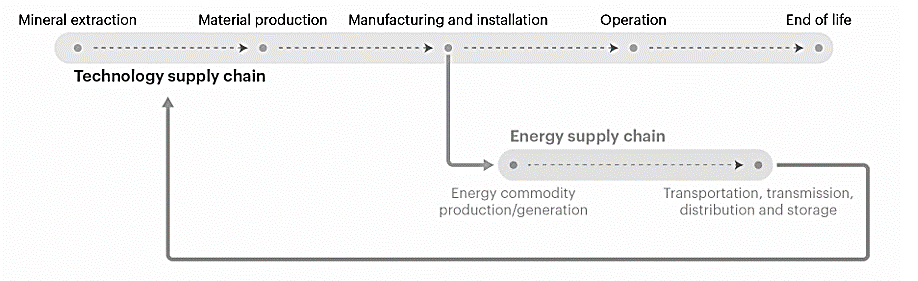
Image source: International Energy Agency, 2023[317]
It is important to recognise that each type of equipment within the energy and technology sectors has its own distinct supply chain, which spans across the initial mining of raw materials to the final production of the product. This process is clearly illustrated in Figure 39, Figure 40, Figure 41, Figure 42 and Figure 43, which demonstrate the individual supply chains for various technologies, including low-emission electricity, low-emission hydrogen, battery EVs, heat pumps, and fuel cell trucks. Each of these technologies involves unique processes and stages of development, ranging from the extraction and processing of specific minerals required for manufacturing to the assembly of components and, finally, to the installation and operation of the finished equipment. Additionally, these supply chains are often interconnected, with materials, technologies and services being transferred between different sectors, underscoring the complexity and interdependence of modern energy and technology systems.[318]
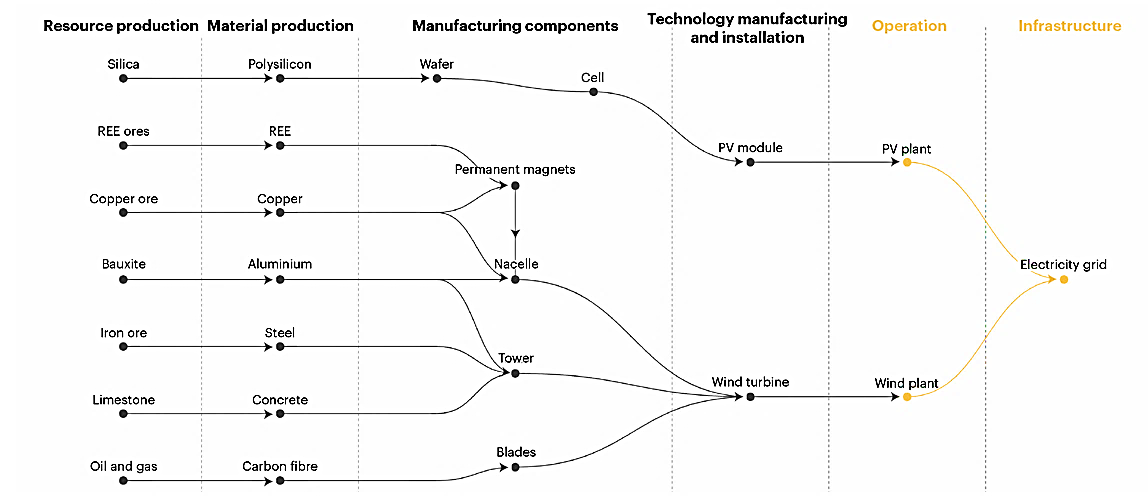
Image source: International Energy Agency, 2023[319]
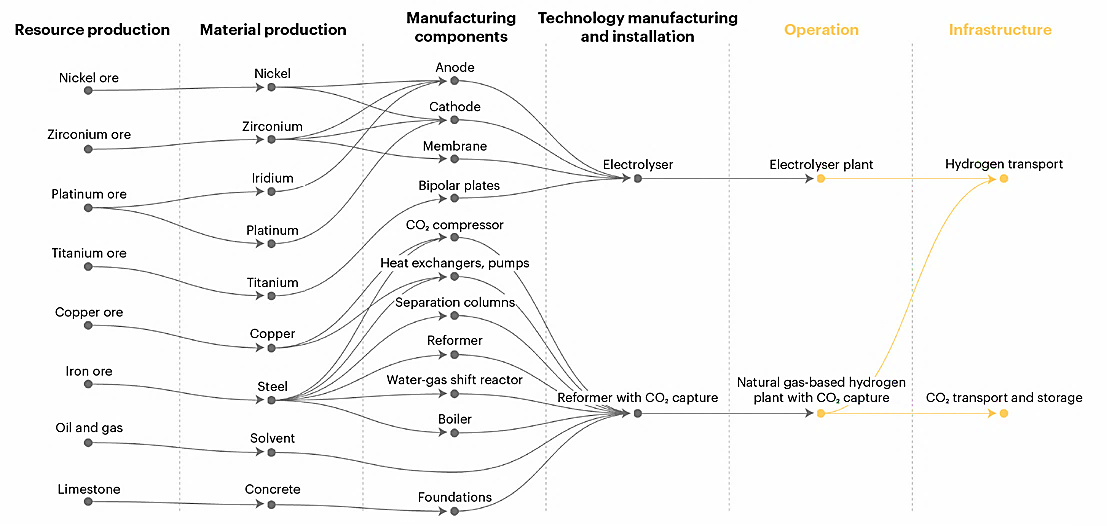
Image source: International Energy Agency, 2023[320]
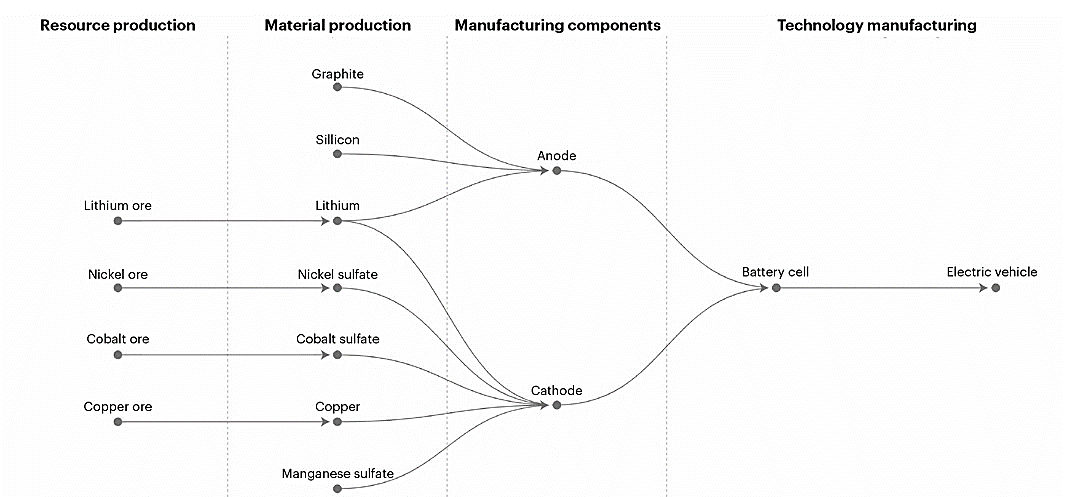
Image source: International Energy Agency, 2023[321]
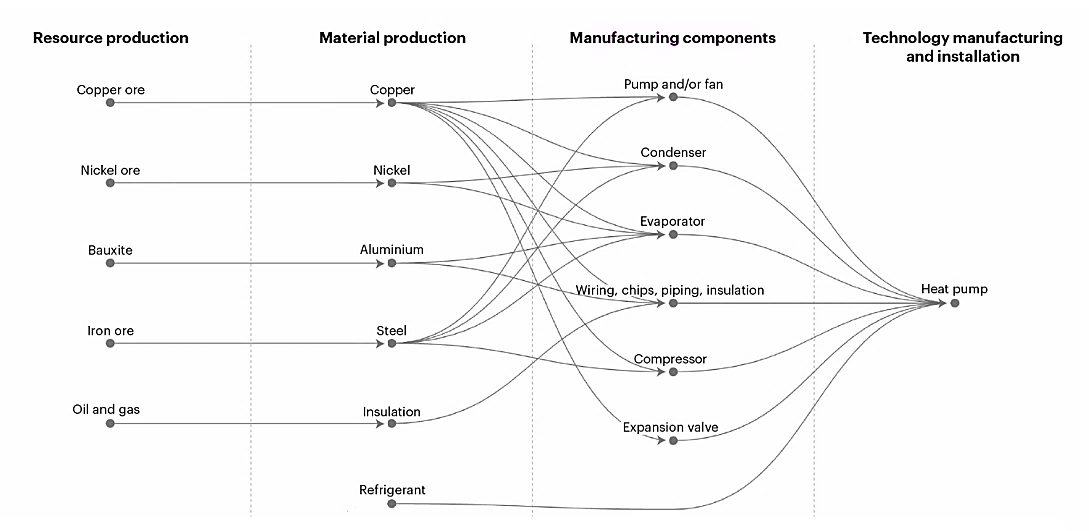
Image source: International Energy Agency, 2023[322]
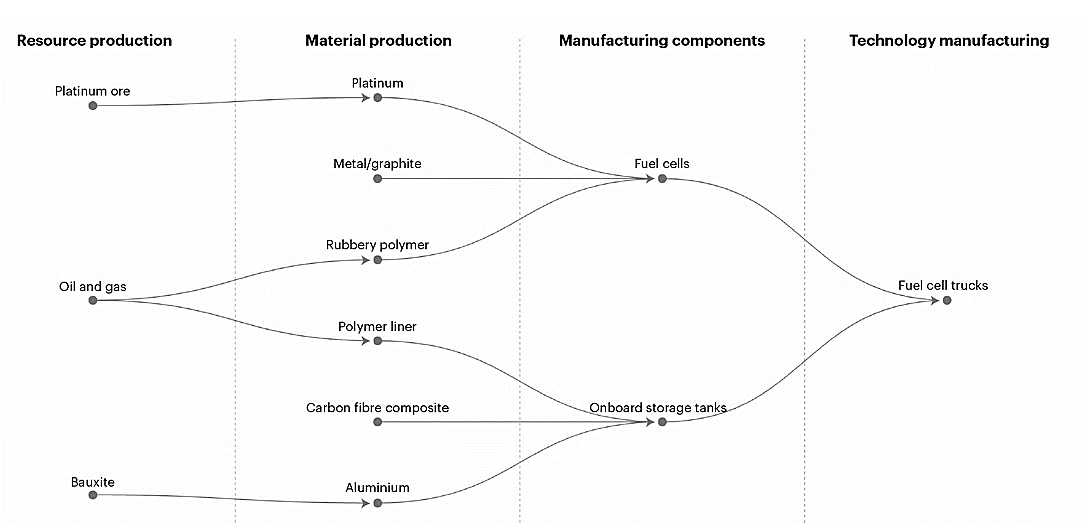
Image source: International Energy Agency, 2023[323]
Regional Capacity for Mineral Resources and Technology Manufacturing in the Supply Chain
Mining and Material Production
Table 25 provides an overview of regional mining capacities and material reserves. It reveals key global players in resource availability, with some regions holding more significant reserves and mining capabilities than others. From this, it can be seen that the Asia-Pacific region and Central and South America have the largest shares of mining capacities and reserves.
| Region | Copper | Nickel | Cobalt | Lithium | Rare earth elements | |||||
|---|---|---|---|---|---|---|---|---|---|---|
| Reserve | Mined | Reserve | Mined | Reserve | Mined | Reserve | Mined | Reserve | Mined | |
| World (kt) | 880,000 | 21,000 | 95,000 | 2,700 | 7,600 | 150 | 22,000 | 100 | 120,000 | 290 |
| China | 3% | 8% | 3% | 4% | 1% | 1% | 7% | 12% | 35% | 57% |
| Europe | 4% | 5% | 0% | 3% | 0% | 1% | 0% | 0% | 1% | 0% |
| North America | 13% | 12% | 2% | 5% | 4% | 3% | 3% | 1% | 2% | 16% |
| Other Asia-Pacific | 13% | 11% | 49% | 66% | 30% | 13% | 36% | 56% | 26% | 24% |
| Central and South America | 32% | 41% | 17% | 10% | 7% | 3% | 42% | 29% | 17% | 0% |
| Africa | 6% | 13% | 0% | 4% | 48% | 76% | 1% | 2% | 1% | 1% |
| Eurasia | 9% | 9% | 8% | 7% | 3% | 2% | 0% | 0% | 17% | 1% |
| Others | 21% | 2% | 21% | 0% | 8% | 0% | 12% | 0% | 0% | 0% |
Table 26 outlines the regional production capacities for critical materials. It shows the extent to which different regions can produce essential materials needed for various industries—copper, lithium and so on. From this, China stands out as the leading country in the production of critical materials.
| Region | Copper | Nickel |
Nickel sulphate |
Cobalt |
Cobalt sulphate |
Lithium |
Lithium chemicals |
Neodymium oxide |
|---|---|---|---|---|---|---|---|---|
| World (kt) | 22,5000 | 2,790 | 228 | 137 | 119 | 95 | 150 | 39 |
| China | 34% | 29% | 56% | 69% | 70% | 59% | 59% | 90% |
| Europe | 11% | 0% | 11% | 16% | 16% | 0% | 0% | 0% |
| North America | 7% | 4% | 0% | 4% | 4% | 1% | 1% | 0% |
| Other Asia-Pacific | 16% | 41% | 17% | 5% | 5% | 3% | 3% | 0% |
| Central and South America | 14% | 0% | 0% | 0% | 0% | 37% | 37% | 0% |
| Africa | 8% | 0% | 0% | 4% | 4% | 0% | 0% | 0% |
| Eurasia | 7% | 4% | 0% | 1% | 1% | 0% | 0% | 0% |
| Others | 2% | 21% | 16% | 0% | 0% | 0% | 0% | 10% |
Table 27 outlines the production capacity of electrolysers across various countries. China holds the top position as the largest producer, followed by Europe, which has made significant investments in green hydrogen and renewable energy. North America and other Asia-Pacific countries also contribute to production, but on a smaller scale compared to China and Europe. This highlights China’s leading role in the electrolyser market, while Europe and North America are working to scale up their production to support the increasing demand for green hydrogen technologies.
| Region | Electrolyser |
|---|---|
| World (GW) | 11 |
| China | 41% |
| Europe | 26% |
| North America | 19% |
| Other Asia-Pacific | 14% |
| Others | 0% |
Table 28 provides an overview of the production capacity for wind turbine components across different countries. China is the dominant player in manufacturing these components, taking the lead in global production. Europe and North America follow with significant but smaller capacities compared to China.
| Region | Tower | Nacelle | Blade | |||
|---|---|---|---|---|---|---|
| Onshore | Offshore | Onshore | Offshore | Onshore | Offshore | |
| World (GW) | 88 | 18 | 100 | 26 | 98 | 25 |
| China | 55% | 53% | 62% | 73% | 61% | 83% |
| Europe | 16% | 41% | 13% | 26% | 18% | 12% |
| North America | 11% | 0% | 10% | 0% | 10% | 0% |
| Other Asia-Pacific | 12% | 6% | 8% | 2% | 6% | 4% |
| Central and South America | 5% | 0% | 6% | 0% | 4% | 0% |
| Others | 1% | 0% | 0% | 0% | 0% | 0% |
The production capacity of different countries for PV components is shown in
Table 29. From this, China stands out as the leader in PV component development, while other countries lack specific production capacities, making them negligible in comparison.
| Region | Wafers | Cells | Modules | |||
|---|---|---|---|---|---|---|
| Production | Capacity | Production | Capacity | Production | Capacity | |
| World | 190 | 370 | 190 | 41 | 190 | 460 |
| China | 96% | 96% | 78% | 85% | 73% | 75% |
| Europe | 0% | 1% | 1% | 1% | 2% | 3% |
| North America | 0% | 0% | 1% | 1% | 5% | 2% |
| Other Asia-Pacific | 3% | 3% | 18% | 13% | 19% | 18% |
| Others | 1% | 0% | 2% | 0% | 1% | 2% |
As listed in Table 30, the primary challenge in securing battery supplies for the Australian Department of Defence is China’s dominance in the global battery supply chain. China leads in the production of key materials and components—anodes, cathodes and so on. Even domestically produced materials often rely on Chinese-produced precursors, creating vulnerabilities in the supply chain. With electrification set to increase significantly by 2030, reliance on China is expected to grow.[329]
| Region | Cathode | Anode | Batteries | Production of electric cars | |||
|---|---|---|---|---|---|---|---|
| Production | Capacity | Production | Capacity | Production | Capacity | ||
| World | 440 kt | 1,400 kt | 250 kt | 810 kt | 340 GWh | 910 GWh | 6,800,000 |
| China | 77% | 68% | 91% | 86% | 66% | 75% | 54% |
| Europe | 1% | 1% | 0% | 0% | 21% | 8% | 27% |
| North America | 16% | 1% | 2% | 1% | 11% | 6% | 10% |
| Other Asia-Pacific | 5% | 26% | 7% | 13% | 2% | 10% | 7% |
| Others | 1% | 4% | 0% | 0% | 0% | 1% | 2% |
Regional capacity and production capabilities are crucial factors in the manufacturing of heat pumps. As shown in Table 31, China has the highest production capacity for these components, followed by North America and Europe in second and third places, respectively.
| Region | Heat pumps | |
|---|---|---|
| Production | Capacity | |
| World (GW) | 100 | 120 |
| China | 38% | 39% |
| Europe | 16% | 16% |
| North America | 29% | 29% |
| Other Asia-Pacific | 13% | 14% |
| Others | 4% | 2% |
Regional capacity and production capabilities are crucial factors in the manufacturing of fuel cell heavy-duty truck components. As shown in .
Table 32, China holds the highest production capacity for these components.
| Region | Fuel cell systems | Fuel cell trucks | |
|---|---|---|---|
| Production | Production | Capacity | |
| World | 19 GW | 900 | 14,000 |
| China | 48% | 84% | 45% |
| Europe | 1% | 9% | 21% |
| North America | 4% | 0% | 18% |
| Other Asia-Pacific | 38% | 6% | 14% |
| Others | 8% | 1% | 2% |
Production Lead Times for Mass-Manufacturing Facilities
Achieving mass production of equipment in the energy sector requires significant lead time due to the complexity of the technologies, production scaling, and the integration of advanced systems. Table 33 illustrates the time required to lead the production of various types of essential equipment in the energy sector.
| Technology | Years | |
|---|---|---|
| Solar PV | Polysilicon | 1–3.5 |
| Wafers | 0.5–2 | |
| Solar cells | 0.5–2 | |
| Solar modules | 0.5–2 | |
| Wind turbine | Blade | 1–2 |
| Tower | 1.5–2.5 | |
| Nacelle | 1.5–2 | |
| Electrolysers | 2–3 | |
| EVs | Anode | 2–5 |
| Cathode | 2–5 | |
| Battery | 0.5–4.5 | |
| Heat pumps | 1–3 | |
| Fuel cell trucks | Fuel cell stacks | 1.5–2.5 |
| Fuel cell trucks | 0.5–1.5 | |
Roadmap for Australian Defence Transition to Mixed Energy Sources
Figure 44 shows an energy transition roadmap outlining the ADF’s approach to adopting alternative energy in line with industry and allied military practices while addressing the unique needs of military operations.[334] In the short term, renewable diesel, sustainable aviation fuel and electrification are prioritised, while hydrogen, uranium and further electrification are considered long-term alternatives for specific platforms. Although Defence will ultimately reduce its reliance on fossil fuels, it is expected that these fuels will remain in the energy mix (either in reduced amounts or blended with alternative fuels) beyond 2050. The transition roadmap should be reviewed periodically, every one to two years, to adjust for technological advancements, market changes, and shifts in government policy.
The energy roadmap emphasises the use of drop-in liquid fuels, such as renewable diesel and sustainable aviation fuel, which have similar chemical properties to conventional fossil fuels and do not significantly impact defence platforms or infrastructure. Electrification and hydrogen are also suitable for certain platforms but will not fully replace liquid fuels, due to limitations in range, survivability and infrastructure needs. Besides, some alternative energy types, like alcohols, ammonia and hydrogen, present unique challenges for defence, including lower energy density, reduced range, larger storage requirements, and potential impacts on platform durability and safety.
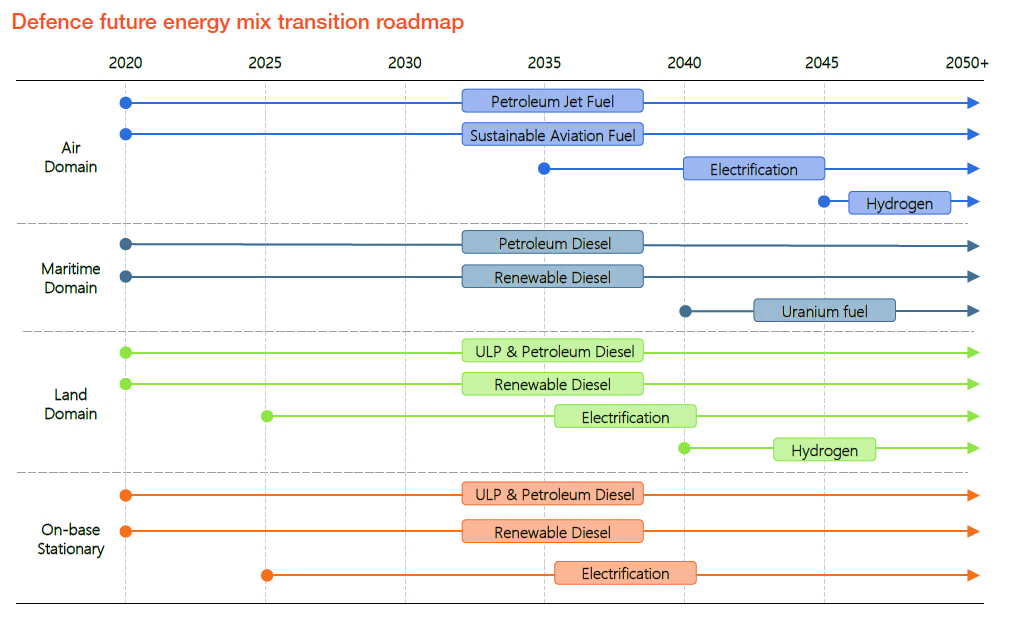
Image source: Australian Government Department of Defence, 2023[335]
Future Energy Demand and Emissions Reduction in the Australian Defence Sector
Defence’s annual fossil fuel requirements are projected to increase to 487 ML by 2050. However, with a shift towards alternative energy, demand profiles will become more complex due to varying energy densities of different fuels and the use of technologies like batteries. Under a balanced adoption scenario (shown in Figure 45), most fossil fuel demand could be displaced by alternative energy by 2045, or even as early as 2040 with a more ambitious approach. This transition will not only enhance Defence’s energy security but also help meet the government’s carbon emissions reduction targets. If Defence follows this transition program, emissions could decrease by 86 to 99 per cent by 2050, with a 92 per cent reduction under the balanced scenario. Some emissions may remain due to the use of some alternative technologies, especially batteries. While renewable fuels may incur higher costs in the short to medium term, price reductions are expected from the mid-2040s due to industry scaling and rising crude oil prices. A faster transition will encourage industry investment, leading to more significant cost savings in the long term. However, this excludes operational and infrastructure costs.[336]
Image source: Australian Government Department of Defence, 2023[337]
Australian Defence Fuel Supply Chain Activities
The energy transition and changes in the ADF’s energy needs will significantly affect the defence fuel supply chain. The defence fuel supply chain includes all activities, resources, technologies and organisations involved in the procurement, storage, management and distribution of fuel for the ADF. The commander of joint logistics is responsible for the safe, efficient and integrated operation of the defence fuel supply chain to meet the ADF’s needs while ensuring optimal value for money.[338] As the ADF begins to transition towards adopting lower-carbon alternatives, the supply chain shown in Figure 46 needs to be followed precisely.
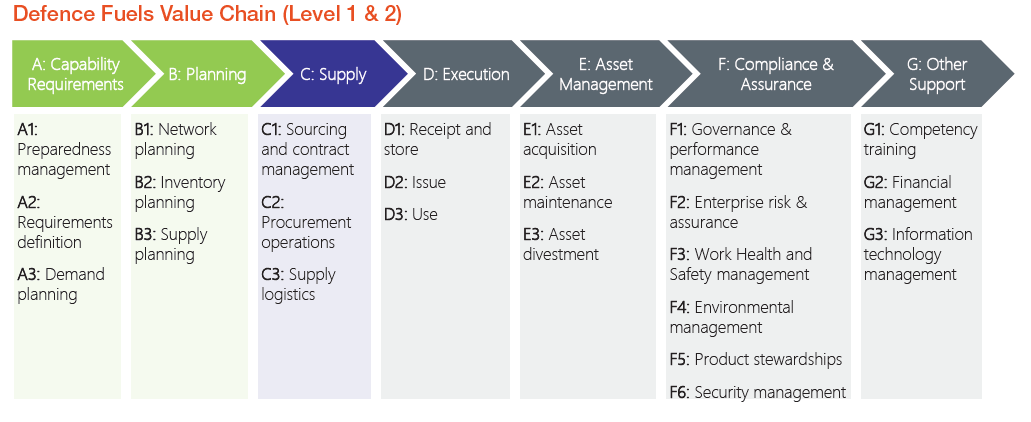
Image source: Australian Government Department of Defence, 2023[339]
Suggested Measures for Enhancing the Supply Chain in Australia
Based on the analysis presented in this paper, Australia is vulnerable in its energy supply chain; therefore, several alternatives are proposed in Table 34 to strengthen the Australian energy sector.
| Vulnerability area | Risk description | Recommended action | Rationale/impact |
|---|---|---|---|
| Fuel import dependency | · Heavy reliance on overseas sources for liquid fuel supply | · Establish strategic fuel reserves; diversify sources and routes | · Enhances national resilience in case of global supply disruptions or access limitations |
| Extended supply chains for defence operations | · Energy supplies for remote or deployed operations depend on long and fragile logistics chains | · Deploy hybrid energy systems (solar + battery + diesel) at operational sites | · Increases autonomy and reduces reliance on vulnerable resupply networks |
| Limited domestic processing and manufacturing | · Key parts of the energy supply chain, such as refining or tech manufacturing, are concentrated outside the country | · Invest in local production and modular processing technologies | · Improves national control over critical energy components and reduces external exposure |
| Centralised energy infrastructure | · Central power systems are exposed to disruptions from physical, natural or digital threats | · Harden infrastructure; deploy microgrids at critical facilities | · Builds resilience and maintains operational continuity under adverse conditions |
| Uneven adoption of resilient technologies | · Modern distributed energy technologies are not yet widely deployed in all sectors | · Accelerate deployment of distributed energy systems in priority areas | · Enhances adaptability and energy security across diverse environments |
| Dependence on global supply chains for technology | · Many energy technologies rely on globally concentrated production and supply networks | · Support domestic research and development and advanced manufacturing | · Reduces risk of shortages or delays due to external shocks or trade restrictions |
| Reliance on externally processed critical minerals | · Key materials used in energy systems are processed or refined outside national borders | · Develop local processing and secure supply agreements | · Ensures long-term access to essential materials for both civilian and defence energy needs |
Role of AI in Autonomous Decision-Making Development for Independent Military Energy Systems
Brief Introduction to AI
Operators encounter various difficulties when large amounts of information are rapidly updated, especially in emergency scenarios. One of the most critical tasks is making key decisions, such as restoring service or managing voltage levels. If these decisions were left to a user-based system, it would be nearly impossible to process the vast amount of data and identify the best course of action. In this context, AI presents a valuable opportunity, allowing power system designers, planners and operators to delegate decision-making to machines that can analyse data and make choices more quickly and efficiently.[340] This approach not only speeds up decision-making but also improves accuracy. The efficiency and precision come from AI being pre-trained, meaning it has already learned general patterns from large datasets, allowing it to generate results within a short timeframe. For instance, AI systems are trained using data specific to power grids, and they function as knowledge-driven tools that can automate the management of modern power networks.
Figure 47 outlines the four primary categories of AI,[341] which have different applications.
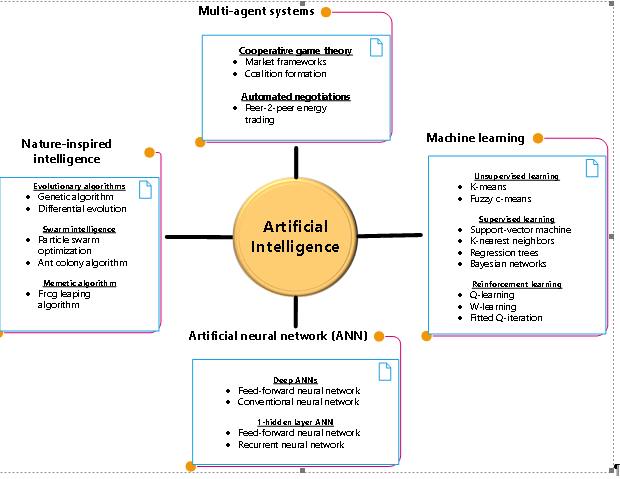
Features of AI in Military Microgrids
Table 35 provides a summary of the key attributes and roles of military-grade AI, focusing on its architecture, capabilities and operational flexibility.[342]
| Feature | Description |
|---|---|
| Design |
• AI systems are specifically tailored to microgrids, optimising energy management, grid optimisation and resource distribution • Uses algorithms and machine learning to enhance energy distribution, forecasting, renewable integration and predictive maintenance • Adaptable to harsh conditions like extreme weather, grid disruptions and cyber threats |
| Operability |
• Operates autonomously or with human oversight, adjusting energy distribution, storage and optimisation based on real-time conditions • Integrates with renewable sources, energy storage and smart meters, enabling seamless monitoring of energy usage and generation • Ensures security of sensitive data, including energy usage and grid control information, from unauthorised access |
| Functionality |
• Processes real-time data for monitoring consumption, detecting faults and identifying anomalies • Analyses operational data to help optimise energy usage, balance load, and plan future energy needs • Predicts energy demand, equipment failures and the impact of renewable energy fluctuations • Responds to issues like power outages or malfunctions, ensuring quicker recovery. • Enhances cyber security to protect digital assets and infrastructure • Detects disinformation to ensure accurate data is used for grid operations • Predicts weather patterns to help with operational planning, especially for renewable energy sources |
Role of AI-Driven Strategies for Efficient and Sustainable Microgrid Operation
Table 36 summarises the key roles of AI in microgrid optimisation, including real-time data analysis, demand forecasting, load balancing, predictive maintenance, cyber security and regulatory compliance.[343],[344]
| Feature | Description |
|---|---|
| Real-time data analysis | AI algorithms process data from IoT sensors to monitor various microgrid parameters (e.g., voltage, power, weather). This data is analysed in real time and stored for future use |
| Demand response management | AI predicts peak demand periods using both real-time and historical data, allowing the system to adjust resource allocation proactively |
| Load balancing | Advanced algorithms optimise power distribution from storage systems, responding to supply and demand fluctuations to ensure efficiency and prevent overloading |
| Predictive maintenance | AI detects minor performance changes to predict when maintenance is needed, automatically alerting staff and scheduling repairs |
| Cyber security and anomaly detection | AI monitors network activity to detect abnormal patterns or cyber threats, helping prevent breaches and ensuring safety |
| Regulatory compliance and optimisation | AI helps microgrids comply with energy regulations and environmental standards while optimising system performance and emissions to meet sustainability goals |
Challenges of AI in Microgrid Expansion
Table 37 outlines the key challenges and limitations associated with the implementation of AI in microgrid expansion.[345],[346]
| Feature | Description |
|---|---|
| High initial costs | Implementing AI in microgrids requires significant investment, and it may take time to see a return on that investment |
| Data dependency | AI systems depend on accurate, consistent data; poor or incomplete data can lead to inaccurate predictions and reduced efficiency |
| Integration challenges | Integrating AI into existing microgrid infrastructure can be difficult, especially for smaller grids with limited data or control systems |
| Complexity of managing decentralised resources | Optimising decentralised DERs like renewable sources or EVs is challenging, especially when they are uncorrelated and spread across different locations |
| Risk of over-reliance on automation | Over-relying on AI could reduce necessary human oversight, making it difficult to address unexpected or nuanced situations |
| Scalability issues | Scaling AI systems for different microgrid sizes can be complex and costly, particularly for smaller grids |
| Data security and privacy | Using AI involves processing large amounts of data, raising concerns about data security and privacy, especially when protections are insufficient |
| Interoperability | AI integration in microgrids faces interoperability issues due to diverse systems, legacy infrastructure, and the need for standard communication protocols |
Technical Challenges in AI-Based Autonomous Microgrids
Table 38 outlines the challenges in developing autonomous systems, including unresolved AI issues, the need to adapt to dynamic environments, and the difficulty of managing emergent behaviours.[347]
| Challenges | Descriptions |
|---|---|
| Devil in the details |
• Use of AI in microgrids faces issues in energy management, dynamic load balancing, and integrating distributed energy resources • Microgrids must perform complex functions such as fault detection, energy needs identification and real-time responses • No system currently integrates all these tasks effectively, especially with the growing complexity of distributed resources |
| Complex and uncertain environments |
• Autonomous microgrids must operate in unpredictable environments like varying energy demand or renewable fluctuations • These systems need to adapt to conditions that cannot be pre-tested, such as changes in weather or grid disruptions • Microgrids must manage unexpected issues such as power failures or changes in energy supply |
| Emergent behaviour |
• Autonomous microgrids must adapt to sudden changes, like power imbalances, without human intervention • Unexpected system behaviour can arise from energy surges, demand shifts or external disruptions |
| Human–machine interactions |
• Success depends on the interaction between human operators and the microgrid system • The system must adjust to evolving goals like load balancing or renewable energy adjustments • The interface should include tools (visual, auditory, tactile) to help operators manage the system • A key challenge is converting human objectives into machine instructions and making the system’s decision-making understandable, especially in emergencies |
| Control |
• As microgrids become more complex, controlling and predicting their behaviour, especially with renewable sources, becomes harder • There is a balance between high performance in energy management and ensuring transparency in how the outcomes are achieved |
Recommendation for Addressing the Challenges of AI-Based Microgrids
Based on the analysis conducted in this paper, Table 39 presents several recommendations to address key challenges in the deployment of AI-based microgrids in military contexts, including data protection, transparency, security, integration issues, and ethical considerations.[348]
| Concern | Recommendations |
|---|---|
| Data protection and privacy |
• Encrypt energy usage data and communications within microgrids to ensure privacy • Secure data exchanges between microgrid components with protected protocols • Limit access to sensitive microgrid data to authorised personnel only • Use multi-factor authentication to secure access to microgrid systems • Anonymise energy usage data when sharing with external parties • Use secure cloud platforms for microgrid data with strict access controls and encryption • Regularly anonymise and securely delete unnecessary microgrid data to comply with privacy regulations |
| Clarity and understandability |
• Design AI models for microgrid management that are transparent and easy for grid operators to interpret • Implement visualisation tools in microgrid systems to make AI decisions clear to operators |
| Strength and dependability |
• Protect AI models within microgrids from cyber threats with strong security measures • Regularly monitor microgrid systems for vulnerabilities and address them with patches • Restrict access to critical AI models and control systems in microgrids to prevent exploitation |
| Technology integration challenges |
• Design flexible and scalable AI systems to ensure smooth integration with existing microgrid infrastructure • Ensure AI systems in microgrids are compatible with current energy sources, storage and smart meters • Test AI systems in real-world microgrid environments to resolve integration issues • Collaborate with energy providers and regulators to advance AI integration in microgrids |
| Insufficient training data |
• Use data augmentation techniques, such as simulating weather patterns and energy consumption, to expand microgrid training datasets • Apply transfer learning to adapt pre-trained models for microgrid-specific tasks • Generate synthetic data for simulations to improve AI models for microgrid scenarios |
| Keeping track of rapid advancements in AI |
• Use agile development processes to quickly incorporate new AI advancements into microgrid systems • Invest in in-house AI research for microgrids to stay ahead of evolving technologies • Partner with academic institutions and industry experts to incorporate the latest AI advancements in microgrid management |
| Ethical and legal considerations |
• Develop ethical guidelines for AI use in microgrids, ensuring accountability and sustainability • Ensure microgrid AI systems comply with energy regulations, environmental laws and privacy standards • Promote transparency in microgrid AI decision-making and document the processes |
Conclusion and Future Work
As Australia works to strengthen the security and resilience of its energy infrastructure, the ADF faces the urgent need to reduce its dependence on centralised power grids and fossil fuels, both of which are vulnerable to disruption and supply shortages. The increasing rates of natural disasters and the escalating risks of cyber and physical threats further underscore the necessity of this transition. This research highlights the strategic importance of localised and independent energy systems, which are essential to ensuring a continuous and reliable power supply for critical defence operations.
The findings indicate that microgrids which combine sustainable sources, battery storage and conventional fuel based generators, such as hydrogen and natural gas, are essential for maintaining operational resilience. These systems provide the capability for military facilities to operate independently when the main grid is compromised, ensuring uninterrupted support for defence activities. However, effective system design must go beyond efficiency. It requires adaptability to varied geographical and operational conditions, and advanced protection systems.
Microgrids also face critical challenges, particularly in the realm of cyber security. As cyber threats grow increasingly sophisticated, the strategic implementation of advanced cyber security measures is vital to protect these systems from potential attacks. Moreover, the integration of emerging technologies, such as AI, holds promising potential for enhancing system autonomy and operational efficiency. However, these technologies also introduce unique complexities, including issues of system integration and maintaining long-term reliability under dynamic and potentially hostile conditions. To ensure resilience, these systems must be equipped with cutting-edge security protocols and adaptive technologies that can effectively mitigate both cyber and physical threats.
Resilience and functionality of microgrids also depend heavily on the stability and reliability of supply chains. Many essential components, such as batteries, solar panels and power electronic technologies, are currently sourced from overseas. This overseas reliance introduces strategic risks, particularly in times of international tension or large-scale supply disruptions. To address this vulnerability, Australia must prioritise domestic manufacturing, promote local innovation, and build a more diverse and secure supply network. These measures will enhance energy security and support the broader goal of strengthening defence capabilities.
For future work, there are several factors that will shape the ADF’s successful transition to independent energy systems. These include the development of comprehensive risk management frameworks, increased investment in research and development, and efforts to integrate resilience, innovation and energy independence into long-term strategic planning. It is these measures that will ensure that the ADF is equipped with secure, reliable and adaptable energy solutions to meet evolving operational needs.
| AC | Alternating current |
| AI | Artificial intelligence |
| ACT | Australian Capital Territory |
| ADF | Australian Defence Force |
| AS/NZS | Australian/New Zealand Standard |
| CHP | Combined heat and power |
| DC | Direct current |
| DEWs | Directed energy weapons |
| DERs | Distributed energy resources |
| ECVs | Electric combat vehicles |
| EVs | Electric vehicles |
| FDI | False data injection |
| IEC | International Electrotechnical Commission |
| IEEE | Institute of Electrical and Electronics Engineers |
| IoT | Internet of things |
| L-ion | Lithium ion |
| NEM | National Electricity Market |
| RESs | Renewable energy sources |
| SCADA | Supervisory control and data acquisition |
| US | United States |
| UPS | Uninterruptible power supply |
Endnotes
[1] Iryna Nikolaieva and Wim Zwijnenburg, Risks and Impacts from Attacks on Energy Infrastructure in Ukraine (PAX and Centre for Information Resilience, 2022), at: https://paxforpeace.nl/wp-content/uploads/sites/2/import/2023-01/PAX_Ukraine_energy_infrastructure_FIN.pdf.
[2] Naval Power and Energy Systems Technology Development Roadmap (Naval Sea Systems Command, 2019), at: https://apps.dtic.mil/sti/pdfs/AD1171909.pdf.
[3] Brendan Teague, TJ Goss and Mark Weiss, ‘Applying Risk and Resilience Metrics to Energy Investments’, MBA professional report, Naval Postgraduate School, Monterey CA, 2015, at: https://apps.dtic.mil/sti/tr/pdf/AD1009298.pdf.
[4] David E Feith, ‘Climate Change and the Defense Department: Adaptation Is a Better Strategy than Mitigation’, research report, Air Command and Staff College Air University, Maxwell Air Force Base AL, 2017, at: https://apps.dtic.mil/sti/pdfs/AD1054568.pdf.
[5] Jeffrey A Drezner, Megan Mckernan, Gabriel Leonard et al., Incorporating Environmental Considerations into Defense Acquisition Practices (Santa Monica CA: RAND Corporation, 2023), at: https://apps.dtic.mil/sti/trecms/pdf/AD1213388.pdf.
[6] William W Anderson Jr, ‘Resilience Assessment of Islanded Renewable Energy Microgrids’, dissertation, Naval Postgraduate School, Monterey CA, 2020, at: https://apps.dtic.mil/sti/pdfs/AD1126753.pdf.
[7] Ruth Fish, ‘Design and Modeling of Hybrid Microgrids in Arctic Environments’, thesis, Naval Postgraduate School, Monterey CA, 2020, at: https://apps.dtic.mil/sti/pdfs/AD1126429.pdf.
[8] Caolionn O’Connell, ‘Unraveling the Gordian Knot: Considering Supply Chain Resiliency’, testimony, House Energy and Commerce Committee, Subcommittee on Consumer Protection and Commerce, 14 October 2021, at: https://apps.dtic.mil/sti/trecms/pdf/AD1150228.pdf.
[9] Bradley Martin, Laura H Baldwin, Paul Deluca et al., Supply Chain Interdependence and Geopolitical Vulnerability (Santa Monica CA: RAND Corporation, 2023), at: https://apps.dtic.mil/sti/trecms/pdf/AD1195673.pdf.
[10] C Samaras, WJ Nuttall and M Bazilian, ‘Energy and the Military: Convergence of Security, Economic, and Environmental Decision-Making’, Energy Strategy Reviews 26 (2019): 100409.
[11] P Wolfram, Carbon Footprint Scenarios for Renewable Electricity Generation in Australia (Berlin Institute of Technology, 2015).
[12] Ibid.
[13] ‘Network Vision’, Electranet (website), 2021, at: https://www.wa.gov.au/organisation/energy-policy-wa/transmission-1
[14] The National Electricity Market (Australian Energy Council, 2018), at: https://www.energycouncil.com.au/media/12973/national-electricity-market.pdf.
[15] What Is Transmission? (Energy Networks Australia), at: https://www.energynetworks.com.au/resources/fact-sheets/fact-sheet-what-is-transmission.
[16] Guide to Australia’s Energy Networks (Energy Networks Australia, 2021), at: https://www.energynetworks.com.au/resources/fact-sheets/guide-to-australias-energy-networks.
[17] Electric Power Generation and Distribution (Department of the Army and Department of the Marine Corps, 2018), at: https://irp.fas.org/doddir/army/atp3-34-45.pdf.
[18] Daniel C Mikkelson, 15 KW Small Turboelectric Power Generation System (Triangle Park NC: US Army Research Office, 2006), at: https://apps.dtic.mil/sti/pdfs/ADA515623.pdf.
[19] John E Dommert, ‘Increasing Endurance in Tactical DC Microgrids with Variable Gain Droop Control’, thesis, Naval Postgraduate School, Monterey CA, 2019, at: https://apps.dtic.mil/sti/pdfs/AD1086988.pdf.
[20] SB Van Broekhoven, N Judson, SVT Nguyen and WD Ross, Microgrid Study: Energy Security for DoD Installations (Lexington MA: Lincoln Laboratory, 2012), at: https://apps.dtic.mil/sti/pdfs/ADA565751.pdf.
[21] Electric Power Generation and Distribution (Department of the Army and Department of the Marine Corps, 2024), at: https://www.marines.mil/Portals/1/Publications/MCRP%203-40D.17%20(SECURED).pdf?ver=d2hv9_fUlZ5FKHENTutIMQ%3D%3D.
[22] National Security and Assured U.S. Electrical Power (CNA, 2015), at: https://www.cna.org/reports/2015/National-Security-Assured-Electrical-Power.pdf.
[23] European Network of Transmission System Operators for Electricity, Supporting Document for the Network Code on Operational Security (ENTSOE, 2013), at: https://eepublicdownloads.entsoe.eu/clean-documents/pre2015/resources/OS_NC/130924-AS-NC_OS_Supporting_Document_2nd_Edition_final.pdf.
[24] Converge Strategies, Regulatory Considerations for Utility Investments in Defense Energy Resilience (National Association of Regulatory Utility Commissioners, 2021), at: https://pubs.naruc.org/pub/9931AF59-1866-DAAC-99FB-17BF932AECF5.
[25] The US Army Energy Strategy for Installations (Department of the Army, 2005), at: https://academy.armymwr.com/application/files/4117/1952/0574/HO-Army-Energy-Strategy-2017.pdf.
[26] Catherine Morehouse, ‘Physical Attacks on Power Grid Surge to New Peak’, Politico, 26 December 2022, at: https://www.politico.com/news/2022/12/26/physical-attacks-electrical-grid-peak-00075216.
[27] Catherine Morehouse, ‘Extremists Keep Trying to Trigger Mass Blackouts—and That’s Not Even the Scariest Part’, Politico, 9 October 2023, at: https://www.politico.com/news/2023/09/10/power-grid-attacks-00114563.
[28] Sector Spotlight: Electricity Substation Physical Security (CISA, 2023), at: https://www.cisa.gov/sites/default/files/2023-02/Sector%20Spotlight%20Electricity%20Substation%20Physical%20Security_508.pdf.
[29] ‘Human-Driven Physical Threats to Energy Infrastructure’, NCSL (website), 22 May 2023, at: https://www.ncsl.org/energy/human-driven-physical-threats-to-energy-infrastructure.
[30] Paul Rothman, ‘Utilities Adapt to Changing Threat Landscape’, SecurityInfoWatch, 10 August 2023, at: https://www.securityinfowatch.com/critical-infrastructure/article/53067505/utilities-adapt-to-changing-threat-landscape.
[31] Marco Genovese, ‘Energy Infrastructure: Facing Up to the Cyber Threat’, Stormshield (website), 8 January 2024, at: https://www.stormshield.com/news/energy-infrastructure-facing-up-to-the-cyber-threat.
[32] Prateek Bhadvia, ‘Cybersecurity Challenges and Solutions in the Energy Sector’, LinkedIn, 2 March 2024, at: https://www.linkedin.com/pulse/cybersecurity-challenges-solutions-energy-sector-cism-csoe--wvxkf.
[33] ‘Cyber Security for the Energy Industry’, Endure Secure (website), at: https://endsec.au/about/cyber-security-for-the-energy-industry-in-australia.
[34] SK Venkatachary, J Prasad, A Alagappan et al., ‘Cybersecurity and Cyber-Terrorism Challenges to Energy-Related Infrastructures: Cybersecurity Frameworks and Economics—Comprehensive Review’, International Journal of Critical Infrastructure Protection 45 (2024): 100677.
[35] Cyber Security and Energy Networks (Energy Networks Australia), at: https://www.energynetworks.com.au/assets/uploads/16022017_cyber_security_and_energy_networks_a4.pdf.
[36] Roya Gordon, ‘The Internet of Things and Increasing Threats to the Electric Grid’, Security Management, 1 February 2024, at: https://www.asisonline.org/security-management-magazine/monthly-issues/security-technology/archive/2024/february/Internet-of-Things-Increasing-Threats-Electric-Grid.
[37] ‘Clean Energy Supply Chains Vulnerabilities’, IEA (website), at: https://www.iea.org/reports/energy-technology-perspectives-2023/clean-energy-supply-chains-vulnerabilities.
[38] Emily Newton, ‘What Are the Top 7 DDoS Mitigation Tactics for Energy Grids?’, Integrity & Compliance Monitoring (website), 5 March 2024, at: https://www.tripwire.com/state-of-security/what-are-top-ddos-mitigation-tactics-energy-grids.
[39] ‘Energy Sector Ransomware Recovery Costs Have Quadrupled’, Energy Source Distribution, 19 July 2024, at: https://esdnews.com.au/energy-sector-ransomware-recovery-costs-have-quadrupled.
[40] ‘What Is Phishing? Common Attacks & How to Avoid Them’, Fortra (website), 28 October 2021, at: https://www.digitalguardian.com/blog/what-phishing-common-attacks-how-avoid-them.
[41] Government Accountability Office, ‘Cyber Threats and Data Breaches Illustrate Need for Stronger Controls across Federal Agencies’, testimony, Subcommittees on Research and Technology and Oversight, Committee on Science, Space, and Technology, House of Representatives, 8 July 2015, at: https://apps.dtic.mil/sti/pdfs/AD1174088.pdf.
[42] ‘Average Number of Weekly Cyberattacks per Organisation in Selected Industries, 2020–2022’, IEA (website), at: https://www.iea.org/data-and-statistics/charts/average-number-of-weekly-cyberattacks-per-organisation-in-selected-industries-2020-2022.
[43] H-C Lee, H-Y Liu and S-Y Teng, ‘Distributed Energy Strategy Using Renewable Energy Transformation in Kinmen Island: Virtual Power Plants that Take the Military Camps as the Mainstay’, Energy Strategy Reviews 44 (2022): 100993.
[44] The Energy and Defence Project, Dispersed, Decentralized and Renewable Energy Sources: Alternatives to National Vulnerability and War (Washington DC: Federal Emergency Management Agency, 1980), at: https://apps.dtic.mil/sti/pdfs/ADA094319.pdf.
[45] Emergency Diesel Generator Backup Power Systems for Military Bases (National Renewable Energy Laboratory, 2020), at: https://www.nrel.gov/docs/fy20osti/76600.pdf.
[46] Mobile Power for Military (Cummins, 2017), at: https://mart.cummins.com/imagelibrary/data/assetfiles/0056765.pdf.
[47] US Department of Energy, Combined Heat and Power in Resilience Planning and Policy (2019), at: https://www.osti.gov/servlets/purl/1643229.
[48] ‘What Is CHP?’, EPA (website), at: https://www.epa.gov/chp/what-chp.
[49] ‘Fuel Cells’, U.S. Department of Energy (website), at: https://www.energy.gov/eere/fuelcells/fuel-cells.
[50] Samina Aslam, Sadia Rani, Kiran Lal et al., ‘Electrochemical Hydrogen Production: Sustainable Hydrogen Economy’, Green Chemistry 25 (2023): 9543–9573, at: https://pubs.rsc.org/en/content/articlehtml/2023/gc/d3gc02849f.
[51] J Peng, J Huang, X-l Wu et al., ‘Solid Oxide Fuel Cell (SOFC) Performance Evaluation, Fault Diagnosis and Health Control: A Review’, Journal of Power Sources 505 (2012): 230058.
[52] MP Alves, W Gul, CA Cimini Jr and SK Ha, ‘A Review on Industrial Perspectives and Challenges on Material, Manufacturing, Design and Development of Compressed Hydrogen Storage Tanks for the Transportation Sector’, Energies 15, no. 14 (2022): 5152.
[53] J Kim, K Boo, J Cho and I Moon, ‘Key Challenges in the Development of an Infrastructure for Hydrogen Production, Delivery, Storage and Use’, in Angelo Basile and Adolfo Iulianelli (eds), Advances in Hydrogen Production, Storage and Distribution (Elsevier, 2014), pp. 3–31.
[54] Linda C Wade, Adam G Bradford, Timothy P Gibbons and Nathan D Platz, ‘Developing Smarter Logistics Support to Remote Areas’, U.S. Army (website), 12 February 2015, at: https://www.army.mil/article/140039/developing_smarter_logistics_support_to_remote_areas.
[55] American Council on Renewable Energy, ‘The Role of Renewable Energy in National Security’ (ACORE, 2018), at: https://acore.org/wp-content/uploads/2018/10/ACORE_Issue-Brief_-The-Role-of-Renewable-Energy-in-National-Security.pdf.
[56] ‘Solar Photovoltaic Cell Basics’, U.S. Department of Energy (website), at: https://www.energy.gov/eere/solar/solar-photovoltaic-cell-basics.
[57] ‘Solar Cell’, Britannica, at: https://www.britannica.com/technology/solar-cell.
[58] H Yao and Q Zhou, ‘Research Status and Application of Rooftop Photovoltaic Generation Systems’, Cleaner Energy Systems 5 (2023): 100065.
[59] H Martin, R Buffat, D Bucher, J Hamper and M Raubal, ‘Using Rooftop Photovoltaic Generation to Cover Individual Electric Vehicle Demand—A Detailed Case Study’, Renewable and Sustainable Energy Reviews 157 (2022): 11196922.
[60] ‘Large-Scale Solar’, ARENA (website), at: https://arena.gov.au/renewable-energy/large-scale-solar.
[61] ‘Concentrated Solar Thermal’, ARENA (website), at: https://arena.gov.au/renewable-energy/concentrated-solar-thermal.
[62] ‘Concentrating Solar-Thermal Power Basics’, U.S. Department of Energy (website), at: https://www.energy.gov/eere/solar/concentrating-solar-thermal-power-basics.
[63] Overview of Solar Thermal Technologies (US Department of Energy), at: https://www1.eere.energy.gov/ba/pba/pdfs/solar_overview.pdf.
[64] ‘Solar Concentrated Power Technologies: A Comprehensive Overview and Their Application in Australia’, Enaxiom (website), at: https://www.enaxiom.com/blog/csp-concentrated-solar-power-technologies-a-comprehensive-overview.
[65] ‘How Do Wind Turbines Work?’, U.S. Department of Energy (website), at: https://www.energy.gov/eere/wind/how-do-wind-turbines-work.
[66] ‘How Do We Harness Wind Energy?’, Repsol (website), at: https://www.repsol.com/en/energy-and-the-future/future-of-the-world/wind-farms/index.cshtml.
[67] ‘Basics of Wind Conversion’, Energy Basics (website), at: https://www.energybasics.org/wind-energy-conversion.
[68] ‘Biomass—Renewable Energy from Plants and Animals’, EIA (website), at: https://www.eia.gov/energyexplained/biomass.
[69] ‘Biomass Energy’, National Geographic, at: https://education.nationalgeographic.org/resource/biomass-energy.
[70] A Demirbas, ‘Biofuels Securing the Planet’s Future Energy Needs’, Energy Conversion and Management 50, no. 9 (2009): 2239–2249.
[71] A Khalid, M Arshad, M Anjum, T Mahmood and L Dawson, ‘The Anaerobic Digestion of Solid Organic Waste’, Waste Management 31, no. 8 (2011): 1737–1744.
[72] A Dahiya, Bioenergy: Biomass to Biofuels (Amsterdam: Elsevier, 2014), pp. 1–36.
[73] ‘Geothermal Energy’, National Geographic, at: https://education.nationalgeographic.org/resource/geothermal-energy.
[74] ‘Geothermal Basics’, U.S. Department of Energy (website), at: https://www.energy.gov/eere/geothermal/geothermal-basics.
[75] ‘Geothermal Power Plants’, U.S. Department of Energy (website), at: https://www.energy.gov/eere/geothermal/electricity-generation.
[76] Center for Sustainable Systems, Geothermal Energy Factsheet (University of Michigan, 2025) at: https://css.umich.edu/publications/factsheets/energy/geothermal-energy-factsheet.
[77] Alexander Richter, ‘Geothermal Energy Is Least Land-Use Intense Source of the Renewable Energy Technologies’, Think Geoenergy, 22 January 2021, at: https://www.thinkgeoenergy.com/geothermal-energy-is-least-land-use-intense-source-of-the-renewable-energy-technologies.
[78] Integrated Logistic Support Plan for Uninterruptible Power Systems (Department of the Navy, 1976), at: https://apps.dtic.mil/sti/tr/pdf/ADA034888.pdf.
[79] M Aamir, KA Kalwar and S Mekhilef, ‘Uninterruptible Power Supply (UPS) System’, Renewable and Sustainable Energy Reviews 58 (2016): 1395–1410, 2016.
[80] A Nasiri, Z Nie, SB Bekiarov and A Emadi, ‘An On-Line UPS System with Power Factor Correction and Electric Isolation Using BIFRED Converter’, IEEE Transactions on Industrial Electronics 55, no. 2 (2008): pp. 722–730.
[81] ‘Demonstrating the Benefits of Long-Duration, Low-Cost Flow Battery Storage in a Renewable Microgrid’, SERDP ESTCP (website), at: https://serdp-estcp.mil/projects/details/fc88f574-2304-4037-b3b4-4c7c04300aba/ew19-5312-project-overview.
[82] ‘Defense Innovation Unit Partners with Departments of the Air Force, Navy and Office of the Secretary of Defense to Extend Duration Storage for Installations (EDSI)’, Defence Innovation Unit (website), at: https://www.diu.mil/latest/defense-innovation-unit-partners-with-departments-of-the-air-force-navy-and.
[83] ‘Saft’s Premier Lithium-Ion Batteries to Power Australian Defense Force’s Mission Critical Equipment’, Saft (website), 15 May 2017, at: https://www.dst.defence.gov.au/sites/default/files/publications/documents/DSTO-GD-0710.pdf
[84] Energy Storage—Large-Scale Batteries (State of Victoria Department of Environment, Land, Water and Planning, 2018), at: https://www.energy.vic.gov.au/__data/assets/pdf_file/0032/591584/large-scale-battery-storage-factsheet.pdf.
[85] Shukri Kazbour, Microgrid and Plug in Electric Vehicle (PEV) with Vehicle to Grid (V2G) Power Services Capability (US Army RDECOM TARDEC, 2015), at: https://apps.dtic.mil/sti/pdfs/ADA625624.pdf.
[86] Brian Donlon, ‘Bringing a Tesla to War: Military Applications of Electric Vehicle Technology’, master’s thesis, Marine Corps University, Quantico VA, at: https://apps.dtic.mil/sti/pdfs/AD1178915.pdf.
[87] Jeffrey Marqusee and Andrew Stringer, Distributed Energy Resource (DER) Reliability for Backup Electric Power Systems (National Renewable Energy Laboratory, 2023), at: https://www.nrel.gov/docs/fy23osti/83132.pdf.
[88] National Renewable Energy Laboratory, Energy Exchange Pre-Conference Workshop: Distributed Energy Technologies for Resilience and Cost Savings (U.S. Department of Energy, 2019), at: https://www.nrel.gov/docs/fy19osti/74625.pdf.
[89] Travis R Bohanan, ‘Renewable Energy and the DoD’s Quest for Operational Resilience’, master’s thesis, Marine Corps University, Quantico VA, at: https://apps.dtic.mil/sti/trecms/pdf/AD1176463.pdf.
[90] ‘What Is the Operation of a CHP Power Plant?’, GMS (website), 3 September 2021, at: https://www.gmsthailand.com/blog/what-is-the-operation-of-a-chp-power-plant.
[91] ‘How CHP Will Facilitate the Energy Transition’, Everllence (website), at: https://www.man-es.com/discover/decarbonization-glossary---man-energy-solutions/combined-heat-and-power.
[92] Heat Pump Swimming Pool Heater / Evoheat, ‘The Advantages and Disadvantages of CHP Combined Heat and Power’, Medium, 10 April 2023, at: https://medium.com/@lhouvan/the-advantages-and-disadvantages-of-chp-combined-heat-and-power-29d33d7f229f.
[93] ‘Combined Heat & Power—Advantages & Disadvantages’, HELEC (website), at: https://helec.co.uk/why-chp/combined-heat-power-advantages-disadvantages.
[94] Operational Energy Architectures Report (Acquisition & Sustainment Office of the Under Secretary of War, 2022), at: https://www.acq.osd.mil/eie/eer/oe/docs/reports/2022/Operational%20Energy%20Architectures%20Report.pdf.
[95] ‘Hydrogen’, IRENA (website), at: https://www.irena.org/Energy-Transition/Technology/Hydrogen.
[96] Edward W Beran, ‘An Electromagnetic Interference Analysis of Uninterruptible Power Supply Systems in a Data Processing Environment’, thesis, Naval Postgraduate School, Monterey CA, at: https://apps.dtic.mil/sti/pdfs/ADA411197.pdf.
[97] ‘How Does an Uninterruptible Power Supply (UPS) Work?’, UPS Solutions (website), at: https://upssolutions.com.au/blogs/ups-solutions-blog/how-does-an-uninterruptible-power-supply-ups-work.
[98] Jamie Smith, ‘Advantages and Disadvantages of Biomass Energy’, Solar Reviews (website), at: https://www.solarreviews.com/blog/biomass-energy-pros-and-cons.
[99] Jacob Marsh, ‘Biomass Energy: Advantages and Disadvantages’, EnergySage (website), 9 March 2022, at: https://www.energysage.com/about-clean-energy/biomass/pros-and-cons-biomass.
[100] ‘Unlocking Earth’s Power: A Comprehensive Guide to Geothermal Energy’, Energy Advice Hub (website), 13 March 2024, at: https://energyadvicehub.org/unlocking-earths-power-a-comprehensive-guide-to-geothermal-energy.
[101] Dan Simms, ‘What Are the Pros and Cons of Geothermal Energy’, Solar Reviews (website), at: https://www.solarreviews.com/blog/geothermal-energy-pros-and-cons.
[102] ‘What Are the Advantages and Disadvantages of Geothermal Energy?’, The Welding Institute (website), at: https://www.twi-global.com/technical-knowledge/faqs/geothermal-energy/pros-and-cons#WhataretheAdvantagesofUsingGeothermal.
[103] ‘The Pros and Cons of Batteries for Energy Storage’, IEC E-Tech (website), at: https://etech.iec.ch/issue/2023-06/the-pros-and-cons-of-batteries-for-energy-storage.
[104] ‘Pros and Cons of Battery Storage’, Sustainable Solar Services (website), at: http://www.sustainablesolarservices.com.au/pros-cons-battery-storage.
[105] Richard H Van Atta, The Role of Energy Storage in Meeting 21st Century Department of Defense Energy Demands (Alexandria VA: Institute for Defense Analyses, 2013), at: https://apps.dtic.mil/sti/pdfs/AD1123787.pdf.
[106] ‘The Advantages and Challenges of Electric Vehicles’, Newark (website), at: https://mexico.newark.com/the-advantages-and-challenges-of-electric-vehicles-trc-ar.
[107] Senate Select Committee on Electric Vehicles, Report (Commonwealth of Australia, 2019), Chapter 3 ‘Increased EV Uptake and Use—Benefits and Challenges’, at: https://www.aph.gov.au/Parliamentary_Business/Committees/Senate/Electric_Vehicles/ElectricVehicles/Report/c03.
[108] ‘Natural Gas vs. Diesel: Which Generator Set Is Right for You?’, PowerLink (website), at: https://powerlinkworld.co.uk/natural-gas-vs-diesel-which-generator-set-is-right-for-you.
[109] Energy Efficiency Training for Manufacturers—Ohio, Combined Heat and Power Technology Today (Better Buildings Solution Center, 2022), at: https://betterbuildingssolutioncenter.energy.gov/sites/default/files/attachments/CHP101Ohioapril122022.pdf.
[110] U.S. Environmental Protection Agency Combined Heat and Power Partnership, Valuing the Reliability of Combined Heat and Power (Environmental Protection Agency, 2007), at: https://www.epa.gov/sites/default/files/2015-07/documents/valuing_the_reliability_of_combined_heat_and_power.pdf.
[111] ‘Solar-Powered Defense’, Foresight Learning (website), at: https://foresightlearn.com/solar-powered-defense-how-renewable-energy-is-shaping-modern-military-operations.
[112] ‘All the Benefits of Wind Power’, Enel (website), at: https://www.enelgreenpower.com/learning-hub/renewable-energies/wind-energy/advantages-wind-energy.
[113] ‘Compact Wind Turbines Could Support Disaster Relief and Military Missions’, U.S. Department of Energy (website), 22 November 2022, at: https://www.energy.gov/eere/wind/articles/compact-wind-turbines-could-support-disaster-relief-and-military-missions.
[114] ‘Utilization of Biomass Technologies on Military Installations’, SERDP ESTCP (website), at: https://serdp-estcp.mil/projects/details/7a83ddcc-ecac-4441-a89f-9f8b75b1a7e9.
[115] ‘Hydrogen Fuel Cells Offer Energy Resilience for Military—NATO study’, PowerUp (website), 26 June 2024, at: https://powerup-tech.com/hydrogen-fuel-cells-offer-energy-resilience-for-militaries-nato-study.
[116] ‘Benefits of SFC Fuel Cells: Reasons to Use Our Fuel Cells’, SFC Energy (website), at: https://www.sfc-publicsecurity.com/en/products/benefits.
[117] Levi T Thompson, ‘FreedomCAR and Military Applications Power Fuel Cell Research’, University of Michigan News, 6 March 2002, at: https://news.umich.edu/freedomcar-and-military-applications-power-fuel-cell-research.
[118] Nguyen Minh, ‘Solid Oxide Fuel Cell (SOFC) Technology for Powering the U.S. Army of the Future’, in National Academies of Sciences, Engineering, and Medicine, Powering the U.S. Army of the Future (Washington DC: The National Academies Press, 2021), at: https://www.nationalacademies.org/read/26052.
[119] Van Atta, The Role of Energy Storage in Meeting 21st Century Department of Defense Energy Demands.
[120] ‘Geothermal Energy for Military Bases’, Thermal Energy Partners (website), at: https://www.diu.mil/latest/u-s-air-force-u-s-army-the-defense-innovation-unit-and-industry-advance-dod.
[121] Greg Nash, ‘Air Force Pioneering Innovative Geothermal Energy Solutions’, Air Force Materiel Command (website), 28 September 2023, at: https://www.afmc.af.mil/News/Article-Display/Article/3542619/air-force-pioneering-innovative-geothermal-energy-solutions.
[122] Joseph Webster, ‘Batteries as a Military Enabler’, War on the Rocks, 20 June 2024, at: https://warontherocks.com/2024/06/batteries-as-a-military-enabler.
[123] ‘How Are Electric Vehicles Used in Defence?’, Rowse (website), at: https://www.rowse.co.uk/blog/post/how-are-electric-vehicles-used-in-defence.
[124] Carolyn Fortuna, ‘Of Course EVs Are Appropriate for the Military!’, CleanTechnica (website), at: https://cleantechnica.com/2023/09/04/of-course-evs-are-appropriate-for-the-military.
[125] The Brattle Group, Navigant Consulting, EcoSolutions and Pierce Atwood LLP, Combined Heat and Power (CHP) Policy Review for the Kingdom of Saudi Arabia (The Brattle Group, 2015), at: https://www.brattle.com/wp-content/uploads/2017/10/5656_combined_heat_and_power_chp_policy_review_for_the_kingdom_of_saudi_arabia-2.pdf.
[126] ‘The Market and Technical Potential for Combined Heat and Power in the Commercial/Institutional Sector’, U.S. Department of Energy (website), at: https://www.energy.gov/sites/prod/files/2013/11/f4/chp_comm_market_potential.pdf.
[127] Commanders Guide to Renewable Energy (Range Commanders Council Sustainability Group, 2011), at: https://apps.dtic.mil/sti/tr/pdf/ADA633291.pdf.
[128] Commander’s Guide to Renewable Energy (White Sands Missile Range NM: Range Commanders Council, 2013), at: https://www.repi.mil/Portals/44/Documents/Primers/Primer_RenewableEnergy.pdf.
[129] Texas A&M Natural Resources Institute, Coordination of Wind Energy and Military Operations in Texas (Texas A&M NRI, 2019), at: https://tent.nri.tamu.edu/static-files/Wind-Energy-and-Military-Activities-in-Texas.pdf.
[130] ‘Wind Power and the Military: An Uneasy Alliance’, at: https://windeurope.org/summit2018/files/downloads/aviation/Maurice-Dixon-Wind-Turbine-Impact-on-Military-Radars.pdf.
[131] Office of the Director of Defense Research and Engineering, The Effect of Windmill Farms on Military Readiness (Department of Defense, 2006), at: https://users.ece.utexas.edu/~ling/US1%20dod_windfarms.pdf.
[132] ‘Biofuels in the DoD: Impact on System Reliability, Availability, and Maintainability’, DSIAC (website), at: https://www.icheme.org/media/9263/xxii-paper-49.pdf.
[133] ‘Societal Benefits of Biofuels in Europe’, ETIP Bioenergy (website), at: https://biofuelsreform.org/social-impact-of-biofuels.html.
[134] Bryant Jones and Peter Tait, ‘Empower the Geothermal Earthshot: Solve the Climate Crisis with Earth’s Energy’, Federation of American Scientists (website), 9 January 2023, at: https://fas.org/publication/solve-the-climate-crisis-with-earths-energy.
[135] John Engel, ‘Could Geothermal Power U.S. Military Bases? DOD Wants to Find Out’, Renewable Energy World (website), 7 April 2022, at: https://www.renewableenergyworld.com/baseload/could-geothermal-power-u-….
[136] Minh, ‘Solid Oxide Fuel Cell (SOFC) Technology for Powering the U.S. Army of the Future’.
[137] Chahrazed Tigha, ‘Hazard Analysis of Hydrogen Fuel Cell Ships Using Land Based Accidents Data and Elicitation of Experts’, dissertation, World Maritime University, Malmö, 2022 at: https://commons.wmu.se/cgi/viewcontent.cgi?article=3072&context=all_dissertations.
[138] ‘Military Use Cases & Risks of Rugged BESS (Battery Energy Storage Systems)’, BSS Unit (website), 17 February 2023, at: https://bssunit.com/military-use-cases-risks-of-rugged-bess-battery-energy-storage-systems.
[139] ‘Battery Safety in Military Vehicles’, Stryten Energy (website), at: https://www.stryten.com/battery-safety-in-military-vehicles.
[140] Yasmin Tadjdeh, ‘Electric Vehicles for the Military Still a Pipedream’, National Defense Magazine, 6 October 2021, at: https://www.nationaldefensemagazine.org/articles/2021/10/6/electric-vehicles-for-the-military-still-a-pipedream.
[141] N Judson, AL Pina, EV Dydek, SB Van Broekhoven and AS Castillo, Application of a Resilience Framework to Military Installations: A Methodology for Energy Resilience Business Case Decisions (Lexington MA: Lincoln Laboratory, 2016), at: https://www.ll.mit.edu/sites/default/files/publication/doc/application-resilience-framework-military-installations-judson-tr-1216.pdf.
[142] Federal Energy Management Program, Using Distributed Energy Resources: A How-to Guide for Federal Facility Managers (U.S. Department of Energy, 2022), at: https://www.nrel.gov/docs/fy02osti/31570.pdf.
[143] ‘14 Pros of Using Biomass’, Inoplex (website), at: https://inoplex.com.au/biomass/14-pros-of-using-biomass.
[144] Katarina Zimmer, ‘Is Geothermal Power Heating Up as an Energy Source?’, Smithsonian Magazine, 22 April 2024, at: https://www.smithsonianmag.com/innovation/is-geothermal-power-heating-up-as-an-energy-source-180984202.
[145] ‘Guide to Using Combined Heat and Power for Enhancing Reliability and Resiliency in Buildings’, U.S. Department of Energy (website), at: https://www.energy.gov/eere/amo/articles/guide-using-combined-heat-and-power-enhancing-reliability-and-resiliency.
[146] ‘Early Markets: Fuel Cells for Backup Power’, U.S. Department of Energy (website), at: https://www.energy.gov/eere/fuelcells/articles/early-markets-fuel-cells-backup-power.
[147] ‘Do Solar Panels and Home Battery Backup Work During a Power Outage?’, Panasonic (website), at: https://na.panasonic.com/us/green-living/do-solar-panels-and-home-battery-backup-work-during-power-outage.
[148] ‘What Is an Uninterruptible Power Supply and How Does It Work?’, Unified Power (website), 19 May 2022, at: https://unifiedpowerusa.com/what-is-a-ups.
[149] ‘Electric Vehicles Can Now Power Your Home for Three Days’, The Washington Post, 17 February 2023, at: https://www.washingtonpost.com/climate-environment/2023/02/07/ev-battery-power-your-home.
[150] Federal Energy Management Program, Using Distributed Energy Resources.
[151] ‘Geothermal FAQs’, U.S. Department of Energy (website), at: https://www.energy.gov/eere/geothermal/geothermal-faqs.
[152] ‘Why Cost of Geothermal Power Plants Will Remain High’, World-Energy (website), 2 July 2022, at: https://www.world-energy.org/article/25659.html.
[153] ‘Diesel Generator Fuel Consumption Guide’, Blue Diamond (website), 7 June 2023, at: https://www.bluedm.com.au/blog/diesel-generator-fuel-consumption-guide.
[154] ‘Combined Heat and Power (CHP): Essential for a Cost Effective Clean Energy Standard’, U.S. Department of Energy (website), at: https://www.energy.gov/eere/amo/articles/combined-heat-and-power-chp-essential-cost-effective-clean-energy-standard-april.
[155] ‘Are Hydrogen Fuel Cells Cost-Effective?’, TutorChase (website), at: https://www.tutorchase.com/answers/igcse/chemistry/are-hydrogen-fuel-cells-cost-effective.
[156] ‘Do Solar Panels and Home Battery Backup Work During a Power Outage?’, Panasonic.
[157] ‘“Black Start” Diesel Generator Provides Stand-Alone Capability’, CAT (website), at: https://www.cat.com/en_AU/by-industry/electric-power/Articles/Testimonials/cogeneration-protects-sensitive-processes-kyocera.html.
[158] Natalie Gregus, ‘Everything You Need to Know About Combined Heat and Power (CHP) Units’, Energy Link (website), 25 June 2021, at: https://goenergylink.com/blog/combined-heat-and-power.
[159] ‘Australia’s First Hydrogen Stand Alone Power System’, Essential Energy (website), 7 December 2022, at: https://www.essentialenergy.com.au/media-centre/media-release/news-6-hydrogen-stand-alone-power-system.
[160] ‘Can I Install Standalone Battery Storage without Solar Panels?’, Panasonic (website), at: https://na.panasonic.com/us/green-living/can-i-install-standalone-battery-storage-without-solar-panels.
[161] Anthony Budd, Ed Gerner and Suzanne O’Reilly, ‘Feeling the Heat: Geothermal Energy’, Australian Academy of Science (website), at: https://www.science.org.au/curious/technology-future/feeling-heat-geothermal-energy.
[162] Nadine Reinert, ‘Combined Heat and Power—Technology Review and Analysis for a Residential Building’, thesis, University of Tennessee, Chattanooga TN, 2012, at: https://scholar.utc.edu/cgi/viewcontent.cgi?article=1068&context=theses.
[163] ‘Fuel Cells: Heat and Electricity’, Greenspec (website), at: https://www.greenspec.co.uk/building-design/fuel-cells.
[164] Brian McKay, ‘Can I Get Heat and Electricity from the Same Solar Panel?’, Aztek Solar (website), 17 January 2022, at: https://www.azteksolar.ca/can-i-get-heat-and-electricity-from-the-same-solar-panel.
[165] Biomass for Heat and Power, Technology Brief E05 (IEA-ETSAP and IRENA, 2015), at: https://www.irena.org/-/media/Files/IRENA/Agency/Publication/2015/IRENA-ETSAP_Tech_Brief_E05_Biomass-for-Heat-and-Power.pdf.
[166] Federal Energy Management Program, Using Distributed Energy Resources.
[167] Hai-Chao Li, Yan-Shen Guo, Ke-Feng Huang et al., ‘Research on Improving Methods of Power Quality of Diesel Generators with Millisecond Pulse Load’, Journal of Physics: Conference Series 2452 (2023): 012032, at: https://iopscience.iop.org/article/10.1088/1742-6596/2452/1/012032/pdf.
[168] ‘Fuel Cells as Power Quality Solutions’, EPRI (website), at: https://www.epri.com/research/products/TR-113469.
[169] Vanya Ignatova, ‘How Solar Production Affects Power Quality’, Schneider Electric (website), 23 January 2020, at: https://blog.se.com/infrastructure-and-grid/power-management-metering-monitoring-power-quality/2020/01/23/how-solar-production-affects-power-quality.
[170] Åke Larsson, ‘The Power Quality of Wind Turbines’, PhD thesis, Chalmers University of Technology, Göteborg, 2000, at: https://publications.lib.chalmers.se/records/fulltext/657/657.pdf.
[171] Power Quality: The First Mile in EV Charging (Powerside, 2023), at: https://powerside.com/wp-content/uploads/2024/01/Power-Quality-The-First-Mile-in-EV-Charging.pdf.
[172] ‘Biomass—Renewable Energy from Plants and Animals’, EIA.
[173] ‘Is Geothermal a Renewable Energy Source?’, Enbridge (website), at: https://www.enbridge.com/energy-matters/energy-school/geothermal-renewable.
[174] ‘Diesel Generator Fuel Consumption Chart in Litres’, FW Power (website), at: https://fwpower.co.uk/wp-content/uploads/2018/12/Diesel-Generator-Fuel-Consumption-Chart-in-Litres.pdf.
[175] ‘Use of Hydrogen’, EIA (website), at: https://www.eia.gov/energyexplained/hydrogen/use-of-hydrogen.php.
[176] ‘What Are the Pros and Cons of Hydrogen Fuel Cells?’, The Welding Institute (website), at: https://www.twi-global.com/technical-knowledge/faqs/what-are-the-pros-and-cons-of-hydrogen-fuel-cells.
[177] ‘Noise Pollution in Diesel Generators’, Worldwide Power Products (website), at: https://www.wpowerproducts.com/blog/power-generation-equipment-resources/diesel-generator-noise-pollution.
[178] V Gusev, V Ledenev, A Antonov and I Matveeva, ‘Noise Sources of Combined Heat and Power Plants and Methods for Noise Estimation in Adjacent Urban Areas’, IOP Conference Series: Materials Science and Engineering 1079 (2021): 042050, at: https://iopscience.iop.org/article/10.1088/1757-899X/1079/4/042050/pdf.
[179] ‘Do Solar Panels Make Any Noise?’, Low Energy Services (website), at: https://lowenergyservices.co.uk/do-solar-panels-make-any-noise.
[180] Facts about Wind Energy and Noise (American Wind Energy Association, n.d.), at: https://www.maine.gov/dacf/lupc/projects/windpower/redington/redingtonrevised/Documents/Section05_Sound/AWEA_Turbine_Noise_FAQ.pdf.
[181] ‘Is the UPS Battery Backup Noisy?’, ATO (website), at: https://www.ato.com/is-the-ups-noisy.
[182] ‘Frequently Asked Questions about Geothermal Energy’, ENEL (website), at: https://www.enelgreenpower.com/learning-hub/renewable-energies/geothermal-energy/faq.
[183] ‘Biomass Incinerator Noise a Nightmare to Neighbors’, Energy Justice Network (website), at: https://www.energyjustice.net/content/biomass-incinerator-noise-nightmare-neighbors.
[184] ‘Compact Wind Turbines Could Support Disaster Relief and Military Missions’, U.S. Department of Energy (website).
[185] Power Generation Enterprises, ‘Unveiling the Power and Versatility of Portable Diesel Generators’, Medium, 11 May 2024, at: https://medium.com/@powergenenterprise/unveiling-the-power-and-versatility-of-portable-diesel-generators-15b024a4003a.
[186] G Li, M Yi, M Tulu, et al., ‘Miniature Self-Powering and Self-Aspirating Combustion-Powered Thermoelectric Generator Burning Gas Fuels for Combined Heat and Power Supply’, Journal of Power Sources 506 (2021): 230263.
[187] ‘Portable Natural Gas Generator CHP System Long Life Span with Electronic Governor’, Genor Power (website), at: https://www.gensetpower.com/sale-11994663d-portable-natural-gas-generator-chp-system-long-life-span-with-electronic-governor.html.
[188] ‘Application of Hydrogen Fuel Cell: Portable Fuel Cell’, Pearl Hydrogen (website), at: http://www.pearlhydrogen.com/html/en-detail-103.html.
[189] ‘Fuel Cells’, U.S. Department of Energy (website), at: https://www.energy.gov/eere/fuelcells/articles/fuel-cells-fact-sheet.
[190] ‘Portable Solar Panels When You Are on the Go!’, ARENA (website), 26 April 2018, at: https://arena.gov.au/blog/portable-solar-panels-when-you-are-on-the-go.
[191] ‘Man-Portable Solar Solutions’, PowerFilm Solar (website), at: https://www.powerfilmsolar.com/markets/government-dod-solutions/man-portable.
[192] Diana DiGangi, ‘DOE to Test Rapidly Deployable, Portable Wind Turbines for Military Use, Disaster Relief’, Utility Dive, 28 November 2022, at: https://www.utilitydive.com/news/portable-wind-turbines-innovation-military-disaster-emergency/637387.
[193] Caitlin McDermott-Murphy, ‘How Wind Turbines Could Power Defense and Disaster Relief’, National Laboratory of the Rockies (website), 22 November 2022, at: https://www.nrel.gov/news/program/2022/how-wind-turbines-could-power-defense-and-disaster-relief.html.
[194] ‘Diesel Generator vs. Gas Generator: Which Is More Efficient?’, General Power (website), at: https://www.genpowerusa.com/blog/diesel-generator-vs-gas-generator-which-is-more-efficient.
[195] ‘Combined Heat and Power (CHP): Efficiency Table’, IPCC (website), at: https://archive.ipcc.ch/publications_and_data/ar4/wg3/en/ch4s4-3-5.html.
[196] ‘Hydrogen Fuel Cell Efficiency: How Does It Compare to Lithium-Ion?’, Flux Power (website), 16 September 2021, at: https://www.fluxpower.com/blog/hydrogen-fuel-cell-efficiency-how-does-it-compare-to-lithium-ion.
[197] Aris Vourvoulias, ‘How Efficient Are Solar Panels in the UK?’, GreenMatch (website), 14 October 2025, at: https://www.greenmatch.co.uk/blog/2014/11/how-efficient-are-solar-panels.
[198] ‘Wind Turbine Efficiency’, DataGenetics (website), at: http://datagenetics.com/blog/june12017/index.html.
[199] Erik Christian Daugherty, ‘Biomass Energy Systems Efficiency: Analyzed through a Life Cycle Assessment’, master’s thesis, Lund University, Gothenburg, 2001, at: https://www.lumes.lu.se/sites/lumes.lu.se/files/daugherty_erik.pdf.
[200] SJ Zarrouk and H Moon, ‘Efficiency of Geothermal Power Plants: A Worldwide Review’, Geothermics 51 (2014): 142–153.
[201] ‘Reduce Energy Loss from Uninterruptible Power Supply Systems’, Energy Star (website), at: https://www.energystar.gov/products/data_center_equipment/16-more-ways-cut-energy-waste-data-center/reduce-energy-losses.
[202] ‘Battery Lifetime, Efficiency and Care’, Wind and Sun (website), at: https://www.windandsun.co.uk/blogs/articles/battery-lifetime-efficiency-and-care.
[203] ‘The Efficiency of Pure Battery-Electric Vehicles Is Much Higher’, Volkswagen (website), at: https://www.sciencedirect.com/science/article/pii/S2590116822000133.
[204] ‘The Life Expectancy of Your Diesel Generator’, React Power Solutions (website), 21 August 2020, at: https://www.reactpower.com/blog/the-life-expectancy-of-your-diesel-generator.
[205] ‘Busting 5 Combined Heat and Power (CHP) Myths’, Centrica Business Solutions (website), at: https://www.centricabusinesssolutions.com/blogpost/busting-five-combined-heat-power-myths.
[206] ‘The True Cost of Fuel Cell Stacks’, Horizon Educational (website), at: https://www.horizoneducational.com/the-true-cost-of-fuel-cell-stacks/t1440?currency=usd.
[207] ‘End-of-Life Management for Solar Photovoltaics’, U.S. Department of Energy (website), at: https://www.energy.gov/eere/solar/end-life-management-solar-photovoltaics.
[208] ‘How Long Do Wind Turbines Last? Can Their Lifetime Be Extended?’, The Welding Institute (website), at: https://www.twi-global.com/technical-knowledge/faqs/how-long-do-wind-turbines-last.
[209] ‘Biomass Heating—A Quick Guide’, Business Energy Scotland (website), at: https://businessenergyscotland.org/guides/biomass-heating-quick-guide.
[210] ‘Harnessing the Earth’s Energy: Pros and Cons of Geothermal Power Plants’, Illuminem (website), 28 May 2023, at: https://illuminem.com/illuminemvoices/harnessing-the-earths-energy-pros-and-cons-of-geothermal-power-plants.
[211] Isaac Prakash, ‘How Long Do Uninterruptible Power Supplies Last?’, UPS Solutions (website), 16 January 2023, at: https://upssolutions.com.au/blogs/ups-solutions-blog/how-long-do-uninterruptible-power-supplies-last.
[212] ‘How Long Does a Solar Battery Last?’, Redback Technologies (website), at: https://www.amber.com.au/blog/how-long-do-solar-batteries-last-a-guide-to-lifespan-and-warranty.
[213] Brendan McAleer, ‘Electric Car Battery Life: Everything You Need to Know, Including How Long They Last’, Car and Driver (website), 24 January 2026, at: https://www.caranddriver.com/features/a31875141/electric-car-battery-life.
[214] ‘What Fuels Power a CHP/Cogeneration System?’, Pure World Energy (website), at: https://www.pureworldenergy.com/solutions/chp/chp-explained.
[215] ‘What Is a Hydrogen Fuel Cell and How Does It Work?’, The Welding Institute (website), at: https://www.twi-global.com/technical-knowledge/faqs/what-is-a-hydrogen-fuel-cell.
[216] ‘Considerations for Diesel vs. Gas Generators’, CK Power (website), at: https://ckpower.com/considerations-diesel-vs-gas-generators.
[217] ‘Hydrogen Fuel Cells: Fire and Explosion’, OSHA (website), at: https://www.osha.gov/green-jobs/hydrogen/fire-explosion.
[218] ‘Anaerobic Digesters and Biogas Safety’, Extension Foundation (website), 3 April 2019, at: https://farm-energy.extension.org/anaerobic-digesters-and-biogas-safety.
[219] Federal Energy Management Program, Using Distributed Energy Resources.
[220] ‘Comparing Diesel vs. Natural Gas Industrial Generators’, Genserve (website), at: https://genserveinc.com/2022/07/03/comparing-diesel-vs-natural-gas-industrial-generators.
[221] ‘Fuel Cell Electric Vehicle Emissions’, U.S. Department of Energy (website), at: https://afdc.energy.gov/vehicles/emissions-hydrogen.
[222] ‘Biomass Energy Basics’, National Laboratory of the Rockies (website), at: https://www.eia.gov/energyexplained/biomass/.
[223] Biomass for Power Generation and CHP (IEA, 2007), at: https://iea.blob.core.windows.net/assets/1028bee0-2da1-4d68-8b0a-9e5e03e93690/essentials3.pdf.
[224] KK Bloomfield and JN Moore, Geothermal Electrical Production CO2 Emissions Study (INEEL, 1999), at: https://www.osti.gov/servlets/purl/10996.
[225] ‘Cracking Hydrogen Colour Codes’, Ricardo (website), at: https://www.belfercenter.org/research-analysis/colors-hydrogen.
[226] ‘The Colors of Hydrogen—Why Green Hydrogen Matters’, Stegra (website), 29 January 2024, at: https://www.h2greensteel.com/articles/the-colors-of-hydrogen.
[227] ‘Standard Family of Mobile Electric Power Generating Sources’, EverySpec (website), at: http://everyspec.com/MIL-STD/MIL-STD-0500-0699/MIL-STD-633G_46917.
[228] Christopher Diamond, ‘Army Begins Testing Off-Road Vehicle Powered by Hydrogen Fuel Cell’, Army Times, 12 July 2017, at: https://www.armytimes.com/news/your-army/2017/07/11/army-begins-testing-off-road-vehicle-powered-by-hydrogen-fuel-cell.
[229] ‘Hydrogen Application in Aerospace Defence Industry’, Markets and Markets (website), at: https://www.marketsandmarkets.com/industry-practice/hydrogen/aerospace-defence-industry.
[230] ‘Hydrogen Fuel Cell Technology Could Bring Stealth to Army Vehicles’, DSIAC (website), at: https://www.defensenews.com/land/2017/04/03/hydrogen-fuel-cell-technology-could-bring-stealth-to-army-vehicles.
[231] Miguel Ortiz, ‘Hydrogen Fuel Cells Could Be the Future of the Military (and Everyone Else)’, We Are the Mighty, 5 January 2022, at: https://www.wearethemighty.com/articles/hydrogen-fuel-cells-could-be-the-future-of-the-military-and-everyone-else.
[232] David Vergun, ‘The ZH2 Hydrogen Fuel Cell Electric Vehicle’, U.S. Army (website), 30 January 2017, at: https://www.army.mil/article/181342/army_showcases_stealthy_hydrogen_fuel_cell_vehicle.
[233] ‘The U.S. Army Develops Stealthy Hydrogen Fuel Cell-Powered Tanks’, FCW (website), 28 August 2019, at: https://fuelcellsworks.com/news/u-s-army-develops-stealthy-hydrogen-fuel-cell-powered-tanks.
[234] Ahjay Rai, ‘Honeywell Wins Contract to Develop Hydrogen Fuel Cell Power System for U.S. Army Soldiers’, Honeywell (website), 2 April 2004, at: https://aerospace.honeywell.com/us/en/about-us/press-release/2024/04/honeywell-wins-contract-to-develop-hydrogen-fuel-cell-power-system-for-us-army-soldiers.
[235] Thomas Gross, Albert Poche Jr and Kevin Ennis, Beyond Demonstration: The Role of Fuel Cells in DoD’s Energy Strategy (McLean VA: LMI, 2011), at: https://apps.dtic.mil/sti/tr/pdf/ADA553273.pdf.
[236] Australia’s Energy Commodity Resources 2021 (Geoscience Australia, 2021), ‘Overview of Australia’s Energy Resources’, at: https://www.ga.gov.au/digital-publication/aecr2021/overview.
[237] Ibid.
[238] Combined Heat and Power Alliance, Combined Heat and Power (CHP) Potential in Military Bases (Arlington VA: Combined Heat and Power Alliance), at: https://chpalliance.org/wp-content/uploads/2021/02/CHP-Military-Factsheet_FINAL_2.3.21.pdf.
[239] ‘Combined Heat & Power: A Federal Manager’s Resource Guide’, U.S. Department of Energy (website), at: https://www.energy.gov/eere/amo/articles/combined-heat-and-power-federal-managers-resource-guide-march-2000.
[240] ‘How the Army National Guard Saves $60,000 Annually with CHP’, Propane (website), at: https://propane.com/2022/02/09/how-the-army-national-guard-saves-60000-annually-with-chp-bwp.
[241] Combined Heat and Power Alliance, Combined Heat and Power (CHP) Potential in Military Bases.
[242] United States Government Accountability Office, DoD Renewable Energy Projects: Improved Guidance Needed for Analyzing and Documenting Costs and Benefits, Report to Congressional Committees (GAO, 2016), at: https://www.gao.gov/assets/gao-16-487.pdf.
[243] David Carroll, ‘Australia’s Military Turns to Solar and Storage to Deliver Energy Security’, PV Magazine, 23 February 2003, at: https://www.pv-magazine-australia.com/2023/02/23/australias-military-turns-to-solar-and-storage-to-deliver-energy-security.
[244] ‘Geothermal Energy in Australia’, ARENA (website), at: https://arena.gov.au/renewable-energy/geothermal.
[245] ‘Geothermal’, Clean Energy Council (website), at: https://www.energymining.sa.gov.au/industry/energy-resources/geology-and-prospectivity/geothermal.
[246] Kevin LJ Hawxhurst, ‘Microgrid Control Strategy Utilizing Thermal Energy Storage with Renewable Solar and Wind Power Generation’, thesis, Naval Postgraduate School, Monterey CA, at: https://apps.dtic.mil/sti/tr/pdf/AD1026632.pdf.
[247] Jeffrey Marqusee, Craig Schultz and Dorothy Robyn, Power Begins at Home: Assured Energy for U.S. Military Bases (Noblis, 2017), at: https://www.pewtrusts.org/~/media/assets/2017/01/ce_power_begins_at_home_assured_energy_for_us_military_bases.pdf.
[248] Ibid.
[249] Dave Robinson, ‘Microgrids for Energy Reliability’, ASHRAE Journal (November 2013), at: https://bacnet.org/wp-content/uploads/sites/4/2022/06/Robinson-2013.pdf.
[250] Marqusee, Schultz and Robyn, Power Begins at Home.
[251] Nicholas Barry and Surya Santoso, ‘Modernizing Tactical Military Microgrids to Keep Pace with the Electrification of Warfare’, Military Review (November-December 2022), at: https://www.armyupress.army.mil/Portals/7/military-review/Archives/English/ND-22/Barry/Barry%20November-December-UA.pdf.
[252] ‘Military “Off-The-Shelf” AC Power Converters & Filters’, SynQor (website), at: https://www.synqor.com/document-viewer?document=milcots+ac-dc+brochure.pdf.
[253] Barry and Santoso, ‘Modernizing Tactical Military Microgrids to Keep Pace with the Electrification of Warfare’.
[254] Ibid.
[255] Ibid.
[256] ‘The Differences between AC Microgrids and DC Microgrids’, Veckta (website), 27 May 2021, at: https://veckta.com/2021/05/27/the-differences-between-ac-microgrids-and-dc-microgrids.
[257] Daniel Fregosi, Sharmila Ravula, Dusan Brhlik et al., A Comparative Study of DC and AC Microgrids in Commercial Buildings across Different Climates and Operating Profiles (National Renewable Energy Laboratory, 2015), at: https://www.nrel.gov/docs/fy15osti/63959.pdf.
[258] U Manandhar, A Ukil and TKK Jonathan, ‘Efficiency Comparison of DC and AC Microgrid’, in 2015 IEEE Innovative Smart Grid Technologies-Asia (ISGT ASIA) (IEEE, 2015), pp. 1-6.
[259] Alissa R Kain, ‘Investigation of Nanogrids for Improved Navy Installation Energy Resilience’, thesis, Naval Postgradutae School, Monterey CA, 2021, at: https://apps.dtic.mil/sti/trecms/pdf/AD1151032.pdf.
[260] Saifur Rahman, Feasibility and Guidelines for the Development of Microgrids in Campus-Type Facilities (SERDP, 2012), at: https://apps.dtic.mil/sti/tr/pdf/ADA579064.pdf.
[261] Ibid.
[262] Ibid.
[263] Ibid.
[264] Ibid.
[265] Ibid.
[266] AS/NZS 61000.2.2:2003: Electromagnetic Compatibility (EMC), Part 2.2: Environment—Compatibility Levels for Low-Frequency Conducted Disturbances and Signalling in Public Low-Voltage Power Supply Systems (Standards Australia, 2003), at: https://www.standards.org.au/standards-catalogue/standard-details?designation=as-nzs-61000-2-2-2003.
[267] The Frequency Operating Standard (AEMC, 2017), at: https://www.aemc.gov.au/sites/default/files/content/c2716a96-e099-441d-9e46-8ac05d36f5a7/REL0065-The-Frequency-Operating-Standard-stage-one-final-for-publi.pdf.
[268] Ibid.
[269] AS/NZS 4777.1:2016: Grid Connection of Energy Systems via Inverters, Part 1: Installation Requirements (Standards Australia, 2016), at: https://www.standards.org.au/standards-catalogue/standard-details?designation=AS-NZS-4777-1-2016.
[270] AS/NZS 4777.2:2020: Grid Connection of Energy Systems via Inverters, Part 2: Inverter Requirements (Standards Australia, 2020), at: https://www.standards.org.au/standards-catalogue/standard-details?designation=as-nzs-4777-2-2020.
[271] AS/NZS 60255.127:2025: Measuring Relays and Protection Equipment, Part 127: Functional Requirements for Over/Under Voltage Protection (Standards Australia, 2025), at: https://www.standards.org.au/standards-catalogue/standard-details?designation=AS-NZS-60255-127-2025.
[272] AS/NZS IEC 60904.1:2023: Photovoltaic Devices, Part 1: Measurement of Photovoltaic Current-Voltage Characteristics (Standards Australia, 2023), at: https://www.standards.org.au/standards-catalogue/standard-details?designation=as-nzs-iec-60904-1-2023.
[273] AS/NZS IEC 60331.2:2021: Tests for Electric Cables under Fire Conditions—Circuit Integrity (Standards Australia, 2021), at: https://www.standards.org.au/standards-catalogue/standard-details?designation=as-nzs-iec-60331-2-2021.
[274] AS/NZS IEC 60947.4.2:2015: Low-Voltage Switchgear and Controlgear, Part 4.2: Contactors and Motor-Starters—AC Semiconductor Motor Controllers and Starters (Standards Australia, 2015), at: https://www.standards.org.au/standards-catalogue/standard-details?designation=as-nzs-iec-60947-4-2-2015.
[275] Edward C Shaffer, Steven L Kaplan, Donald H Porschet, Denise Hanus and Darrell Massie, Microgrid Modeling and Simulation Study (Adelphi MD: US Army Research Laboratory, 2016), at: https://apps.dtic.mil/sti/tr/pdf/AD1018437.pdf.
[276] Sumit Bose, Smart Microgrid Energy Management Controls for Improved Energy Efficiency and Renewables Integration at DoD Installations (Alexandria VA: Environmental Security Technology Certification Program, 2013) at: https://apps.dtic.mil/sti/pdfs/ADA600329.pdf.
[277] Microgrid Enabled Distributed Energy Solutions (MEDES)—Fort Bliss Military Reservation (Alexandria VA: Environmental Security Technology Certification Program, 2014), at: https://apps.dtic.mil/sti/pdfs/ADA606683.pdf.
[278] Slobodan Krstic and Tom Pier, Distributed Storage Inverter and Legacy Generator Integration Plus Renewables Solution for Microgrids (Menomonee Falls WI: Eaton Corporation, 2015), at: https://apps.dtic.mil/sti/citations/ADA626260.
[279] U.S. Department of Energy, ‘Combined Heat and Power and Microgrid Installation Databases: Microgrid Installations’, Onsite Energy Installation Database, at: https://doe.icfwebservices.com/microgrid.
[280] Liaqat Ali and Farhad Shahnia, ‘Determination of an Economically-Suitable and Sustainable Standalone Power System for an Off-Grid Town in Western Australia’, Renewable Energy 106 (2017): 243–254, at: https://www.sciencedirect.com/science/article/abs/pii/S0960148116311533.
[281] Z Zeng, R Zhao, H Yang and S Tang, ‘Policies and Demonstrations of Micro-grids in China: A Review’, Renewable and Sustainable Energy Reviews 29 (2014): 701–718.
[282] ‘Clean Energy for Rural and Remote Communities Program’, Natural Resources Canada (website), at: https://natural-resources.canada.ca/reducingdiesel.
[283] T Jensen and P Pinson, ‘RE-Europe, a Large-Scale Dataset for Modeling a Highly Renewable European Electricity System’, Scientific Data 4 (2017): 170175.
[284] Greentech Media, ‘US Microgrid Capacity Will Exceed 1.8GW by 2018’, at: https://businessfacilities.com/us-microgrid-capacity-will-exceed-1-8gw-by-2018.
[285] U.S. Department of Energy, ‘Combined Heat and Power and Microgrid Installation Databases: Microgrid Installations’.
[286] Ali and Shahnia, ‘Determination of an Economically-Suitable and Sustainable Standalone Power System for an Off-Grid Town in Western Australia’.
[287] AKV de Oliveira, KLR de Azevedo, DO dos Santos et al., ‘Assessing the Potential of Green Hydrogen in Decarbonizing Off-Grid Amazonian Communities’, in 2023 International Conference on Future Energy Solutions (FES) (IEEE, 2023), pp. 1–6.
[288] Zeng, Zhao, Yang and Tang, ‘Policies and Demonstrations of Micro-grids in China’.
[289] ‘Clean Energy for Rural and Remote Communities Program’, Natural Resources Canada.
[290] Jensen and Pinson, ‘RE-Europe, a Large-Scale Dataset for Modeling a Highly Renewable European Electricity System’.
[291] Greentech Media, ‘US Microgrid Capacity Will Exceed 1.8GW by 2018’.
[292] F Nejabatkhah, YW Li, H Liang and R Reza Ahrabi, ‘Cyber-Security of Smart Microgrids: A Survey’, Energies 14, no. 1 (2020): 27.
[293] Ibid.
[294] SM Abdelkader, J Amissah, S Kinga et al., ‘Securing Modern Power Systems: Implementing Comprehensive Strategies to Enhance Resilience and Reliability against Cyber-Attacks’, Results in Engineering 23 (2024): 102647.
[295] Y Chakhchoukh and H Ishii, ‘Coordinated Cyber-Attacks on the Measurement Function in Hybrid State Estimation’, IEEE Transactions on Power Systems 30, no. 5 (2014): 2487–2497.
[296] AF Taha, J Qi, J Wang and JH Panchal, ‘Risk Mitigation for Dynamic State Estimation against Cyber Attacks and Unknown Inputs’, IEEE Transactions on Smart Grid 9, no. 2 (2016): 886–899.
[297] R Deng, G Xiao, R Lu, H Liang and AV Vasilakos, ‘False Data Injection on State Estimation in Power Systems—Attacks, Impacts, and Defense: A Survey’, IEEE Transactions on Industrial Informatics 13, no. 2 (2016): 411–423.
[298] D Jafarigiv, K Sheshyekani, M Kassouf et al., ‘Countering FDI Attacks on DERs Coordinated Control System Using FMI-Compatible Cosimulation’, IEEE Transactions on Smart Grid 12, no. 2 (2020): 1640–1650.
[299] A Joseph, K Smedley and S Mehraeen, ‘Secure Power Distribution against Reactive Power Control Malfunction in DER Units’, IEEE Transactions on Power Delivery 36, no. 3 (2020): 1552–1561.
[300] P Ju and X Lin, ‘Adversarial Attacks to Distributed Voltage Control in Power Distribution Networks with DERs’, in Proceedings of the Ninth International Conference on Future Energy Systems (2018), pp. 291–302.
[301] D Choeum and D-H. Choi, ‘Vulnerability Assessment of Conservation Voltage Reduction to Load Redistribution Attack in Unbalanced Active Distribution Networks’, IEEE Transactions on Industrial Informatics 17, no. 1 (2020): 473–483.
[302] AM Mohan, N Meskin and H Mehrjerdi, ‘A Comprehensive Review of the Cyber-Attacks and Cyber-Security on Load Frequency Control of Power Systems’, Energies 13, no. 15 (2020): 3860.
[303] J Khalili, NM Dehkordi and M Hamzeh, ‘Distributed Event-Triggered Secondary Frequency Control of Islanded AC Microgrids under Cyber Attacks with Input Time Delay’, International Journal of Electrical Power & Energy Systems 143 (2022): 108506.
[304] M Kermani, ‘Transient Voltage and Frequency Stability of an Isolated Microgrid Based on Energy Storage Systems’, in 2016 IEEE 16th International Conference on Environment and Electrical Engineering (EEEIC) (IEEE, 2016), pp. 1–5.
[305] AA De Sotomayor, D Della Giustina, G Massa et al., ‘IEC 61850-Based Adaptive Protection System for the MV Distribution Smart Grid’, Sustainable Energy, Grids and Networks 15 (2018): 26–33.
[306] Y Barbar, E ElGhanam, AH Osman and MS Hassan, ‘A Blockchain-Based Solution for Detecting False Data Injection (FDI) Attacks in Overcurrent Protection Relays’, in 2024 7th International Conference on Electric Power and Energy Conversion Systems (EPECS) (IEEE, 2024), pp. 106–111.
[307] Cyber Security: A Crisis of Prioritization (Arlington VA: President’s Information Technology Advisory Committee, 2005), at: https://apps.dtic.mil/sti/pdfs/ADA449192.pdf.
[308] ‘Human-Driven Physical Threats to Energy Infrastructure’, NCSL (website).
[309] ‘The DDoS Threat for Energy and Utility Companies’, ElectronicSpecifier.com, 19 January 2018, at: https://www.electronicspecifier.com/products/cyber-security/the-ddos-threat-for-energy-and-utility-companies.
[310] Emily Cerf, ‘Ukraine Blackouts Caused by Malware Attacks Warn against Evolving Cybersecurity Threats to the Physical World’, UC Santa Cruz (website), 17 May 2024, at: https://news.ucsc.edu/2024/05/ukraine-cybersecurity.html.
[311] ‘Top Three (3) Notable Cyber Incidents in Recent Australian History’, New Era Technology (website), at: https://www.news.com.au/technology/online/hacking/energy-australia-hacked-after-data-stolen-from-medibank-optus/news-story/7fd668f480e8ab0b8c227fd772ed530f:.
[312] Julian Bajkowski, ‘ASD Reveals Foreign State Hackers Hit Australian “Energy Provider”’, The Mandarin, 4 November 2022, at: https://www.themandarin.com.au/204562-asd-reveals-foreign-state-hackers-hit-australian-energy-provider.
[313] Angie Raphael, ‘EnergyAustralia Hacked after Data Stolen from Medibank, Optus’, News.com.au, 21 October 2022, at: https://www.news.com.au/technology/online/hacking/energy-australia-hacked-after-data-stolen-from-medibank-optus/news-story/7fd668f480e8ab0b8c227fd772ed530f.
[314] AiGroup Defence Council and Perth USAsia Centre, Securing Australia’s Defence Supply Chains (AiGroup, 2022), at: https://www.aigroup.com.au/globalassets/news/reports/2022/defence-supply-chain-report-280822.pdf.
[315] Ibid.
[316] International Energy Agency, Energy Technology Perspectives 2023 (IEA, 2023), at: https://iea.blob.core.windows.net/assets/a86b480e-2b03-4e25-bae1-da1395e0b620/EnergyTechnologyPerspectives2023.pdf.
[317] Ibid.
[318] Ibid.
[319] Ibid.
[320] Ibid.
[321] Ibid.
[322] Ibid.
[323] Ibid.
[324] Ibid.
[325] Ibid.
[326] Ibid.
[327] Ibid.
[328] Ibid.
[329] Securing Defense-Critical Supply Chains (US Department of Defense, 2022), at: https://media.defense.gov/2022/Feb/24/2002944158/-1/-1/1/DOD-EO-14017-REPORT-SECURING-DEFENSE-CRITICAL-SUPPLY-CHAINS.PDF.
[330] International Energy Agency, Energy Technology Perspectives 2023.
[331] Ibid.
[332] Ibid.
[333] Ibid.
[334] Defence Future Energy Strategy (Australian Government Department of Defence, 2023), at: https://www.defence.gov.au/sites/default/files/2024-04/Defence-Future-Energy-Strategy.pdf.
[335] Ibid.
[336] Ibid.
[337] Ibid.
[338] Ibid.
[339] Ibid.
[340] BF Wollenberg and T Sakaguchi, ‘Artificial Intelligence in Power System Operations’, Proceedings of the IEEE 75, no. 12 (1987): 1678–1685.
[341] I Antonopoulos, V Robu, B Couraud et al., ‘Artificial Intelligence and Machine Learning Approaches to Energy Demand-Side Response: A Systematic Review’, Renewable and Sustainable Energy Reviews 130 (2020): 109899.
[342] Jairo Eduardo Márquez-Díaz, ‘Benefits and Challenges of Military Artificial Intelligence in the Field of Defense’, Computación y Sistemas 28, no. 2 (2024): 309–323, at: https://www.scielo.org.mx/pdf/cys/v28n2/2007-9737-cys-28-02-309.pdf.
[343] Oleksandr Bezrukov, ‘How AI Can Be Used for Microgrid Optimization’, Techstack (website), 30 May 2024, at: https://tech-stack.com/blog/microgrid-optimization/#advanced-use-of-ai-for-microgrid-operations.
[344] ‘How AI Powers Today’s Advanced Microgrids’, SE Advisory Services (website), 12 November 2020, at: https://perspectives.se.com/blog-stream/how-ai-powers-today-s-advanced-microgrids.
[345] ‘AI Aims for Real: Artificial Intelligence and Its Role in the Microgrid-Distributed Energy Future’, PowerSecure (website), 17 October 2023, at: https://powersecure.com/blog/ai-role-in-the-microgrid-distributed-energy-future.
[346] ‘Microgrid AI’, Sustainability Directory (website), 12 March 2025, at: https://sustainability-directory.com/term/definition/microgrid-ai.
[347] Andrew Ilachinski, Artificial Intelligence & Autonomy Opportunities and Challenges (CAN, 2017), at: https://apps.dtic.mil/sti/pdfs/AD1041749.pdf.
[348] Cheng-Hung Hsu, The Military Use of AI: Challenges and Opportunities for Taiwan (RUSI, 2024), at: https://static.rusi.org/military-uses-of-ai-in-taiwan.pdf.