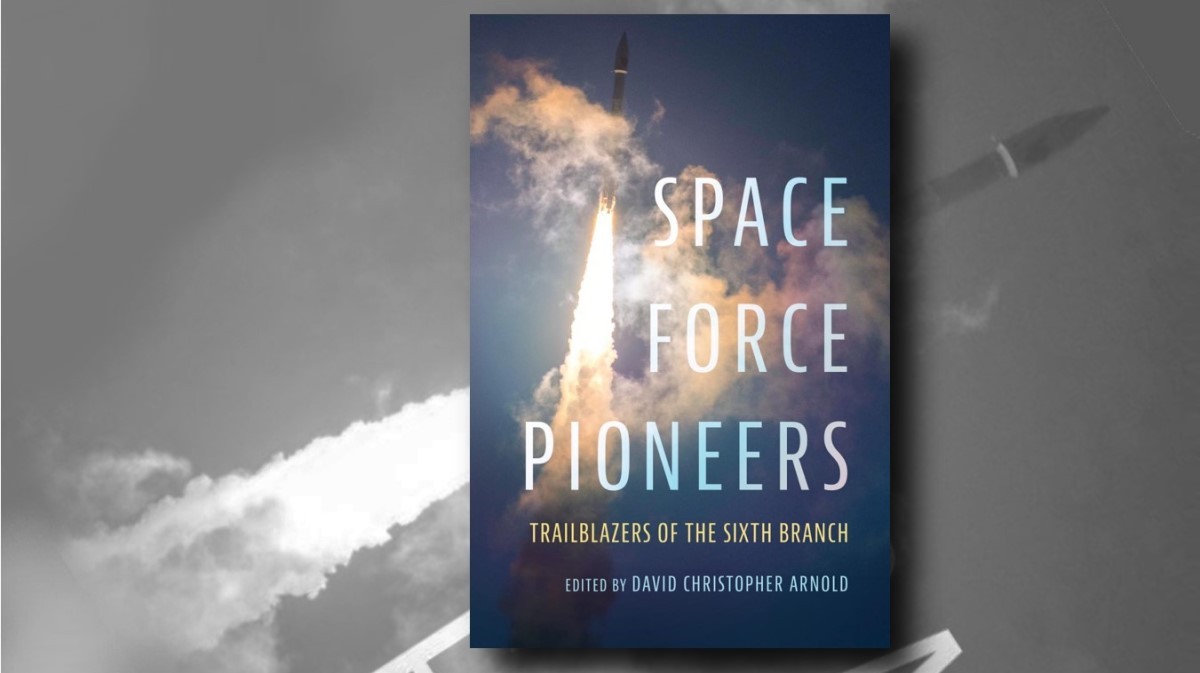
Trailblazers of the Sixth Branch

Naval Institute Press, 2024, ISBN 9781682471449, 328 pp USD$41.95
Edited by: David Christopher Arnold
Reviewed By: Steven Henry
Space Force Pioneers, edited by David Christopher Arnold, is far more than a historical account of the formation of the United States Space Force. It is, at its core, a study of leadership—technical, organisational, and cultural—told through the stories of the individuals who shaped America’s military space enterprise across decades. While its title suggests an institutional history, the book reveals itself to be something richer and more human: a deeply researched, candid examination of the personalities, decisions and innovations that have pushed the United States into the space age and continue to shape its future.
The book opens with an authoritative introduction, and a first chapter that sets the historical foundations for the study. Arnold and his contributors describe the evolution of American military space organisations from their earliest incarnations—often operating behind classified programs during the Cold War—through their emergence into mainstream joint operations. As space technology developed and the strategic value of space assets became undeniable, organisational structures shifted, responsibilities migrated, and once-specialised capabilities began to enter the broader military enterprise. These early chapters are clear, accessible and well-paced, providing readers who may not be steeped in space history with the context needed to understand the reasons behind the establishment of a dedicated United States Space Force in December 2019.
After establishing this groundwork, the book transitions into a biographical mode that becomes its enduring strength. Each chapter, comprehensively researched and written by individual authors, focuses on a key figure in the evolution of US military space power. These profiles are meticulously constructed, drawing on careful archival research, interviews, and a deep understanding of strategic context. Rather than glowing recollections of perfect humans, the book offers well balanced portraits: the triumphs, missteps, insights and blind spots of these leaders are laid out with refreshing honesty.
The early biographical chapters centre on the engineers, thinkers and operators who built America’s foundational space and missile capabilities, such as the Atlas, Titan and Minuteman Intercontinental Ballistic Missiles and the Explorer and Corona satellite programs. These individuals—many of whom laboured in obscurity for most of their careers—were pivotal in designing the technical architecture that still underpins modern space operations and capability development. Their stories illuminate the peculiar combination of engineering rigour, strategic foresight and bureaucratic persistence required to advance space projects in a system often resistant to change. For readers who have served in technical or acquisition roles, these chapters resonate especially powerfully.
One of the most striking contributions comes from Brian Ziarnick, whose chapter stands out not only for its scholarship but for its courage. Ziarnick challenges the prevailing narrative that General Bernard Schriever—the namesake of Schriever Space Force Base in Colorado—is the obvious ‘first guardian’ of American space power. Instead, he argues provocatively that General Thomas S. Power deserves greater recognition as the true visionary and more influential architect of America’s early space efforts. Whether one agrees fully with Ziarnick’s position or not, his argument is grounded, compelling and rigorously presented. It forces the reader to reconsider assumptions and engage more critically with the lineage of American military space thought. For anyone interested in progressive thinking about space power, Ziarnick’s writings are not just valuable—they are essential.
The book’s final third turns to the contemporary era examining, amongst others, the contributions of two of the most consequential leaders in recent US space history: General John Hyten and General John ‘Jay’ Raymond. The recency of their contributions makes their inclusion seem a little unusual in a largely historical recollection, but their inclusion is both appropriate and necessary to any retelling of the evolution of the modern US space enterprise. The establishment of the US Space Force is one of the most significant organisational changes in American defence in decades, and Hyten and Raymond were central to making it a reality. As outlined in these chapters, their leadership navigated not only bureaucratic resistance but also the rapidly accelerating pace of geopolitical competition in the space domain. The stories told here demonstrate that organisational change is not something that happens once in a founding moment; it is an ongoing process animated by leaders willing to challenge assumptions, articulate bold visions, and make difficult choices.
In a compelling conclusion, Arnold brings together the multiple threads of the book, arguing that the enduring lesson across all eras of military space development is the critical importance of visionary leadership. Technological progress alone is insufficient without leaders who can imagine futures not yet visible, inspire institutions to evolve and—perhaps most important—persist through the long cycles of resistance and inertia that characterise large bureaucracies. His assertion is not merely rhetorical; the preceding chapters provide case after case in which the trajectory of US space capability hinged on the decisions or persistence of individuals who were willing to push boundaries.
For international readers, Space Force Pioneers offers value beyond the specifics of the US organisational experience. The challenges, tensions and leadership dilemmas described throughout the book mirror those faced by military and civilian space agencies around the world. As nations including Australia wrestle with questions of organisational structure, talent cultivation, technological investment and strategic posture in the space domain, the lessons embedded in these biographies are highly transferable. The book demonstrates that space organisations succeed not only because of engineering prowess or strategic necessity but also because of people—leaders who can unify technical communities, integrate new capabilities, and shepherd cultural change across complex systems.
Ultimately, Space Force Pioneers succeeds as both a historical reference and a leadership study. It is accessible enough for general readers yet sufficiently detailed to serve as a useful resource for practitioners, scholars and policy professionals. Those in or aspiring to technical and engineering leadership roles will find in these chapters a wealth of insights about navigating innovation inside large institutions. Those interested in military history will appreciate the book’s clear lineage of ideas and personalities. And readers seeking inspiration will find numerous examples of individuals who advanced their fields not through perfection or infallibility but through persistence, curiosity and courage.
In short, Arnold has curated a volume that is not only informative but genuinely compelling—deeply researched, highly readable, and unafraid to challenge canonical narratives. Space Force Pioneers stands as a significant contribution to the literature on military space power, and an essential read for anyone seeking to understand how visionary leadership has shaped, and will continue to shape, our continuing journey into the space domain.