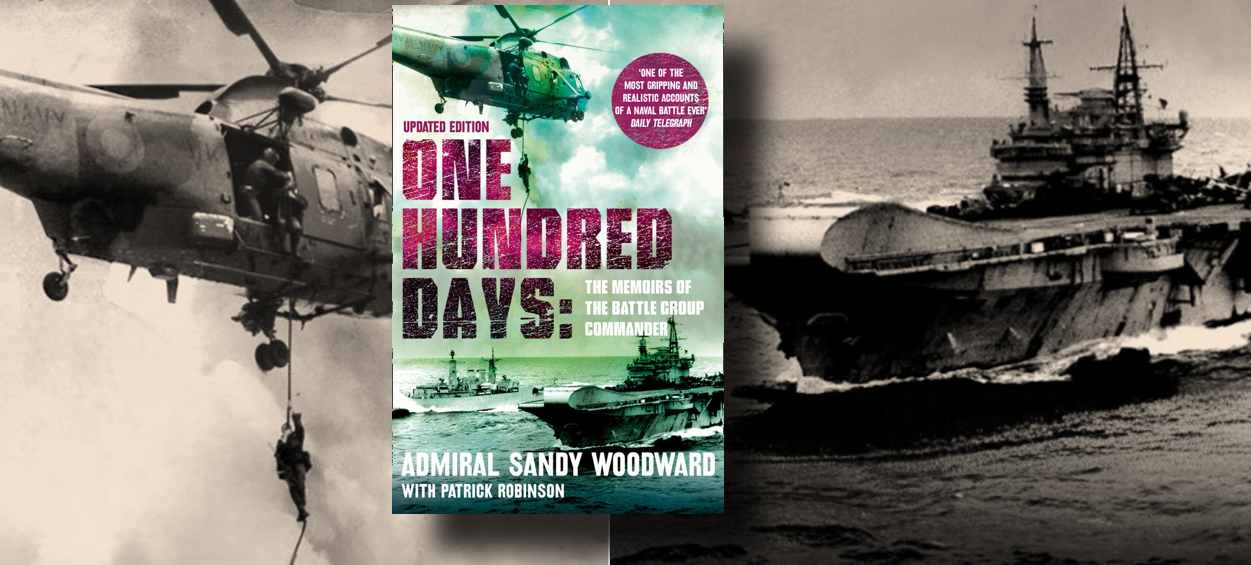
The Memoirs of the Falklands Battle Group Commander
HarperCollins, 3rd edition, 2012, ISBN 9780007436408 , 511 pp $22.99 (Paperback)
Author: Sandy Woodward, with Patrick Robinson
Reviewed By: Felicity Petrie
One Hundred Days presents Admiral Sandy Woodward’s personal account of commanding the Royal Navy’s Battle Group during the 1982 Falklands conflict. Rather than an official history, Woodward self-describes the book as a reflective narrative drawn from personal diaries. To modern military readers, it contains insight into the human pressures of high-stakes command, the strain of rapid mobilisation and force deployment, and the realities of fighting a technologically evolving maritime war at extreme range.
The Falklands War was a short but intense undeclared conflict fought over remote islands more than 12,000 kilometres from the UK. Argentina’s invasion on 2 April 1982 prompted a rapid British response. The political consensus of the time—reflected in former Prime Minister Margaret Thatcher’s 1992 foreword to the book’s first edition—emphasised territorial integrity and national resolve. Her assertion that “we, as a people, believe in the Rule of Law… we will not accept military hooliganism against us…” reveals both the sentiment and the strategic posture of the period.[1]
The third edition includes forewords and prefaces from earlier releases. These track Woodward’s evolving reflections—from defensiveness and self-doubt, to more measured assessments of the war’s purpose and cost. He notes that, over the course of the campaign, more British servicemen died than there were British civilians on the islands, prompting retrospective questions about “worthiness” and proportionality.
The opening chapter recounts the sinking of HMS Sheffield, an event that continues to shape modern naval thinking. For the Royal Australian Navy (RAN) and many allied navies, the loss of Sheffield remains a powerful reminder of the persistent threat posed by anti-ship missiles and the enduring importance of layered air and missile defence, ship survivability, and coordinated, integrated operations in contested maritime environments.
This is followed by a recount of the sinking of ARA General Belgrano, an Argentinian light cruiser—the first vessel sunk by a nuclear powered submarine during military operations—and concludes with the return home of the UK Battle Group 100 days after departure. From there, the narrative moves chronologically through Woodward’s naval career, and the Falklands War conflict in greater detail.
Throughout the book Woodward candidly highlights the consequences of prolonged austerity on the Royal Navy, and the effect this had on the rapid generation of the task force. He reveals capability gaps, limited ship numbers, and a shortage of experienced personnel. Indeed, after setting sail the task force was required to engage in a period of learning. The lean years prior to the conflict had diminished the warfighting skills of personnel across the board, and with this required a decisive shift in posture. As he notes,
War requires a complete change of attitude… the emphasis shifts from avoiding the low chance of a silly accident, to dealing with the high chance of destruction by the enemy… we had to learn fast that limits were still required. More than once, we found out the hard way.[2]
Indeed, it is this sentiment which stands out in particular from One Hundred Days for the contemporary Australian Defence Force (ADF). In essence, the Falklands War exposed a disconnect between the training the UK forces were undertaking and the operations they were expected to carry out in war. The book is therefore a telling reminder that, in peacetime, the ADF must train as it intends to fight so that the force is ready for the contingencies that may come.
The Falklands campaign required integrated maritime, land, and air operations at a scale and distance not attempted for decades. As the Australian Army continues its pivot into a force that places littoral warfare at the ‘center’ of its ‘ethos, mindset, investments and training’,[3] Woodward’s One Hundred Days offers many considerations for these complex operations. In particular, Woodward illustrates the interdependence of sea control, amphibious operations, and land manoeuvre for the operational success in the Falklands.
Woodward led a naval task group (of both military and civilian vessels), required to secure the air and sea lines to enable the amphibious landing of troops, and then provided support for the land forces to reclaim the Falklands. His reflections, drawn from the diaries he kept at the time, reinforce points now central to joint doctrine: logistics determines tempo, range determines survivability, and maritime forces must enable land forces without becoming overextended.
This detailed and personal account by the commander of a combined force, conducting integrated operations in austere and contested conditions, offers much for contemporary military professionals to consider. Woodward's reflections on command across vast distances, coordination between military and civilian organisations, and the limitations of communications systems demonstrate challenges that remain familiar despite significant technological advances. He also highlights the enduring reality that even clear and concise orders can be interpreted differently by individuals operating under pressure and in conditions of uncertainty. Above all, the narrative reinforces a central lesson of the Falklands campaign: operational success depends on the ability to sustain forces over long distances and to coordinate air, maritime, and land capabilities in support of a shared objective, often pushing each element of the force to the limits of its capacity.
Woodward also raises numerous questions relevant to contemporary military planners. With modern long-range weapons, persistent surveillance, and autonomous systems, where—if anywhere—is a capital ship safe but also able to contribute tangibly to an operational outcome? Also, how would the ADF fight a similar conflict today, and could it sustain the required logistics? The book therefore offers much food for thought and prompts us to question some of the assumptions that underlie our planning.
One Hundred Days is a valuable read for all members of the ADF’s profession at arms. For those without maritime experience, it clarifies and makes painfully real the complexity of naval operations supporting land forces, and vice versa. For joint planners, it provides insight into integration, communications, and the limits of force projection. The book remains a timely study of, and reflection on, a hard-fought littoral campaign, and one which offers much food for thought to Army professionals for how such campaigns may be fought in future.
Endnotes
[1] Margaret Thatcher, ‘Foreword to the First Edition’, in One Hundred Days: The Memoirs of the Falklands Battle, by Sandy Woodward with Patrick Robinson (HarperCollins, 2012), [pp xiii]
[2] Sandy Woodward with Patrick Robinson, One Hundred Days: The Memoirs of the Falklands Battle, 3rd ed. (HarperCollins, 2012), [pp 137].
[3] The Australian Army Contribution to the National Defence Strategy 2026 (Australian Army, 2026), 1, available at https://www.army.gov.au/our-work/strategy/australian-army-contribution-….