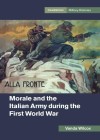
Cambridge University Press, 2016, ISBN 9781316610152, pp. 226 paperback, $64.00
https://doi.org/10.1017/CBO9781316661840
Author: Vanda Wilcox
Reviewed by: Jordan Beavis
The reader of this review may wonder why a book published in 2016 has been reviewed in 2026. In the past ten years, the world and the study of its history has changed much. New historical analyses are continually produced, each containing new interpretations on old events – even those as well researched and studied as World War One. Most, but not all, such books have interesting (and fresh) arguments to make. New problems are rarely ‘new’, and to help us face them we look to deep bodies of literature for inspiration, guidance, or even examples to avoid – acknowledging significant temporal and cultural differences between the topics being studied and Australia and its Army in the latter half of the 2020s.
Vanda Wilcox’s Morale and the Italian Army during the First World War (hereafter referred as Morale and the Italian Army) is one such book. Based on Wilcox’s doctoral thesis and published in 2016 by Cambridge University Press, it is a book that has appeared on this reviewer’s ‘To Read’ list since the author appeared on the Wavell Room podcast in a September 2019 episode tellingly entitled, ‘How to Not Manage Morale’.[1] Here, Wilcox explored how the Italian Army of the First World War is perhaps one of the worst models for morale and discipline management a modern force could ever emulate. Even a cursory read of Morale and the Italian Army reveals that this may be an understatement.
Through seven chapters, an introduction and a conclusion, Wilcox presents a comprehensive analysis of how the Italian Army aimed (or didn’t) to support the morale of its troops while it was engaged in a brutal and often unpopular war against the Central Powers – primarily Germany and Austria-Hungary. Wilcox’s wide-ranging and thorough research permits her to assess the approaches to fostering morale from both top-down and bottom-up perspectives, gauging the effectiveness of policies instituted by the Italian high command to encourage their troops in battle, and how Italian soldiers voted with their feet as a result.
Morale and the Italian Army opens with a comprehensive introduction, which can stand alone as an important piece on the fundamental value of studying and measuring morale. As Wilcox notes, ‘morale’ as a concept is exceedingly hard to nail down – it is ‘the great intangible of military affairs, difficult to define and to assess, and even harder to analyse historically; it acts as both cause and effect, and is always subjective’.[2] For a definition of the concept, Wilcox relies on that provided by Jonathan Fennell in 2011 which states that ‘[m]orale can be defined as the willingness of an individual or group to prepare for and to engage in an action required by an authority or institution’.[3] Morale is never static, and ebbs and flows according to war’s changing context. Further, as modes of warfare change, so do the challenges of maintaining morale among both soldiers and civilians. Wilcox nonetheless identifies four primary influences on combatant morale: leadership, discipline, positive incentives, and combat readiness, with these forming the lens through which this case study on Italian army morale is assessed through subsequent chapters.
In the limited space available in this review, it is difficult to provide an effective summary worthy of the book’s substantive chapters. Nonetheless, in Part I (Chapters 2 – 5), Wilcox explores the influence of institutional factors including leadership, command culture, organisation, incentivisation, discipline, and combat readiness. Prior to World War One (and in its early years), the Italian Army had little understanding of the importance of fostering morale among its personnel – instead emphasising discipline (expressed in a penal code the Army inherited from the pre-unification Piedmontese Army of the 1850s that remained in effect) and adherence to orders. Leadership and command culture were exceedingly poor – leadership was not emphasised in training, the Army’s officers were not promoted on merit, and all lived in fear of summary dismissal from their posts. Between July 1914 and November 1917, for example, more than 800 officers (including 217 generals) were dismissed by Luigi Cadorna in his role as Chief of the General Staff. There was little to no attempt given, prior to Cadorna’s own dismissal, of educating Italian solders (principally conscripted) on the need for or goals of the war. This was a significant leadership failure given the fractious and disunited society within Italy throughout the conflict. There was also little incentive for the conscripts to fight, beyond fear of the harsh punishments on offer. The Army was largely composed of ill-educated peasant soldiers who were underpaid, underfed, undertrained, underequipped, and underappreciated – all of which relentlessly undermined morale.
Part II of the book explores the experiences of the soldiers themselves, and covers aspects such as identity, consent and compliance, indiscipline, protest, and mental exhaustion, prior to finishing in a brief conclusion. In an entirely agreeable section, Wilcox emphasises that the ‘will to fight depends in part on an individual’s perception of himself as a soldier’.[4] Given their poor treatment and lack of training, Wilcox shows how many Italians struggled to conceive of themselves as soldiers, and notes that when their duty as soldiers and their duty to their country conflicted with their duties to their family, the family won out every time. Yet, somewhat in spite of this, Italian peasant soldiers nonetheless demonstrated an ‘astonishing endurance’ in the ‘face of almost unimaginable hardship.[5] In Chapter 7, the author explores the different contexts for the development of morale between average Italian Army units, and elite units such as the Alpini, Arditi, and Bersaglieri. Perhaps unsurprisingly, these elite units generally performed better and arguably maintained a higher degree of morale due to the better conditions they served under and the training they received – a result that showed how poorly the average conscript was treated by the institution.
Wilcox’s study of the Italian Army’s morale and discipline during the war rarely generates lessons or observations that modern military forces might want to emulate. Indeed this force suffered one of the highest desertion rates among combatants in that war (though many voluntarily returned to the frontlines). Further, as a proportion of the overall force, it executed more of its soldiers for desertion or ill-discipline than many other (and larger) armies, with a total of 4,028 capital sentences passed, of which 750 were carried out.[6] While morale and discipline remained a weakness for the Italian Army throughout the conflict, following the disastrous defeat at the Battle of Caporetto in 1917 a change in the Army’s high command finally allowed for substantive improvements. Such improvements aimed merely to treat the soldiers more humanely by displaying greater consideration for their concerns as citizen-soldiers conscripted into a brutal war, while educating them on Italy’s justification for fighting the war. Such improvements had a positive effect on the Army’s performance, and allowed it to remain in the field until the end of the war. Indeed, that it did so (even achieving a decisive victory at Vittorio Veneto in October 1918) was perhaps against all odds, as Wilcox relates:
Despite the appalling physical environment; the flaws in strategy, operations and tactics; the lack of clear political consensus within the country or of convincing endorsement by all sectors of civil society; despite the weakness of Italian national identity in this period; despite high rates of desertion and indiscipline, the Italian Army fought on until the enemy was defeated.[7]
Morale and the Italian Army is an excellent case study in how military institutions should not manage morale. Its only drawback for the casual reader is that, as a case study, it often presumes some knowledge of the Italian campaigns. New readers to this topic should therefore first prepare themselves by reading a broader surveys of the Italian Front, such as that contained in Nick Lloyd’s The Eastern Front: A History of the First World War (2024) or Mark Thompson’s The White War: Life and Death on the Italian Front, 1915-1919 (2008). Nonetheless, this book should be read widely. In light of Chief of Army, Lieutenant-General Simon Stuart’s, focus on self-regulation as a pillar of the Army Profession, and the Australian Defence Force’s renewed focus on large scale combat operations, Wilcox’s book is scholarly, insightful, essential reading. Indeed, it would make a fine addition to a future iteration of the Chief of Army Professional Study Guide.
Endnotes
[1] Vanda Wilcox, ‘How to Not Manage Morale’, 14 September 2019, Wavell Room, podcast, available at https://wavellroom.com/podcast/how-to-not-manage-morale/. Since publication of this book and this podcast appearance Wilcox has published a second book. See Vanda Wilcox, The Italian Empire and the Great War (Oxford University Press, 2021).
[2] Vanda Wilcox, Morale and the Italian Army during the First World War (Cambridge University Press, 2016), 4.
[3] Wilcox, Morale and the Italian Army, 5.
[4] Wilcox, Morale and the Italian Army, 121.
[5] Wilcox, Morale and the Italian Army, 138.
[6] Wilcox, Morale and the Italian Army 76-78. By way of comparison, the British Army issued 3,080 death sentences in the war, 346 of which were carried out; the French condemned 2,000 and executed 600-700; while the German Army issued 150 sentences and carried out approximately 48. The Italian figure of 750 does not include a further 296 other cases of summary execution which occurred on or near the battlefield.
[7] Wilcox, Morale and the Italian Army, 3-4.