Case Studies on the Integration of Air Power on the Battlefield
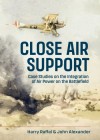
Helion & Co, 2024, ISBN 9781804515358, 256 pp
Editors: Harry Raffal & John Alexander
Reviewed By: Lachlan Trott
Commanders have long faced the dilemma of prioritising air assets. Since the inception of airpower over a century ago, there has been an ongoing need to balance support for ground forces with concurrent operational-level targeting, and tensions remain.
Close Air Support: Case Studies on the Integration of Air Power on the Battlefield. The book has its origins in a 2023 Royal Air Force (RAF) and British Commission for Military History conference on this topic. The list of contributors is impressive, and includes a range of historians, academics, public servants and RAF personnel. It also features a concise foreword by Sebastian Cox, the Head of the RAF Air Historical Branch. Organised into a series of case studies covering the period from the First World War through to the Global War on Terror, and including an introduction and analytical conclusion, the book covers much ground.
In their introductory chapter, Raffal and Alexander state that their aim is to examine ‘how, and when, close air support can influence the battlefield.’[1] The first three case studies, covering the First World War, illustrate the cultural and technological obstacles that influenced early ‘low-flying work.’ Struggling to quantify the effect they were having on the battle from air interdiction missions, fighter pilots preferred air-to-air combat and embraced the idea of the ‘score,’ where shooting down an enemy plane added to a pilot’s tally.[2] Casualty rates were extreme, with one pilot being shot down three times in a week and certain RAF squadrons losing on average 75 per cent of their pilots each month.[3]
Chapters 3-4, written by Mike Meech and Geoffrey Vesey Holt respectively, provide insight into the development of additional roles for aviation. These roles included reconnaissance, communication and control. The influence of weather on air power is illustrated through a vignette on the Tank Corps’ experience of planning assaults with integrated aviation support. The authors conceptualise air-land integration where the ‘cooperation of aeroplanes with tanks is of incalculable importance, the aeroplanes protecting the tanks and the tanks protecting the infantry.’
Close Air Support’s fifth chapter explores US aviator William C. Sherman’s concepts for ground attack aviation, developed during the interwar years. A common theme through the book, and the history of aviation, is the struggle between prioritisation of efforts and taskings. Broadly, aviators saw merit in conducting their own missions, prioritising strikes on operational targets or maintaining control of the air. Simultaneously, ground force commanders viewed aviation’s primary role as being to support them in battle.[5] Sherman identifies potential command and control arrangements, similar to modern-day operational control (OPCON), that would allow for tasking by (but not subordination to) ground forces.[6] The chapter relies heavily on Sherman’s own work, Air Warfare, but effectively summarises key concepts and ideas of the time.
Chapters 6-8 comprise case studies from the Second World War. They examine the continued tension between centralised control of air power and its employment in direct support of ground forces. Chapter 6, which is a case study on Malaya in 1941-42 by Harry Raffal, is well researched and provides numerous clear lessons learned that apply to practitioners and planners today. These include the importance of decentralised command in a communications-degraded environment, the persistent requirement for air superiority and the necessity of integrated training before conflict. Unfortunately, John Alexander’s contribution, which explores General Bernard Law Montgomery’s development as a leader (Chapter 7), is the most tangential to the book’s central thesis. While providing a differing disciplinary approach to the history of CAS, it lacks the same depth of analysis and, unlike other chapters, does not distil key lessons.
The final four chapters cover the entire period from the end of the Second World War to Afghanistan. Indeed, the book would have benefited from further chapters on the post-war period in order to reinforce the enduring relevance of CAS on the battlefield. For example, a single case study (Chapter 9) is provided on Vietnam, focusing on the employment of helicopter gunships to supplement field artillery units. In Chapter 11, Gus Macdonald observes that CAS peaked during the Korean War, yet no chapter on this important conflict is included, and it only receives a brief mention elsewhere in Close Air Support.[7]
Despite relative lack of contemporary example, there are nevertheless some valuable observations in the closing chapters of the book. For example, chapter 10 covers the use of CAS in the Falklands Campaign and is an effective reminder of an all-too-common failure to implement lessons learned from prior conflicts. Macdonald’s exploration of CAS in Afghanistan (Chapter ?) is the strongest case study. It includes concise excerpts of CAS missions prefaced by the situation faced by commanders at the time and followed by an assessment of events with lessons and considerations clearly discussed. This chapter is one of the few that prioritise assessment of scenarios supported by historical anecdote rather than a history where the reader is left to assess their own lessons learned.
Raffal and Alexander’s concluding chapter is particularly strong and compensates for the limited analytical depth evident in several of the presented case studies. Here, the authors make a concerted effort to examine the overarching utility of CAS. The scope of discussion is broad. It includes: the psychological impact of CAS; how it can achieve decisive effects; training and preparation for its employment; communications requirements; its limitations and flexibility; precision guided munitions and how they change the roles and situations where CAS can be employed; the suitability of specific aircraft for CAS tasks; budgetary limitations in the procurement of CAS; the balance of air power in support of operational and strategic missions; the requirement for air superiority; and a very short section on Ukraine. A well-rounded conclusion, this chapter could be read independently of the case studies contained within the book.
In summary, Close Air Support: Case Studies on the Integration of Air Power on the Battlefield offers a well-researched and diverse historical account of CAS, drawing on a wide range of authors and disciplinary perspectives. The book’s heavy emphasis on the First and Second World Wars, coupled with comparatively limited treatment of Korea, Vietnam, and contemporary conflicts, however, constrains its ability to fully realise its stated aim of examining how and when CAS influences the modern battlefield. It is unfortunate, as well, that the editors did not include a glossary—a feature that would have made the book significantly more accessible for the generalist or non-academic reader.[8] For historians and academics, the book provides an interesting exploration of various battles. On the military side, the book is most suited for operational-level commanders and staff, with its conclusion stating clear lessons for future implementation. Close Air Support is best approached as a unique history of CAS, of which one could draw many lessons for the future battlefield if they are willing to engage critically with the material.
Endnotes
[1] John Alexander and Harry Raffal, ‘Introduction’, in Close Air Support: Case Studies on the Integration of Air Power on the Battlefield, ed. Harry Raffal and John Alexander (Helion and Co, 2024), 21.
[2] Mike Terry, ‘’Everything was Sheer Chance’: No. 46 Squadron’s Experiences with Close Air Support on the Western Front, 1917-1918’, in Close Air Support: Case Studies on the Integration of Air Power on the Battlefield, ed. Harry Raffal and John Alexander (Helion and Co, 2024), 33-4.
[3] Alexander and Raffal, ‘Introduction’, 20; Terry, ‘Everything was Sheer Chance’, 32.
[4] Geoffrey Vesey Holt, ‘Close Air Support to the Tank Corps in the First World War: A Developing Success’, in Close Air Support: Case Studies on the Integration of Air Power on the Battlefield, ed. Harry Raffal and John Alexander (Helion and Co, 2024), 84
[5] Sebastian H. Lukasik, ‘’New Vistas of Usefulness’: William C. Sherman and the Development of Ground Attack Aviaition in the United States, 1919-1927’, in Close Air Support: Case Studies on the Integration of Air Power on the Battlefield, ed. Harry Raffal and John Alexander (Helion and Co, 2024), 89
[6] Lukasik, ‘New Vistas’, 90
[7] Gus Macdonald, ‘Close Air Support in Afghanistan – an RAF Tornado Perspective’, in Close Air Support: Case Studies on the Integration of Air Power on the Battlefield, ed. Harry Raffal and John Alexander (Helion and Co, 2024),197.
[8] For example, demonstrating the difference between air superiority and air supremacy.