Author: Oleksandra Molloy
Introduction
This is part two of a Land Power Forum series exploring 12 prevalent myths concerning the use of uncrewed systems (UxS). Using the Russia-Ukraine War as a frame of reference, the first six myths covered assumptions around whether drones replace people, perceptions as to their simplicity and cost-effectiveness, and their implications for institutional reform. Each myth was countered by the operational realities that prevail on the battlefield. This second part of the series explores a further six myths, including questions on the ongoing relevance of traditional concepts of military capability, drone susceptibility on the battlefield, and likely future directions in drone technology.
Myth 7: Drones have killed manoeuvre warfare; tanks and large formations are obsolete
Operational reality. A popular misconception circulating in Western military circles is that the proliferation of drones – especially intelligence, surveillance and reconnaissance (ISR) drones and first-person view (FPV) kamikaze systems – has ended manoeuvre warfare. Some insist that tanks can no longer operate, large movements are impossible, and that the battlefield has become permanently static. This view misinterprets the battlespace that currently exists in Ukraine. Drones have made manoeuvre more difficult, but not impossible. The battlefield is in an evolutionary – not revolutionary – phase, and smart people are finding ways to negate drone effects. In reality, manoeuvre warfare will evolve and return.
The widespread use of drones has undeniably increased battlefield transparency and lethality, making large-scale movement and massed formations more hazardous. Adaptations in manoeuvre warfare methods have therefore been necessary. These have included the introduction of new countermeasures, tactics, and organisational responses to drone-enabled surveillance and strike. The following examples are relevant.
Firstly, rather than eliminating the need for movement and shock, drone warfare has strengthened the find-and-fix functions of the kill chain. Armoured and mechanised forces remain essential for breaching, exploitation, and control of terrain. What has changed is the requirement for dispersion, deception, and integration of armoured capabilities with counter-UAS and electronic warfare (EW). Ukrainian and Russian forces have both adapted by reducing formation density, improving camouflage and concealment, and synchronising manoeuvre with EW and fires to disrupt enemy drone reconnaissance.
Secondly, the Russia-Ukraine War demonstrates that battlefield dominance fluctuates with the balance between sensors and countermeasures. Periods in which drones have appeared decisive on the battlefield have often been followed by phases in which jamming, physical obstacles, and air defence have reduced their effectiveness, enabling renewed manoeuvre. The introduction of fibre-optic drones, terrain-masking flight profiles, and decoys reflects an ongoing contest between reconnaissance and concealment rather than the permanent triumph of one over the other.
Thirdly, armoured warfare has adapted rather than disappeared. Tanks and infantry fighting vehicles continue to play critical roles in assault and defence, but with modified tactics: operating in smaller packets, using extensive engineer support, and coordinating closely with ISR and fires. Ukrainian counteroffensives and Russian defensive operations alike have shown that, while armoured breakthroughs are harder to achieve, they remain operationally necessary for exploiting tactical success and achieving decision at scale.
Finally, historical patterns caution against premature claims of obsolescence. Consider, for example, previous technological shocks – machine guns, precision-guided munitions, and airpower – were each declared the ‘end’ of manoeuvre warfare. Yet all were ultimately absorbed into evolving combined arms concepts. Drone-enabled surveillance represents a further increase in battlefield lethality, but it does not negate the enduring requirement for manoeuvre to dislocate the enemy, seize ground, and impose operational dilemmas.
In operational reality, manoeuvre warfare is not obsolete. Instead, it is being reshaped by a new balance between detection and denial. The contest is shifting toward who can better integrate drones, EW, deception, and armour within combined arms formations. Events on the battlefield in Ukraine suggest that advantage will accrue to forces capable of suppressing enemy sensors long enough to enable movement and mass effects at decisive points. While drones have raised the cost of manoeuvre, they have not eliminated its necessity.
The force design decisions made by the Australian Defence Force (ADF) and its partner forces in NATO should not abandon armoured or manoeuvre formations. Rather they must invest in measures to restore manoeuvre under drone threat: counter-UAS, electronic warfare, smoke and obscuration, decoys, engineering support, and tighter integration of ISR and fires.
The current phase of the war thus reflects an adaptive struggle between surveillance and manoeuvre rather than a definitive victory for either.
One NATO Colonel asked me a question: “Why isn’t Ukraine conducting manoeuvre warfare?” Good question – in one sense. In another sense it shows someone who looks but does not see. Two answers: (1) Manoeuvre warfare is extremely demanding in terms of command and control coordination. Current military management and competence levels are insufficient; (2) Manoeuvre warfare under dense drone saturation is unclear even for NATO commanders. NATO standards may be higher, but would they succeed in this reality? To manoeuvre you must concentrate forces, and now you can’t. Even when a soldier casually leaves the garrison and goes to pick up weapons, a strike can hit him. Should you manoeuvre? Yes. How to do it under these conditions? That is the real question. And another question: When was the last time you were on the zero line, under dense drone saturation? (P3)
That’s just how it is at the moment. Western armies are getting there, but we fought in the desert for so long against a force, but without big front lines, just sporadic pockets of action. Now what we are seeing is large scale operations with a massive front line. This is not how we’re mentally trained or prepared to fight at the moment. I think that's a big learning curve that we haven’t quite got to yet. Well, I think we’re working on it, but we aren’t quite there yet. (P13)
Myth 8: Soon there will be no radio-controlled drones on the frontline, and they will be replaced by fibre-optic drones
Operational reality. A common misconception appearing in Western discussions is that fibre-optic drones are the future and will eventually dominate the battlefield, rendering radio-controlled FPV drones obsolete. This is a complete myth from both a practical and tactical perspective.
The myth about drones is that soon there will be no radio-controlled drones on the front, and they’ll all be replaced by fibre-optic drones. This is an absolute myth. It’s unrealistic – not because these drones cannot be produced, but because of the tactics of how they are used. First, fibre-optic drones move more slowly; they fly at roughly 30-40 km/h. Second, they are less manoeuvrable, and their use is significantly more limited than radio-controlled drones. It is also important to understand how fibre-optic drones are used tactically. In sectors where assault and offensive actions are underway on new terrain, fibre-optic drones are often used to knock out electronic warfare (EW) systems, because EW does not work against fibre-optic control. After EW is suppressed, radio-controlled drones can then fly more freely. Why is this still a myth? Because radio-controlled drones are much cheaper. They are easier to manufacture, easier to operate, and far easier to scale. They also carry a larger explosive payload. So yes, fibre-optic drones will occupy a certain share – currently around 25-30 per cent of the total mass of drones in some contexts – but they are unlikely to fully replace radio-controlled drones. (P15)
Myth 9: Drones are simple because they are cheap and built in Ukraine (the myth of simplicity)
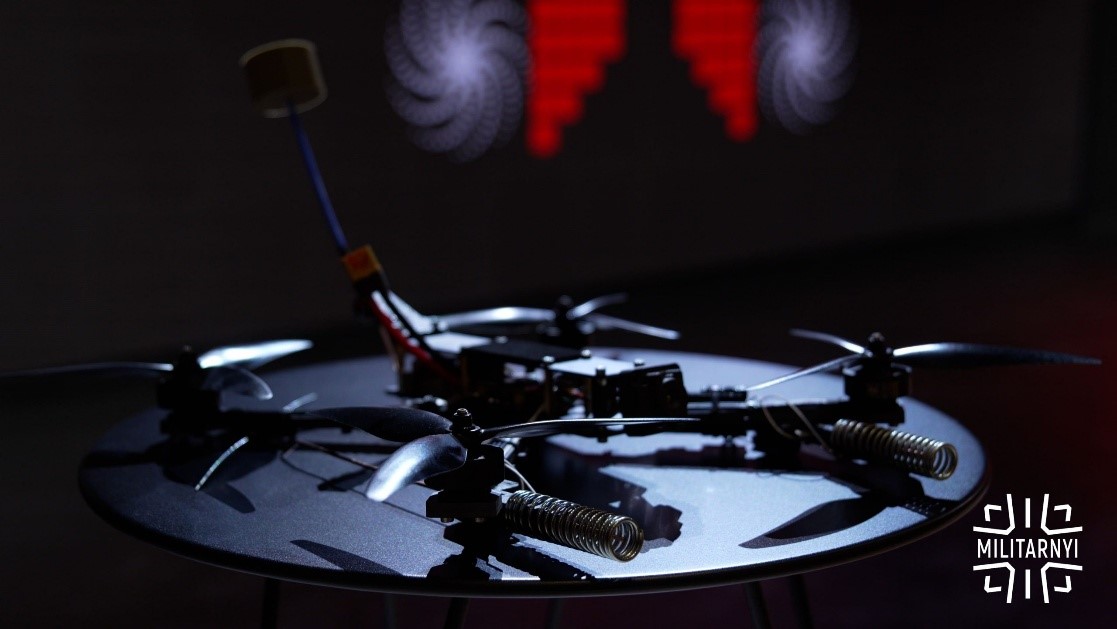
Operational reality. The media often portrays drone warfare as a single operator with a cheap remote, and Western observers often equate ‘cheap’ with ‘simple’. And because Ukraine produces millions of inexpensive FPV drones, many assume these platforms require little training and minimal technological sophistication (see Figure 1).
The truth is much more complex. A successful strike on a tank involves a sophisticated ‘kill chain’. Further, even inexpensive drones demand highly skilled operators, in complex support ecosystems, that rely on advanced ISR, autonomy, and the integration of command and control systems. Indeed, the ‘cheaper’ the drone, the more skill is required from the operator. This is because FPV drones lack stabilisation and require fine motor control and rapid decision-making. Further, pilots must fly visually through low-resolution goggles to simultaneously navigate, avoid fire, recognise targets, and maintain flight stability. This task imposes extreme cognitive load. It is only the more expensive drones, with more sophisticated internal systems, that take over some of the human pilots’ tasks, freeing them for higher-level decision-making.
The myth of simplicity misleads Western militaries into underestimating the training burden, human factors, and technical complexity behind Ukrainian drone operations. This finding is well illustrated by the following excerpts from our research:
Although FPV drones appear low-cost, the entire ecosystem is technologically sophisticated: ISR drones performing autonomous waypoint navigation; onboard processing; target detection; integration of FPV strike drones; multi-layered kill chains. FPVs are just the “last step” in a high-tech process that includes autonomous ISR drones flying pre-planned routes; AI-supported camera feed interpretation; multi-drone coordination; rapid target data transfer. The public sees only the final strike. The underlying architecture is vastly more complex. Before a tank is hit by an FPV, at least one ISR drone has autonomously identified it, tracked it, and passed targeting data. (P17)
Behind the scenes there are very smart and complex drones involved in the whole targeting process. ISR drones can fly themselves on waypoints… operators just set points on a map. That’s much more complex than what the media is portraying. A successful strike on a tank involves a sophisticated “kill chain”:
- Complex ISR (Intelligence, Surveillance, and Reconnaissance): Higher-end drones fly autonomous waypoint patterns using Google Maps overlays. The operator doesn’t “fly” the drone; they focus entirely on the camera feed to find targets.
- The “Brain” Transfer: We are moving the “brain” of the operator onto the drone itself. As the drone becomes more autonomous, it becomes significantly harder to defend against. (P17)
The last 12-18 months have seen significant growth and change driven directly by Ukraine. We have started to progress from basic drone use to over 20-ish various types of drones… and we are now in the next six months starting to look at employing live munitions dropped from UAS and also fibre-optic cable-controlled UAS. (P11)
What I have seen is [a] definite rapid increase in use informed by current conflicts and lessons learned… and also the lessons that are reported through the ‘Battle labs’ or other avenues. For me, it’s the tactical employment and everything that feeds into that, logistics and otherwise, its power management, and then airspace management. The ADF is actively and quickly adapting small UAS and C-UAS, based on Ukraine’s experience, with concrete experimentation and doctrinal implications already underway. (P11)
Myth 10. Drones are a ‘silver bullet’ and all countries should adopt the drone centric warfare
Operational reality. Drones (especially FPVs) have proven highly destructive when paired with skilled operators and tactics. Small drones can inflict a lot of damage. When well piloted, they can destroy tanks and artillery systems and inflict serious damage to the capabilities of the enemy. They are not, however, a ‘silver bullet’– they cannot solve all battlefield problems.
Drones have fundamentally changed the character of war. But their effectiveness lies not in platform sophistication, but in cost-exchange ratio, operator skill, and integration into combined arms operations. Ultimately, drones have transformed the way modern warfare is conducted, even while traditional forms – such as trench warfare – continue to exist.
The biggest takeaway around that untruthful myth is really that drones are going to do everything… as long as we’ve got more drones, we’re going to be fine. And I just don’t think that's the case. Drones are context-dependent, and that no drone system is a “silver bullet”. The importance lies in integrating UAS into a broader combined-arms ecosystem, not relying on drones alone. (P23)
I think one of the biggest myths about drones is that they are a silver bullet and that all countries should now adopt fully drone-centric warfare. There is this belief that states should simply invest heavily in drones, buy large numbers of them, and that all battlefield developments are now moving exclusively toward unmanned technologies. This is not true. Drones are complementary to other weapon systems and traditional capabilities. They do not replace them. Ukraine, for example, would clearly benefit from having more conventional systems as well, not only drones. Ukraine is using drones largely out of necessity, rather than simply because they are revolutionary or can do everything on the battlefield. That said, one of the key realities we are seeing is that small, low-cost attack drones can inflict significant damage. These inexpensive systems have destroyed traditional military equipment such as tanks and artillery systems. When used with sound tactics and strong military leadership, they can seriously degrade enemy capabilities and have a disproportionate impact on the battlefield. (P29)
We’re certainly seeing that drones have changed the way that warfare is being fought. We’re still seeing traditional trench warfare… but then we’re also seeing the introduction of drones to advance that and provide that capability multiplier. Drones now serve as a capability multiplier, reshaping ISR, precision strike, targeting cycles, morale effects, and tactical tempo. (P29)
Myth 11. Autonomous killer drones (or true swarms) are operational combat realities today
Operational reality. While drones are powerful weapons, they remain inseparable from human operators and reconnaissance systems. They do not function as independent killing agents; they operate as components within a broader, human-controlled kill chain.
Further, claims as to the existence of operational drone ‘swarms’ conflate ‘coordinated employment’ with ‘true swarm autonomy’[1]. In Ukraine, mass drone attacks are typically synchronised through human planning and pre-programmed routes rather than through self-organising collective intelligence. These are centrally coordinated salvos, not emergent, autonomous swarms capable of independent adaptation. The distinction is critical: a swarm implies decentralised machine decision-making, whereas current practice relies on human-directed mass and timing.[2]
In drone warfare, the decisive variable is not autonomous lethality. It is instead the enhanced capability that can be generated from human–machine teaming and organisational integration.[3] The following excerpts from our research are relevant in this regard:
When you think that they would get killer drones that are deployed by a mothership and they fall down from the sky to the city and recognise your face and do a precision strike. That’s a vision. We’re far from that, very far from that industrial reality, fortunately. Swarming technology is far from being there yet. Autonomy and AI? No, it doesn’t work. True autonomous swarms or AI killer drones exist today. Swarming? The technology is far from being there yet. Nothing from civilian AI works in combat. Western media exaggerates autonomy; Ukraine’s reality is human-driven, high-risk, high-loss, rapid-iteration warfare. (P26)
Drone adoption is not about drones… it changes everything: planning, correction, TTPs. It changes a lot of things. Drone-enabled ISR, logistics, and strike define tempo, survivability, and lethality. We’ve been doing this for six years. We had 18 drones, then 30 companies came through. We still don’t have 700 drones that work perfectly. (P26)
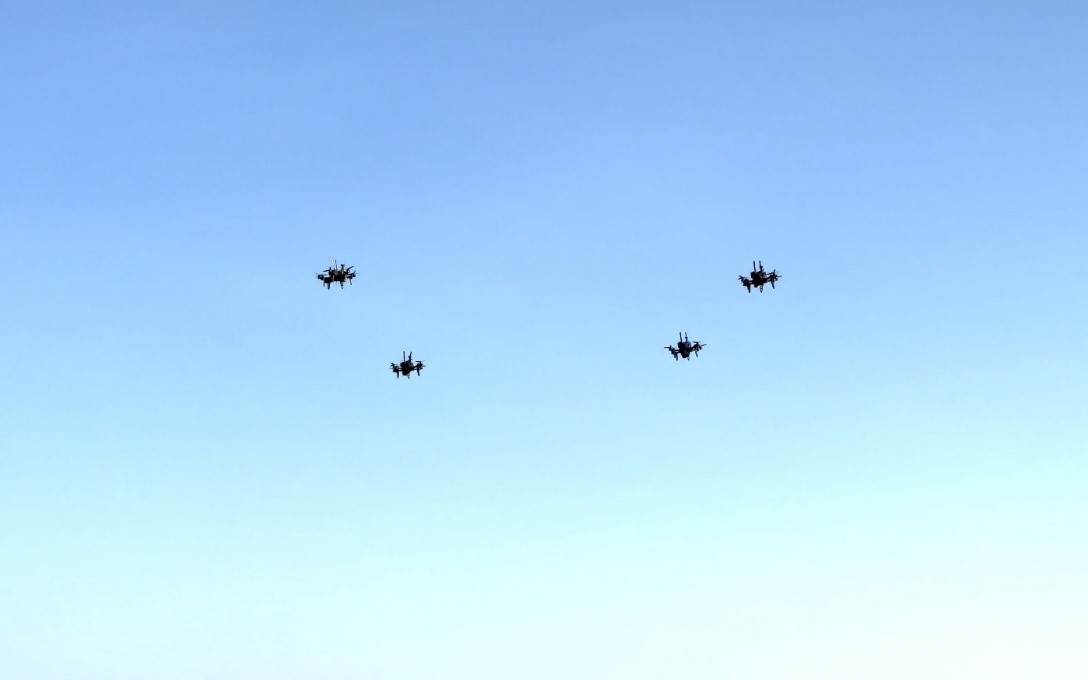
Successful testing and experimentation of swarm technology has been evident on the battlefield in Ukraine to lay mines, to target Russian soldiers, equipment and infrastructure (see Figure 2). The swarm technology represents the next frontier for drone warfare because of its potential to allow tens or even thousands of drones – or swarms – to be deployed at once to overwhelm the defences of a target, be that a city or an individual military asset. More testing is currently undergoing to further develop this capability. Once battlefield swarming becomes commonplace in all domains there will be a shift in the density of drones and humans in military operations. Ultimately, the goal is to achieve true swarm behaviour, where one operator can control many drones through distributed intelligence, dynamic path planning, and inter-drone communication. Hence, both generating and countering future potential drone swarms remains a priority for Ukraine.
Myth 12: Lessons from Ukraine cannot be translated into the Australian context because of geography, terrain, and contexts are too different
Operational reality. There is a common misconception that drones are irrelevant to Australia; ‘we will fight in jungles or over water’. However, urban littoral environments, long-range drones, and enemy industrial scale mean drones are central to future Australian conflict scenarios. The historical perception that ‘Australia’s vastness is our safety net’ has been negated. Today, the DF-31 intercontinental ballistic missile developed by China has Australian population centres within its range.[4]
When considering the relevance of the Russia-Ukraine War to Australia’s circumstances, it is a known fact that lessons from one military conflict rarely provide a template for other nations to follow. This is for reasons of geography, political factors and the strategic circumstances of each conflict. It is nevertheless possible to translate the insights from the war in Ukraine to Australia, but only if one can discern key common characteristics – translation filters – through which to filter those lessons.[5]
Ukraine is not a template for the Indo-Pacific, but it remains a critical source of insight provided that lessons are translated rather than replicated. As Major General Mick Ryan argues, wars do not provide universal solutions, yet their operational insights can be adapted by filtering them through theatre-specific characteristics such as geography, terrain and weather, political context, and adversary capabilities.[6] This approach avoids superficial lesson-copying while preserving durable insights about contemporary warfare, including adaptation speed, attrition, electronic warfare contestation, and the organisational demands of uncrewed systems and counter-UAS.
For Australia, the task is not to replicate Ukrainian tactics, but to reformulate Ukraine’s experiences as operational problems – how to degrade enemy ISR, sustain high-attrition drone ecosystems, integrate UxS into joint kill webs, and institutionalise rapid learning – then tailor solutions to Indo-Pacific conditions of extended lines of communication, maritime logistics, and regional escalation dynamics. Ukraine’s relevance therefore lies not in its physical battlespace, but in what it reveals about the evolving conduct of high-intensity warfare.[7]
Centralised conduct of operations by conventional platforms gave way to the proliferation of de-centralised UxS. The AFU are equipped with a disparate range of land and air domain platforms, which complicates maintenance, supply chain and training; training not of just operators but their enablers. However, the ADF have consolidated artillery, armoured fighting vehicles, infantry equipment, army aviation fleets, medium/heavy vehicle fleets; and largely compatible Air Force platforms: F/A-18 F and G variants; E7/Boeing Business Jet (B737); and C130/C27. This factor leads to synergy with logistics (including common spare parts), operating costs and training.[8]
The Australian Army has already begun the process of operationalising lessons from the Russia-Ukraine War. Small UAS and counter-UAS capabilities are being scaled and their acquisition is driving changes in tactics, logistics and airspace management:
This comes through when you raise the standard argument about different environments. Of course, we’ve seen how the different types of drones are used in Ukraine or Israel or other theatres… there is always that argument about different location for Australia, but also in the Pacific. Australian agencies are already working to adapt the same classes of systems to local conditions. DSTG… do a lot of focus work on how to make these same systems operate effectively in our area of interest. There are definite areas of research and experimentation in Army that help us solve the unique problem that we have to face for UAS and there are solutions as well. (P12)
In the 2026 security landscape, the ADF and its allies cannot afford to wait for the end of the war to achieve greater certainty about lessons that need to be incorporated into strategy, doctrine, training, and other military affairs. Instead, learning with and from Ukraine and joint initiatives (i.e., Drone Capability Coalition, INTERFLEX, Kudu, etc.), as well as filtering current, albeit incomplete, battlefield insights into our training and acquisition cycles now to maintain a competitive edge in the Indo-Pacific. There are many broader lessons from the war in Ukraine, beyond just lessons from innovations and technology, that must be observed, filtered and implemented in contemporary military endeavours.
Conclusion
This Land Power Forum post has refuted six prevalent myths concerning the use of drones in the Russia-Ukraine War. It has demonstrated the risks when such myths are perpetuated and acted upon by strategic-level decision makers, operational planners and tactical operators. As the war in Ukraine is ongoing and rapidly changing, the ‘myths versus reality’ expressed here should not be perceived as absolute fact. Instead, they reflect the outcomes of the author’s interviews with subject matter experts and from open-source information available at the time of writing.
Endnotes
[1] {Price, 2025 #630}
[2] Alistair MacDonald, "AI-Powered Drone Swarms Have Now Entered the Battlefield," (September 2, 2025 2025). https://www.wsj.com/world/ai-powered-drone-swarms-have-now-entered-the-battlefield-2cab0f05?msockid=3f98c9d76298614c3501dfb663ee60fc.
[3] Molloy, "Drones in Modern Warfare: Lessons Learnt from the War in Ukraine."
[4] Sean O'Connor, PLA Ballistic Missiles (Air Power Australia, Jan 27, 2014 (Last Updated) 2010), https://www.ausairpower.net/index.html.
[5] Mick Ryan, "Translating Ukraine Lessons for the Pacific Theatre," Australian Army Occasional Paper 33 (2025).
[6] Mick Ryan, Combat Adaptations. A USAREUR-AF Ukraine Lessons Learned Publication (2025).
[7] Ryan, Combat Adaptations. A USAREUR-AF Ukraine Lessons Learned Publication.
[8] The Australian Army, "Equipment," (2025). https://www.army.gov.au/equipment.