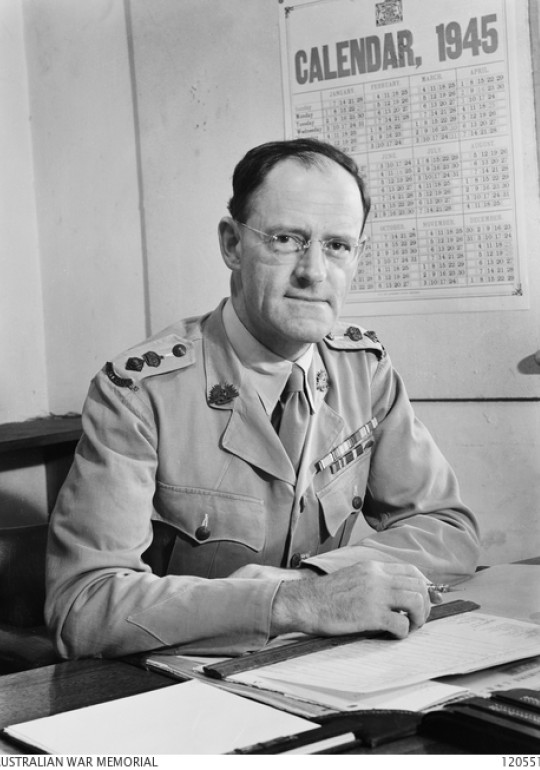
Colonel E. G. Keogh, MBE, ED (Retd)
First Editor, Australian Army Journal
ONE day early in 1948 I met by chance Major General Ian Campbell (then Brigadier and Director of Military Training) in the old Naval and Military Club in Alfred Place, Melbourne. The Brigadier told me that it was proposed to continue publication of the war-time Army Training Memorandum and that the VCGS (General Rowell) had suggested that I might be interested. Since I was indeed interested, the machinery for establishing the necessary civilian position in the Department of the Army was set in motion. Eventually I found myself installed in a small room in “M” Block, Victoria Barracks, Melbourne, a CMF officer employed on the civil pay roll. I had the best — and the worst — of both worlds.
During World War II the Army Training Memorandum was produced monthly by the Directorate of Military Training and circulated to formations, units and training establishments. It gave the latest information about enemy organization, weapons and tactics gathered from many sources, including unit and observer team reports. It contained material on the latest developments on our own training aids, techniques and requirements. Generally, it was designed to keep all concerned up to date on all aspects of training activities.
It was clear, however, that in peace time there was not nearly enough material of this kind to produce a publication on a monthly or even a quarterly basis. Consequently we attempted to convert the old ATM into a magazine of general military interest. But it did not really go. The title was uninspiring and the format dull. It looked like a half-hearted attempt to pursue some ill-defined object.
So we put up a paper recommending the establishment of an “Australian Army Journal” having the following aims:—
- To provide a medium through which to convey to the officers of the army and the cadet corps the trends in military thought and developments at home and abroad.
- To provide information designed to assist officers with their personal studies and training problems.
- To stimulate thought and to encourage the study of military art.
- To provide the basis of an Australian military literature which it is hoped, in the fullness of time will equal in diversity and dignity the military literature of other countries.
The CGS approved the production of a journal, initially on a two monthly basis and eventually on a monthly basis when sufficient material was forthcoming and when satisfactory printing and production arrangements could be made.
Until funds became available the journal would have to be printed by the Army Headquarters Printing Press, a unit formed in the Middle East during the war and not really equipped for work of this kind. Although under pressure for the production of training manuals and other urgently-needed publications, they cheerfully undertook the additional task. AAJ No 1, June-July 1948, was distributed to Stationery Depots during the last week in June.
While the journal was generally well received, snipers soon began to take pot shots at the Editor. These usually took the form of telephone calls questioning the inclusion of some of the material on various grounds. Finally a senior officer objected strongly to an article on railway unification on the ground that it might encourage the government to divert defence funds to railway construction. We took that one to the VCGS. General Rowell said “Ah, the old bellyaching problem. Tell him to put it up in writing and we’ll consider it. Very few will, you know, because when they have to commit themselves to paper — and the record — their argument seldom looks as good as it did over a couple of drinks in the mess.”
Next day General Rowell followed up his advice with a paper which clearly and unequivocally established the Editor’s responsibility and authority. The word soon got around.
During the first eighteen months pressure of work on the inadequately-equipped Army Headquarters Printing Press caused an ever-widening gap between publication dates and actual delivery times. Eventually, on the insistence of General Rowell, funds were made available for an outside contract. Wilke and Company Ltd were the successful tenderers. We took this opportunity to change from a two monthly to a monthly basis. The first monthly journal — No 12 — was published in June 1950.
Another problem in those early days arose from the fact that higher authority, particularly on the civil side, seemed to be firmly convinced that the Editor was practically unemployed. At any rate numerous odd jobs were constantly being thrust upon me. Perhaps the most frustrating was the presidency of a board set up to investigate the loss of books from the Defence Department Library in Melbourne and the apparent total loss of the small library established in Darwin just before the war.
We thought that Darwin was disposed of when we found that the Japanese had bombed the building housing the library to smithereens. Then some cad produced two miserable tattered and battered volumes that had turned up at Alice Springs. So we had to find an expert willing to put in a statement saying that the marks and stains on the books were undoubtedly caused by an explosive substance.
The missing Defence Library books turned out to be flimsy paperbacks about tropical diseases hastily produced for urgent issue to medical units and detachments in New Guinea. For some extraordinary reason they had been taken on charge by the library and then sent on loan to the units. Now after three years of war and five years of peace we were supposed to find the books or produce evidence to justify a write-off. We compiled a list of convincing explanations and proceeded to fire them one at a time. The file went back and forth for weeks and weeks and got fatter and fatter. But we never saw it again after we fired the round labelled “White Ants”. That exercise in futility must have cost the taxpayer quite a packet.
In 1952 the Shenandoah campaign was set as a subject for study in military history. At the time only a few regular officers were involved. In September of the following year when the number of students was much greater, it was discovered that there were not nearly enough suitable books available. The Military Board ordered the DMT (not the officer who set the campaign in the first place) to produce one for issue in January. Then the DMT found that there was not enough money in the printing and stationery vote though he had a little to spare in the fund allotted to the Journal. This was our big chance. We offered to write the book and produce it as an enlarged January 1954 issue of the Journal, provided the Editor was relieved permanently of all extraneous duties. We just made it.
If we got rid of those time-consuming jobs, we found ourselves more or less committed to producing a series of campaign studies to assist officers preparing for promotion examinations. Since this could fairly be regarded as a direct contribution to the aim of developing an Australian military literature and the programme was spread over ten years, we accepted it as a fair exchange for the distractions that always seemed to beset us at the worst possible moment.
From 1954 onwards production of the Journal proceeded fairly smoothly, though we had occasional tussles with people who raised objections to some of the material included. Perhaps the most memorable was the occasion when we were attacked for according a seven-pointed star a prominent place in the cover design. It was claimed this was a communist emblem and was in use as a distinguishing feature of the kit worn by the troops representing the enemy in training activities. We spun the discussion out for quite a while. Communist emblem or not, a deathly silence settled over the stricken field when we drew attention to the Australian coat of arms, our national flag and the coinage then in use.
In the new phase of its existence, the Journal will have an important contribution to make to the development of the intellectual atmosphere essential to the integrated organization envisaged in the new defence structure. May every success attend its efforts. ⚔️