Search
Using the filters to the left, click your selection, it will become bold and filter the results, click it again to remove that filter.
Introduction As describe in Part 1 of this paper , Land 8113: Long Range Fires, is a critical acquisition program that promises to revolutionise the Australian Army’s way of war as well as the land force’s place in the strategic defence of the nation. Part 1 addressed the redefinition of Army’s strategic role in the defence of the nation. This section will consider the effect Land 8113 will have on the culture and organisation of the land force. So profound is the promise of Long Range Fires that the …
In response to the growing geopolitical competition within our near-region, Australia must become more assertive when projecting its strategic interest. This may require an ADF that is capable of suppressing a more aggressive range of threats, and independently capable of creating the environmental conditions for political stability to return. This is a strategic reality not only recognised by the 2020 Defence Update, [i] but also forecasted in the 2019 Future’s Statement by the Chief of Army. An era of ‘ …

Deterrence From Foreign Policy , a reflective piece upon the employment of nuclear weapons at Hiroshima and Nagasaki, and the resultant Cold War arms race. This theme was picked up by the AIIA arguing for the endurance of the nuclear non-proliferation treaty. In a thought-provoking piece from the Modern War Institute , the idea is posed of swarming drone technology as a weapon of mass destruction (thereby intimating an ability to deter using such capability). The threat posed by swarming drones is an idea …

The Future of Warfare The Australian National University launched the Futures Hub earlier this year. The hub explores future trends and to promulgate consumable material that helps to inform decision-makers. This site has now reached a healthy quorum of analytic material of interest to Army, namely: That ‘Asia will go from being a global centre of economic growth and political stability, to a centre of economic power but political instability’ ( here ). That ‘Economic growth in Southeast Asia will taper …
Part 1 of this series addressed the factors surrounding the humanitarian crisis in Yemen, concluding that legitimacy is arguably the single most important resource for governments recovering from civil war. In terms of regional and international pressure, Yemen’s neighbour Saudi Arabia remains the most dominant regional pressure and vocal actor in the Yemen conflict. The UAE is another major player with heavy influence in the region. The success of peace processes and efforts to legitimise Yemen’s …

Yemen’s pathway to peace will involve a focus upon human security issues, inclusive of halting violence, alleviating poverty and unemployment. Through a two-part blog, I demonstrate how this pathway is inextricably linked with issues of the ADF’s security posture and partnership with the United Arab Emirates (UAE) and Australia’s support to UN-led humanitarian initiatives. Even though the ADF has not been actively involved in the growing humanitarian crisis in Yemen, Australia’s trade interests in the …

Numerous single-service training adversaries have been developed by the Australian Army over the past 70 years. This process has created a variety of training adversaries, all of which have rapidly become out-dated. These training adversaries usually represented either opponents the Army was actually fighting, or opponents it had just fought. This led the Army to train for operations against an adversary it was unlikely to fight, rather than preparing for probable future conflict against a reality-based, …
The dawn of a new financial year brought the release of the 2020 Defence Strategic Update (DSU) and its companion, the 2020 Force Structure Plan. Released as a ‘ guide for our nation through one of the most challenging times we have known since the 1930s and the early 1940s.’ The DSU dictates adjustments to Australia’s strategic defence posture to tackle a scale of regional change described as the ‘most consequential strategic realignment since the Second World War’. While the ‘C’ word of 2020 must sadly …
Military Strategy. Professor Peter Roberts, Director Military Sciences at RUSI, leads a wide ranging discussion with Frank Hoffman , in a podcast format. A recent symposium addressing the topic of austerity in the face of U.S. DoD budget cuts has elicited a number of short essays from leading American national security writers. For example, T.X. Hammes writes about an end to exquisite weapons and Steven Metz argues an expansion of the aperture through thinking big about defense budget cuts . A wiliness to …
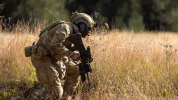
We have been a favoured isle, with many natural advantages for many decades, but we have not seen the conflation of global, economic and strategic uncertainty now being experienced here in Australia and in our region since the existential threat we faced when the global and regional order collapsed in the 1930s and 1940’s. This is a sobering thought, and it’s something that I have reflected on quite a lot lately as we’ve considered the dire economic circumstances we face. That period of the 1930’s has been …