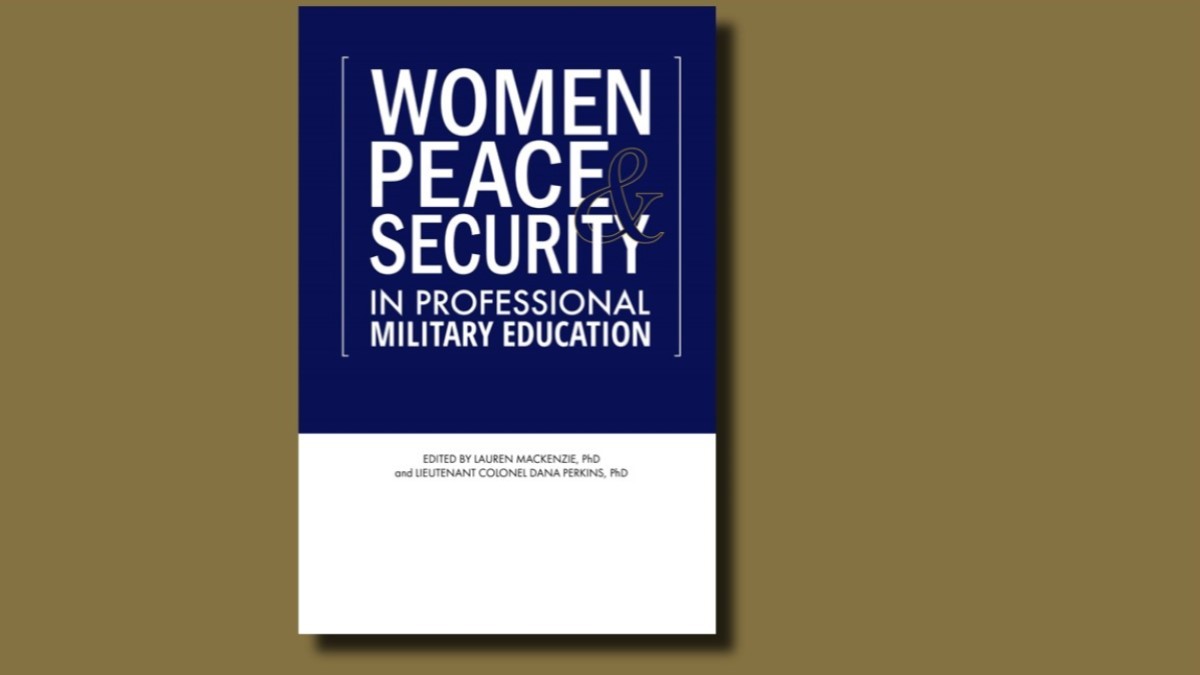
Marine Corps University Press, Virginia, 2022, ISBN: 9798985340372, 288 pp
Editors: Lauren MacKenzie, and Dana Perkins
Reviewed By: Jenni Yao
To understand the intricacies of modern conflict, we must examine every aspect of the battlespace. Understanding the people involved in conflict is key. If half the population is overlooked, it is not just a knowledge gap, it is a vulnerability. The integration of the ‘Women, Peace and Security’ (WPS) agenda is not about box ticking, it is about using all available resources in order to strengthen the military’s ability to plan, operate and lead in complex environments.
Since the introduction of United Nations Security Council Resolution (UNSCR) 1325 in 2000, the United States has implemented plans and strategies focused on WPS in various government departments, including the Department of Defence (DOD). Women, Peace and Security in Professional Military Education, edited by Lauren MacKenzie and Lieutenant Colonel Dana Perkins, is a study on the importance of embedding the WPS agenda within the professional development of all military leaders. The book brings together a collection of essays from US Department of Defense academic institutions including the US Army War College, Marine Corps University, and the National Defense University. They draw from research in gender studies, security policy, pedagogy and international military cooperation.
Women, Peace and Security in Professional Military Education explores how meaningful integration of gendered perspectives is fundamental to improving operational effectiveness, strategic thinking, and ethical leadership. The collection considers how conceptual ambiguities and institutional barriers can limit the implementation of the WPS agenda. This agenda aims to ensure that women and girls are protected from the impacts of conflict and are able to meaningfully participate in conflict prevention, peace building, and post-conflict relief and recovery. A common assumption is that WPS equates solely to ‘women’s participation’. However, the authors articulate how WPS insights allow a more holistic understanding of the human battlespace through how social roles, power relations and gender-differentiated conflict impacts shape the operational environment. This is reflected in the variety of essay topics which allow readers to better understand how the WPS agenda can be implemented and that reduce the conceptual ambiguity of the WPS.
The book places the WPS agenda within the broader global framework established by UNSCR 1325 and subsequent resolutions that establish women’s participation, protection and leadership as essential components of sustainable peace and effective security operations. The book moves from conceptual foundations to applied pedagogy, curriculum design and institutional reform. Each of the essays can be read on their own without reference to the other essays. What ties the essays together is the topics’ relationship to the WPS agenda and how the principles of WPS can be implemented within the domain of the selected topic.
The case studies analysed in the book illustrate how various defence education systems approach WPS. These studies offer insights on how political and cultural context shape the rhetoric and substance of WPS integration and implementation. For example, in chapter 6 of Part 1, A Strategic Imperative, Commander Kristen Vechinski (US Navy) argues that the WPS agenda must be framed in operational terms to overcome institutional resistance. For example, she stresses that WPS is “not about social policy; it is about operational effectiveness”. Commander Vechinski notes that scepticism arises when gender perspectives are perceived as external mandates rather than as professional competencies—that “without a clear link to mission success, gender perspectives are easily dismissed”. She also highlights practical barriers that echo across the other case studies, such as curricular congestion and limited expertise. Commander Vechinski also underlines the issue of weak accountability mechanisms, warning, “what is not assessed is not taken seriously” in professional military education (PME). With examples from Afghanistan, Commander Vechinski approaches WPS considerations within the realities of planning, command, and tactical execution, rather than presenting abstract policy frameworks.
The book is realistic in acknowledging the difficulties that exist in efforts to integrate the WPS agenda into PME. Consequently, the effective implementation of WPS principles requires deliberate integration into existing institutional priorities, such as mission command, ethical leadership, and civilian harm mitigation and information advantage, thus reinforcing both operational effectiveness and strategic outcomes. The authors offer analysis on the organisational and cultural variables that enable WPS integration. Senior leaderships’ involvement in framing the WPS agenda as an integral part of professional excellence and mission success cannot be understated. The research shows that military members are more likely to engage with the WPS agenda when their superiors actively employ its principles.
The book’s focus on connecting WPS concepts to real-world requirements and strategic logic demonstrates operational credibility. Part 1: Implementing and incorporating a gender perspective, addresses the integration of WPS into operational planning and decision making in PME and illustrates how gender perspectives contribute directly to situational awareness, command decision making and operational effectiveness. The guidance provided is grounded in feasible, mission-orientated approaches that focus on design, delivery, assessment and change management. In Part 4, Lieutenant Colonel C Grider’s chapter on The Strategic Centrality of Women, Peace, and Security, outlines recommendations on where WPS concepts could be incorporated in US Air Force Air War College (AWC) courses using focused discussion questions, embedding WPS across courses rather than as an isolated topic. The contributors articulate the strategic rationale of WPS in PME with a balanced tone acknowledging cultural resistance and practical constrains without diminishing the relevance of WPS.
While the essays provide practical insights, there is some unevenness in analytical depth and chapter structure. As the book is a collation of essays, there is a limited cumulative progression from theory to application to evaluation. Key concepts are reintroduced repeatedly, yet holistically the book does not build foundational concepts before introducing more advance applications. Some essays assume familiarity of WPS doctrine and gender theory, and this may challenge readers who are new to the subject. Assessment frameworks could be further developed through standardised indicators to enable universal evaluation. Although there is a wide scope of case studies, more evidence linking PME-based WPS education to improved operational outcomes would strengthen the case for resourcing and institutional adoption.
As the contributors of this book are from education institutions within the Department of Defense, their focus is on WPS in PME as it applies within the US. While there are ideas and lessons that can be extracted from the content for broader application, readers will require knowledge of their own country’s WPS implementation systems in order to properly integrate any suggestions. Notably, Part 8, Chapter 4 specifically covers WPS implementation in the Australian Defence Force.
Women, Peace and Security in Professional Military Education sheds light on the importance of integrating the WPS agenda into PME to enhance operational effectiveness, strategic comprehension and leadership development. The necessity of WPS in PME is articulated through a variety of case studies that are supported with practical and evidence based recommendations. The book provides an understanding of where and how the WPS agenda has been implemented, however, due to the variety of topics it may be more effective for some readers to read specific chapters pertaining to their area of interest.
For military personnel appointed to command or staff roles, the book offers conceptual clarity and actionable guidance. The book’s mix of theory, pedagogy and change strategy makes it a substantial contribution to PME, policy and security.