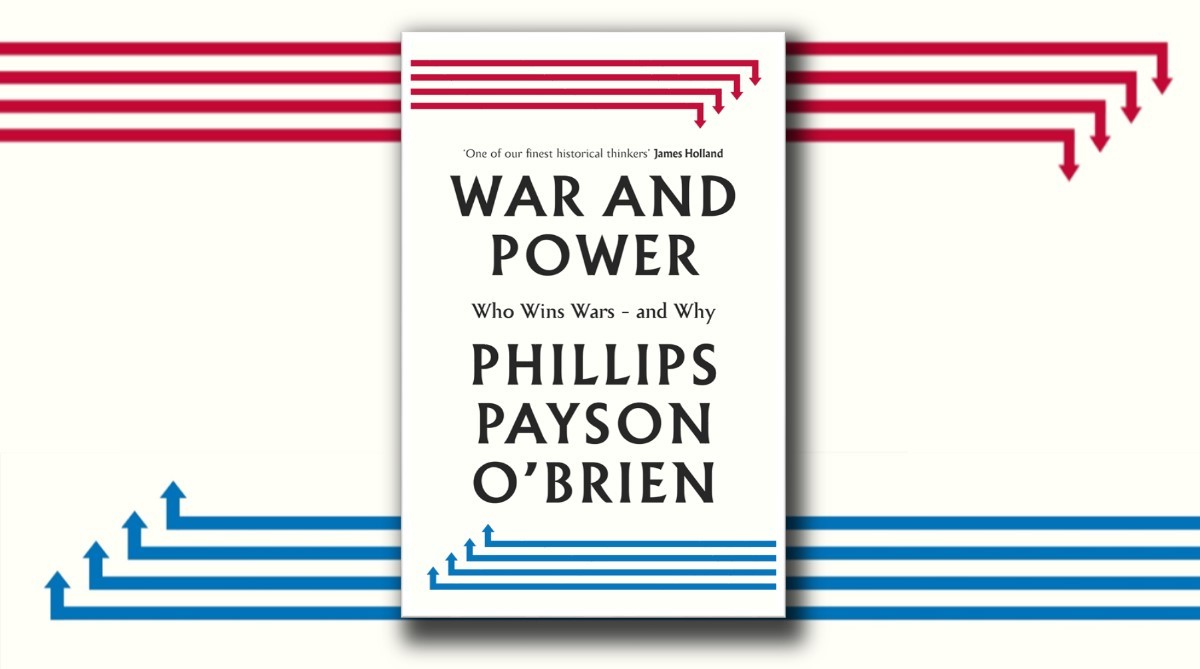
Who Wins Wars – and Why
Viking, 2025, ISBN 9780241744185, 288 pp, (AUD) $36.99 (paperback)
Author: Phillips Payson O’Brien
Reviewed by: John Nash
In late February 2022, as Russian forces massed on the border of Ukraine. Conventional wisdom held that if they did invade, what followed would be a short war. The ‘Great Power’ Russia would quickly overwhelm Ukraine which had received Western training and weapons, but not enough to be decisive. The weeks that followed demonstrated this forgone conclusion to have been spectacularly wrong. The misjudgement of so many analysts led many to question why defence experts and military strategists vastly overestimated Russian military effectiveness, and severely underestimated Ukrainian combat capability and will to fight. In his latest book, Phillips Payson O’Brien turns to the lessons of history as a way of explaining how victory in war is achieved—or not. In doing so, he explores a number of key themes, including technology, leadership, politics, and society, and how these factors (and others) contribute to making a military effective in war, and hence make a state powerful.
O’Brien starts by taking a shot at the very idea of ‘Great Powers’, a term that has no clear definition, though it has been bandied about since the early 19th century.[1] Underscoring the meaningless nature of this term, O’Brien cites the under-performance of Great Power Russia in its invasion of Ukraine. Initially envisaged as a 3-day ‘special military operation,’ the campaign is now four years old now – longer than Russia’s Second World War. Indeed, O’Brien argues that it is the distorted historical view of the relative military contributions in World War Two that has fostered the belief that the USSR (and then post-Soviet Russia) is worthy of Great Power status. Specifically, many commentators attribute the Soviet Union with having contributed far more to the defeat of Nazi Germany than was actually the case.[2] In reality, these power calculations were taken by ‘realist’ international relations thinkers and used to make all manner of determinations as to power status in the wake of World War Two, quite unhelpfully as O’Brien argues. None of these assessments of power has been terribly useful in predicting the outcomes of conflicts, be it France or the US in Vietnam, the USSR and then the US in Afghanistan, or Russia in Ukraine. Supposed ‘Great Powers’ do not always prevail in conflicts that, on paper, should be a no-lose scenario.
A poor appreciation of history has led many analysts to subsequently repeat these errors. The short war fallacy is among one of the most prominent. Prognostications of rapid Russian victory in 2022 seem little different to the short war fantasies of the World War One – where even the pessimists thought the war would be no longer than two years in length – and then the World War Two Axis powers’ conviction that initial rapid defeats of their enemies all but ensured a short war would follow.[3] Even the 1991 Iraq War—the paragon of a ‘short war’ in the 20th Century—required a very long build-up by the US-led coalition and a 40-day air campaign to defeat Saddam Hussein’s regime. Further, the war was conducted with very limited goals, stopping well short of an invasion of Iraq proper.[4] That wars almost always outlast their predicted end dates should be at the forefront of military planning and political appreciation.
Despite all evidence to the contrary, optimism bias is still very prevalent in analysis of how wars will progress. This is almost always the result of observers focusing on the wrong things, especially the efficacy of technology. O’Brien uses another excellent historical example here with the case of early airpower theory. The early theorists and proponents of air power held that air power heralded a revolutionary change in warfare and that nothing would ever be the same again. This thinking permeated the highest levels of governments, with the UK Prime Minister Staley Baldwin in 1932 making the infamous statement that ‘the bomber will always get through’.[5] As with most things concerning war and technology, however, imagination often outran practical considerations of what could actually be achieved with new platforms and systems. Strategic bombing would eventually prove important in the Allied victory over the Axis in World War Two, but it cost tens of thousands of lives and an enormous sum of money to develop an effective capability.
Chapter 6 is a key part of the book, examining how the idea of decisive battle has become overblown in modern analyses of wars. This theme follows on from other works on the topic, such as Cathal Nolan’s 2019 book, The Allure of Battle, which argues that the role of decisive battle in war has been overvalued and that, in fact, battles themselves are rarely decisive.[6] Two key points reinforce this position. Firstly, O’Brien illustrates with the short war fallacy that wars often go for much longer than anticipated. If battles were truly as decisive as claimed, then it would be hard to see how wars could stretch for so many years. Secondly, there are the well-worn examples of the wars in Vietnam and Afghanistan, where the US and Allied forces rarely lost a battle, and yet did not emerge victorious in the end. As O’Brien previously discussed in How the War Was Won, by the end of World War Two there were times when the Germans and Japanese were losing more aircraft outside of combat than in it. Too often narratives of battle are layered with emotive language in order to convey the sense of importance around such violent events.[7] Thus the tendency to focus on battles as a measure of success in war falls well short of meaningful analysis. However, this is not to suggest that battles are unimportant. They can help show trends, the direction in which different military forces are moving and the different constituents of military power are working – or not.[8]
The final chapter of War and Power deals with alliances and how they affect Great Power thinking. The largest and most impactful conflicts are often fought-out between rival alliances or partnerships, not sole Great Powers. Strong allies can be a great boon, but weak allies a huge impediment in war. This is even more so when a Great Power is fighting on behalf of a smaller ally – the US in Vietnam or US and Soviets in Afghanistan, for instance. O’Brien argues that the US has prioritised the wrong ally over the last decade, funnelling money and weapons towards an unwilling ally in Afghanistan when it could have been supporting Ukraine. As has been proven by subsequent events, Ukraine is a country that is more than willing to shoulder the responsibility for its own defence, in contrast to an Afghan government that collapsed in hours.[9]
O’Brien’s thesis on how war is achieved is consolidated in the conclusion which focuses on a potential future conflict scenario in the Indo-Pacific. This conclusion is itself followed by an Afterword that tries to add further analysis in the wake of the re-election of Donald Trump as President of the United States. Unfortunately, here the book loses some of its punch, and the analysis is very bleak and one-sided. While rightfully pointing out how the US election has massively disrupted power calculation due to the unpredictable policy coming from the White House, O’Brien misses entirely other regional developments over the same period. For example, there is no mention of Chinese President Xi Jinping’s ongoing purge of senior military officers and how this affects the People’s Liberation Army’s readiness for conflict. Considering how O’Brien is at pains to detail how Russian systemic corruption woefully impacted the country’s military readiness, the fact that senior Chinese military officials have been purged for the very same crime is surely worthy of note. So too O’Brien misses other developments with allies, such as Japan’s increasing pushback against Chinese military posturing in the region. Japan’s efforts have manifested in a military build-up and revamp to match, with the Japanese government even linking its own interests with those of Taiwan. These are significant issues, and O’Brien’s singular focus on US developments ignores much of his own advice.
Despite the lacklustre ending to the book, War and Power is still a worthy read for those interested in matters of war and strategy. O’Brien has made a very useful contribution to the debate on what makes for success in war, far beyond vague calculations of military strength. War is a messy, complicated business and determining who wins wars requires consideration of a litany of factors. War and Power does a great job of highlighting how we might approach the complex task of judging power and military effectiveness.
Endnotes
[1] Phillips Payson O’Brien, War and Power. Who Wins Wars – and Why (Viking, 2025), 3-4.
[2] O’Brien, War and Power, 6-9. This is explored in great detail in O’Brien’s 2015 book, How the War Was Won. Air-Sea Power and Allied Victory in World War II (Cambridge University Pres, 2015).
[3] O’Brien, War and Power, 11-12.
[4] O’Brien, War and Power, 122-123.
[5] O’Brien, War and Power, 34.
[6] Nolan, Cathal J., The Allure of Battle. A History of How Wars Have Been Won and Lost (Oxford University Press, 2019).
[7] O’Brien, War and Power, Viking, 2025, pp. 138-139.
[8] O’Brien, War and Power, Viking, 2025, p. 223.
[9] O’Brien, War and Power, Viking, 2025, pp. 216-218.