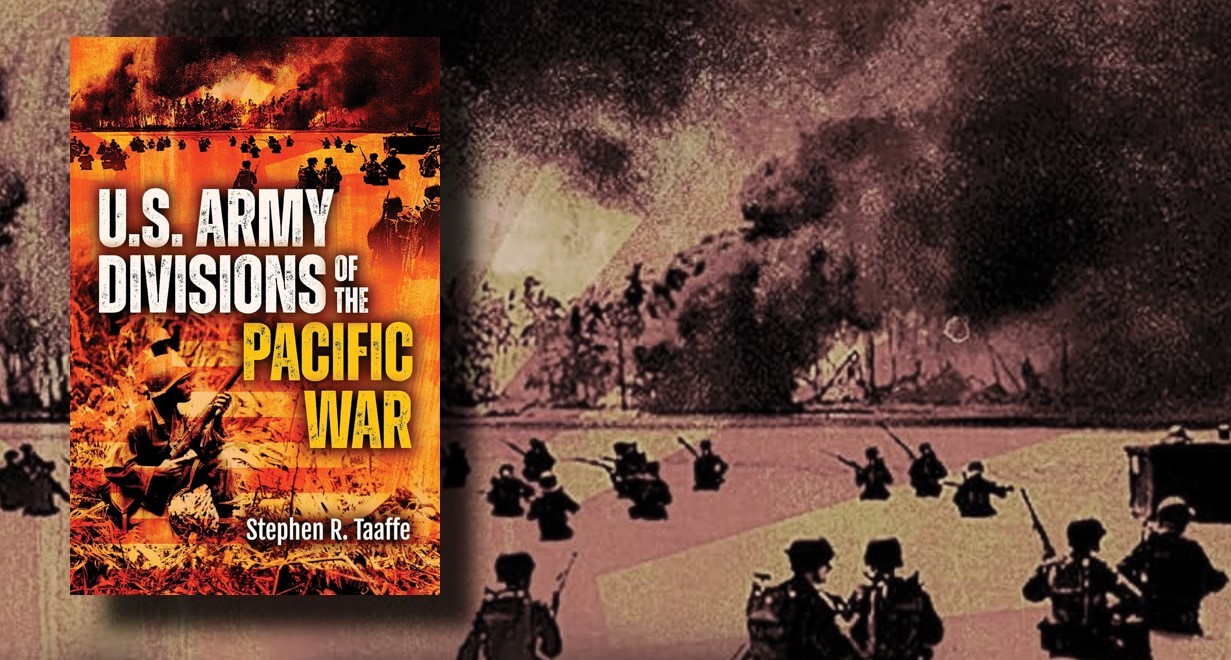
Casement Publishers, 2024, ISBN 978-1-63624-449-5, 222 pp US$ 34.95 (Hardcover)
Author: Stephen R. Taaffe
Reviewed By: Karl James
“These men looked hard and tough. If there were any criticism on my part it would have been that I seemed to notice a bit of tenseness on the part of the men.” So wrote Lieutenant General Robert Eichelberger, describing the United States Army’s 24th Infantry Division to Lieutenant General Walter Krueger in August 1943.[1] For his part, Krueger rated the 24th Division as one of the best in the theatre.
Nicknamed “Victory”, the 24th Division was activated in October 1941, a Regular Army formation built around a core of experienced, professional soldiers, supplemented by newly conscripted draftees. The division participated in the landings at Hollandia and Biak Island in Dutch New Guinea, and later saw extensive combat in the Philippines. The 24th Division had such a difficult time on Leyte, however, that Krueger replaced its commander and temporarily withdrew it from the front line.
Twenty US Army combat divisions fought against Japan in the Pacific during the Second World War: 19 infantry divisions (including the 1st Cavalry Division) and one airborne division. Half of the divisions were National Guard formations.
Stephen R. Taaffe’s US Army Divisions of the Pacific War looks beyond superficial impressions and the tendency to privilege the Regular Army over the National Guard to pose questions such as: what made one division more successful and reliable than another? Is it possible to rate the achievements and reputations of one formation against another?
The author of eight books, including the excellent MacArthur’s Jungle War: the 1944 New Guinea Campaigns (1998), Taaffe has published extensively, largely focusing on the American military experience in the Second World War.[2] He has long been an advocate for recognising the US Army’s contribution to defeating Japan, challenging the popular conception that only the US Navy and Marine Corps fought in the theatre. As Taaffe points out, not only did the US Army conduct more amphibious assaults and operations than the Marines, but by the war’s end it had 1.77 million troops deployed in the Pacific and Asia, with the Marines numbering 484,000.[3]
Taaffe has not been alone in highlighting US Army involvement in the Pacific. John C. McManus’s Fire and Fortitude (2019), Island Infernos (2021) and To the End of the Earth (2023) pursue this theme at length. However, these monumental tomes consist of some 1,600 pages, while the 220-odd pages of Taaffe’s provide a more concise account.[4]
US Army Divisions of the Pacific War is tightly focused on its subject matter. Those readers looking for detailed discussions of Admiral Chester W. Nimitz, the US Navy, amphibious operations conducted by the Marines in the Central Pacific, or dissection of US bombing campaigns against Japan will be disappointed. Taaffe’s narrative follows the deployment of the army’s divisions. Beginning with the Guadalcanal campaign in Solomon Islands in 1942–43, he follows the gradual increase in General Douglas MacArthur’s US forces in the South-West Pacific Area, offensive campaigns in New Guinea and the Solomon Islands, through the island-hopping campaigns across the Netherlands East Indies, before returning to the Philippines. Such was the scale of the campaigns in the Philippines that 19 US Army divisions fought there. Along the way, Taaffe discusses the Aleutians campaign of 1942–43, US Army contributions at Peleliu, Guam, and Okinawa, and proposed plans for the invasion of Japan in 1945–46. In this, Taaffe has prepared a useful and accessible, single-volume history of the Pacific War, albeit one with an undeniable focus on the US Army.
Australian readers’ interest will be piqued by chapters on the “South Pacific Maelstrom” and “MacArthur’s New Guinea Road”, where the contributions of Australian diggers in Papua and New Guinea are appropriately acknowledged, alongside those of the American GI.
Taaffe’s after-action assessments contain some particularly pithy and insightful commentary. He writes with sympathy when considering the 32nd Infantry Division at Buna in 1942, describing how weak senior leadership, a lack of training and poor unit cohesion took its toll on the National Guard division from Michigan and Wisconsin, which fought against stiffer than expected Japanese opposition without the logistical and firepower advantage that the Allies would enjoy in later campaigns. “The 32nd Division may have won at Buna, but it did not look that way”, Taaffe reflects. “The division had not only suffered heavy losses, but was also wounded psychologically and reputationally. Morale was shot and equipment in need of repair.”[5] Such woes were not uncommon for units going into combat for the first time.
Taaffe follows a similarly concise style throughout the book. While this works well for smaller, limited operations, the approach is more challenging when the reader encounters MacArthur’s liberation of the Philippines in 1944–45, where greater detail would have helped explain the true scale of US operations and the varying conditions across different islands of the archipelago.
The Philippines campaign involved amphibious landings, airborne operations, and bitter urban fighting that virtually destroyed the city of Manilla. Recalling the jungle fighting in the mountains of Luzon where the Japanese had well-prepared fortified positions, a soldier from the 38th Infantry Division wondered:
How did we crack this formidable defense? The same way we’ve cracked all of them – artillery and mortar fire to keep them down while we maneuvered close enough to blow them out with grenades or burn them out with flame throwers. It was the old, tedious, painful pattern and none of us shall ever forget the 16 days it took to do it.[6]
Comparing the different divisions, their battlefield successes and setbacks, allows Taaffe to evaluate their performance and reputation. The commander was integral to a formation’s personality. Each division had a distinct command style, organisational culture, histories, traditions, and modes of operation. Some themes emerge: ill-trained and inexperienced divisions, lacking in unit cohesion, repeatedly suffered highly casualties and performed poorly in combat when compared to well-trained, bonded, battle-hardened units. Most US formations performed poorly in their initial combat actions against the Japanese. Similarly, corps commanders and higher ranks often pressed their formations for quick victories. Hesitant or cautious divisional commanders were often sacked. They may have been equipped, structured and looked the same, but each formation did not always perform consistently or even predictably. Although the US Army “designed most of its divisions to be as uniform and interchangeable”, Taaffe astutely notes, “this was not the reality because these units were composed of human beings.”[7]
An erudite, engaging, and considered study of the US Army in the Pacific War. It is not a pamphlet for conducting amphibious operations or urban warfare at a divisional level in the Asia–Pacific region. Rather than specific lessons, Taaffe’s work on historic US divisions and regiments highlights considerations that are relevant for those who train and lead contemporary Australian brigades and battalions. In this way, Taaffe’s study is particularly relevant to field grade officers today.
Endnotes
[1] Stephen R. Taaffe, US Army Divisions of the Pacific War (Casement Publishers, 2024), p. 86.
[2] Stephen R. Taaffe, MacArthur’s Jungle War: The 1944 New Guinea Campaign (University Press of Kansas, 1998).
[3] Taaffe, US Army Divisions of the Pacific War, p. x.
[4] John C. McManus, Fire and Fortitude: The US Army in the Pacific War, 1941–1943 (Dutton Caliber, 2019); John C. McManus, Island Infernos: The US Army’s Pacific War Odyssey, 1944 (Dutton Caliber, 2021); and John C. McManus, To the End of the Earth: The US Army and the Downfall of Japan, 1945 (Dutton Caliber, 2023).
[5] Taaffe, US Army Divisions of the Pacific War, p. 19.
[6] Ibid., p. 133.
[7] Ibid., p. 167.