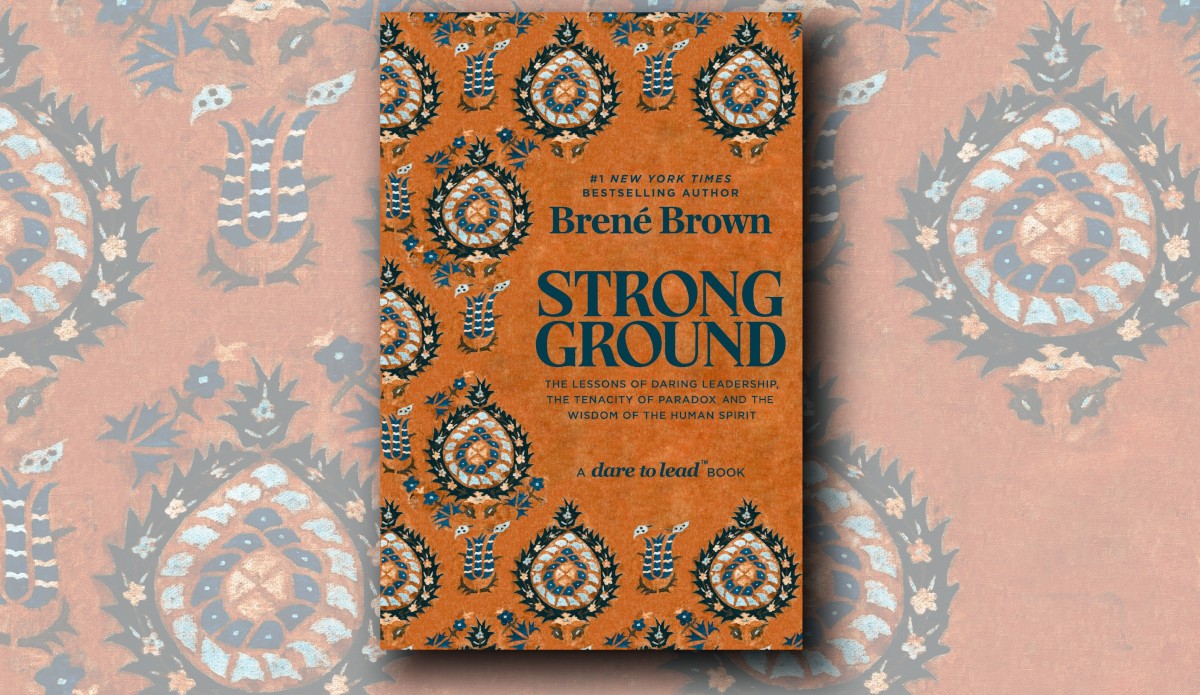
The Lessons of Daring Leadership, the Tenacity of Paradox and the Wisdom of the Human Spirit
Vermilion, London, 2025 ISBN: 9781785043208, 448 pp Hardback
Author: Brené Brown
Reviewed By: Darren Cronshaw
Brené Brown is most well-known for boldly saying that experiencing vulnerability is not weakness but is instead essential for courage. Further, courage is a skill-set we can learn and is a characteristic of brave leaders. She first popularised this perspective in The Power of Vulnerability,[i] one of the most-watched TED talks ever, with over 60 million views. It is also the theme of her best-selling books including Dare to Lead and the related training, ‘Brave Leaders and Courageous Cultures,’ that has been completed by150 000 leaders in 45 countries.[ii]
In her most recent book, Strong Ground, Brown unpacks lessons from teaching Dare to Lead skills. She also analyses the implications for leadership of fresh challenges in world affairs including geopolitical instability and violence, the revolution in artificial intelligence (AI), digital transformation, pressing climate challenges, the growing fragility of democracy and global order, and post-pandemic uncertainty. Brown suggests that risk aversion, increased bureaucracy, political siloes, and widespread tendencies toward micromanagement are present across these sectors. In this context, she argues that now— more than ever—we need to understand the nature and principles of collaborative and courageous leadership.
Courageous leaders are prepared to step up and lean-in to find solutions to complex issues. So, courageous leadership is about being daring and pro-active. This approach can be contrasted to ‘armouring up’ without vulnerability. Leaders of this persuasion attempt to lead by reacting to problems rather than engaging in tough conversations, staying curious and learning to listen. Related to courageous leadership, the concept of collaborative leadership involves working among and through others where (ideally) everyone on the team demonstrates the characteristics of a courageous leader. This requires specific behaviours that foster connection and empathy and that build cultures of trust including, for example, giving and receiving productive real-time feedback with sometimes tough conversations. Another behaviour that Brown suggests—that is both collaborative and courageous—is the use of open-ended language during team ‘rumbling’, a term she uses to describe where all team members feel free to contribute alternative or contrary positions. Examples of such language may include, “I’m curious about …; help me understand …; We’re both dug in – tell me about your passion for this? …. What problem are we trying to solve? … Let’s take some time out”.[iii]
Brown uses metaphors to help explain the concept of courageous leadership. For example, she observes that, just as athletes need a strong grounding in core/functional strength and mindfulness, so too leaders need to invest in their people’s healthy functioning and interconnections. This is what builds a team’s capacity for collaboration. Athletes and leaders both do best when they prioritise the foundations of functional strength and address (rather than ignore) dysfunction. Athletic illustrations are spread throughout the book—such as athletes visualising success, for when things go well and also for when perseverance is needed to overcome obstacles and adversity. Brown draws on the experience of former competitive US swimmer Michael Phelps to illustrate her point. Phelps reported having visualised a successful race so often that, when his goggles leaked at the Beijing 2008 Olympics 200 meter butterfly final, he simply reverted to visualising in his mind the strokes it would take to get him the win. In Brown’s view, a leader is like the coach who helps their athlete or team remain grounded and ready to face future obstacles. Moving beyond the swimming analogy, Brown observes that leaders, like footballers, need to find their footing and trust that their teammates are equally grounded. In presenting her ideas, Brown offers a high view of leadership that elevates it as critically important and valuable, and yet a role that is nevertheless broadly accessible: “A leader is anyone, regardless of title and position, who holds themselves accountable for finding potential in people and ideas, and who has the courage to develop their potential.”[iv]
From my perspective, one weakness of Strong Ground is that it seeks to cover such broad areas of leadership that it does not delve deeply into any one area. The book sometimes reads more like a journal of reflections on best practice—inspiring stories and conversation partners—than a straightforward text on leadership. The book dances between Brown’s own experiences, insights from leaders she or her organisation has coached, and the latest new ideas from other thought leaders. Of twenty-two theme-based chapters, seven are substantial summary discussions of the contributions made by other ground breaking writers on leadership.
At its best, however, Strong Ground delivers a range of principles and best-practice tools of leadership that are as relevant in a military context as they are to other spheres. For example, Brown counsels on the importance of identifying and practising espoused values, especially the underlying behaviours that embody those values. In this regard, I was prompted to observe that the Australian Defence Organisation is good at articulating Defence Values and Behaviours,[v] but we could always benefit from more attention to what these principles mean. To this end, I have written elsewhere about the topic of Australian Defence Force (ADF) values ‘Training Transformation’ and ADF values ‘Quick Military Education’.[vi]
Brown is unapologetic about the need for leaders to help explain the team’s mission in crystal clear and simple terms. An example she offers is a hospital steward she met who could clearly articulate the purpose of her job, “I cure cancer”.[vii] Understanding one’s mission is obviously of particular importance for military members. Brown discusses how understanding and delivering mission can vary for different generations. For example, she observes that Generation Y (born 1981-1996) may have room to grow with and need extra help to grow in resilience compared to other generations, and generally have a desire to understand the “Why?” of their stated mission. “Because I said so” is rarely the best motivator, even if it is sometimes true in wartime conflict.
In a number of chapters, the book addresses future trends and challenges of emerging technology. In one chapter she refers to futurist Amy Webb who describes, as a ‘technology supercycle,’ the unprecedented growth in development and productivity involving AI, advanced sensors and generative biology/biotechnology.[viii] In response, Brown urges the development of ethical thinking and forecasting expertise to meet the associated challenges. In another chapter, Brown urges the adoption of, what Adam Grant refers to as, ‘rethinking’ (being prepared to overcome pride and bias so we can question what we think we know) and ‘intellectual humility’. From Brown’s perspective, in a rapidly changing world we need to be less preachy and more curious.[ix]
One of the most significant strengths of Strong Ground is its attention to the need for systems and discipline. Brown underlines the importance of doing what is needed to achieve what you want to achieve. For example, she discusses James Clear of Atomic Habits who suggests: “You do not rise to the level of your goals, you fall to the level of your systems.”[x] Her discussion of Aiko Bethea’s principles underlines the importance of being anchored, aligned and accountable, and urges the reader to ask: “Could I be doing better – and how?”[xi] Brown’s discussion of Adam Grant’s writing encourages the reader to evaluate learning in terms of what knowledge and skills you take out, rather than just the time and energy you put in. After all, learning is not about effort but is about results.[xii]
Strong Ground is relevant reading for uniformed or Australian Public Service leaders, especially those who have appreciated Brené Brown’s previous work or those looking for a compass bearing in times of change. It offers a wealth of resources for leaders prepared to rethink and to learn what it takes to bring courage and kindness, focus and discipline to the greatest challenges facing us – including, potentially, the challenges we have not yet imagined.
Endnotes
[i] “The Power of Vulnerability | Brené Brown | TED Talk”, (4 Jan 2011) http://youtube.com/watch?v=iCvmsMzlF7o&vl=en
[ii] Brené Brown, Dare to Lead: Brave Work. Tough Conversations. Whole Hearts (London: Vermilion, 2018), reviewed by Darren Cronshaw in The Forge (12/4/2022), https://theforge.defence.gov.au/article/book-review-dare-lead-brene-brown; see also https://brenebrown.com.
[iii] For another medium of Brené Brown expanding on these issues listen to her podcast ‘Brené Brown on Strong Ground: Ask Me Anything, Part 1 of 2’ (29/10/2025), https://brenebrown.com/podcast/strong-ground-ask-me-anything-part-1-of-2/
[iv] Brené Brown, Strong Ground: The Lessons of Daring Leadership, The Tenacity of Paradox and the Wisdom of the Human Spirit (Vermilion, 2025), p. 82
[v] https://www.defence.gov.au/about/who-we-are/values-behaviours
[vi] Darren Cronshaw, “ADF Values Training Transformation”, The COVE (27/07/2023), https://cove.army.gov.au/article/adf-values-training-transformation; Darren Cronshaw, “ADF Values – Quick Military Education (QMEs)”, The COVE (12/06/2024), https://cove.army.gov.au/article/adf-values-quick-military-education-qmes
[vii] Brown, Strong Ground, p. 165
[viii] Brown, Strong Ground, pp. 183-192
[ix] Adam Grant, Think Again: The Power of Knowing What You Don’t Know (Viking Books, 2021); discussed on pp.65-74.
[x] James Clear, Atomic Habits (New York: Avery 2018), quoted on p.122.
[xi] Aiko Bethea Anchored, Aligned and Accountable: A Framework for Transcending Bullsh*t and Transforming Our Lives and Work (Ebury 2026); quoted on p.333.
[xii] Adam Grant, “No You Don’t Get an A For Effort”, The New York Times (Dec 26, 2024); quoted on pp.376-8.