The Intersection of Profession and Ethics
Naval Institute Press, 22 January 2019, 978-1682473634 $45.00
Edited by: Nathan K. Finney and Tyrell O. Mayfield
Reviewed By: Benjamin Gray
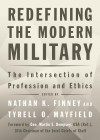
Redefining the Modern Military: The Intersection of Profession and Ethics aims to re-evaluate what it means to be a military expert in the 21st century, with professional ethics placed at the core of that identity. The volume challenges and updates classic theories of the profession of arms, whilst concurrently exploring how education, ethical frameworks, and agency shape professionalism. Its main purpose is to stimulate intellectual self‑reflection within the military, arguing that legitimacy and professional trust depend less on abstract institutional reform and more on the ethical development and responsibility of individual service members. Co-edited by Nathan K. Finney and Tyrell O. Mayfield, both serving US military officers, Redefining the Modern Military combines professional practice with intellectual engagement. Finney, an Army officer focused on strategy and planning, has been a long‑standing contributor to military scholarship through fellowships, professional networks, and published research. Mayfield is an Air Force officer specialising in advising foreign partners and expeditionary security operations. The authors are an extraordinary group of scholar-practitioners: military professionals, historians, ethicists, legal experts, and humanitarians with global operational experience and deep academic credentials. Their combined expertise spans war studies, strategy, ethics, history, and leadership; making these contributors both intellectually formidable and practical.
Redefining the Modern Military offers an insightful contribution to contemporary defence literature. It presents a vision of modernisation that integrates technology, doctrine, and culture into a framework that supports consideration of future strategic realities. The book moves beyond technical upgrades, instead emphasising systemic transformation that reflects the complexity of the modern battlefield. Importantly, while Redefining the Modern Military is written from a US vantage point, its core inquiry (how ethics, education, and individual agency sustain professionalism) maps closely to contemporary debates about the Army profession writ large. Much of the book’s argument can be read directly against the Australian Army’s enduring pillars of professionalism: jurisdiction, expertise, and self‑regulation. The emphasis on revisiting classic thinkers and investment in professional education aligns with concerns about intellect doctrinal sufficiency, and readiness for complex operations. Equally pertinent is the importance placed on individual agency and professional stewardship. However, readers should absorb insights with care: legal frameworks, societal expectations, regulatory mechanisms, and joint structures vary significantly between the US and Australia, shaping how the profession of arms is composed and regulated. Redefining the Modern Military offers a strong scaffold for understanding and strengthening the Army profession, provided its US-centric cases are viewed through the lens of the Australian context and realities.
The central argument of Redefining the Modern Military is that military professionalism is evolving. As an ethics-based practice, the military profession has been shaped in recent decades by post‑9/11 conflicts, great power rivalry, and rapid technological change. The book therefore broadly engages with classic debates on professionalism, and thereby goes a long way toward showing that the attainment of professionalism is not a fixed standard but an ongoing process requiring reflection and honest discussion. Several key themes run through the book, such as the role of legality in the conduct of war, the functions of ethical judgement, duty to the nation and society, and the discussion of how rules may fail in morally complex situations.
Part I (Chapters 1-6) of Redefining the Modern Military examines what it means to be a modern military professional and reexamines whether the military constitutes a profession, an often-contentious question.[1] It compares the armed forces with other professional fields such as law and medicine and summarises the major debates clearly. From this part, a particularly valuable chapter is H. M. ‘Mike’ Denny’s ‘Professionals Know When to Break the Rules’. Denny’s thesis is stimulating, and in his chapter, he provides examples of leadership in war to contextualise dilemmas and friction, making the ideas accessible to a breadth of readers. Part I provides a strong foundation for studying military professionalism and would be an effective read when paired with a discussion of real-world scenarios in unit professional development.
Part II (Chapters 7-12) addresses more practical issues, including professionalism in each domain, the role of military education, mentorship, and humanitarian work in war zones. A compelling aspect is the focus on the human dimension. Redefining the Modern Military emphasises that modernisation isn't just about advanced platforms but about developing adaptable professionals who can operate in chaotic environments. Leadership, resilience, and ongoing learning remain central even as militaries integrate artificial intelligence, machine learning, robotics, autonomous systems, and advanced cyber capabilities. The service-specific chapters are particularly valuable, encouraging readers to reflect on what shapes military identity, culture and mastery. In all chapters, professionalism remains the unifying thread, but particularly in the land domain, Chapter 10's discussion is worth noting. Steven Foster explores the foundations of professionalism, obstacles, improvement, and stewardship, as well as the impacts of bureaucracy, sustained combat, and attrition of talented individuals on the profession.
Given the book's strong aspects discussed above, it is unfortunate that it is at its weakest in its treatment of military ethics. The main issue is the tendency to frame ethical behaviour as only rule-following, rather than confronting deeper moral challenges of contemporary war. Major issues such as responsibility for autonomous lethal decisions, the impacts of cyber operations on infrastructure, and humanitarian implications receive limited attention. Furthermore, little guidance is provided on managing diplomatic pressures, political interventions, and maintaining legitimacy in ethically uncertain environments. The suggested vision for modernisation is admittedly ambitious, but the practical mechanisms for integrating ethical reasoning into doctrine, training, and decision-making are not addressed in detail.
Despite these minor shortcomings, Redefining the Modern Military remains a significant contribution, providing a comprehensive and future-oriented framework that encourages militaries to view modernisation not as a technical upgrade but as continuous cultural and conceptual improvement. Its analysis of technology, doctrine, and organisational culture is robust, as is its investigation of how emerging technologies influence force design and operational concepts. Importantly, the overall focus on leadership, ethics, and adaptability highlights the importance of the human element beyond weapons and platforms. As a focal point for in-unit professional discussions or individual rumination, this book can help young professionals advance their careers. By stepping through real stories, simple frameworks, and clear examples, it can situate the reader in the Army profession and explain where they fit and why expertise matters. From a very simple point of view, it serves as a vehicle for reflecting on questions like: What is my role? Who am I responsible to? What standard am I being held to? Over time, such reflection may build a deeper understanding of professional obligations without a performative lecture or the delivery of leadership truisms. Redefining the Modern Military provides practical ideas, honest reflection, and useful tools that individuals can carry, potentially helping them find their place in the profession and navigate their impact on others.
Ultimately, Redefining the Modern Military offers a useful framework for thinking beyond conventional modes of warfare, embracing multi-domain integration, and innovative approaches to military adaptation on a rapidly evolving battlefield. While the book would benefit from deeper engagement with the ethical and moral complexities of future conflict, it remains a valuable and forward-looking work that challenges military professionals to think differently. It is particularly recommended for professionals early in their careers so that they can reflect on their own decision-making, character, and expertise. Whilst many concepts may feel abstract to junior members, the various chapters use contemporary examples to illustrate difficult problem sets that may require addressing with limited experience or preparation. One of the core strengths of Redefining the Modern Military is its sincere reflection from within the profession, contributing to wider efforts to reconsider what it means to serve, even as questions about the profession’s long-term structure remain.
Endnotes
[1] For a recent discussion on this in the context of Australia, see Philip Hoglin, ‘Does the Profession of Arms Exist? Alternative Views on the Nature of the Profession’, Australian Army Journal 21, no. 3 (2025): 113-130.