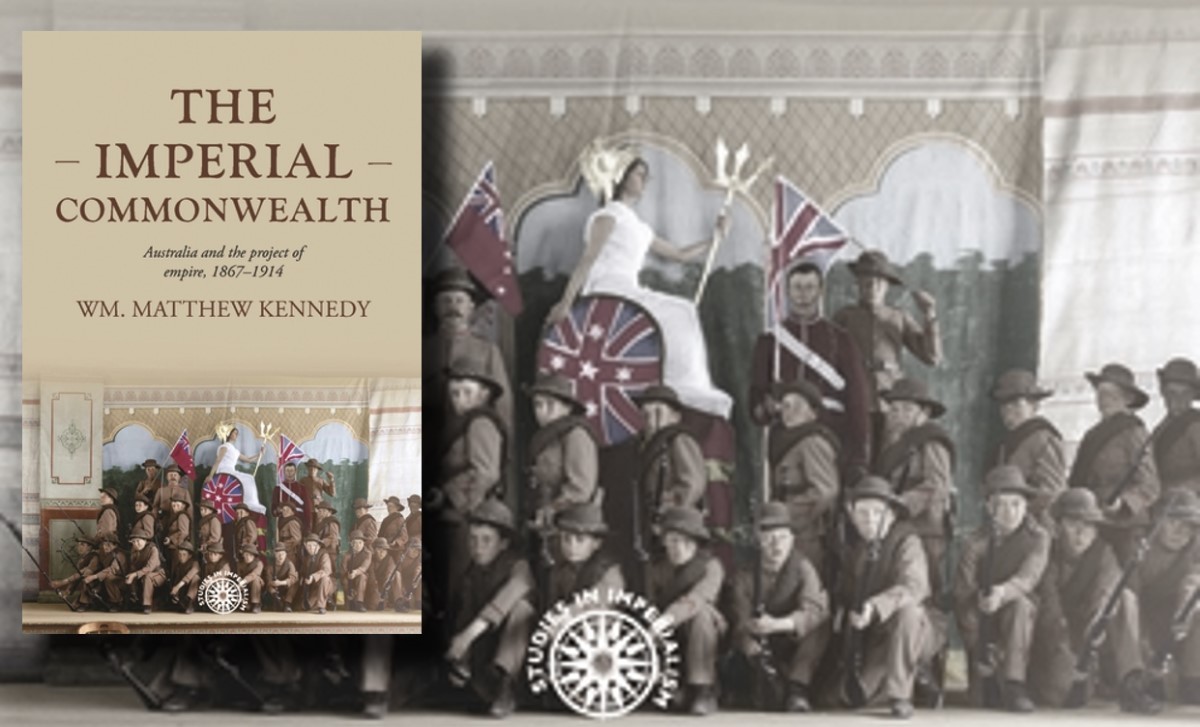
Australia and the project of empire, 1867-1914
Manchester University Press, 2023, pp. 280, ISBN 9781526162755, £85.00
Author: Wm. Matthew Kennedy
Reviewed by: Jordan Beavis
It is undeniable that Australia is the product of empire. Throughout the 19th century, and well into the 20th century, Australia existed as an ‘outpost’ of the British Empire in the Pacific. From initial white settlement in 1788, the colonies that eventually federated into the Commonwealth of Australia on 1 January 1901 maintained a strong association with Britain, particularly in demography, immigration, culture, legislation, legal processes, trade, and defence. During an Empire Day demonstration in Melbourne on 24 May 1922, Member of Parliament William Watt spoke for many when he enjoined ‘young Australians’ to understand that they were ‘better Britons’ if they were ‘true Australians, and it is your duty to be both’.[1] That many Australians evinced whole-hearted support for the British ‘imperial project’, in the words of noted historian of the British Empire John Darwin, is well known.[2] What is less understood is that, from the 1870s onwards, many Australians came to believe they could do empire better than the British.
This is the topic of Wm. Matthew Kennedy’s The Imperial Commonwealth: Australia and the project of empire, 1867-1914. Based on his doctoral research at the University of Sydney, Kennedy explores how Australia came to be ‘an empire’ – a ‘small’ one, ‘necessarily entangled with Britain’s global empire’, but an empire nonetheless – and one in which its citizens’ behaved ‘imperially’.[3] Not only were Australians eager and willing participants in the British Empire, Kennedy shows, but the Australian colonies (and later the Commonwealth of Australia) eagerly sought to establish their own colonial holdings in the region and enact their own more ‘progressive’ version of imperialism. Over some five chapters, bookended by an introduction and conclusion, Kennedy explores this understudied aspect of Australian history. It is something which still has significant bearing on Australia’s relationships with nations in our region today, most especially Papua New Guinea and Fiji.
To initiate his study, Chapter 1 of The Imperial Commonwealth explores Australian settler-colonial visions of the future of the British Empire. It provides an accessible introduction to the cultural landscape of 19th century Australia, including the embedded notion of Britishness and colonial political association within the broader empire. By the early 1900s, as Kennedy notes, ‘a federated Australia was firmly part of Britain’s imperial system, even as it asserted greater autonomy within it’.[4] Indeed, separation of the colonies or federated Australia from the British world was ‘not only unwanted; it was also not realistic’ owing to the ‘daily experience’ many Australians had within the empire in relation to the movement of people, money, and information within it.[5] Of interest within this chapter is Kennedy’s identification of a unique demonstration that occurred during the 1887 Golden Jubilee celebrations in Sydney, when a mock naval engagement was held within the harbour, following which ‘the naval volunteers of Sydney, together with the German warship Bismark and a Japanese vessel moored in Sydney harbour, repelled an invasion by an unknown force’.[6] Given subsequent wars against both these protagonists, this is a curious historical footnote that deserves more study.
The book’s second chapter explores Australian responses to two famines in India in 1876-1879 and 1896-1898. As Kennedy shows, perceptions within Australia that poor administration and policy by the British Raj exacerbated these famines provided a grounds for criticism of Britain’s imperial practices. Communities around Australia rallied in both crises to provide humanitarian support to ‘rectify injustice’, and in doing so viewed themselves as taking a greater responsibility in the maintenance of the empire and the wellbeing of its subject peoples. This, in turn, encouraged some to consider alternative imperial policies that could be implemented in colonial possessions closer to, and within, Australia.
While Chapter 2 offers interesting discourse related to the book’s theme, readers of this review may find it a somewhat abstract analysis. Luckily, such readers will find substantially more of interest in the third, fourth, and fifth chapters. Chapter 3, for example, explores colonial Australia’s involvement in imperial war-marking. Kennedy’s perspective in this chapter is an original one. He argues that by 1914 Australians of the ‘Anzac generation’ were culturally ‘well-equipped’ to wage far away war as, for 50 years prior, governments had despatched multiple state-based contingents or individual officers to imperial conflicts and garrisons in the Sudan, southern Africa, and India (including the volatile Northwest Frontier). Such Australian involvement in imperial wars, paired with an understanding of the colonies’ need to provide for their own defence and that of the Australian continent more broadly, was helpfully triggered by the withdrawal of the remaining British garrison from Australia in 1870. In a statement that echoes to today and the seasonal deployment of the Marine Rotational Force – Darwin, one commentator opined that:
To have imagined that security from foreign aggression rested, not with ourselves, but with a handful of the traditional British redcoats, not numbered more than two or three hundred, would be so abject and wilful a delusion that we cannot suppose any person of ordinary common sense, who happened to think on the matter at all, ever entertained such a foolish fancy.[7]
The slow professionalisation of the colonial militaries over this period stemmed from this as well as an understanding that colonial, and later national, contributions to imperial wars would be increasingly welcomed by Britain. In 1900 Australia was described by Lord George Curzon—Viceroy of India—as the ‘South-East frontier of the whole British Empire’.[8] Kennedy’s suggestion that, by 1912, the Australian Army maintained ‘war plans’ for the defence of this Pacific frontier, or undertaking imperial policing behind the lines, is overenthusiastic. No such ‘war plans’ existed, with verbal agreements on action that may be taken upon the outbreak of war not constituting such. Regardless, this chapter is of significant utility and interest to a contemporary defence audience focused on potential conflict in Australia’s region.
Chapters 4 and 5 continue Kennedy’s analysis, but focus in more depth on Australia’s attempts at empire along this ‘South-East frontier’. These chapters examine Australian motivations—largely commercial and security—for participating in a ‘Scramble for the Pacific’[9] Among Australian statesmen, concerns abounded that a failure to secure Pacific islands would render the colonies vulnerable to German attack or commercial competition, or, ironically, even to ‘moral contamination’ from French convicts in New Caledonia.[10] As such, the 1870s and 1880s saw attempts by Australian colonists to annex first Fiji and then New Guinea into the empire under some form of Australian colonial influence. In the latter case, in 1883 Queensland’s Premier, Thomas McIlwraith, despatched a police commissioner from Thursday Island to Port Moresby to proclaim the subjugation of the eastern half of New Guinea to British protection. McIlweaith, as Kennedy shows, lacked the authority to undertake this action and in going ahead anyway he caused a diplomatic incident between himself, the British Colonial Secretary, and Imperial Germany.
The subsequent split of New Guinea between Germany and Britain scarcely dampened Australian enthusiasm for a slice of empire. Yet such benefaction took time. 19 troubled years elapsed between the proclamation of the British Protectorate of New Guinea in 1884 to the transfer of the Colony of New Guinea (established 1888) into federated Australia’s responsibility in 1905, whereon it was renamed Papua. Kennedy explores here how both Papua and the Northern Territory were viewed by Australian imperialists such as John Hubert Plunkett Murray—Lieutenant-Governor of Papua from 1908 to his death in 1940—as laboratories of a new type of ‘scientific’, ‘developmental’, and ‘progressive’ imperialism.[11] Such an approach, Kennedy suggests, viewed itself as differing from British practice in that it aimed to jointly develop the territory and the people, incorporated the use of anthropology to establish an understanding of Papuan culture and thereby leverage Papuans into engaging with the colonial administration on its terms. For the modern reader it is hard to see this as anything but paternalism rebranded, and an approach that continues to influence modern Papua New Guinea and its relationship with Australia.
Kennedy’s The Imperial Commonwealth is a fascinating read for the historian. Detailed and containing an impressive depth of research, it reshapes our understanding of a formative time in the development of Australian national identity, Australia’s contemporary relationship with our regional neighbours, and our conception of Australian defence prior to the First World War. The book is, however, dense, and not to be recommended to the generalist reader or an individual new to the study of pre-First World War Australian history and defence policy. Indeed, Kennedy should be encouraged to develop a trade-version of this book that is more accessible for a generalist or defence audience and, importantly, more affordable. How Australians of the late 19th and early 20th centuries interacted with the region they sought to influence and govern has significant relevance for Australian defence challenges of today, and our place as a middle-power in the Indo-Pacific.
Endnotes
[1] ‘Town Hall Demonstration: Archbishop Lees on England’s Queens’, The Age (Melbourne), 25 May 1922, pg. 7.
[2] See John Darwin, The Empire Project: The Rise and Fall of the British World-System, 1830-1970 (Cambridge University Press, 2011).
[3] Wm. Matthew Kennedy, The Imperial Commonwealth: Australia and the project of empire, 1867-1914 (Manchester University Press, 2023), 1.
[4] Kennedy, The Imperial Commonwealth, 17.
[5] Kennedy, The Imperial Commonwealth, 22.
[6] Kennedy, The Imperial Commonwealth, 34.
[7] Editorial, The Age (Melbourne), 20 August 1870, 2. Part of this quote is provided in The Imperial Commonwealth. See Kennedy, The Imperial Commonwealth, 98.
[8] Quoted in Kennedy, The Imperial Commonwealth, 120.
[9] Kennedy, The Imperial Commonwealth, 137.
[10] Kennedy, The Imperial Commonwealth, 137.
[11] Kennedy, The Imperial Commonwealth, 176.