
The Lure and Logic of Airmindedness
Air University Press, 2022, ISBN 9781585663224, 240 pp Free Download (online)
Author: Jason M. Trew
Reviewed By: Trav Hallen
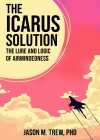
The Icarus Solution: The Lure and Logic of Airmindedness explores the evolution of the United States Air Force’s (USAF) organisational culture using a unique blend of the history of technology, Greek mythology, and air power theory. Its author, retired USAF Colonel Jason Trew, argues that the orthodox view of USAF culture as one that replaces strategy with technology is flawed. The story is far more nuanced. Technology, creativity, and strategic imagination are not mutually exclusive; they are, for Trew, complementary. One of the reasons we fail to see this complementarity is that we often default to binary modes of thought: your culture is either technology- or creativity-centric; it cannot be both. Trew uses the dualities of Greek mythology (Apollo-Dionysus, Daedalus-Icarus, and Bia-Metis) to shift the reader’s perspective, revealing how air power technology enabled the USAF’s creative and “strategically playful” culture to emerge. This is an imaginative and, at times, entertaining approach; however, the book will not appeal to all readers. The book never escapes its origins as a PhD project, and at times, the esoteric arguments on topics such as Plato’s impact on Greek terminology can make the book hard going. For those willing to push through the denser passages, The Icarus Solution offers a genuinely original argument that will help readers, aviator and non-aviator alike, understand why aviators think differently.
Trew's decision to use Greek mythology as an analytical framework is a deliberate and largely successful attempt to make accessible the complexity of organisational culture. The gods and heroes of ancient Greece personified different aspects of the human experience. Though they may appear to be in opposition, they reflect the complexity and, at times, contradictory aspects of humanity. Using stories to make sense of complexity is something that humans are primed to do and Trew capitalises on this. By overlaying the mythological figures with key periods in the development of USAF culture, he makes the abstract more accessible. When coupled with a chronological approach, starting with the aviators of World War I and concluding with the counterinsurgency campaigns in Iraq and Afghanistan, his approach builds successive layers to help the reader make sense of the complexity of USAF cultural evolution. Readers without a background in philosophy and Greek terminology may find the early chapters hard work, but the historical overlays help by connecting Trew’s theoretical framework to concrete, well-known examples.
Trew builds his argument across three chronological case studies, each anchored by a mythological duality. The first uses Apollo (god of reason, order and discipline) and Dionysus (god of wine and revelry) to explore the interplay between the disciplined, episodic violence of aerial warfare above the trenches of the Western Front in the First World War, and the partying, storytelling and camaraderie of base life behind the front lines. As Trew recounts, the tension between these two extremes—a natural consequence of airbases often being positioned well behind the front lines—laid the foundations of USAF culture that is evident in the contrast between the Apollonian discipline and technical mastery of the Weapons School and the Dionysian revelry and camaraderie of the Squadron Fighter Bar. These cultural institutions are not at odds with each other; they are, as Trew argues, complementary expressions of an airminded culture more complex than its critics have acknowledged.
‘Airmindedness’ as a term gained prominence during the interwar years as the possibilities of aviation began to spread from the military to permeate all aspects of society. This phenomenon is Trew’s second case study, in which he explores the rise of civic and military airmindedness during the interwar period through the Daedalus-Icarus duality. Daedalus, the cautious engineer, was conservative in employing the technology he had created. His son Icarus—young, brash, and enamoured by the exhilaration of flying—pushed beyond those limits and flew close to the sun, falling to his death. Trew uses the contrast between these two mythic pioneers of flight to tell the story of how the Daedalus-like methodical institution-builders during the interwar period competed with the imaginative, boundary-pushing spirit of early Icarus-like civil and military aviators. For Trew, air power, both civil and military, would not have developed so rapidly during the interwar period without the tension between institutional conservatism that identifies boundaries and the visionary theories that push beyond them.
The third and most analytically ambitious case study uses the Bia-Metis duality to examine the stagnation-innovation-stagnation cycle of air power theory development through the Cold War and into the post-Desert Storm era. Bia was the embodiment of force, power, and strength, as exemplified by the Greek hero Achilles. Metis provides the counterpoint: a figure whose name embodied adaptability and cunning intelligence; attributes personified by Odysseus. Trew argues that both qualities are evident in the development of USAF strategies and concepts, but the periods when American air power has been most effective are when Metis-like creativity has been allowed to complement the application of USAF’s formidable firepower. Trew’s examples here are compelling. Industrial Web Theory, which guided US targeting in the Second World War, reflected the creative application of novel technology to the specific context of the Nazi war machine and economy, ossified into a targeting list applied blindly to the quite different contexts of Korea and Vietnam. Decades later, USAF Colonel John Warden’s insights into the enemy as a system enabled the brilliance of the Desert Storm air campaign, but USAF was unable to adapt to the complexity of counterinsurgency campaigns in Iraq and Afghanistan, defaulting again to seeing the adversary as a targeting problem. What the Bia-Metis duality highlights in this final case study is that the effectiveness of air power cannot rely solely on its precise and destructive potential (Bia); its application must be guided by planners and commanders who are adaptive and creative, matching the potential to the unique context of the situation in which they operate.
The Icarus Solution is a genuinely original contribution to the study of air force culture, offering a richer and more nuanced analytical framework than the institutional critiques it seeks to challenge. The Greek mythology framework takes some getting used to, and the theoretical groundwork of the early chapters is hard going, but the historical case studies that follow reward persistence. Trew's focus on the USAF means that an Australian readership will need to use discretion when applying the insights to Royal Australian Air Force (RAAF) culture. It is worth the effort. Trew challenges his readers to look beyond binaries and embrace the complexity of air force culture as a dynamic and creative force to be understood and leveraged. The Icarus Solution provides a rigorous, historically grounded, and at times entertaining account of how a century of experience shaped air force culture. It is well suited for Army personnel working closely with RAAF colleagues, particularly those in operational roles, who want to better understand what makes them tick.
About the Reviewer
Group Captain Trav Hallen is currently the Chief of Defence Liaison Officer to US Pacific Command. He is a graduate of the United States Air Force School of Advanced Air and Space Studies. Group Captain Hallen is currently a PhD candidate at Deakin University and Swedish Defence University where he is researching the relationship between Swedish defence policy and air power development during the Cold War.