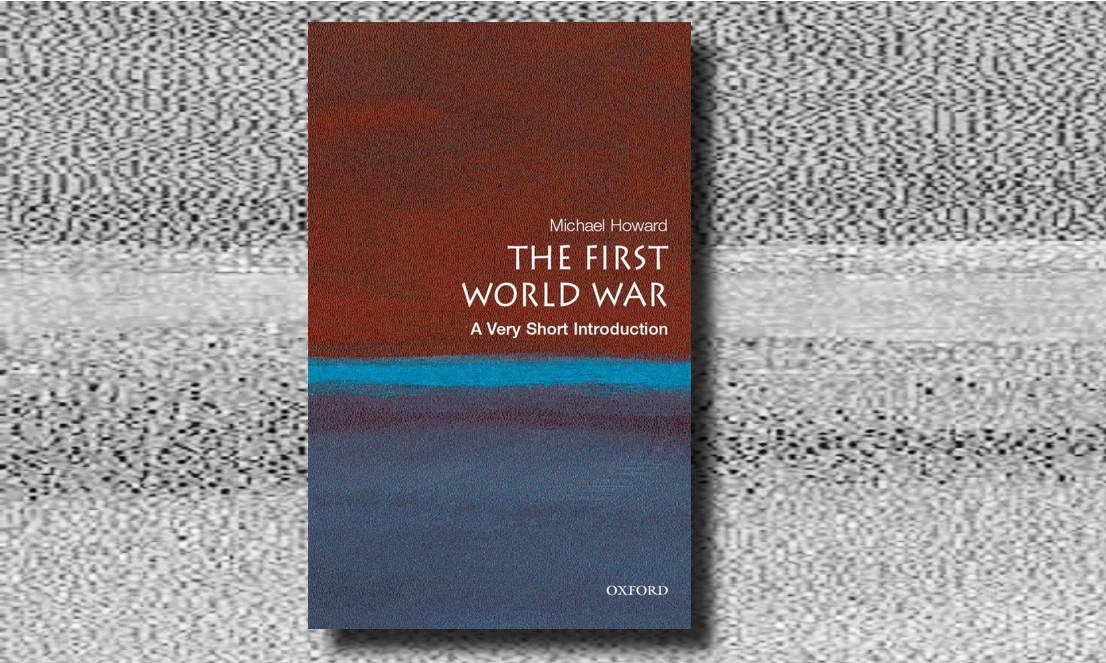
A Very Short Introduction
Oxford University Press, 2002 ISBN 978-0199205592, 134 pp
Written by: Michael Howard
Reviewed By: Nick Rose
WWI, or ‘The Great War’, is a complex and multi‑faceted topic of significant – some might consider, especial – relevance to Australian military professionals. For one, it is amongst the few examples of Australian forces engaging the main enemy in a modern industrial war (on the Western Front). Beyond this, deep study of the Great War offers both lessons for future conflict planning as well as insights into the underlying drivers of Large‑Scale Combat Operations (LSCO) and their broader impacts on society.[1] Although many detailed books on this war exist that emphasise or focus on specific topics, few present the broader conflict in an accessible yet authoritative way for a general reader.
Sir Michael Howard’s The First World War: A Very Short Introduction stands apart for its readability. The book contains succinct summaries of major aspects of the conflict without oversimplifying its complexity. It also provides a comprehensive overview that is highly relevant for contemporary leaders to appreciate the complex interplay of geopolitics, social licence, economics, industrial output, and military power. The book is particularly valuable for those new to the subject or anyone seeking a clear and informed general understanding of WWI.
As a giant in the field of military history, Howard is particularly well placed to produce an introductory study of this nature, which he executes with notable precision over the book’s scant 134 pages. The work’s central analytical framework is grounded in Clausewitz’s concept of the trinity,[2] through which Howard examines the interrelationship between governmental and political decision‑makers, military leadership and operational planning, and—critically—the role of the populace in sustaining and participating in the war.[3] By structuring his narrative around these three dimensions, Howard offers a genuinely holistic interpretation of the conflict. This approach moves beyond narrow accounts focused solely on battles or campaigns, and instead provides readers with a broad, integrated, and highly informative foundation for understanding the scale, complexity, and consequences of World War One.
The book adopts a chronological structure for each chapter to provide important context on political, social, and military developments for each major power (including those in the United Kingdom, France, Russia, Austro-Hungary, and Germany).[4] Starting with a discussion of the state of European powers before 1914, the introduction allows an understanding of the intricacy of the political dynamics that gave rise to the conflict, without attributing ‘blame’ to any single nation.[5] Howard addresses the causes of the war in the book’s initial chapters, outlining the complexity and interconnectedness of European alliances (including royal family links) as well as the connected nature of continental military forces. Interestingly, the book charts the evolving goals for each nation, with 1918’s war aims being very different from those in 1914.[6]
Setting this context, Howard then distils the key military developments and strategic plans for each major power. This includes analysis of the utility of deploying large military formations via railway networks; the pursuit of swift, low‑cost victories; the adoption of emerging communication systems; and the rapidly expanding role of heavy artillery and modern infantry weapons. Collectively, these developments had profound and lasting effects on the conduct and trajectory of the conflict.[7]
In the following chapters, Howard details each year of the war from 1914 through to 1918, as well as the major decisions and political consequences that shaped the post‑war global order in 1919. Each chapter focuses on a specific year of the conflict and provides concise summaries of significant campaigns and notable battles, without delving unnecessarily into tactical detail. Of particular interest to Australian readers, the 1915 chapter discusses the Dardanelles campaign from a strategic perspective, highlighting its failure to achieve key objectives within the broader context of seeking an alternative to the grinding defensive struggle in mainland Europe.[8] Throughout these chapters, Howard maintains a genuinely global perspective, contrasting developments on the Western and Eastern fronts with parallel events in the Middle East, the Pacific, and parts of Africa.
One of the book’s key strengths lies in its portrayal of the political, cultural, and home‑front dimensions of the conflict—perspectives often underrepresented in traditional military histories. Howard carefully examines the challenges faced by all belligerent governments in mobilising and sustaining large armies amid high attrition; in developing and transporting war materiel to the front; and in maintaining national economies essential for survival.[9] The significance of nationalism and propaganda in sustaining public support for the war also features prominently in this section. Additionally, Howard highlights the unprecedented powers assumed by governments during the conflict to regulate the daily lives of their populations, manage their economies directly, and control the flow of information—elements that are deployed by modern states today, and lessons that remain highly relevant for contemporary considerations of large‑scale, whole-of-nation war efforts.[10]
The final chapters of the book address the entry of the United States into the war in 1917, the concluding offensives undertaken by both German and Allied forces in 1918, and the complex process of negotiating the post‑war settlement. Importantly, these chapters highlight the considerable difficulties faced by governments in late 1918 and 1919 in attempting to secure a durable peace, despite the war weariness of fighting forces and populations alike. Issues surrounding the reparations imposed on Germany, the proposed establishment of the League of Nations, and the reconfiguration of Europe and the Middle East after the war are addressed in a clear and accessible manner. Awareness of how and why these tectonic geopolitical shifts unfolded is key to understanding the modern Middle East, as well as appreciating the decline and fall of major European empires and the rise of the United States as a global military and industrial superpower.
The book also incorporates a series of well‑designed maps that assists readers in following the major theatres of the conflict. The maps complement selected illustrations, including depictions of political and military figures, propaganda materials, and images of key events, all of which enhance the reader’s understanding. Supplementary reading on the conflict is in an annex, alongside US President Woodrow Wilson’s Fourteen Points,[11] which provides further value for the generalist reader.
Howard’s Very Short Introduction is highly recommended not only for professionals seeking a concise and well‑crafted overview of the First World War, but also for a broader audience across government. Despite covering a conflict more than a century ago, the book outlines and articulates the relevance of the Great War’s lessons to produce a highly readable yet authoritative account that addresses and encompasses the strategic, political, industrial and societal dimensions to large-scale industrial war. Staff engaged in strategic and operational planning, those working within major headquarters, and individuals responsible for long‑term preparation for potential conflict will find the work particularly beneficial to glean insights, as a touchpoint to return to and assess, or as a springboard to deeper treatments of various elements of mass war. Professionals involved in policy development and members of the intelligence community will likewise derive significant value from Howard’s analysis.
Endnotes
[1] Dzwonszyk J, and Merkley C., “Through a Glass Clearly: An Improved Definition of LSCO, ” Military Review Online, November (2023): 1-8, https://www.armyupress.army.mil/portals/7/military-review/archives/engl….
[2] Karl von Clausewitz, On War, trans. Michael Howard and Peter Paret (Princeton University Press, 1989), 89.
[3] Michael Howard, The First World War: A Very Short Introduction (Oxford University Press, 2002), 1.
[4] Howard, The First World War, 17.
[5] Howard, 21-22.
[6] Howard, 80.
[7] Howard, 18-19.
[8] Howard, 43-45.
[9] Howard, 58-62.
[10] Howard, 56.
[11] Howard, 120-124.