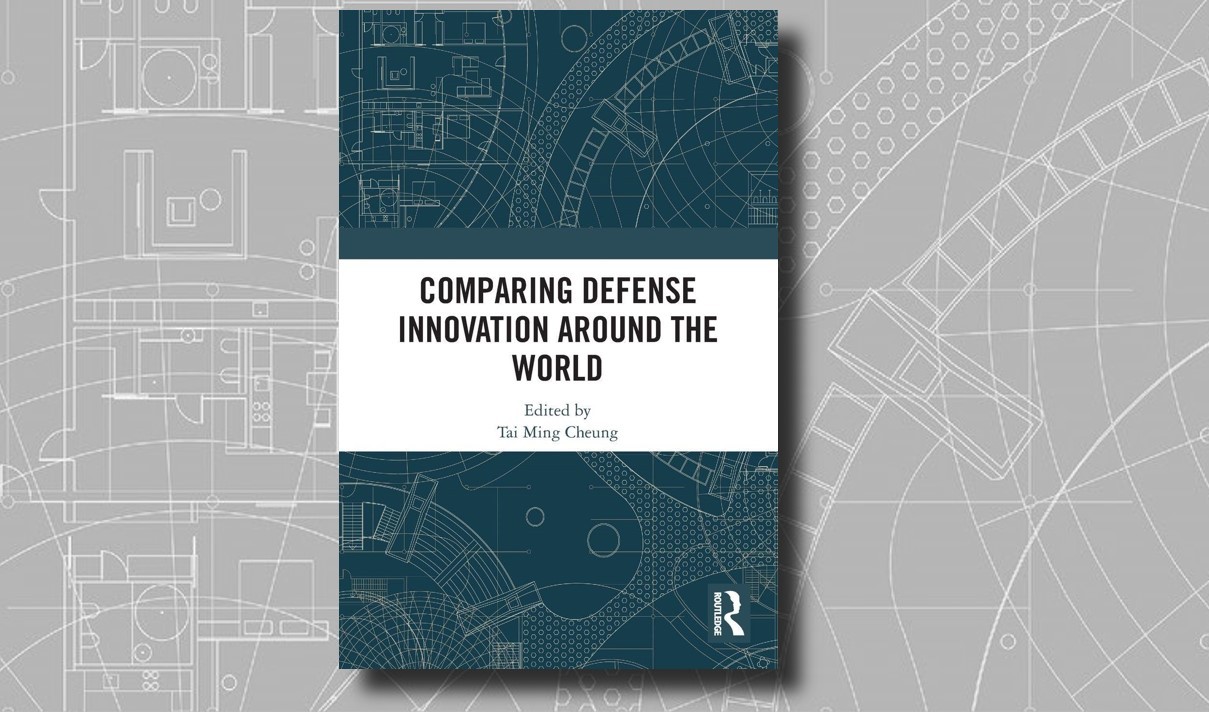

Routledge, 2023, ISBN: 9781032350523, 177 pp Hardback
Editor: Tai Ming Cheung
Reviewed By: Alice Paton
‘Innovation’, or its precursor ‘R&D’ (research and development), are easy terms to use but difficult to deliver upon. By its nature, innovation is an activity built upon inspiration and creativity as much as solid technical and operational knowledge. This characteristic has challenged efforts to articulate (and provide) the necessary factors for success. Tai Ming Cheung attempts to resolve this issue in Comparing Defence Innovation Around the World. In this collection of articles previously published in the Journal of Strategic Studies, Cheung develops a conceptual framework for defence innovation that is then applied to a variety of nations.
Cheung’s introductory article situates the collection by defining defence innovation to underpin the subsequent framework and studies. Cheung deliberately uses the term ‘defence innovation’ rather than ‘military innovation’, arguing that military innovation focuses too narrowly on warfighting without considering defence industry or dual-use applications. Defence innovation tends to focus on technological development, whereas military innovation prioritises doctrinal and tactical innovation. Cheung’s delineation between defence and military innovation is unfortunate as it eliminates consideration of how conceptual innovation can identify novel applications and combinations of existing technology to support organisational and doctrinal objectives. This omission overlooks an agile, cost-effective form of innovation particularly suited to mid-sized countries such as Australia, where resources may be constrained but where human capital is highly creative.
Cheung continues by presenting an innovation framework that maps the many factors that influence defence innovation. Regrettably, this effort fails to capture the complexity of the innovation ecosystem. While the framework provides a useful grouped list of the many factors that contribute to defence innovation, it does not adequately depict the interrelationship between them. For example, this formulation places ‘institutional’ factors (such as norms, practices, procedures and relations) downstream of the organisations that conduct development and the associated networks. More realistically, institutional factors set the conditions for organisations and networks. Significantly, this inadequate portrayal of linkages ignores the critical connections that exist among relevant innovation factors and between the innovator and the customer and/or operator. ‘End-user demand’ is neatly listed as an output, but without continual engagement with the customer/operator, innovation inevitably becomes a self-serving activity used to justify research budgets without generating worthwhile outcomes. This deficiency in the proposed framework is a by-product of Cheung’s delineation between military and defence innovation and his decision to omit a focus on warfighting.
Cheung then modifies the innovation framework, removing selected factors to illustrate how defence innovation ecosystems vary across nations at different levels of innovation. Countries are classified as incremental catch-up regimes (India and Brazil), rapidly catching-up regimes (North Korea, China), advanced developed regimes (US, Israel, Singapore, and Russia), and emerging technological domains (China’s development of quantum technologies). This method of categorisation applies a linear hierarchy that distinguishes countries based upon the type of innovation they conduct. For example, imitation (duplication) is the domain of catch-up regimes whereas advanced developed regimes are capable of radical innovation involving extensive resources and sophisticated research and development capabilities.
Beyond the dubious inclusion of Russia as an advanced developed regime for defence innovation, Cheung does not provide adequate justification for the modifications he proposes to the framework. For example, he asserts that incremental catch-up regimes are defined by two limitations—the lack of catalysts for innovation (such as external threats) and insufficient investment in the human capital required for innovation. A more nuanced analysis would acknowledge that these two conditions are related but not necessarily inseparable, with the dominant factor likely to be the extent of investment in human capital rather than the stimuli present. The article authored by Cheung and Laxman Kumar Behara highlights how the generalisations that underpin the framework can result in inconsistencies in its application. Here, the authors reiterate that India is an incremental catch-up state because it suffers the two limitations outlined above, while simultaneously observing that India has demonstrated strong innovation in strategic weapons and space capabilities. A more detailed analysis may have identified that India’s external threat environment has been the catalyst for it to concentrate investment in specific fields of innovation assessed as being most likely to mitigate security risks (instead of diffusing its limited resources into broad innovation across many capabilities).
Each of the essays applies Chueng’s innovation framework to a specific country, providing a brief overview that regrettably lacks analysis of the adequacy of the framework or an assessment of how the factors identified interact to either support or constrain innovation. Eugene Gholz and Harvey M. Sapolsky provide the most insightful contribution to the book, utilising Cheung’s delineation between 'hard' (quantifiable) qualities and 'soft' (intangible) factors to explore defence innovation in the US. Although it is debatable whether the article appropriately categorises the relevant innovation factors (e.g. historical legacy is listed as a 'hard' or measurable factor), the discussion nevertheless provides good insight into how historical context, culture, governance frameworks, and incentivisation can shape defence innovation. It is unfortunate that the remainder of this article simply catalogues the various inputs to the American defence innovation ecosystem without assessing how effective each factor has been or how well integrated it is within the broader system. Instead, the authors simply conclude that the US remains unrivalled in defence innovation due to its significant investment.
Unfortunately, limited analysis characterises all the articles within the book. Each provides a superficial overview rather than examining what lessons can be learned and applied to other countries with similar conditions. It is also concerning that the articles appear to reinforce a belief in innovation for the sake of innovation—celebrating quantity over quality—rather than examining how to ensure scarce defence resources are best utilised for the benefit of the nation and those that serve it. This deficiency stems from the distinction drawn between defence and military innovation which obscures the central purpose of innovation: delivering the best possible outcomes for the warfighter, whether through doctrinal, tactical or technological means. R&D already has a reputation for being a ‘self-licking ice-cream’, let us not perpetuate that perception.
Notwithstanding the limitations outlined in this review, Comparing Defence Innovation Around the World nonetheless identifies many factors that contribute to defence innovation. It will therefore be of some utility to those looking to develop or refine innovation programs. It is not, however, recommended for general reading. Ultimately, those looking to gain insight into innovation and adaptation within militaries would be better served by reading Williamson Murray and Allan Millett’s Military Innovation in the Interwar Period and Meir Finkel’s On Flexibility: Recovery from Technological and Doctrinal Surprise on the Battlefield.