The Newcastle Covering Force in Peace and War
Author: Sam Baumgarten
Introduction
The Newcastle Covering Force (NCF) was a divisional-strength military formation deployed to defend the coastal Hunter region in 1942. It was characterised by the adaptations it made in response to pre-war strategic planning. This article focuses on key changes to the structure and tactical posture of the NCF during its homeland defence role after the commencement of the Pacific War. These changes demonstrate what adaptation looks like during the initial stages of conflict.
The NCF’s genesis was one part of Australia’s pre-war efforts to defend Newcastle and Sydney from an amphibious invasion by Japan. The title of NCF derived from doctrine; it was to be a forward security element that protected an assembling counter-attack force. The NCF was raised in April 1941 and comprised a mix of (predominantly) part-time forces who had differing levels of readiness and capability. Just a year after it was raised, the NCF was renamed the 10th Division. While the impetus for this change was a complete reorganisation of the Australian Army’s higher command, the NCF’s transition to a divisional structure matched the improved levels of capability it had come to achieve. Indeed, by the time it was renamed, the NCF was conducting robust defence in depth across the Hunter Valley region.
The example of the NCF provides a valuable case study of adaptation in warfare. Improvisation was an initial characteristic of the NCF as it sought to balance a circumscribed allocation of forces with the need to achieve rapid deployment. A process of appraisal changed the NCF’s mission from defence to destruction of the invasion force as the Army’s leadership came to better understand the nature of the Japanese threat. While it was successful in raising a defensive capability rapidly, logistics nevertheless remained the NCF’s chief shortcoming and constituted a significant impediment to its freedom of action. These constraints ultimately led to the 10th Division being disbanded in September 1942, just nine months after it was established as a formation-level organisation.
The experience of the NCF in World War II provides valuable insights into the process of rapidly preparing a formation while conflict is already underway. The NCF was able to deploy a force while it was still under development and to achieve a level of understanding about its operational setting that was ahead of the direction available from higher headquarters. Its experiences remain relevant as the Australian Army prepares security response forces for homeland defence in accordance with the Defence Strategic Review.[1] The challenges faced by the NCF underscore the reality that standardised doctrinal structures are the preferable aim point for growth when preparing for uncertain operational situations. It also demonstrates the importance of adapting the mission allocated to subordinate elements to align with correct analysis of the threat, in line with higher intent and formation capability.
Preparations up to the Commencement of the Pacific War
The origins of the NCF can be found in pre-war strategic planning. The 1920 Senior Officers’ Conference, had predicted that the Japanese military was capable of conducting an amphibious invasion of Australia with approximately 100,000 personnel in one convoy.[2] This assessment, however, was not uniformly accepted in political circles. United Australia Party Prime Minister Joseph Lyons (1932–1939) and his successive Ministers of Defence Sir George Pearce (1931–1934) and Archdale Parkhill (1934–1937) sought to predicate Army structure, mobilisation and base defence plans against the threat of smaller-scale raids of approximately 200 personnel. They assessed that any threat to Australian territory could be met within the existing limited resources of the Australian Military Forces (AMF). Instead of prioritising homeland defence, their preference was to fund the Royal Australian Navy and the development of the Singapore Naval Base which, it was hoped, would keep the Japanese threat far from Australia’s shores.[3]
The AMF’s senior leadership objected to this approach. Two successive Chiefs of the General Staff, Major General Sir Julius Bruche (1931–1935) and Major General Sir John Lavarack (1935–1939), made contrary preparations for more substantial anti-invasion forces.[4] Ultimately, the strategic-level concept comprised an AMF of sufficient strength to defend key locations on Australia’s eastern seaboard against the stronger threat envisaged by the Senior Officers Conference. The Hunter region and Port Kembla were identified as critical due to their economic importance as ports and their proximity to Sydney. The plan to raise this defence force was titled the Plan of Concentration.
The Plan of Concentration would be better characterised as a system of mobilisation and an allocation of forces rather than an operational plan. At the time, the AMF consisted of the part-time Citizen Military Forces (CMF) for service in Australia and the small Permanent Military Force, which performed cadre responsibilities such as training. The Plan of Concentration placed considerable emphasis on training for coastal defence. It drew on lessons learned from a combined arms exercise conducted by the 1st Brigade at Port Stephens in October 1938 to repel a coastal incursion. This was, at the time, the largest exercise ever conducted in Australia.[5]
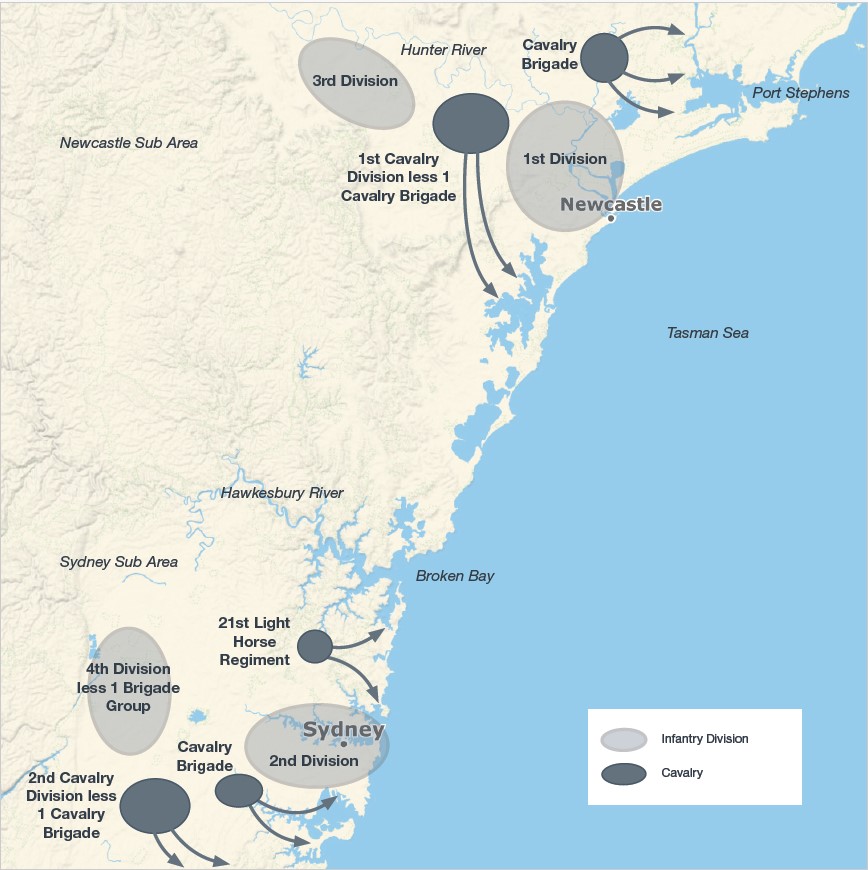
The Plan of Concentration committed two corps to defend the Sydney–Newcastle–Port Kembla region. In a concept developed by the 2nd Military District (which commanded all AMF units in New South Wales), forces would be mobilised in two discrete phases. The first phase would be triggered during a period of heightened threat before formal hostilities and was known as the Precautionary Stage.[6] It involved a modest posture of NSW-based infantry units to protect Newcastle, the 2nd Battalion and 13th Battalion, to provide security to the Newcastle fixed defences.[7] Subsequent to the Precautionary Stage, the First Line Component phase would see both corps fully raised, with one to defend Sydney and the other to defend Newcastle. The First Line Component called for 40 infantry battalions, 11 artillery brigades and 10 engineer field companies. At the time, the entire nation’s AMF numbered just 45,000 members, of whom more than 75 per cent would be committed just for the defence of the Sydney–Newcastle–Port Kembla region. This constituted ‘an overwhelming allocation of the Army’s strength’[8] and left nothing for the defence of south-east Queensland or Victoria.
In August 1940, the 1st (Australian) Division (1 Div) was allocated to Newcastle under a modification of the First Line Component. It was to deploy when called out for full-time service, less one brigade. Its purpose was to cover the concentration of the rear division (3rd (Australian) Division).[9] This was less than the allocation envisaged under the original Plan of Concentration, which had seen both 1 Div and elements of the 1st Cavalry Division (1 Cav) earmarked for the role of covering the rear division before a subsequent counter-attack.[10] 1 Div began homeland defence training activities when it was assembled for periods of training; however, it remained a part-time formation and was not scheduled to fill the covering force role fully until the CMF was called out for full-time duty. It was assessed that a large amphibious assault would place the force under considerable pressure. Therefore, 1 Div recognised early that mounting an effective defence of the coastline around Newcastle would require ‘as large and mobile reserves as possible’.[11]
Over the next 12 months, increased demands on the AMF’s modest force, including provision of defensive capabilities at other locations such as south-east Queensland and Victoria, led to a redistribution of forces. While defence of the Hunter Valley region remained a priority, there was growing anxiety about the wider threat to populated areas of Australia. In April 1941, 1 Div was redeployed to Sydney, where its mission was changed to the defence of the Port Kembla–Sydney region.[12] To fill this gap, Eastern Command (which had succeeded the 2nd Military District at this time) immediately created a new formation, the Newcastle Covering Force (NCF), to protect the strategically important Hunter Valley region. Whereas previously this had been a name for the defensive task around Newcastle, the NCF was officially established on 8 April 1941 and was allocated the role that bore its name. The Precautionary Stage had commenced by this point.
The term ‘covering force’ can be found in the 1935 edition of Field Service Regulations, which was the capstone doctrine for the AMF in this period. The section titled ‘The Preparation of a Campaign’ characterised the function of a covering force as protecting a concentration area, ideally one covered by a natural obstacle.[13] The key observation is that the role of a covering force was considered provisional to enable the concentration of the main battle force. It was therefore fundamentally defensive in nature. Field Service Regulations was an operational-level document that used the ‘covering force’ terminology to encapsulate the function of a senior echelon. While the term is no longer used in Australian doctrine, it is still employed by the US in its Army Techniques Publication 3-92—Corps Operations to mean a formation-level security task.[14]
A cadre of NCF headquarters staff was soon assembled, predominantly from part-time officers.[15] The forces available were situated in the context of the extant mobilisation regime. The CMF was a predominantly part-time organisation until the start of the Pacific War. Its readiness had, if anything, diminished since the commencement of the Second World War. It had seen many of its superior leaders enlist for overseas service in the AIF and substantial amounts of its equipment allocated as well. Conscription commenced in 1940 and extended to camp periods of six months for recruits and 90 days for trained soldiers from July 1941. The camp periods usually involved the embodiment of whole CMF units, who facilitated initial and collective training.
The first Commander of the NCF was Brigadier Fritz Solling, a doctor who had served in the First World War as a Regimental Medical Officer. He was undertaking full-time duty, having previously commanded the 13th Battalion and 1st Brigade.[16] The early headquarters staff were a mix of CMF personnel on part-time and full-time duty.[17] The process of consolidating the NCF’s subordinate forces proved slow and complex. By September 1941, the force comprised some permanent units such as such as anti-aircraft elements and the Newcastle Fortress Command, which operated coastal artillery and associated equipment. But it still relied heavily on units such as the 1st Field Regiment (artillery), 16th Machine Gun Regiment and 8th Garrison Battalion to allocate their periods of continuous training to the NCF.[18] This approach was at odds with initial planning for the Precautionary Stage, which had seen 2nd and 13th Battalions neatly allocated as the two manoeuvre units. Instead, the rotational allocation of part-time units was an adaptation based on necessity and represented the first in a series of such improvisations.
The NCF suffered from the exodus of experienced military officers to the AIF like much of the rest of the CMF. The AIF was raised for overseas service. With war underway, younger officers and soldiers of the CMF frequently transferred to the AIF. This meant that senior command appointments within the NCF were filled predominantly by older officers with First World War service. While such experience appeared to offer significant advantage, historian Garth Pratten has observed that the benefit of having veteran leaders was tempered by the fact that many had not actually served for over 20 years.[19]These veterans were often advanced in rank on rejoining the CMF, blocking younger officers from advancement, despite a lengthy break in service. Meanwhile, the bulk of the captains and temporary majors belonged to a cohort who had commenced military service in the 1920s era of compulsory military training.[20] The junior officers had generally served in the ranks in the late 1930s and were commissioned immediately prior to the Pacific War. The overall effect was that the AMF suffered from a paucity of leaders with contemporaneous combat experience. The loss of substantial amounts of allocated equipment to the AIF overseas, combined with the shortage of leaders, considerably diminished the CMF’s capability. [21]
Actions Taken on the Commencement of the Pacific War
On 7 December 1941, Japan attacked Pearl Harbor, triggering the Pacific War. In response, the NCF was mobilised to full-time duty. It moved to war stations two days later and began occupying defensive positions with forces then available.[22]
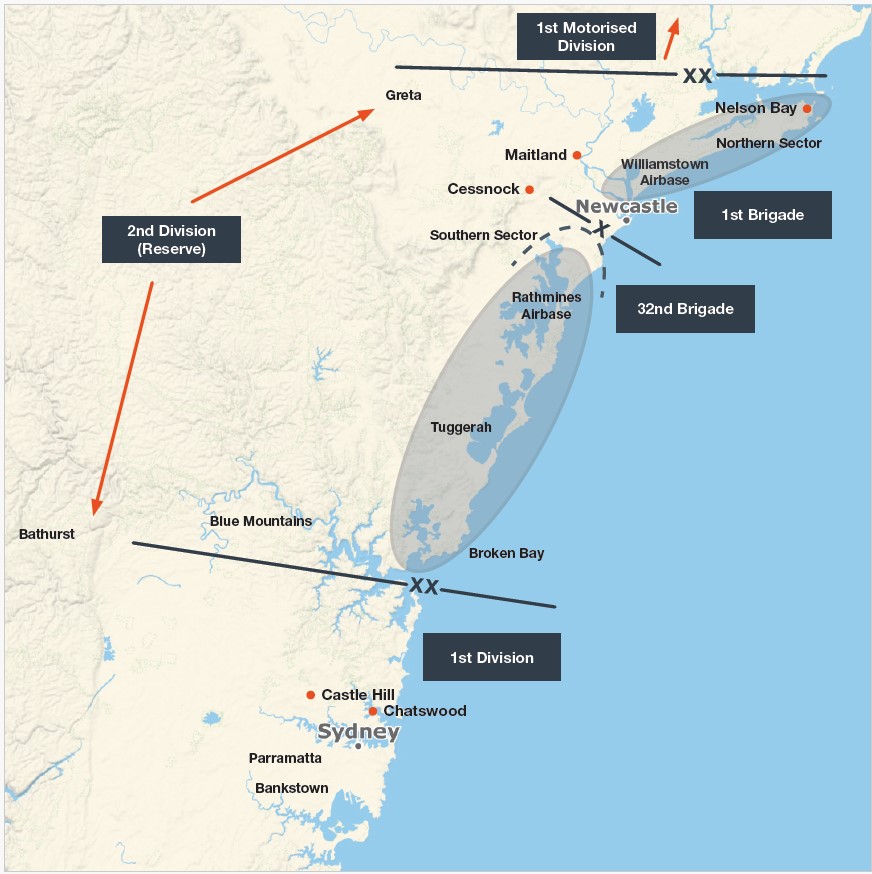
On 10 December, the NCF released Operations Order No. 1, which consolidated all of the units allocated for defence in the Hunter region. It allocated the 1st Infantry Brigade (with three infantry battalions) to defend the northern sector, above the Hunter River, including the Williamtown Air Base. The 33rd Infantry Battalion (detached from the 1st Infantry Brigade) was tasked to defend the southern sector, which incorporated the eastern Lake Macquarie area. The designation of ‘sectors’ constituted an improvised command and control arrangement in lieu of brigades. This command structure was imperfect, for the sectors were soon treated as brigade tasks in all but name.[23]
Mobilisation occurred throughout December. Most officers commenced duty within one week of the commencement of the Pacific War, while others (such as those posted to the 33rd Battalion) were already on duty conducting periods of continuous training.[24] Employment of NCF capabilities was dictated by a hierarchy of unit readiness. Accordingly, units with low levels of readiness and training, such as garrison battalions, were initially placed in static roles. These were generally filled with older soldiers, largely veterans of the First World War. They were specifically raised ‘for the local protection of the coast defences’.[25] By now, the NCF had a strength of one infantry brigade and one independent infantry battalion. This was still almost a brigade short of the infantry allocation envisaged for the First Line Component stage that it had now entered, but it would soon grow. On 26 December, Eastern Command released Operations Instruction No. 7, which directed the NCF and 1 Div to battle positions.[26] Most units within the NCF were immediately committed to coastal defence tasks, with only battalion-strength reserves maintained in the northern and southern sectors respectively.
Whereas the 1st Brigade had responsibility for defence of the northern sector, no standing headquarters element was allocated to the southern sector.[27] In response, the NCF improvised by generating its own. Initially, Lieutenant Colonel William James, the Commanding Officer of the 16th Machine Gun Regiment was appointed to command the southern sector, most of whose unit had been task-assigned to other units. The southern sector by now comprised the 8th Garrison Battalion with the 33rd Battalion in reserve. On 3 January 1942, Brigadier John McNeill (who had held the rank of major just three years earlier)[28] was posted from his appointment as Commander 1st Infantry Brigade to command the 32nd Brigade.[29] The 32nd Brigade was formally raised on 19 January 1942 and immediately assumed command of the 8th Garrison Battalion and the 33rd Battalion in the southern sector.[30] The brigade headquarters staff was augmented by officers on temporary loan,[31] and sub-units (including companies of the 16th Machine Gun Regiment and 11 Battery of the 3rd Anti-Tank Regiment) were force assigned to enable the brigade to generate combined arms effects.[32]
Throughout this period, new soldiers arrived untrained to reinforce existing units or to constitute new ones. The experience of the 20th Field Regiment, an artillery unit, is an illustrative example of this process. On 9 February 1942, the regiment was added to the war establishment of the 32nd Brigade. Lieutenant Colonel Keith Flavelle was appointed to command the regiment on 21 February along with 10 other officers,[33] followed by 462 recruits to bring the regiment up to strength on 2 March. In addition to these troops, the regiment received six obsolete 18-pounder guns on 19 March[34] accompanied by more trained personnel such as Captain Arthur Bruce. He had commanded an 18-pounder section at Ocean Island (present-day Kiribati) for a brief period before it was relieved shortly before the island’s capture in early 1942. Having returned to Australia on 8 March 1942, he posted into 20th Field Regiment on 25 March. By 31 March, he was supervising a regimental survey training school.[35]
The new and existing units of the rapidly expanding NCF required significant training to meet the requirements of their mission. On 8 February, less than three weeks after the 32nd Brigade’s formation, the 33rd Battalion was directed to conduct a ‘free-for-all’ exercise on 12 February with one company pitted against another.[36] The fact that such training occurred implies a degree of independent capability among NCF elements, with Battalion Headquarters providing the umpires. No evaluation of this exercise was filed, but subsequent collective training activities would increase in scale for all units in the NCF. For example, on 20 March, a directive was issued that personnel who could not swim were to be given ‘sufficient instruction to enable them to have some measure of confidence in the water’.[37] The requirement for water competence reflects the fact that much of the 32nd Brigade’s collective training was focused on river crossing,[38] a necessary undertaking in the Lake Macquarie area, which contains substantial waterways. In a further, unusual directive, ‘every effort [was to] be made to train all personnel to ride a bicycle and where facilities exist to be taught to ride a horse’. This directive was in response to the relatively short supply of motor vehicles.
The NCF’s ability to quickly raise a new subordinate headquarters and fighting units demonstrated the positive potential of improvisation. Realistic appraisal of the threat, and what the available forces could achieve, was the next step in the NCF’s evolution.
Appraisal and Change
It rapidly became apparent that the NCF would not be able to defeat a Japanese invasion with its existing linear, coastal posture. Despite 1 Div previously having appreciated the requirement for ‘as large and mobile a reserve as possible’, the higher command demonstrated an ongoing bias towards coastal defence achieved through static, coastal deployment and defensive works. Mobile defensive tactics were neither considered nor within the NCF’s capability during its early development.
Prior to and during December 1941, Eastern Command regarded landing points as the location where the battle would be decided. In an appreciation conducted on 19 September 1941, Eastern Command attributed to the enemy the advantage of surprise, but emphasised the importance of preventing landing or consolidation.[39] Underscoring its reliance on repelling the enemy at the beaches, on 9 December 1941, HQ Eastern Command issued Operation Instruction No 1—Occupation of War Stations. It stated:
Owing to the absence of Garrison B[attalio]ns, until mobilised, Covering Force Commanders will make temporary adjustments of their plans for distribution of their forces to ensure that landing places giving access to forts are guarded.[40]
In a memorandum to the Minister of Defence, Francis Forde, on 4 February 1942, Lieutenant General Iven Mackay, Commander in Chief Home Forces, expressed concern about meeting the enemy’s first thrusts.[41]
Higher-level doctrine provided minimal guidance on the conduct of mobile defence. The Field Service Regulations provided only a short description of defensive operations. Volume 2—Operations General devoted just 16 of 220 pages to defensive tactics, with an additional two pages to defence in positional warfare. Here, no distinction was made between tactical methods such as area defence, delay or mobile defence.[42] The pamphlet Infantry Training, an edition of tactical doctrine that was directed at the battalion level, briefly mentioned mobile operations but described defensive operations as occurring in well-developed positions with tight control.[43] AMF doctrine at the time reflected the prevailing British doctrine of the inter-war period. As observed by Tim Moreman in his study of imperial military doctrine, ‘[t]he British Army’s defensive doctrine emphasised painstaking preparation and tight control over the battlefield’.[44] The practical effect is that mobile defence may have been considered innovative or anachronistic in contrast.[45] Tactical-level doctrine could have inspired early NCF planners and leadership to consider a more flexible approach. However, they remained staunchly focused on linear, static, coastal defensive tactics. Change was underway, and as early as 6 January 1942, NCF Operations Order No. 3 stated: ‘The guiding principle will be MINIMUM of t(roo)ps disposed and MAXIMUM held in reserve’.[46]
The Transition to Defence in Depth
Ultimately, it was from within the NCF that commanders instigated more flexible methods of fighting. This process commenced after a change of leadership at the highest level of the NCF. On 3 January 1942, Major General John Murray replaced Solling as Commander, NCF, with Solling returning to command the 1st Brigade. While it is broadly accepted that Murray was instrumental in driving the NCF towards a defence-in-depth posture, his exact role is unclear. There are few records of his tenure within the NCF and (later) the 10th (Australian) Division, and his memoirs focus on his experiences in the Tobruk campaign.[47] So we cannot be certain whether he had a close role in planning and execution, or whether he delegated these functions. What is known is that Murray shared the same characteristics as many of his formation’s officers, namely that he was older and of questionable physical fitness. He had been removed from his command of the 20th Brigade after the Tobruk campaign by (then) Lieutenant General Thomas Blamey, Commander 2nd AIF. David Horner notes that, his being overweight, questions were asked about Murray’s suitability for the role.[48] Despite any physical limitations, Murray had been awarded a bar to his Distinguished Service Order for his command in the tough conditions of the Tobruk campaign and there seems to have been no question as to his professional competence.[49]
In a succinct military appreciation dated 30 March 1942, Murray acknowledged the utter indefensibility of his area of operations by linear means. Rather than contemplating a reduction of security tasks or the total abandonment of the coast,[50] he took a different approach. Specifically, he proposed the generation of the largest possible mobile reserve, drawing on combined arms elements from his most effective CMF battalions. Explaining the purpose of this course of action, he stated:
- It will enable me to strike a heavy blow at the enemy whether he chooses to attack from the coast or on my perimeter.
- It will give me the best means with the forces at my disposal, of protecting vital communications in my area, particularly the WILLIAMTOWN AERODROME.[51]
The use of mobile reserves, delegated to subordinate commanders, was consistent with Murray’s experiences at Tobruk.[52] There were differences between the New South Wales coastline and the North African desert; Tobruk utilised a more robust perimeter of fixed-concrete defensive works and was manned by a greater density of personnel. However the importance of reserves was a key similarity of the two defensive plans. Up to this point, the NCF maintained no centralised reserve. Instead, the task was nominally being performed by 2 Div as the Eastern Command reserve in support of 1 Div (the Sydney–Port Kembla covering force), 1st Motorised Division (Coffs Harbour) and the NCF. The issue for Murray was that 2 Div was located at Greta and the Central West meaning that it could not be easily transported and committed to any of his subordinate formations’ locations.[53] Accordingly, Murray made no mention of 2 Div as a reserve in his appreciation. It can be inferred from this omission that he anticipated fighting alone.
Murray now departed from the existing reliance on tightly controlled static defence. He adopted the term ‘watching posts’ to describe observation effects along the coastline. This function would be undertaken by the 8th Garrison Battalion in the southern sector. Meanwhile, the 4th and 33rd Battalions were to be ‘held in reserve as a mobile striking force’ in the 32nd Brigade area of operations.[54] Importantly, Murray’s plan recognised that a defence-in-depth posture would result in the initial capitulation of Australian territory, and that mobile defence placed a considerable burden on newly formed forces. Acknowledging this, he (in effect) delegated to well-resourced subordinate elements the task of repelling any Japanese attack, granting them freedom of action to manoeuvre offensively or defensively as the situation required.
A prominent change in this period was the reorganisation of the AMF. On 9 April 1942, Eastern Command became II Corps under the First Army commanded by Lieutenant General Sir John Lavarack. It was based in Toowoomba.[55] Concurrently, the NCF was formally retitled the 10th (Australian) Division (10 Div), which is the title that will be used for the remainder of this article.[56]
The reorganisation of the AMF was accompanied by progressively more coherent direction to 10 Div from higher headquarters concerning its mission to defeat the Japanese. The formation-level concept that took shape appears to have been an instance of policy catching up with Murray’s appreciation of 30 March. It is difficult to determine how 10 Div had already responded to the events unfolding in Australia’s near region. However, evidence suggests that it had begun to re-posture to achieve a thinly held coastal zone, supported by reserves, before it was formally directed to do so. On 30 May 1942, 10 Div’s Operational Instruction No. 2 was issued. It directed a reduction in troop presence on the coastline to an observation strength and the generation of the largest possible reserve at each level of command. An extract from the relevant policy issued by Headquarters First Army was appended to the instruction to provide operational-level context.[57] In parallel, training publications were released which publicised new tactical methods. For example, the Army Training Memorandum was a monthly bulletin-style publication which promulgated lessons from Australian and Allied forces, initially in the Middle East and then against the Japanese. The war diaries of 10 Div reflect that key editions were disseminated widely.[58] Drawing on lessons from the 8th Division’s failed efforts to defend Singapore, the May edition observed:
The object of the Australian army must be to destroy any enemy force that lands on our shores. This can only be done if troops are disposed so that they can attack the enemy at every opportunity.[59]
Following promulgation of Operational Instruction No. 2, 10 Div effected a significant redistribution of forces. The garrison battalions were progressively allocated the lion’s share of fixed defensive roles along the coast, with generally younger, better-trained CMF units consolidated to provide mobile, combined-arms reserves. The defence-in-depth posture that emerged drew on the AIF’s earlier combined arms experience during World War I. As Stephen Biddle observes in his description of this as the ‘modern system’, this approach imparted independence to small units to manoeuvre over a wider area and force the enemy to ‘slow down in order to survive, and to extend this period of furtive movement into depth, affording defenders time to respond’.[60]
The redistribution of 32nd Brigade assets clearly illustrates this change in defensive posture. Earlier, on 14 March, a substantial portion of the force was deployed in platoon and company strength astride the coast in what was termed Zone 3—the eastern side of Lake Macquarie.[61] Zones 1 and 2 were further south in the Tuggerah–Broken Bay area and were collectively screened by a motorised company and machine gun platoon. In total, 750 32nd Brigade troops were allocated to Zone 3, operating a variety of crew-served and individual weapons. The balance of 8th Garrison Battalion, 33rd Battalion and 4th Battalion were concentrated at centralised locations approximately 5 kilometres inland and on the approaches to Newcastle, namely Adamstown, Gateshead and Blackall Park.[62] By the time Operations Order No. 3 was released on 17 July, Zone 3 had been expanded to include locations in Newcastle, but the forces allocated to directly defend the beaches had been reduced to three companies (approximately 300 soldiers), all of whom were from the 8th Garrison Battalion. Meanwhile, Zones 1 and 2 further south now consisted of coast reporting posts only. As the only CMF battalion allocated to 32nd Brigade in July, 33rd Battalion was deployed in reserve and centrally placed relative to the Lake Macquarie and Newcastle area at Mount Hutton.[63]
Training
Over just a few short months, 10 Div had reappraised the Japanese threat and the measures needed to defeat a Japanese intrusion, whether a raid or an invasion. While it remained a brigade short of a full division, it had evolved from an improvised covering force to a formation with a standardised structure able to execute a greater range of tactical tasks. The challenge now was to generate a collective training program that accounted for these changes.
While training had been occurring from the early stage of the NCF’s establishment, by May 1942 it appears to have become a priority. Training activities undertaken at unit level varied from range shooting to unit-level advances-to-contact and attacks. The latter activities involved the relief in place of entire battalions.[64] The high tempo of training activities paralleled the efforts of other brigades employed on defensive tasks during the same period, including 7th Brigade, which would shortly depart for operations in New Guinea.[65] Further supporting 10 Div’s training efforts, lectures were delivered to members of the division from officers who had avoided capture during the Malayan campaign.[66]
The effectiveness of 10 Div’s training effort is difficult to gauge. In March 1942, Lieutenant Arthur Duprez (awarded a Military Cross in World War I) filed a highly critical observation report concerning the coordination and fieldcraft in a training exercise undertaken by three companies of 33rd Battalion.[67] However, such criticism is not reflected in other reports included in the relevant war diaries of 32nd Brigade and 33rd Battalion.[68] Regardless, the assessed standard of 10 Div never rose above the level of the effective units operating independently, not collectively. In an appraisal of readiness standards issued on 19 July 1942, both brigades of 10 Division were assessed at Standard F: ‘Unit training is not yet complete’.[69] The efforts to bring 10 Div to a higher standard of collective readiness achieved only modest results in the time allocated. (Having said this, it is notable that 7th Brigade only achieved Standard D: ‘Individual brigades are efficient in a static role’ prior to its departure for New Guinea but nevertheless performed reasonably well at Milne Bay.[70]) Evidently, six months was simply insufficient time to raise the military standard of so many raw recruits into an independent infantry division. However, it is fair to say that 10 Div’s training efforts were similar to those undertaken by many other formations at the time and, despite their limitations, raised skills considerably in a short amount of time.
Equipment
The allocation of equipment to 10 Div compared favourably with allocations to other AMF elements and to the CMF formations that were deployed to the Pacific. This situation evidently reflected the high priority placed on the defensive role around the Newcastle–Sydney–Port Kembla region under the Plan of Concentration.
The CMF units of 10 Div operated on a war establishment. In this regard, the division benefited from its proximity to the sources of production, its access to training, and the high priority that Army placed on its defensive task. For example, significant universal carrier production commenced in Australia from February 1941 and approximately 1,000 units had been produced by October.[71] The 20 Div’s 33rd Battalion was one of a number of CMF infantry units that held an allocation of these relatively scarce vehicles. Bren guns were available throughout the NCF’s existence. By contrast, the 39th Battalion lacked Bren guns until July 1942, which was after it had already commenced combat operations in the Kokoda campaign.[72] 10 Div’s artillery regiments were allocated 25-pounder guns relatively quickly: the 1st Field Regiment was equipped with 25-pounder guns by at least January 1942.[73] Subsequently, the 20th Field Regiment received two dozen 25-pounder guns between 5 and 8 June.[74] While this equipment allocation was impressive, in reality much of it was probably misallocated from units that had a greater need of it. In hindsight, it may have been more usefully employed in New Guinea as it was evident that shortages of modern weapons were felt offshore.
Logistics Support
From its earliest days, 10 Div faced significant shortfalls in logistical support. Pre-war planning had envisaged that the defensive role would reduce the burden of supply on the division because local resources would be available.[75] The limited allocation of motor transport and mechanisation prior to the war meant that numbered light aid detachments (which conducted first-line maintenance) only existed at the base district level within each state, at a ratio of about one per division.[76] Gradually, more logistic elements were apportioned to 10 Div at the divisional and brigade levels.[77] The 1st Brigade brought a number of supporting units into 10 Div, including the 1st Field Company (Engineers) and the 1st Field Ambulance.[78] Then, on 1 March 1942, a supply column and a petrol and ammunition company was established as one unit.[79] In addition, light aid detachments were formed at unit level in 1942 to serve the growing number of vehicles and equipment.
In addition to the pre-existing capabilities, 10 Div required significant new logistic enablers to operate effectively. But in the rush to generate combat power these were the last to be raised. They included a divisional ordnance workshop, an ordnance field park, the 311th Light Aid Detachment, the 11th Laundry and Decontamination Unit and a field hygiene section as at 1 March.[80] To operate effectively these units required specialised personnel and equipment that had not existed in the pre-war AMF. A growing gap developed between arms units and support.
Many 10 Div personnel were re-tasked to better match their skills to logistic requirements. The NCF’s Routine Orders—Part 1, dated 17 February 1942, stipulated: ‘The attention of all Commanding Officers is directed to the urgent need of employing all manpower in such a manner as to provide the maximum results’.[81] Thus, where personnel were regarded as unsuited to field service on the basis of age or other considerations, the orders directed that they ‘are to be transferred to Maintenance units etc, and replaced by younger men’.[82] Examples included Lieutenant Hedley Apthorpe, an officer of the 33rd Battalion who was 35 years old and listed his occupation as motor mechanic. He was detached to 10 Div and later in the war posted to instruct on a driver-mechanic course.[83] Commenting on the situation, one source notes:
While the term ‘purge’ conjures up impressions of a public defenestration, many (if not most) were quietly pushed aside and offered less physically demanding appointments in keeping with the army’s ‘gentlemanly’ ethos.[84]
While 10 Div’s logistics capabilities ultimately improved, they were never properly resolved. These shortcomings, and the division’s reliance on garrison support, considerably reduced its tactical flexibility. For example, the 32nd Brigade Operations Order No. 3 of 17 July 1942 allocated supplies of food and ammunition by zones, assuming the presence of either battalion, company or platoon sized headquarters. While some smaller 10 Div elements were allocated seven days food and water, most battalion and company concentrations were allocated only two. Rifle ammunition holdings were generally about 120 rounds per weapon.[85] This allocation probably reflected an expectation that 10 Div would undertake only a short, independent operational role. Certainly, ammunition holdings were insufficient for sustained area defence. This is an example of inadequate logistic support dictating tactics.[86]
Ultimately, 10 Div had grown quickly and without the fundamental inputs to capability that would have enabled it to operate as a balanced force. The failure to generate requisite logistic components, despite the requirement for the force to fight independently, was a significant limitation. There was insufficient material or personnel to address the support shortfalls. By September 1942, Prime Minister Curtin characterised the AMF’s level of mobilisation as unsustainable. It was at this point that the division was disbanded and its personnel transferred to other organisations.
The experience of the officers in the 33rd Battalion illustrates the variety of units to which personnel were redeployed. In September 1942,[87] the battalion was disbanded and merged into the 13th Battalion of 1st Brigade. At this time, several of the 33rd Battalion’s 40 officers were transferred to infantry or artillery units in the AIF, where they saw active service in the Pacific. At least eight other officers[88] (and many soldiers) were transferred to anti-aircraft regiments, primarily the 103rd Anti-Aircraft Regiment. Up to six officers subsequently served in the machine gun (MG) battalions (formed in late 1942 for defensive roles) and deployed to either Thursday Island (5 MG Battalion)[89] or New Guinea (6 MG Battalion).[90] At least three officers were posted to higher headquarters as staff officers.[91] Only two subsequently saw active service in infantry battalions of the AIF. One of these, Lieutenant Charlie Brennan, became the only one of the battalion’s officers who was killed, while serving with the 2/31 Battalion at Tarakan on 3 July 1945.[92] It is difficult to assess whether these reallocations constituted the best use of the battalion’s personnel, but it is nevertheless reasonable to assume that they ultimately made a meaningful contribution to Australia’s war effort.
The NCF’s Phases of Change During the Response to Conflict
The experiences of 10 Div provide valuable insights into how land forces transition amid the uncertainty of pending and actual hostilities. The simultaneous demand for AMF resources imposed an imperfect force on the NCF, and on 10 Div after its establishment following Japan’s entry into the war. This situation dictated an imperative to adapt which manifested in two basic forms.
Rapid Force Generation. When 1 Div ceased its task to defend the Hunter Valley region, the resultant capability gap needed to be filled quickly. So new units and formations were raised in a process that was rushed and imperfect. While priority was given to defence of the Port of Newcastle and the industry in Zone 1 (nearest to Newcastle), in the zones further south, which were considered of lower priority, there was an even smaller allocation of defending forces. This allocation was insufficient for the defensive task they had been assigned, and set the scene for a reappraisal of their mission.
Appraisal of the Threat. Once 10 Div had achieved a minimum level of capability, its leaders reflected on what was the best method of defeating the Japanese threat to Australian soil. In the face of the pervading sense of Japanese superiority that existed in early 1942,[93] 10 Div’s response was to adopt a defence-in-depth posture, accompanied by more robust official language concerning the division’s resolve. This example of appraisal is probably the principal lesson for the contemporary Army as it contemplates homeland defence. It is a truism that plans almost never survive first contact and must change. The case of 10 Div provides an example of the uncertain conditions under which that change might need be effected.
The issues of force generation and appraisal will be critical for the Australian Army if it is to effectively respond to a threat to Australian territorial integrity. The initial imperative will be to quickly assemble forces capable of securing key locations in a manner that is as consistent as possible with the pre-war plans. As greater clarity emerges regarding the mission, a higher degree of freedom and flexibility can emerge from the subsequent appraisal of the threat and the emerging operational conditions. This may be accompanied by acceptance of strategic risk, which in 1942 manifested as a willingness to cede territory to provide a greater chance of defeating any threat. Such an appraisal will need to be accompanied by an assessment of training needs, and the generation of training serials that encapsulate new lessons. In the case of 10 Div, its planning took place against the backdrop of an existential threat to Australian territory. In the future, similar confronting circumstances may provide the context within which operational and strategic planners identify, communicate and manage solutions.
The Importance of Standardised Structures
Until 10 Div was raised, the NCF operated as a bespoke entity, tasked to perform the ad hoc tactical task of a covering force in response to an identified threat. In a future scenario, the shortage of standardised forces may again tempt decision-makers to build bespoke structures to meet specific needs. Indeed, such a situation has already arisen in recent years. An obvious example is the security response task units that were raised by the 2nd (Australian) Division in response to a need for defensive effects that was identified in the Defence Strategic Review.[94] In all but name, these units constitute motorised infantry battlegroups, and they can reasonably be anticipated to function as such.
While the generation of such ad hoc capabilities can help assuage an immediate threat, 10 Div’s experience demonstrates the risk that such formations can become unsustainable. Operational formations require their appropriate allocation of support elements, especially logistics, if they are to be expected to act relatively independently. While 10 Div attempted to evolve as closely as possible into a standardised infantry division, ultimately it was unable to do so. The reality is that standardised force structures better permit formations to conduct a wide range of doctrinal tasks in a sustainable manner.
Conclusion
In large part, the NCF (and then 10 Div) needed to translate strategic direction into tactical action. The process of transforming plans issued by higher headquarters into defensive capability was made substantially harder than initially envisaged. This was due to the disruption caused by the reallocation of 1 Div and the requirement for concurrent defensive apportionment. Further, there was insufficient doctrinal guidance to support the tactical effort. This left 10 Div to raise and train much of the force itself, and to conduct its own appraisal of the operational situation and the necessary response.
The life cycle of the NCF and 10 Div demonstrates how change can be achieved by military formations against the competing priorities of operational deployment and force generation. It also shows that the generation of standardised unit structures is ultimately preferable to the establishment of bespoke forces to achieve specific operational tasks. Not least among the reasons for this is the inefficiencies that arise when disparate personnel and organisations are rapidly assembled outside of these structures.
Viewed through the lens of Australia’s contemporary operating environment, the task of homeland defence does not need to be tied to pre-war planning. The experience of the NCF and 10 Div demonstrates that strategic and threat challenges will create a dynamic environment that demands evolutions in the plan. When considering how best to achieve the force structure changes that may be needed to secure Australia’s territorial integrity against potential threats, it may be worth remembering that subordinate formations are often best placed to recommend change.
About the Author
LTCOL Sam Baumgarten graduated from the Australian Defence Force Academy in 2005 and the Royal Military College, Duntroon, in 2006 and served as a Royal Australian Artillery officer in 16 Air Defence Regiment and 1 Recruit Training Battalion. He deployed on Operation Catalyst and Operation Slipper. He transferred to the Army Reserve in 2013 and served as a Royal Australian Engineer officer before transferring to Royal Australian Infantry in 2020. He is a graduate of the Canadian Forces College and in his civilian career has worked as a solicitor.
Acknowledgments
The author is extremely grateful to Colonel Dayton McCarthy, CSC and the two anonymous reviewers who provided definitive guidance on this paper’s direction.
Endnotes
[1] Australian Government, National Defence: Defence Strategic Review 2023 (Commonwealth of Australia, 2023) p. 58.
[2] Conference of Senior Military Officers of the Australian Military Force, Report on the Military Defence of Australia (Albert J. Mullet, Government Printer: Melbourne, 1920), AWM 1/20/7, 6.
[3] David Horner, Strategy and Command: Issues in Australia’s Twentieth-Century Wars (Cambridge: Cambridge University Press, 2021), 90.
[4] Brett Lodge, Lavarack: Rival General (St Leonards: Allan and Unwin, 1998), pp. 40–51.
[5] David Horner, ‘Serving Vital Interests: Australia’s Strategic Planning in Peace and War’, in Peter Dennis and Jeffrey Grey (eds), Proceedings of the Australian Army History Conference Held at the Australian War Memorial, 30 September 1996 (Canberra: UNSW, 1996), p. 7.
[6] NAA: MP729/6, 16/401/125—Newcastle Fortress, Letter from Commandant 2nd Military District to Secretary of the Military Board—2nd District Base Defence Scheme—Newcastle Fortress, dated 28 April 1939.
[7] Dayton McCarthy, ‘The First Half Measures: The Australian Militia and the Fitful Path to Mobilisation, 1939–1941’, Australian Army Journal 20(3) (2024): 168; AWM, ‘Eastern Command “G” Branch Registry Files, at: https://www.awm.gov.au/collection/C2130446.
[8] Albert Palazzo, ‘Failure to Obey, The Australian Army and the First Line Component Deception’, Australian Army Journal, Vol 1(1) (2003), 90.
[9] NAA: MP729/6, 16/401/125, Newcastle Fortress, Letter from Commandant 2nd Military District to Secretary of the Military Board—Letter from Director of Military Operations and Intelligence to Commandant 2nd Military District—2nd District Base Defence Scheme—Newcastle Fortress; AWM54/243/7/1, Appreciation and Operational Plan Strategic Role 1 Div, dated October 1940.
[10] NAA: B4717 DP3, Bundey, E.W., GSO1 of Headquarters 1st Division, correspondence from July–October 1940 was sent from Headquarters 1st Division at Raymond Terrace.
[11] 2nd District Base Defence Scheme—Newcastle Fortress; AWM54/243/7/1, Appreciation and Operational Plan Strategic Role 1 Div, dated October 1940, 2 para. 2.(b)(2).
[12] Graham McKenzie-Smith, The Unit Guide: Volume 2—Headquarters, Infantry, Cavalry, Armoured and Intelligence Units (Newport: Big Sky Publishing, 2018), 2.030.
[13] War Office, Field Service Regulations—Volume III (London: Her Majesty’s Stationary Office, 1935), p. 12.
[14] Headquarters, Department of the Army, Army Techniques Publication 3-92—Corps Operations (Washington: 2025), para. 5-24.
[15] McCarthy, ‘The First Half Measures’, pp. 171–176.
[16] NAA: B884, N14911, Solling, F.P.M., p. 42 of folio.
[17] A review of personnel files of staff subsequently posted to the Headquarters of the Newcastle Covering Force at 7 February 1942 demonstrates this mix. Approximately half of those listed on that date had served on a full-time basis with the NCF prior to the commencement of hostilities with Japan.
[18] NAA: A1196, 12/501/93 Eastern Command Planning Committee, ‘Combined Planning Committee Eastern Command—Appreciation No 1—Appendix B: Eastern Command Defence Plan, para. 5(b), dated 19 September 1941, p. 55 of folio.
[19] Garth Pratten, Australian Battalion Commanders in the Second World War (Cambridge: Cambridge University Press, 2009), pp. 167, 172.
[20] These conclusions are primarily based on the records of officers posted to the 33rd Battalion on 30 May 1942—AWM/8/3/72, 33rd Battalion War Diary—‘Nominal Roll of Officers on Strength’, dated 30 May 1942, p. 145 of folio.
[21] McCarthy, ‘The First Half Measures’, pp. 171–176.
[22] AWM52 1/7/4, Eastern Command War Diary December 1941 – April 1942, ‘E.C. Operation Instruction No. 1 Occupation of War Stations’, dated 8 December 1941, p. 5 of folio.
[23] AWM52 8/1/4/1, Newcastle Covering Force War Diary, NCF OO No 1, dated 10 December 1941, p. 4, p. 9 of folio.
[24] McKenzie-Smith, The Unit Guide, 2.231–2.232.
[25] Dudley McCarthy, Volume V—South-West Pacific Area—First Year: Kokoda to Wau, Australia in the War of 1939–1945 Series 1—Army (Canberra: Australian War Memorial, 1959), p. 3.
[26] AWM52 1/7/4, Eastern Command War Diary December 1941 – April 1942, ‘Eastern Command OPERATION INSTRUCTION NO. 7’, dated 30 December 1941, p. 41 of folio.
[27] AWM52 8/1/4/1, Newcastle Covering Force War Diary, NCF OO No 2, dated 25 December 1941, pp. 18–21 of folio.
[28] The Military Board, The Army List of the Australian Military Forces. Part 1, Active List. 1st February 1939 (Melbourne: H.J. Green, 1939), p. 386.
[29] NAA B883, NX111868, McNeill, John George Donald.
[30] AWM52 8/2/32/1, 32nd Brigade War Diary Jan–Feb 1942, ‘HQ NCF Message 22’, dated 19 January 1942, pp. 34–36 of folio—authority having been received on 13 January 1942.
[31] AWM52 8/2/32/1, HQ 32nd Brigade War Diary January–February 1942, p. 89 of folio—13 as at 17 January 1942.
[32] AWM52 8/1/4/1, Newcastle Covering Force War Diary, Appendix C of NCF OO No 3, dated 6 January 1942, p. 33 of folio.
[33] AWM52 8/1/4/1, Newcastle Covering Force War Diary—February 1942, dated 9 February 1942, p. 3 (64).
[34] AWM52 4/2/34/1, 20th Field Regiment War Diary—February–April 1942 pp. 6–7.
[35] NAA: B883, NX12575, Bruce A.L.
[36] AWM 8/2/32/1, Annexure 12A to HQ 32 Brigade War Diary—Operations Order No 1 (For Exercise), dated 8 February 1942, p. 36 of folio.
[37] AWM 8/2, Appendix No. 8 to HQ Newcastle Covering Force War Diary March 1942—Training, dated 20 March 1942, p. 95 of folio.
[38] AWM/8/3/72, 33rd Battalion War Diary—Various newspaper clippings, pp. 81–84 of folio.
[39] NAA: A1196, 12/501/93 Eastern Command Planning Committee, ‘Combined Planning Committee Eastern Command—Appreciation No 1, dated 19 September 1941, 5, p. 40 of folio.
[40] AWM52 1/7/4, Eastern Command War Diary December 1941 – April 1942, ‘E.C. Operation Instruction No. 1 Occupation of War Stations’, para. 2, dated 9 December 1941, p. 5 of folio.
[41] Mackay to Forde Memorandum, ‘Defence of Australia’, dated 4 February 1942, taken from John Robertson and John McCarthy, Australian War Strategy 1939–1945: A Documentary History (St Lucia: University of Queensland Press, 1985), p. 262.
[42] Field Service Regulations—Volume 2 (London: Her Majesty’s Stationary Office, 1935), Chapter VII, pp. 164–165.
[43] Army Council, Infantry Training (Infantry and War) (London: The Snelling Printing Works, 1937), Chapter 12, pp. 144–166.
[44] Tim Moreman, The Jungle, Japanese and the British Commonwealth Armies,(London: Routledge, 2013), p. 90.
[45] Richard Dannatt and Robert Lyman, Victory to Defeat: The British Army 1918–1940 (Oxford: Osprey Publishing, 2024), p. 161.
[46] AWM52 8/1/4/1, Newcastle Covering Force War Diary, Operations Order No. 3—para. 6.a., dated 6 January 1942, p. 24 of folio.
[47] A.J. Hill, ‘John Joseph Murray (1892–1951)’, Australian Dictionary of Biography, at: https://adb.anu.edu.au/biography/murray-john-joseph-11212.
[48] David Horner, Crisis of Command: Australian Generalship and the Japanese Threat, 1941–43 (Canberra : Australian National University Press, 1978), p. 52.
[49] NAA: B883, NX365—Murray John Joseph, p. 14 of folio.
[50] AWM52 8/1/4/1, Newcastle Covering Force War Diary, Appreciation of the Situation, dated 30 March 1942, p. 4, p. 170 of folio.
[51] Ibid., p. 10, p. 182 of folio.
[52] Robert Lyman, The Longest Siege: Tobruk (London: MacMillan, 2009), p. 133.
[53] AWM52 1/5/3/4, June–July 1942, 2nd Division War Diary, 2nd Australian Division Operational Instruction No. 4, dated 12 June 1942, p. 2, p. 44 of folio; Horner, Crisis of Command, pp. 85–86.
[54] AWM52 8/1/4/1, Newcastle Covering Force War Diary, Appreciation of the Situation, dated 30 March 1942, p. 8, p. 178 of folio.
[55] Horner, Crisis of Command, pp. 56–66.
[56] McKenzie-Smith, The Unit Guide, 2.050.
[57] AWM52 1/5/23/1, 10th Australian Div GS War Diary, Operational Instruction No. 2, dated 30 May 1942, pp. 10–13 of folio.
[58] On 8 July 1942, ‘33 Bn instructed arrange each offr and sec comd to have copy article “section organisation” A.T.M. No 11 p. 41’. See WM52 8/2/32/4, HQ 32nd Brigade War Diary June–July 1942, p. 58 of folio.
[59] Australian Military Forces, Army Training Memorandum (War) (Australia) No 10 (Melbourne: F.J. Hilton and Co, 1942), p. 11.
[60] Stephen Biddle, Military Power: Explaining Victory and Defeat in Modern Battle (Princeton: Princeton University Press, 2004), p. 60.
[61] AWM52 8/2/32/2, HQ 32nd Brigade War Diary March – April 1942, Operations Order No 2, Appendix A, dated 14 March 1942, pp. 27–28 of folio.
[62] Ibid.
[63] AWM52 8/2/32/4, HQ 32nd Brigade War Diary June–July 1942, Operations Order No 3, dated 17 July 1942, pp. 88–92 of folio.
[64] AWM 8/2/32/2, Annexure 21 to HQ 32nd Brigade War Diary March 1942—Exercise, dated 28 March 1942, p. 53 of folio.
[65] AWM 8/2/7, 7th Infantry Brigade War Diary February 1942—Training Instruction Part III No 2, pp. 79–84 of folio.
[66] AWM52 8/2/32/3, HQ 32nd Brigade War Diary April–May 1942, p. 3, dated 16 April 1942, p. 4 of folio.
[67] AWM 8/2/32/2, 32nd Brigade War Diary April–March 1942—‘Report on Field Operations Carried Out on 12 Mar 42 in Conjunction with 33rd Battalion’, dated 14 March 1942, p. 33 of folio.
[68] NAA: B884, N106257, Duprez Arthur Alexander, p. 20 of folio.
[69] Horner, Crisis of Command, pp. 302–304. The standards were:
- Efficient and experienced for mobile offensive operations.
- Efficient as a formation for mobile offensive operations but not experienced.
- Individual brigades are efficient for mobile offensive operations, but higher training has not been completed.
- Individual brigades are efficient in a static role. Additional brigade and higher training is required.
- Units have completed training. A considerable amount of brigade and higher training is required.
- Unit training is not yet complete.
[70] Horner, Crisis of Command, p. 87.
[71] ‘Australia’s Bren Gun Carrier Is Superior to Original’, Nambour and North Coast Advertiser, 9 January 1942, p. 1.
[72] Victor Austin, To Kokoda and Beyond (Melbourne: Melbourne University Press, 1988), pp. 66, 100. They were flown directly to forward elements after the commencement of the Kokoda Campaign.
[73] AWM52 8/1/4/1, Newcastle Covering Force War Diary, para. 12 of NCF OO No 3, dated 6 January 1942, p. 26 of folio.
[74] AWM52 4/2/34/1, 20th Field Regiment War Diary—June 1942, Appendix III—‘Report by QM for the Month of June 1942’, p. 1.
[75] NAA: A1196, 12/501/93 Eastern Command Planning Committee, ‘Combined Planning Committee Eastern Command—Appreciation No 1’, dated 19 September 1941, 6, para. 16.
[76] Ibid, 33–45.
[77] See The Military Board, The Army List of the Australian Military Forces. Part 1, Active List. 1st February 1939, p. 226.
[78] AWM52 8/1/4/1, Newcastle Covering Force War Diary, NCF OO No 1, dated 10 December 41, p. 8 of folio.
[79] AWM52 8/1/4/1, Newcastle Covering Force War Diary, Appendix A to NCF OO No 4, dated 1 March 1942, p. 54 of folio.
[80] Ibid.
[81] AWM52 8/1/4/1, Newcastle Covering Force War Diary, Routine Orders Pt 1, dated 17 February 1942, para. 5, ‘Allotment of Tradesmen Classes II and III’.
[82] AWM52 8/1/4/1, Newcastle Covering Force War Diary, NCF Routine Orders, No 14/42, dated 26 March 1942, p. 237 of folio.
[83] NAA: B883, NX165963, Apthorpe, H.A.; NAA: B883, NX108723, Burgess, A.A.
[84] James Morrison, ‘The Australian Militia at War 1939–1945’, unpublished PhD thesis (UNSW at ADFA, 2022), p. 54.
[85] AWM52 8/2/32/2, HQ 32nd Brigade War Diary, March 1942.
[86] Ibid.
[87] McKenzie-Smith, The Unit Guide. 2.232.
[88] NAA: B883, NX108743, Wilson J.A.; NAA: B883, NX175242, Foreman A.I; NAA: B883, NX108728, Doust K.E.; NAA: B883, NX108744, Wood R.L.; NAA: B883, NX108741 Reeves, G.G.; ‘World War Two Service—Veteran Details—Moore, Donald Harold’, Department of Veterans’ Affairs, at: https://nominal-rolls.dva.gov.au/veteran?id=665860&c=WW2#R, 240124 (N19232, NX108737); NAA: B883, NX108727, Davis C.A.; NAA: B883, NX108727, Nicholson, G.A.; NAA: B883, NX108742, Taylor, H.W.H.; NAA: B883, NX108726, Campbell, C.A.H.
[89] NAA: B883, NX108722, Black K.L.
[90] NAA: B883, NX108729, Egan, C.B.; NAA: B883, NX108740, Quick, T.W.; NAA: B883, NX108732, Leahy, T.J.; NAA: B883, NX167738, Russell. E.B.; NAA: B883, NX165808, McGrath, H.
[91] NAA: B883, NX102508, J.R. Atkin; NAA: B883, NX108729, Egan C.B., NAA: B883, NX108730, Hawkins, N.H.
[92] NAA: B883, NX110392, Brennan, C.D.
[93] Jeremy Black, Strategy and the Second World War (London: Robinson, 2021), p. 117.
[94] Australian Army, Australian Army Contribution to the National Defence Strategy 2024 (Department of Defence, 2024), p. 16; Kayla Walliss, ‘Northern Airbase Security Kicked up a Notch’, Defence (website), 28 July 20025, at: www.defence.gov.au/news-events/news/2025-07-28/northern-airbase-security-kicked-up-notch.