
National Defence and the Land Domain
Author: Dr Andrew Richardson
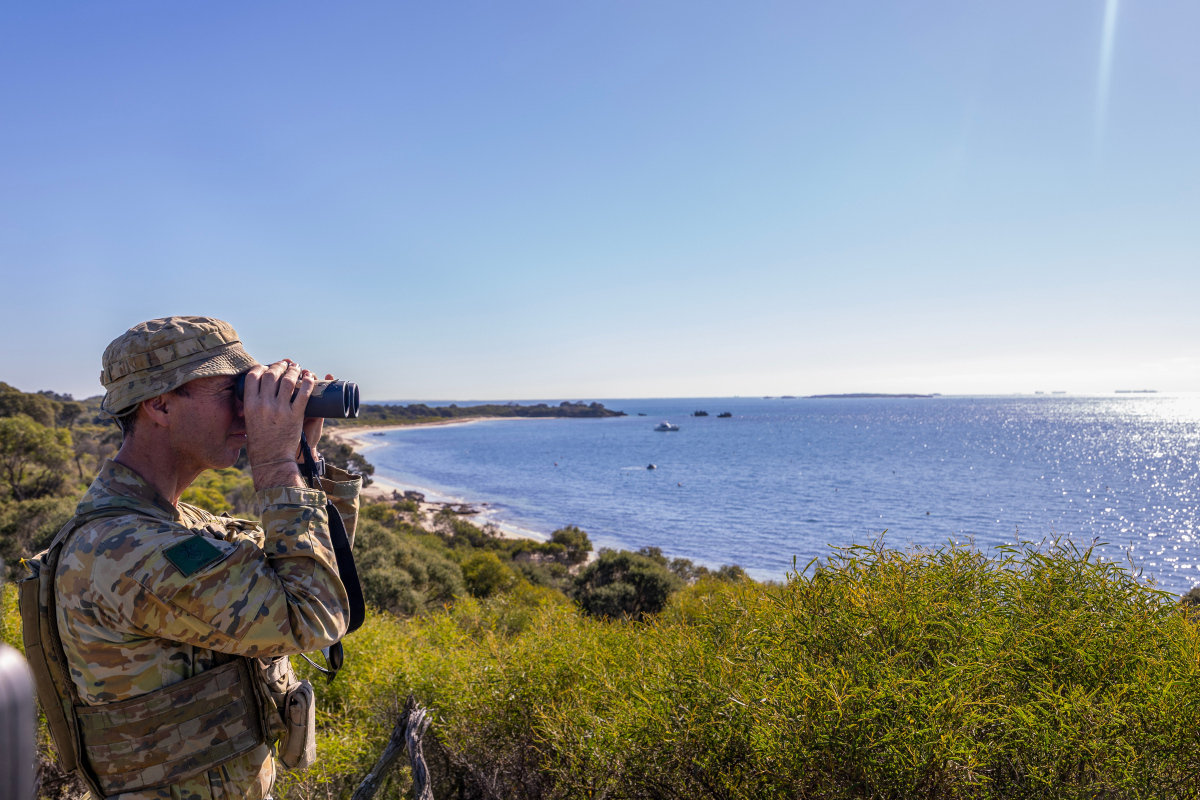
Source: LSIS Zac Dingle, Department of Defence, at: http://images.defence.gov.au/20260713ran8656906_0272.jpg.
‘There is no more important task for the Government than defending Australia and protecting the security, interests and way of life of the Australian people.’[1]
2026 National Defence Strategy
‘If there’s an attack on Australian soil, I assure you that there will be soldiers across the north of Australia in response.’[2]
Lieutenant General Susan Coyle AM, CSC, DSM
Chief of Army
Protecting, defending and securing the nation is the single most important responsibility for the Australian Government. Arguably, the most effective tool to achieve this responsibility is the Australian Defence Force (ADF). A 2026 survey of public attitudes to the ADF found that almost half of respondents ‘identified the defence of Australia as the ADF’s most important role’.[3] The question, then, is: How does the Australian Army contribute to the defence of Australia and what else might it need to do to meet that mission?
The emphasis of 2023’s Defence Strategic Review (DSR) is the defence of the nation. There is rightful prominence of the development of concepts to project force offshore to hold potential adversaries at distance from Australia. The National Defence Strategy (NDS) codified the DSR’s principles, with the central point—frequently lost amid newspaper columns on capability budgets and acquisition—being the entire purpose, to defend the nation. The ADF’s own Theatre Concept Aspire has as its centre Theatre Mission 1: The Defence of Australia. This is the ADF’s first and most important mission. It will be achieved through a variety of ways, including fighting offshore and alongside partners to maintain regional stability, to protect a way of life or defend certain principles, and to maintain alliances. Across all of this, the single thread of logic underpinning Concept Aspire, Australian military power, and our NDS documents is the mission to protect Australia: its people, its territorial integrity, its democratic and political freedoms, its infrastructure and resources, and its connection with the world (trade and communications).
Over the past quarter-century, the most widely felt impacts of war on the Australian population have been financial. Levies have been implemented to pay for military campaigns, such as that imposed by the Howard Government to cover the costs of the International Force East Timor (INTERFET) deployment in East Timor.[4] Though Australia has not faced external threat to its territorial integrity or its way of life since Japan’s air and maritime strikes in 1942–43, any perceived threat to the country’s territorial sovereignty becomes the most serious national challenge. In World War II, a national mobilisation of military, economic and industrial resources was required to defend the nation from Imperial Japan’s war aims in this region, along with significant support from United States forces. The current fear is that regional instability may jeopardise Australia’s sovereignty and territorial integrity, with a need to defend the homeland. In the 2020s and 2030s, the cost of doing so will require more than the imposition of a levy.
Since the DSR’s release, pronouncements from the Prime Minister, the Deputy Prime Minister / Minister for Defence, and guiding strategic documentation have constantly reiterated that Australia faces the most challenging strategic circumstances since World War II, with the international system ‘under greater strain than at any time since the Cold War’.[5] In this era of renewed uncertainty we must revisit assumptions about defending Australia in the 21st century and examine what precise forms that might take. The 2024 NDS and 2026 NDS both outlined the concept of ‘National Defence’.
What is National Defence?
The 2024 NDS introduced the ambitious concept of ‘National Defence’, which was established as one of the key pillars of Australia’s strategy of deterrence by denial. National defence, as articulated by government, is a concept that encompasses more than the ADF and goes beyond the Department of Defence. Distinct from the Defence of Australia policy— formalised in 1986’s Dibb Report and the 1987 Defence White Paper to protect Australia’s northern air/sea gap—the intent of national defence is to integrate all arms of national power to maximise the nation’s security capacity and advance its interests.[6] In this, it shares some similarities with Nordic concepts of ‘comprehensive defence’ or ‘total defence’—best expressed through the Finnish model—though in other ways, its immaturity as a concept in Australian security policy means that it falls well short of the practical manifestations of northern European practice.[7] For Nordic and Baltic nations particularly, the existential threat that arises from close proximity to a powerful and belligerent neighbour is an inherent motivator to preparedness. Australia, however, has enjoyed the complacency afforded by geography, and is only in the nascent stages of working through the ramifications of the national defence concept to harmonise the elements of national power. Recent crises such as the Iran war (and its subsequent impact on fuel security) have provided an impetus for government to open that preparedness conversation with the Australian public.
The perceived threat felt by Nordic countries is such that Denmark, Finland, Norway and Sweden have introduced compulsory military service. Sweden, Denmark, Finland, Greenland, Iceland, the Faroe Islands and Norway conduct national civil defence drills,[8] construct dual-purpose infrastructure (e.g., public facilities doubling as resistance shelters and highways doubling as makeshift runways for aircraft),[9] and have signed regional declarations on preparedness and security of supply in the transport sector covering emergencies and war.[10] Australia, meanwhile, still runs a national rail network of three different gauges that were determined in the pre-Federation era,[11] with vast internal distances still relying heavily on truck transport, which renders Australia’s internal lines of communication exceedingly vulnerable. Australia’s frequent weather extremes are being exacerbated by climate change and regularly render large parts of the national highway system impassable, particularly in Australia’s north where Defence’s post-DSR build-up is now focused. However, it is not as simple as transplanting Nordic or Baltic practices to Australia and expecting them to work. As Matthew Jones and Andrew Maher have argued, some elements are better suited to the Australian context than others.[12]
Though national defence spans a whole-of-nation approach, its direction to the military has resulted in changes to the ADF’s structure, posture and investment in new capabilities, enabling preparation for deployment in the Indo-Pacific. That potential offshore operational focus has dominated discussions of integrated investment forecasts and led to the cascade of new and expensive platforms that grab news headlines. However, the 2026 NDS is clear that the national defence pillar is a critical component of the deterrence piece in our national denial strategy.
The Land Domain in National Defence
The capacity of the ADF to physically protect Australia’s landmass and territories and contribute to collective regional deterrence is a complicating factor for belligerents who would seek to destabilise Australian or regional security. For, as Lawrence Freedman has reminded us, deterrence depends on ‘convincing the target that prospective costs [of an action] would outweigh prospective gains’.[13] The 2026 NDS and the accompanying Australian Army Contribution to the National Defence Strategy 2026 (Army Contribution) describe how Army will contribute towards deterrence by denial. While national defence is a whole-of-government and whole-of-nation activity, only the ADF can contribute military power to protect Australia.
The emphasis on transforming into a force optimised for littoral manoeuvre should not automatically presume that Army will project force into the region. Holding an adversary at distance is the preferred option, but fighting ‘in the littoral’ also means fighting in and around Australia in its defence—its coastline, rivers, estuaries, wetlands, reefs, shoals, ports, beaches, archipelagos, cities and urban areas, and the region inland. As the Army Contribution reminds us, approximately 87 per cent of Australia’s population lives near the coast, 99 per cent of national trade moves from and through the coast, and the coast is where vital submarine cables keep us connected to the world.[14] To defend all these elements is to defend Australia’s way of life. All missions that protect the nation fall under the broad umbrella of national defence, but it is not necessary to term all functions and tasks as such; ‘the defence of Australia’, ‘homeland defence’ and variations are appropriate, acknowledging they are task words to describe government’s national defence objective.
The Army Contribution (and the 2024 edition before it) identified the 2nd (Australian) Division (2 (AS) Div) as the lead formation to undertake Army’s contribution to homeland defence and its support to alliance and regional warfighting relationships.[15] That assessment presupposes that the 1st Australian Division (1 (AS) Div) will be offshore, contributing to efforts to keep an adversary at distance—but as noted above, Theatre Mission 1 commits the ADF’s entire capability to the defence of the nation. While unlikely, it is nonetheless conceivable that Army’s new landing craft, main battle tanks, hardened logistics nodes, long-range fires and suite of attack, multi-role and heavy lift helicopters could be deployed far closer to home than planned. Should any echoes of a 1942-like threat to northern Australia arise, there would be strong arguments to husband the ADF’s core capabilities for homeland defence; the Australian community would likely look askance at suggestions that a distant offshore role was more pressing than the defence of continental Australia. Indeed, in the event of war, capabilities that assist in controlling Australia’s northern air and sea approaches —such as 10 Brigade’s long-range fires—could find themselves retained on Australian territory to meet political expectations and soothe national nerves.
The Land Force Contribution to a Whole-of-Government Effort
While the Army Contribution provides Army’s mission statement, the land force’s specific contribution to homeland defence will be varied and uneven in practice. It will also face numerous challenges that will be reprised from the World War II era, such as infrastructure protection, overlaid with fresh dilemmas that have emerged from the adoption of new technologies honed in the Russia–Ukraine war, such as the proliferation of cheap and ubiquitous uncrewed systems. The Army—expressed initially through 2 (AS) Div in its role as Joint Task Force 629 (JTF 629)—will be expected by government to work with state and territory authorities to meet these threats. As the World War II experience reveals, cooperation between the Commonwealth and the states is necessary for any effective defence.[16] The same substantive structure remains—that is, states own (or run) the functions —police, fire, ambulance, hospitals, public transport, electricity, water and ports—while the Commonwealth seeks to coordinate.[17] This constitutional relationship endures, though the pandemic-era National Cabinet established a new collaborative forum for closer federal–state coordination in matters of national importance. The directed tasks will be executed through JTF 629 (or a variation of it) and include assignments as varied as intelligence, surveillance and reconnaissance, population protection, and asset and area defence[18] through to potentially controversial responsibilities such as prisoner of war security, enemy internment and detention operations.
Army is rehearsing some of these assignments now. Convened biennially, Exercise Austral Shield tests 2 (AS) Div’s capacity to respond to domestic security threats. Held in Queensland and Western Australia in July 2026, it assessed the division’s capacity to deploy forces to new areas of operation, working alongside personnel from across the ADF (RAAF, RAN, Cyber Command, Space Command) and representatives from state and federal agencies to secure critical infrastructure and protect national resources.[19] Such preparedness generates critical muscle memory and exercises the whole-of-government component under national defence. Rather than cause for alarm, however, the public messaging of such large domestic exercises is about reassurance. The Finnish example teaches that ‘by embedding preparedness across society and integrating a whole scale of capabilities, Finland strengthens deterrence by denying adversaries easy avenues for coercion or harassment’.[20] It is arguable whether Australia is at a point to embed national preparedness towards a broader improvement in resilience, but regular community-based military exercises certainly result in localised reassurance and contribute to resilience improvements.
Austral Shield’s intention during peacetime and competition is to improve preparedness and coordination to protect the population, critical infrastructure and national resources, with 2 (AS) Div providing the military power necessary for such operations. In its purest expression, Army’s reserve division is to defend the homeland and contribute to national resilience, protecting the northern base network and critical infrastructure.[21] This is an enormous responsibility, and becomes yet greater when calculating the range of individual tasks that are likely to fall upon it.
The complexity of Australia’s physical terrain and population demographics are well known, but knowing does not make the operations any less challenging. Protecting the country from kinetic military threats will be complicated further by threats of foreign interference, espionage, cyber attack, sabotage, disinformation, social agitation, and internal unrest that could manifest in a number of different ways. As the wars in Ukraine and the Middle East have demonstrated, kinetic attacks may come from the air (missiles, drones) and sea (maritime drones, naval assets, shadow fleets), accompanied by cyber attack to disorientate and slow or paralyse defensive efforts. Our reliance on internet-based services for everything from banking to electricity grids has made digital infrastructure as essential to national operations and wellbeing as physical infrastructure. Further, irregular migration has become weaponised by belligerent states, and could comprise one of the array of complex challenges that 2 (AS) Div supports other government agencies in responding to.[22] The ADF’s longstanding contribution to Operation Resolute provides a deep well of ADF experience in interagency cooperation; however, in times of crisis or war, 2 (AS) Div’s capacity to address all necessary security challenges will undoubtedly be stretched to breaking point. Australia is, after all, a large place, and the Division cannot be everywhere it needs (or will be expected) to be. Government will set expectations, but as the largest component of the ADF response to homeland defence, Army will be largely responsible for delivery via JTF 629.
An Expectation Gap?
The operating environment frames any conception of Army’s work in the defence of Australia. Domestically, this will be affected by the degree of social cohesion, which varies by region, demographics and time, and the associated social licence Army will rely upon to deliver its mission.[23] Though social cohesion is not an Army responsibility, it has a very direct bearing on the permissiveness of the environment in which it will operate. A 2026 University of New South Wales survey on societal attitudes towards Defence shows that more than two-thirds of Australians trust the ADF, reaching a high of 71 per cent in Queensland and a low of 63 per cent in the Australian Capital Territory.[24] One scholar has noted the ‘degree of confidence and trust the public places in the Australian armed forces’ as a consequence of 2 (AS) Div-led contributions to bushfire (2019–20) and flood (2022) assistance.[25] Though this work was not core to the defence of the country, it was nonetheless essential in maintaining societal linkages as a reminder that Army is of and for the community, and a loyal servant of the government of the day. Such work, and the importance of maintaining similar positive and effective interactions through major exercises like Talisman Sabre and Austral Shield, maintain Army’s social licence to operate across the Australian community.
This social licence is not uniform across the nation. Army’s work and engagement will need to differ depending on location, requiring different approaches to leverage the soft power of the Australian Army. The Tiwi Islands, for example, will require a different type of engagement than a Canberra demographic. As Australia could be in strategic competition for a long period of time, the building of that long-term social licence will be an investment in resilience and deterrence, and will continue setting the conditions for persistent access. However, the trust Army enjoys may evaporate if it is tasked to undertake unpopular or divisive missions.[26] The reception that JTF 629 elements might receive will depend on where in Australia it is directed to deploy and what it is directed to do. The deployment of military capabilities could even be resisted by local communities if their presence is perceived to make the area more liable to attack. Communication and expectation management will be key in messaging the nature of Army’s role in each individual homeland defence mission.
There will be challenges for 2 (AS) Div, too. National climatic crises such as floods, bushfires and cyclones have historically seen Australian governments call on the ADF as a panacea to address the most acute assistance needs. The same trust that Army might rely upon now is partly driven by societal misconceptions of the ADF’s core role, based on Defence Assistance to the Civil Community.[27] A crisis or wartime scenario, however, places enormous pressure on formations like 2 (AS) Div to meet a range of homeland defence obligations across the entirety of Australian territory, its population bases and its infrastructure. Along with a range of other judicious World War II era administrative and governing architecture for homeland defence, legislative limitations would almost certainly apply to ‘reserved occupations’ that are considered essential for the effective functioning of the country and the economy. A sizeable number of 2 (AS) Div’s strength is drawn from a cohort that also perform critical roles in civilian employment (such as emergency services), casting doubt on their capacity to render immediate wartime service until Australia’s societal/military/industrial needs are understood.
The Journal
The articles in this special themed journal address some key contentions in national defence and the land domain’s role in it. They cover a range of themes and tasks to inform and support thinking about how Army might approach the role of homeland defence. Firstly, Samuel Baumgarten provides a historical article on the Newcastle Covering Force that explores the challenges of area defence and the adaptations made in the early stages of war to the prewar defensive plan. Dayton McCarthy’s paper on the garrison battalions and Volunteer Defence Corps of World War II provides an example of the multilayered defence schemes that utilised the wartime workforce to its maximum; McCarthy employs Fundamental Inputs to Capability to link historical lessons to the contemporary environment. From there, the journal evolves to look at the present and future, with Stephan Frühling’s conceptual article encouraging Army to develop a ‘coherent image’ of what major war looks like in terms of Australia’s territorial defence, the roles of its two divisions, and the impact on national defence. Andrew Maher’s provocative piece analyses historical precedent in supporting resistance in other countries, to ponder a modern implementation as a tenet of Australia’s own strategy of deterrence by denial.
The second half of the journal has a strong focus on technology and people. Vincent Connelly’s article analyses the British Army’s post-1980s history with Regular Reserve forces, its renewed attempts to revitalise this cadre, and the lessons it may offer the Australian Army’s use of its SERCAT 2 workforce. A discussion by John Coyne of Army’s reserve force design follows, framed around the challenges of meeting the mobilisation of its people to protect Australia’s northern base network. Julian McMahon then scopes the options and opportunities to strengthen sustainment and resilience to this new operational epicentre, including the testing of different models to strike the right balance for Australian capabilities and conditions. The threat that drones now present to defensive forces is the subject of Carl Rhodes’ article in assessing counter-UAS options for the defence of Australia, which argues that prioritisation of effort will be best served through a layered approach and surge capacity to the most vulnerable areas. Phillip Hoglin, meanwhile, engages the impalpable yet essential concept of societal cohesion and its impact on Army’s social legitimacy—a prerequisite for successful domestic operations for national defence. Finally, in a professional reflection piece, Matthew Jones and Samuel Miller articulate the value of the polymath reservist: a citizen soldier who strives for excellence across civilian and military service, and the benefits that accrue from the translation of such expertise from one world to the other.
This journal provides a basis for practitioners, academics, policymakers and educated readers to explore the breadth of tasks that may fall to Army under a whole-of-society effort to defend the nation. Owing to Army’s trusted position in Australian society, it will be the first organisation to meet the challenge, and will be relied upon to deliver the last line of defence. The responsibilities that will fall to the Australian Army under national defence will be substantial and largely underappreciated, but—fortunately—not new. The World War II experience provides important evidence of successful past practice by maximising the available workforce to undertake everything from intelligence and surveillance, air defence, reconnaissance and ground security to area denial, infrastructure protection, interagency enforcement and bolstering national resilience. We hope never to have the need to deploy troops to protect the Wivenhoe Dam or guard the Sydney Opera House, but all such tasks (and many more besides) will fall to an Army that is already preparing and already rehearsing.
Author’s note: AI contributed no ideas to this article
Endnotes
[1] Australian Government, 2026 National Defence Strategy (Canberra: Commonwealth of Australia, 2026), p. 5, at: www.defence.gov.au/about/strategic-planning/2026-national-defence-strategy-2026-integrated-investment-program.
[2] Lieutenant General Susan Coyle quoted in Nicola Smith, ‘“My Job Is to Assume Things Get Worse”, Says Our New Defence Chief’, Financial Review, 24 September 2026, at: www.afr.com/policy/foreign-affairs/my-job-is-to-assume-things-get-worse-says-our-new-defence-chief-20260924-p60e7u (accessed 25 September 2026).
[3] Richard Dunley, Nicole Townsend, Margaret Hutchison, Tristan Moss, Ashleigh Brown and Rhys Crawley, Public Attitudes Towards the Australian Defence Force: 2026, War Studies Research Group, UNSW Canberra, 2026, p. 11, at: http://www.unsw.edu.au/content/dam/pdfs/unsw-canberra/hass/2026-07-5253529-PublicAttitudeTowardsTheADFSurveyReport-Final.pdf. See also Figure 12, p. 13 which provides the breakdown of expected roles for the ADF.
[4] John Howard, ‘Statement by the Prime Minister on East Timor’, 1 July 2000, transcript at: https://pmtranscripts.pmc.gov.au/release/transcript-10984 (accessed 28 September 2026).
[5] See, for example, Prime Minister Albanese’s statement on the release of the DSR: Guardian Australia, “‘Most Challenging Strategic Circumstances” Since WWII: Defence Strategic Review Revealed’ (video), YouTube, 24 April 2023, at: www.youtube.com/watch?v=zRqWNzMfbr0; Australian Government, National Defence: Defence Strategic Review 2023 (Canberra: Commonwealth of Australia, 2023), p. 32; Australian Government, 2024 National Defence Strategy (Canberra: Commonwealth of Australia, 2024), p. 5; Australian Government, 2026 National Defence Strategy, p. 11; Deputy Prime Minister Richard Marles, ‘Speech to the National Press Club’, 16 April 2026, transcript at: www.minister.defence.gov.au/speeches/2026-04-16/speech-national-press-club (accessed 9 September 2026); Australian Army, Australian Army Contribution to the National Defence Strategy 2026 (Canberra: Australian Government, 2026), p. 1.
[6] Paul Dibb, Review of Australia's Defence Capabilities (Canberra: Australian Government Publishing Service, 1986); Department of Defence, The Defence of Australia: 1987 (Canberra: Australian Government Publishing Service, 1987), at: https://nla.gov.au:443/tarkine/nla.obj-1663719677; Australian Government, 2024 National Defence Strategy, p. 6.
[7] The concept of ‘comprehensive defence’ grew out of the Cold War era total defence principle. However, as security scholar Ieva Berzina has noted, as ‘hybrid threats cover all major societal functions, the defence against them must be comprehensive ... [c]onsequently, the two basic principles governing comprehensive national defence are the whole-of-society and whole-of-government approaches’. Ieva Berzina, ‘From “Total” to “Comprehensive” National Defence: The Development of the Concept in Europe’, Journal on Baltic Security 6, no. 2 (2020): 2, at: https://journalonbalticsecurity.com/journal/JOBS/article/2/text.
[8] ‘Finland Holds Europe’s Largest Civil Defence Drill Since WWII’, Helsinki Times, 4 September 2026, at: www.helsinkitimes.fi/finland/finland-news/domestic/29232-finland-holds-europe-s-largest-civil-defence-drill-since-wwii.html (accessed 9 September 2026).
[9] Kari Pelkonen and Veli-Petteri Valkamo, ‘Finland’s Comprehensive Security and Total Defence: Operationalising Resilience’, Ares & Athena 29 (2026): 36, at: https://chacr.org.uk/2026/06/23/ares-athena-issue-29-coming-ready-or-not (accessed 18 September 2026).
[10] The agreement ties Sweden, Denmark, Finland, Greenland, Iceland, Faroe Islands and Norway to cooperating on the ‘security of supply in crisis and war’. Carl-Oskar Bohlin, ‘Joint Nordic Declaration on Security of Supply’, Government Offices of Sweden, 2 September 2026, at: www.government.se/statements/2026/09/joint-nordic-declaration-on-security-of-supply (accessed 9 September 2026).
[11] In 2024, there were approximately 31,212 kilometres of operational heavy railways, of which 56 per cent were standard gauge, 35.5 per cent were narrow gauge, 8 per cent broad gauge, and less than 1 per cent dual gauge. See Bureau of Infrastructure and Transport Research Economics, Trainline 12 (Department of Infrastructure, Transport, Regional Development, Communications, Sport and the Arts, 2025), p. iv.
[12] Matthew LM Jones and Andrew Maher, Towards Total Defence: A Literature Review and Feasibility Assessment for Australia, Australian Army Occasional Paper No. 39 (Australian Army Research Centre, 2026).
[13] Lawrence Freedman, Strategy: A History (Oxford University Press, 2013), p. 159.
[14] Australian Army Contribution to the National Defence Strategy 2026, p. 10.
[15] Australian Army Contribution to the National Defence Strategy 2024, p. 18; Australian Army Contribution to the National Defence Strategy 2026, p. 17.
[16] Joyce Fisher, ‘Appendix 1: Civil Defence Organisation’, in Paul Hasluck, The Government and the People, 1942–1945, Volume II, Australia in the War of 1939–1945, Series 4—Civil (1970), p. 636.
[17] Ibid. On 27 September 1939, the Australian Government issued its provisional list of 172 reserved occupations: ‘172 “Reserved” Occupations’, The Argus, Victoria, 28 September 1939, p. 2. With greater understanding of wartime and manpower needs, by March 1942, the government arranged three national industry priority groups. These were industries for which: 1) production was to be maintained at the highest capacity: munitions, aerodrome construction, hospitals, iron and steel manufacture, cable communication; 2) production may be allowed to fall to a limited extent: state government administration, road transport, wireless radio and newspapers, dairy farming; 3) production may be allowed to decline substantially: film production, non-newspaper printing services, motor hire services, and pickle and sauce manufacturing. Newspaper reporting claimed that men called up from reserved occupations could still undertake their war work ‘if the army requires such men’. ‘New Schedule of Reserved Occupations’, Barrier Miner, New South Wales, 13 March 1942, p. 1.
[18] In mid-2026, elements of 2 (AS) Div undertook Exercise Austral Shield. The division also contributed to 2025’s edition of Exercise Talisman Sabre. See Captain Tim Klingner, ‘Sappers Gear Up for Asset Protection’, media release, 18 July 2025, at: www.defence.gov.au/news-events/news/2025-07-18/sappers-gear-up-asset-protection (accessed 16 September 2026).
[19] Defence Media, ‘Australian Security Strengthened as Part of Exercise Austral Shield’, media release, 16 June 2026, at: www.defence.gov.au/news-events/releases/2026-06-16/australian-security-strengthened-part-exercise-austral-shield (accessed 16 September 2026).
[20] Pelkonen and Valkamo, ‘Finland’s Comprehensive Security and Total Defence’, p. 36.
[21] Captain Jon Stewart, ‘A Shift of Focus to the North’, media release, 13 October 2023, at: www.defence.gov.au/news-events/news/2023-10-13/shift-focus-north (accessed 18 September 2026).
[22] See for example Mark Galeotti, People as Ammunition: The Structures Behind Russian and Belarusian Weaponized Migration (Global Initiative Against Transnational Organized Crime, 2026), at: https://globalinitiative.net/analysis/russian-belarusian-weaponized-migration (accessed 18 September 2026); Tom Searle, ‘Migration: A Multifaceted Tool in the IW Toolbox’, Irregular Warfare Center, 11 May 2026, at: https://irregularwarfarecenter.org/publications/insights/migration-a-multifaceted-tool-in-the-iw-toolbox (accessed 18 September 2026); Jaiden Ahuja, ‘Weaponized Migration: When Mobility Becomes a Weapon of War’, NATO Association of Canada, 9 August 2026, at: https://natoassociation.ca/weaponized-migration-when-mobility-becomes-a-weapon-of-war (accessed 18 September 2026).
[23] Army’s relationship with the Australian community and its social licence was the topic of the 2025 Chief of Army Symposium, held in Canberra. See Chief of Army Simon Stuart, ‘A Brief History of National Conversations’, speech, Chief of Army Symposium, 26 August 2026, transcript at: www.army.gov.au/news-and-events/speeches-and-transcripts/2025-08-26/chief-army-symposium-keynote-speech-brief-history-national-conversations.
[24] Dunley et al., Public Attitudes Towards the Australian Defence Force: 2026, p. 3.
[25] John Fowler, ‘Disaster Relief in Australia: Competing Visions of the Military’, PhD thesis, The University of Queensland, 2026, at: https://doi.org/10.14264/db546ea.
[26] The ADF has historically been used by government for tasks that might be considered ‘divisive’. These include industrial disputes, the most notorious being the 1949 Coalminers’ Strike, when the Chifley Labor Government sent 2,500 troops to the Hunter and Central West regions of New South Wales in July and August that year as labour to break the strike. See Phillip Deery, ‘Chifley, the Army and the 1949 Coal Strike’, Labour History 68 (1995): 80–97; Elizabeth Ward, Call Out the Troops: An Examination of the Legal Basis for Australian Defence Force Involvement in ‘Non-Defence’ Matters, Australian Parliamentary Research Paper No. 8 (Parliament of Australia, 1997–98).
[27] ‘Defence Assistance to the Civil Community Initiative’, Department of Defence, at: www.defence.gov.au/defence-activities/programs-initiatives/defence-assistance-civil-community-initiative (accessed 21 September 2026).