
Understanding the Causal Logic of Modern War and Warfare
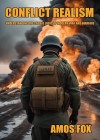
Howgate Publishing, 2024, 230 pp
Hardback ISBN: 9781912440528
Paperback ISBN: 9781912440535
EPUB ISBN: 9781912440610
Author: Amos Fox
Reviewed by: Sam Baumgarten
Amos Fox’s Conflict Realism is a bold, revisionist attempt at reinvigorating military theory. The author combines systems theory and quantitative data analysis to query and propose an improved methodology for military operations. Conflict Realism is fearless in its assault on accepted Western military orthodoxy. It is also constructive in its suggestions for improvement. Critiques of military theory are relatively common in recent years and this volume appropriately fits alongside the works of other contemporary iconoclasts such as Jim Storr[1] and Major General Mick Ryan.[2] The latter has lent his authoritative hand to a preface.
Fox is well suited to the task he attempts in this work. He is a retired US Army armour officer who graduated first in his class at the School of Advanced Military Studies and who served in the full range of post-9/11 conflicts. In addition, he is a Fellow at Arizona State University, where he is well known for his unbridled critique of the present state of military theory. Fox also hosts the Revolution in Military Affairs podcast. Despite the podcast’s title, the analytical perspective taken by Fox in Conflict Realism shows that he does not subscribe to the orthodoxy that technology makes radical and sudden changes to armed conflict.
The busy military professional may query the benefit of fitting this volume into their already limited reading time. Fox’s key point of difference is his analytical method of theorisation that uses data to prioritise threat as the predominant determinant of operational decision-making. This reasoning fits well within the Western school of military theory, which is analysed and succinctly summarised in the book’s first chapter. Here, Fox showcases his knowledge of key theorists’ works such as Carl von Clausewitz’s On War, Geoffrey Blainey’s The Causes of War, and especially Cathal Nolan’s The Allure of Battle.
Following this introductory survey, chapter 2 delves into Fox’s concept of ‘conflict realism’. Fox defines this term as an attempt to:
understand how military forces—both state and non-state—conduct war. As such, ‘conflict realism’ is a concept that operates just below the level of international relations scholarship and is a companion to conflict and security studies.[3]
This chapter presents the first of many heuristics that complement the book’s underpinning premise. These heuristics have specific titles, namely verities in the case of those in this chapter. Specifically, Fox’s first verity provides that:
an adversary always has more resources and bases of power than what correlation of forces and means (COFMs) comparisons prior to, and during the initial days of a conflict indicate.
While this proposition will be familiar to almost anyone who has studied or experienced conflict, the reassertion of this (and other) truisms helps reinforce the logic of Fox’s arguments throughout the book.
In Conflict Realism’s third chapter, ‘The Paradoxes of Modern (and Future) Armed Conflict’, Fox unpacks many of his concerns about modern military doctrine. These misgivings strike at the heart of the concepts and foundational assumptions of Western military organisation. For example, Fox queries the continued relevance of the ‘centre of gravity’, arguing that the ‘underlying logic behind these ideas remains anchored in the long obsolescent belief that centres of gravity (COGS) are some sort of magic button’.[4] More broadly, he uses data and heuristics to demonstrate that five of the fundamental tenets of contemporary military theory are logically unsound, arguing that they should be characterised as paradoxes. These paradoxes are (1) ‘the command paradox’, (2) ‘small, light and dispersed is better’, (3) ‘the looming importance of battlefield transparency’, (4) ‘warfighting preference matters’ and (5) ‘defeat mechanisms’. His dismissal of the second paradox (small, light, dispersed) nests strongly within his subsequent discussion concerning the centrality of attrition to modern warfare.
A welcome feature of the book is the way Fox juxtaposes the concepts of war and warfare in chapter 4 as possessing mutual characteristics. While ‘war’ concerns the use of the military to deliver strategic objectives, ‘warfare’ is more concerned with the delivery of military effects at an operational level. Drawing on another useful recent work on military theory, Understanding Land Warfare by Christopher Tuck,[5] Fox presents the two concepts as possessing inverse characteristics effected by the adversary. In this context, inverse relates to the fact that a threat of war by one party will inevitably trigger the opponent to consider options for a quick military response. In this way, Fox uses the inverse principles to underpin how parties respond to the chaos of war and, in particular, how decisions are made in conflict.
Beyond chapter 4, most principles and heuristics presented in Conflict Realism follow a similar pattern of apportioning to an opponent a logical response to any actions taken against it. In this way, Fox seeks to demonstrate that conflict is never a zero-sum game and that conditions of victory are always assessed against one’s own side’s criteria as well as those of the opponent generating the threat. This assertion is at odds with the commonly accepted ‘Principles of War’, which are predicated on one’s own side’s capability. While accepting that his proposition is controversial, Fox supports his position using data that demonstrates how existing military theory is ill-adapted to the chaotic nature of modern warfare, both now and into the future. In making his case, Fox’s arguments are compelling.
Having generated a new conceptual foundation for modern military theory, Fox applies his analysis to several practical scenarios. The first of these is urban warfare, which he discusses in chapters 5 and 6. Here he uses data to review the strategy and operational practice that commonly prevail in this type of warfare and to provide a methodology for understanding this form of conflict, which is frequently characterised as too complex for structured analysis. Fox asserts that urban warfare has the characteristic of siege warfare, which is a more familiar concept in the canon of Western conflict but seemingly of reduced significance in the modern era—another example of his willingness to confront existing orthodoxy. He provides informative observations about the nature of victory in this category.
Chapter 7 is a study of attrition. Here, Fox characterises attrition as the key characteristic of conflict. In doing so, he takes a theoretical viewpoint that is anathema to contemporary Western military doctrine. Specifically, it is usually accepted that the preferable and most economical way to achieve victory is to undermine the enemy’s cohesion. By contrast, attrition warfare is a method that is generally perceived as having critical shortcomings. Fox summarises these as assertions which he disputes—for example, ‘attrition abuses one’s own logistics’ and ‘attrition is a lesser form of warfare’. Fox does not shy from the controversial nature of his position. Instead, he considers five common criticisms of attrition warfare and convincingly refutes them. Fox determines that attrition needs to be better understood, as it is prevalent in all forms of conflict.
Building on his analysis of attrition, chapter 8 is devoted to a critique of precision strike. Precision strike is a method that contrasts sharply with attrition warfare in that it seeks to apply minimum force surgically to enable enemy defeat. This chapter references recent conflicts, such as Operation Inherent Resolve and the war in Ukraine, to support the assertion that precision strike fails to deliver on its promise to swiftly end battles and wars through the decapitation of enemy leadership or by paralysing its command and control apparatus. Instead, attrition remains as a proven method that has consistently achieved success on the battlefield.
While not all readers will accept Fox’s conclusions, Conflict Realism undoubtedly opens the aperture for new ways of thinking about military theory. For example, Fox provides valuable perspectives on common decision-making processes adopted by militaries, perceiving them as too rigid.[6] The ADF has recently reflected on this issue and attempted to address it through new doctrine, such as the Decision-Making and Planning Processes (DMPP). In a recent article in the Australian Army Journal, the doctrine’s author, Major General Michael Krause, described military decision-making as a reductionist analytical process that reflects low levels of flexibility. In the face of such concerns, Fox’s principles, paradoxes and conclusions may offer suitable substitutes for existing doctrines. As Krause recently observed, ‘To achieve sound military decisions, the key is to effectively harness both analytical process and individuals’ intuitive tendencies’.[7]
In sum, Conflict Realism provides both the methodology for review and specific recommendations to reinvigorate military theory. It is not narrative in nature but contains well-connected observations and suggestions regarding the topics under analysis. Some military professionals may be drawn to the comprehensive reconfiguration of military theory offered by Fox, and the specific tools he identifies to support its analysis and critique. Others may welcome the opportunity to enhance their understanding of military theory. Ultimately, this reviewer assesses that Conflict Realism is most suited to readers seeking a polemic reappraisal of planning and the operational art. Fox’s military theory, and the heuristics upon which his analysis is based, are both unique and useful. As part of a broader analysis, this book has much to offer anyone seeking to shape a much-needed intuitive reappraisal of the ADF’s tactical and operational approach to decision-making processes.
Endnotes
[1] Jim Storr, Something Rotten: Land Command in the 21st Century (Howgate, 2022).
[2] Mick Ryan, War Transformed (Naval Institute Press, 2022).
[3] Amos Fox, Conflict Realism (Howgate Publishing, 2024), p. 34.
[4] Ibid, p. 46.
[5] Christopher Tuck, Understanding Land Warfare, 2nd edition (Routledge, 2022).
[6] Ibid, pp. 64–67.
[7] Michael Krause, ‘Towards a Deeper Understanding of Military Planning’, Australian Army Journal 21, no. 3 (2025).