
Army’s Changed Approach to Thinking About the Future, 1998–2000
Looks Can Be Deceiving
By early 2000, the Australian Army had just completed the most successful peace enforcement operation in modern history to date. The troops were welcomed home with a parade in Sydney that April; none of the angst or protest experienced during Vietnam War parades was on show. Public support for the Army was at an all-time high and political support, naturally, followed. However successful, this operation downplayed significant flaws and weaknesses that had been building in Army as a whole over the previous two decades. Change was needed, and it was up to the Army’s leaders to provide a rationale for investment at a time when naval and air forces were the priority for Australian governments, whose strategic policy had been based on defending Australia since the 1970s.
This case study examines the period 1998–2000, when Army sought to influence strategic policy towards an ‘expeditionary’ posture and away from the 1970–80s priorities for defending continental Australia. In particular, this case study describes how then-Chief of Army Lieutenant General Frank Hickling, together with his deputy Major General Peter Abigail, prepared foundations for a future army while still meeting government expectations for combat-ready forces. These efforts were conducted within a rapidly evolving strategic and policy setting, which included significant global instability after the Cold War, major operations in the near region, and a nascent ‘revolution in military affairs’ based on emerging information and communications technology.
Hickling met the challenges of his day by using a two-pronged effort to create a new narrative for Army. While Hickling led an external effort to describe the Army’s role in the nation, Abigail led the internal effort to develop a ‘concept led–capability based’ framework to describe Army’s strategic role and guide its future development. As with all bold efforts within a large bureaucracy, this work featured progress, dead ends and setbacks, including ‘the book that never was’, Future Land Warfare 2030. Ultimately, this obscure work about possible future land force roles and technology was positive for Army because it provided a coherent story to influence policy, created new ways of thinking in a joint force context, provided support to an emerging experimentation function, and established a role for futures studies in the heart of Army Headquarters.
Army Must Deal with Two Strategic Environments
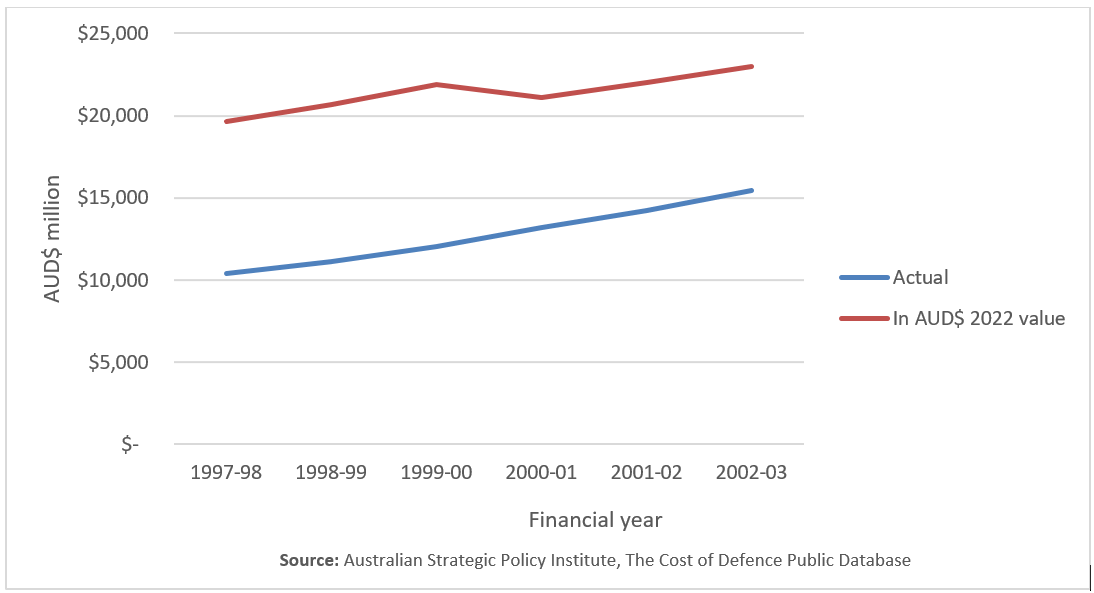
Events of the day usually dominate headlines and political attention. However, armed forces must think beyond the present, because planning large-scale expenditure to deliver equipment—and ultimately trained forces—takes years and the products stay in service for decades. This means armies must deal with a continuum of strategic environments: from the past to the immediate and into the distant future, often with waypoints in between. In practical terms, armies must divide their spending between maintaining the current force (described below by the shorthand of ‘preparedness’) and investing in a future force (known as ‘capability development’[1]). They must do both, but the proportion spent on each might change due to priorities or policy. Coming to a decision on apportionment is an art that is especially complicated when budget allocations are falling (see Figure 1).
Instability close to Australia and examples of modern warfare across the globe dominated the immediate strategic environment of 1998–2000. Of most concern was instability in Indonesia and the South Pacific. Major events included a 1987 coup in Fiji, which saw the ADF prepare—with inadequate capability—to evacuate Australian citizens from the island nation by sea and air. Further instability, triggered by the 1998 Asian Economic Crisis, prompted the political transition in Indonesia and ultimately the independence referendum in the Indonesian province of Timor Timur (East Timor). This instability led to the deployment of INTERFET, an 11,000-strong multinational force, for six months from September 1999. Papua New Guinea also remained troubled, even as a measure of peace was coming to the conflict-torn island of Bougainville. On top of this, Solomon Islands was experiencing violence that would ultimately lead to an Australian-led intervention in 2003. This situation saw Australian commentators refer to an ‘arc of instability’ that would come to be a major factor in Australian strategic policy and Army’s employment over the next two decades.[2]
The South-West Pacific was not the only area of instability at that time. Brutal, low-tech local wars were raging in places such as Somalia, Cambodia, Afghanistan, Sudan and Rwanda. In Europe, Yugoslavia began disintegrating in 1991, leading to international interventions in 1995 and again in early 1999—this time based on a US-led air campaign in Kosovo. Taken together, the experience of warfare and the unstable strategic environment was broadly congruent with the existing Australian policy settings. These settings did not see a major power attempting to invade Australia, but did see a role for military force to conduct ‘short warning conflict’ (1994) or ‘defend Australia’s regional interests’ (1997). Neither setting completely discounted conventional conflict. However, both were designed—in practical terms—to cope with the low levels of military capability possessed by regional nations and militias (albeit that some had increasing access to modern technologies).[3] Yet Australian guidance of the time ignored the importance of power projection over distances and the clear benefits of truly joint warfare.[4]
Even while these events were occurring, some military planners had their minds elsewhere: on assessments about the future strategic environment. The key features of the anticipated, and perhaps emergent, strategic environment were going through what some termed a ‘revolution in military affairs’ based on computers and information.[5] The 1990–91 Gulf War gave these ‘futurists’ glimpses of how information, precision firepower and manoeuvre would be decisive in conventional conflict, while the end of the Cold War two years before had made the existing strategic settings for many major nations redundant. This was especially so for the United States, and both the US Marines and the US Army launched major initiatives to conceptualise this strategic and technological change.[6] Their work influenced Australian thinking and provided some conceptual support for emerging policy change.
Australia’s Defence Policy Changed Significantly over the 1990s
Given the lack of direct threats to the nation, Australian governments had since 1976, and especially after 1987, made the defence of Australia and denial in the ‘sea and air gap’ the main strategic priority. Added to this, successive governments were unwilling to send land combat formations overseas except on peacekeeping operations. This focus and its limits achieved political consensus within the governing Australian Labor Party and framed the 1994 Defence White Paper.[7]
The ‘Defence of Australia’ policy also meant the Army’s main role was to defeat small and limited raids on the Australian mainland, with the lodging forces likely to have been either reduced by maritime forces or limited to small raiding parties. Given both the importance of interdiction as far as possible from Australia and the low likelihood that Australia would even experience raids, the Hawke-Keating government (1983–1996) prioritised investment in forces required in the ‘sea-air gap’, especially command and control, intelligence and surveillance, and maritime forces including fighter aircraft, frigates and submarines.[8] Investment in land combat and logistics would be restricted to creating and supporting light forces for overseas deployment, and forces for operations in northern Australia. The government also decided to move much of Army’s combat force to northern Australia. This included moving key units of the 1st Brigade from Sydney to Darwin, starting in 1992.
Then-Chief of Army Lieutenant General John Sanderson knew further change was needed to meet the government’s expectations. So he initiated the Army 21 (A21) review of 1995 and the subsequent Restructure the Army program, or RTA, starting in 1997.[9] RTA was an innovative yet highly controversial and indeed opposed initiative. The central feature of RTA was a new structure based on permanently organised, combined-arms, battalion-sized task forces suited to protection operations in northern Australia. It recognised the vast distances involved in the task of defeating raids, and the need for high degrees of independence for each. This was concerning to many—including a number of Army’s senior officers. The key objections to the RTA approach were that it reduced Army’s ability to concentrate forces, mobilise into large formations and have sufficient heavy forces ready to conduct high-end conventional warfighting.[10] RTA was also criticised because it only held a small, light-scales force for deployment into low-threat environments.[11] Further, RTA was described as being an ‘end-point’ for development with no concept for how the force would change over time.[12] The plan itself was ‘resisted’ and this impeded implementation.[13]
More important to the next stage of Army’s development—vastly more than all the internal criticism of RTA—was a change in defence policy. The first defence policy statement of the Howard government (1996–2007) attempted to differentiate the new from the old, and presented a caricature of the previous government as narrow isolationists. The new policy headline was ‘a secure country in a secure region’, which significantly broadened the focus of defence policy from defending Australia.[14] Now ‘our defence planning recognises that the Government may decide that such a commitment (to defending regional interests) is warranted’ and made developing suitable capability its second priority.[15] This was a significant change from 1994, although land forces remained a low priority and Army remained focused on developing the RTA task forces.[16]
RTA was still in progress in 1998 when Lieutenant General Frank Hickling was appointed as Chief of Army. Hickling was a highly experienced commander. He began his career in 1960 and, after graduation from Officer Cadet School Portsea, was allocated to the Royal Australian Engineers. Subsequent postings and promotions saw him appointed as second in command of an engineer squadron in Vietnam. Later postings and commands included 2nd Field Engineer Regiment in 1979–80 and 1st Brigade in 1988–89; joint roles in Northern Command and the Australian Defence Force Academy; and commander of Army’s Training Command and then Land Command.
Hickling’s first tasks on becoming Chief of Army would include defining Army’s situation; increasing ministerial, Defence and public understanding of what that meant for Australia; and making the case for why change was needed. He would marshal some very useful resources, including his deputy, his own headquarters and an internal ‘think tank’ called the Land Warfare Studies Centre (LWSC), which had been established in July 1997 by Lieutenant General Sanderson.
Hickling Saw the Need to Change Army’s Direction
The effects of strategic change in the region—particularly in Indonesia—were hard for Hickling to foresee in 1998, but he already understood one new factor: the coalition government under John Howard wanted to take a different view of the role of military forces in promoting Australia’s interests. In Hickling’s view, the Howard government’s more ‘outward looking’ policies required an ‘expeditionary’ capability that could deploy large-scale combat forces overseas.[17]
Yet Hickling took command of an Army that was far from ready for that kind of commitment. Urgent change was needed, but the Army lacked a narrative that could counter the powerful and entrenched logic of the ‘Defence of Australia’.[18] So one of his first moves was to task Future Land Warfare Branch (FLW Branch) and the LWSC to develop a new narrative about the strategic role of land forces.
Within three months of his appointment as Chief of Army, Hickling asked Dr Michael Evans, a former officer in the Rhodesian Army and then a research historian at the LWSC, to produce a short explanation of the Army’s role in a maritime strategy. Evans’s paper pointed to the gap between the coalition government’s declared maritime strategy and the Army’s force structure for defending the continent. At the same time, Evans argued that the existing maritime strategy was too ‘navalist’ and failed to make use of highly mobile and flexible land forces. He urged Hickling to ‘seek a more proactive role’ within the maritime strategy and develop a structure that could conduct a range of missions, including ‘littoral-expeditionary operations’.[19] Evans would have discussed these ideas with senior Army leaders, for these were soon to become central and controversial features of the next stage of Hickling’s efforts to reframe the narrative.
The development of new capstone doctrine, Land Warfare Doctrine 1: The Fundamentals of Land Warfare (1998), took only a few months longer to produce.[20] A product of FLW Branch, this new doctrine was both intentionally forward looking and controversial. The former characteristic came from the interaction of the idea of ‘concept led, capability based’ force development with a significant elaboration of the ‘revolution in military affairs’ and its implications for Army.[21]
While retaining congruence with the 1994 edition of The Fundamentals of Land Warfare in the way it defined war, the 1998 edition was far more aggressive in tone. The explicit references to ‘warfighting’ and its description as ‘the unique and critical function that the ADF provides to the Government’ attempted to break the view that armies should focus on less violent tasks like peacekeeping and protective operations. Yet the real difference from the 1994 edition was the idea foreshadowed in Evans’s paper of the Australian Army as an ‘expeditionary force’ and the reconceptualisation of the ‘air and sea gap’ as a ‘littoral’ space that was available for manoeuvre. This new narrative would, in defence bureaucratic terms, be the framework for Hickling’s efforts to convince external audiences to support his vision for the force.
Army’s new doctrine attracted controversy. One academic criticised the warfighting emphasis, describing it as ‘highly selective’ in terms of roles, as providing ‘inadequate guidance’ for leaders, and as ‘unreflective of the Army’s contemporary experience’.[22] It was also subtly damned by the architect of the ‘Defence of Australia’ policy, Paul Dibb, who noted the Army lacked the budget to implement its doctrine.[23] Still, The Fundamentals of Land Warfare was launched with some fanfare within Army and was a clear attempt to officially reframe the Army’s strategic narrative, even if details (and budget) were lacking.
A High-Risk Play
Hickling’s next step was to make a public case for change. In a combative and direct speech to Canberra’s National Press Club on 14 April 1999, Hickling attempted to completely change the narrative about the role of, and need for, a combat-oriented Army.[24] His speech ranged broadly, including over the pace and direction of technological change, regional stability, using Reserves, and Army’s commitment to a maritime strategy. As part of this strategic approach, Hickling reminded his audience that the Army existed to defend both continental Australia and the nation’s interests, wherever they might be:
A maritime strategy also recognises the need to defend Australia’s interests in the region and globally, as well as direct defence of our sovereignty. And it also means that we must be able to exert influence, by adding weight to diplomacy, particularly in our region.[25]
The addition of ‘national interests’ was seemingly uncontroversial but it had important implications. To defend Australia’s global and regional interests, its Army needed to be capable of more than just protecting vital assets at home. It would need to be deployable, bring real firepower and be able to survive in combat. While his warnings about the changing strategic circumstances, his comments on the inadequate funding assigned to Defence and his relentless focus on warfighting attracted the most attention, it was the concept of an expeditionary army that would have the most influence on subsequent work within Army Headquarters.
While partially covered by recent government decisions to raise the readiness of 1st Brigade and by the increasing concern about violence in East Timor, Hickling’s approach was very risky on two fronts. Firstly, his speech placed Army outside Defence’s consensus-based decision process of the day. While his position reflected an analysis of policy that was arguably ahead of the rest of the department, his direct appeal to public opinion challenged the ‘Defence of Australia’ orthodoxy and a decade’s worth of investment planning. Consequently (and according to Hickling), the speech was not well received by others:
There was a good deal of internal friction resulting from what I had said. This was because I was taking the Army in a different direction without going through the committee processes.[26]
Placing himself outside the established policy process effectively repudiated the consensus-making norm that dominated Defence. At best, such an approach might shape a new consensus by highlighting the flaws in current policy. At the worst, this approach could have extensive implications for Army across all areas of bureaucratic activity as others might seek to ‘rein in’ the non-conformer by opposing other proposals. After all, bureaucratic processes can be hard to work at the best of times—added friction makes simple tasks hard.
Hickling added to the risk by not gaining clearance for his speech beforehand. This challenged the ‘no surprises’ norm associated with high-level policymaking:
This was very much a ‘crash through or crash’ policy! Of course, the Minister was furious but I had nothing to lose. Even if I was sacked, I still would have achieved my purpose; and I assessed, correctly, that CDF Barrie wouldn’t stand in my way.[27]
There is no indication that such a dramatic move was contemplated, and his speech was vindicated by the intervention into East Timor five months later and subsequent operations after the 9/11 terrorist attacks on the US. Nor was the speech a ‘standalone’ effort. The work done within Army Headquarters to prepare the ideas and logic meant that Hickling was well positioned to argue his case in other forums, including a parliamentary inquiry which started a month later.
Looking to Parliament
The ‘Phantom to Force’ inquiry, which started in May 1999 and reported in September 2000, provided a more expansive outlet for Hickling to make Army’s case. Care and thought were needed because this kind of engagement is fraught with downside. Parliamentary inquiries are largely public and often contested, so they can go in unanticipated directions. This meant Hickling needed to balance competing tensions through the narrative he presented. On one hand, Hickling needed to present the facts as he saw them and present a forceful statement. Yet he also needed to protect the Army’s reputation and deterrent potential, and avoid accusations that the significant amount of money spent on Army was wasted.
This tension was resolved through a narrative that was nuanced in its presentation. While Army was not willing to write off its ability to fight altogether, its existing capability was described to the parliamentary committee in June 2000 as (author’s italics):
The Army presently has some capability for warfighting in a medium to high-threat environment. Australia would be able to offer a brigade-sized contingent for a warfighting contingency in a coalition setting, but with considerable risk, and it is likely that the contingent would be deficient in aspects of firepower, manoeuvre and force protection. Examples of areas that suffer capability limitations include ground-based air defence systems; rotary wing assets and indirect firepower assets; and nuclear, chemical and biological defences.[28]
The caveats are worth highlighting: ‘some capability’, ‘considerable risk’, ‘deficient in aspects’. Any of these would be concerning for Defence leaders, but when issued together they were alarming. This passage should not be disregarded because it was written to influence a parliamentary committee. It was cleared by Hickling, and (this time) was briefed to the Chief of the Defence Force, the Secretary of the Department of Defence and the Minister for Defence. That the bipartisan Joint Standing Committee on Foreign Affairs, Defence and Trade agreed with the assessment shows that Army’s dire self-assessment was generally accepted by others without a vested interest.[29]
The caveats used in Army’s submission described an Australian Army that was now really only useful for operations in low-threat environments unless a government was willing to take significant risk. To draw a contrast, the Australian Army of 44,000 that deployed for a decade during the Vietnam War was fully interoperable with the US Army. Thirty years later, the Australian Army of 24,000 was no longer able to fight in an environment that was any more threatening than that experienced in the 1960s, while the US Army had developed capability to fight massed manoeuvre warfare against the Soviets and was experimenting with leading-edge capabilities involving precision weapons and information.
While Army was presenting this argument in public, it was also preparing its internal processes to create change. Clearly, keeping pace with technology was a priority but the resources available were needed to sustain the force in East Timor, not prepare for a future high-tech war. Hickling needed to broaden the focus of effort, and this was perhaps his most important decision as a strategic leader. He delegated the task of creating a narrative about the future Army, and building coherent internal processes to realise it, to his energetic and creative deputy, Major General Peter Abigail.
New Leaders Bring New Ideas
Major General Peter Abigail enlisted in 1965 and attended Royal Military College. He saw combat in Vietnam, and later commanded the Army’s parachute battalion and 3rd Brigade. He had also marked himself as an expansive thinker, which saw him promoted to be Head Strategic Policy and Plans in Defence in 1996. This positioning provided him an excellent platform for growing and maturing ideas that would become useful when he was appointed Deputy Chief of Army in June 1998.
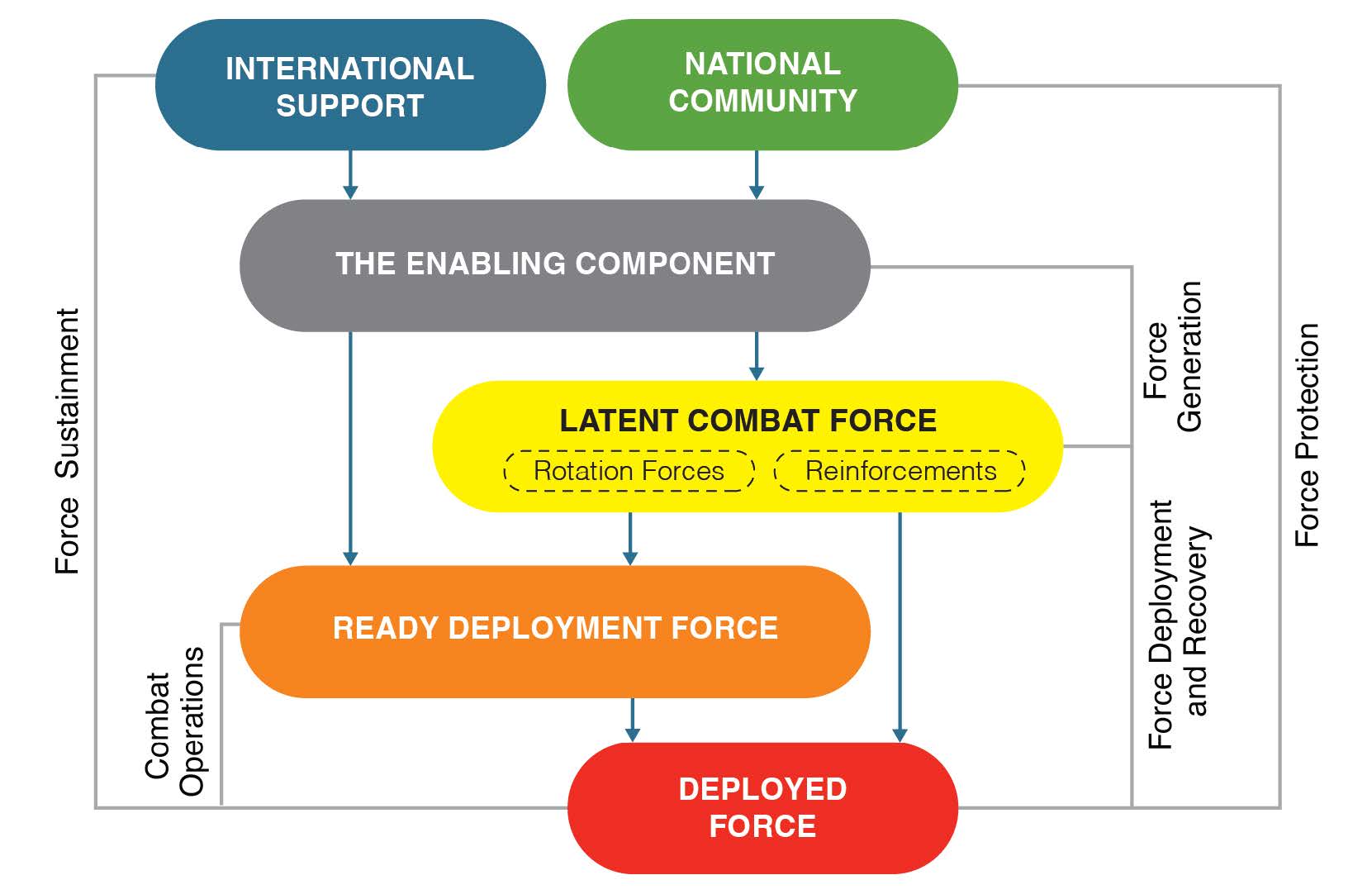
One of Abigail’s first contributions to reshaping the Army’s strategic narrative was the Army Model (Figure 2).[30] This model, developed as an iterative process on Abigail’s whiteboard and PowerPoint slides, helped explain that Army was more than just the force actually deployed on operations that would be drawn from the Townville-based ready deployment force. Creating that deployed and deployable force was the combined effort of a ‘latent combat force’, an ‘enabling component’ and a national and international support base. Each component had shared and specific functions, which together described what an Army did. These functions included combat operations, deployment, force generation and sustainment, and force protection.[31]
Another key set of ideas became the Army Continuous Modernisation Process (ACMP). The goal of the process was, as set by Hickling, for Army to become ‘potent, versatile and modern’.[32] These characteristics would be developed over time as the existing Army, or ‘Army in Being’ (AIB) transitioned over the next 15 years into an ‘Enhanced Combat Force’ (ECF). This development process would be supported by an ‘Army After Next’ (AAN), which was a group of concepts and initiatives that could be ‘backcast’ into force development plans. This construct allowed Hickling and Abigail to show a logical path from the present to the future, using a 15-year waypoint to guide planning and potential equipment acquisitions. Together, the Army Model and continuous modernisation concept anchored the idea of Army being ‘concept led and capability based’.
The 1999 ACMP started with a self-critique that cogently presented a case for change:
Too often we have defaulted to the simple replacement of capital items when they reach life-of-type. Such an approach risks the perpetuation of outdated concepts and doctrine and a future force ill prepared for conflict.[33]
This required some change in Army’s force planning practices, which had been ‘uncoordinated’ for too long and reluctant to think about the future.[34] This plan would help Army balance investment between preparedness for the present and future investment, and its products would be warfighting concepts and ‘Army Capability Output’ development plans (Figure 3).
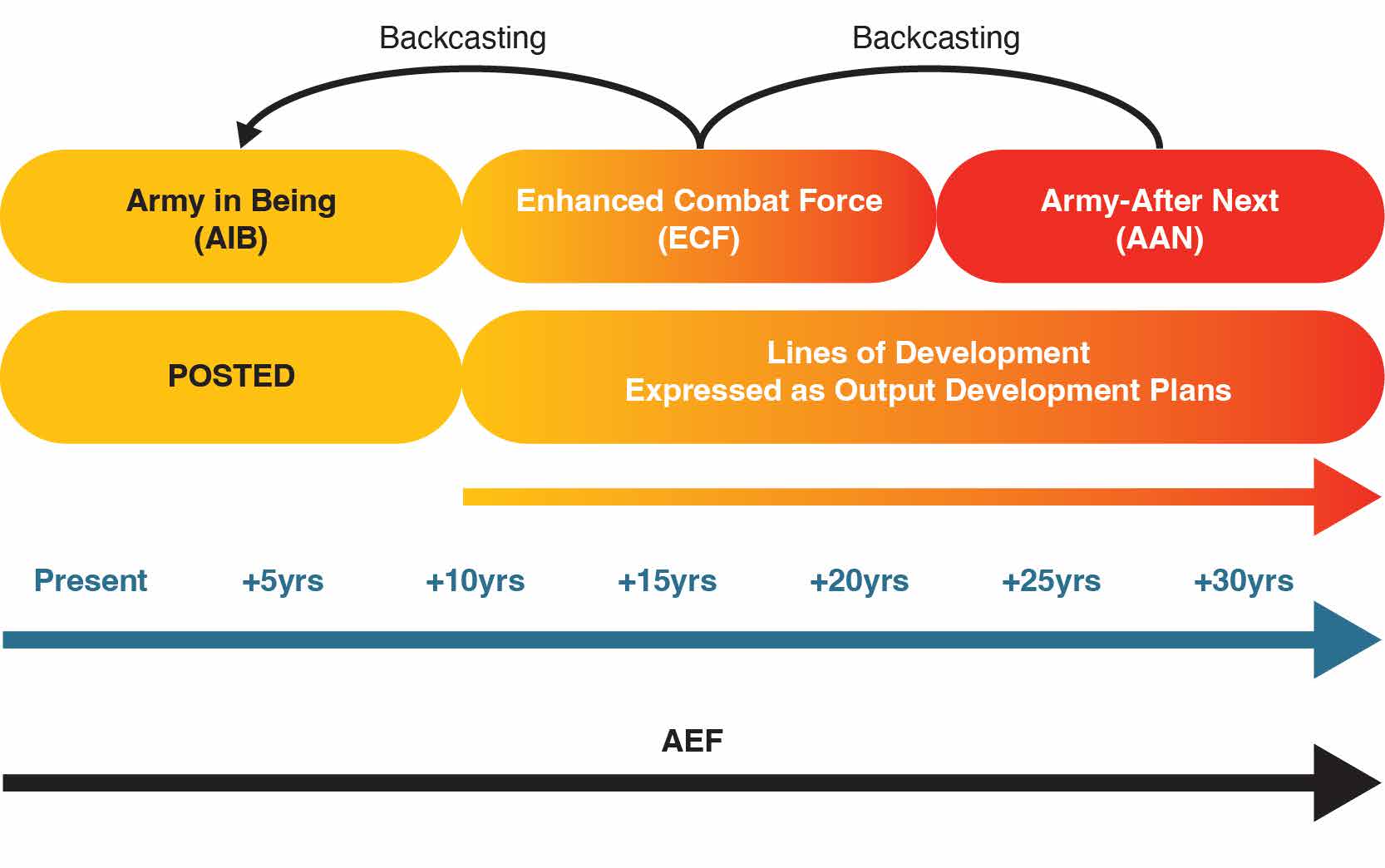
POSTED - Inputs to capability comprising People, Organisation, Support, Training, Equipment and Doctrine (analogous to today's 'Fundamental Inputs to Capability')
AEF - Army Experimentation Framework
New Leaders Bring a Supportive Leadership Climate
Key organisational activities like the ACMP reinforced Hickling’s and Abigail’s desire to avoid the ‘slam dunk’, as they perceived A21/RTA. They wanted to show Army that ideas were up for debate.[35] This type of leadership climate led to more Army elements being involved in the development process, primarily to expand the ‘buy in’ from its members. According to his senior officers of the time, Hickling ‘had a genuine, understated way of putting out his narrative and it was OK for people to comment’.[36] This was carried through by Abigail, who ‘used ACMC [Army Capability Management Committee] like a debating society’ to test ideas and generate new ones. The effort would not create an end point: it would be a ‘continuum’ of work that would require constant effort and engagement.[37] Buy-in was also important because Hickling needed to generate more horsepower from outside Canberra after the Defence Efficiency Review and subsequent reform program limited Army Headquarters to 100 staff. Investing in FLW Branch—which grew to around a quarter of Army Headquarters by early 1999—showed the priority Hickling would give to modernisation. But most of the staff effort for planning would need to come from the newly formed, Puckapunyal-based Combined Arms Training and Development Centre (CATDC) and the Sydney-based Land Headquarters if ideas were to become a reality. Most importantly, this method sent a message that Army’s approach under Hickling would be different.
This open and inquiring approach was becoming built into Army Headquarters processes. Abigail would conduct sessions with his key staff on ‘big ideas’, which often revolved around diagrams and dichotomies: ‘his strength was his visual thinking and he loved diagrams’, recalled then-Director-General FLW Branch (DGFLW) Brigadier Mike Smith.[38] Then-Colonel Justin Kelly recalled how Abigail actively drove the discussion and added to the arguments; as Kelly recalled, Abigail ‘was not a passive observer’. Then-Lieutenant Colonel Andris Balmaks also remarked how Abigail ‘pushed the envelope to challenge the thinking of ASP97 [Australia’s Strategic Policy 1997]’ that the Army was only preparing to fight as if Australia were a ‘land locked nation’. This insight helped people to see the near region not as a ‘sea and air gap’ but as a littoral environment that was a space for manoeuvre in sea, air, land and cyber domains.[39] Abigail’s ‘campaign plan’ for realising this approach was multifaceted; it included a framework based on ‘continuous modernisation’, an experimentation program, and concept development using new, forward-looking publications.
The New Climate Sought Evidence
Experimentation was a cornerstone of the ACMP, for these activities were to provide ‘analytical rigour to support ongoing Army modernisation’.[40] The idea to experiment with force structures came from A21/RTA, starting with field trials based on 1st Brigade and 6th Brigade in 1997–98. The first major activity under the ACMP was named ‘Headline 99’, which tested the RTA Phase 2 ‘deliverable’ of EXFOR1 (Experimental Force 1), or the initial ECF. It should be noted that the ECF of 1999 was very different in structure, combat weight and role from the independent task forces envisaged under A21/RTA and trialled in 1st Brigade.[41] Army’s current leaders recognised that since ditching everything to do with A21/RTA was both bad politics and a risk to Army’s credibility, it was more prudent to maintain the banner while changing the activities under it.[42]
Military experimentation was not a new idea, but modern computer technology and ideas borrowed from the United States Marine Corps added a depth of sophistication to the methods.[43] However, ‘we came to experiment by accident’ according to then-Colonel Steve Quinn, who was charged with closing the RTA trial. This lack of structure spurred the effort to create a better-planned and repeatable process that could be challenged logically.
The trials had shown potential to test ideas by changing variables, and key figures in Army soon saw the value in developing a more robust approach to capability development and analysis based on scientific method. Most importantly, experimentation provided quantitative evidence to support assertions by experts and move away from an argument-based approach.[44] The results of experimentation were soon found to be extremely useful in the committee environment, where the data was ‘weaponised’ to good effect by Army’s leaders.[45] This approach also provided Army leaders with ways to test key questions and breaking points within the complex system, and so focus discussion on the places where decisions were most needed.[46] The key insights developed through this process included (in an Australian context) the ideas of close combat, littoral manoeuvre, complex terrain, ‘wheels versus tracks’ for certain applications, and the ‘detection threshold’.[47] On the other hand, there was also a view that it took a significant period of time to produce ‘confirmed’ experimental results. In one view, this delay occurred because the experiments were insufficiently resourced to do them properly; in another view, the delay occurred because the Defence Science and Technology Organisation (DSTO) did not yet provide sufficient focus or clarity of objectives.[48] Despite these limitations, experimentation offered Army something new and it would continue into the future.[49]
The Headline experiments were managed under the Army Experimentation Framework (AEF), which was itself a subordinate element of the ACMP. The AEF was governed through a steering committee, master question and a five-year plan. It was also a clear partnership between Army and the DSTO, with the latter providing activity design and the analytical skills and modelling tools to make sense of the data and insights produced through the wargames and experiments. DTSO also took the lead in producing a number of supporting studies, one of which examined the definition of ‘close combat’. This kind of work became a crucial element of Army’s later plans to replace tanks and retain its warfighting capabilities.[50]
Experimentation Received Direction from New Concepts
Experimentation is more than just explorations of force mixes without context: successful experiments needed a guiding theme and an action to test. Concepts, which describe the military problem to be solved and approaches to be tested, provide the necessary base guidance. The concepts used by the Australian Army at this time were developed and publicised through a book that remained in draft form and was only ever officially endorsed by DGFLW. This was the book that never was: Future Land Warfare 2030.
Army had previously used ‘concepts’ in capability development, but the ACMP gave this device both a greater standing and centrality in the development process. From now, concepts would explain how the Army wanted to fight in future wars, and provide a ‘clearly articulated vision’ for capabilities to meet these demands.[51] Army’s concepts would then be used to both influence the central Defence long-term planning process and provide a lead for Army capability output development plans.[52] These plans, once mature, would provide the guidance needed to produce capability proposals and acquisitions. Therefore, the initial concepts would need to bear significant weight if they were to withstand scrutiny and the contest associated with Defence capability development. Scrutiny would be especially challenging given that Army was now deviating from standard policy thinking.
Brigadier Mike Smith tasked Balmaks and then-Lieutenant Colonel Angus Campbell, with Major Mike Baldwin in support, to scope the concepts work in early 1999. The team quickly identified that writing credibly to influence future development will inevitably come back to today’s budgets and policies. This would be a major problem, so they argued that concepts must not be constrained by today’s settings at the outset. The work could be ‘aspirational’, which allowed them to cast the AAN as what Army ‘would like to do’ given their assessment of change.[53] Describing how an Army might fight was another challenge. However, this was quickly surmounted by using the established concepts of manoeuvre theory—an approach to warfare that was quickly gaining currency in Army and formally adopted in The Fundamentals of Land Warfare—as the philosophical basis for how the ECF and AAN would fight when using new technologies.[54]
After a pitch to Hickling in April 1999, FLW Branch and CATDC began work on two new concept books: FLW 1 Enhanced Combat Force, and FLW 2 Army After Next.[55] These books aimed to ‘focus’ Army’s understanding of future warfare so that ‘battlespace operating development plans’ could be developed by the CATDC staff. Other audiences, such as the DSTO and logistics staff of Support Command Australia (Army), would also contribute to the work. Consultation with the other services and with parts of Defence was planned, but this would be an overwhelmingly Army effort at this stage.[56]
Drafting began with a working group involving Quinn and his team from CATDC’s Force Development Group. While the effort would remain led by Balmaks and the FLW team, Quinn’s team would provide analytical horsepower and maintain the link between the concepts and the intended outputs. The first writing group meeting, on 11 June 1999, started along those lines, and a number of broad concepts and framing devices were discussed and tested in that meeting. By the second meeting, on 23 July, it was clear that the ‘two book’ approach was creating duplication. While thinking about the AAN and ECF had been beneficial, the approach was also dragging the authors ‘down into the weeds’ and they were providing detail that was more appropriate to the subordinate output development plans. The changed approach would also undoubtedly help the project leads to maintain their very tight schedule, which required a full draft by the end of August 1999.[57]
FLW 2000—as the work was then tentatively titled—began to take its final shape in August. Its early contextual chapters were reviewed by different senior officers, with ‘early feedback … that they are on the right track and informative’.[58] The second draft saw the three main warfighting concepts emerge from the outlines already provided in The Fundamentals of Land Warfare. These concepts were essentially geographically defined and based on existing strategic priorities, but they contained important divergences from, and extensions to, existing policy settings.
The first concept answered the ‘Defence of Australia’ strategic imperative that still remained a key constant in Defence thinking despite what was happening in Timor. The now-renamed ‘Protective and Security Operations on Australian Territory’ separated the threats to Australia into contingency operations against other military forces and homeland defence against non-state actors. This division was both prescient and different from existing policy because it downplayed the threat of raids and raised newer threats such as missile defence, cyber defence and counterterrorism to first-order concerns in the 2030 timeframe.[59]
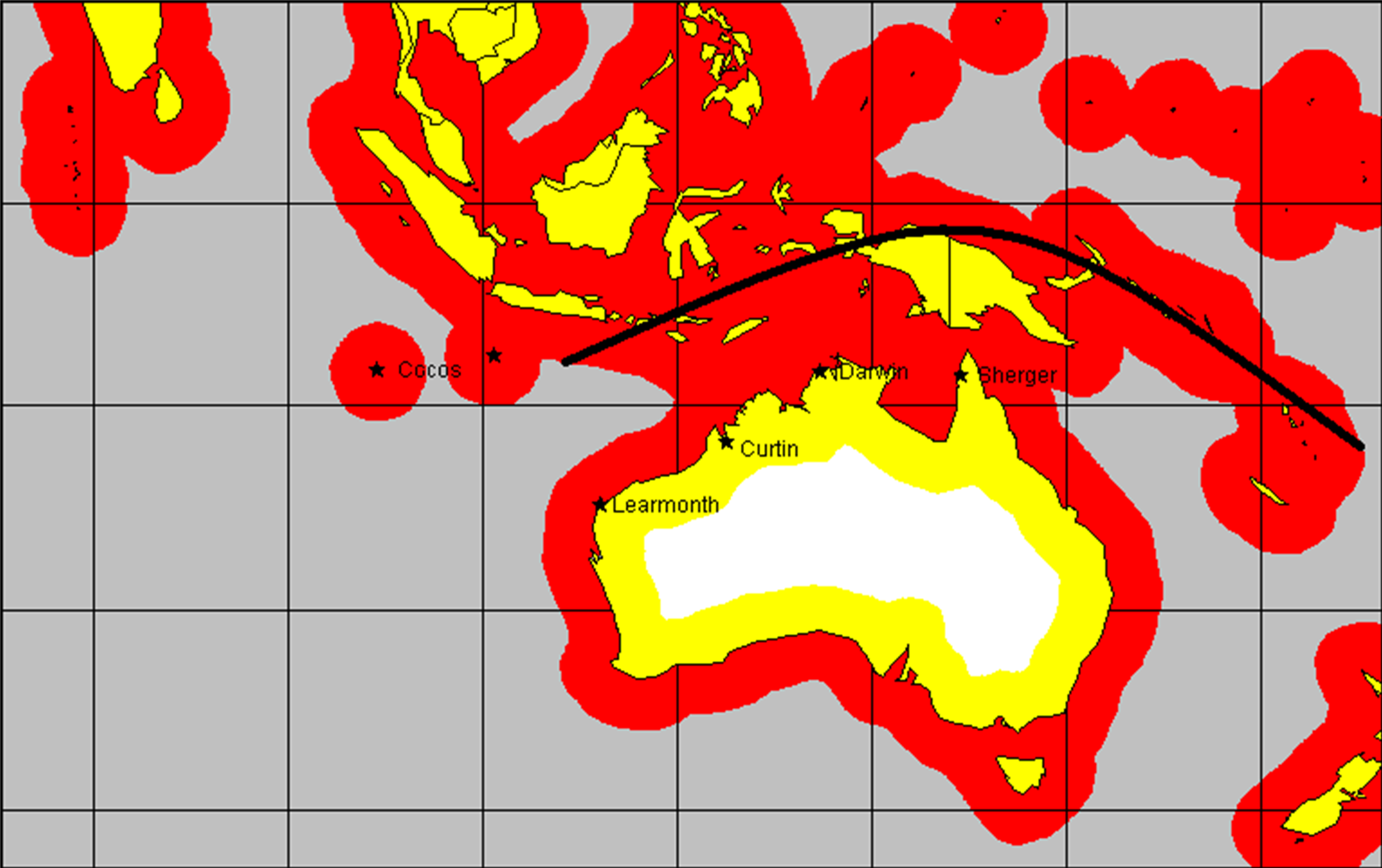
The second concept—and where Army wanted to put its focus—was called ‘Manoeuvre Operations in the Littoral Environment’, or MOLE. By mid-1999, Army produced a diagram showing Australia’s region divided into two sections. The first was ‘the littoral’, defined as ‘the area from the open ocean, which must be controlled to support operations ashore, to the area inland from the shore from which that control can be contested’.[60] The littoral was depicted by coloured areas showing the ability of the expected ship-based and land-based missiles of 2010 to reach inland and seawards from the coastline (see Figure 4). The second area was the white space showing land more than sea-launched missile range from the coastline. The coloured areas displayed on the map were dominant and showed that every island in the Pacific and all of maritime South-East Asia was classed as littoral. From this, Army deduced a need to be able to project power ashore and seaward from the shore, perhaps unilaterally, to protect Australia’s interests.
The yellow and red shading in Figure 4 indicates the range of ship-based land attack missiles and land-based anti-shipping missiles anticipated to be commercially available by 2010.
The third concept was familiar ground for Army—providing ‘contributions to coalition operations worldwide’. Dubbed ‘CCOW’, this concept identified the way Australia’s use of armed force to protect its interests overseas had varied over time—‘nevertheless, it is worth noting that unless the forces committed have the deployability, lethality, survivability and interoperability to undertake the missions assigned, they are unlikely to achieve the strategic outcomes desired’.[61] Army Headquarters thought all four characteristics were necessary to provide meaningful support to any US-led force. Without these characteristics—and without accepting an ‘equitable share of the costs and risks’—the Australian contribution would not achieve the strategic objective.[62]
While Future Land Warfare 2030 was drafted as a staff product within Army Headquarters, the initial intention was to seek a wider range of contributions. An effort was made to bring Army’s Command and Staff College into the process, with the aim of providing new ideas. This did not ‘prove possible’ at the time, and Steve Quinn thought the students were ‘too afraid to take intellectual risks’ while under the pressure of assessment.[63] The contribution by DSTO staff was considered ‘really important’ to the process, as they bought views about technology to the writing team.[64]
Quinn also saw a need and an opportunity to develop ideas in more detail than would be possible in a ‘coherent and formal’ document like Future Land Warfare 2030. He wanted somewhere for staff to do some ‘creative risk taking’. As a result, he commissioned the ‘WinNow’ papers to provide an outlet for thinking about capability requirements for the future force. Quinn framed these as ‘debate papers’ to encourage further contributions. WinNow was a one-off production—regrettably, because it could have provided Army with an ongoing outlet for capability development thinking by junior officers and been an iterative vehicle for linking experimentation findings to the critical task of capability development.
While drafting Future Land Warfare 2030 was hard, the task of exposing the work outside Army would prove tougher. Justin Kelly recalled the different reactions the work received when it was circulated to the wider Defence audience:
Navy liked it, Air Force accepted it, but the Strategy people thought putting it out would muddy the waters for the White Paper. It said lots that wasn’t said in the white paper like cyber and ballistic missile defence ...[65]
Balmaks agreed with Kelly on the views of the Strategy Group, and also recalled being ‘hauled over the coals’ in the minister’s office over the draft paper. Ideas like arming the new ‘unmanned aerial vehicles’—by then an existing capability but not yet employed in Australia—were considered objectionable.[66] The focus on missile defence and cyber manoeuvre was interpreted as Army ‘over-reach’, while the potential for non-state actors to effectively oppose Western states attracted ‘you can’t be serious’ comments. However, Balmaks recalled the other services’ views differently from Kelly. He thought Air Force—who were undertaking their own futures work, Project Oracle—were generally supportive but not all were thrilled with the idea of unmanned aircraft. Some resistance was met in Navy, as he recalled. However, then-Commander Ray Griggs, later Vice Chief of the Defence Force, supported the concept of littoral manoeuvre and so he ‘he took a bit of a leap of faith on MOLE in supporting it’.[67]
Future Land Warfare 2030 ultimately foundered on the rocks of bureaucratic politics. The bad news was delivered to FLW Branch staff in mid-2000 by the Assistant Secretary Corporate Communication of the time, Ms Jenny McHenry. Future Land Warfare 2030 would not be published, because its messages conflicted with those being developed for the forthcoming Defence White Paper. Since people could not be trusted to distinguish between policy and concept, Future Land Warfare 2030 could only serve to distract and perhaps detract from the government’s message.[68]
Consequently, the project was quietly shelved and a ‘final draft’ version was released, under the signature of then-DGFLW Brigadier Ian Gordon, in mid-2001. While the work did not have a lasting impact in itself, important aspects of it were revised in 2003 when the Army published its conceptual framework.
Future Land Warfare 2030, Experimentation and Other Concepts Supported Army’s Narrative
It would be easy to dismiss an unpublished book, and one that some of the participants could hardly remember 20 years later, as a failure. However, they all recalled the way Army began to describe its strategic challenges and how it began to shape the case for further investment. A number also recalled how the ideas contributed to the requirements definition for Navy’s future amphibious capability. This work also provided the base of argument and methodology for the next round of force development, which would become the ‘Hardened and Networked Army’ of 2003.[69]
The key value of Future Land Warfare 2030 lay not in its coverage of trends and operations but in the way it helped Army form an institutional view about its desired future. Since concepts provided a way to express, debate and refine ideas, this written work helped Army create its narrative. The key elements of this narrative are expressed in concepts such as littoral manoeuvre, which described how and why the Army needed to be deployable offshore. Also, discussions about combat weight, survivability and firepower find their rationale in the CCOW concept and their expression through the ECF, which was used in experimentation and became an enduring theme for the next stage of Army’s modernisation effort, which included the ‘Complex Warfighting’ concept and the Hardened and Networked Army initiative.[70]
Future Leaders Can Learn Much from Army’s Experience of the Late 1990s
The 1998–2000 period was one in which, in some ways, events were going in the right direction for the Army’s leaders. The East Timor operation averted the worst of the anticipated resource cuts to Army—indeed, the force would begin to grow from the end of 1999. The Defence White Paper of December 2000 would also provide Army with a rough formula for its preparedness levels. Still, the Army’s actions and initiatives of this period provide three important lessons.
The first is the importance of understanding the strategic environment and explaining the service’s role in it. In this case, Hickling reframed the debate in an uncontroversial way, by arguing the Army existed to defend the nation and its interests. This simple change allowed Army to shift its focus from the defence of continental Australia to a more expansive role in protecting interests, no matter where those interests lay or how they were challenged. While he was not completely successful, at least this change helped Army prosecute arguments in the ongoing competition for resources that characterises the strategic level.
The second is the value of a coherent narrative. This particular story starts with some frustration at the existing situation, and the glimpse of opportunity that came with the change in government policy. It took time and deliberate effort to build the narrative, and three elements were needed: consistency with the past, investment in idea generation, and ways to publicly expound those ideas. Hickling was careful not to ‘trash’ RTA, for to do that would have meant missing some good ideas and would have presented Army as a vacillating institution that could not be trusted with investment. Hickling used the LWSC—an initiative of his predecessor—to generate the ideas. That he tasked it directly to answer his most pressing problems shows how small research organisations can be used to inform and advocate. Advocacy is not just words on paper; it takes effort and a willingness to accept risk. Hickling’s ‘crash through or crash’ approach, which was exemplified in the April 1999 National Press Club address, could have gone another way. That it did not shows that a strategic leader must have a thorough understanding of the context and of the nuances and tensions within the decision-making environment.
The third major lesson for strategic leaders is the need to create structures and a supportive command climate. No one person can come up with the ideas, let alone marshal the evidence needed to win arguments in a bureaucracy like Defence. Robust, well-channelled debate refines ideas, allows people to raise questions, and ultimately helps to create buy-in from the organisation. In some ways, Hickling was greatly assisted by the times, including by the reduction of his Headquarters staff and the changing strategic environment. But it was his leadership that counted most—and part of that leadership was allowing his deputy to run the process for him. Abigail’s creative and methodical approach to building the system within Army is an example of how future strategic leaders might appropriate existing ideas for good use. In this case, Abigail used the emerging idea of futures studies, concepts and experimentation, and the broader ‘revolution in military affairs’ to provide the space needed to develop Army’s case. In particular, the ability to situate Army’s main arguments outside the budget and policy cycle—using the ECF and AAN—meant that Army’s attack on the existing system was oblique and defensible. The approach was effective at the time, and it would lay the foundation for the role concept development and experimentation that remains at the heart of Army’s force development work today.
Endnotes
[1] ‘Capability’ is a defence term for ‘the power to achieve a desired operational effect in a nominated environment within a specified time, and to sustain that effect for a designated period’ (Australian Defence Glossary). Capability is developed when essential inputs are combined and used to achieve government objectives. The inputs to capability used by Army at this time included personnel, organisation, support and facilities, training, equipment and doctrine. Army’s named capabilities in 1998 were manoeuvre, fire support, intelligence and surveillance, mobility and survivability, information operations, air defence, command and control, and combat service support (Australian Army, Land Warfare Doctrine 1: The Fundamentals of Land Warfare (Puckapunyal: Commonwealth of Australia, 1998), Chapter 5).
[2] Robert Ayson, ‘The “Arc of Instability” and Australia’s Strategic Policy’, Australian Journal of International Affairs 61, no. 2 (2007).
[3] See Commonwealth of Australia, Defending Australia: Defence White Paper 1994 (Canberra: Australian Government Publishing Service, 1994), pp. 24–25; Commonwealth of Australia, Australia’s Strategic Policy (Canberra: Commonwealth of Australia, 1997).
[4] Michael Evans, The Role of the Australian Army in a Maritime Concept of Strategy (Canberra: Land Warfare Studies Centre, 1998), pp. 18, 24, 36–37, 40–41.
[5] A ‘revolution in military affairs’, or RMA, occurs where new technologies or concepts change the character of warfare in fundamental ways. Past revolutions included gunpowder, powered mobility, and atomic weapons. See Lawrence Freedman, Strategy: A History (Oxford: Oxford University Press, 2013), Chapter 16.
[6] Dan Gouré, ‘Creating the Army After Next, Again’, Real Clear Defense, 16 August 2019, at: https://www.realcleardefense.com/articles/2019/08/16/creating_the_army_after_next_again_114670.html. See also Paul E Menoher Jr, ‘Force XXI: Redesigning the Army through Warfighting Experiments’, Military Intelligence Professional Bulletin, April–June 1996, at: https://irp.fas.org/agency/army/mipb/1996-2/menoher1.htm.
[7] Defending Australia, p. 5.
[8] Ibid., pp. 32–34.
[9] Renée Kidson, Force Design in the 1990s: Lessons for Contemporary Change Management (Canberra: Australian Army History Unit, 2017).
[10] Major General (Retired) Michael Smith, interview, 2 June 2022. See also Kidson, Force Design in the 1990s, p. 5.
[11] Brigadier (Retired) Justin Kelly, interview 12 May 2022.
[12] Ibid. Michael Smith also noted that the Army Development Guide, a forerunner to A21 from the 1980s, was similarly ‘flat’ and had no real basis for creating change (Smith, interview, 2022).
[13] Kidson, Force Design in the 1990s, pp. 20, 41, 44.
[14] Australia’s Strategic Policy, p. iii.
[15] Ibid., pp. 32, 36.
[16] Ibid., p. 65.
[17] ‘An Interview with Lieutenant General (Retired) Francis Hickling’, Australian Army Journal IX, no. 3 (2012): 14; Lieutenant General (Retired) Frank Hickling, interview with author, 10 August 2023.
[18] Hickling, interview, 2023.
[19] Evans, The Role of the Australian Army in a Maritime Concept of Strategy, pp. 3–4, vii.
[20] Fundamentals of Land Warfare. This publication replaced the Manual of Land Warfare series of the same name that had seen various editions since 1977.
[21] Fundamentals of Land Warfare, pp. 1-7 to 1-9, 4-5 to 4-18. Doctrine describes how the Army will fight its next battle, and forms the basis of training and preparation for operations.
[22] And, it should be noted, it remained unreflective of the Army’s experience for the next 20 years (with the exception of the special forces role in Iraq, 2003). Graeme Cheeseman, ‘Army’s Fundamentals of Land Warfare: A Doctrine for “New Times”?’, Australian Defence Force Journal, November/December 1999, p. 6.
[23] Paul Dibb, quote provided for rear cover of Fundamentals of Land Warfare.
[24] ‘An Interview with Lieutenant General (Retired) Francis Hickling’, p. 9.
[25] Lieutenant General Frank Hickling, speech, National Press Club of Australia, 14 April 1999.
[26] ‘An Interview with Lieutenant General (Retired) Francis Hickling’, p. 9.
[27] Hickling quoted in Nicholas Jans, The Chiefs: A Study of Strategic Leadership (Australian Defence College, 2013), p. 69.
[28] Australian Army, Submission 47 to Joint Standing Committee on Foreign Affairs, Defence and Trade Inquiry into the Suitability of the Australian Army for Peacetime, Peacekeeping and War (2000), p. 14. Emphasis added by author.
[29] Joint Standing Committee on Foreign Affairs, Defence and Trade, From Phantom to Force: Towards a More Efficient and Effective Army (Canberra: Parliament of Australia, 2000), pp. 5, 85–88.
[30] Kelly, interview, 2022.
[31] Future Land Warfare 2030, Chapter 1.
[32] Australian Army, Army Continuous Modernisation Plan, 1999–2004 (Army Headquarters, c. 1999), p. i.
[33] Ibid., p. i.
[34] Smith, interview, 2022; Brigadier (Retired) Steve Quinn, interview, 22 September 2022.
[35] Hickling, interview, 2023; Frank Hickling, interview with author, 24 December 2024; Major General (Retired) Peter Abigail, interview, 2 May 2022.
[36] Abigail, interview, 2022. Kelly and Smith also described Hickling’s command climate in similar ways (Kelly, interview, 2022; Smith, interview, 2022).
[37] Abigail, interview, 2022. ACMC was chaired by Abigail, and its members included Brigadier-level (one star) representatives of the Army’s major components.
[38] Smith, interview, 2022; Kelly, interview, 2022; Lieutenant Colonel (Retired) Andris Balmaks, interview with author, 11 March 2022.
[39] Balmaks, interview, 2022.
[40] Army Continuous Modernisation Plan, pp. 8, 9–13.
[41] Australian Army, ‘Headline 00 Interim Report (Draft)’ (copy in author’s possession), p. 7; Balmaks, interview, 2023.
[42] Army was careful not to ‘trash’ A21/RTA in public. Instead, the modernisation activities under Hickling were usually portrayed as a continuation of RTA, and the ideas generated were attributed to the evidence collected through its trials and experiments. See John N Blackburn, Lee Cordner and Michael A Swan, ‘“Not the Size of the Dog in the Fight”: RMA—The ADF Application’, Australian Defence Force Journal 144 (2000): 68.
[43] The Australian Army had some experience with experimentation and trials before, but it is difficult to argue that this methodology for decision support was embraced. More often, the Army would wait for others—such as the British with regard to mechanisation and the United States in response to the ‘atomic battlefield’—to provide evidence for change through experiments. See respectively James C Morrison, Mechanising an Army: Mechanisation and the Conversion of the Light Horse, 1920–1943 (Canberra: Land Warfare Studies Centre, 2006); John Blaxland, Organising an Army: The Australian Experience 1957–1965, Canberra Papers in Strategy and Defence No. 50 (Canberra: Australian National University, 1989).
[44] Professor Mike Brennan, interview with author, 20 October 2022.
[45] Ibid. The methods would be applied to good effect in future work covering amphibious capability requirements: see Army Experimental Framework, The Army’s Future Amphibious Requirements (December 2002), Army file A356814.
[46] Brennan, interview, 2022; Quinn, interview, 2022.
[47] Ibid.
[48] Balmaks, interview, 2023.
[49] Senior Officer Study Period presentation, ‘Headline Experiment 2000—Interim Report’, 1 December 2000, copy in author’s possession; Balmaks, interview, 2023.
[50] Brennan, interview, 2023.
[51] Army Continuous Modernisation Plan, p. 1.
[52] Ibid., p. 1. These plans would morph into ‘Objective Force Design Papers’ by 2002. See FLW Branch, Army Conceptual Framework (Draft) (Army Headquarters, 2002), pp. 6–7.
[53] Fundamentals of Land Warfare, pp. 1-7, 1-8; FLW Branch, Army Conceptual Framework, p. 4; Balmaks, interview, 2022.
[54] Future Land Warfare 2030, Chapters 7 and 8.
[55] Brief, Balmaks to Hickling, ‘Future Land Warfare (FLW) 1 and 2: Warfighting in the Enhanced Combat Force and Warfighting in the Army After Next’, 28 April 1999, Army file A151790.
[56] ‘Minutes of the Meeting for the Writing of Future Land Warfare 1 Warfighting in the ECF and Future Land Warfare 2 Warfighting in the AAN, Held at the CATDC on 30 April 1999’, Army file CA 98-21238.
[57] Meeting notes, Baldwin and Balmaks, ‘Key Points of the Meeting for the Writing of FLW 1 & 2, Held at the CATDC on 23 July 1999’, Army file A151816.
[58] Ibid.
[59] The 2000 Defence White Paper gives only passing mention to these ‘non-military’ security threats and proposes no new capability to meet them. See Australian Government, Defence 2000: Our Future Defence Force (Canberra: Commonwealth of Australia, 2000).
[60] Future Land Warfare 2030, Chapter 4, 26 August 1999, p. 1, Army file A151997.
[61] Ibid., Chapter 6, p. 4. Emphasis in original.
[62] Ibid., Chapter 6, p. 3.
[63] The crowded staff college curriculum, which was designed to meet tertiary accreditation needs, is the probable reason why students could not be engaged in the writing task. Brief, Kelly to Hickling and Abigail, ‘Future Land Warfare—Characteristics of Future Land Warfare (FLW)’, 29 July 1999, Army file A151881; Quinn, interview, 2022.
[64] Balmaks, interview, 2022.
[65] Kelly, interview, 2022.
[66] The ‘unmanned’ descriptor has been replaced by ‘uncrewed’ in Defence today.
[67] Balmaks, interview, 2022.
[68] Kelly, interview, 2022.
[69] John Caligari, ‘The Adaptive Army Post-Afghanistan: The Australian Army’s Approach Towards Force 2030’, Security Challenges 7, no. 2 (2011): 2.
[70] Peter Leahy, ‘Towards the Hardened and Networked Army’, Australian Army Journal 2, no. 1 (2004). See also Australian Army, Complex Warfighting (Canberra: Department of Defence, 2004).
