
The Island Campaigns and the Founding of China’s Navy
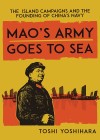
Author: Toshi Yoshihara
Georgetown University Press, 2023, 176 pp, RRP USD$34.95 (softback)
Paperback ISBN 9781647122829
Reviewed by: Dan Phelan
Much of China’s history, from its ambition and grandeur through to its conflict with foreign powers, has come from and been tied to the maritime domain. In its conquest of and victory over the Kuomintang (KMT), the Chinese Communist Party (CCP) faced the arduous task of building a navy from the ground up with limited resources and pressing influences coming from all directions, including the Korean War restricting the CCP’s ability to take the island of Formosa (Taiwan). By analysing the formation and early campaigns of the People’s Liberation Army Navy (PLAN), this book provides insight into some of the operational decisions the modern Chinese navy might take in the South China Sea.
Mao’s Army Goes to Sea: The Island Campaigns and the Founding of China’s Navy, by Toshi Yoshihara, examines this area and the recent history of the latter period of the Chinese Civil War and revolution. The book traverses this history as the PLAN shifted its focus from a predominantly land campaign against the KMT, forcing it to the south of China, to forming a naval fleet from a small number of the KMT’s coastal defence fleets which were abandoned, defected or surrendered. The CCP’s capability transformed from one with little central control and scattered sympathetic armed groups (such as the Qiongya Column in Hainan), to a fulfilled fighting force with growing naval capability and greater centralised control. The author draws parallels with this short period of history, comparing the PLAN in its early days from the period of 1949 to 1950 to some elements of its organisation and structure today. This comparison provides the basis for Yoshihara’s commentary on how the PLAN might operate in a contemporary naval campaign. In doing so, he finds that the PLAN’s contemporary leadership still draws influence from nostalgia born of its historical mandate when developing its policies and practices.
The book covers a range of events and elements in the formation of the PLAN. In Chapter 1, Yoshihara introduces the scope of the book and explains the scholarship and study that is included in it. The book then introduces the East China Navy as the formative precursor to the PLAN, tying it into the formation of the PLAN in Chapter 2. In this chapter, Yoshihara also introduces the sequence of actions that the PLAN was deciding upon for a conquest of Taiwan. As Yoshihara outlines, this would either be an island-by-island attack or replicate US military island-hopping strategies. Importantly, the chapter fills an intellectual gap in Western scholarly understanding about the seemingly ‘obscure’ nature of China’s seaward turn during and after the Chinese Civil War.
Chapters 3 and 4 analyse the East China Navy’s early days of formation and introduce a key character in China’s naval history, Zhang Aiping. In April 1949, Zhang assumed control of the East China Navy, which was newly created as an entity within the structure of the People’s Liberation Army (PLA). Zhang faced considerable obstacles in his efforts to raise the service, due to limited available resources. But through a pragmatic vision, he was able to utilise former Nationalist naval officers and sailors to undertake modest-scale campaigns late in 1950. This served as a proof of concept, testing and validating ideas while enabling the national navy to be stood up. In September 1950, the PLAN was created as an independent navy separate to the PLA, with Xiao Jinguang appointed as the first commander. Yoshihara examines the influence of Zhang on Xiao and unpacks the early doctrines of the PLAN. Taking a long-term view of Chinese sea power and its requirements, a key motto of the PLAN was to ‘look to Western navies, learn useful lessons’. Yoshihara concludes this discussion of the founding of the PLAN and its history by focusing on Xiao’s enduring influence on the PLAN today.
Chapters 5 and 6 consider the key events and campaigns the PLAN undertook during this period of its formation, including the smaller island campaigns of Xiamen, Kinmen and Zhoushan in the west and south-west of China. Contrasting these early campaigns to the larger offensives of Hainan Island and the Wanshan islands, these chapters showcase the evolution of the PLAN over a short period. Yoshihara analyses a variety of Taiwanese and PLA accounts to provide different insights into the results and outcomes of these campaigns.
Chapters 7 and 8 present Yoshihara’s own assessment of the formation period of the PLAN. First, Yoshihara assesses the PLA’s ‘seaward turn’ through original analysis of Chinese scholarship and appraisal of the campaigns and events previously discussed. Yoshihara also presents contemporary analysis of Chinese civilian-military partnerships, including an assessment of how the PLAN has been able to supplement military capabilities with Chinese civilian ships, and its experimentation with resupply infrastructure. Yoshihara also provides recommendations for future research in order to develop deeper understanding of this period. One suggested area of inquiry includes the impact of the Korean War in setting back the PLAN’s modernisation plans due to the shift of focus by the CCP from the PLAN to the People’s Liberation Air Force throughout the conflict.
Mao’s Army Goes to Sea: The Island Campaigns and the Founding of China’s Navy presents a unique and interesting perspective that is useful to anyone interested in understanding the historical context within which the PRC’s modern-day navy operates. The author also usefully contrasts historical analysis with observations on how the PLAN is studied and understood today. The book’s intended audience would likely be those interested in and curious about defence studies, the Indo-Pacific, and Chinese military history. Written in a clear and concise manner, this is a book that can be easily understood by those less familiar with Chinese studies and sea power.
Yoshihara ultimately seeks to analyse the early chain of events that led to the founding of the PLAN, alongside its early period of campaigning as the CCP pushed the KMT to Taiwan. Overall, this book is extremely valuable for the insights it provides into the formation of the PLAN. Readers of this book will be well placed to understand the impact of the PLAN’s early campaigns against the KMT, and to assess how modern-day Chinese practitioners have used lessons learned from this period to shape the policies and practices applied in contemporary conflict. Through grounded assessment of sources, this book presents a digestible narrative that provides useful insights into the foundations of China’s modern navy.