
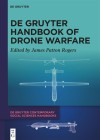
De Gruyter, 2024, 517 pp, RRP EUR €139.95
Hardcover ISBN 9783110741926
Edited by: James P Rogers
Reviewed by: Carl Rhodes
The use of drones in warfare has expanded significantly over the past two decades and, as with the applications of any new technology, many questions have been raised about their past, present and future role. These enquiries encompass not only the technological capabilities of drones and their effectiveness on the battlefield but also the ethical implications of remote force application, the integration of drones into the principles of ‘just war’ theory for various conflict scenarios, and their potential impact on civilian populations. While many argue that drones are simply a continuation of a longer evolutionary trend enabling the application of force from distance with improved precision, it is undeniable that drones have garnered public and research attention in a way that few other weapons have since the atomic bomb.
The De Gruyter Handbook of Drone Warfare, edited by James Patton Rogers, addresses these questions comprehensively across the past, present and future of drone warfare. This substantial publication, comprising 517 pages, draws upon the expertise of 37 contributors across 30 standalone chapters that delve into a wide range of drone-related research topics. The contributors hail from diverse backgrounds, including military, history, law, research and human rights. Each chapter includes a comprehensive list of references, enabling readers to pursue further exploration of topics of interest.
The book consists of four sections, commencing with introductory chapters that explore the historical and scholarly aspects of drone warfare. Daniel Gettinger’s chapter, ‘Defining Drones’, serves as a foundational introduction by providing a concise historical overview of combat drones, spanning from World War I to the present day. Amelie Theussen’s chapter, ‘Drones and International Law’, establishes a useful reference point for subsequent chapters by examining the unique legal challenges associated with drones and their deployment by various nations over the past two-and-a-half decades.
I found two chapters in this initial section to be less connected to the overall themes of the handbook, specifically the chapters related to drone art in combat and to the role of gender and drones in counterinsurgency. Both topics are important but were not explored again elsewhere. The authors of the chapter on the latter topic demonstrated a comprehensive understanding of the role of gender in counterinsurgency operations, but I found the connection to drones a bit more tenuous.
The handbook then chronicles the period known as ‘the First Drone Age’, spanning from 2001 to 2020, during which the United States extensively utilised drones in counterinsurgency campaigns both within and outside established conflict zones. This section primarily concentrates on the deployment of medium-altitude long-endurance drones, such as the Predator and Reaper. Christopher Fuller provides an in-depth historical account of the CIA’s drone program, dating back to the 1980s, and elucidates the role of CIA drones following the September 11 attacks. While drones were touted as a more effective means of combat against terrorists and insurgents who operate in concealed environments, chapters in this section offer a valuable analysis of the overall impact on civilians potentially affected by drone strikes. Furthermore, Daniel Brunstetter examines the legality of employing drones for self-defence against hostile groups outside of conflict zones and assesses whether this should override the sovereign rights of a country where a strike may occur.
The subsequent section explores the concept of ‘the Second Drone Age’, a period characterised by a significant expansion in the types of drones employed, tactics utilised, technologies integrated, and actors involved in drone operations. Drones have played a pivotal role in numerous conflicts since 2020, including Russia’s invasion of Ukraine, Libya’s civil war, and combat in Africa, Yemen and Ethiopia. Notably, violent non-state actors have also harnessed the capabilities of drones to support their endeavours. This section presents an in-depth analysis of the drone operations employed in these conflicts, evaluating their effectiveness or shortcomings on the battlefield. The examination of these conflicts proved to be the most captivating and insightful chapters of the book for me.
The concluding section focuses on ‘the Third Drone Age’ and addresses the emerging challenges posed by drones. Topics covered include the impact of rapidly advancing technology that enables drone swarming and enhanced autonomy, the application of international law to inexpensive, small drones, and methods for countering drone threats. Commercial off-the-shelf drones are prominently featured throughout this section. The 10-year retrospective chapter authored by Michael Kreuzer, which draws upon his doctoral dissertation findings on the diffusion of military drones, provides valuable insights. Overall, Kreuzer’s model of military diffusion and proliferation trends is validated. However, the absence of predicted investment in counter-drone technology resulted in his thesis underestimating the number of nations capable of effectively fielding small armed drones.
Overall, James Patton Rogers’s handbook is a valuable resource and a crucial reference for a diverse range of audiences. The comprehensive list of authors and the quality of their contributions are noteworthy. As one of the few in-depth texts on drone warfare, the book serves as a valuable resource for individuals seeking to delve deeper into a specific aspect of contemporary drone research. Experts in international law, military ethics, the impact of war on civilians, and the influence of technology on military operations will find specific chapters that connect their areas of interest to the latest drone-related research, complemented by a detailed bibliography.
For individuals interested in drones, robotics, and autonomous systems in general, the entire book is a worthwhile read, albeit a lengthy one. Fortunately, the standalone nature of the individually contributed chapters allows for a gradual consumption of the substantial handbook. Each chapter can be read independently, enabling readers to complete the book at their own pace.