
Debating the Future of War
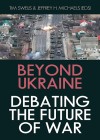
Hurst Publishers, 2024, 432 pp, ISBN 101911723162
Editors: Tim Sweijs and Jeffrey Michaels
Reviewed by: Jason Kirkham
Can the war in Ukraine provide us a clearer perspective on the nature and character of future war? This is precisely the question that Tim Sweijs and Jeffrey Michaels attempt to answer in Beyond Ukraine: Debating the Future of War, an edited collection of essays by leading scholars in the field of future war studies. The book provides a diverse range of insights into the future of war, which collectively highlight a central premise: we have not overcome the darker angels of humanity, war will continue well into the future, and only through careful examination can we hope to forecast war’s evolving nature.
The book is divided into four parts which each deal with a fundamental question in the field of future war studies. Each section covers a diverse range of topics which collectively produce an extensive mosaic of perspectives on future war.
In Part One, a robust case is put forward that the so-called ‘decline of war’ is a delusion. Antulio Echevarria convincingly posits that the global conditions we have come to associate with the decline of war were, surprisingly, responsible for precipitating its eruption in Ukraine, and that these same factors are likely to trigger conflicts elsewhere. Frans Osinga reinforces this view by arguing that rather than receding, war is instead evolving across independent but interrelated visions. Specifically, he contends that war is likely to manifest along what Azar Gat terms ‘the boundaries of the zone of peace’: geographic regions where social, economic and political conditions promote conflict.[1] Part One concludes neatly by addressing the fact that the democratisation of war through cyberspace, as demonstrated in Ukraine, will inevitably attract hundreds of new cyber groups as parties to future conflicts, greatly expanding the reach and effect of future wars.
Part Two paints a gripping picture of future war that entails a multivariate struggle between state and non-state actors in which societies will play a central and expanding role. Frank Hoffman compellingly elucidates that future war will manifest non-linearly, exhibiting blends of cognitive, societal, proxy and conventional conflicts. Jan Honig complements and deepens Hoffman’s view by pointing out the ever-increasing role of society in conflict, where the definition of combatant is changing and becoming muddied by the maturation of war-enabling civilian technologies. David Betz maintains Honig’s people-centric focus by describing the West’s inevitable descent into civil war. Betz provocatively, and at times overconfidently, asserts that the degradation of social trust and unity will fuel intercommunal violence on a grand scale. Paul van Hooft concludes the section with a view that the uneven distribution of technology will result in a strategic stalemate alterable only by the few nations rich enough to technologically innovate. While van Hooft’s argument is compelling, he drifts thematically away from the main theme of Part Two, and his essay might better have been included in Part Three.
Part Three examines the evolving role of technological innovation in future war. Audrey Cronin persuasively submits that the convergence of advanced technologies into widely accessible forms will alter military innovation from a centralised top-down process to one that must draw increasingly on civilian and commercial technology sectors to remain competitive. Cronin’s argument is vindicated by Lauren Gould’s, Linde Aretenze’s and Marjin Hoijtink’s examination of how Netherland’s innovative ‘Military–Industrial–Commercial Complex’ has generated a more efficient and integrated relationship between military and non-military technology providers. TX Hammes expands on the need for this type of innovation to generate new access-enforcing capabilities to break the defensive predominance on today’s battlefields. His contribution segues well into Kenneth Payne’s essay on artificial intelligence (AI), a technology he argues will deliver revolutionary effects on data aggregation, wargaming and endurance—though he stops short of asserting that AI alone will be strategically decisive.
Part Four sets out to provide a sophisticated lens through which to anticipate future war, and it succeeds to an extent. Beatrice Heuser advocates for deep historical reflection, rather than flawed presentism, to inform potential directions of future war. Collin Meisel’s systems-based approach posits five factors that explain why war has been—and will remain—inherently resistant to long-term forecasts. Jeni Mitchell reminds us that the risk of apocalypse via biological, environmental and societal factors will continue to play a commanding role in all of humanity’s decisions regarding war. Antoine Bousquet then concludes with a call to abandon further attempts to divine war’s essence in favour of efforts to understand how and why war changes over time. All four essays combine exceptionally well to support the view that, while war is unknowable, history evidences traceable patterns and characteristics. Unfortunately, while it elucidates war’s undefinable nature, Part Four leaves the reader uncertain about how to anticipate future war.
At its best, Beyond Ukraine successfully overcomes the implacable challenge of capturing war’s complexities in written form. The diversity of subjects is so varied that even experienced war studies readers will be challenged and enlightened. Beyond Ukraine belongs alongside other great works on the nature of war, such as Lawrence Freedman’s The Future of War: A History, and Steven Pinker’s The Better Angels of our Nature: Why Violence Has Declined. In my view, HR McMaster’s description of the book as ‘The best edited volume on war and warfare to appear in this century’ is a fair one.
The reader can be misled into purchasing this book on the premise that it will feature Ukraine as a core subject matter. The image of embattled Russian tanks on the book’s cover certainly invites this perception, as does the cover endorsement by Mick Ryan, who describes the book as ‘one of the most detailed and forensic explorations of the war in Ukraine’.[2] These marketing ploys detract from the book’s far deeper subject matter, and references to the Ukraine war sometimes appear tokenistic and forced.
The book’s greatest flaw is that it leaves the reader with no clearer understanding of war’s uncertain trajectory or form. In reading the book, one hopes to gain an irreducible concept or unifying model to understand future war: a reference point to plot war’s perilous and uncharted trajectory. Instead, the editors acknowledge the often contradictory views of its contributors and leave readers to plot their own course and direction. In this regard, the book leaves the reader unfulfilled, presenting as many questions as it answers. In dealing with such a complex topic, the book’s strength is also its weakness.
Beyond Ukraine discusses competing visions and realities about the future of war, amassing a diverse range of perspectives from war studies scholars conveyed in a compelling four-part format. Each part engages deeply and compellingly, transposing real-world events to the deep and unsolvable conundrums of the future war field. The book reminds us that the study of war and its future remains as important as ever.
In sum, Beyond Ukraine is an excellent book that is highly recommended to military personnel in middle-level leadership roles, industry members in defence-related fields, leaders across government, and anyone with an interest in the future of war.
Endnotes
[1] Azar Gat, ‘After Russia’s Invasion of Ukraine: Is the Decline of War an Illusion?’, in Tim Sweijs and Jeffrey Michaels (eds), Beyond Ukraine: Debating the Future of War (New York: Oxford University Press, 1994).
[2] Mick Ryan, cover endorsement for Tim Sweijs and Jeffrey Michaels (eds) Beyond Ukraine: Debating the Future of War (London: Hurst Publishers, 2024).