
Digitising the Commander’s Intent
Towards Effective Governance of Decentralised Human–AI Teams
Authors: Lieutenant Colonel Dr Adam Hepworth and Professor Hussein Abbass
Introduction
Commander’s intent (CI) is a directive framework under uncertainty that promotes action and initiative in military operations, functioning as a semantic compression mechanism across teams with shared situational and contextual understanding. It enables disciplined initiative through the delegation of authority, where the commander remains accountable for mission outcomes. Shared understanding, built through professional military education, common doctrine, individual and collective training, and trust developed through the command climate, has enabled CI to operate effectively in predominantly homogeneous human teams. The introduction of AI-enabled autonomous systems (AIAS) into military operations begins to fracture the underlying cognitive and physical homogeneity assumptions of the mission command paradigm.
In our prior work, we introduced meaningful human command (MHC1) as an evolution of meaningful human control (MHC) for military human–robot interaction (HRI). In this paper, we address an enabling requirement for MHC1 that our prior work did not specify: a technical and governance mechanism for disciplined initiative under uncertainty in human–machine teams, which we propose as the digital commander’s intent (DCI). DCI marks a transformation from an action-oriented view of CI to a governance-oriented view in which CI itself becomes the instrument that establishes purpose, boundary conditions and risk appetite for human and machine subordinates. We articulate the problem space, identify three challenges for extending CI to mission command in human–machine teams, propose a four-skill framework for commanders and outline a pathway for future work.
Commander’s Intent in Human Settings
The employment of AI-enabled autonomous systems (AIAS) in military operations is increasing globally, challenging existing governance and systems of control.[1] Existing international legal[2] and operational[3] frameworks build on the assumption that a human commander retains decision custodianship throughout all phases of an operation. The introduction of AIAS challenges this paradigm, in particular the underlying ability of a commander to assess, direct and verify the actions of commandeers—any delegatee, be they human or machine.[4] This paper addresses the implications of extending the concept of commander’s intent (CI) across heterogeneous human–machine teams and the associated governance challenges of fulfilling command responsibilities as decision-making boundaries become less well defined. Mission commanders oversee the governance framework of the mission. Commanders must be conscious that their intent will interact with governance controls, especially in environments with automated workflows such as those involving AIAS entities. Because a commander’s intent must operate through these governance controls, a competent AIAS may try to relax a specific control to satisfy the CI—that is, a capable AIAS pursuing the commander’s intent may trade away a governance control to reach the goal. The digital commander’s intent (DCI) prevents this: it makes explicit which controls are binding and which may flex, and by how much.
In our prior work, we established meaningful human command (MHC1) as an evolution of meaningful human control (MHC) for military human–robot interaction (HRI) settings.[5] This paper addresses an essential mechanism that MHC1 requires but did not specify: a formal representation of CI for heterogeneous human–machine teams.
Commander’s Intent: Definition and Role
The Australian Defence Force defines the commander’s intent (CI) as a ‘clear and concise expression of the operation’s purpose, method and end state’.[6] The United States Civil Air Patrol Unit Commanders Course guide describes a CI as ‘the description and definition of what a successful mission will look like’.[7]
Expanding the aperture to the link between CI and mission command, UK doctrine asserts that mission command is ‘founded on the clear expression of intent by commanders and the freedom of subordinates to act to achieve that intent’, expressing that ‘trust is a prerequisite of mission command’ and going on to highlight that ‘commanders will decide the extent of delegation based upon the specific context and judgement of their subordinates’.[8] Canadian doctrine positions mission command as a key to the manoeuvrist approach, articulating that it is ‘the philosophy of command that promotes unity of effort, the duty and authority to act, and initiative to subordinate commanders’. Three key tenets are elucidated: the importance of understanding superior intent; clear responsibility of subordinates to achieve the intent; and decision-making in a timely manner.[9]
These diverse national perspectives jointly surface a common conceptual connection, the CI, being anchored in the mission command philosophy: the purpose is to succeed on all criteria that matter to the commander. It is a natural expression and expectation of effective decision-making to describe what success looks like, what is acceptable, what is unacceptable, and what the conditions and failure modes are—that is, the no-go conditions and the threshold the commander establishes to differentiate success from failure. CI is the minimum description of purpose and the goal that remains informative regardless of how uncertainty in the operational environment changes. It is the invariant why and the desired end state that remains when tasks, synchronisation and uncertainty invariably require adaptation to changing operational contexts.
The practice of command exists on a spectrum ranging from centralised to decentralised control models, with each extreme representing a model with unique characteristics and features.[10] CI enables a disciplined form of delegation under a decentralised model, in which a commander delegates to at least one commandeer. These commandeers, in return, are expected to take initiative and act within the bounds of the rules of engagement (ROE), military values and legal boundaries. As uncertainty escalates, the complexity or scale of a mission increases and commanders must delegate more, transitioning from hands-on to hands-off execution. This form of delegation, enabled and exercised through mission command (MC), is imperative when operations face severe uncertainties in contested environments. It provides CI at all levels where command and control (C2) is practised, from a military section’s second-in-command to strategic command through government to the most senior military leaders. CI enables both individuals and teams to exercise disciplined initiative; the orders become a framework to operate within, in contrast to a specific set of ‘only do’ actions.
Exercising Mission Command
Mission command (MC) represents the practical upper-bound expression of decentralised execution, where commanders delegate authority to commandeers who subsequently perform command functions within the delegated scope.[11] While commanders delegate authority and responsibility for execution in MC, a commander cannot delegate accountability.[12] The commander remains accountable for mission success, invariant to the degree of delegation, including ancillary impacts of mission performance, in addition to achievement of mission objectives. The ability to delegate execution requires significant skills from commanders. CI as a mechanism operationalises the concept of MC, offering a path for commanders to enable commandeers to act in situations of physical dislocation, communications degradation or both.
An underlying and often unstated assumption of MC is that the CI framework ‘works’ for human teams with its inherent semantic compression[13] due to a common lexicon and training paradigm, shared concept space and inculcated culture of practice. Due to this shared space, there is an explicit part of CI and an implicit one,[14] in which commandeers use their shared understanding of the doctrines to infer that their plans and actions will align with the commander’s overall intent.[15]
The fundamental idea of MC holds when transitioning from homogeneous human teams to heterogeneous human–machine teams; however, implementations begin to fracture as the complexity of command increases. Such underlying assumptions embedded as elements of pre-specified intent may require further shared awareness and specification, with a commander needing to adapt the CI as the situation evolves. For example, as these assumptions begin to fracture in human teams operating with partners from diverse linguistic perspectives, different national backgrounds and divergent cultural understandings, CI as an operating modality can become brittle in practice. The introduction of robotic team members further increases team heterogeneity and amplifies this brittleness, both cognitive and physical, with differences becoming more apparent as assumptions of the underlying model fracture and fail.[16] The shared understanding is decoupled among agents unless explicitly engineered. In such cases, a new construct is necessary to highlight and bound the effect of hidden assumptions in both the explicit and implicit parts of a CI, contributing to team assurance across heterogeneous teams and systems.
Commander’s Skills
Research on MC has identified factors of success, including necessary enabling conditions. Recent work suggests that MC is a cultural and institutional phenomenon for the Australian Army.[17] While not the focus of this article, we must briefly highlight a few critical commander’s skills that will drive the foundations for our discussion on CI for AIAS: commandeers’ capacity assessment, commander’s risk foresight, clarity of communication and commander’s comprehension.
- Commandeers’ capacity assessment: Commanders issuing direction need to have the ability to assess the capacity of commandeers receiving direction. Commanders are accountable, and are therefore responsible for ensuring that the delegatee has the capacity to perform the delegated responsibility. Capacity here includes the delegatee possessing the skills and competencies to perform and lead the delegated tasks—that they have the cognitive and physical resources and are responsible moral agents bounded by law, obligations to the welfare of soldiers, and military values. For AI-enabled commandeers, we posit that test, evaluation, verification and validation (TEVV) is analogous to the qualifications, competency and currency of homogeneous human team members. It follows that the need for a responsible human agent increases, with the AIAS unable to bear a moral responsibility. The commander’s ability to assess the capacity of the commandeers through this lens must necessarily be calibrated to the bounds of machine performance, both desirable and undesirable.
- Commander’s risk foresight: When commanders maintain close control of their commandeers in simple missions, they are directly exposed to the situations their commandeers face and can assist in managing unfolding risks. As commanders step back and delegate, distancing themselves from the situations their commandeers face, they need to be skilled in risk foresight for the situations their commandeers will face. These skills could be developed in simulated settings to accelerate commanders’ training; these must include scenarios to improve the commander’s competencies for assessing the psychological, physical and mission stressors that their commandeers face. Mission stressors may impact the capacity of the performer, increase uncertainty for commanders, degrade team culture and impact mission success. For AIAS, the concept of the commander’s risk foresight must generalise to include known and plausible machine failure modes, calibrating behavioural envelopes beyond procedural controls. The key task for the commander in such a situation is the same as with human commandeers: to identify the boundary conditions under which the envelope no longer holds. The commander must understand changes in the situation over time, particularly the assumptions underpinning risk tolerances and when risks deviate beyond the established risk appetite, necessitating reassessment.
- Clarity of communication: Communication has been a cornerstone in the discussion of command. Commanders are expected to have clarity about what they want commandeers to achieve; they need to communicate their CI clearly. This expectation is managed in a human-only setting through education and training. In the military, standards in training regimes can achieve scale through training the whole organisation on concrete linguistic structures, including lexicons, to be used and therefore understood by everyone. While the style of communication in the military has been successful in delivering military missions, it is well documented in the literature that implementation of MC varies between doctrine and practice.[18] For example, there is a body of literature on the communication challenges that arise from civil–military cooperation.[19] Similarly, communication styles in academia vary by discipline, posing challenges for multidisciplinary research. Moreover, the linguistic nuances of spoken language and freeform documents, while offering flexibility in communication, introduce complexities in interpretation and in the resulting mental models. A structured document with clear linguistic structure and rules could reduce some of these effects through education and transfer learning—for example, from other structured military documents such as task orders.
- Commander’s comprehension: In a human team context, a commander requires the necessary intuition to ‘read’ how commandeers are performing during execution of tasks. This allows the commander to evaluate how the execution is progressing—or, if it is diverging, why. Seminal work in the field discusses this in the three situational awareness (SA) levels model, featuring Level 1 (perception), Level 2 (comprehension) and Level 3 (projection), extending beyond awareness and understanding to anticipation of future states.[20] Within human teams, this anticipatory skill is enabled by shared cognitive and cultural contexts. For heterogeneous human–machine teams, a commander’s skill degrades as heterogeneity increases, due to distinct failure modes and new signals to learn, necessitating the development of new competencies to interpret outputs. In our setting, we position ‘comprehension’ after anticipation and communication, distinct from established framing and language in the literature. This deliberate choice reflects the nested cycles of situation awareness, in which the first three skills enable the commander to operate effectively within the team and the fourth skill operates at a higher level of abstraction, synthesising team-level outputs into an integrated assessment of mission and system-of-systems state. Distinct from Level 2 SA, which precedes projection, our fourth skill encompasses all three SA levels applied at the mission scale and is predicated on functioning team-level SA.
Functional Elements of CI
The practical implementation of CI is as an instrument, often delivered through a document, for decentralised work execution under uncertainty. It provides a stable core of direction, including purpose (‘why’), tasks and effects (‘what to do’ and ‘what not to do’) and the end state (‘what to accomplish’).[21] The upshot here is a framework that provides operational resilience as the context and plans change, with intent remaining static until revised by the commander. It is important to understand the linguistic and functional decomposition described above, and equally important to appreciate the interdependencies and intricacies of CIs. A CI, therefore, is not a wish list that commanders aspire to achieve. A CI describes success on one level such that, when all CIs on this level are successful, they describe elements of success for higher levels of command. The ADF Command philosophical doctrine states:
[T]he commander’s intent provides the unifying idea that allows decentralised decision-making and execution within an overarching framework. Understanding the commander’s intent two levels up enhances unity of effort by ensuring those on the ground have an understanding of the bigger picture as it applies to them.[22]
This nesting requires alignments across all levels of a hierarchy, affording an understanding of how they are situated within the broader operation. Different literature presents complementary structures on the contents of a CI. The variations are predominantly due to differences of scale, organisational structure, scope and mission types. The constant information needed in any CI answers the following three questions:
- What is the current situation (why is the mission needed)? This could be a strategic, tactical or operational situation as an element of the broader context.
- What is the mission? This could include mission scope, resources, and rules of engagement, as well as additional essential elements of information.
- What does success look like? This could vary between a quantitative description of success, such as delivering all cargo to their destinations (homogeneous weighting), or a description such as delivering all cargo that is of high military value (heterogeneous weighting). A description of success could also set constraints on operations such as safety, ethical boundaries and legal boundaries. Success could also be defined qualitatively, such as ‘protect the force’ or ‘delay the enemy as much as possible’, where neither description has a concrete objective form or a quantitative threshold to define what ‘protect’ and ‘as much as possible’ mean.
Command Workflow
A CI is only a single document in a mission workflow. It exists in a broader context of orders, guidance, constraints, rules and command direction. A CI could be the starting point in a workflow that then informs one or more task orders, which in turn gets decomposed into other sub-task orders for different teams. Similarly, the CI needs to be tested with the CI of the commander two levels up. A CI delivers information that propagates through the workflow; thus, understanding the overall workflow is vital, especially in the context of MC. It is inadequate to describe only the CI format or document structure without understanding how the information embedded in the CI will propagate into the rest of the workflow, the nature and type of the audience who need to put it into action, and how the information needs of the workflow influence and shape the contents of the CI.
The complexity of the workflow depends on the scope of the CI. For example, when a strategic leader issues a CI, the scope may be an entire nation or organisation, whereas when a tactical commander issues a CI in a tactical mission, the scope is limited to the boundaries of the mission and the personnel with a need to know. Integrating workflows across a large operation or an organisation must necessarily include the scope of the tactical commander’s mission. It is important in this form of integration not only that the classic information for workflow—including task orders—is integrated but also that intents are integrated and linked to the overall effect space of the organisation’s jurisdiction.[23]
A commander exists for a purpose. In a more holistic context, a commander delivers the effects expected to meet strategic and national direction. This strategic statement then propagates down through the command hierarchy and is decomposed into intents that may linguistically seem distant from the strategic intent but functionally are the vehicles necessary to deliver it. For example, a tactical commander may not describe the strategic intent in a CI statement; instead, they may focus their CI on operational or higher-level tactical intents. In a well-designed organisation, the intent of a commander takes the form of an executive order to deliver the intent of a possibly more senior commander. The nesting of a CI’s ‘two-up’ ensures semantic connectedness and mission synchronisation at all levels of command to form the basis for governance in the C2 system as the connective tissue of the organisation.
The inclusion of AIAS in this integrated workflow suggests two requirements. The workflow must be digitised and automated to enable seamless coordination and tasking of AIAS. The workflow must also rely on a common language for both humans and AIAS to communicate information or have the capacity to translate between languages with sufficient fidelity to preserve intent. We posit that translation is prone to error due to linguistic inequivalence and ambiguities, multiple interpretations when one language is transformed to another, and the underlying fact that AIAS do not receive the classically grounded information that machines with low levels of autonomy require.[24] Provided with explicit bounds, MC has the potential to expose heterogeneous human–machine teams to brittleness during the exercise of ‘initiative’.[25] If the CI remains a governing construct for human–machine mission command, the explicit form of translation into machine action will need to consider how to transform intent into an objective in a context.
Transitioning from Humans to Machines—Requirements and Challenges
Towards a Digital Commander’s Intent
We now transition our discussion from CI as an instrument of command aimed at delivering a directive expression of purpose, method and end state, to CI as an instrument of governance. The CI has classically been communicated from the human commander to the human commandeers. Machines, automation and digital decision-support systems have been tools in this human-centric decision-making cycle, in part due to the low cognitive readiness for computer-based systems to compute, make decisions and have a degree of freedom in executing actions when faced with problems under uncertainty. As the processing capacity of AIAS to explore large option spaces in support of CI increases, its cognitive readiness—and, consequently, its autonomy level—increases too. The increase in autonomy readiness can lead to an increase in the complexity of tasks assigned to these systems and the degrees of freedom to generate, evaluate, execute, monitor and assess diverse courses of action (COAs).
Digitisation in this sense is the deliberate act of drawing out implicit assumptions and treating them as variables to be considered, particularly due to growing cultural and physical divergences between human and non-human cognitive agents (i.e., disparate cultural and contextual perspectives). We suggest that the establishment of a DCI must extend practices undertaken between human–human teams of distinct cultural backgrounds to generate a new shared understanding. As a working definition in this paper, we suggest that DCI is given as a formal representation of CI designed for bidirectional communication and shared understanding across heterogeneous human–machine teams. MC with human–human teams could be broadly thought about as treating understanding as observable through behaviours, composed of actions and information. More abstractly, actions required by tasks and ends shaping the effect space can become the evaluation framework to decompose how a machine may be planning and conducting a task.
Most machines in their current autonomy-readiness level are incapable of handling even a constrained form of a CI. If CI is seen as the invariant why, with a task order being seen as the concrete what and descriptive how, it is important to map out some of the fundamental requirements for a machine to handle a (constrained form of) CI. In this paper, we will assume advanced AIAS systems capable of performing missions autonomously—that is, once delegated a mission from the commander, the AIAS can execute it autonomously without further communication with the commander, except when necessary and possible. We will refer to these as DCI-ready systems. Through this lens, the DCI is a general form of CI that relaxes homogeneous cognitive and physical assumptions.
Contemporary CI can be communicated as a static artefact, from higher-level commanders to lower-level commanders that possess a shared lexical, cultural and semantic frame. This enables the interpretation of ambiguity through a common contextual lens, often leading to an end state that is within the realm of the commander’s desired (or expected) state. However, where this may begin to break down is with the introduction of AIAS, as a result, in part, of the divergence between lexical and semantic frames across human and non-human cognitive agents.
Challenge 1: Minimum Requirements for Machines to Be Issued with a CI
A DCI-ready system is assumed to have explicit decision loops formulated around a version of the observe–orient–decide–act (OODA) framework.[26] However, OODA is not merely an architecture for the machine but an architecture for what humans need to understand about the machine in a command cycle. Humans may ask questions about what the machine observed; how the machine integrated and adjusted these observations within background contextual information; how COAs were generated; what criteria were used to decide the best COA; and when, where and how the machine used the chosen COA to actuate on itself and the environment. Each phase of OODA should have the capacity to be queried as a result of traceability, auditing, accountability and situation-awareness expectations, and the ability to answer using an appropriate reasoning approach that does not compromise need to know and other safety and security requirements.
Underpinning the above requirement for an OODA-interoperable reasoning box, both humans and machines need to exchange messages efficiently. Transparency requirements of interpretability and explainability are necessary; however, it is important to emphasise that the core requirement is understanding. Both humans and machines need to understand the information they receive. To effectively manage the high-tempo nature of military operations, this understanding needs to occur using minimum information—that is, messages need to be semantically compressed, shared for integration with previous messages to avoid redundancies, and considered within the bandwidth of communication channels and cognitive actors. Both machines and humans have different, but ultimately limited, bandwidth. For a human, this is known as cognitive capacity; a machine is the same, with limited memory and processing capacities. While transparency is necessary, it is not sufficient for understanding.[27]
Thus, the DCI requires explicit representation designed for bidirectional human–machine communication, in contrast to approaches dominant today that adapt concepts for intent sharing from human natural language. This thinking and approach build on existing literature focusing on structured communication languages, in which the objective is not linguistic realism but rather the reduction of information ambiguity to reduce coordination and reliability uncertainty.[28] This draws out a new nuance in the trade space: while constraining language increases traceability and assurance, it may also risk oversimplifying the underlying values inherent in CI. The DCI must preserve essential information (constraints, risk appetites and tolerances, and bounds) while explicitly articulating what cannot be formalised (situational atmospherics and contextual nuance).
The last set of requirements for a machine to be ready to process a (constrained form of) CI is related to those stemming from the disciplined initiative expected in a commandeer executing MC; these include policies, processes, procedures, doctrines, and legal and ethical requirements. The transition between ‘hands-on’ and ‘hands-off’ execution necessitates the commander having the ability and capacity to assess a commandeer’s capacity. With AIAS, this must be both analytical and technical, assessing not only the ‘capacity’ of battery life or system range but—arguably more importantly—its cognitive resource capacity and biases. This could include such aspects as (un)certainty, data relevance (training to mission divergence), functions and the impact of different parameterisations, and ethical alignment. Recall that the commander retains accountability.[29]
It is therefore necessary to calibrate the verified performance envelope of the machine, with CI constraints modulated relative to ability. Let us take two boundary cases as an example. In the low-capacity case, to meaningfully address the scenario (for instance) where a novel situation is beyond the training distribution of the machine, a detailed (prescriptive command) approach may be taken with explicit and controlled bounds. In the high-capacity case, a guided approach (MC) may be assumed with loose constraints and a dynamic state space for allowable actions, changing dynamically without reauthorisation in response to the necessity of the scenario.[30]
Challenge 2: CI as an Instrument of Governance in Military HRI
As a practical element of human–machine teaming, we consider the CI as an instrument of governance, establishing purpose, boundary conditions, and the risk appetite and tolerances that a commandeer agent—be they human or machine—may exhibit as the context changes and actions deviate from the agreed plan. In contrast to more abstract governance artefacts, CI in this setting underwrites key principles of mission command, such as disciplined initiative, enhancing accountability logic.[31]
Determining a context-appropriate level of CI for AIAS requires determining whether to translate high-level human intent from a human to a machine or extend specific machine orders to humans. Generalisation may be a promising path of exploration, based on the underlying assumption that to achieve MHC1,[32] we must extend beyond constrained procedural control paradigms, enabling machine exploration of new subspaces and the generation of novel COA. This assumption parallels how CI works for human teams; however, it requires further validation. Such an approach affords a ‘task order’ with flexible boundaries, as with human agents and teams, in contrast to a state vector of static information, as a decomposition of intent from human expressiveness to machine specificity.
This approach necessitates further consideration of accountability mechanisms, transforming from an action-oriented view (CI) towards a governance-oriented view (DCI). This opens an opportunity to consider new ways of addressing existing legal and governance challenges around international humanitarian law,[33] ensuring consistent command accountability[34] and decision custodianship. Where contemporary implementations of CI rely on several implicit assumptions (such as shared understanding) to maintain accountability, the governance-oriented view exposes the delegatory bounds of parameterised authority, including risk tolerances, constraints and ROE. These are necessary conditions when the commandeer is an AIAS, operating beyond direct human supervision and oversight. The detailed design for a DCI as a governance architecture must consider its interaction with legal and ethical obligations, as well as command responsibility.
Challenge 3: Commander’s Skills for Human–Machine Mission Command
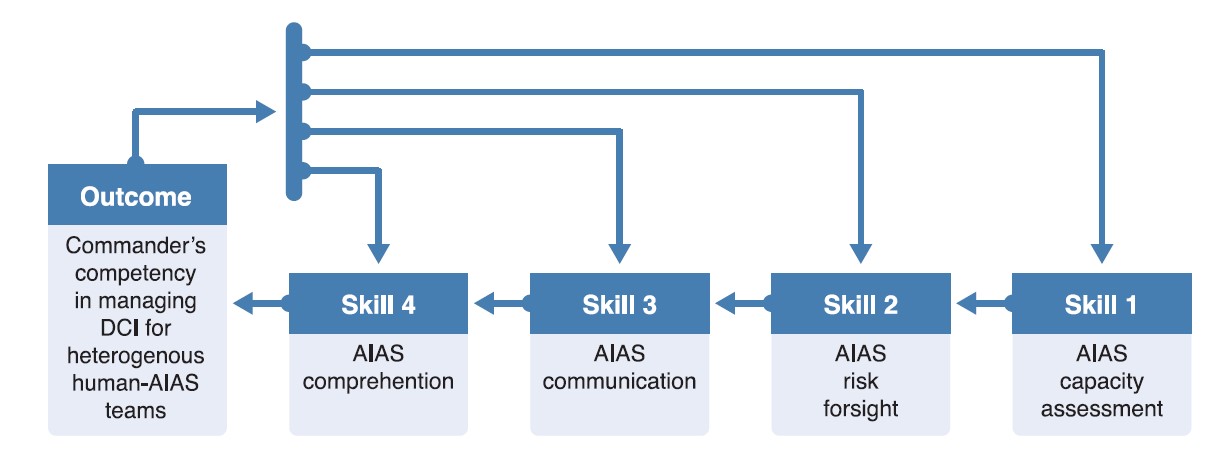
Bridging the gap between traditional CI and DCI will require the development of new skills in which commanders must be proficient. Following the transformation from an action-oriented (CI) to a governance-oriented (DCI) view, we identify four key skills as fundamental for a commander to deliver DCI. These include the AIAS capacity assessment, AIAS risk foresight, AIAS communication, and AIAS comprehension. Each skill follows a chain of skills for human–machine mission command (HMMC), including assessing the machine’s capability, anticipating where the machine may fracture or fail, communicating the CI within appropriate bounds, and observing output behaviours to determine if the machine is executing as intended.
For homogeneous human teams, these skills are embedded as latent variables (for instance, shared understanding, trust, initiative, failure tolerance) inherent to the professional intuition and judgement of commanders experienced in the practice of command.[35] For heterogeneous human–machine teams, new competencies are necessary to interpret these distinct information signals. Table 1 summarises the key skills for each distinct logical task as phases of the commander–AIAS interaction.
| Commander’s skill for HMMC | Logical task | Lifecycle step | Function |
|---|---|---|---|
| AIAS capacity assessment | Assess machine capability | Assess | Evaluate what the machine can and cannot do, mapping performance envelopes to task demands |
| AIAS risk foresight | Anticipate where it may fail | Anticipate | Anticipate how the machine may begin to fracture or fail and where this may occur, identifying specific failure modes and environment stressors |
| AIAS communication | Communicate a bounded CI | Communicate | Deliver CI through the DCI, encoding governance bounds, outcomes, constraints, authorities and accountabilities |
| AIAS comprehension | Comprehend mission achievement | Comprehend | Interpret output behaviour to confirm execution aligns with the DCI |
These skills are grounded in both military philosophical doctrine and HRI literature, providing a common foundation for proposing them. For the AIAS capacity assessment, military doctrine establishes the requirement for commanders to responsibly assess if a commandeer can execute the given task.[36] Previous human–automation research, adjacent to HRI, developed autonomy levels to aid humans in understanding machine capacity.[37] Function design when integrating humans and AIAS is a pertinent provision for dynamic situations requiring continuous reallocation of roles to agents,[38] with more recent work providing a formal representation of what an AIAS agent can do, defining the ontology that underpins a function space to evaluate capacity.[39] Without establishing a baseline representational structure, the commander and AIAS have no shared concept space to effectively map tasks to requirements. This is grounded through a risk-based framework, articulating what risks the AIAS introduces and how this links to the evaluation of delegation capacity.[40]
AIAS risk foresight provides anticipatory reasoning about how and when the machine may begin to fracture and subsequently fail. Existing work has established that demonstrating why an agent is unreliable does not necessarily change trust but does provide a commander with awareness of the machine’s limitations.[41] Identifying novel machine-specific risks as failure modes that may impact the mission outcome is an essential task.[42] A commander must have the capacity to understand, identify and consider these risks, a skill grounded presently only in homogeneous human teams. As commanders develop this skill over time, it will be important to train both over-reliance and under-reliance situations, with risk foresight providing awareness of the contextual capability and capacity bounds for an AIAS.[43]
AIAS communication is the outbound-directional encoding of CI from the commander to the AIAS machine. Previous work provides our basis for this skill, establishing formal representation structures through which the CI can be encoded for machine consumption.[44] The requirement for bidirectional information flow represents CI through a structured representation rather than through a natural language paradigm alone. The rationale for this approach is established in the literature, with the limitations of direct communication highlighting that unstructured communication is insufficient for the delivery of a CI.[45] Recent work has framed machine education and communication as codependent pillars, suggesting that the communication skill is more than simply encoding intent—it is about ensuring that the skills to comprehend and negotiate intent are embedded in the pedagogical framework of an AIAS education and training architecture.[46]
AIAS comprehension provides the inbound-directional interpretation of AIAS behaviour during execution—it is the bidirectional twin of AIAS communication. This skill focuses on the commander’s ability to operationalise the tenets of transparency, including interpretability (can the commander understand what the AIAS is doing?), explainability (can the commander understand why?) and predictability (can the commander anticipate what will come next?) under real-world constraints.[47] The situation awareness-based agent transparency (SAT) model provides a basis of information levels that the machine must convey for the commander to exercise the skill, highlighting the bidirectional communication need for heterogeneous human–machine teams.[48] A primary outcome of AIAS comprehension is the commander being competent to manage DCI for heterogeneous human–AIAS teams.
While each skill is distinct, they necessarily have a directional dependency in practice. Figure 1 depicts the dependency structure of skills, leading to the commander attaining a competency in managing DCI for heterogeneous human–AIAS teams as the outcome of the commander’s skills for HMMC. It also highlights the importance of the feedback loop as these skills continue to evolve as both the technology and environment continue to change.
Looking Forward
The idea of DCI is not new, with established work on machine-interpretable representations of CI dating back to at least 2008 and the 13th International Command and Control Research and Technology Symposium (ICCRTS).[49] The term DCI has appeared in the literature as far back as 2015, originating from Defense Advanced Research Projects Agency and US Air Force Research Laboratory efforts,[50] with the use of the term in these settings extending traditional technical and doctrinal perspectives. Our governance-as-CI reframing, introduction of the four-skill commander framework for HMMC and explicit positioning of DCI as an enabling mechanism for MHC1 departs from the existing path.
To continue on this new path, an immediate first task is to formally specify the DCI for HMMC, including metrics for bidirectional comprehension, robustness, and stress testing to understand how elements of human–human team friction and fracture manifest in human–machine teams. Emerging discussions on test, evaluation and lifecycle assurance of military AI provides a foundational starting point for such metrics.[51] Over the longer term, a well-developed DCI should inform practical evolutions of MC principles and requirements, specific to heterogeneous human–machine teams, generalising the key tenets for emerging heterogeneous teams.
In this paper, we have established an initial set of conditions for the introduction of a digital commander’s intent (DCI), which will require new approaches to develop shared understanding between heterogeneous human–machine teams. This initial work articulates the problem space, identifies three key challenges for extending CI to mission command, and proposes a four-skill framework for commanders. Through this perspective, the DCI can be considered a generalisation of the commander’s intent, providing a structured, two-way artefact that a machine can act on and be governed through. The expansion beyond homogeneous human teams to heterogeneous human–machine teams necessitates a generalised approach to mission command (MC) that accounts for the heterogeneity inherent across culturally diverse biological and artificial agents. Realising DCI will necessitate the evolution of the existing MC paradigm to account for more artificial and heterogeneous agents, as well as the development of the necessary technical, policy and procedural interfaces and standards.
Endnotes
[1] International Committee of the Red Cross, ‘ICRC Position on Autonomous Weapon Systems’, International Review of the Red Cross 915 (2022), at: https://international-review.icrc.org/articles/icrc-position-on-autonomous-weapon-systems-icrc-position-and-background-paper-915.
[2] Marta Bo, Laura Bruun and Vincent Boulanin, Retaining Human Responsibility in the Development and Use of Autonomous Weapon Systems: On Accountability for Violations of International Humanitarian Law Involving AWS (Stockholm: SIPRI, 2022).
[3] Australian Defence Force, ADF Philosophical Doctrine 0 Series: ADF-P-0 Command (Canberra: Commonwealth of Australia, 2024).
[4] Per M Gustavsson, Michael R Hieb, Philip Moore, Patric Eriksson, Lars Niklasson and Robbert van Geen, ‘Machine Interpretable Representation of Commander’s Intent’, in 13th International Command and Control Research and Technology Symposium: C2 for Complex Endeavors (ICCRTS, 2008). The term commandeer generalises the concept of command delegation, relaxing the subordinate constraint to not assume that delegation is to a lower rank—it could be at the same organisational level. Whereas the term subordinate assumes a hierarchal structure, ‘commandeer’ assumes a more general heterarchy, which may be more suitable in teaming contexts.
[5] Adam J Hepworth, Zena Assaad, Alexander Wyatt and Hussein A Abbass, ‘Meaningful Human Command: Towards a New Model for Military Human-Robot Interaction’, in Simon Watson and Navinda Kottege (eds), Comprehensive Robotics for Extreme and Challenging Environments (Amsterdam: Elsevier, forthcoming). MHC1 is founded on the principles of mission command, as an organisational relationship to contextualise the operation of autonomous artificial cognitive agents within a human commander’s intent. MHC1 is an evolution of meaningful human control, shifting from a control-centric model requiring direct supervision and intervention to a command-centric framing in which accountability is retained through bounded delegation rather than continuous oversight.
[6] Australian Defence Force, ADF-P-0 Command.
[7] Civil Air Patrol, Commander’s Intent: CAP Unit Commanders Course Student Guide (Maxwell Air Force Base AL: Civil Air Patrol, n.d.).
[8] UK Ministry of Defence, Joint Doctrine Publication 0-01, 6th edition (UK Ministry of Defence, 2022).
[9] Canada Ministry of National Defence, B-GL-300-001/FP-001 Land Operations (Canada Ministry of National Defence, 2008).
[10] Australian Defence Force, ADF-P-0 Command.
[11] US Department of the Army, ADP 6-0: Mission Command: Command and Control of Army Forces (Washington DC: Headquarters, Department of the Army, 2019).
[12] Australian Defence Force, ADF-P-0 Command.
[13] Semantic compression, in this work, means conveying the maximum meaning (information signal) through the minimum words (information content) by relying on shared context.
[14] Gustavsson et al., ‘Machine Interpretable Representation’.
[15] Anthony Duus, ‘Paying the Mission Command Bill’, Australian Army Journal 21, no. 3 (2025): 79–89; Dayton McCarthy, ‘“Anything but Simple and Clear Cut”: The Utility of Mission Command Within Domestic Security and Response Operations’, Australian Army Journal 21, no. 3 (2025): 40–57; Sindre Sjøgren and Niklas Nilsson, ‘Multinational Mission Command: From Paper to Practice in NATO’, Scandinavian Journal of Military Studies 8, no. 1 (2025): 89–103; Hepworth et al., ‘Meaningful Human Command’.
[16] John Blaxland, ‘Mission Command and the Australian Army (Mission Command Response)’, Australian Army Journal 21, no. 3 (2025).
[17] Blaxland, ‘Mission Command and the Australian Army’.
[18] Sjøgren and Nilsson, ‘Multinational Mission Command’.
[19] Blaxland, ‘Mission Command and the Australian Army’.
[20] Mica R Endsley, ‘Toward a Theory of Situation Awareness in Dynamic Systems’, Human Factors 37, no. 1 (1995): 32–64.
[21] Australian Defence Force, ADF-P-0 Command, paras. 3.34, 6.11.
[22] Ibid., para. 6.11.
[23] Simon Stuart, The Challenges to the Australian Army Profession: Address by the Chief of Army (Canberra: AARC, 2024).
[24] David S Alberts and Richard E Hayes, Understanding Command and Control (Washington DC: CCRP Publication Series, Department of Defense, 2006).
[25] Ibid.
[26] Frans PB Osinga, Science, Strategy and War: The Strategic Theory of John Boyd (London: Routledge, 2007). This assumption does not exclude connectionist architectures, where the full framework is encoded in a neural network without explicit non-overlapping modules for each phase (i.e. where the reasoning is spread across a neural network rather than separated into inspectable steps, so each phase is difficult to verify). This is a well-known assurance gap in mechanistic interpretability.
[27] Hussein Abbass, Keeley Crockett, Jonathan Garibaldi, Alexander Gegov, Uzay Kaymak and Joao Miguel C Sousa, ‘Editorial: From Explainable Artificial Intelligence (xAI) to Understandable Artificial Intelligence (uAI)’, IEEE Transactions on Artificial Intelligence 5, no. 9 (2024): 4310–4314.
[28] Hussein A Abbass, Eleni Petraki and Robert Hunjet, ‘JSwarm: A Jingulu-Inspired Human-AI-Teaming Language for Context-Aware Swarm Guidance’, Frontiers in Physics 10 (2022): 944064.
[29] Australian Defence Force, ADF-P-0 Command.
[30] Ibid.
[31] US Department of the Army, ADP 6-0.
[32] Hepworth et al., ‘Meaningful Human Command’.
[33] Bo, Bruun and Boulanin, Retaining Human Responsibility.
[34] Australian Defence Force, ADF-P-0 Command.
[35] Niklas Nilsson, ‘Practicing Mission Command for Future Battlefield Challenges: The Case of the Swedish Army’, Defence Studies 20, no. 4 (2020): 436–452; Blaxland, ‘Mission Command and the Australian Army’.
[36] Australian Defence Force, ADF-P-0 Command; US Department of the Army, ADP 6-0.
[37] Raja Parasuraman, Thomas B Sheridan and Christopher D Wickens, ‘A Model for Types and Levels of Human Interaction with Automation’, IEEE Transactions on Systems, Man, and Cybernetics—Part A: Systems and Humans 30, no. 3 (2000): 286–297.
[38] Hussein A Abbass, ‘Social Integration of Artificial Intelligence: Functions, Automation Allocation Logic and Human-Autonomy Trust’, Cognitive Computation 11, no. 2 (2019): 159–171.
[39] Adam J Hepworth, Daniel P Baxter and Hussein A Abbass, ‘Onto4MAT: A Swarm Shepherding Ontology for Generalized Multiagent Teaming’, IEEE Access 10 (2022): 59843–59861.
[40] Zena Assaad, ‘A Risk-Based Trust Framework for Assuring the Humans in Human-Machine Teaming’, in Proceedings of the Second International Symposium on Trustworthy Autonomous Systems (New York: Association for Computing Machinery, 2024), pp. 1–9.
[41] Aya Hussein, Sondoss Elsawah and Hussein A Abbass, ‘The Reliability and Transparency Bases of Trust in Human-Swarm Interaction: Principles and Implications’, Ergonomics 63, no. 9 (2020): 1116–1132.
[42] Mica R Endsley, ‘From Here to Autonomy: Lessons Learned from Human-Automation Research’, Human Factors 59, no. 1 (2017): 5–27.
[43] John D Lee and Katrina A See, ‘Trust in Automation: Designing for Appropriate Reliance’, Human Factors 46, no. 1 (2004): 50–80.
[44] Hepworth, Baxter and Abbass, ‘Onto4MAT’.
[45] Maarten Schadd, Anne Merel Sternheim, Romy Blankendaal, Martin van der Kaaij and Olaf Visker, ‘How a Machine Can Understand the Command Intent’, The Journal of Defense Modeling and Simulation 22, no. 1 (2025): 41–58.
[46] Hussein Abbass, Eleni Petraki, Aya Hussein, Finlay McCall and Sondoss Elsawah, ‘A Model of Symbiomemesis: Machine Education and Communication as Pillars for Human-Autonomy Symbiosis’, Philosophical Transactions of the Royal Society A 379, no. 2207 (2021): 20200364.
[47] Adam J Hepworth, Daniel P Baxter, Aya Hussein, Kate J Yaxley, Essam Debie and Hussein A Abbass, ‘Human-Swarm-Teaming Transparency and Trust Architecture’, IEEE/CAA Journal of Automatica Sinica 8, no. 7 (2021): 1281–1295.
[48] Jessie YC Chen, Kimberly Procci, Michael Boyce, Julia Wright, Andre Garcia and Michael Barnes, Situation Awareness-Based Agent Transparency, Report No. ARL-TR-6905 (Aberdeen Proving Ground MD: US Army Research Laboratory, 2014); Jessie YC Chen, Shan G Lakhmani, Kimberly Stowers, Anthony R Selkowitz, Julia L Wright and Michael Barnes, ‘Situation Awareness-Based Agent Transparency and Human-Autonomy Teaming Effectiveness’, Theoretical Issues in Ergonomics Science 19, no. 3 (2018): 259–582.
[49] Gustavsson et al., ‘Machine Interpretable Representation’.
[50] Stephen Lee-Urban, Ethan Trewhitt, Ian Bieder, Joel Odom, Timothy Boone and Elizabeth Whitaker, ‘CORA: A Flexible Hybrid Approach to Building Cognitive Systems’, in Proceedings of the Third Annual Conference on Advances in Cognitive Systems, Poster Collection (Cognitive Systems Foundation, 2015).
[51] David Helmer, Michael Boardman, S Kate Conroy, Adam J Hepworth and Manoj Harjani, ‘Human-Centred Test and Evaluation of Military AI’, arXiv (2024), at: https://doi.org/10.48550/arXiv.2412.01978; Zena Assaad and Adam Hepworth, A Systems Engineering Lifecycle Approach to Responsible AI (The Hague: The Hague Centre for Strategic Studies, 2025).
